Subject -Verb
Agreement
Subject-Verb Agreement refers to the
relationship between the verb and its subject.
 Every clause or sentence must agree in number
and person with its subject.
Verb must be singular if its subject is singular;
verb must be plural if its subject is plural.
Subject -Verb Agreement
•Singular Subject and Singular Verb
She studies hard.
•Plural Subject and Plural Verb
They study hard.
For example:
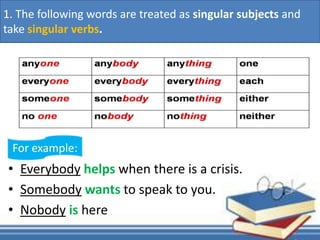
• Everybody helps when there is a crisis.
• Somebody wants to speak to you.
• Nobody is here
1. The following words are treated as singular subjects and
take singular verbs.
For example:
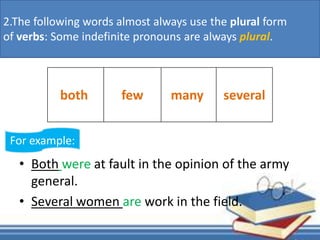
• Both were at fault in the opinion of the army
general.
• Several women are work in the field.
both few many several
2.The following words almost always use the plural form
of verbs: Some indefinite pronouns are always plural.
For example:
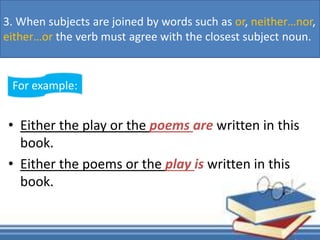
• Either the play or the poems are written in this
book.
• Either the poems or the play is written in this
book.
3. When subjects are joined by words such as or, neither…nor,
either…or the verb must agree with the closest subject noun.
For example:
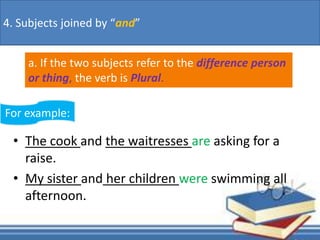
• The cook and the waitresses are asking for a
raise.
• My sister and her children were swimming all
afternoon.
a. If the two subjects refer to the difference person
or thing, the verb is Plural.
4. Subjects joined by “and”
For example:
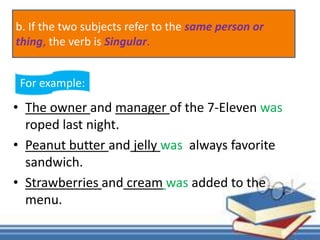
• The owner and manager of the 7-Eleven was
roped last night.
• Peanut butter and jelly was always favorite
sandwich.
• Strawberries and cream was added to the
menu.
b. If the two subjects refer to the same person or
thing, the verb is Singular.
For example:
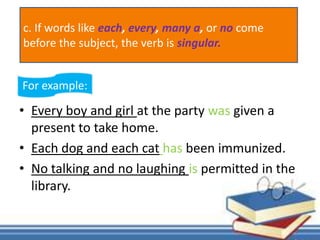
• Every boy and girl at the party was given a
present to take home.
• Each dog and each cat has been immunized.
• No talking and no laughing is permitted in the
library.
For example:
c. If words like each, every, many a, or no come
before the subject, the verb is singular.
• Three weeks is a long time.
• Two hundred dollars is a lot of money.
• Twenty miles on the way seems like two
hundred.
For example:
4.When units of measurement for distance, time, volume,
height, weight, money, etc. are used as subjects, they usually
take the singular verb form.
• Your advice is always appreciated.
• The new gym equipment has just been
delivered.
• That information is very helpful.
For example:
5.Uncountable noun and abstract noun take a singular verb.
• A number of people are waiting to see you.
• The number of stars in the sky seems
countless.
For example:
6. The word “number”
•When the word number is preceded with the word a, use a
plural verb.
•When the word number is preceded with the word the, use
a singular verb.
• Saddling the wild horse was no easy task for the
cowboy.
• Making pies is my specialty.
• Collecting jewelry and playing the banjo are my
hobbies.
For example:
7. A gerund that is used as the subject of a sentence takes the
singular form of the verb. However, two gerunds linked by
“and” take the plural form of the verb.
• audience
• jury
• senate
• public
• council
• crowd
• family
• class
• board
• assembly
• committee
• panel
• orchestra
• group
• herd
• swarm
• flock
8.Collective nouns define group of people or animal:
• The team plays well after a good night’s sleep.
(team refers to the whole group)
• The jury has been deliberating for two days.
(jury refers to the whole group)
For example:
a. Use a singular verb with collective nouns regarded
as a unit.
• The audience are crapping their hands.
• The faculty are expecting their pay raises in
the spring.
(faculty and audience refer to all the individual
members, not to the group as a whole)
For example:
b. Use the plural verb if the collective noun refers to
individuals in a group.
• Statistics is not being offered this semester.
• Finkle Brothers has a sale this week.
• The Philippines has a tropical climate.
• Rickets is cause by malnutrition.
For example:
9. Some nouns that end in “s” are singular in meaning and
take singular verb.
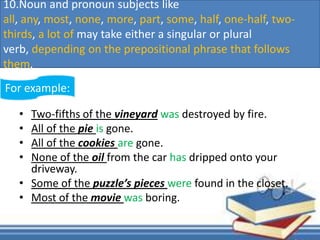
• Two-fifths of the vineyard was destroyed by fire.
• All of the pie is gone.
• All of the cookies are gone.
• None of the oil from the car has dripped onto your
driveway.
• Some of the puzzle’s pieces were found in the closet.
• Most of the movie was boring.
For example:
10.Noun and pronoun subjects like
all, any, most, none, more, part, some, half, one-half, two-
thirds, a lot of may take either a singular or plural
verb, depending on the prepositional phrase that follows
them.
• The rich get richer.
• The poor have many problem.
For example:
11.Adjectives proceeded by THE and used as plural nouns
take a plural verb.
• Jim as well as Helen is planning the picnic.
• John together with Mary is planning the
picnic.
For example:
12.With expressions AS WELL AS, IN ADDITION TO, TOGETHER
WITH, the first noun determines if the verb is singular or
plural.
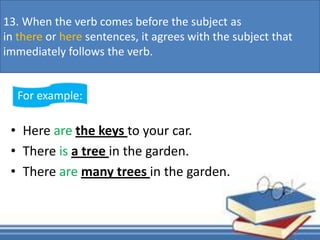
• Here are the keys to your car.
• There is a tree in the garden.
• There are many trees in the garden.
For example:
13. When the verb comes before the subject as
in there or here sentences, it agrees with the subject that
immediately follows the verb.

Verb subject agreement

  • 1.
  • 2.
    Subject-Verb Agreement refersto the relationship between the verb and its subject.  Every clause or sentence must agree in number and person with its subject. Verb must be singular if its subject is singular; verb must be plural if its subject is plural. Subject -Verb Agreement
  • 3.
    •Singular Subject andSingular Verb She studies hard. •Plural Subject and Plural Verb They study hard. For example:
  • 4.
    • Everybody helpswhen there is a crisis. • Somebody wants to speak to you. • Nobody is here 1. The following words are treated as singular subjects and take singular verbs. For example:
  • 5.
    • Both wereat fault in the opinion of the army general. • Several women are work in the field. both few many several 2.The following words almost always use the plural form of verbs: Some indefinite pronouns are always plural. For example:
  • 6.
    • Either theplay or the poems are written in this book. • Either the poems or the play is written in this book. 3. When subjects are joined by words such as or, neither…nor, either…or the verb must agree with the closest subject noun. For example:
  • 7.
    • The cookand the waitresses are asking for a raise. • My sister and her children were swimming all afternoon. a. If the two subjects refer to the difference person or thing, the verb is Plural. 4. Subjects joined by “and” For example:
  • 8.
    • The ownerand manager of the 7-Eleven was roped last night. • Peanut butter and jelly was always favorite sandwich. • Strawberries and cream was added to the menu. b. If the two subjects refer to the same person or thing, the verb is Singular. For example:
  • 9.
    • Every boyand girl at the party was given a present to take home. • Each dog and each cat has been immunized. • No talking and no laughing is permitted in the library. For example: c. If words like each, every, many a, or no come before the subject, the verb is singular.
  • 10.
    • Three weeksis a long time. • Two hundred dollars is a lot of money. • Twenty miles on the way seems like two hundred. For example: 4.When units of measurement for distance, time, volume, height, weight, money, etc. are used as subjects, they usually take the singular verb form.
  • 11.
    • Your adviceis always appreciated. • The new gym equipment has just been delivered. • That information is very helpful. For example: 5.Uncountable noun and abstract noun take a singular verb.
  • 12.
    • A numberof people are waiting to see you. • The number of stars in the sky seems countless. For example: 6. The word “number” •When the word number is preceded with the word a, use a plural verb. •When the word number is preceded with the word the, use a singular verb.
  • 13.
    • Saddling thewild horse was no easy task for the cowboy. • Making pies is my specialty. • Collecting jewelry and playing the banjo are my hobbies. For example: 7. A gerund that is used as the subject of a sentence takes the singular form of the verb. However, two gerunds linked by “and” take the plural form of the verb.
  • 14.
    • audience • jury •senate • public • council • crowd • family • class • board • assembly • committee • panel • orchestra • group • herd • swarm • flock 8.Collective nouns define group of people or animal:
  • 15.
    • The teamplays well after a good night’s sleep. (team refers to the whole group) • The jury has been deliberating for two days. (jury refers to the whole group) For example: a. Use a singular verb with collective nouns regarded as a unit.
  • 16.
    • The audienceare crapping their hands. • The faculty are expecting their pay raises in the spring. (faculty and audience refer to all the individual members, not to the group as a whole) For example: b. Use the plural verb if the collective noun refers to individuals in a group.
  • 17.
    • Statistics isnot being offered this semester. • Finkle Brothers has a sale this week. • The Philippines has a tropical climate. • Rickets is cause by malnutrition. For example: 9. Some nouns that end in “s” are singular in meaning and take singular verb.
  • 18.
    • Two-fifths ofthe vineyard was destroyed by fire. • All of the pie is gone. • All of the cookies are gone. • None of the oil from the car has dripped onto your driveway. • Some of the puzzle’s pieces were found in the closet. • Most of the movie was boring. For example: 10.Noun and pronoun subjects like all, any, most, none, more, part, some, half, one-half, two- thirds, a lot of may take either a singular or plural verb, depending on the prepositional phrase that follows them.
  • 19.
    • The richget richer. • The poor have many problem. For example: 11.Adjectives proceeded by THE and used as plural nouns take a plural verb.
  • 20.
    • Jim aswell as Helen is planning the picnic. • John together with Mary is planning the picnic. For example: 12.With expressions AS WELL AS, IN ADDITION TO, TOGETHER WITH, the first noun determines if the verb is singular or plural.
  • 21.
    • Here arethe keys to your car. • There is a tree in the garden. • There are many trees in the garden. For example: 13. When the verb comes before the subject as in there or here sentences, it agrees with the subject that immediately follows the verb.