The Verb: Are We All in
Agreement?
BY: The Writing Center for
The College of Business Administration
Subject
Verb
Agreement
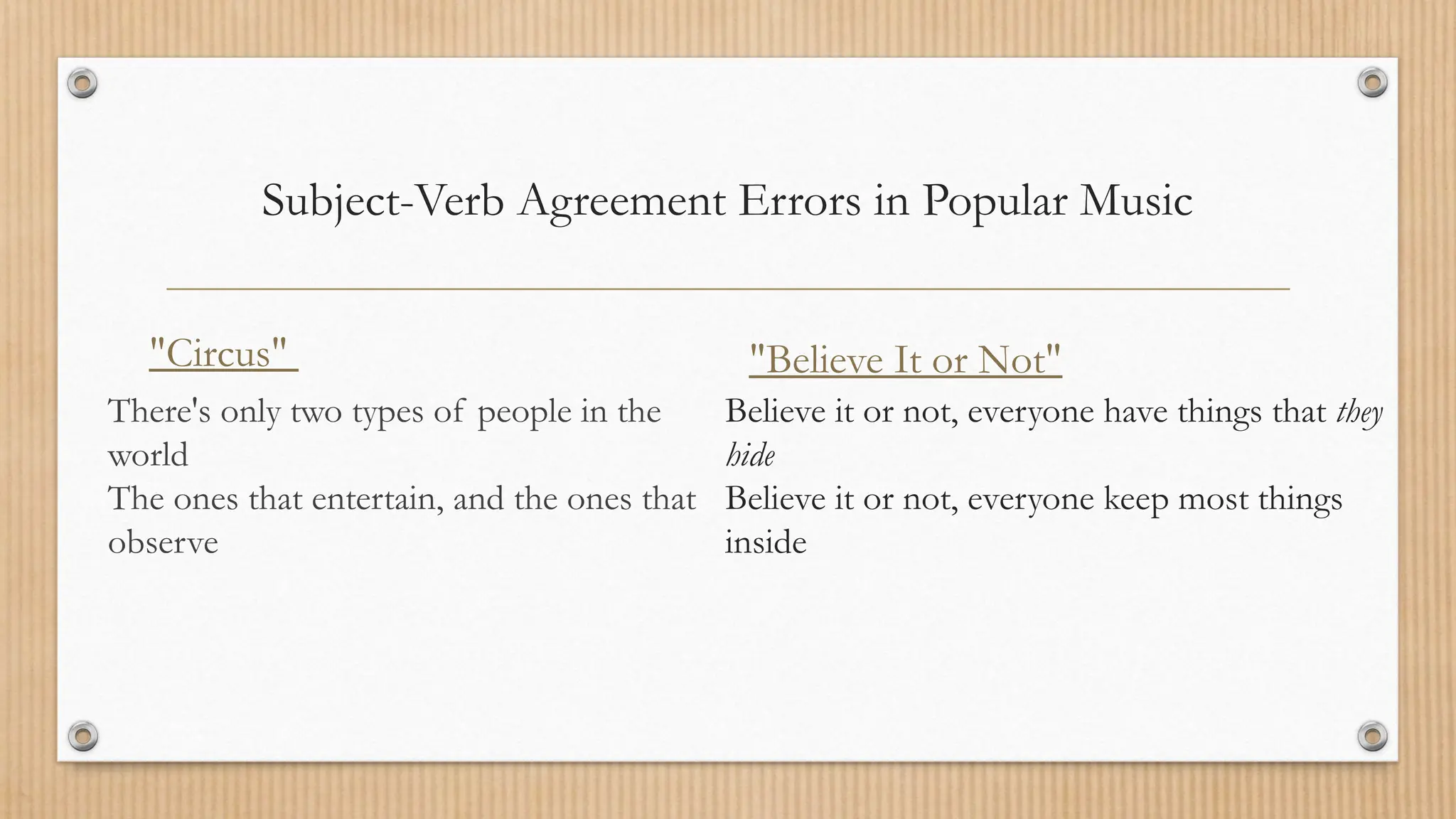
Subject-Verb Agreement Errors in Popular Music
"Circus"
There's only two types of people in the
world
The ones that entertain, and the ones that
observe
"Believe It or Not"
Believe it or not, everyone have things that they
hide
Believe it or not, everyone keep most things
inside
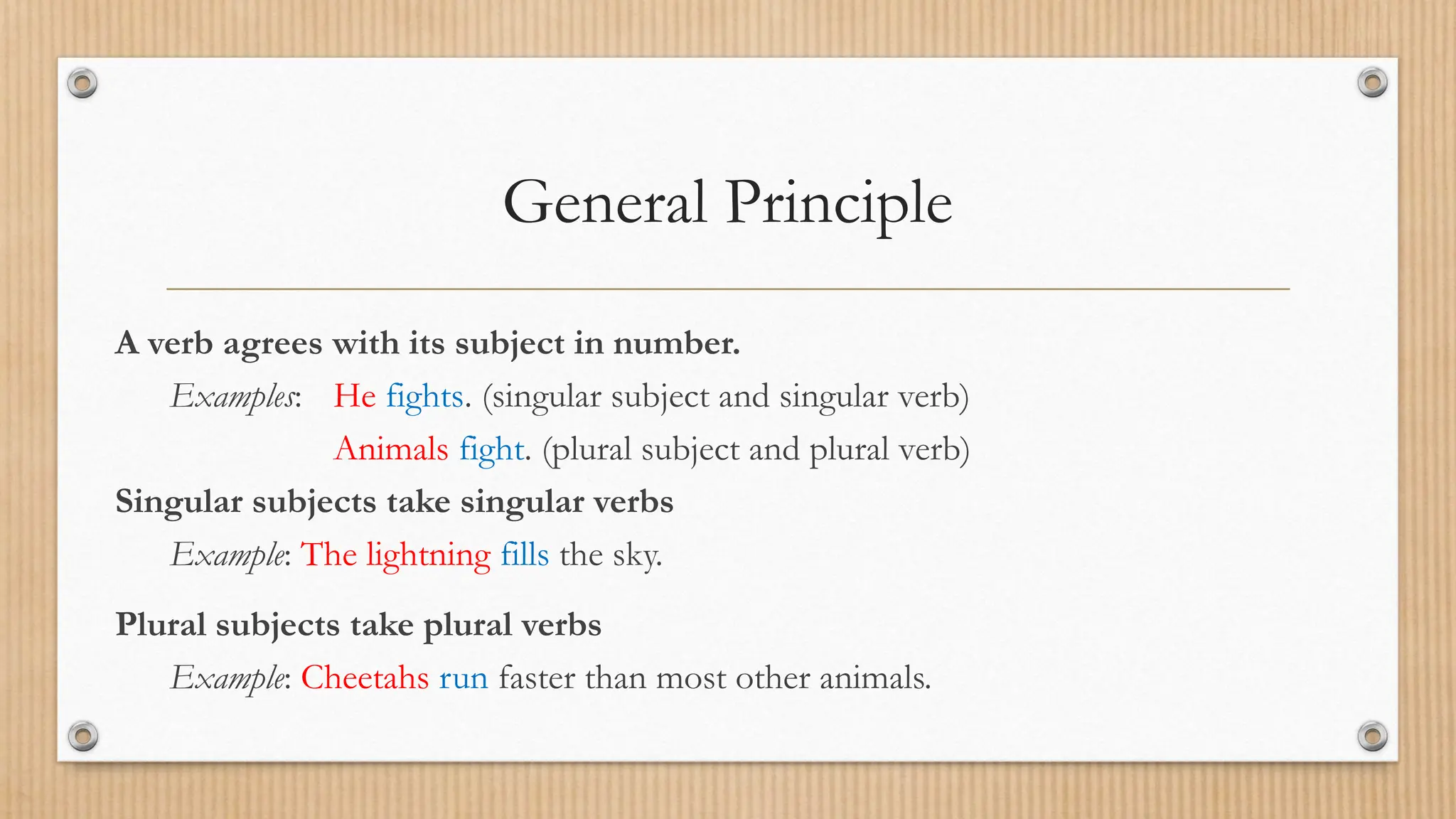
General Principle
A verb agrees with its subject in number.
Examples: He fights. (singular subject and singular verb)
Animals fight. (plural subject and plural verb)
Singular subjects take singular verbs
Example: The lightning fills the sky.
Plural subjects take plural verbs
Example: Cheetahs run faster than most other animals.
So, What Makes Subject-Verb
Agreement Complicated?
What’s the Secret?
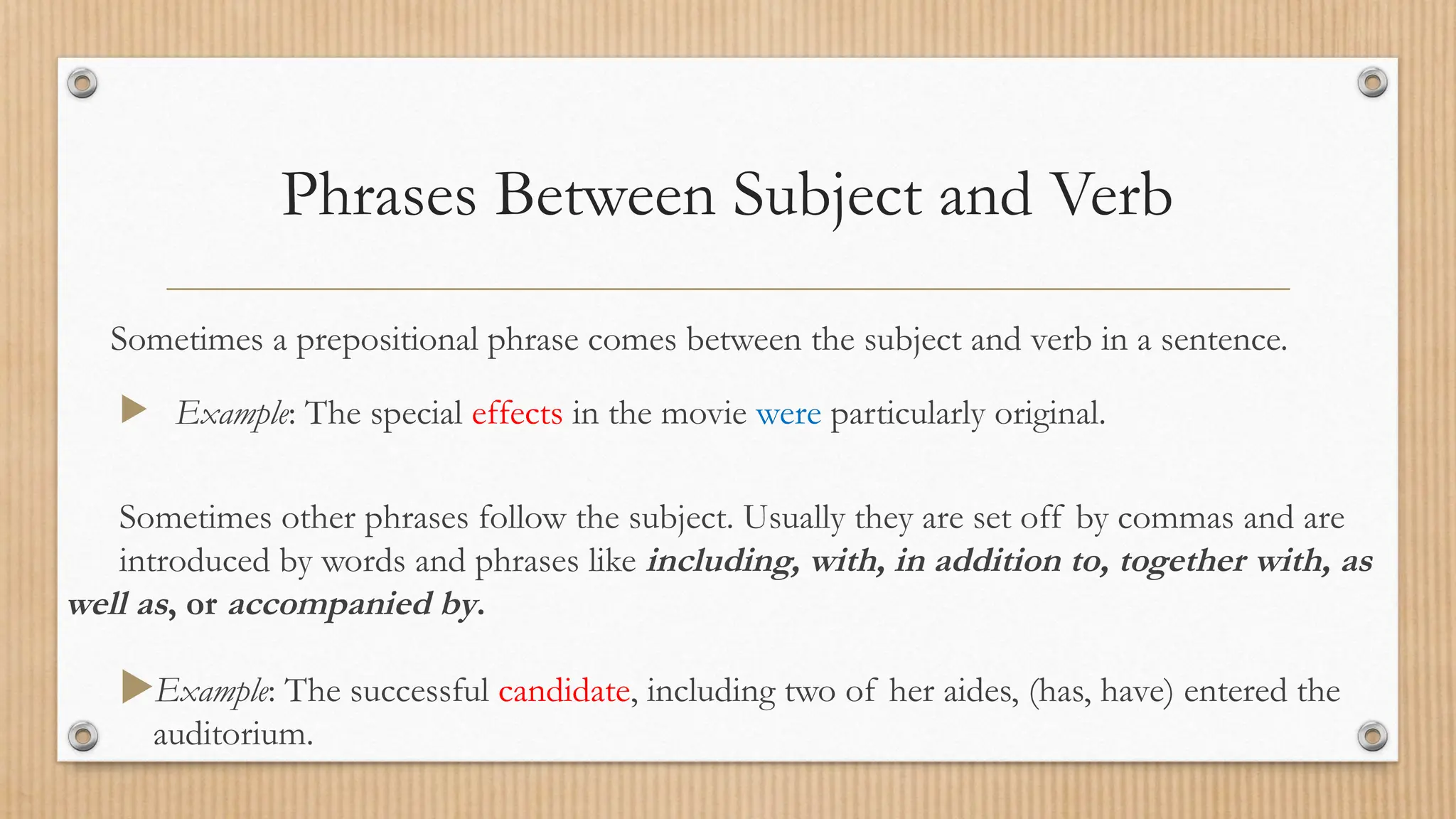
Phrases Between Subject and Verb
Sometimes a prepositional phrase comes between the subject and verb in a sentence.
 Example: The special effects in the movie were particularly original.
Sometimes other phrases follow the subject. Usually they are set off by commas and are
introduced by words and phrases like including, with, in addition to, together with, as
well as, or accompanied by.
Example: The successful candidate, including two of her aides, (has, have) entered the
auditorium.
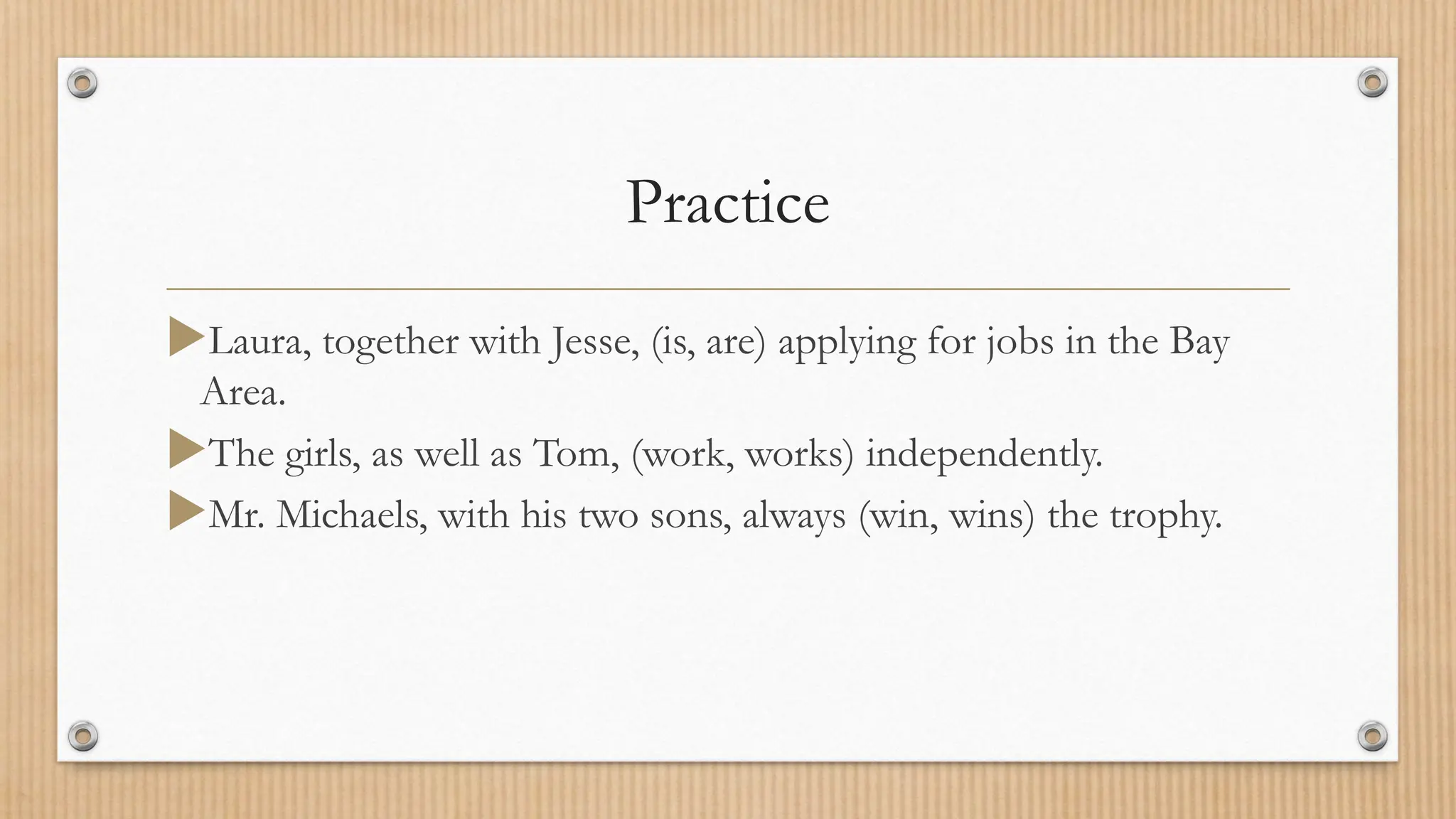
Practice
Laura, together with Jesse, (is, are) applying for jobs in the Bay
Area.
The girls, as well as Tom, (work, works) independently.
Mr. Michaels, with his two sons, always (win, wins) the trophy.
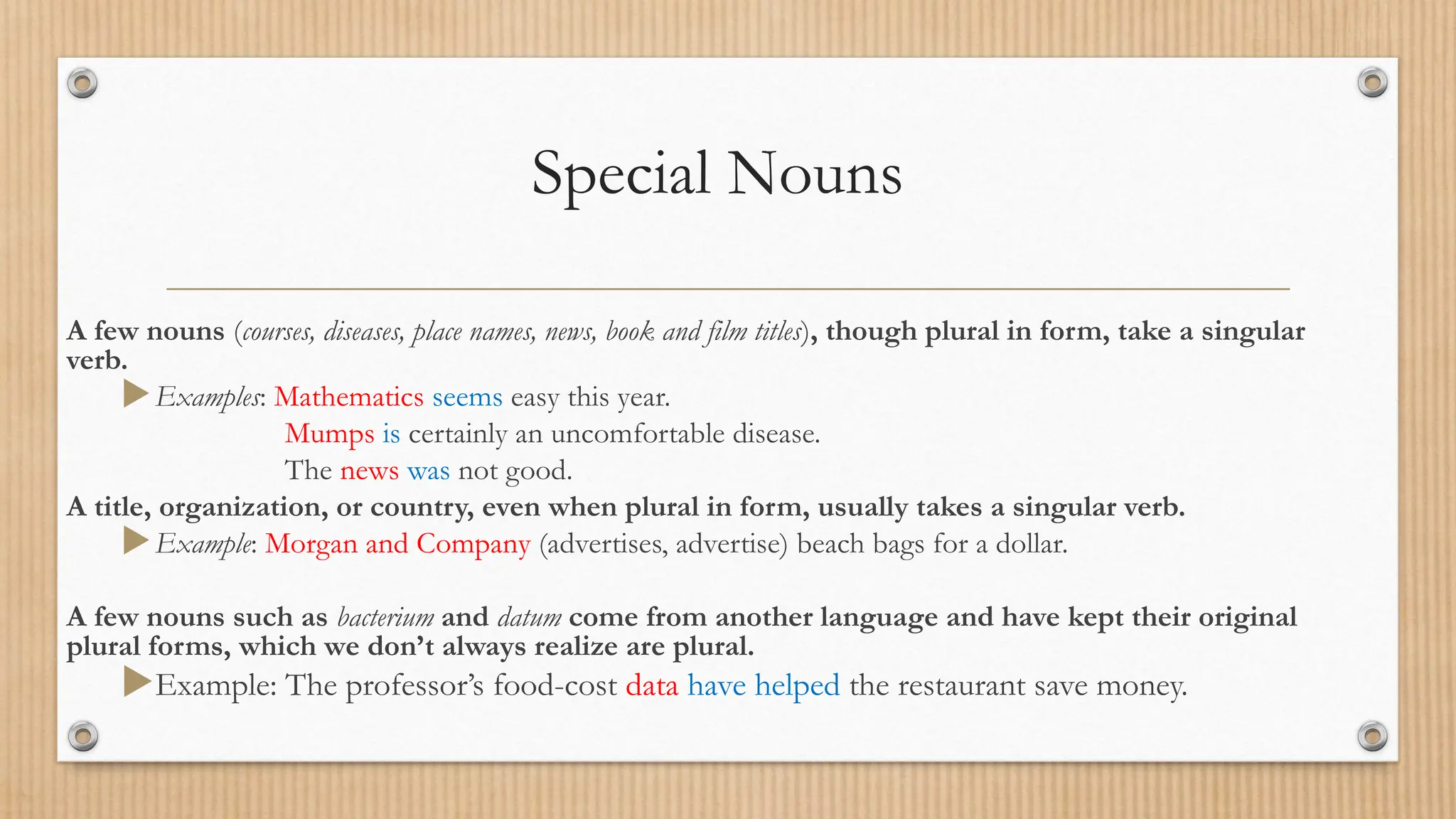
Special Nouns
A few nouns (courses, diseases, place names, news, book and film titles), though plural in form, take a singular
verb.
Examples: Mathematics seems easy this year.
Mumps is certainly an uncomfortable disease.
The news was not good.
A title, organization, or country, even when plural in form, usually takes a singular verb.
Example: Morgan and Company (advertises, advertise) beach bags for a dollar.
A few nouns such as bacterium and datum come from another language and have kept their original
plural forms, which we don’t always realize are plural.
Example: The professor’s food-cost data have helped the restaurant save money.
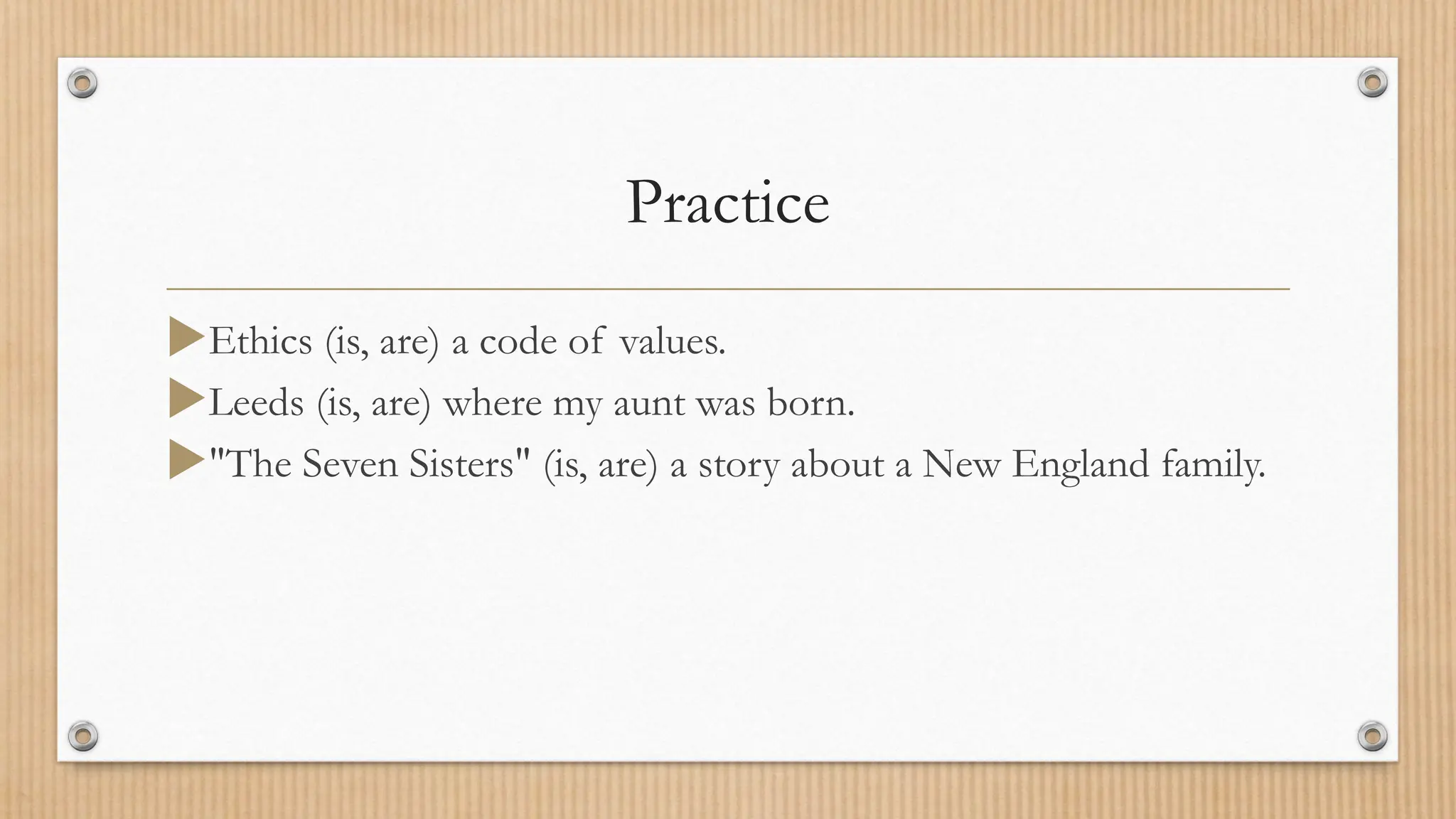
Practice
Ethics (is, are) a code of values.
Leeds (is, are) where my aunt was born.
"The Seven Sisters" (is, are) a story about a New England family.
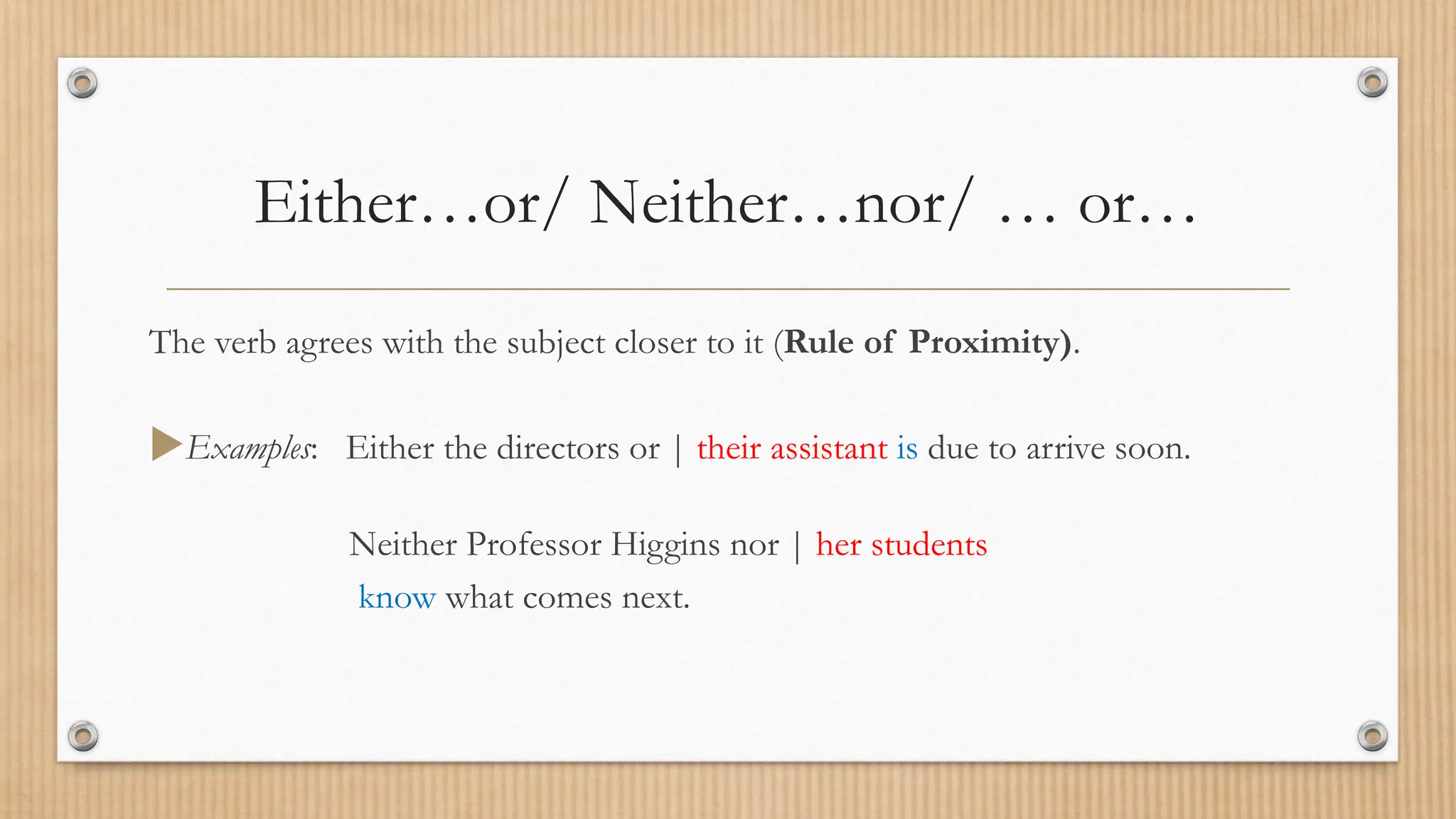
Either…or/ Neither…nor/ … or…
The verb agrees with the subject closer to it (Rule of Proximity).
Examples: Either the directors or | their assistant is due to arrive soon.
Neither Professor Higgins nor | her students
know what comes next.
Practice
• Neither a blanket nor sheets (is, are) furnished at camp.
• Either you or I (am, are) responsible for this month’s financial report; please
let me know if I should submit it.
• A vocabulary notebook or vocabulary flashcards (is, are) helpful for review.
• (Has, Have) the book or other supplies come?
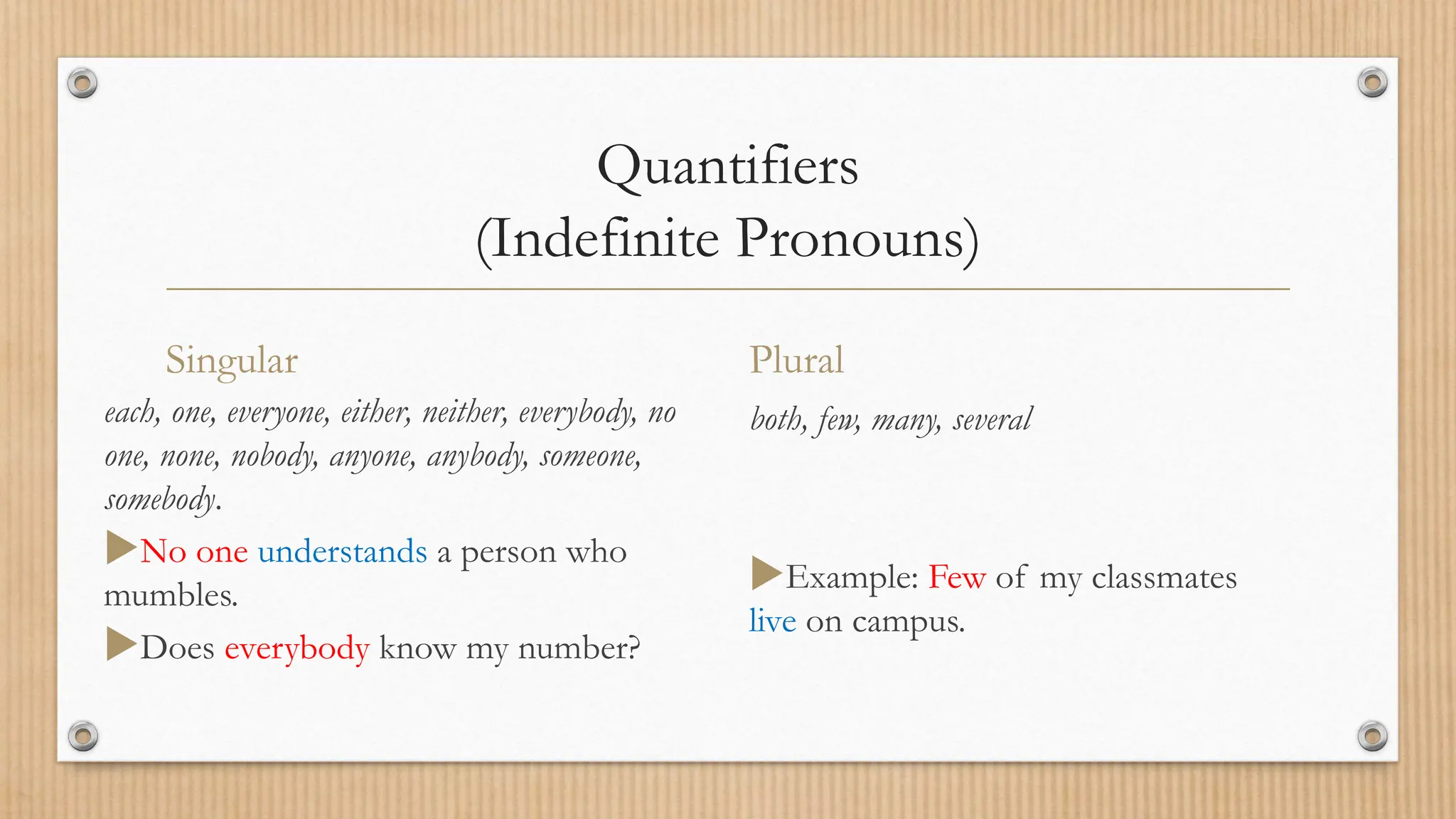
Quantifiers
(Indefinite Pronouns)
Singular
each, one, everyone, either, neither, everybody, no
one, none, nobody, anyone, anybody, someone,
somebody.
No one understands a person who
mumbles.
Does everybody know my number?
Plural
both, few, many, several
Example: Few of my classmates
live on campus.
Practice
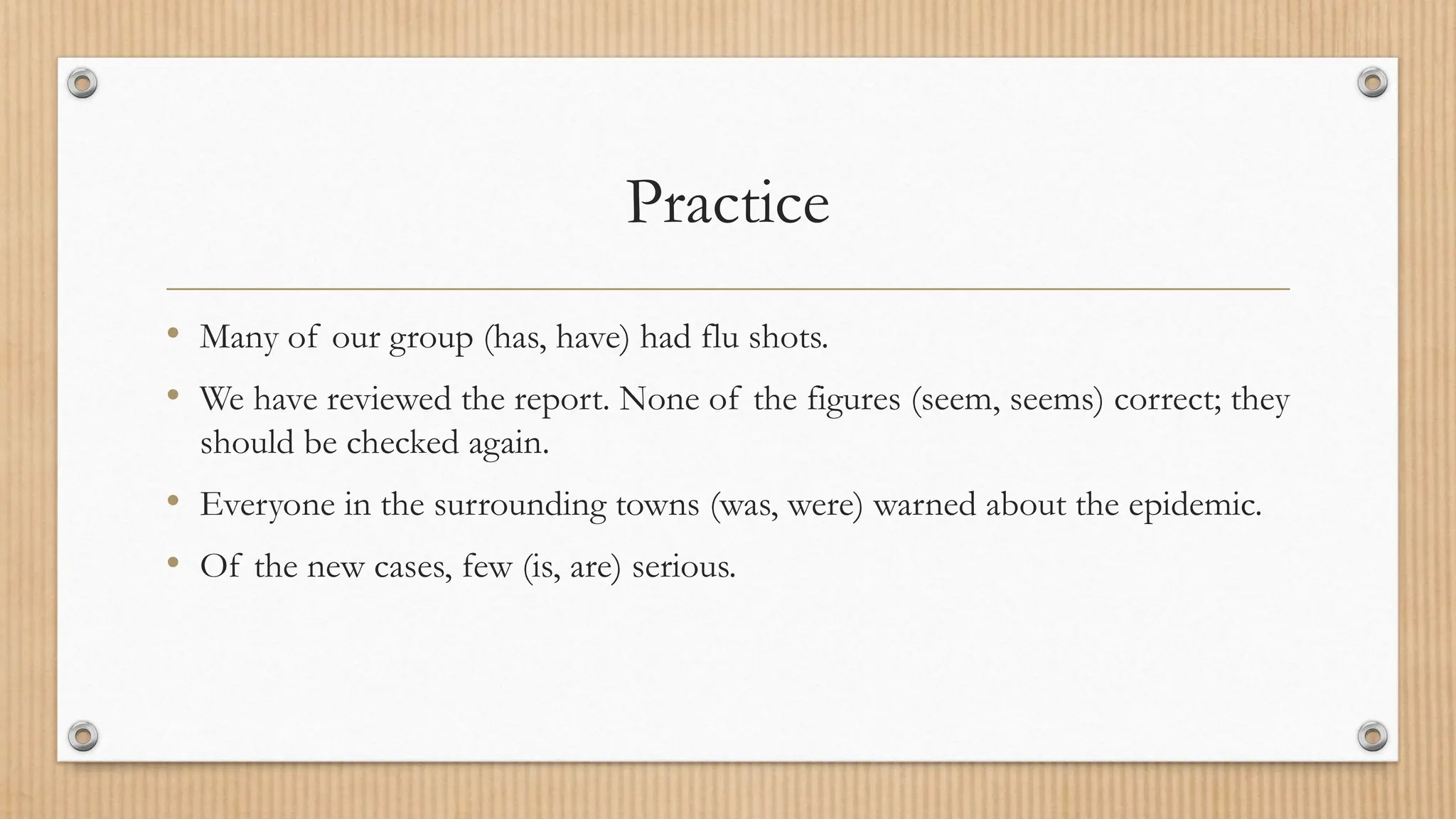
• Many of our group (has, have) had flu shots.
• We have reviewed the report. None of the figures (seem, seems) correct; they
should be checked again.
• Everyone in the surrounding towns (was, were) warned about the epidemic.
• Of the new cases, few (is, are) serious.
Collective Nouns
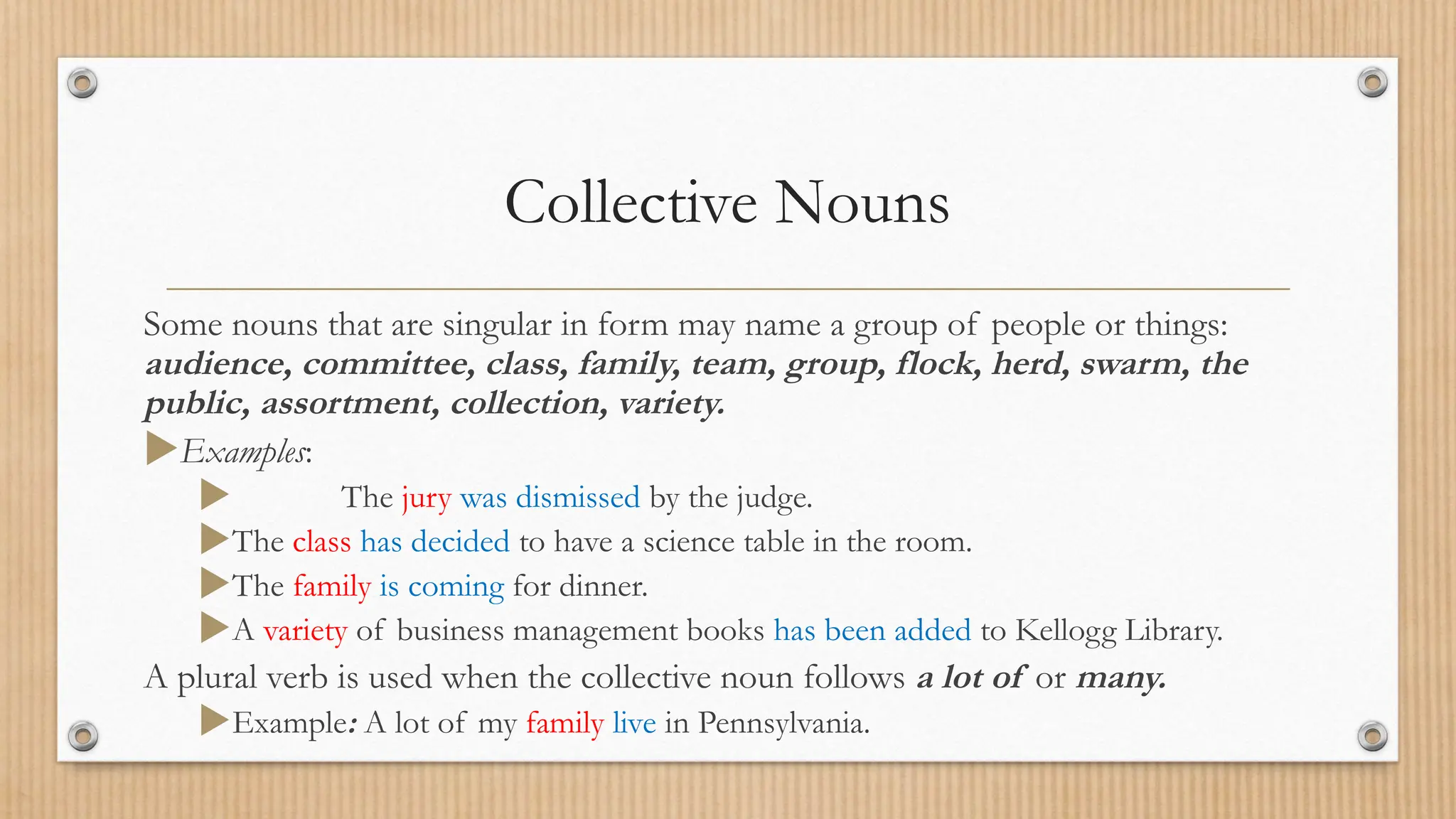
Some nouns that are singular in form may name a group of people or things:
audience, committee, class, family, team, group, flock, herd, swarm, the
public, assortment, collection, variety.
Examples:
 The jury was dismissed by the judge.
The class has decided to have a science table in the room.
The family is coming for dinner.
A variety of business management books has been added to Kellogg Library.
A plural verb is used when the collective noun follows a lot of or many.
Example: A lot of my family live in Pennsylvania.
Practice
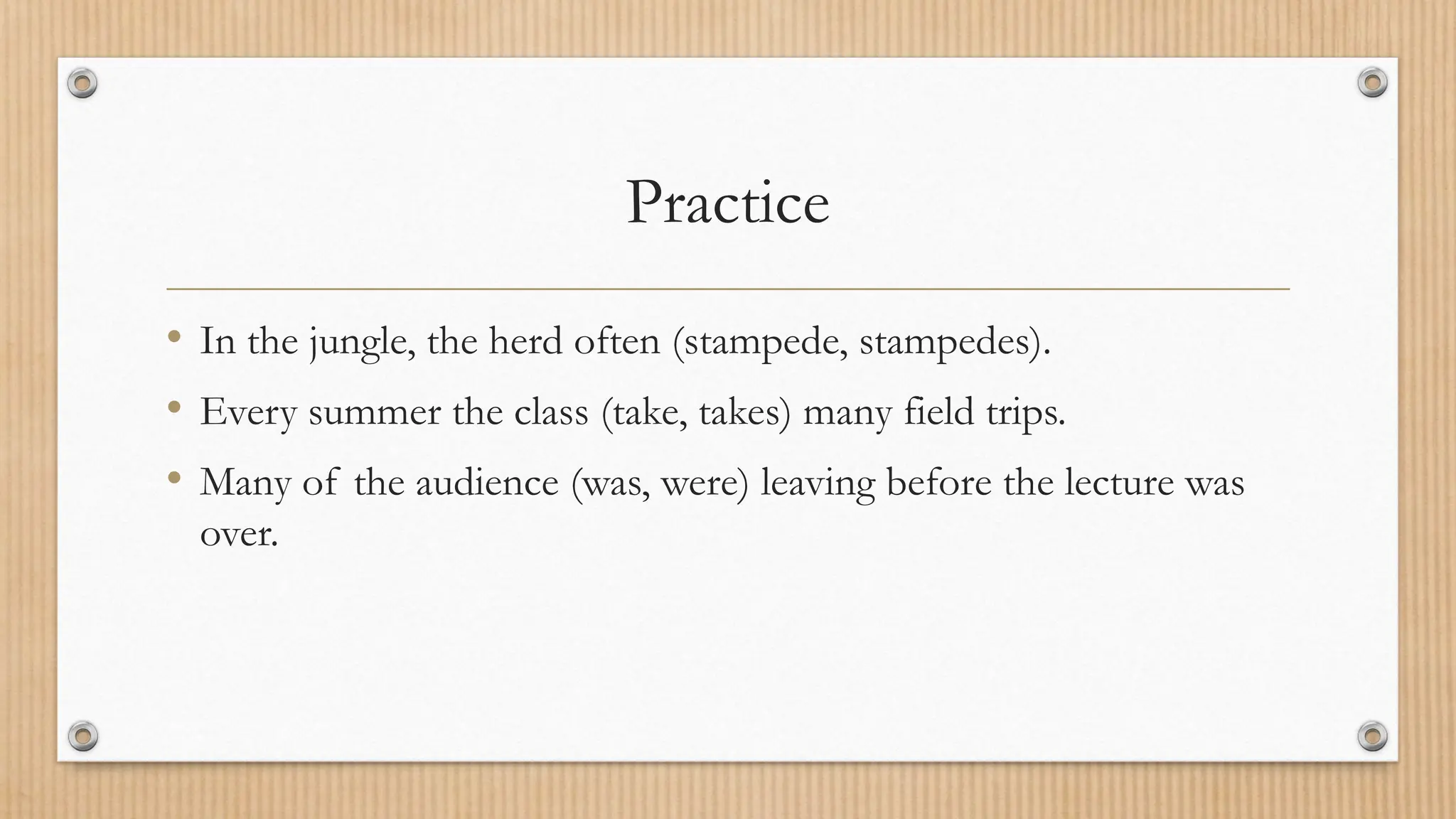
• In the jungle, the herd often (stampede, stampedes).
• Every summer the class (take, takes) many field trips.
• Many of the audience (was, were) leaving before the lecture was
over.
Here, There, Where
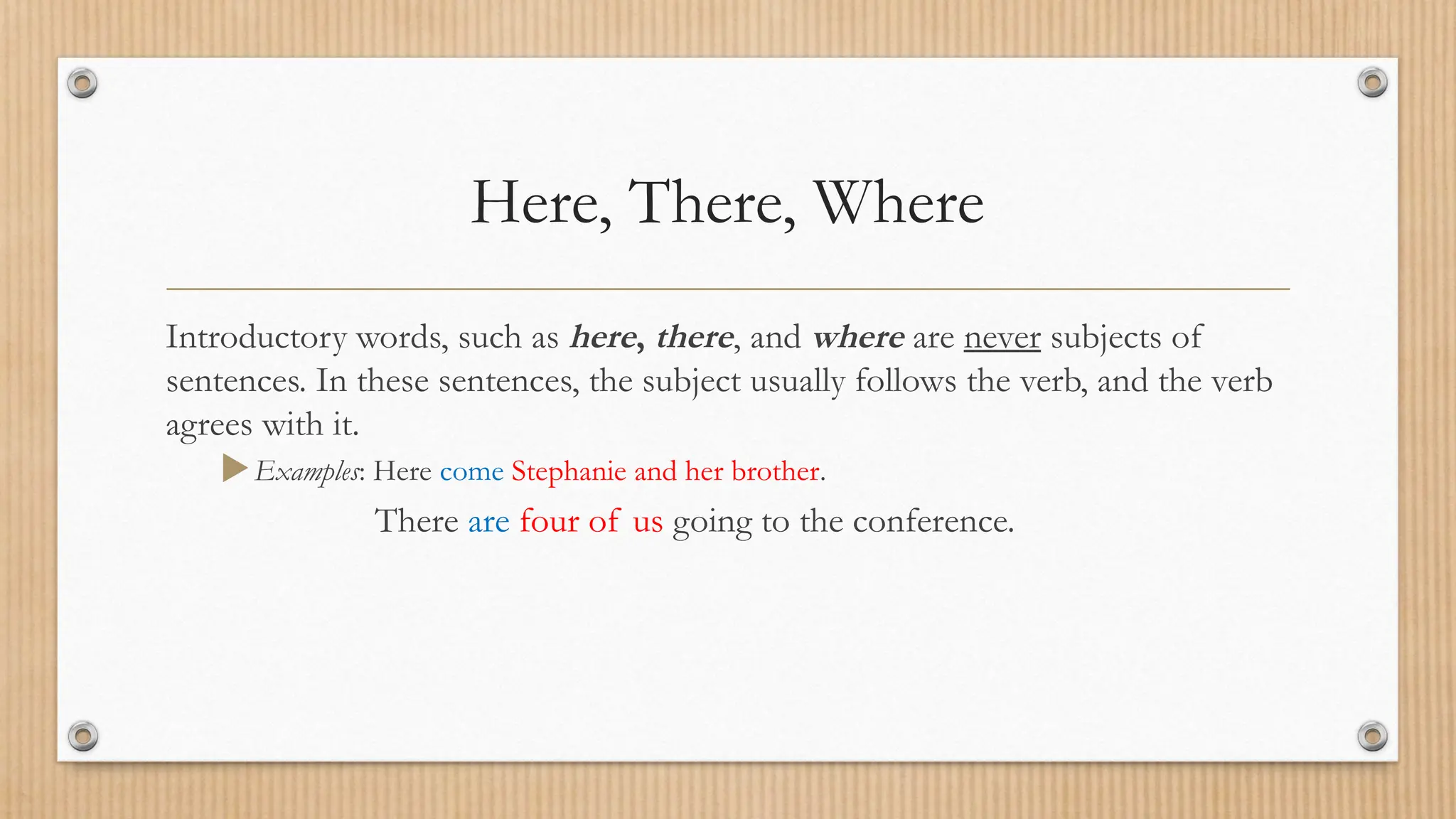
Introductory words, such as here, there, and where are never subjects of
sentences. In these sentences, the subject usually follows the verb, and the verb
agrees with it.
Examples: Here come Stephanie and her brother.
There are four of us going to the conference.
Practice
There (has, have) been rumors of a strike.
Here in this room (is, are) the best paintings.
There (come, comes) the team.
Amount, Distance, Time, & Money
Plural unit words of distance, time, and money are followed by singular verbs.
Examples:
Two cups of flour seems too much for that recipe. (amount)
Thirty-five cents is not enough for lunch today. (money)
Two weeks goes fast when you are on vacation. (time)
Six hundred miles is too far to drive in one day. (distance)
Practice
• Three days (was, were) all the time we needed for the tour.
• Ten miles (is, are) too far to walk.
• Five dollars (is, are) more than enough for a kid’s allowance.
Fractions % Percentages
The verb agrees with the preceding noun :
Countable nouns:
One-third of this article is taken up with statistical analysis.
Two-thirds of the building was destroyed.
Fifty percent of the computers have CD-ROM drives.
Noncount nouns (always singular):
Ninety percent of the toxic waste has escaped.
Half of the wine comes from France.
Practice
• Forty-nine percent of the population surveyed in a recent poll (consider,
considers) Earnest Hemingway to be the greatest author of all time.
• Although half of Americans polled (say, says) that they have read a book by
Ernest Hemingway, less than a third of the respondents (was, were) able to
recognize him as the author of one of his most famous novels, The Old Man
and the Sea.
The number of… vs…. A number of…
Practice
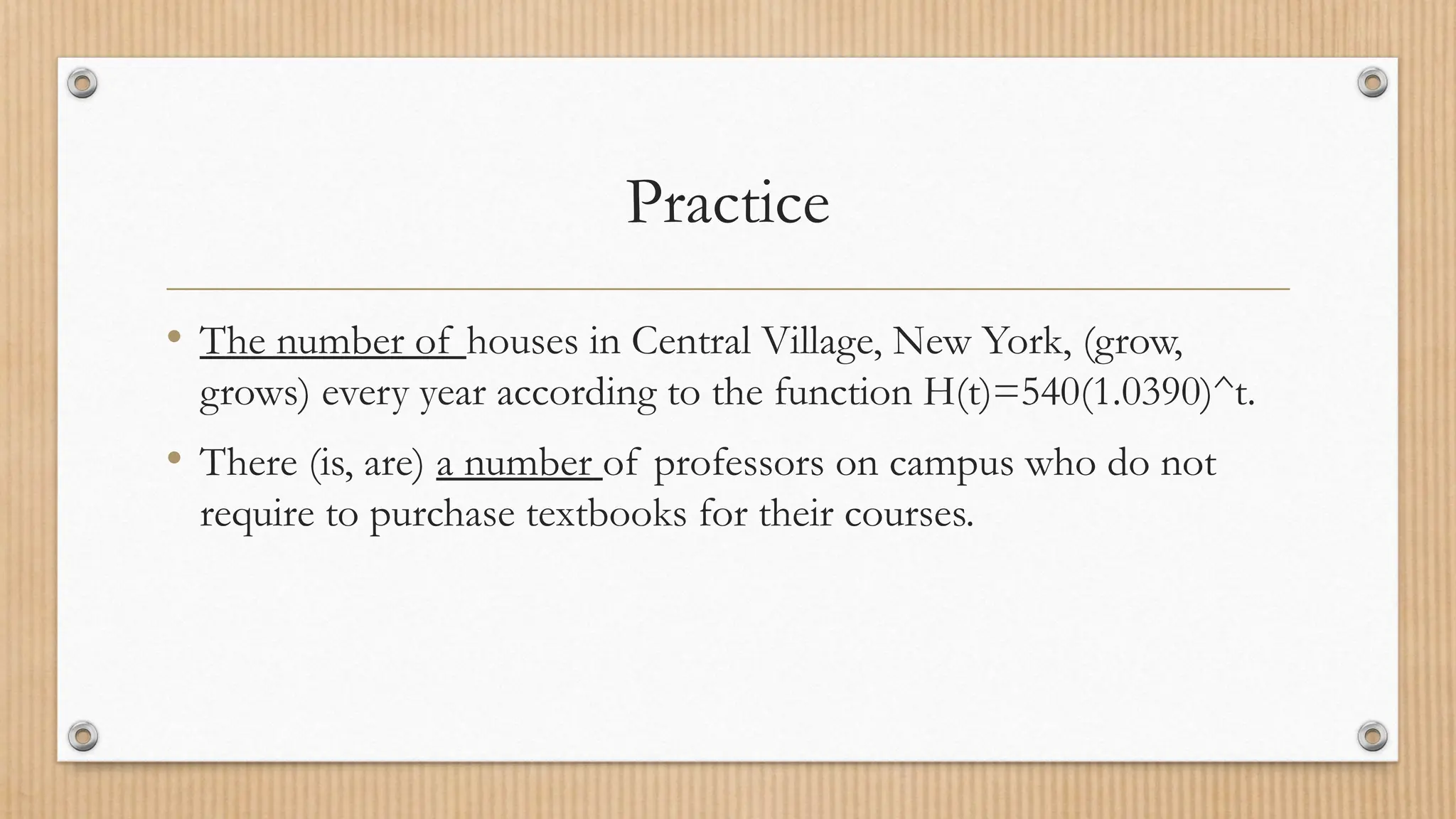
• The number of houses in Central Village, New York, (grow,
grows) every year according to the function H(t)=540(1.0390)^t.
• There (is, are) a number of professors on campus who do not
require to purchase textbooks for their courses.
Final Practice
Surprise!

WORKSHOP 2 SubjectVerb Agreement (6).ppt

  • 1.
    The Verb: AreWe All in Agreement? BY: The Writing Center for The College of Business Administration Subject Verb Agreement
  • 3.
    Subject-Verb Agreement Errorsin Popular Music "Circus" There's only two types of people in the world The ones that entertain, and the ones that observe "Believe It or Not" Believe it or not, everyone have things that they hide Believe it or not, everyone keep most things inside
  • 4.
    General Principle A verbagrees with its subject in number. Examples: He fights. (singular subject and singular verb) Animals fight. (plural subject and plural verb) Singular subjects take singular verbs Example: The lightning fills the sky. Plural subjects take plural verbs Example: Cheetahs run faster than most other animals.
  • 5.
    So, What MakesSubject-Verb Agreement Complicated? What’s the Secret?
  • 6.
    Phrases Between Subjectand Verb Sometimes a prepositional phrase comes between the subject and verb in a sentence.  Example: The special effects in the movie were particularly original. Sometimes other phrases follow the subject. Usually they are set off by commas and are introduced by words and phrases like including, with, in addition to, together with, as well as, or accompanied by. Example: The successful candidate, including two of her aides, (has, have) entered the auditorium.
  • 7.
    Practice Laura, together withJesse, (is, are) applying for jobs in the Bay Area. The girls, as well as Tom, (work, works) independently. Mr. Michaels, with his two sons, always (win, wins) the trophy.
  • 8.
    Special Nouns A fewnouns (courses, diseases, place names, news, book and film titles), though plural in form, take a singular verb. Examples: Mathematics seems easy this year. Mumps is certainly an uncomfortable disease. The news was not good. A title, organization, or country, even when plural in form, usually takes a singular verb. Example: Morgan and Company (advertises, advertise) beach bags for a dollar. A few nouns such as bacterium and datum come from another language and have kept their original plural forms, which we don’t always realize are plural. Example: The professor’s food-cost data have helped the restaurant save money.
  • 9.
    Practice Ethics (is, are)a code of values. Leeds (is, are) where my aunt was born. "The Seven Sisters" (is, are) a story about a New England family.
  • 10.
    Either…or/ Neither…nor/ …or… The verb agrees with the subject closer to it (Rule of Proximity). Examples: Either the directors or | their assistant is due to arrive soon. Neither Professor Higgins nor | her students know what comes next.
  • 11.
    Practice • Neither ablanket nor sheets (is, are) furnished at camp. • Either you or I (am, are) responsible for this month’s financial report; please let me know if I should submit it. • A vocabulary notebook or vocabulary flashcards (is, are) helpful for review. • (Has, Have) the book or other supplies come?
  • 12.
    Quantifiers (Indefinite Pronouns) Singular each, one,everyone, either, neither, everybody, no one, none, nobody, anyone, anybody, someone, somebody. No one understands a person who mumbles. Does everybody know my number? Plural both, few, many, several Example: Few of my classmates live on campus.
  • 13.
    Practice • Many ofour group (has, have) had flu shots. • We have reviewed the report. None of the figures (seem, seems) correct; they should be checked again. • Everyone in the surrounding towns (was, were) warned about the epidemic. • Of the new cases, few (is, are) serious.
  • 14.
    Collective Nouns Some nounsthat are singular in form may name a group of people or things: audience, committee, class, family, team, group, flock, herd, swarm, the public, assortment, collection, variety. Examples:  The jury was dismissed by the judge. The class has decided to have a science table in the room. The family is coming for dinner. A variety of business management books has been added to Kellogg Library. A plural verb is used when the collective noun follows a lot of or many. Example: A lot of my family live in Pennsylvania.
  • 15.
    Practice • In thejungle, the herd often (stampede, stampedes). • Every summer the class (take, takes) many field trips. • Many of the audience (was, were) leaving before the lecture was over.
  • 16.
    Here, There, Where Introductorywords, such as here, there, and where are never subjects of sentences. In these sentences, the subject usually follows the verb, and the verb agrees with it. Examples: Here come Stephanie and her brother. There are four of us going to the conference.
  • 17.
    Practice There (has, have)been rumors of a strike. Here in this room (is, are) the best paintings. There (come, comes) the team.
  • 18.
    Amount, Distance, Time,& Money Plural unit words of distance, time, and money are followed by singular verbs. Examples: Two cups of flour seems too much for that recipe. (amount) Thirty-five cents is not enough for lunch today. (money) Two weeks goes fast when you are on vacation. (time) Six hundred miles is too far to drive in one day. (distance)
  • 19.
    Practice • Three days(was, were) all the time we needed for the tour. • Ten miles (is, are) too far to walk. • Five dollars (is, are) more than enough for a kid’s allowance.
  • 20.
    Fractions % Percentages Theverb agrees with the preceding noun : Countable nouns: One-third of this article is taken up with statistical analysis. Two-thirds of the building was destroyed. Fifty percent of the computers have CD-ROM drives. Noncount nouns (always singular): Ninety percent of the toxic waste has escaped. Half of the wine comes from France.
  • 21.
    Practice • Forty-nine percentof the population surveyed in a recent poll (consider, considers) Earnest Hemingway to be the greatest author of all time. • Although half of Americans polled (say, says) that they have read a book by Ernest Hemingway, less than a third of the respondents (was, were) able to recognize him as the author of one of his most famous novels, The Old Man and the Sea.
  • 22.
    The number of…vs…. A number of…
  • 23.
    Practice • The numberof houses in Central Village, New York, (grow, grows) every year according to the function H(t)=540(1.0390)^t. • There (is, are) a number of professors on campus who do not require to purchase textbooks for their courses.
  • 24.

Editor's Notes

  • #12 Remind SS that not just verbs but pronouns as well need to be singular with each, one, etc.