Regression Analysis of Rotor Spinning Yarn Quality
Parameters
Federal TVET Institute/University
Textile and Apparel Fashion Technology
Division
Textile Technology Department
Course Name: Technology Research Methodology
Course Code: TXT 652
Regression Analysis of Rotor Spinning Yarn Quality
Parameters
Submitted by
Meseret Bogale
Reg no MTR/236/12
Submitted to: - Dr.Gurumurthy.B.R. Ph.D
Ph.D (Textile Technology) - Instructor in Textile Technology
ABSTRACTABSTRACT
This paper reveals some information regarding quality
profiles of rotor spun yarn mainly mass irregularity
values (Unevenness in terms of mass Um%, various
imperfection value (Thick places, Thin places, Neps,
Imperfection Index (IPI), Hairiness (H) and bundle yarn
strength (Count-Strength-Product CSP) in respect to
change in different rotor speed.
by using different rotor speed, the changes of above
mention quality parameters were observed. In every case
with the increase of rotor speed the quality profiles such
Um%, CVm% and imperfection index declined but the
improved values were obtained in terms of H and CSP.
This paper reveals some information regarding quality
profiles of rotor spun yarn mainly mass irregularity
values (Unevenness in terms of mass Um%, various
imperfection value (Thick places, Thin places, Neps,
Imperfection Index (IPI), Hairiness (H) and bundle yarn
strength (Count-Strength-Product CSP) in respect to
change in different rotor speed.
by using different rotor speed, the changes of above
mention quality parameters were observed. In every case
with the increase of rotor speed the quality profiles such
Um%, CVm% and imperfection index declined but the
improved values were obtained in terms of H and CSP.
For each quality parameters in relationship with
variation of rotor speeds both coefficient of
determination and single linear regression
analysis were also established. At last using all
the parameters a multiple regression equation was
established.
INTRODUCTIONINTRODUCTION
high-quality and cost-saving kind of spinning
method have become a major issue in the textile
industry.
Spinning is one of the most important production
processes in the field of textile science. Spinning
is a complicated procedure to convert fibers into
yarn through many investigations with some new
technological and technical process.
Now a day in competition with ring spun yarn, the
production of open end yarns such as rotor spun
yarn is increasing significantly because of many
quality parameters issues and productivity .
high-quality and cost-saving kind of spinning
method have become a major issue in the textile
industry.
Spinning is one of the most important production
processes in the field of textile science. Spinning
is a complicated procedure to convert fibers into
yarn through many investigations with some new
technological and technical process.
Now a day in competition with ring spun yarn, the
production of open end yarns such as rotor spun
yarn is increasing significantly because of many
quality parameters issues and productivity .
In rotor spinning it is possible to produce better
quality yarn from very poor grade of cotton and
even from wastage among other process.
Another few important dimensions like
reduction in space, process and personnel have
given rotor a new era to produce uniform and
regular cotton yarn. Rotor spinning is a
recognized spinning system mainly for medium
and course counts .
This technology has gained the reputation of
being „cotton friendly‟, since two-thirds of all
fibers used in rotor spinning are cotton
In rotor spinning it is possible to produce better
quality yarn from very poor grade of cotton and
even from wastage among other process.
Another few important dimensions like
reduction in space, process and personnel have
given rotor a new era to produce uniform and
regular cotton yarn. Rotor spinning is a
recognized spinning system mainly for medium
and course counts .
This technology has gained the reputation of
being „cotton friendly‟, since two-thirds of all
fibers used in rotor spinning are cotton
LITERATURE REVIEWLITERATURE REVIEW
 Now a day, the competitive edge of rotor spinning is
reflected in the implementation of faster rotor-spinning
speeds, more sophisticated monitoring and control
systems, and automatic start up, doffing, cleaning
devices.
 The strength of Reiter's rotor spinning lies not only in its
high productivity but also its great flexibility in terms of
raw material and yarn construction. The special feature
of the fully-automated rotor spinning machine producer
is to achieve highest productivity and lowest energy
consumption.
 Now a day, the competitive edge of rotor spinning is
reflected in the implementation of faster rotor-spinning
speeds, more sophisticated monitoring and control
systems, and automatic start up, doffing, cleaning
devices.
 The strength of Reiter's rotor spinning lies not only in its
high productivity but also its great flexibility in terms of
raw material and yarn construction. The special feature
of the fully-automated rotor spinning machine producer
is to achieve highest productivity and lowest energy
consumption.
 Rotor spinning is well known for its high output with
wide raw materials. During rotor spinning process, under
the action of the centrifugal force of rotor rotation and
fibers slip into the groove after they enter the slipped
wall of the rotor by the high negative pressure, then the
fibers gathered and twisted to form rotor spun yarn.
 synthetic fibers and blends on rotor-spinning machine
with the discussion of optimization of surface
characteristics and physical properties of man-made
fibers .
 optimization of open-end rotor spinning frame parameter
and estimation of relevant quality characteristics using
Lyocell fibers are used to spin the Ne 32 yarns.
 Rotor spinning is well known for its high output with
wide raw materials. During rotor spinning process, under
the action of the centrifugal force of rotor rotation and
fibers slip into the groove after they enter the slipped
wall of the rotor by the high negative pressure, then the
fibers gathered and twisted to form rotor spun yarn.
 synthetic fibers and blends on rotor-spinning machine
with the discussion of optimization of surface
characteristics and physical properties of man-made
fibers .
 optimization of open-end rotor spinning frame parameter
and estimation of relevant quality characteristics using
Lyocell fibers are used to spin the Ne 32 yarns.
Characteristics of rotor spun yarn
 The yarn characteristics of rotor spun yarn are affected
by various factors related to raw material, machine
parameters and processing parameters. Many researchers
have already investigated the effect of these parameters
on yarn quality from different outlooks.
 Rotor yarns are less irregular compared to the ring spun
yarn because of multiple doubling or back doubling of
fibers in the rotor groove. In addition, rotor spun yarns
are not as affected by roller drafting wave as ring yarns.
 Rotor spinning is considered as most suitable and
successful spinning process among many open-end
spinning methods.
Characteristics of rotor spun yarn
 The yarn characteristics of rotor spun yarn are affected
by various factors related to raw material, machine
parameters and processing parameters. Many researchers
have already investigated the effect of these parameters
on yarn quality from different outlooks.
 Rotor yarns are less irregular compared to the ring spun
yarn because of multiple doubling or back doubling of
fibers in the rotor groove. In addition, rotor spun yarns
are not as affected by roller drafting wave as ring yarns.
 Rotor spinning is considered as most suitable and
successful spinning process among many open-end
spinning methods.
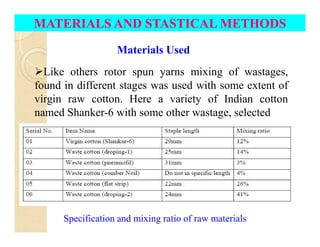
MATERIALS AND STASTICAL METHODSMATERIALS AND STASTICAL METHODS
Like others rotor spun yarns mixing of wastages,
found in different stages was used with some extent of
virgin raw cotton. Here a variety of Indian cotton
named Shanker-6 with some other wastage, selected
Materials Used
Specification and mixing ratio of raw materials
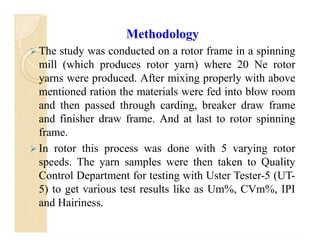
Methodology
 The study was conducted on a rotor frame in a spinning
mill (which produces rotor yarn) where 20 Ne rotor
yarns were produced. After mixing properly with above
mentioned ration the materials were fed into blow room
and then passed through carding, breaker draw frame
and finisher draw frame. And at last to rotor spinning
frame.
 In rotor this process was done with 5 varying rotor
speeds. The yarn samples were then taken to Quality
Control Department for testing with Uster Tester-5 (UT-
5) to get various test results like as Um%, CVm%, IPI
and Hairiness.
Methodology
 The study was conducted on a rotor frame in a spinning
mill (which produces rotor yarn) where 20 Ne rotor
yarns were produced. After mixing properly with above
mentioned ration the materials were fed into blow room
and then passed through carding, breaker draw frame
and finisher draw frame. And at last to rotor spinning
frame.
 In rotor this process was done with 5 varying rotor
speeds. The yarn samples were then taken to Quality
Control Department for testing with Uster Tester-5 (UT-
5) to get various test results like as Um%, CVm%, IPI
and Hairiness.
 To get reliable test result with minimum variability 5
specific drums were used. The yarn tests were carried
out on Evenness Tester (UT-5) by ASTM D1425-96 for
Um% and hairiness by ASTM D 5647-01 and Lea
Strength Tester by ASTM D 1578-93. Above all tests
were done under standard atmospheric conditions 27 ±
2°C and 65% RH. Then by using both multiple and
single regression analysis the correlation between rotor
speed with yarn quality was observed and the
construction of multiple regression analysis equations by
using these variables.
 To get reliable test result with minimum variability 5
specific drums were used. The yarn tests were carried
out on Evenness Tester (UT-5) by ASTM D1425-96 for
Um% and hairiness by ASTM D 5647-01 and Lea
Strength Tester by ASTM D 1578-93. Above all tests
were done under standard atmospheric conditions 27 ±
2°C and 65% RH. Then by using both multiple and
single regression analysis the correlation between rotor
speed with yarn quality was observed and the
construction of multiple regression analysis equations by
using these variables.
Correlation and Regression Analysis
Correlation analysis
 Correlation Analysis is a group of statistical techniques
to measure the association between two variables known
as a dependent and independent variable. The dependent
variable is the variable being predicted or estimated. The
Independent Variable provides the basis for estimation.
It is the predictor variable. Such as to determine the
relationship between ring yarn properties and the fiber
properties obtained by AFIS. A Scatter Diagram is used
to portray the relationship between two variables.
Correlation and Regression Analysis
Correlation analysis
 Correlation Analysis is a group of statistical techniques
to measure the association between two variables known
as a dependent and independent variable. The dependent
variable is the variable being predicted or estimated. The
Independent Variable provides the basis for estimation.
It is the predictor variable. Such as to determine the
relationship between ring yarn properties and the fiber
properties obtained by AFIS. A Scatter Diagram is used
to portray the relationship between two variables.
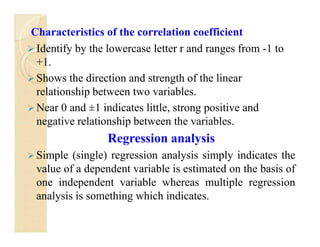
Characteristics of the correlation coefficient
 Identify by the lowercase letter r and ranges from -1 to
+1.
 Shows the direction and strength of the linear
relationship between two variables.
 Near 0 and ±1 indicates little, strong positive and
negative relationship between the variables.
Regression analysis
 Simple (single) regression analysis simply indicates the
value of a dependent variable is estimated on the basis of
one independent variable whereas multiple regression
analysis is something which indicates.
Characteristics of the correlation coefficient
 Identify by the lowercase letter r and ranges from -1 to
+1.
 Shows the direction and strength of the linear
relationship between two variables.
 Near 0 and ±1 indicates little, strong positive and
negative relationship between the variables.
Regression analysis
 Simple (single) regression analysis simply indicates the
value of a dependent variable is estimated on the basis of
one independent variable whereas multiple regression
analysis is something which indicates.
the estimation of the value of a dependent variable in
terms of two or more independent variables. Here, Y
stands for dependent variable and X for the independent
variable.
So it can be said that single regression analysis involves
with one for both dependent and independent variable but
we have to go for multiple regression analysis we want to
estimate a value which depends on more than one
independent variable.
Construction of simple regression equation
 Regression Equation is an equation that expresses the
linear relationship between two variables.
the estimation of the value of a dependent variable in
terms of two or more independent variables. Here, Y
stands for dependent variable and X for the independent
variable.
So it can be said that single regression analysis involves
with one for both dependent and independent variable but
we have to go for multiple regression analysis we want to
estimate a value which depends on more than one
independent variable.
Construction of simple regression equation
 Regression Equation is an equation that expresses the
linear relationship between two variables.
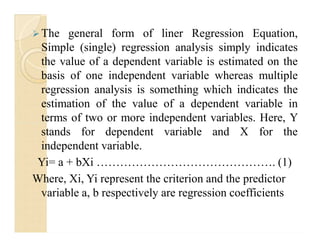
 The general form of liner Regression Equation,
Simple (single) regression analysis simply indicates
the value of a dependent variable is estimated on the
basis of one independent variable whereas multiple
regression analysis is something which indicates the
estimation of the value of a dependent variable in
terms of two or more independent variables. Here, Y
stands for dependent variable and X for the
independent variable.
Yi= a + bXi ………………………………………. (1)
Where, Xi, Yi represent the criterion and the predictor
variable a, b respectively are regression coefficients
 The general form of liner Regression Equation,
Simple (single) regression analysis simply indicates
the value of a dependent variable is estimated on the
basis of one independent variable whereas multiple
regression analysis is something which indicates the
estimation of the value of a dependent variable in
terms of two or more independent variables. Here, Y
stands for dependent variable and X for the
independent variable.
Yi= a + bXi ………………………………………. (1)
Where, Xi, Yi represent the criterion and the predictor
variable a, b respectively are regression coefficients
RESULT AND DISCUSSIONRESULT AND DISCUSSION
The different qualities parameters have been found by
varying rotor speed are listed below in the table .
Effect of Rotor Speed on Different Yarn Qualities
Impact of Um% on Rotor Speed
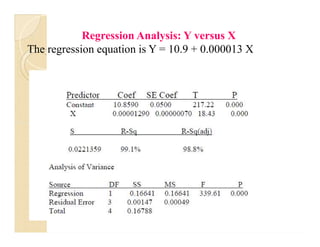
The below graph shows the Um% of rotor yarn
samples produced with different rotor speed. It is
showed that Um% increases slightly with the
increase of rotor speed.
the increase in the rotor speed, the fiber feed also
increases and uncontrolled feeding of fibers to
rotor takes place which may cause haphazard
lying of fiber in the rotor groove resulting to
unevenness.
Impact of Um% on Rotor Speed
The below graph shows the Um% of rotor yarn
samples produced with different rotor speed. It is
showed that Um% increases slightly with the
increase of rotor speed.
the increase in the rotor speed, the fiber feed also
increases and uncontrolled feeding of fibers to
rotor takes place which may cause haphazard
lying of fiber in the rotor groove resulting to
unevenness.
Regression Analysis: Y versus X
The regression equation is Y = 10.9 + 0.000013 X
9000080000700006000050000
12.1
12.0
11.9
11.8
11.7
11.6
11.5
x
y
S 0.0221359
R-Sq 99.1%
R-Sq(adj) 98.8%
impact of UM% on rotor speed
y = 10.86 + 0.000013 x
9000080000700006000050000
12.1
12.0
11.9
11.8
11.7
11.6
11.5
x
y
S 0.0221359
R-Sq 99.1%
R-Sq(adj) 98.8%
impact of UM% on rotor speed
y = 10.86 + 0.000013 x
Impact of Um% on Rotor speed
Impact of CVm% on rotor speed
 The favorable impact of processing parameters on the
yarn characteristics were accessed by co-efficient of
variation (CVm %), imperfection index (IPI), hairiness,
tenacity, count strength product (CSP) and force at break.
The yarn qualities were improved with increasing of rotor
speed and rotor diameter.
 The results indicate that these variables significantly
affects unevenness [U%], coefficient of variation (CV %),
Regression Analysis: y versus x
The regression equation is y = 14.0 + 0.000015 x
Impact of CVm% on rotor speed
 The favorable impact of processing parameters on the
yarn characteristics were accessed by co-efficient of
variation (CVm %), imperfection index (IPI), hairiness,
tenacity, count strength product (CSP) and force at break.
The yarn qualities were improved with increasing of rotor
speed and rotor diameter.
 The results indicate that these variables significantly
affects unevenness [U%], coefficient of variation (CV %),
Regression Analysis: y versus x
The regression equation is y = 14.0 + 0.000015 x
Regression Analysis: y versus x
The regression equation is y = 14.0 + 0.000015 x
9000080000700006000050000
15.4
15.3
15.2
15.1
15.0
14.9
14.8
14.7
x
y
S 0.0296648
R-Sq 98.8%
R-Sq(adj) 98.4%
Impact of cvm% on rotor speed
y = 14.02 + 0.000015 x
9000080000700006000050000
15.4
15.3
15.2
15.1
15.0
14.9
14.8
14.7
x
y
S 0.0296648
R-Sq 98.8%
R-Sq(adj) 98.4%
Impact of cvm% on rotor speed
y = 14.02 + 0.000015 x
Impact of cvm% on rotor speed
Impact of IPI on Rotor Speed
 Immature cottons have very much liability to produce
neps during processing. However in terms of speed,
combing roll speed and pneumofil percentage are
significant factors in terms of 95% confidence level. It is
seen that yarn imperfection has been increased with the
increase of combing roll speed.
 The occurrence attributed due to impairment of fiber
orientation in rotor groove during back doubling process
because of increasing damaged fibers of higher speed. At
higher speed fibers get less time to be straightened that
will be resulted in poor fibers orientation in rotor groove.
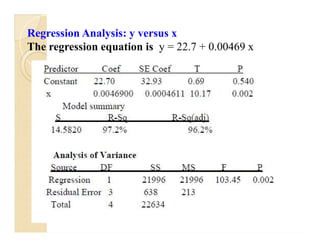
Ultimately, the graph also showed that yarn
imperfections increased with the increase rotor speed.
Impact of IPI on Rotor Speed
 Immature cottons have very much liability to produce
neps during processing. However in terms of speed,
combing roll speed and pneumofil percentage are
significant factors in terms of 95% confidence level. It is
seen that yarn imperfection has been increased with the
increase of combing roll speed.
 The occurrence attributed due to impairment of fiber
orientation in rotor groove during back doubling process
because of increasing damaged fibers of higher speed. At
higher speed fibers get less time to be straightened that
will be resulted in poor fibers orientation in rotor groove.
Ultimately, the graph also showed that yarn
imperfections increased with the increase rotor speed.
Regression Analysis: y versus x
The regression equation is y = 22.7 + 0.00469 x
9000080000700006000050000
450
400
350
300
250
x
y
S 14.5820
R-Sq 97.2%
R-Sq(adj) 96.2%
Impact of IPI on Rotor Speed
y = 22.70 + 0.004690 x
9000080000700006000050000
450
400
350
300
250
x
y
S 14.5820
R-Sq 97.2%
R-Sq(adj) 96.2%
Impact of IPI on Rotor Speed
y = 22.70 + 0.004690 x
Impact of IPI on Rotor speed
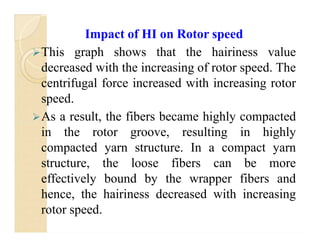
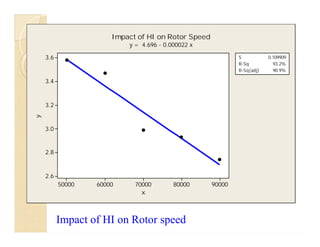
Impact of HI on Rotor speed
This graph shows that the hairiness value
decreased with the increasing of rotor speed. The
centrifugal force increased with increasing rotor
speed.
As a result, the fibers became highly compacted
in the rotor groove, resulting in highly
compacted yarn structure. In a compact yarn
structure, the loose fibers can be more
effectively bound by the wrapper fibers and
hence, the hairiness decreased with increasing
rotor speed.
Impact of HI on Rotor speed
This graph shows that the hairiness value
decreased with the increasing of rotor speed. The
centrifugal force increased with increasing rotor
speed.
As a result, the fibers became highly compacted
in the rotor groove, resulting in highly
compacted yarn structure. In a compact yarn
structure, the loose fibers can be more
effectively bound by the wrapper fibers and
hence, the hairiness decreased with increasing
rotor speed.
Regression Analysis: y versus x
The regression equation is y = 4.70 - 0.000022 x
9000080000700006000050000
3.6
3.4
3.2
3.0
2.8
2.6
x
y
S 0.109909
R-Sq 93.2%
R-Sq(adj) 90.9%
Impact of HI on Rotor Speed
y = 4.696 - 0.000022 x
9000080000700006000050000
3.6
3.4
3.2
3.0
2.8
2.6
x
y
S 0.109909
R-Sq 93.2%
R-Sq(adj) 90.9%
Impact of HI on Rotor Speed
y = 4.696 - 0.000022 x
Impact of HI on Rotor speed
Impact of CSP on Rotor Speed
The graph shows that, when rotor speed
increased CSP also increased. Because in terms
of rotor spinning the strength of rotor spun yarn
mainly depends on degree of compactness of the
yarn. The compact structure can be wrapped
easily by the wrapping fiber. The effect of
wrapping fiber higher than the effect of thin,
thick & neps on yarn. As a result, CSP increased
with the increasing of rotor speed.
Impact of CSP on Rotor Speed
The graph shows that, when rotor speed
increased CSP also increased. Because in terms
of rotor spinning the strength of rotor spun yarn
mainly depends on degree of compactness of the
yarn. The compact structure can be wrapped
easily by the wrapping fiber. The effect of
wrapping fiber higher than the effect of thin,
thick & neps on yarn. As a result, CSP increased
with the increasing of rotor speed.
Regression Analysis: y versus x
The regression equation is y = 936 + 0.00596 x
9000080000700006000050000
1500
1450
1400
1350
1300
1250
1200
x
y
S 27.9786
R-Sq 93.8%
R-Sq(adj) 91.7%
Impact of CSP on Rotor Speed
y = 935.8 + 0.005960 x
9000080000700006000050000
1500
1450
1400
1350
1300
1250
1200
x
y
S 27.9786
R-Sq 93.8%
R-Sq(adj) 91.7%
Impact of CSP on Rotor Speed
y = 935.8 + 0.005960 x
Impact of CSP on Rotor speed
Regression Analysis
By using the Minitab software we can easily
establish the different equation in regression
both for single and multiple regressions and the
obtained R2 value indicates the strength of
relationship between varying the rotor speeds
with different rotor yarn quality parameters.
Using all the quality parameters with varying
rotor speed we can establish the multiple
regression equation.
Regression Analysis
By using the Minitab software we can easily
establish the different equation in regression
both for single and multiple regressions and the
obtained R2 value indicates the strength of
relationship between varying the rotor speeds
with different rotor yarn quality parameters.
Using all the quality parameters with varying
rotor speed we can establish the multiple
regression equation.
Single regression equations and the values of R2
and R for different relationship between rotor
speeds and different quality parameters
CONCLUSIONCONCLUSION
 Speed of a machine greatly influences the production as
well as quality of the product. In case of a rotor spinning
machine, rotor rpm is the parameter by which machine
speed is set. In this study, we experimented with a view
to assess its effect on the properties of the produced
yarn. The increase of speed had a detrimental effect on
the evenness and imperfection level of yarn as the
performance of opening roller decreased with increasing
material throughput rate. On the other hand
improvements were observed in terms of yarn hairiness
and yarn strength (CSP).
 Therefore, it can be concluded that the increase of rotor
speed have a mixed impact on different quality
parameters of the rotor spun yarn.
 Speed of a machine greatly influences the production as
well as quality of the product. In case of a rotor spinning
machine, rotor rpm is the parameter by which machine
speed is set. In this study, we experimented with a view
to assess its effect on the properties of the produced
yarn. The increase of speed had a detrimental effect on
the evenness and imperfection level of yarn as the
performance of opening roller decreased with increasing
material throughput rate. On the other hand
improvements were observed in terms of yarn hairiness
and yarn strength (CSP).
 Therefore, it can be concluded that the increase of rotor
speed have a mixed impact on different quality
parameters of the rotor spun yarn.
seminar on research methodology (3)

seminar on research methodology (3)

  • 1.
    Regression Analysis ofRotor Spinning Yarn Quality Parameters Federal TVET Institute/University Textile and Apparel Fashion Technology Division Textile Technology Department Course Name: Technology Research Methodology Course Code: TXT 652 Regression Analysis of Rotor Spinning Yarn Quality Parameters Submitted by Meseret Bogale Reg no MTR/236/12 Submitted to: - Dr.Gurumurthy.B.R. Ph.D Ph.D (Textile Technology) - Instructor in Textile Technology
  • 2.
    ABSTRACTABSTRACT This paper revealssome information regarding quality profiles of rotor spun yarn mainly mass irregularity values (Unevenness in terms of mass Um%, various imperfection value (Thick places, Thin places, Neps, Imperfection Index (IPI), Hairiness (H) and bundle yarn strength (Count-Strength-Product CSP) in respect to change in different rotor speed. by using different rotor speed, the changes of above mention quality parameters were observed. In every case with the increase of rotor speed the quality profiles such Um%, CVm% and imperfection index declined but the improved values were obtained in terms of H and CSP. This paper reveals some information regarding quality profiles of rotor spun yarn mainly mass irregularity values (Unevenness in terms of mass Um%, various imperfection value (Thick places, Thin places, Neps, Imperfection Index (IPI), Hairiness (H) and bundle yarn strength (Count-Strength-Product CSP) in respect to change in different rotor speed. by using different rotor speed, the changes of above mention quality parameters were observed. In every case with the increase of rotor speed the quality profiles such Um%, CVm% and imperfection index declined but the improved values were obtained in terms of H and CSP.
  • 3.
    For each qualityparameters in relationship with variation of rotor speeds both coefficient of determination and single linear regression analysis were also established. At last using all the parameters a multiple regression equation was established.
  • 4.
    INTRODUCTIONINTRODUCTION high-quality and cost-savingkind of spinning method have become a major issue in the textile industry. Spinning is one of the most important production processes in the field of textile science. Spinning is a complicated procedure to convert fibers into yarn through many investigations with some new technological and technical process. Now a day in competition with ring spun yarn, the production of open end yarns such as rotor spun yarn is increasing significantly because of many quality parameters issues and productivity . high-quality and cost-saving kind of spinning method have become a major issue in the textile industry. Spinning is one of the most important production processes in the field of textile science. Spinning is a complicated procedure to convert fibers into yarn through many investigations with some new technological and technical process. Now a day in competition with ring spun yarn, the production of open end yarns such as rotor spun yarn is increasing significantly because of many quality parameters issues and productivity .
  • 5.
    In rotor spinningit is possible to produce better quality yarn from very poor grade of cotton and even from wastage among other process. Another few important dimensions like reduction in space, process and personnel have given rotor a new era to produce uniform and regular cotton yarn. Rotor spinning is a recognized spinning system mainly for medium and course counts . This technology has gained the reputation of being „cotton friendly‟, since two-thirds of all fibers used in rotor spinning are cotton In rotor spinning it is possible to produce better quality yarn from very poor grade of cotton and even from wastage among other process. Another few important dimensions like reduction in space, process and personnel have given rotor a new era to produce uniform and regular cotton yarn. Rotor spinning is a recognized spinning system mainly for medium and course counts . This technology has gained the reputation of being „cotton friendly‟, since two-thirds of all fibers used in rotor spinning are cotton
  • 6.
    LITERATURE REVIEWLITERATURE REVIEW Now a day, the competitive edge of rotor spinning is reflected in the implementation of faster rotor-spinning speeds, more sophisticated monitoring and control systems, and automatic start up, doffing, cleaning devices.  The strength of Reiter's rotor spinning lies not only in its high productivity but also its great flexibility in terms of raw material and yarn construction. The special feature of the fully-automated rotor spinning machine producer is to achieve highest productivity and lowest energy consumption.  Now a day, the competitive edge of rotor spinning is reflected in the implementation of faster rotor-spinning speeds, more sophisticated monitoring and control systems, and automatic start up, doffing, cleaning devices.  The strength of Reiter's rotor spinning lies not only in its high productivity but also its great flexibility in terms of raw material and yarn construction. The special feature of the fully-automated rotor spinning machine producer is to achieve highest productivity and lowest energy consumption.
  • 7.
     Rotor spinningis well known for its high output with wide raw materials. During rotor spinning process, under the action of the centrifugal force of rotor rotation and fibers slip into the groove after they enter the slipped wall of the rotor by the high negative pressure, then the fibers gathered and twisted to form rotor spun yarn.  synthetic fibers and blends on rotor-spinning machine with the discussion of optimization of surface characteristics and physical properties of man-made fibers .  optimization of open-end rotor spinning frame parameter and estimation of relevant quality characteristics using Lyocell fibers are used to spin the Ne 32 yarns.  Rotor spinning is well known for its high output with wide raw materials. During rotor spinning process, under the action of the centrifugal force of rotor rotation and fibers slip into the groove after they enter the slipped wall of the rotor by the high negative pressure, then the fibers gathered and twisted to form rotor spun yarn.  synthetic fibers and blends on rotor-spinning machine with the discussion of optimization of surface characteristics and physical properties of man-made fibers .  optimization of open-end rotor spinning frame parameter and estimation of relevant quality characteristics using Lyocell fibers are used to spin the Ne 32 yarns.
  • 8.
    Characteristics of rotorspun yarn  The yarn characteristics of rotor spun yarn are affected by various factors related to raw material, machine parameters and processing parameters. Many researchers have already investigated the effect of these parameters on yarn quality from different outlooks.  Rotor yarns are less irregular compared to the ring spun yarn because of multiple doubling or back doubling of fibers in the rotor groove. In addition, rotor spun yarns are not as affected by roller drafting wave as ring yarns.  Rotor spinning is considered as most suitable and successful spinning process among many open-end spinning methods. Characteristics of rotor spun yarn  The yarn characteristics of rotor spun yarn are affected by various factors related to raw material, machine parameters and processing parameters. Many researchers have already investigated the effect of these parameters on yarn quality from different outlooks.  Rotor yarns are less irregular compared to the ring spun yarn because of multiple doubling or back doubling of fibers in the rotor groove. In addition, rotor spun yarns are not as affected by roller drafting wave as ring yarns.  Rotor spinning is considered as most suitable and successful spinning process among many open-end spinning methods.
  • 9.
    MATERIALS AND STASTICALMETHODSMATERIALS AND STASTICAL METHODS Like others rotor spun yarns mixing of wastages, found in different stages was used with some extent of virgin raw cotton. Here a variety of Indian cotton named Shanker-6 with some other wastage, selected Materials Used Specification and mixing ratio of raw materials
  • 10.
    Methodology  The studywas conducted on a rotor frame in a spinning mill (which produces rotor yarn) where 20 Ne rotor yarns were produced. After mixing properly with above mentioned ration the materials were fed into blow room and then passed through carding, breaker draw frame and finisher draw frame. And at last to rotor spinning frame.  In rotor this process was done with 5 varying rotor speeds. The yarn samples were then taken to Quality Control Department for testing with Uster Tester-5 (UT- 5) to get various test results like as Um%, CVm%, IPI and Hairiness. Methodology  The study was conducted on a rotor frame in a spinning mill (which produces rotor yarn) where 20 Ne rotor yarns were produced. After mixing properly with above mentioned ration the materials were fed into blow room and then passed through carding, breaker draw frame and finisher draw frame. And at last to rotor spinning frame.  In rotor this process was done with 5 varying rotor speeds. The yarn samples were then taken to Quality Control Department for testing with Uster Tester-5 (UT- 5) to get various test results like as Um%, CVm%, IPI and Hairiness.
  • 11.
     To getreliable test result with minimum variability 5 specific drums were used. The yarn tests were carried out on Evenness Tester (UT-5) by ASTM D1425-96 for Um% and hairiness by ASTM D 5647-01 and Lea Strength Tester by ASTM D 1578-93. Above all tests were done under standard atmospheric conditions 27 ± 2°C and 65% RH. Then by using both multiple and single regression analysis the correlation between rotor speed with yarn quality was observed and the construction of multiple regression analysis equations by using these variables.  To get reliable test result with minimum variability 5 specific drums were used. The yarn tests were carried out on Evenness Tester (UT-5) by ASTM D1425-96 for Um% and hairiness by ASTM D 5647-01 and Lea Strength Tester by ASTM D 1578-93. Above all tests were done under standard atmospheric conditions 27 ± 2°C and 65% RH. Then by using both multiple and single regression analysis the correlation between rotor speed with yarn quality was observed and the construction of multiple regression analysis equations by using these variables.
  • 12.
    Correlation and RegressionAnalysis Correlation analysis  Correlation Analysis is a group of statistical techniques to measure the association between two variables known as a dependent and independent variable. The dependent variable is the variable being predicted or estimated. The Independent Variable provides the basis for estimation. It is the predictor variable. Such as to determine the relationship between ring yarn properties and the fiber properties obtained by AFIS. A Scatter Diagram is used to portray the relationship between two variables. Correlation and Regression Analysis Correlation analysis  Correlation Analysis is a group of statistical techniques to measure the association between two variables known as a dependent and independent variable. The dependent variable is the variable being predicted or estimated. The Independent Variable provides the basis for estimation. It is the predictor variable. Such as to determine the relationship between ring yarn properties and the fiber properties obtained by AFIS. A Scatter Diagram is used to portray the relationship between two variables.
  • 13.
    Characteristics of thecorrelation coefficient  Identify by the lowercase letter r and ranges from -1 to +1.  Shows the direction and strength of the linear relationship between two variables.  Near 0 and ±1 indicates little, strong positive and negative relationship between the variables. Regression analysis  Simple (single) regression analysis simply indicates the value of a dependent variable is estimated on the basis of one independent variable whereas multiple regression analysis is something which indicates. Characteristics of the correlation coefficient  Identify by the lowercase letter r and ranges from -1 to +1.  Shows the direction and strength of the linear relationship between two variables.  Near 0 and ±1 indicates little, strong positive and negative relationship between the variables. Regression analysis  Simple (single) regression analysis simply indicates the value of a dependent variable is estimated on the basis of one independent variable whereas multiple regression analysis is something which indicates.
  • 14.
    the estimation ofthe value of a dependent variable in terms of two or more independent variables. Here, Y stands for dependent variable and X for the independent variable. So it can be said that single regression analysis involves with one for both dependent and independent variable but we have to go for multiple regression analysis we want to estimate a value which depends on more than one independent variable. Construction of simple regression equation  Regression Equation is an equation that expresses the linear relationship between two variables. the estimation of the value of a dependent variable in terms of two or more independent variables. Here, Y stands for dependent variable and X for the independent variable. So it can be said that single regression analysis involves with one for both dependent and independent variable but we have to go for multiple regression analysis we want to estimate a value which depends on more than one independent variable. Construction of simple regression equation  Regression Equation is an equation that expresses the linear relationship between two variables.
  • 15.
     The generalform of liner Regression Equation, Simple (single) regression analysis simply indicates the value of a dependent variable is estimated on the basis of one independent variable whereas multiple regression analysis is something which indicates the estimation of the value of a dependent variable in terms of two or more independent variables. Here, Y stands for dependent variable and X for the independent variable. Yi= a + bXi ………………………………………. (1) Where, Xi, Yi represent the criterion and the predictor variable a, b respectively are regression coefficients  The general form of liner Regression Equation, Simple (single) regression analysis simply indicates the value of a dependent variable is estimated on the basis of one independent variable whereas multiple regression analysis is something which indicates the estimation of the value of a dependent variable in terms of two or more independent variables. Here, Y stands for dependent variable and X for the independent variable. Yi= a + bXi ………………………………………. (1) Where, Xi, Yi represent the criterion and the predictor variable a, b respectively are regression coefficients
  • 16.
    RESULT AND DISCUSSIONRESULTAND DISCUSSION The different qualities parameters have been found by varying rotor speed are listed below in the table . Effect of Rotor Speed on Different Yarn Qualities
  • 17.
    Impact of Um%on Rotor Speed The below graph shows the Um% of rotor yarn samples produced with different rotor speed. It is showed that Um% increases slightly with the increase of rotor speed. the increase in the rotor speed, the fiber feed also increases and uncontrolled feeding of fibers to rotor takes place which may cause haphazard lying of fiber in the rotor groove resulting to unevenness. Impact of Um% on Rotor Speed The below graph shows the Um% of rotor yarn samples produced with different rotor speed. It is showed that Um% increases slightly with the increase of rotor speed. the increase in the rotor speed, the fiber feed also increases and uncontrolled feeding of fibers to rotor takes place which may cause haphazard lying of fiber in the rotor groove resulting to unevenness.
  • 18.
    Regression Analysis: Yversus X The regression equation is Y = 10.9 + 0.000013 X
  • 19.
    9000080000700006000050000 12.1 12.0 11.9 11.8 11.7 11.6 11.5 x y S 0.0221359 R-Sq 99.1% R-Sq(adj)98.8% impact of UM% on rotor speed y = 10.86 + 0.000013 x 9000080000700006000050000 12.1 12.0 11.9 11.8 11.7 11.6 11.5 x y S 0.0221359 R-Sq 99.1% R-Sq(adj) 98.8% impact of UM% on rotor speed y = 10.86 + 0.000013 x Impact of Um% on Rotor speed
  • 20.
    Impact of CVm%on rotor speed  The favorable impact of processing parameters on the yarn characteristics were accessed by co-efficient of variation (CVm %), imperfection index (IPI), hairiness, tenacity, count strength product (CSP) and force at break. The yarn qualities were improved with increasing of rotor speed and rotor diameter.  The results indicate that these variables significantly affects unevenness [U%], coefficient of variation (CV %), Regression Analysis: y versus x The regression equation is y = 14.0 + 0.000015 x Impact of CVm% on rotor speed  The favorable impact of processing parameters on the yarn characteristics were accessed by co-efficient of variation (CVm %), imperfection index (IPI), hairiness, tenacity, count strength product (CSP) and force at break. The yarn qualities were improved with increasing of rotor speed and rotor diameter.  The results indicate that these variables significantly affects unevenness [U%], coefficient of variation (CV %), Regression Analysis: y versus x The regression equation is y = 14.0 + 0.000015 x
  • 21.
    Regression Analysis: yversus x The regression equation is y = 14.0 + 0.000015 x
  • 22.
    9000080000700006000050000 15.4 15.3 15.2 15.1 15.0 14.9 14.8 14.7 x y S 0.0296648 R-Sq 98.8% R-Sq(adj)98.4% Impact of cvm% on rotor speed y = 14.02 + 0.000015 x 9000080000700006000050000 15.4 15.3 15.2 15.1 15.0 14.9 14.8 14.7 x y S 0.0296648 R-Sq 98.8% R-Sq(adj) 98.4% Impact of cvm% on rotor speed y = 14.02 + 0.000015 x Impact of cvm% on rotor speed
  • 23.
    Impact of IPIon Rotor Speed  Immature cottons have very much liability to produce neps during processing. However in terms of speed, combing roll speed and pneumofil percentage are significant factors in terms of 95% confidence level. It is seen that yarn imperfection has been increased with the increase of combing roll speed.  The occurrence attributed due to impairment of fiber orientation in rotor groove during back doubling process because of increasing damaged fibers of higher speed. At higher speed fibers get less time to be straightened that will be resulted in poor fibers orientation in rotor groove. Ultimately, the graph also showed that yarn imperfections increased with the increase rotor speed. Impact of IPI on Rotor Speed  Immature cottons have very much liability to produce neps during processing. However in terms of speed, combing roll speed and pneumofil percentage are significant factors in terms of 95% confidence level. It is seen that yarn imperfection has been increased with the increase of combing roll speed.  The occurrence attributed due to impairment of fiber orientation in rotor groove during back doubling process because of increasing damaged fibers of higher speed. At higher speed fibers get less time to be straightened that will be resulted in poor fibers orientation in rotor groove. Ultimately, the graph also showed that yarn imperfections increased with the increase rotor speed.
  • 24.
    Regression Analysis: yversus x The regression equation is y = 22.7 + 0.00469 x
  • 25.
    9000080000700006000050000 450 400 350 300 250 x y S 14.5820 R-Sq 97.2% R-Sq(adj)96.2% Impact of IPI on Rotor Speed y = 22.70 + 0.004690 x 9000080000700006000050000 450 400 350 300 250 x y S 14.5820 R-Sq 97.2% R-Sq(adj) 96.2% Impact of IPI on Rotor Speed y = 22.70 + 0.004690 x Impact of IPI on Rotor speed
  • 26.
    Impact of HIon Rotor speed This graph shows that the hairiness value decreased with the increasing of rotor speed. The centrifugal force increased with increasing rotor speed. As a result, the fibers became highly compacted in the rotor groove, resulting in highly compacted yarn structure. In a compact yarn structure, the loose fibers can be more effectively bound by the wrapper fibers and hence, the hairiness decreased with increasing rotor speed. Impact of HI on Rotor speed This graph shows that the hairiness value decreased with the increasing of rotor speed. The centrifugal force increased with increasing rotor speed. As a result, the fibers became highly compacted in the rotor groove, resulting in highly compacted yarn structure. In a compact yarn structure, the loose fibers can be more effectively bound by the wrapper fibers and hence, the hairiness decreased with increasing rotor speed.
  • 27.
    Regression Analysis: yversus x The regression equation is y = 4.70 - 0.000022 x
  • 28.
    9000080000700006000050000 3.6 3.4 3.2 3.0 2.8 2.6 x y S 0.109909 R-Sq 93.2% R-Sq(adj)90.9% Impact of HI on Rotor Speed y = 4.696 - 0.000022 x 9000080000700006000050000 3.6 3.4 3.2 3.0 2.8 2.6 x y S 0.109909 R-Sq 93.2% R-Sq(adj) 90.9% Impact of HI on Rotor Speed y = 4.696 - 0.000022 x Impact of HI on Rotor speed
  • 29.
    Impact of CSPon Rotor Speed The graph shows that, when rotor speed increased CSP also increased. Because in terms of rotor spinning the strength of rotor spun yarn mainly depends on degree of compactness of the yarn. The compact structure can be wrapped easily by the wrapping fiber. The effect of wrapping fiber higher than the effect of thin, thick & neps on yarn. As a result, CSP increased with the increasing of rotor speed. Impact of CSP on Rotor Speed The graph shows that, when rotor speed increased CSP also increased. Because in terms of rotor spinning the strength of rotor spun yarn mainly depends on degree of compactness of the yarn. The compact structure can be wrapped easily by the wrapping fiber. The effect of wrapping fiber higher than the effect of thin, thick & neps on yarn. As a result, CSP increased with the increasing of rotor speed.
  • 30.
    Regression Analysis: yversus x The regression equation is y = 936 + 0.00596 x
  • 31.
    9000080000700006000050000 1500 1450 1400 1350 1300 1250 1200 x y S 27.9786 R-Sq 93.8% R-Sq(adj)91.7% Impact of CSP on Rotor Speed y = 935.8 + 0.005960 x 9000080000700006000050000 1500 1450 1400 1350 1300 1250 1200 x y S 27.9786 R-Sq 93.8% R-Sq(adj) 91.7% Impact of CSP on Rotor Speed y = 935.8 + 0.005960 x Impact of CSP on Rotor speed
  • 32.
    Regression Analysis By usingthe Minitab software we can easily establish the different equation in regression both for single and multiple regressions and the obtained R2 value indicates the strength of relationship between varying the rotor speeds with different rotor yarn quality parameters. Using all the quality parameters with varying rotor speed we can establish the multiple regression equation. Regression Analysis By using the Minitab software we can easily establish the different equation in regression both for single and multiple regressions and the obtained R2 value indicates the strength of relationship between varying the rotor speeds with different rotor yarn quality parameters. Using all the quality parameters with varying rotor speed we can establish the multiple regression equation.
  • 33.
    Single regression equationsand the values of R2 and R for different relationship between rotor speeds and different quality parameters
  • 34.
    CONCLUSIONCONCLUSION  Speed ofa machine greatly influences the production as well as quality of the product. In case of a rotor spinning machine, rotor rpm is the parameter by which machine speed is set. In this study, we experimented with a view to assess its effect on the properties of the produced yarn. The increase of speed had a detrimental effect on the evenness and imperfection level of yarn as the performance of opening roller decreased with increasing material throughput rate. On the other hand improvements were observed in terms of yarn hairiness and yarn strength (CSP).  Therefore, it can be concluded that the increase of rotor speed have a mixed impact on different quality parameters of the rotor spun yarn.  Speed of a machine greatly influences the production as well as quality of the product. In case of a rotor spinning machine, rotor rpm is the parameter by which machine speed is set. In this study, we experimented with a view to assess its effect on the properties of the produced yarn. The increase of speed had a detrimental effect on the evenness and imperfection level of yarn as the performance of opening roller decreased with increasing material throughput rate. On the other hand improvements were observed in terms of yarn hairiness and yarn strength (CSP).  Therefore, it can be concluded that the increase of rotor speed have a mixed impact on different quality parameters of the rotor spun yarn.