PRESENTED BY : AKSHITA MENGI
ROLLNO . 12
INTRODUCTION
 Carp culture is the oldest form of aquaculture known to the world .
It is the process of growing improved variety of carp having good
taste under controlled conditions and management for food and
ornamental purposes.
 Cyprinidae are the family of freshwater fishes which includes carps
and their relatives . This family is commonly known as carp family .
Species of carp fishes referred by their geographic origins are :
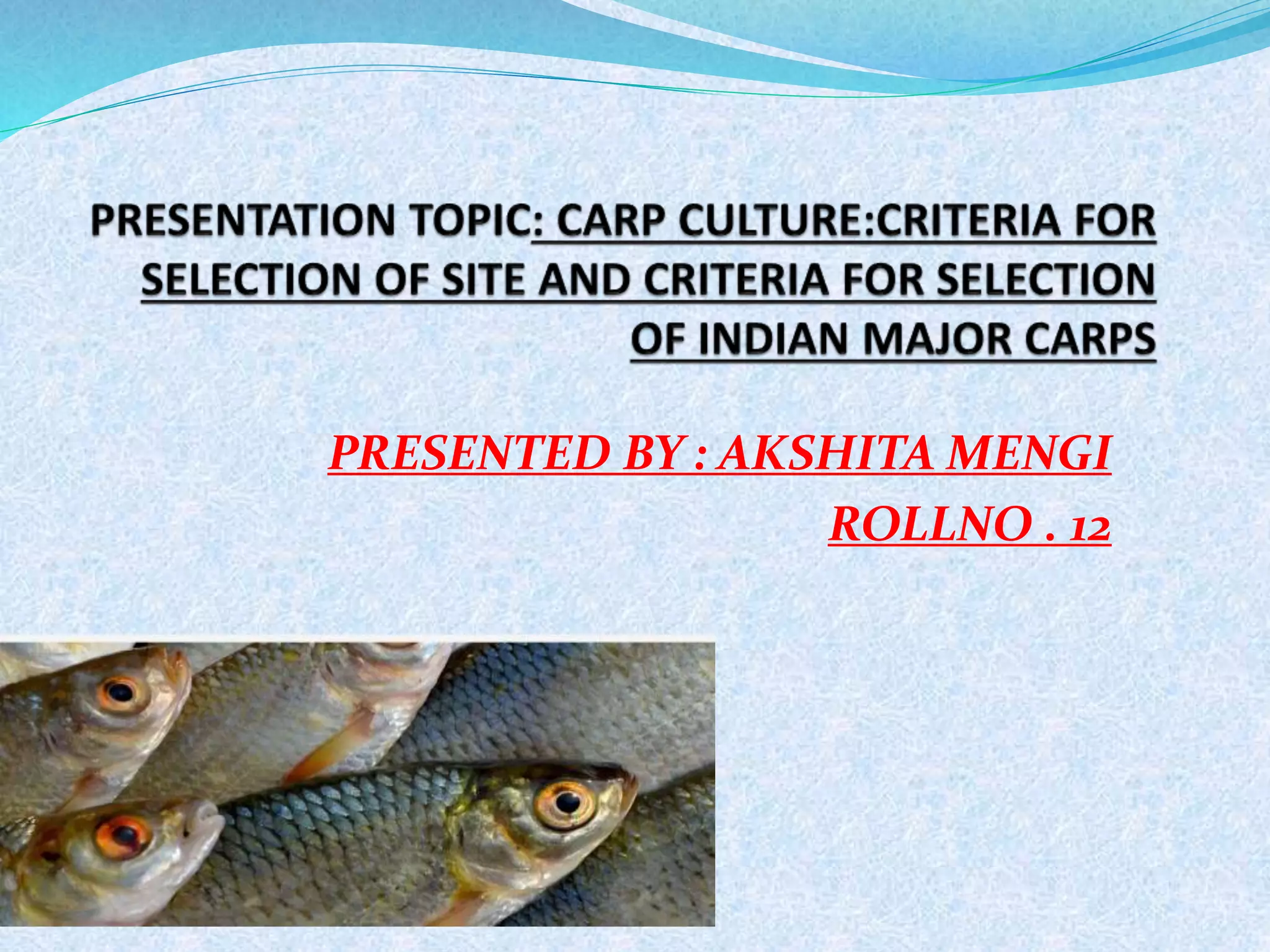
Indian carps : Catla catla , Labeo rohita , Cirrhina mrigal
 Exotic carps : Cyprinus carpio ,Hypopthalmichthys molitrix (silver
carp )
 Minor carps : Labeo bata
 Carps have been the backbone of aquaculture practice in India and it
is the three Indian major carps Catla , Rohu and Mrigal together with
three other exotic carps silver carp , grass carp , and common carp
contribute over 85 % of the aquaculture production of the country .
CARPS
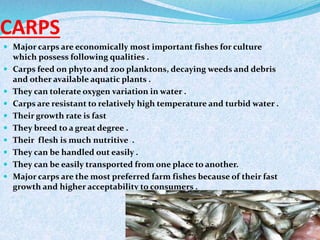
 Major carps are economically most important fishes for culture
which possess following qualities .
 Carps feed on phyto and zoo planktons, decaying weeds and debris
and other available aquatic plants .
 They can tolerate oxygen variation in water .
 Carps are resistant to relatively high temperature and turbid water .
 Their growth rate is fast
 They breed to a great degree .
 Their flesh is much nutritive .
 They can be handled out easily .
 They can be easily transported from one place to another.
 Major carps are the most preferred farm fishes because of their fast
growth and higher acceptability to consumers .
Pre stocking management :SITE SELECTION
 The main criteria to be kept in mind while selecting the pond for carp
culture is that soil should be water retentive , adequate supply of water
is assured and that the pond is not in a flood prone area . The site should
be easily accessible by road or any form of transport to reach the market
for easy fish disposal .
 In addition to this , the accessibility of inputs such as feed , fertilizer and
construction material should be available nearby site . The site should
be free from pollution , industrial waste , domestic waste or any other
harmful activities .
 For site selection various ecological , biological and social factors need
to be considered .
 Ecological factors : SOIL : The soil quality influences the pond
productivity and water quality. The properties of soil texture and
permeability are determined to decide suitability of a site.
 Pond bottom should have ability to hold water . Loamy , clayey
loamy and clay silt soil are most suitable for pond construction .
 Selected site’s soil in its every 100 gm should contain 50 -75 mg
nitrogen , 6-12 mg phosphorus and 1.5 -2.5 gm organic carbon .
 For good production – soil pH should lie between 7.5 to 8.5 .
WATER : An adequate amount of water is required to build the fish
farm because water depth need to be adjusted at regular intervals
. Water should not be acidic or alkaline and if it is found to be so
, then correction is to be done by applying lime or organic
manure .
Ideal water temperature is 20 -30 degree C for fish farm .
TOPOGRAPHY : Type of pond construction is determined by land
topography . Normally flood prone areas and poor rainfall areas
need to be avoided . Areas such as industrial zones , fields with
underground oil pipelines , irregular land area are also not
recommended for pond construction .
 BIOLOGICAL FACTORS :
 Biological factors include the species to be cultured , seed source and
culture type and they need to be considered before site selection .
 SOCIAL ,ECOLOGICAL FACTORS : The social fabric , market , and its
structure , services directly or indirectly linked with culture sector such
as transportation , storage , wholesale market aspects need to be
considered . The land identified for farm should be without legal issues
and fish farming should be accepted by local people . Other factors
include availability of labour , electricity etc .
 Availability of natural food resources , their better utilization and
intensification (feeding of fish , pond fertilizers ). Fish needs to be fed
with grass like para , maize leaves , banana leaves chopped green cattle
fodder etc. These should be made available there .
 Pollution free area. The insecticides used in agriculture are toxic to fish , heavy
metals and various chemicals discarded from industries are also poisonous to
fish .
 After the selection of the suitable site , pond is constructed .
 The place is cleared of ropes , cables and other items . Trees and bushes and other
obstacles that hinder movement of heavy equipment around the site are to be
removed . All the vegetation including wood are to be cleared in in the area . The
surface soil which has highest concentration of roots and organic material is not
suitable for pond construction . Hence about 30 cm of surface soil has t be
removed .
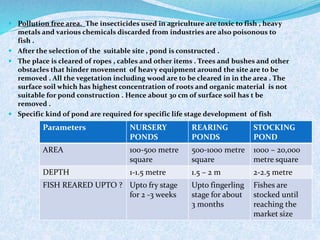
 Specific kind of pond are required for specific life stage development of fish
Parameters NURSERY
PONDS
REARING
PONDS
STOCKING
POND
AREA 100-500 metre
square
500-1000 metre
square
1000 – 20,000
metre square
DEPTH 1-1.5 metre 1.5 – 2 m 2-2.5 metre
FISH REARED UPTO ? Upto fry stage
for 2 -3 weeks
Upto fingerling
stage for about
3 months
Fishes are
stocked until
reaching the
market size
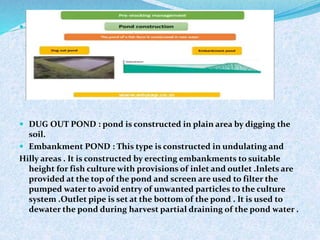
 The pond of a fish farm is constructed in two ways .
 DUG OUT POND : pond is constructed in plain area by digging the
soil.
 Embankment POND : This type is constructed in undulating and
Hilly areas . It is constructed by erecting embankments to suitable
height for fish culture with provisions of inlet and outlet .Inlets are
provided at the top of the pond and screen are used to filter the
pumped water to avoid entry of unwanted particles to the culture
system .Outlet pipe is set at the bottom of the pond . It is used to
dewater the pond during harvest partial draining of the pond water .
 CONDITIONING OF POND : layer of lime is spread
over the bottom of the pond for two weeks . It removes
the acidity of the soil and facilitates desirable
geochemical cycles and also kills soil organisms . Water
is let slowly after two weeks and filled to desired depth .
The quality parameters such as temperature , oxygen
content , ph is maintained before stocking the fish .
 MANURING OF POND : after conditioning of pond
organic or chemical manure is applied in order to
develop the fish food organisms like phtoplankton and
zooplankton . Use of chemical fertilizers varies
according to concentration of phosphorus and nitrogen
in the soil .
CRITERIA FOR SELECTION OF MAJOR CARPS
 The following criteria should be considered before selecting a fis h
for farming purpose .
 RATE OF GROWTH : Fish which grow to a large size in shorter period
are suitable for the culture .
 ADAPTATION TO THE CLIMATE : The cultured species of fishes
should be able to adapt to the local climate conditions of the farm .
 TOLERANCE : The fish should have the capacity to tolerate wide
fluctuations in the physic chemical conditions such as oxygen ,
salanity and temperature etc of the water .
 ACCEPTANCE OF ARTIFICAL FEED : When more number of fish is to
be accommodated in a limited space , there is the need for
supplementary feeding on compounded diets . The fish should
show ready preference for these feeds .
 RESISTANCE : It is desirable that the cultured fish is hard
enough to resist the common diseases and attack of parasites .
 AMIABILITY AND COMPATIBILITY : The fishes proposed to be
cultured together should be able to live together without
interfering or attacking the other .
 CONVERSION EFFICIENCY : The species of fish which give more
edible flesh per unit of food consumed is preferred .
 CONSUMER’S PREFERENCE : Food preference of people varies
with geographic regions . Hence the species cultured should be
marketable locally or to the targeted consumers .
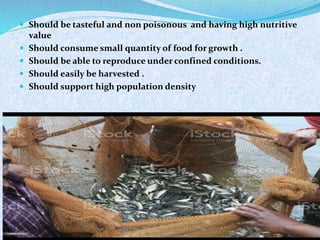
 Should be tasteful and non poisonous and having high nutritive
value
 Should consume small quantity of food for growth .
 Should be able to reproduce under confined conditions.
 Should easily be harvested .
 Should support high population density
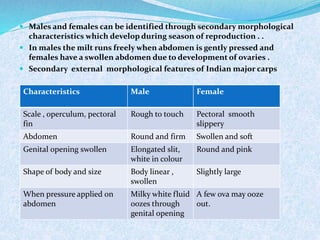
 Males and females can be identified through secondary morphological
characteristics which develop during season of reproduction . .
 In males the milt runs freely when abdomen is gently pressed and
females have a swollen abdomen due to development of ovaries .
 Secondary external morphological features of Indian major carps
Characteristics Male Female
Scale , operculum, pectoral
fin
Rough to touch Pectoral smooth
slippery
Abdomen Round and firm Swollen and soft
Genital opening swollen Elongated slit,
white in colour
Round and pink
Shape of body and size Body linear ,
swollen
Slightly large
When pressure applied on
abdomen
Milky white fluid
oozes through
genital opening
A few ova may ooze
out.
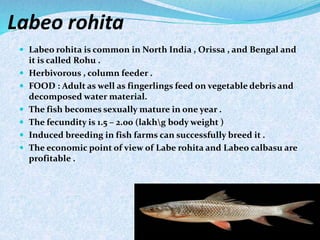
Labeo rohita
 Labeo rohita is common in North India , Orissa , and Bengal and
it is called Rohu .
 Herbivorous , column feeder .
 FOOD : Adult as well as fingerlings feed on vegetable debris and
decomposed water material.
 The fish becomes sexually mature in one year .
 The fecundity is 1.5 – 2.00 (lakhg body weight )
 Induced breeding in fish farms can successfully breed it .
 The economic point of view of Labe rohita and Labeo calbasu are
profitable .
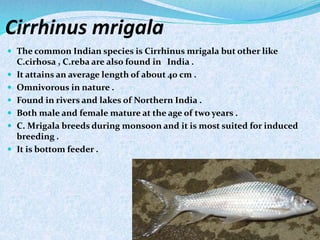
Cirrhinus mrigala
 The common Indian species is Cirrhinus mrigala but other like
C.cirhosa , C.reba are also found in India .
 It attains an average length of about 40 cm .
 Omnivorous in nature .
 Found in rivers and lakes of Northern India .
 Both male and female mature at the age of two years .
 C. Mrigala breeds during monsoon and it is most suited for induced
breeding .
 It is bottom feeder .
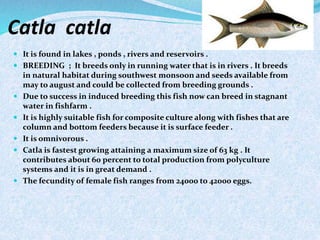
Catla catla
 It is found in lakes , ponds , rivers and reservoirs .
 BREEDING ; It breeds only in running water that is in rivers . It breeds
in natural habitat during southwest monsoon and seeds available from
may to august and could be collected from breeding grounds .
 Due to success in induced breeding this fish now can breed in stagnant
water in fishfarm .
 It is highly suitable fish for composite culture along with fishes that are
column and bottom feeders because it is surface feeder .
 It is omnivorous .
 Catla is fastest growing attaining a maximum size of 63 kg . It
contributes about 60 percent to total production from polyculture
systems and it is in great demand .
 The fecundity of female fish ranges from 24000 to 42000 eggs.
THANK YOU

CARP CULTURE 2.pptx

  • 1.
    PRESENTED BY :AKSHITA MENGI ROLLNO . 12
  • 2.
    INTRODUCTION  Carp cultureis the oldest form of aquaculture known to the world . It is the process of growing improved variety of carp having good taste under controlled conditions and management for food and ornamental purposes.  Cyprinidae are the family of freshwater fishes which includes carps and their relatives . This family is commonly known as carp family . Species of carp fishes referred by their geographic origins are : Indian carps : Catla catla , Labeo rohita , Cirrhina mrigal  Exotic carps : Cyprinus carpio ,Hypopthalmichthys molitrix (silver carp )  Minor carps : Labeo bata  Carps have been the backbone of aquaculture practice in India and it is the three Indian major carps Catla , Rohu and Mrigal together with three other exotic carps silver carp , grass carp , and common carp contribute over 85 % of the aquaculture production of the country .
  • 3.
    CARPS  Major carpsare economically most important fishes for culture which possess following qualities .  Carps feed on phyto and zoo planktons, decaying weeds and debris and other available aquatic plants .  They can tolerate oxygen variation in water .  Carps are resistant to relatively high temperature and turbid water .  Their growth rate is fast  They breed to a great degree .  Their flesh is much nutritive .  They can be handled out easily .  They can be easily transported from one place to another.  Major carps are the most preferred farm fishes because of their fast growth and higher acceptability to consumers .
  • 4.
    Pre stocking management:SITE SELECTION  The main criteria to be kept in mind while selecting the pond for carp culture is that soil should be water retentive , adequate supply of water is assured and that the pond is not in a flood prone area . The site should be easily accessible by road or any form of transport to reach the market for easy fish disposal .  In addition to this , the accessibility of inputs such as feed , fertilizer and construction material should be available nearby site . The site should be free from pollution , industrial waste , domestic waste or any other harmful activities .  For site selection various ecological , biological and social factors need to be considered .  Ecological factors : SOIL : The soil quality influences the pond productivity and water quality. The properties of soil texture and permeability are determined to decide suitability of a site.
  • 5.
     Pond bottomshould have ability to hold water . Loamy , clayey loamy and clay silt soil are most suitable for pond construction .  Selected site’s soil in its every 100 gm should contain 50 -75 mg nitrogen , 6-12 mg phosphorus and 1.5 -2.5 gm organic carbon .  For good production – soil pH should lie between 7.5 to 8.5 . WATER : An adequate amount of water is required to build the fish farm because water depth need to be adjusted at regular intervals . Water should not be acidic or alkaline and if it is found to be so , then correction is to be done by applying lime or organic manure . Ideal water temperature is 20 -30 degree C for fish farm . TOPOGRAPHY : Type of pond construction is determined by land topography . Normally flood prone areas and poor rainfall areas need to be avoided . Areas such as industrial zones , fields with underground oil pipelines , irregular land area are also not recommended for pond construction .
  • 6.
     BIOLOGICAL FACTORS:  Biological factors include the species to be cultured , seed source and culture type and they need to be considered before site selection .  SOCIAL ,ECOLOGICAL FACTORS : The social fabric , market , and its structure , services directly or indirectly linked with culture sector such as transportation , storage , wholesale market aspects need to be considered . The land identified for farm should be without legal issues and fish farming should be accepted by local people . Other factors include availability of labour , electricity etc .  Availability of natural food resources , their better utilization and intensification (feeding of fish , pond fertilizers ). Fish needs to be fed with grass like para , maize leaves , banana leaves chopped green cattle fodder etc. These should be made available there .
  • 7.
     Pollution freearea. The insecticides used in agriculture are toxic to fish , heavy metals and various chemicals discarded from industries are also poisonous to fish .  After the selection of the suitable site , pond is constructed .  The place is cleared of ropes , cables and other items . Trees and bushes and other obstacles that hinder movement of heavy equipment around the site are to be removed . All the vegetation including wood are to be cleared in in the area . The surface soil which has highest concentration of roots and organic material is not suitable for pond construction . Hence about 30 cm of surface soil has t be removed .  Specific kind of pond are required for specific life stage development of fish Parameters NURSERY PONDS REARING PONDS STOCKING POND AREA 100-500 metre square 500-1000 metre square 1000 – 20,000 metre square DEPTH 1-1.5 metre 1.5 – 2 m 2-2.5 metre FISH REARED UPTO ? Upto fry stage for 2 -3 weeks Upto fingerling stage for about 3 months Fishes are stocked until reaching the market size
  • 8.
     The pondof a fish farm is constructed in two ways .  DUG OUT POND : pond is constructed in plain area by digging the soil.  Embankment POND : This type is constructed in undulating and Hilly areas . It is constructed by erecting embankments to suitable height for fish culture with provisions of inlet and outlet .Inlets are provided at the top of the pond and screen are used to filter the pumped water to avoid entry of unwanted particles to the culture system .Outlet pipe is set at the bottom of the pond . It is used to dewater the pond during harvest partial draining of the pond water .
  • 9.
     CONDITIONING OFPOND : layer of lime is spread over the bottom of the pond for two weeks . It removes the acidity of the soil and facilitates desirable geochemical cycles and also kills soil organisms . Water is let slowly after two weeks and filled to desired depth . The quality parameters such as temperature , oxygen content , ph is maintained before stocking the fish .  MANURING OF POND : after conditioning of pond organic or chemical manure is applied in order to develop the fish food organisms like phtoplankton and zooplankton . Use of chemical fertilizers varies according to concentration of phosphorus and nitrogen in the soil .
  • 10.
    CRITERIA FOR SELECTIONOF MAJOR CARPS  The following criteria should be considered before selecting a fis h for farming purpose .  RATE OF GROWTH : Fish which grow to a large size in shorter period are suitable for the culture .  ADAPTATION TO THE CLIMATE : The cultured species of fishes should be able to adapt to the local climate conditions of the farm .  TOLERANCE : The fish should have the capacity to tolerate wide fluctuations in the physic chemical conditions such as oxygen , salanity and temperature etc of the water .  ACCEPTANCE OF ARTIFICAL FEED : When more number of fish is to be accommodated in a limited space , there is the need for supplementary feeding on compounded diets . The fish should show ready preference for these feeds .
  • 11.
     RESISTANCE :It is desirable that the cultured fish is hard enough to resist the common diseases and attack of parasites .  AMIABILITY AND COMPATIBILITY : The fishes proposed to be cultured together should be able to live together without interfering or attacking the other .  CONVERSION EFFICIENCY : The species of fish which give more edible flesh per unit of food consumed is preferred .  CONSUMER’S PREFERENCE : Food preference of people varies with geographic regions . Hence the species cultured should be marketable locally or to the targeted consumers .
  • 12.
     Should betasteful and non poisonous and having high nutritive value  Should consume small quantity of food for growth .  Should be able to reproduce under confined conditions.  Should easily be harvested .  Should support high population density
  • 13.
     Males andfemales can be identified through secondary morphological characteristics which develop during season of reproduction . .  In males the milt runs freely when abdomen is gently pressed and females have a swollen abdomen due to development of ovaries .  Secondary external morphological features of Indian major carps Characteristics Male Female Scale , operculum, pectoral fin Rough to touch Pectoral smooth slippery Abdomen Round and firm Swollen and soft Genital opening swollen Elongated slit, white in colour Round and pink Shape of body and size Body linear , swollen Slightly large When pressure applied on abdomen Milky white fluid oozes through genital opening A few ova may ooze out.
  • 14.
    Labeo rohita  Labeorohita is common in North India , Orissa , and Bengal and it is called Rohu .  Herbivorous , column feeder .  FOOD : Adult as well as fingerlings feed on vegetable debris and decomposed water material.  The fish becomes sexually mature in one year .  The fecundity is 1.5 – 2.00 (lakhg body weight )  Induced breeding in fish farms can successfully breed it .  The economic point of view of Labe rohita and Labeo calbasu are profitable .
  • 15.
    Cirrhinus mrigala  Thecommon Indian species is Cirrhinus mrigala but other like C.cirhosa , C.reba are also found in India .  It attains an average length of about 40 cm .  Omnivorous in nature .  Found in rivers and lakes of Northern India .  Both male and female mature at the age of two years .  C. Mrigala breeds during monsoon and it is most suited for induced breeding .  It is bottom feeder .
  • 16.
    Catla catla  Itis found in lakes , ponds , rivers and reservoirs .  BREEDING ; It breeds only in running water that is in rivers . It breeds in natural habitat during southwest monsoon and seeds available from may to august and could be collected from breeding grounds .  Due to success in induced breeding this fish now can breed in stagnant water in fishfarm .  It is highly suitable fish for composite culture along with fishes that are column and bottom feeders because it is surface feeder .  It is omnivorous .  Catla is fastest growing attaining a maximum size of 63 kg . It contributes about 60 percent to total production from polyculture systems and it is in great demand .  The fecundity of female fish ranges from 24000 to 42000 eggs.
  • 17.