
Ashish sahu
INTRODUCTION
 High Oxygen
 Low Carbon dioxide
 Inorganic soil
 Sparse vegetation and food
 Low fertility & high transparency
CONTD…
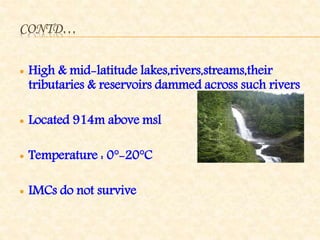
 High & mid-latitude lakes,rivers,streams,their
tributaries & reservoirs dammed across such rivers
 Located 914m above msl
 Temperature : 0°-20°C
 IMCs do not survive
 Contribute less to total inland fish production
 but comprise unique biodiversity with valuable
indigenous germplasm & maintain
environmental quality in hills
 Trouts & salmons are the only exotic game
fishes introduced
• Coldwater species – in Himalayas & Peninsular hill
ranges
• Maintain relatively low temperatures & supports
low productivity
• Waters of temperature within the tolerance of
trouts of family Salmonidae are termed cold
• 0°-20°C, optimum 10°-12°C
DISTRIBUTION
 258 species spread over the Himalayas & the
Peninsular Plateau
 Belong to 21 families & 76 genera
CHARACTERISTIC OF COLD WATER STREAM
 V-shaped valley
 High gradient
 Clean water
 Rocky and gravelly bottom
 Little organic matter and cool temperature.
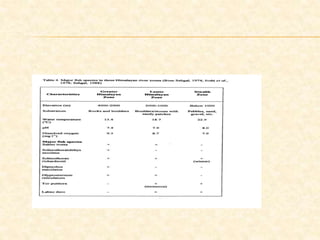
DISTRIBUTION IN THE INDIAN HIMALAYAS
 Depends on the flow rate, nature of substratum, water
temperature & availability of food
 Torrential streams-3 zones based on dominant species
& hydrological features (Sehgal,1988)
 1. Headwater zone: inhabited by rheophilic loaches &
catfishes – Nemacheilus gracilis, N.stoliczkae &
Glyptostemum reticulatum
CONTD…
2. Large stream zone: formed by the
joining of headwater streams,inhabited
by Diptychus maculatus & Nemacheilus
spp.
In the upper reaches of the most
torrential section of this zone inhabits
snow trouts – Schizothoraichthys
esocinus, S.progastus, Schizothorax
richardsonii & Schizopygopsis
stoliczkae
Intermediate reaches occupied by
CONTD...
 Least rapid reaches occupied by Garra
gotyla,Crossocheilus diplochilus,Labeo dero &
L.dyocheilus
 3. Slow moving meandering zone: inhabited by
a large number of cold & eurythermal species-
Barilius spp.,Tor spp.,catfishes,Homalopterid
fishes & snakeheads(Channa spp.)
CONTD…
• Menon(1954) recognised 6 major groups of
Himalayan fishes based on morphological
characteristics which enable them to inhabit
the torrential streams
• 1. dwelling in shallow,clear coldwater in
foothills without any striking modification to
current-Labeo spp., Tor spp., Barilius spp., &
Puntius spp.
• 2.inhabiting the bottom water layers in deep
fast current, with powerful muscular
cylindrical body –Schizothoracines &
introduced trouts
CONTD…
• 3. sheltering among pebbles & stone to ward off the
strong current- Crossocheilus diplocheilus
• 4. sheltering among pebbles & shingles in shallows
with special attachment devices – loaches,
Nemacheilus spp., Botia spp. & Amblyceps spp.
• 5. cling to exposed surfaces of bare rocks in lower
current with adhesive organs on the ventral side –
Garra, Glyptothorax,Glyptosternum
• 6. cling to exposed surfaces of bare rocks in fast
current, with limpet shaped bodies & mouth, gills, &
fins highly moified - Balitora
TEMPERATURE TOLERANCE
 Endemic Schizothoracines(Schizothoraichthys
esocinus & Diptychus maculatus) - cold
stenothermic
 Exotic Brown trout – upper tolerance 20°C.
 Carps, mahseers & lesser barils – tolerate over
25°C.
 Schizothoracines & brown trout – remain
active in near zero temperatures which
prevail in lesser & greater Himalayan streams
during December & January
MIGRATION
 Steep fall in temperature during winter months
 Schizothoracines migrate from head waters to
lower altitude & represent a sizeable part of the
catch in large rivers & their tributaries
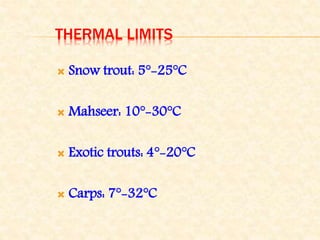
THERMAL LIMITS
 Snow trout: 5°-25°C
 Mahseer: 10°-30°C
 Exotic trouts: 4°-20°C
 Carps: 7°-32°C
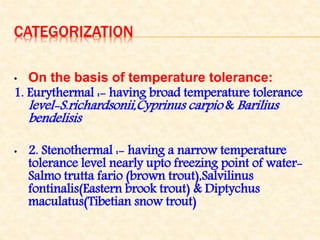
CATEGORIZATION
• On the basis of temperature tolerance:
1. Eurythermal :- having broad temperature tolerance
level-S.richardsonii,Cyprinus carpio & Barilius
bendelisis
• 2. Stenothermal :- having a narrow temperature
tolerance level nearly upto freezing point of water-
Salmo trutta fario (brown trout),Salvilinus
fontinalis(Eastern brook trout) & Diptychus
maculatus(Tibetian snow trout)
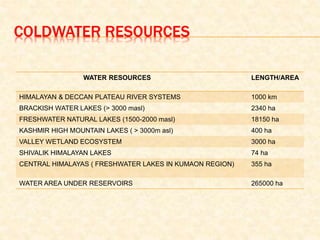
COLDWATER RESOURCES
WATER RESOURCES LENGTH/AREA
HIMALAYAN & DECCAN PLATEAU RIVER SYSTEMS 1000 km
BRACKISH WATER LAKES (> 3000 masl) 2340 ha
FRESHWATER NATURAL LAKES (1500-2000 masl) 18150 ha
KASHMIR HIGH MOUNTAIN LAKES ( > 3000m asl) 400 ha
VALLEY WETLAND ECOSYSTEM 3000 ha
SHIVALIK HIMALAYAN LAKES 74 ha
CENTRAL HIMALAYAS ( FRESHWATER LAKES IN KUMAON REGION) 355 ha
WATER AREA UNDER RESERVOIRS 265000 ha
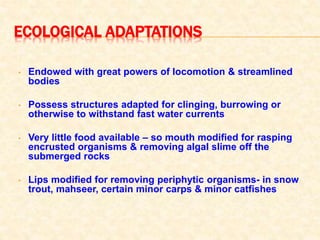
ECOLOGICAL ADAPTATIONS
• Endowed with great powers of locomotion & streamlined
bodies
• Possess structures adapted for clinging, burrowing or
otherwise to withstand fast water currents
• Very little food available – so mouth modified for rasping
encrusted organisms & removing algal slime off the
submerged rocks
• Lips modified for removing periphytic organisms- in snow
trout, mahseer, certain minor carps & minor catfishes
CONTD…
• not adapted for feeding in deep &
muddy waters
 Adapted to live in highly oxygenated
waters – so gill openings narrowed &
gills reduced – so cannot live in
waters poor in oxygen
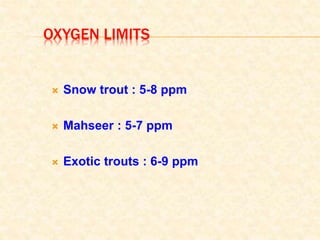
OXYGEN LIMITS
 Snow trout : 5-8 ppm
 Mahseer : 5-7 ppm
 Exotic trouts : 6-9 ppm
SPECIES DIVERSITY
 Indigenous + exotic – 258 species
spread over the Himalayas & the
Peninsular plateau
 21 families & 76 genera
 Vast & varied piscine diversity – tiny
loaches to mighty mahseers
 Known for sports,for food & for
ornamental value
SPORT FISHES
 Principal species of sport value in Kashmir,Himachal
Pradesh,Uttarakhand,North-Eastern states,Nilgiris,Kodai
hills & Munnar ranges:
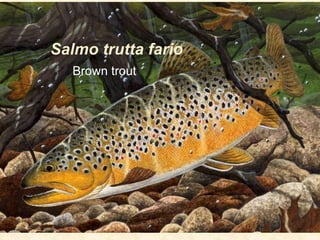
 Brown trout – Salmo trutta fario
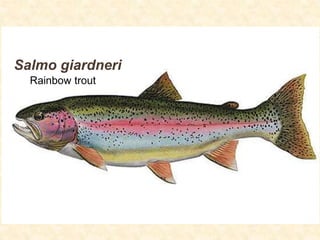
 Rainbow trout – Salmo giardneri
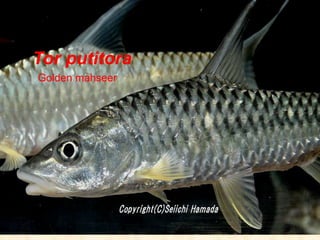
 Golden mahseer – Tor putitora
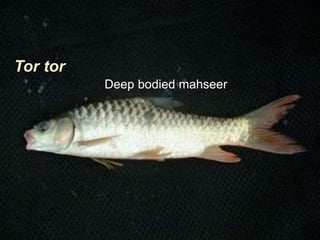
 Deep bodied mahseer – Tor tor
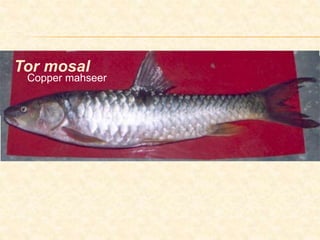
 Copper mahseer – Tor mosal
 Black mahseer – Naziritor chelynoides
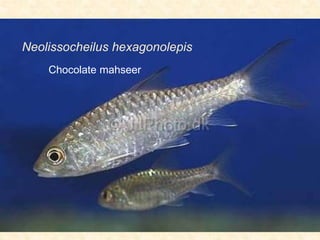
 Chocolate mahseer – Neolissocheilus hexagonolepis
Salmo trutta fario
Brown trout
Salmo giardneri
Rainbow trout
Tor putitora
Golden mahseer
Tor tor
Deep bodied mahseer
Tor mosal
Copper mahseer
Neolissocheilus hexagonolepis
Chocolate mahseer
FOOD FISHES
 Snowtrouts- schizothorax spp., Schizothoraichthys
spp. & Lepidopygopsis typus
 Tor spp., Common carp,& a few minor carps(L.dero &
L.dyocheilus)
 But contribution to commercial fisheries is low:
* slow growth & small size – fetch low price
* main gear – cast net –one man unit – so hardly any
community fishing
 Meagre transportation facilities
ORNAMENTAL FISHES
 Many colourful & fascinating species recognised
as ornamentals
 uplands of N-E Himalaya known as Repository of
Ornamental fish species
INDIGENOUS COLDWATER FISHES
 Mahseer ,Snow trout & Indian hill trout
 Important mahseers:
 Tor tor(Hamilton): head shorter than depth of
the body
 Attains a length of 1.5m
 Occurs along the foothills of Himalayas from
Kashmir to Assam & in R.Narmada & R.Tapti
 Prolonged breeding season
IMPACTS OF INTRODUCTION OF EXOTICS
 Schizothoracines losing ground in Dal lake in kashmir
due to highly fecund Common carp
 Both have identical feeding habits – feeding on
detritus and benthos
 Brown trouts also prey upon younger stages of
Schizothoracines
 Common carp & Silver carps introduced in
Gobindsagar & Pong reservoirs & in Dal & Kumaon
lakes now dominates the catches
FISHERIES
Divided into two:
1.Subsistence Fishery
2.Recreational Fishery
Commercial fishery is on a limited scale – low
fish production because of low biological
productivity
HIMALAYAS – 2 ZONES
 1. Rithron Zone
 2.Potamon Zone
RITHRON ZONE
 Monthly mean temperature: 17.3°C
 High concentration of DO: 10.1 mg/l
 Fast current: 0.9 – 1.8 m/s
 Turbulent water
 Rocky substratum with sand & silt patches
& some pools
 Stenothermic fishes – brown trout & snow
trout
POTAMON ZONE
 Higher mean water temperature: 22.1°C
 DO: 8 mg/l
 Current velocity: 0.5 - 0.7 m/s
 Subsratum – boulders, stones, gravel & patches of
aquatic vegetation
 Fish fauna is eurythermic/warm-stenothermic
SPORT & RECREATIONAL FISHERY
 Tor putitora,Tor tor & Salmo trutta
 Trout : in J&K,Himachal Pradesh and to a lesser in
the Central & East Himalayas
 Permitted to be caught in the rod & line using
both artificial & live baits
 Mahseer : Tor putitora,Tor tor, & Tor mosal
 Wide range distribution in the Himalayan rivers
MAHSEER FISHING
 5 principal ways for Mahseer fishing
 Fly fishing
 Spinning
 Live bait fishing
 Gram fishing
 Paste fishing
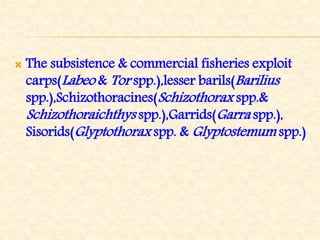
 The subsistence & commercial fisheries exploit
carps(Labeo & Tor spp.),lesser barils(Barilius
spp.),Schizothoracines(Schizothorax spp.&
Schizothoraichthys spp.),Garrids(Garra spp.),
Sisorids(Glyptothorax spp. & Glyptostemum spp.)
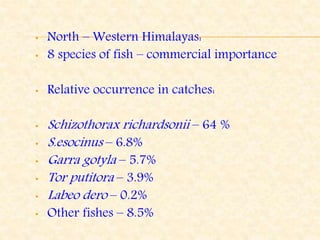
• North – Western Himalayas:
• 8 species of fish – commercial importance
• Relative occurrence in catches:
• Schizothorax richardsonii – 64 %
• S.esocinus – 6.8%
• Garra gotyla – 5.7%
• Tor putitora – 3.9%
• Labeo dero – 0.2%
• Other fishes – 8.5%
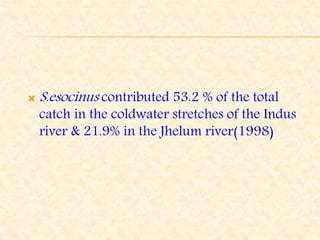
 S.esocinus contributed 53.2 % of the total
catch in the coldwater stretches of the Indus
river & 21.9% in the Jhelum river(1998)
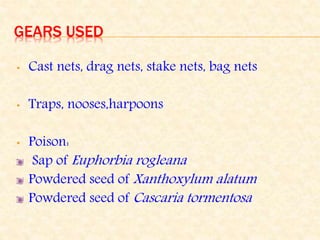
GEARS USED
• Cast nets, drag nets, stake nets, bag nets
• Traps, nooses,harpoons
• Poison:
Sap of Euphorbia rogleana
Powdered seed of Xanthoxylum alatum
Powdered seed of Cascaria tormentosa
LAKES
 Wular, Dal,Manasbal- situated in Kashmir valley
at an altitude of 1537-1587m asl
Schizothoracines: S.niger,S.micropogon,
S.curvirostris,S. planifrons,S.esocinus
Labeo dero,L.dyocheilus,C.latus,Puntius
conchonius,Glyptothorax kashmeriensis
 1959- Common carp –introduced in Kashmir to
augment fish production
• Kumaon lakes- Khurpatal, Nainital, Sattal,
Bhimtal & Naukuchiatal-in Uttar Pradesh
• Bhimtal – largest lake- 72 ha
• Naukuchiatal – deepest(40-80m)
• Except Khurpatal – infested with aquatic
macrophytes
• Nainital – polluted
• Silver carp & Grass carp – introduced in
Bhimtal lake in 1985-’86
• Lakes Zumsar & Gadsar have an endemic
Schizothoracine – Diptychus maculatus
RESERVOIRS
 Himachal pradesh – 3 reservoirs
Gobindsagar – Sutlej river at 560m(16867ha)
Pong – Beas river at 436m(24529ha)
Pandoh – Beas river 987m(200 ha)
GOBINDSAGAR RESERVOIR
• 1978 : Sutlej – Beas link completed : divert Beas
water into Gobindsagar to augment the power
generation & irrigation capacity of the reservoir
• Blending of cool Beas water & warmer Sutlej water
in the reservoir –unique pattern in thermal and
oxygen regime,& dissolved chemical components :
impact on biota
• Prior to dam construction, upper reaches of Sutlej
had 30 species of fish
 Dominant Species: Tor putitora,Labeo dero,
L.dyocheilus, Schizothorax & Aorichthys
seenghala
 1961-62: Gobindsagar stocked with IMCs
followed by a regular stocking of Common
carp
 1979 – appearance of silver carp & its
establishment - change in catch structure:
Silver carp dominated all other species
 Today, introduced Silver carp & Common carp
dominate the total catch
 Other commercially important species: Catla, Tor
putitora,L.rohita, Mrigal,L.calbasu, A.seenghala,
S.plagiostomus
 Total fish catch increasing but percentage
contribution of indigenous Tor putitora has been
decreasing
PONG RESERVOIR
Shallow water body with lower productivity than
Gobindsagar
Fish fauna dominated by catfishes,minor carps,etc
Stocking of Common carp & IMCs altered the catch
structure –
Rohu,A.seenghala,L.calbasu,T.putitora,Mrigal,W.att
u,Common carp,L.dero,Catla & Channa spp.
Maximum annual yield – 33.2kg/ha recorded in
1987-’88
IMPACT
Construction of Gobindsagar & Pong reservoirs –
perinneal source of fish supply for people of HP &
adjoining states
Certain species – adversly affected:
Tor putitora- no longer able to migrate to Kangra
valley due to dam at Pong
Luckly self-reproducing stocks were established
within the new limits
Schizothoracines were also seriously affected
PANDOH RESERVOIR
• Small, forms part of Beas – Sutlej link, diverting
Beas water to Sutlej basin
• Water temperature is cool, 16.5 - 10.5°C.
• Used for occassional recreation/sport fishing
• Brown trout,L.dero,L.dyocheilus,T.putitora,…
AQUACULTURE
 Very recent in origin,Still in developing stage
 Earlier restricted to Government farms/
hatcheries-to maintain some broodstocks for
annual seed production of Brown trout – to
maintain sport fishing population
EXOTIC SPECIES CULTURE
Effort for trout culture in uplands – initiated since
1863
Sir Francis Day (1863)–made an unsuccessful
attempt to introduce eyed eggs & fry of Brown
trout & Lock-leven trout in the Nilgiri hills
Mr. F.T.Michell (1900)– succeeed in introuction
of eyed eggs of Brown trout in the Harwan
hatchery in J&K
RAINBOW TROUT
Has better growth & maximum cultivable traits
amongst coldwater species
But farming needs high investment- pond
construction,procurement of
seed,feed,maintenance of fish health & quality
water requirement
Rearing & breeding – in trout farms at Kokernag
in J&K and Patlikuhl in HP
BROWN TROUT
Methodology for reduction in mortality at
different stages- ova,alevin,fry & fingerling
Percentage survival raised to 80% from 20%
between green egg to early fry stage
TROUT PRODUCTION
25 trout hatcheries - 1.5-2.0 million trout seeds per
year-for farm rearing & stocking in streams for
angling
Maximum from J&K and HP
current prduction of rainbow trout: 300-5OO T
potential to increase many folds if:
The losses from disease can be controlled
Other financial assistance including management
support,marketing facility & processing is extended to
hill states
CARPS
3 strains of exotic carps:
Cyprinus carpio var. communis – scale carp
Cyprinus carpio var. nudus – leather carp
Cyprinus carpio var. specularis – mirror carp
Introduced in the Himalayan lakes to provide faster
growing fish in hills
MONOCULTURE OF EXOTIC CARPS
 In village ponds of Kashmir
 Using kitchen refuse & other runoff from the
village as a source of input
MIXED CULTURE
IMCs do not grow well in uplands, so Chinese
carps have been taken as candidate species
Feasible fish farming techniques for hill region by
DCFR(NRCCWF)
Polyculture including Common carp,Silver carp
& Grass carp – 2 or 3-4 fish/m².
INDUCED BREEDING
DCFR has succeeded in induced breeding of
Silver carp & Grass carp at high altitudes at
1600m asl
6-7 years to mature in high altitudes
Advanced maturity by hormonal feeding of brood
stock
Bred by injecting Ovaprim @ 1.3-1.6 ml/kg in 2-
3 doses during 14-16 hours at 22- 23°C.
Helps seed production during suitable growing
period(April-October)
INDIGENOUS SPECIES CULTURE
• Different species of: snow trouts (Schizothoraichthys esocinus,
S.progastus , Schizothorax richardsonii, S. niger and S. curvifrons)
• mahseers (Tor putitora and Tor tor)
• Tor putitora, S. progastus and S. richardsonii are
preferred-wide range of distribution in the Himalayas
• Anthropogenic & environmental stresses- decline in
fishery
• Succeeded in artificial propogation – to restore fishery
• Pure healthy seeds of Schizothoraichthys
niger,S.esocinus,S.micropogon & S.richardsonii
DEVELOPMENT ISSUES
 J&K and HP – significant progress in capture
fisheries – sport fishery & aquaculture
 North-Eastern states – development is in very low
level
 Arunachal Pradesh & Sikkim has gained some
momentum
 Cold water fishery contribute to food & nutrition
in hill regions
 So need due importance in terms of finance
infrastructure & modern institutional backup
facilities
POSSIBLE MEASURES FOR FISHERIES
DEVELOPMENT
Horizontal & vertical expansion of fish culture
activities:suitable water bodies should be
identified & brought under any one of the three
pronged farming practices-
 1. Trout farming :-suitable above 1500m asl at
4-20°C
 2.Polyculture:- 700-1500m asl ,Chinese carps
 3.eco-climatic conditions below 500m asl-
composite culture of IMCs & Chinese carps
CONTD…
 paddy cum fish culture: initiated in Arunachal &
Manipur need to be expanded to other hills also
Production enhancement in lentic systems:
 By intensive culture practices- rational stocking &
harvesting,cage & pen culture based on
autochthonus productivity of water body
Development of ornamental fishery:
 N.E hills – number of ornamental fish species
 Collection,breeding & rearing – provide lucrative
profession
CONSERVATION & MANAGEMENT
• Increased use of river water for irrigation,
hydropower production,municipal & industrial
purpose & inputs of pollutants- affects fish
stocks
• Stock enhancement – by regular releases of
hatchery produced fingerlings
• Better estimates of carrying capacity-better
regulation of recreational fishing,stocking rates
can also be determined
CONTD…
 Increased demand for trout fishing in
Himalayas – authorities enforced a reduction
in bag limit & closed certain streams
 Study on recapture of tagged fish – needed to
estimate the percentage return of stocked fish
 Need to improve infrastructure for
recreational fishing – attract more tourists
 In Kashmir 273km of streams available for
trout fishing,HP- 184km,UP- 150km
FUTURE PERSPECTIVES
Now at 4% growth in farming, production of
brown trout is 150 T – can be increased to
200T
Domestic demand is 800T – so steps must be
taken to increase production
Further promote feed industry & preservation
units at high altitudes
Also short & long duration transportation of
trouts will come into operation
CONTD..
Establishment of carp hatcheries in lower
altitudes – to meet the demand of local farmers
Tremendous potential for running water fish
culture based on exotic carps- should be
encouraged by providing knowhow & seed to
farmers
Contd…
Approach for overall fisheries development:
Expansion of fish culture activities in all potential
areas
Integrated aquaculture
Stock diversification
Implementation of suitable production
enhancement measures in lakes & reservoirs
Development of ornamental fishery
Promotion of fishery based eco-tourism at suitable
states
PENINSULAR INDIA
 Western ghats
 Aravali range
 Vindhya mountain
 Satpura mountain
WESTERN GHATS
Western ghat area
Three major drainage system.
Rivers and streams do not show zonetion of
water parameter.
102 Fish species found in Western Ghats area
Various spp of cyprinidae are dominant
Exotic varity of spp are also found
SPECIES DIVERSITY
 Cyprinids : Labeo spp.,Cirrhinus spp.,Puntius
spp. & Tor spp.
 Endemic mahseers: T.khudree & T.mussullah
 Exotics : C.carpio,C.carassius,Tinca tinca,
O.mosambicus & S.giardneri
SEED PRODUCTION
 Since 1970 the Tata Electric Companies (TEC)
fish seed farm at Lonavla, Maharashtra.
 1970s- both T. khudree a nd T. tor were
successfully bred using hypophysation
 Successful artificial breeding of Tor putitora,
a Himalayan species, was achieved in the
same fish farm in 1995 and 1996
 "Rehabilitation and Development of Mahseer
Fishery in the Rivers and Reservoirs of Western
Ghats“- project of the Department of Fisheries,
Karnataka-1987
 Indian trout (Raiamas bola) -have excellent potential
to become a sport fish in streams & rivers of the
Western Ghats where mahseer is not common
 Subsistence fishery based on the captured of medium-
sized fish, Barilius gatensis, Puntius carnaticus
, P.sarana, Labeo spp. , Cirrhinus fulungee
,Crossocheilus latius, Garra spp.,Mystus
malabaricus, M. vittatus, Xenentodon cancila, Channa
gachua & Mastacembelus armatus
LAKES
 Ooty (2500 m altitude, 34.0 ha) in Nilgiris
 the Kodaikanal (2285 m, 26 ha)
 the Berijam in the Palni Hills
 All 3 situated in the state of Tamil Nadu
 Two smaller lakes, the Devicolam (6.0 ha) and
the Letchmi Elephant (2.0 ha) are in the
Munnar High Range
 Lake Yercaud (1340 m, 8 ha) in Shevaroy
Hills
.
COMMON SPECIES
 Danio spp, Rasbora daniconius , Gambusia
affinis, rainbow trout and common carp
RESERVOIRS
 Lonavla & Walwahn-Maharashtra
 V.V. Sagar, K.R. Sagar & Tungabhadra -
Malnad area of Karnataka
 Mettur, Upper Bhawani, Mukurti, Parson's
Valley, Avalanche, Emarold, Pykara,
Sandynulla & Glenmorgan - Tamil Nadu
 Kundallay & Maddupatty -High Range of
Kerala.
 Lonavla, Walwahn, Upper Bhawani, Mukurti,
Parson's Valley, Avalanche, Emarold, Pykara,
Sandynulla, Glenmorgan, Kundally & Madupatty-
important for their commercial & sport fisheries
for trout, mahseer & common carp
AQUACULTURE
• Introduction and development of aquaculture of
trout in Munnar High Range, Kerala, attemped in
1909 with the importation of eyed eggs of brown
trout(not succeed)
• preference was switched over to the rainbow
brought in from Sri Lanka
• by 1941 a trout farm was established at
Eravikolam, followed one at Rajamallay
• More recently, these hatcheries in High Range
were taken over by the Tata Tea Company.
 aquaculture of mahseer (Tor khudree) –in
Lonavla in a privately owned hatchery of the
Tata Electric Companies
 brood stock is collected from the Walwahn
reservoirs during July-August using gill nets
 main objective of the aquaculture of rainbow
trout in the Western Ghats- to meet the
requirements of the sport and recreational
fishery
INTRODUCTION OF EXOTICS
 Trout in Nilgiris: first attempt to transplant
trout in Tamilnadu, India
 Sir Francis Day – 2 attempts to introduce
Brown trout in 1863 & 1866 – unsuccessful
 1906 – Wilson succeeded in transplanting &
culture in a scientific manner
 Mirror carp introduced in 1939 in Niligiri
from Ceylon .
• Trout in Kodai hills: first in Kodaikanal lake in 1894 – but
unsuccessful
• 1943 – Freeman transplanted fingerlings of Rainbow trout
from Munnar High Range Angling Association
• Tench introduced in 1874 Ooty lake from England by Mac
• Carrassius sp was introduced in 1874 from Central America
in Ooty lake
 Trout in Kashmir: first attempt in 1900- brown trout but
unsuccessful.
 Mr. F.T.Michell (1900)– succeeed in introuction of eyed eggs
of Brown trout in the Harwan hatchery in J&K
 5 species of trouts & salmons introduced in Kashmir –
Brown,Rainbow,Eastern brook,the Splake(hybrid of Lake trout
& Brook trout) & the Sebago salmon
 Brown & Rainbow trouts acclimatized well both in streams &
farms
 Eastern Brook trout – low fecundity & viability of fertilized
eggs – hinder its spread
 Trout in HP : first attempted in 1909-brown
trout itroduced in beas rver in kullu velly.
 Rainbow trout from Kashmir in 1919
 Culture abandoned due to susceptibility to
infections
 Trout in Kumaon Himalayas: 1910, trout
spp
 Do not prove success because of high
summer temperatures
TROUT HATCHERIES
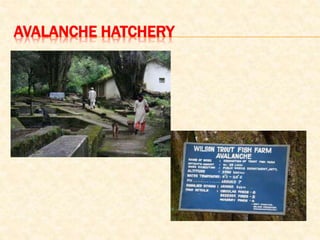
 Avalanche Hatchery: at an altitude of 2280m
 First to built in the country
 7 stocking ponds, 20 uncemented nurseries
 Water supply from near by stream
 Stripping season: September to February
 Survival from green egg to fry: 16.91-67.44%
AVALANCHE HATCHERY
 Rajamallay Hatchery: small, at an altitude of
2295m asl
 4 nursery & 6 stocking ponds
 Stripping season: October - January
 Hatcheries at Achhabal, Laribal & Harwan:
 In Kashmir
 Achhabal- water supply from a spring, Laribal
& Harwan from streams
 Achhabal – one of the largest & biggest in the
state
 Stripping season: Mid-November to end-
December
contd…
 Barrot Hatchery:
 At an altitude of 2068m in HP
 water supply from a spring
 Stripping season same as in Kashmir: Mid-
November to end December
Contd…
 Kulu Hatcheries:
 Mahili & Patlikuhl
 At an altitude of 1462m
 Fed by streams
 Hatching troughs have individual water
supply
CONSERVATION & MANAGEMENT
 Conserving the spawning ground of trout
 Studying the carrying capacity of trout streams
to make sport fishery attactive
 Conserving masheers and snowtrouts to save
them from extinction
 Improving existence trout hatchery
 Evolving dry, compound pelleted feeds for trout.
CONTD..
• Improving existance stock of brown and
rainbow trouts to produce healthy disease
resistance stock.
• Increasing selectivity of fast growing rainbow
trout strains to increase trout production on
commercial lines.
• Establishing farms and hatcheries for extensive
production of mahaseer and snow trout.
CONTD…
 Regulations for trout fishing need to be revised-
to ensure a high and sustained fish yield to
anglers
 finances and manpower should be made
available- for better management
 protection of spawning fish from poachers and
of spawning beds
REFERENCES
• Cold water fisheries of India: V.G.Jhingran &
K.L.Sehgal
• http://www.ct.gov/dep/lib/dep/water/water_quality
_management/monitoringpubs/coldwater.pdf
• Fish & fisheries of India: V.G.Jhingran
• Twenty five years of research on coldwater
fisheries in India: K.L.Sehgal
• Handbook of fisheries & aquaculture: ICAR
2011
• http://www.fao.org
• http://agritech.tnau.ac.in
THANK YOU

Coldwater fisheries ppt

  • 1.
  • 2.
    INTRODUCTION  High Oxygen Low Carbon dioxide  Inorganic soil  Sparse vegetation and food  Low fertility & high transparency
  • 3.
    CONTD…  High &mid-latitude lakes,rivers,streams,their tributaries & reservoirs dammed across such rivers  Located 914m above msl  Temperature : 0°-20°C  IMCs do not survive
  • 4.
     Contribute lessto total inland fish production  but comprise unique biodiversity with valuable indigenous germplasm & maintain environmental quality in hills  Trouts & salmons are the only exotic game fishes introduced
  • 5.
    • Coldwater species– in Himalayas & Peninsular hill ranges • Maintain relatively low temperatures & supports low productivity • Waters of temperature within the tolerance of trouts of family Salmonidae are termed cold • 0°-20°C, optimum 10°-12°C
  • 6.
    DISTRIBUTION  258 speciesspread over the Himalayas & the Peninsular Plateau  Belong to 21 families & 76 genera
  • 7.
    CHARACTERISTIC OF COLDWATER STREAM  V-shaped valley  High gradient  Clean water  Rocky and gravelly bottom  Little organic matter and cool temperature.
  • 8.
    DISTRIBUTION IN THEINDIAN HIMALAYAS  Depends on the flow rate, nature of substratum, water temperature & availability of food  Torrential streams-3 zones based on dominant species & hydrological features (Sehgal,1988)  1. Headwater zone: inhabited by rheophilic loaches & catfishes – Nemacheilus gracilis, N.stoliczkae & Glyptostemum reticulatum
  • 9.
    CONTD… 2. Large streamzone: formed by the joining of headwater streams,inhabited by Diptychus maculatus & Nemacheilus spp. In the upper reaches of the most torrential section of this zone inhabits snow trouts – Schizothoraichthys esocinus, S.progastus, Schizothorax richardsonii & Schizopygopsis stoliczkae Intermediate reaches occupied by
  • 10.
    CONTD...  Least rapidreaches occupied by Garra gotyla,Crossocheilus diplochilus,Labeo dero & L.dyocheilus  3. Slow moving meandering zone: inhabited by a large number of cold & eurythermal species- Barilius spp.,Tor spp.,catfishes,Homalopterid fishes & snakeheads(Channa spp.)
  • 12.
    CONTD… • Menon(1954) recognised6 major groups of Himalayan fishes based on morphological characteristics which enable them to inhabit the torrential streams • 1. dwelling in shallow,clear coldwater in foothills without any striking modification to current-Labeo spp., Tor spp., Barilius spp., & Puntius spp. • 2.inhabiting the bottom water layers in deep fast current, with powerful muscular cylindrical body –Schizothoracines & introduced trouts
  • 13.
    CONTD… • 3. shelteringamong pebbles & stone to ward off the strong current- Crossocheilus diplocheilus • 4. sheltering among pebbles & shingles in shallows with special attachment devices – loaches, Nemacheilus spp., Botia spp. & Amblyceps spp. • 5. cling to exposed surfaces of bare rocks in lower current with adhesive organs on the ventral side – Garra, Glyptothorax,Glyptosternum • 6. cling to exposed surfaces of bare rocks in fast current, with limpet shaped bodies & mouth, gills, & fins highly moified - Balitora
  • 14.
    TEMPERATURE TOLERANCE  EndemicSchizothoracines(Schizothoraichthys esocinus & Diptychus maculatus) - cold stenothermic  Exotic Brown trout – upper tolerance 20°C.  Carps, mahseers & lesser barils – tolerate over 25°C.  Schizothoracines & brown trout – remain active in near zero temperatures which prevail in lesser & greater Himalayan streams during December & January
  • 15.
    MIGRATION  Steep fallin temperature during winter months  Schizothoracines migrate from head waters to lower altitude & represent a sizeable part of the catch in large rivers & their tributaries
  • 16.
    THERMAL LIMITS  Snowtrout: 5°-25°C  Mahseer: 10°-30°C  Exotic trouts: 4°-20°C  Carps: 7°-32°C
  • 17.
    CATEGORIZATION • On thebasis of temperature tolerance: 1. Eurythermal :- having broad temperature tolerance level-S.richardsonii,Cyprinus carpio & Barilius bendelisis • 2. Stenothermal :- having a narrow temperature tolerance level nearly upto freezing point of water- Salmo trutta fario (brown trout),Salvilinus fontinalis(Eastern brook trout) & Diptychus maculatus(Tibetian snow trout)
  • 18.
    COLDWATER RESOURCES WATER RESOURCESLENGTH/AREA HIMALAYAN & DECCAN PLATEAU RIVER SYSTEMS 1000 km BRACKISH WATER LAKES (> 3000 masl) 2340 ha FRESHWATER NATURAL LAKES (1500-2000 masl) 18150 ha KASHMIR HIGH MOUNTAIN LAKES ( > 3000m asl) 400 ha VALLEY WETLAND ECOSYSTEM 3000 ha SHIVALIK HIMALAYAN LAKES 74 ha CENTRAL HIMALAYAS ( FRESHWATER LAKES IN KUMAON REGION) 355 ha WATER AREA UNDER RESERVOIRS 265000 ha
  • 19.
    ECOLOGICAL ADAPTATIONS • Endowedwith great powers of locomotion & streamlined bodies • Possess structures adapted for clinging, burrowing or otherwise to withstand fast water currents • Very little food available – so mouth modified for rasping encrusted organisms & removing algal slime off the submerged rocks • Lips modified for removing periphytic organisms- in snow trout, mahseer, certain minor carps & minor catfishes
  • 20.
    CONTD… • not adaptedfor feeding in deep & muddy waters  Adapted to live in highly oxygenated waters – so gill openings narrowed & gills reduced – so cannot live in waters poor in oxygen
  • 21.
    OXYGEN LIMITS  Snowtrout : 5-8 ppm  Mahseer : 5-7 ppm  Exotic trouts : 6-9 ppm
  • 22.
    SPECIES DIVERSITY  Indigenous+ exotic – 258 species spread over the Himalayas & the Peninsular plateau  21 families & 76 genera  Vast & varied piscine diversity – tiny loaches to mighty mahseers  Known for sports,for food & for ornamental value
  • 23.
    SPORT FISHES  Principalspecies of sport value in Kashmir,Himachal Pradesh,Uttarakhand,North-Eastern states,Nilgiris,Kodai hills & Munnar ranges:  Brown trout – Salmo trutta fario  Rainbow trout – Salmo giardneri  Golden mahseer – Tor putitora  Deep bodied mahseer – Tor tor  Copper mahseer – Tor mosal  Black mahseer – Naziritor chelynoides  Chocolate mahseer – Neolissocheilus hexagonolepis
  • 24.
  • 25.
  • 26.
  • 27.
  • 28.
  • 29.
  • 30.
    FOOD FISHES  Snowtrouts-schizothorax spp., Schizothoraichthys spp. & Lepidopygopsis typus  Tor spp., Common carp,& a few minor carps(L.dero & L.dyocheilus)  But contribution to commercial fisheries is low: * slow growth & small size – fetch low price * main gear – cast net –one man unit – so hardly any community fishing  Meagre transportation facilities
  • 31.
    ORNAMENTAL FISHES  Manycolourful & fascinating species recognised as ornamentals  uplands of N-E Himalaya known as Repository of Ornamental fish species
  • 32.
    INDIGENOUS COLDWATER FISHES Mahseer ,Snow trout & Indian hill trout  Important mahseers:  Tor tor(Hamilton): head shorter than depth of the body  Attains a length of 1.5m  Occurs along the foothills of Himalayas from Kashmir to Assam & in R.Narmada & R.Tapti  Prolonged breeding season
  • 33.
    IMPACTS OF INTRODUCTIONOF EXOTICS  Schizothoracines losing ground in Dal lake in kashmir due to highly fecund Common carp  Both have identical feeding habits – feeding on detritus and benthos  Brown trouts also prey upon younger stages of Schizothoracines  Common carp & Silver carps introduced in Gobindsagar & Pong reservoirs & in Dal & Kumaon lakes now dominates the catches
  • 34.
    FISHERIES Divided into two: 1.SubsistenceFishery 2.Recreational Fishery Commercial fishery is on a limited scale – low fish production because of low biological productivity
  • 35.
    HIMALAYAS – 2ZONES  1. Rithron Zone  2.Potamon Zone
  • 36.
    RITHRON ZONE  Monthlymean temperature: 17.3°C  High concentration of DO: 10.1 mg/l  Fast current: 0.9 – 1.8 m/s  Turbulent water  Rocky substratum with sand & silt patches & some pools  Stenothermic fishes – brown trout & snow trout
  • 37.
    POTAMON ZONE  Highermean water temperature: 22.1°C  DO: 8 mg/l  Current velocity: 0.5 - 0.7 m/s  Subsratum – boulders, stones, gravel & patches of aquatic vegetation  Fish fauna is eurythermic/warm-stenothermic
  • 38.
    SPORT & RECREATIONALFISHERY  Tor putitora,Tor tor & Salmo trutta  Trout : in J&K,Himachal Pradesh and to a lesser in the Central & East Himalayas  Permitted to be caught in the rod & line using both artificial & live baits  Mahseer : Tor putitora,Tor tor, & Tor mosal  Wide range distribution in the Himalayan rivers
  • 39.
    MAHSEER FISHING  5principal ways for Mahseer fishing  Fly fishing  Spinning  Live bait fishing  Gram fishing  Paste fishing
  • 40.
     The subsistence& commercial fisheries exploit carps(Labeo & Tor spp.),lesser barils(Barilius spp.),Schizothoracines(Schizothorax spp.& Schizothoraichthys spp.),Garrids(Garra spp.), Sisorids(Glyptothorax spp. & Glyptostemum spp.)
  • 41.
    • North –Western Himalayas: • 8 species of fish – commercial importance • Relative occurrence in catches: • Schizothorax richardsonii – 64 % • S.esocinus – 6.8% • Garra gotyla – 5.7% • Tor putitora – 3.9% • Labeo dero – 0.2% • Other fishes – 8.5%
  • 42.
     S.esocinus contributed53.2 % of the total catch in the coldwater stretches of the Indus river & 21.9% in the Jhelum river(1998)
  • 43.
    GEARS USED • Castnets, drag nets, stake nets, bag nets • Traps, nooses,harpoons • Poison: Sap of Euphorbia rogleana Powdered seed of Xanthoxylum alatum Powdered seed of Cascaria tormentosa
  • 44.
    LAKES  Wular, Dal,Manasbal-situated in Kashmir valley at an altitude of 1537-1587m asl Schizothoracines: S.niger,S.micropogon, S.curvirostris,S. planifrons,S.esocinus Labeo dero,L.dyocheilus,C.latus,Puntius conchonius,Glyptothorax kashmeriensis  1959- Common carp –introduced in Kashmir to augment fish production
  • 45.
    • Kumaon lakes-Khurpatal, Nainital, Sattal, Bhimtal & Naukuchiatal-in Uttar Pradesh • Bhimtal – largest lake- 72 ha • Naukuchiatal – deepest(40-80m) • Except Khurpatal – infested with aquatic macrophytes • Nainital – polluted • Silver carp & Grass carp – introduced in Bhimtal lake in 1985-’86 • Lakes Zumsar & Gadsar have an endemic Schizothoracine – Diptychus maculatus
  • 46.
    RESERVOIRS  Himachal pradesh– 3 reservoirs Gobindsagar – Sutlej river at 560m(16867ha) Pong – Beas river at 436m(24529ha) Pandoh – Beas river 987m(200 ha)
  • 47.
    GOBINDSAGAR RESERVOIR • 1978: Sutlej – Beas link completed : divert Beas water into Gobindsagar to augment the power generation & irrigation capacity of the reservoir • Blending of cool Beas water & warmer Sutlej water in the reservoir –unique pattern in thermal and oxygen regime,& dissolved chemical components : impact on biota • Prior to dam construction, upper reaches of Sutlej had 30 species of fish
  • 48.
     Dominant Species:Tor putitora,Labeo dero, L.dyocheilus, Schizothorax & Aorichthys seenghala  1961-62: Gobindsagar stocked with IMCs followed by a regular stocking of Common carp  1979 – appearance of silver carp & its establishment - change in catch structure: Silver carp dominated all other species  Today, introduced Silver carp & Common carp dominate the total catch
  • 49.
     Other commerciallyimportant species: Catla, Tor putitora,L.rohita, Mrigal,L.calbasu, A.seenghala, S.plagiostomus  Total fish catch increasing but percentage contribution of indigenous Tor putitora has been decreasing
  • 50.
    PONG RESERVOIR Shallow waterbody with lower productivity than Gobindsagar Fish fauna dominated by catfishes,minor carps,etc Stocking of Common carp & IMCs altered the catch structure – Rohu,A.seenghala,L.calbasu,T.putitora,Mrigal,W.att u,Common carp,L.dero,Catla & Channa spp. Maximum annual yield – 33.2kg/ha recorded in 1987-’88
  • 51.
    IMPACT Construction of Gobindsagar& Pong reservoirs – perinneal source of fish supply for people of HP & adjoining states Certain species – adversly affected: Tor putitora- no longer able to migrate to Kangra valley due to dam at Pong Luckly self-reproducing stocks were established within the new limits Schizothoracines were also seriously affected
  • 52.
    PANDOH RESERVOIR • Small,forms part of Beas – Sutlej link, diverting Beas water to Sutlej basin • Water temperature is cool, 16.5 - 10.5°C. • Used for occassional recreation/sport fishing • Brown trout,L.dero,L.dyocheilus,T.putitora,…
  • 53.
    AQUACULTURE  Very recentin origin,Still in developing stage  Earlier restricted to Government farms/ hatcheries-to maintain some broodstocks for annual seed production of Brown trout – to maintain sport fishing population
  • 54.
    EXOTIC SPECIES CULTURE Effortfor trout culture in uplands – initiated since 1863 Sir Francis Day (1863)–made an unsuccessful attempt to introduce eyed eggs & fry of Brown trout & Lock-leven trout in the Nilgiri hills Mr. F.T.Michell (1900)– succeeed in introuction of eyed eggs of Brown trout in the Harwan hatchery in J&K
  • 55.
    RAINBOW TROUT Has bettergrowth & maximum cultivable traits amongst coldwater species But farming needs high investment- pond construction,procurement of seed,feed,maintenance of fish health & quality water requirement Rearing & breeding – in trout farms at Kokernag in J&K and Patlikuhl in HP
  • 56.
    BROWN TROUT Methodology forreduction in mortality at different stages- ova,alevin,fry & fingerling Percentage survival raised to 80% from 20% between green egg to early fry stage
  • 57.
    TROUT PRODUCTION 25 trouthatcheries - 1.5-2.0 million trout seeds per year-for farm rearing & stocking in streams for angling Maximum from J&K and HP current prduction of rainbow trout: 300-5OO T potential to increase many folds if: The losses from disease can be controlled Other financial assistance including management support,marketing facility & processing is extended to hill states
  • 58.
    CARPS 3 strains ofexotic carps: Cyprinus carpio var. communis – scale carp Cyprinus carpio var. nudus – leather carp Cyprinus carpio var. specularis – mirror carp Introduced in the Himalayan lakes to provide faster growing fish in hills
  • 59.
    MONOCULTURE OF EXOTICCARPS  In village ponds of Kashmir  Using kitchen refuse & other runoff from the village as a source of input
  • 60.
    MIXED CULTURE IMCs donot grow well in uplands, so Chinese carps have been taken as candidate species Feasible fish farming techniques for hill region by DCFR(NRCCWF) Polyculture including Common carp,Silver carp & Grass carp – 2 or 3-4 fish/m².
  • 61.
    INDUCED BREEDING DCFR hassucceeded in induced breeding of Silver carp & Grass carp at high altitudes at 1600m asl 6-7 years to mature in high altitudes Advanced maturity by hormonal feeding of brood stock Bred by injecting Ovaprim @ 1.3-1.6 ml/kg in 2- 3 doses during 14-16 hours at 22- 23°C. Helps seed production during suitable growing period(April-October)
  • 62.
    INDIGENOUS SPECIES CULTURE •Different species of: snow trouts (Schizothoraichthys esocinus, S.progastus , Schizothorax richardsonii, S. niger and S. curvifrons) • mahseers (Tor putitora and Tor tor) • Tor putitora, S. progastus and S. richardsonii are preferred-wide range of distribution in the Himalayas • Anthropogenic & environmental stresses- decline in fishery • Succeeded in artificial propogation – to restore fishery • Pure healthy seeds of Schizothoraichthys niger,S.esocinus,S.micropogon & S.richardsonii
  • 63.
    DEVELOPMENT ISSUES  J&Kand HP – significant progress in capture fisheries – sport fishery & aquaculture  North-Eastern states – development is in very low level  Arunachal Pradesh & Sikkim has gained some momentum  Cold water fishery contribute to food & nutrition in hill regions  So need due importance in terms of finance infrastructure & modern institutional backup facilities
  • 64.
    POSSIBLE MEASURES FORFISHERIES DEVELOPMENT Horizontal & vertical expansion of fish culture activities:suitable water bodies should be identified & brought under any one of the three pronged farming practices-  1. Trout farming :-suitable above 1500m asl at 4-20°C  2.Polyculture:- 700-1500m asl ,Chinese carps  3.eco-climatic conditions below 500m asl- composite culture of IMCs & Chinese carps
  • 65.
    CONTD…  paddy cumfish culture: initiated in Arunachal & Manipur need to be expanded to other hills also Production enhancement in lentic systems:  By intensive culture practices- rational stocking & harvesting,cage & pen culture based on autochthonus productivity of water body Development of ornamental fishery:  N.E hills – number of ornamental fish species  Collection,breeding & rearing – provide lucrative profession
  • 66.
    CONSERVATION & MANAGEMENT •Increased use of river water for irrigation, hydropower production,municipal & industrial purpose & inputs of pollutants- affects fish stocks • Stock enhancement – by regular releases of hatchery produced fingerlings • Better estimates of carrying capacity-better regulation of recreational fishing,stocking rates can also be determined
  • 67.
    CONTD…  Increased demandfor trout fishing in Himalayas – authorities enforced a reduction in bag limit & closed certain streams  Study on recapture of tagged fish – needed to estimate the percentage return of stocked fish  Need to improve infrastructure for recreational fishing – attract more tourists  In Kashmir 273km of streams available for trout fishing,HP- 184km,UP- 150km
  • 68.
    FUTURE PERSPECTIVES Now at4% growth in farming, production of brown trout is 150 T – can be increased to 200T Domestic demand is 800T – so steps must be taken to increase production Further promote feed industry & preservation units at high altitudes Also short & long duration transportation of trouts will come into operation
  • 69.
    CONTD.. Establishment of carphatcheries in lower altitudes – to meet the demand of local farmers Tremendous potential for running water fish culture based on exotic carps- should be encouraged by providing knowhow & seed to farmers
  • 70.
    Contd… Approach for overallfisheries development: Expansion of fish culture activities in all potential areas Integrated aquaculture Stock diversification Implementation of suitable production enhancement measures in lakes & reservoirs Development of ornamental fishery Promotion of fishery based eco-tourism at suitable states
  • 71.
    PENINSULAR INDIA  Westernghats  Aravali range  Vindhya mountain  Satpura mountain
  • 72.
    WESTERN GHATS Western ghatarea Three major drainage system. Rivers and streams do not show zonetion of water parameter. 102 Fish species found in Western Ghats area Various spp of cyprinidae are dominant Exotic varity of spp are also found
  • 73.
    SPECIES DIVERSITY  Cyprinids: Labeo spp.,Cirrhinus spp.,Puntius spp. & Tor spp.  Endemic mahseers: T.khudree & T.mussullah  Exotics : C.carpio,C.carassius,Tinca tinca, O.mosambicus & S.giardneri
  • 74.
    SEED PRODUCTION  Since1970 the Tata Electric Companies (TEC) fish seed farm at Lonavla, Maharashtra.  1970s- both T. khudree a nd T. tor were successfully bred using hypophysation  Successful artificial breeding of Tor putitora, a Himalayan species, was achieved in the same fish farm in 1995 and 1996
  • 75.
     "Rehabilitation andDevelopment of Mahseer Fishery in the Rivers and Reservoirs of Western Ghats“- project of the Department of Fisheries, Karnataka-1987
  • 76.
     Indian trout(Raiamas bola) -have excellent potential to become a sport fish in streams & rivers of the Western Ghats where mahseer is not common  Subsistence fishery based on the captured of medium- sized fish, Barilius gatensis, Puntius carnaticus , P.sarana, Labeo spp. , Cirrhinus fulungee ,Crossocheilus latius, Garra spp.,Mystus malabaricus, M. vittatus, Xenentodon cancila, Channa gachua & Mastacembelus armatus
  • 77.
    LAKES  Ooty (2500m altitude, 34.0 ha) in Nilgiris  the Kodaikanal (2285 m, 26 ha)  the Berijam in the Palni Hills  All 3 situated in the state of Tamil Nadu  Two smaller lakes, the Devicolam (6.0 ha) and the Letchmi Elephant (2.0 ha) are in the Munnar High Range  Lake Yercaud (1340 m, 8 ha) in Shevaroy Hills .
  • 78.
    COMMON SPECIES  Daniospp, Rasbora daniconius , Gambusia affinis, rainbow trout and common carp
  • 79.
    RESERVOIRS  Lonavla &Walwahn-Maharashtra  V.V. Sagar, K.R. Sagar & Tungabhadra - Malnad area of Karnataka  Mettur, Upper Bhawani, Mukurti, Parson's Valley, Avalanche, Emarold, Pykara, Sandynulla & Glenmorgan - Tamil Nadu  Kundallay & Maddupatty -High Range of Kerala.
  • 80.
     Lonavla, Walwahn,Upper Bhawani, Mukurti, Parson's Valley, Avalanche, Emarold, Pykara, Sandynulla, Glenmorgan, Kundally & Madupatty- important for their commercial & sport fisheries for trout, mahseer & common carp
  • 81.
    AQUACULTURE • Introduction anddevelopment of aquaculture of trout in Munnar High Range, Kerala, attemped in 1909 with the importation of eyed eggs of brown trout(not succeed) • preference was switched over to the rainbow brought in from Sri Lanka • by 1941 a trout farm was established at Eravikolam, followed one at Rajamallay • More recently, these hatcheries in High Range were taken over by the Tata Tea Company.
  • 82.
     aquaculture ofmahseer (Tor khudree) –in Lonavla in a privately owned hatchery of the Tata Electric Companies  brood stock is collected from the Walwahn reservoirs during July-August using gill nets  main objective of the aquaculture of rainbow trout in the Western Ghats- to meet the requirements of the sport and recreational fishery
  • 83.
    INTRODUCTION OF EXOTICS Trout in Nilgiris: first attempt to transplant trout in Tamilnadu, India  Sir Francis Day – 2 attempts to introduce Brown trout in 1863 & 1866 – unsuccessful  1906 – Wilson succeeded in transplanting & culture in a scientific manner  Mirror carp introduced in 1939 in Niligiri from Ceylon .
  • 84.
    • Trout inKodai hills: first in Kodaikanal lake in 1894 – but unsuccessful • 1943 – Freeman transplanted fingerlings of Rainbow trout from Munnar High Range Angling Association • Tench introduced in 1874 Ooty lake from England by Mac • Carrassius sp was introduced in 1874 from Central America in Ooty lake
  • 85.
     Trout inKashmir: first attempt in 1900- brown trout but unsuccessful.  Mr. F.T.Michell (1900)– succeeed in introuction of eyed eggs of Brown trout in the Harwan hatchery in J&K  5 species of trouts & salmons introduced in Kashmir – Brown,Rainbow,Eastern brook,the Splake(hybrid of Lake trout & Brook trout) & the Sebago salmon  Brown & Rainbow trouts acclimatized well both in streams & farms  Eastern Brook trout – low fecundity & viability of fertilized eggs – hinder its spread
  • 86.
     Trout inHP : first attempted in 1909-brown trout itroduced in beas rver in kullu velly.  Rainbow trout from Kashmir in 1919  Culture abandoned due to susceptibility to infections  Trout in Kumaon Himalayas: 1910, trout spp  Do not prove success because of high summer temperatures
  • 87.
    TROUT HATCHERIES  AvalancheHatchery: at an altitude of 2280m  First to built in the country  7 stocking ponds, 20 uncemented nurseries  Water supply from near by stream  Stripping season: September to February  Survival from green egg to fry: 16.91-67.44%
  • 88.
  • 89.
     Rajamallay Hatchery:small, at an altitude of 2295m asl  4 nursery & 6 stocking ponds  Stripping season: October - January
  • 90.
     Hatcheries atAchhabal, Laribal & Harwan:  In Kashmir  Achhabal- water supply from a spring, Laribal & Harwan from streams  Achhabal – one of the largest & biggest in the state  Stripping season: Mid-November to end- December
  • 91.
    contd…  Barrot Hatchery: At an altitude of 2068m in HP  water supply from a spring  Stripping season same as in Kashmir: Mid- November to end December
  • 92.
    Contd…  Kulu Hatcheries: Mahili & Patlikuhl  At an altitude of 1462m  Fed by streams  Hatching troughs have individual water supply
  • 93.
    CONSERVATION & MANAGEMENT Conserving the spawning ground of trout  Studying the carrying capacity of trout streams to make sport fishery attactive  Conserving masheers and snowtrouts to save them from extinction  Improving existence trout hatchery  Evolving dry, compound pelleted feeds for trout.
  • 94.
    CONTD.. • Improving existancestock of brown and rainbow trouts to produce healthy disease resistance stock. • Increasing selectivity of fast growing rainbow trout strains to increase trout production on commercial lines. • Establishing farms and hatcheries for extensive production of mahaseer and snow trout.
  • 95.
    CONTD…  Regulations fortrout fishing need to be revised- to ensure a high and sustained fish yield to anglers  finances and manpower should be made available- for better management  protection of spawning fish from poachers and of spawning beds
  • 96.
    REFERENCES • Cold waterfisheries of India: V.G.Jhingran & K.L.Sehgal • http://www.ct.gov/dep/lib/dep/water/water_quality _management/monitoringpubs/coldwater.pdf • Fish & fisheries of India: V.G.Jhingran • Twenty five years of research on coldwater fisheries in India: K.L.Sehgal • Handbook of fisheries & aquaculture: ICAR 2011 • http://www.fao.org • http://agritech.tnau.ac.in
  • 97.