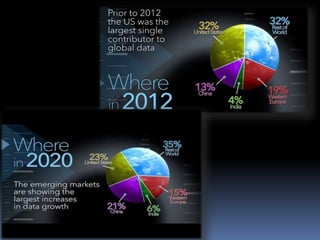
Big data is a term that describes the large
volume of data – both structured and
unstructured – that inundates a business
on a day-to-day basis. But it’s not the
amount of data that’s important. It’s
what organizations do with the data that
matters. Big data can be analyzed for
insights that lead to better decisions and
strategic business moves.
What Is
What is Big Data?
• ‘Big Data’ is similar to ‘small data’, but bigger in size .
• Having data bigger it requires different approaches:
-- Techniques, tools and architecture
• An aim to solve new problems or old problems in a better
way.
• Big Data generates value from the storage and processing
of very large quantities of digital information that cannot be
analyzed with traditional computing techniques.
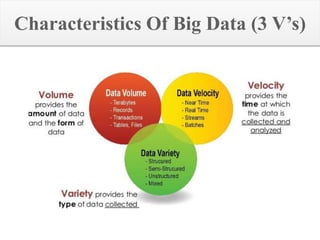
Characteristics Of Big Data (3 V’s)
Volume
Organizations collect data from a variety of sources,
including business transactions, social media and
information from sensor or machine-to-machine data.
In the past, storing it would’ve been a problem – but
new technologies (such as Hadoop) have eased the
burden.
A typical PC might have had 10 gigabytes of storage
in 2000.
Today, Facebook ingests 500 terabytes of new data
every day.
Velocity
 High-frequency stock trading algorithms reflect
market changes within microseconds .
 Machine to machine processes exchange data
between billions of devices .
 Infrastructure and sensors generate massive log data
in realtime .
 On-line gaming systems support millions of
concurrent users, each producing multiple inputs per
second.
Variety
Data comes in all types of formats – from
structured, numeric data in traditional databases to
unstructured text documents, email, video, audio,
stock ticker data and financial transactions.
Big Data isn't just numbers, dates, and strings. Big
Data is also geospatial data, 3D data, audio and
video, and unstructured text, including log files and
social media.
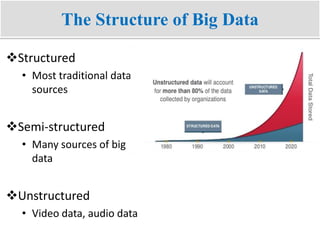
The Structure of Big Data
Structured
• Most traditional data
sources
Semi-structured
• Many sources of big
data
Unstructured
• Video data, audio data
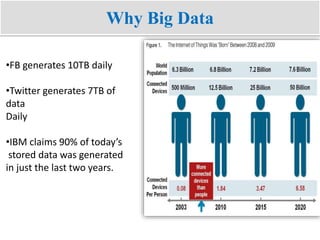
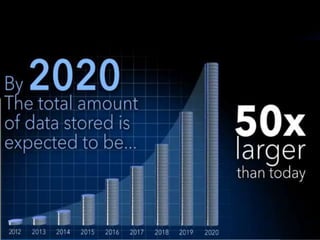
Why Big Data
•FB generates 10TB daily
•Twitter generates 7TB of
data
Daily
•IBM claims 90% of today’s
stored data was generated
in just the last two years.
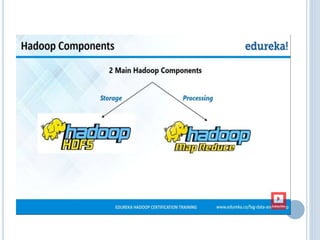
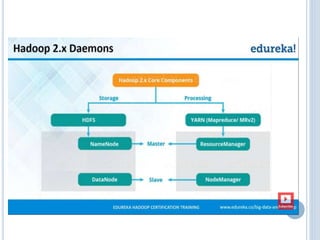
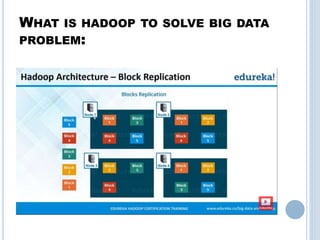
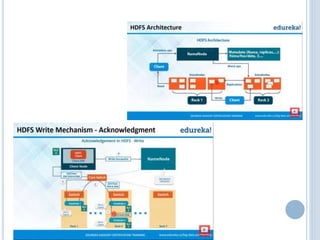
WHAT IS HADOOP TO SOLVE BIG DATA
PROBLEM:
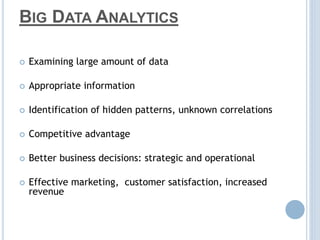
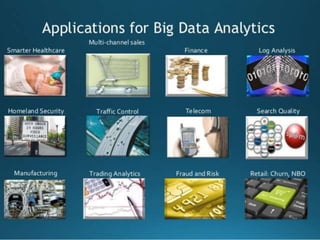
BIG DATA ANALYTICS
 Examining large amount of data
 Appropriate information
 Identification of hidden patterns, unknown correlations
 Competitive advantage
 Better business decisions: strategic and operational
 Effective marketing, customer satisfaction, increased
revenue
HOW BIG DATA IMPACTS ON IT
• Big data is a troublesome force presenting
opportunities with challenges to IT organizations.
 By 2015 4.4 million IT jobs in Big Data ; 1.9 million
is in US itself
 India will require a minimum of 1 lakh data
scientists in the next couple of years in addition to
data analysts and data managers to support the Big
Data space.
Benefits of Big Data
•Real-time big data isn’t just a process for storing petabytes or
exabytes of data in a data warehouse, It’s about the ability to make
better decisions and take meaningful actions at the right time.
•Fast forward to the present and technologies like Hadoop give you
the scale and flexibility to store data before you know how you are
going to process it.
•Our newest research finds that organizations are using big data to
target customer-centric outcomes, tap into internal data and build a
better information ecosystem.
•Big Data is already an important part of the $64 billion database and
data analytics market
References
Links:
 http://studymafia.org/big-data-seminar-report-with-ppt-and-pdf/
 https://www.slideshare.net/nasrinhussain1/big-data-ppt-31616290
 https://www.sas.com/en_in/insights/big-data/what-is-big-data.html#
 https://en.wikipedia.org/wiki/Big_data
Pousin China
IT,3rd yr, 67
Shatavisha Roy Chowdhury
IT, 3rd yr, 97
Trisha Ghosh
IT ,3rd yr, 118

Overview of Big data(ppt)

  • 2.
    Big data isa term that describes the large volume of data – both structured and unstructured – that inundates a business on a day-to-day basis. But it’s not the amount of data that’s important. It’s what organizations do with the data that matters. Big data can be analyzed for insights that lead to better decisions and strategic business moves.
  • 4.
  • 5.
    What is BigData? • ‘Big Data’ is similar to ‘small data’, but bigger in size . • Having data bigger it requires different approaches: -- Techniques, tools and architecture • An aim to solve new problems or old problems in a better way. • Big Data generates value from the storage and processing of very large quantities of digital information that cannot be analyzed with traditional computing techniques.
  • 6.
    Characteristics Of BigData (3 V’s)
  • 7.
    Volume Organizations collect datafrom a variety of sources, including business transactions, social media and information from sensor or machine-to-machine data. In the past, storing it would’ve been a problem – but new technologies (such as Hadoop) have eased the burden. A typical PC might have had 10 gigabytes of storage in 2000. Today, Facebook ingests 500 terabytes of new data every day.
  • 8.
    Velocity  High-frequency stocktrading algorithms reflect market changes within microseconds .  Machine to machine processes exchange data between billions of devices .  Infrastructure and sensors generate massive log data in realtime .  On-line gaming systems support millions of concurrent users, each producing multiple inputs per second.
  • 9.
    Variety Data comes inall types of formats – from structured, numeric data in traditional databases to unstructured text documents, email, video, audio, stock ticker data and financial transactions. Big Data isn't just numbers, dates, and strings. Big Data is also geospatial data, 3D data, audio and video, and unstructured text, including log files and social media.
  • 10.
    The Structure ofBig Data Structured • Most traditional data sources Semi-structured • Many sources of big data Unstructured • Video data, audio data
  • 11.
    Why Big Data •FBgenerates 10TB daily •Twitter generates 7TB of data Daily •IBM claims 90% of today’s stored data was generated in just the last two years.
  • 15.
    WHAT IS HADOOPTO SOLVE BIG DATA PROBLEM:
  • 17.
    BIG DATA ANALYTICS Examining large amount of data  Appropriate information  Identification of hidden patterns, unknown correlations  Competitive advantage  Better business decisions: strategic and operational  Effective marketing, customer satisfaction, increased revenue
  • 19.
    HOW BIG DATAIMPACTS ON IT • Big data is a troublesome force presenting opportunities with challenges to IT organizations.  By 2015 4.4 million IT jobs in Big Data ; 1.9 million is in US itself  India will require a minimum of 1 lakh data scientists in the next couple of years in addition to data analysts and data managers to support the Big Data space.
  • 21.
    Benefits of BigData •Real-time big data isn’t just a process for storing petabytes or exabytes of data in a data warehouse, It’s about the ability to make better decisions and take meaningful actions at the right time. •Fast forward to the present and technologies like Hadoop give you the scale and flexibility to store data before you know how you are going to process it. •Our newest research finds that organizations are using big data to target customer-centric outcomes, tap into internal data and build a better information ecosystem. •Big Data is already an important part of the $64 billion database and data analytics market
  • 22.
    References Links:  http://studymafia.org/big-data-seminar-report-with-ppt-and-pdf/  https://www.slideshare.net/nasrinhussain1/big-data-ppt-31616290 https://www.sas.com/en_in/insights/big-data/what-is-big-data.html#  https://en.wikipedia.org/wiki/Big_data
  • 23.
    Pousin China IT,3rd yr,67 Shatavisha Roy Chowdhury IT, 3rd yr, 97 Trisha Ghosh IT ,3rd yr, 118