Structure of atom
Concept of hybridization
Orientation in monosubstitued benzene
Anwar R. Shaikh
M. Pharm. Ph.D. FIC
Pharmacy_2003@rediffmail.com
Professor and HOD
MCE Society’s Allana College of Pharmacy, PUNE
View this animated power point presentation
@
www.authorstream.com
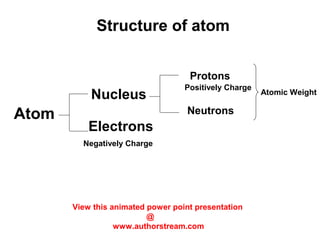
Structure of atom
Atom
Nucleus
Electrons
Protons
Neutrons
Negatively Charge
Positively Charge
Atomic Weight
View this animated power point presentation
@
www.authorstream.com
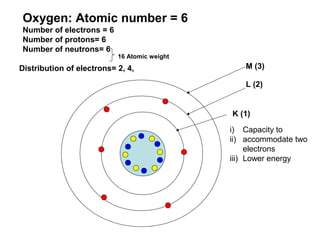
Oxygen: Atomic number = 6
Number of electrons = 6
Number of protons= 6
Number of neutrons= 6
16 Atomic weight
Distribution of electrons= 2, 4,
K (1)
L (2)
M (3)
i) Capacity to
ii) accommodate two
electrons
iii) Lower energy
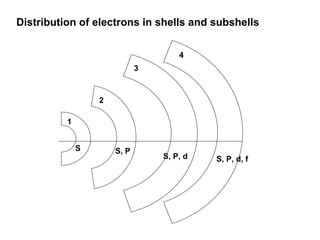
Distribution of electrons in shells and subshells
1
2
4
3
S S, P
S, P, d S, P, d, f
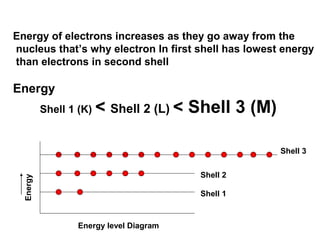
Energy of electrons increases as they go away from the
nucleus that’s why electron In first shell has lowest energy
than electrons in second shell
Energy
Shell 1 (K) < Shell 2 (L) < Shell 3 (M)
Energy
Shell 1
Shell 2
Shell 3
Energy level Diagram
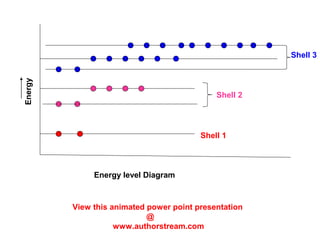
Energy
Shell 1
Shell 2
Shell 3
Energy level Diagram
View this animated power point presentation
@
www.authorstream.com
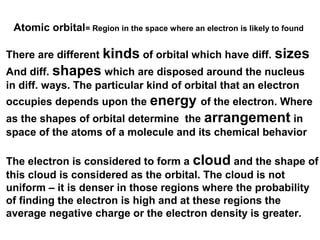
Atomic orbital= Region in the space where an electron is likely to found
There are different kinds of orbital which have diff. sizes
And diff. shapes which are disposed around the nucleus
in diff. ways. The particular kind of orbital that an electron
occupies depends upon the energy of the electron. Where
as the shapes of orbital determine the arrangement in
space of the atoms of a molecule and its chemical behavior
The electron is considered to form a cloud and the shape of
this cloud is considered as the orbital. The cloud is not
uniform – it is denser in those regions where the probability
of finding the electron is high and at these regions the
average negative charge or the electron density is greater.
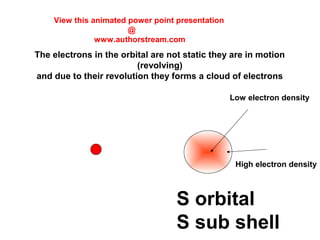
The electrons in the orbital are not static they are in motion
(revolving)
and due to their revolution they forms a cloud of electrons
Low electron density
High electron density
S orbital
S sub shell
View this animated power point presentation
@
www.authorstream.com
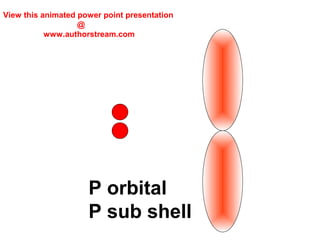
P orbital
P sub shell
View this animated power point presentation
@
www.authorstream.com
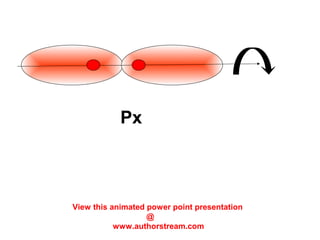
Px
View this animated power point presentation
@
www.authorstream.com
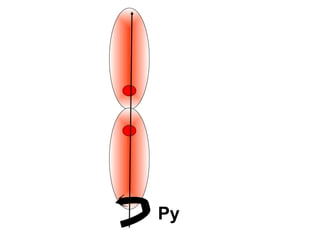
Py
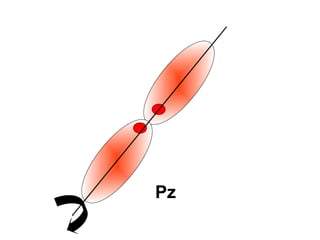
Pz
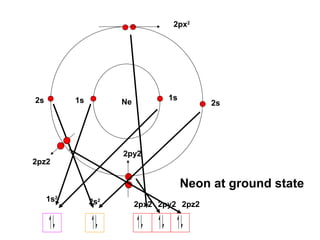
Ne
Neon at ground state
2px2
2py2
2s2s 1s 1s
1s2
2s2
2px2 2py2
2pz2
2pz2
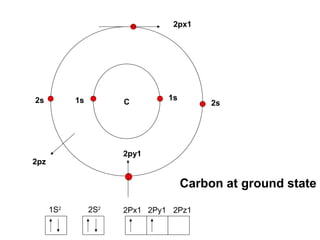
C
Carbon at ground state
2px1
2py1
2s2s 1s 1s
2pz
1S2
2S2
2Px1 2Py1 2Pz1
Concept of Hybridization
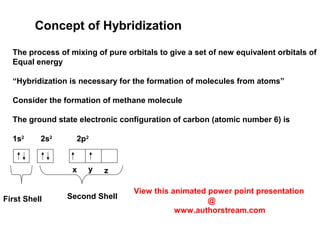
The process of mixing of pure orbitals to give a set of new equivalent orbitals of
Equal energy
“Hybridization is necessary for the formation of molecules from atoms”
Consider the formation of methane molecule
The ground state electronic configuration of carbon (atomic number 6) is
1s2
2s2
2p2
x y z
First Shell Second Shell
View this animated power point presentation
@
www.authorstream.com
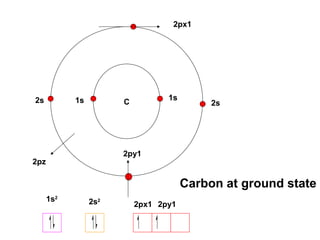
C
Carbon at ground state
2px1
2py1
2s2s 1s 1s
1s2
2s2
2px1 2py1
2pz
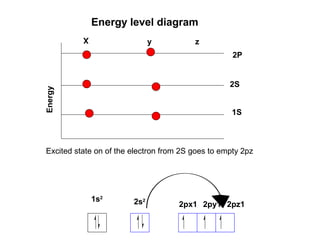
Energy level diagram
1S
2S
2P
X
y
Energy
z
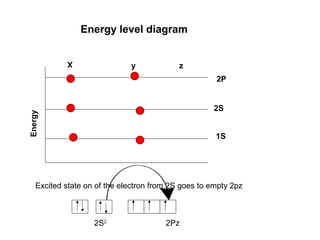
Excited state on of the electron from 2S goes to empty 2pz
1s2
2s2
2px1 2py1 2pz1
C
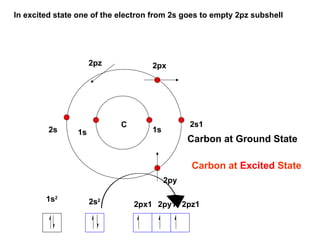
In excited state one of the electron from 2s goes to empty 2pz subshell
2px
2py
2pz
2s1
1s1s
1s2
2s2
2px1 2py1 2pz1
2s
Carbon at Ground State
Carbon at Excited State
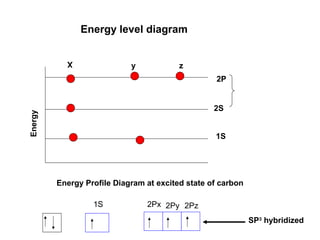
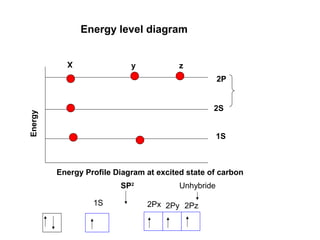
Energy level diagram
1S
2S
2P
X
y
Energy
z
Energy Profile Diagram at excited state of carbon
1S 2Px 2Py 2Pz
SP3
hybridized
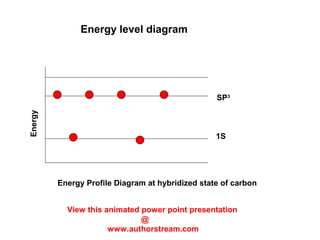
Energy level diagram
1S
SP3
Energy
Energy Profile Diagram at hybridized state of carbon
View this animated power point presentation
@
www.authorstream.com
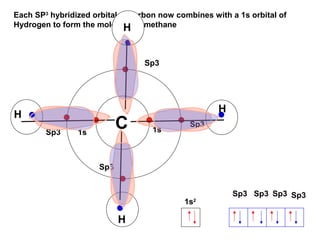
Each SP3
hybridized orbital of carbon now combines with a 1s orbital of
Hydrogen to form the molecule of methane
Sp3
Sp3
1s1s
1s2
C
H
H
H
H
Sp3
Sp3
Sp3Sp3 Sp3 Sp3
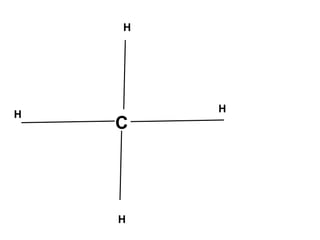
C
H
H
H
H
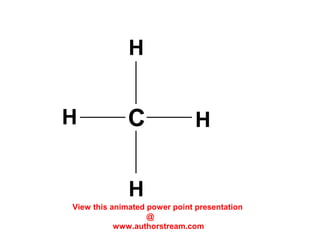
C
H
H
H
H
View this animated power point presentation
@
www.authorstream.com
• In SP2
Hybridization
• One S + 2 P orbitals mixes
View this animated power point presentation
@
www.authorstream.com
Energy level diagram
1S
2S
2P
X
y
Energy
z
Energy Profile Diagram at excited state of carbon
1S 2Px 2Py 2Pz
SP2
Unhybride
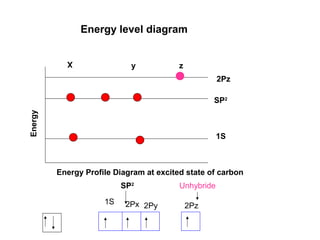
Energy level diagram
1S
SP2
2Pz
X
y
Energy
z
Energy Profile Diagram at excited state of carbon
1S 2Px 2Py 2Pz
SP2
Unhybride
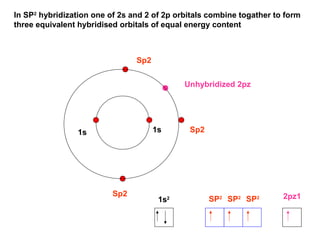
In SP2
hybridization one of 2s and 2 of 2p orbitals combine togather to form
three equivalent hybridised orbitals of equal energy content
1s1s
1s2 SP2 2pz1
Sp2
Sp2
Sp2
Unhybridized 2pz
SP2
SP2
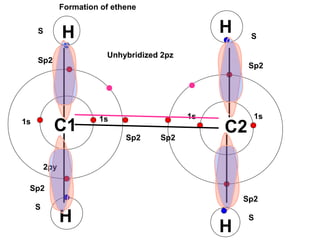
C1
Formation of ethene
2py
1s1s
Sp2
Sp2
Sp2
Unhybridized 2pz
1s1s
Sp2
Sp2
Sp2
C2
H H
H
H
S
S
S
S
C C
H
H
H
H
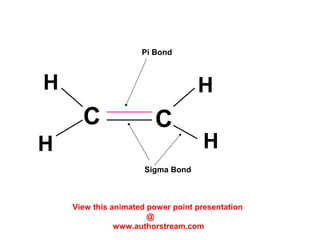
Pi Bond
Sigma Bond
View this animated power point presentation
@
www.authorstream.com
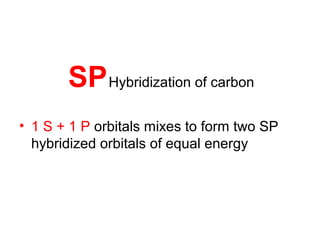
SPHybridization of carbon
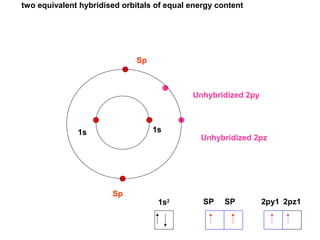
• 1 S + 1 P orbitals mixes to form two SP
hybridized orbitals of equal energy
Energy level diagram
1S
2S
2P
X
y
Energy
z
Excited state on of the electron from 2S goes to empty 2pz
2S2
2Pz
Energy level diagram
1S
1S
1P
2 PX
Energy
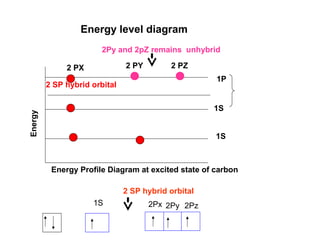
Energy Profile Diagram at excited state of carbon
1S 2Py 2Pz
2 SP hybrid orbital
2Px
2 PY 2 PZ
2 SP hybrid orbital
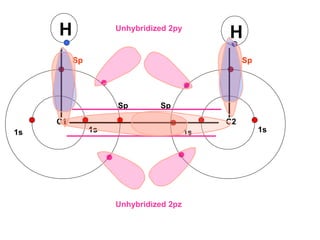
2Py and 2pZ remains unhybrid
two equivalent hybridised orbitals of equal energy content
1s1s
1s2 SP SP 2py1 2pz1
Sp
Sp
Unhybridized 2py
Unhybridized 2pz
1s1s
Sp
Sp
Unhybridized 2py
Unhybridized 2pz
C1
1s1s
Sp
Sp
C2
H H
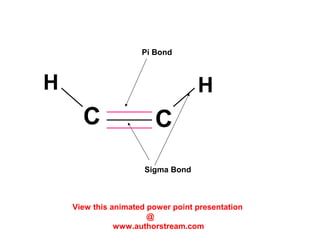
C C
H H
Pi Bond
Sigma Bond
View this animated power point presentation
@
www.authorstream.com
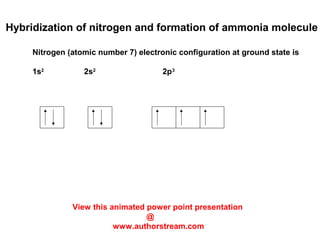
Hybridization of nitrogen and formation of ammonia molecule
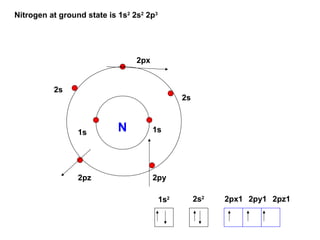
Nitrogen (atomic number 7) electronic configuration at ground state is
1s2
2s2
2p3
View this animated power point presentation
@
www.authorstream.com
Nitrogen at ground state is 1s2
2s2
2p3
2pz
1s1s
1s2 2s2
2px1 2py1 2pz1
2s
2px
2py
2s
N
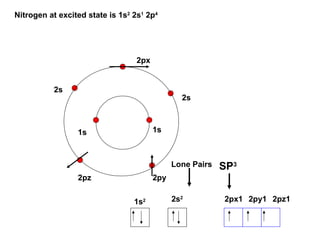
Nitrogen at excited state is 1s2
2s1
2p4
2pz
1s1s
1s2 2px1 2py1 2pz1
2s
2px
2py
2s
2s2
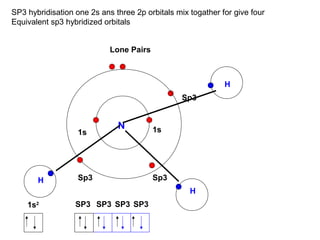
SP3Lone Pairs
Sp3
1s1s
Sp3
Sp3
Lone Pairs
SP3 hybridisation one 2s ans three 2p orbitals mix togather for give four
Equivalent sp3 hybridized orbitals
1s2 SP3 SP3 SP3
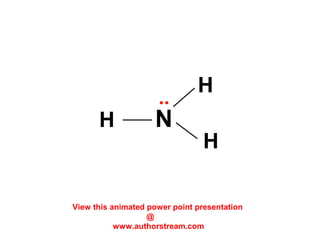
H
N
H
H
SP3
NH
H
H
View this animated power point presentation
@
www.authorstream.com
E-mail:
pharmacy_2003@rediffmail.com
knowledgepublication@gmail.com
View this animated power point presentation
@
www.authorstream.com
Input “search word”
Anwar.structure of atom

Structure of atom final