
Amjad Khan Afridi Department of Health and Biological science
Abasyn University Peshawar Campus
SUBJECT
General Human Physiology
Teachers can open the door, but you must enter it yourself…!
The beautiful thing about learning is that no one can take if
away from you..!
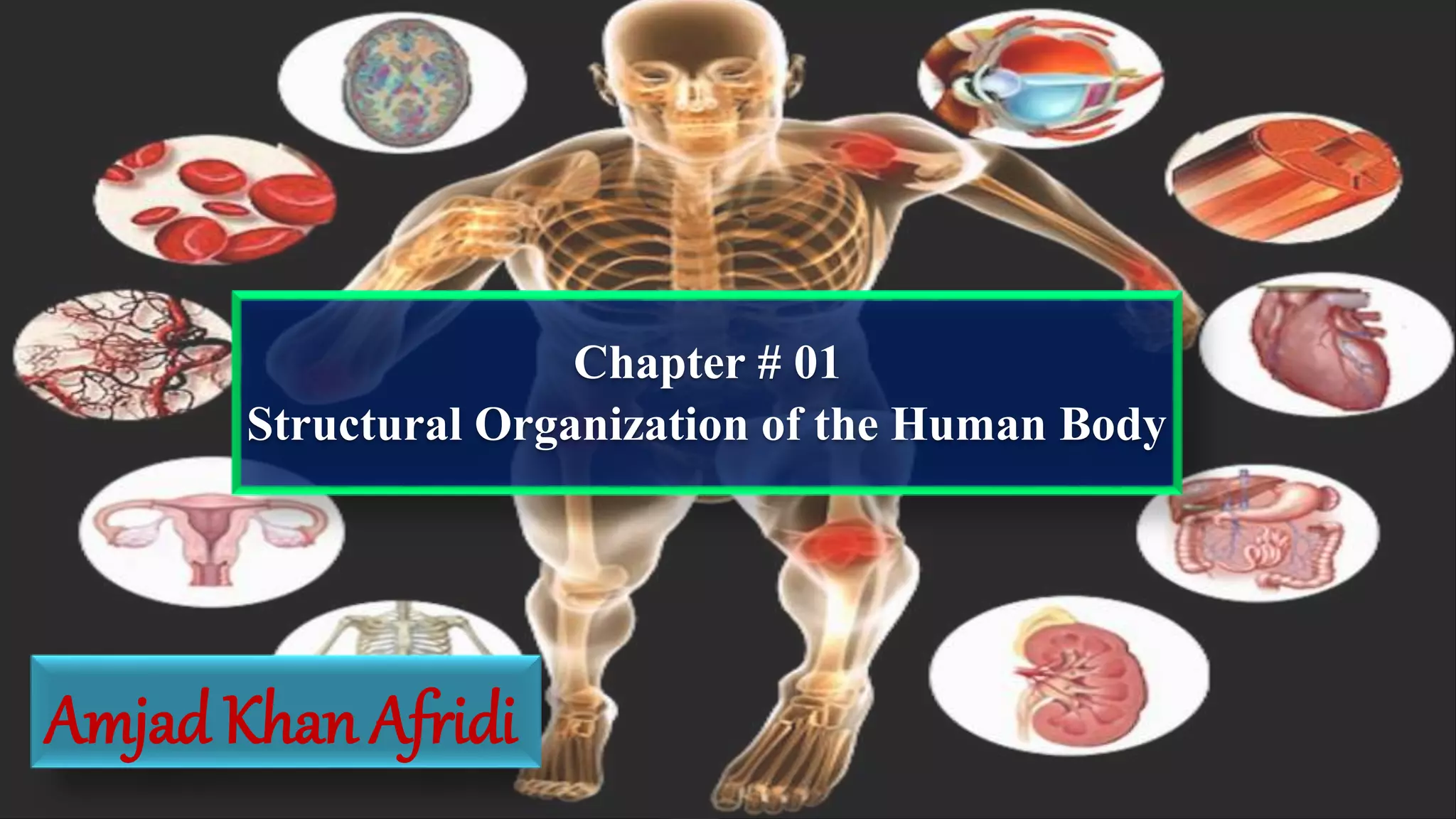
Chapter # 01
Structural Organization of the Human Body
Amjad Khan Afridi
 Before you begin to study the different structures and functions of the
human body, it is helpful to study its basic construction; that is, how
its smallest parts are assembled into larger structures.
 It is useful to consider the structures of the body in terms of
fundamental levels of organization that increase in complication, such
as (from smallest to largest): chemicals, cells, tissues, organs, organ
systems, and an organism.
 The organization of the body often is discussed in terms of the different
levels of increasing complexity, from the smallest chemical building
blocks to a unique human organism.
25th November, 2021

Structural organization of the human body

  • 1.
    Amjad Khan AfridiDepartment of Health and Biological science Abasyn University Peshawar Campus SUBJECT General Human Physiology Teachers can open the door, but you must enter it yourself…! The beautiful thing about learning is that no one can take if away from you..!
  • 2.
    Chapter # 01 StructuralOrganization of the Human Body Amjad Khan Afridi
  • 3.
     Before youbegin to study the different structures and functions of the human body, it is helpful to study its basic construction; that is, how its smallest parts are assembled into larger structures.  It is useful to consider the structures of the body in terms of fundamental levels of organization that increase in complication, such as (from smallest to largest): chemicals, cells, tissues, organs, organ systems, and an organism.  The organization of the body often is discussed in terms of the different levels of increasing complexity, from the smallest chemical building blocks to a unique human organism.
  • 14.

Editor's Notes

  • #2 Human physiology is the science of the functioning of human organs and the cells that compose them. Human physiology studies the mechanical, physical, and biochemical functions that determine the health of an individual. According to the classes of organisms, the field can be divided into medical physiology, animal physiology, plant physiology, cell physiology, and comparative physiology. Central to physiological functioning are biophysical and biochemical processes, homeostatic control mechanisms, and communication between cells.
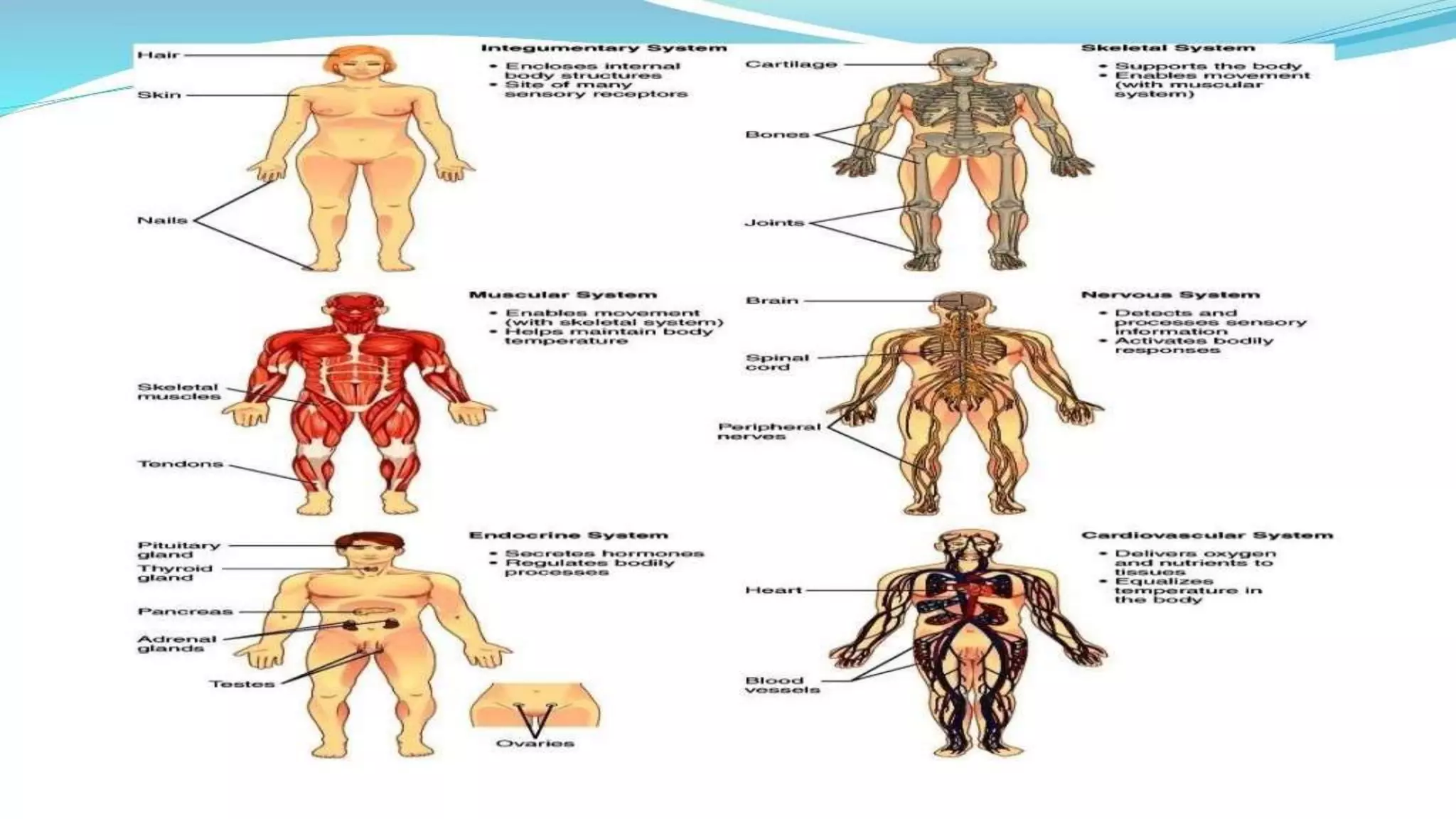
  • #12 The integumentary system is the largest organ of the body that forms a physical barrier between the external environment and the internal environment that it serves to protect and maintain. The integumentary system includes the epidermis, dermis, hypodermis, associated glands, hair, and nails