ANATOMY AND
PHYSIOLOGY
RIO D. DOMALAON,RN,MAN,JD
COURSE DESCRIPTION:
The course deals with the combined study of
the structures and functions of the human
body, the relationship between Human
Anatomy and Physiology, and this includes the
definition of terms. Correlation of human
biologic structure and normal physiologic
functions, basic regulatory mechanisms which
promotes homeostasis, familiarization of some
physiologic parameters which serves as
indicators for the organisms state of health.
LEARNING OUTCOMES:
At the end of the course, the students should
be able to:
KNOWLEDGE
1.Enumerate the different systems and each
part of the human body and their function.
2.Define the different anatomical terms and its
application to human anatomy and physiology.
3.Explain the different processes that are taken
placed in human body.
LEARNING OUTCOMES
VALUES
1.Imbibe the importance of Human Anatomy and
Physiology in the value of healthy lifestyle and
how this lifestyle can lead to good life.
2.Imbibe the importance of their knowledge in
Human Anatomy and Physiology in the holistic
caring of their future patients.
3.Imbibe the importance of Human Anatomy and
Physiology in educating their future patients.
LEARNING OUTCOMES
SKILLS
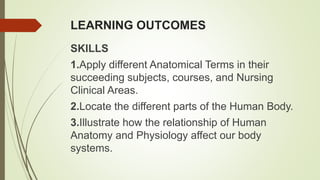
1.Apply different Anatomical Terms in their
succeeding subjects, courses, and Nursing
Clinical Areas.
2.Locate the different parts of the Human Body.
3.Illustrate how the relationship of Human
Anatomy and Physiology affect our body
systems.
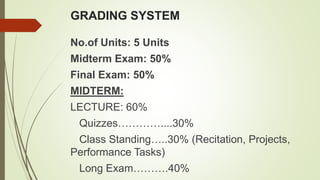
GRADING SYSTEM
No.of Units: 5 Units
Midterm Exam: 50%
Final Exam: 50%
MIDTERM:
LECTURE: 60%
Quizzes…………....30%
Class Standing…..30% (Recitation, Projects,
Performance Tasks)
Long Exam……….40%
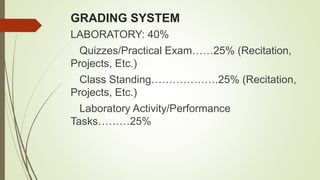
GRADING SYSTEM
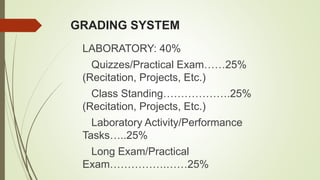
LABORATORY: 40%
Quizzes/Practical Exam……25% (Recitation,
Projects, Etc.)
Class Standing……………….25% (Recitation,
Projects, Etc.)
Laboratory Activity/Performance
Tasks………25%
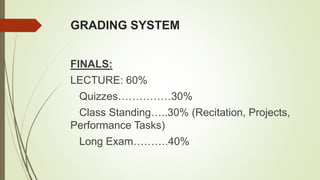
GRADING SYSTEM
FINALS:
LECTURE: 60%
Quizzes……………30%
Class Standing…..30% (Recitation, Projects,
Performance Tasks)
Long Exam……….40%
GRADING SYSTEM
LABORATORY: 40%
Quizzes/Practical Exam……25%
(Recitation, Projects, Etc.)
Class Standing……………….25%
(Recitation, Projects, Etc.)
Laboratory Activity/Performance
Tasks…..25%
Long Exam/Practical
Exam…………….……25%
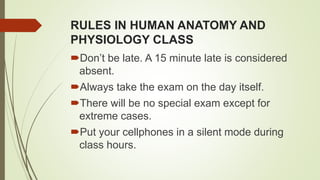
RULES IN HUMAN ANATOMY AND
PHYSIOLOGY CLASS
Don’t be late. A 15 minute late is considered
absent.
Always take the exam on the day itself.
There will be no special exam except for
extreme cases.
Put your cellphones in a silent mode during
class hours.
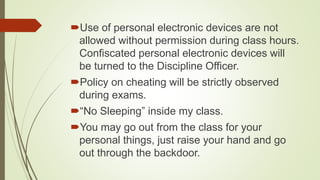
Use of personal electronic devices are not
allowed without permission during class hours.
Confiscated personal electronic devices will
be turned to the Discipline Officer.
Policy on cheating will be strictly observed
during exams.
“No Sleeping” inside my class.
You may go out from the class for your
personal things, just raise your hand and go
out through the backdoor.
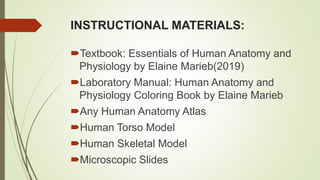
INSTRUCTIONAL MATERIALS:
Textbook: Essentials of Human Anatomy and
Physiology by Elaine Marieb(2019)
Laboratory Manual: Human Anatomy and
Physiology Coloring Book by Elaine Marieb
Any Human Anatomy Atlas
Human Torso Model
Human Skeletal Model
Microscopic Slides
HUMAN BODY: AN ORIENTATION
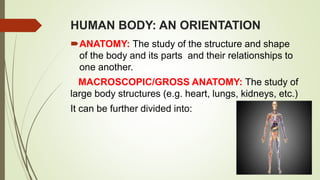
ANATOMY: The study of the structure and shape
of the body and its parts and their relationships to
one another.
MACROSCOPIC/GROSS ANATOMY: The study of
large body structures (e.g. heart, lungs, kidneys, etc.)
It can be further divided into:
MACROSCOPIC/GROSS ANATOMY
1.Regional Anatomy
-all structures(muscles, bones, blood vessels, nerves
etc.) in one particular region such as abdomen or leg
2.Systematic Anatomy
-system by system
3.Surface Anatomy
-study of external body structures
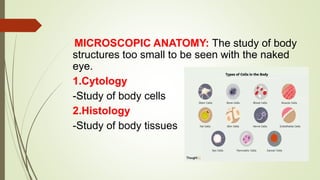
MICROSCOPIC ANATOMY: The study of body
structures too small to be seen with the naked
eye.
1.Cytology
-Study of body cells
2.Histology
-Study of body tissues
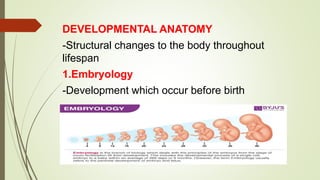
DEVELOPMENTAL ANATOMY
-Structural changes to the body throughout
lifespan
1.Embryology
-Development which occur before birth
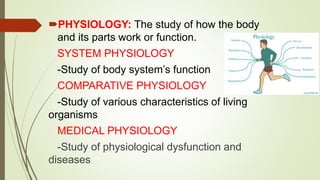
PHYSIOLOGY: The study of how the body
and its parts work or function.
SYSTEM PHYSIOLOGY
-Study of body system’s function
COMPARATIVE PHYSIOLOGY
-Study of various characteristics of living
organisms
MEDICAL PHYSIOLOGY
-Study of physiological dysfunction and
diseases
They are always related
The parts of the body form a well organized
unit.
PRINCIPLE OF COMPLEMENTARITY OF
STRUCTURE AND FUNCTION
-States that function is dependent
on structure, and that the form of
a structure relates to its function.
Examples:
1.Bones can support and protect body organs
because they contain hard mineral deposits.
2.Blood flows in one direction because the heart
has valves that prevent backflow.
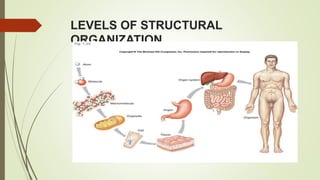
LEVELS OF STRUCTURAL
ORGANIZATION
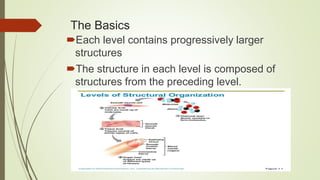
The Basics
Each level contains progressively larger
structures
The structure in each level is composed of
structures from the preceding level.
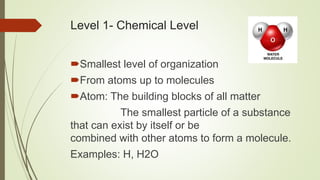
Level 1- Chemical Level
Smallest level of organization
From atoms up to molecules
Atom: The building blocks of all matter
The smallest particle of a substance
that can exist by itself or be
combined with other atoms to form a molecule.
Examples: H, H2O
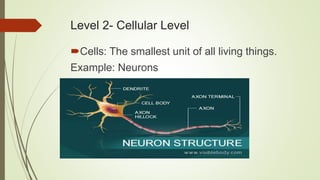
Level 2- Cellular Level
Cells: The smallest unit of all living things.
Example: Neurons
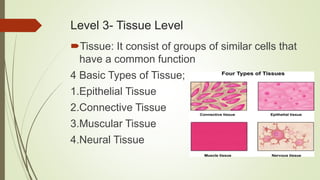
Level 3- Tissue Level
Tissue: It consist of groups of similar cells that
have a common function
4 Basic Types of Tissue;
1.Epithelial Tissue
2.Connective Tissue
3.Muscular Tissue
4.Neural Tissue
Level 4- Organ Level
Organ: The structure composed of two or more
tissues types that performs a specific function.
At this level, extremely complex functions become
possible
Example:
Brain
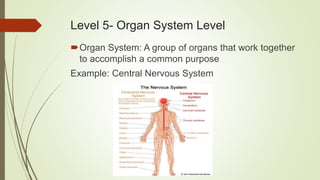
Level 5- Organ System Level
Organ System: A group of organs that work together
to accomplish a common purpose
Example: Central Nervous System
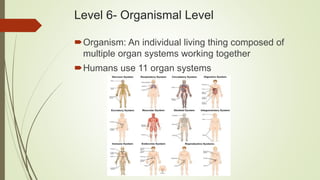
Level 6- Organismal Level
Organism: An individual living thing composed of
multiple organ systems working together
Humans use 11 organ systems
THE HUMAN ORGAN SYSTEMS
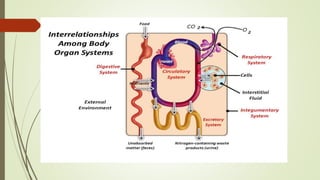
Please take note the structures involved and how
each of these structures function both independently
and together.
Take note how the organ systems are interrelated
INTEGUMENTARY SYSTEM
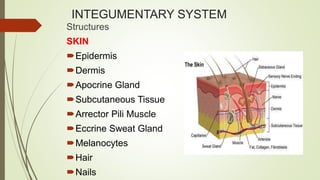
Structures
SKIN
Epidermis
Dermis
Apocrine Gland
Subcutaneous Tissue
Arrector Pili Muscle
Eccrine Sweat Gland
Melanocytes
Hair
Nails
FUNCTIONS:
Protect
Fluid balance
Absorption
Synthesis of Vitamin D
Sensation/Communication with external environment
Thermoregulation
Immunity
Excretion
SKELETAL SYSTEM
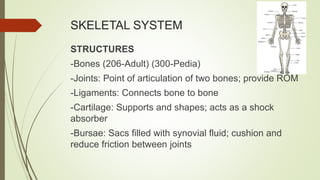
STRUCTURES
-Bones (206-Adult) (300-Pedia)
-Joints: Point of articulation of two bones; provide ROM
-Ligaments: Connects bone to bone
-Cartilage: Supports and shapes; acts as a shock
absorber
-Bursae: Sacs filled with synovial fluid; cushion and
reduce friction between joints
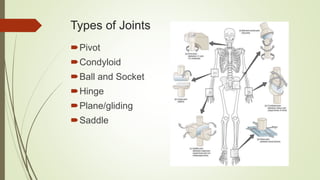
Types of Joints
Pivot
Condyloid
Ball and Socket
Hinge
Plane/gliding
Saddle
FUNCTIONS OF SKELETAL SYSTEM
1.Supports the body
2.Provides a framework for skeletal muscles
3.Protects some organs
4.Performs hematopoiesis
HEMATOPOIESIS: Formation of blood cells
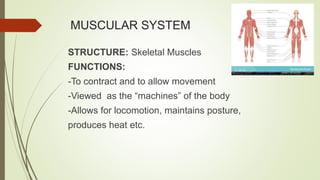
MUSCULAR SYSTEM
STRUCTURE: Skeletal Muscles
FUNCTIONS:
-To contract and to allow movement
-Viewed as the “machines” of the body
-Allows for locomotion, maintains posture,
produces heat etc.
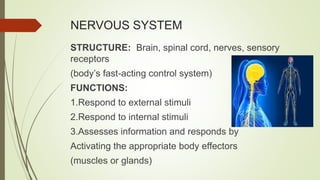
NERVOUS SYSTEM
STRUCTURE: Brain, spinal cord, nerves, sensory
receptors
(body’s fast-acting control system)
FUNCTIONS:
1.Respond to external stimuli
2.Respond to internal stimuli
3.Assesses information and responds by
Activating the appropriate body effectors
(muscles or glands)
ENDOCRINE SYSTEM
STRUCTURE: Pituitary, Thyroid, Parathyroids,
Adrenals, Thymus, and Pineal Glands,
Pancreas, Ovaries/Testis
FUNCTIONS:
1.Controls body activities
(slower than the nervous system)
2.Produce and release hormones
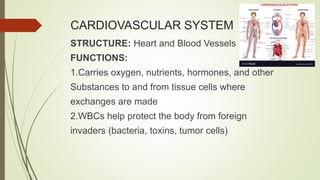
CARDIOVASCULAR SYSTEM
STRUCTURE: Heart and Blood Vessels
FUNCTIONS:
1.Carries oxygen, nutrients, hormones, and other
Substances to and from tissue cells where
exchanges are made
2.WBCs help protect the body from foreign
invaders (bacteria, toxins, tumor cells)
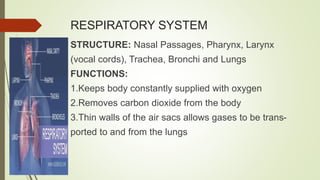
RESPIRATORY SYSTEM
STRUCTURE: Nasal Passages, Pharynx, Larynx
(vocal cords), Trachea, Bronchi and Lungs
FUNCTIONS:
1.Keeps body constantly supplied with oxygen
2.Removes carbon dioxide from the body
3.Thin walls of the air sacs allows gases to be trans-
ported to and from the lungs
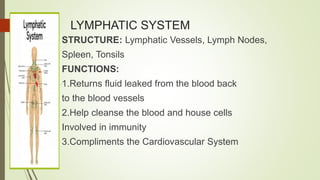
LYMPHATIC SYSTEM
STRUCTURE: Lymphatic Vessels, Lymph Nodes,
Spleen, Tonsils
FUNCTIONS:
1.Returns fluid leaked from the blood back
to the blood vessels
2.Help cleanse the blood and house cells
Involved in immunity
3.Compliments the Cardiovascular System
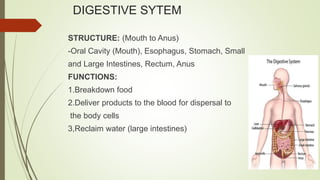
DIGESTIVE SYTEM
STRUCTURE: (Mouth to Anus)
-Oral Cavity (Mouth), Esophagus, Stomach, Small
and Large Intestines, Rectum, Anus
FUNCTIONS:
1.Breakdown food
2.Deliver products to the blood for dispersal to
the body cells
3,Reclaim water (large intestines)
Liver is a digestive organ because it produces
bile, which breakdown fats
Pancreas delivers digestive enzymes to the
small intestines, functionally a digestive organ
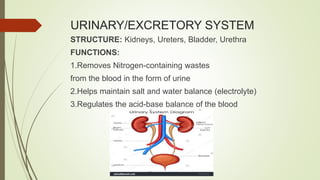
URINARY/EXCRETORY SYSTEM
STRUCTURE: Kidneys, Ureters, Bladder, Urethra
FUNCTIONS:
1.Removes Nitrogen-containing wastes
from the blood in the form of urine
2.Helps maintain salt and water balance (electrolyte)
3.Regulates the acid-base balance of the blood
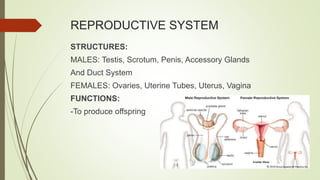
REPRODUCTIVE SYSTEM
STRUCTURES:
MALES: Testis, Scrotum, Penis, Accessory Glands
And Duct System
FEMALES: Ovaries, Uterine Tubes, Uterus, Vagina
FUNCTIONS:
-To produce offspring
NECESSARY LIFE FUNCTION
What things must happen in
individual organ systems and
between multiple organ systems to
allow the human body to function?
THE BASIC IDEA
 All organisms must use and
maintain necessary life
functions
 Organ systems are
interdependent
 It is important to establish
which organ systems are
most directly related to
each life fnction
WHAT MUST HAPPEN
 Maintain boundaries
 Movement
 Responsiveness
 Digestion
 Metabolism
 Excretion
 Reproduction
 Growth
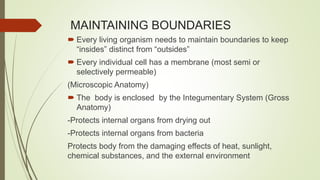
MAINTAINING BOUNDARIES
 Every living organism needs to maintain boundaries to keep
“insides” distinct from “outsides”
 Every individual cell has a membrane (most semi or
selectively permeable)
(Microscopic Anatomy)
 The body is enclosed by the Integumentary System (Gross
Anatomy)
-Protects internal organs from drying out
-Protects internal organs from bacteria
Protects body from the damaging effects of heat, sunlight,
chemical substances, and the external environment
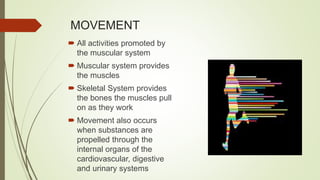
MOVEMENT
 All activities promoted by
the muscular system
 Muscular system provides
the muscles
 Skeletal System provides
the bones the muscles pull
on as they work
 Movement also occurs
when substances are
propelled through the
internal organs of the
cardiovascular, digestive
and urinary systems
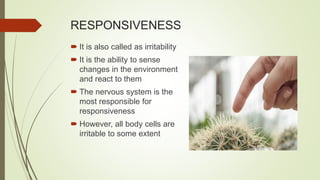
RESPONSIVENESS
 It is also called as irritability
 It is the ability to sense
changes in the environment
and react to them
 The nervous system is the
most responsible for
responsiveness
 However, all body cells are
irritable to some extent
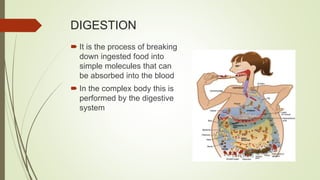
DIGESTION
 It is the process of breaking
down ingested food into
simple molecules that can
be absorbed into the blood
 In the complex body this is
performed by the digestive
system
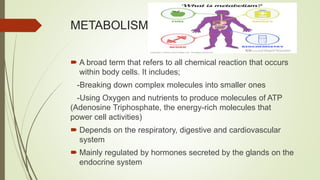
METABOLISM
 A broad term that refers to all chemical reaction that occurs
within body cells. It includes;
-Breaking down complex molecules into smaller ones
-Using Oxygen and nutrients to produce molecules of ATP
(Adenosine Triphosphate, the energy-rich molecules that
power cell activities)
 Depends on the respiratory, digestive and cardiovascular
system
 Mainly regulated by hormones secreted by the glands on the
endocrine system
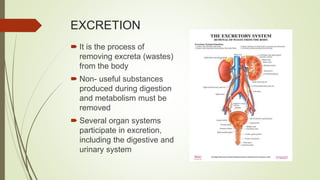
EXCRETION
 It is the process of
removing excreta (wastes)
from the body
 Non- useful substances
produced during digestion
and metabolism must be
removed
 Several organ systems
participate in excretion,
including the digestive and
urinary system
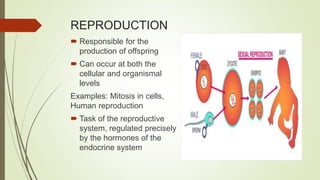
REPRODUCTION
 Responsible for the
production of offspring
 Can occur at both the
cellular and organismal
levels
Examples: Mitosis in cells,
Human reproduction
 Task of the reproductive
system, regulated precisely
by the hormones of the
endocrine system
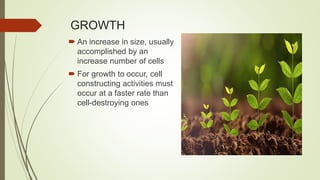
GROWTH
 An increase in size, usually
accomplished by an
increase number of cells
 For growth to occur, cell
constructing activities must
occur at a faster rate than
cell-destroying ones
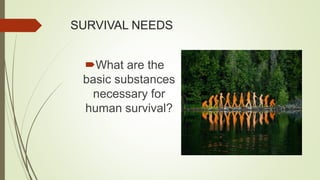
SURVIVAL NEEDS
What are the
basic substances
necessary for
human survival?
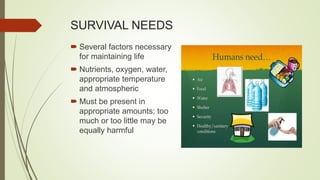
SURVIVAL NEEDS
 Several factors necessary
for maintaining life
 Nutrients, oxygen, water,
appropriate temperature
and atmospheric
 Must be present in
appropriate amounts; too
much or too little may be
equally harmful
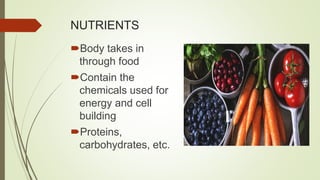
NUTRIENTS
Body takes in
through food
Contain the
chemicals used for
energy and cell
building
Proteins,
carbohydrates, etc.
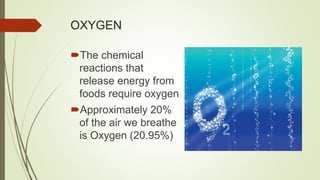
OXYGEN
The chemical
reactions that
release energy from
foods require oxygen
Approximately 20%
of the air we breathe
is Oxygen (20.95%)
WATER
 60-80% body weight, 65-
75% in muscle, only 10% in
fat
 50-60% in most people,
women have a lower
percentage due to higher
body fat
 Single most abundant
chemical substance in the
body
 Provides the fluid base for
body secretions and
excretions
(secretion is an active
process-particle movement/
excretion is a passive
process-waste removal)
 Chiefly ingested from foods
and liquids
 Lost by evaporation and
body excretions
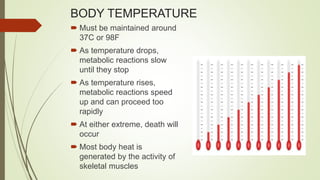
BODY TEMPERATURE
 Must be maintained around
37C or 98F
 As temperature drops,
metabolic reactions slow
until they stop
 As temperature rises,
metabolic reactions speed
up and can proceed too
rapidly
 At either extreme, death will
occur
 Most body heat is
generated by the activity of
skeletal muscles
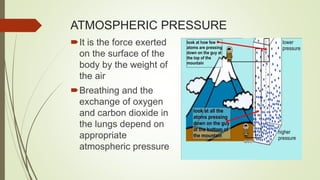
ATMOSPHERIC PRESSURE
It is the force exerted
on the surface of the
body by the weight of
the air
Breathing and the
exchange of oxygen
and carbon dioxide in
the lungs depend on
appropriate
atmospheric pressure
HOMEOSTASIS
What is homeostasis?
Why is it important?
HOMEOSTASIS
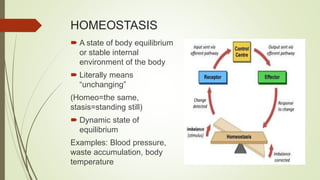
 A state of body equilibrium
or stable internal
environment of the body
 Literally means
“unchanging”
(Homeo=the same,
stasis=standing still)
 Dynamic state of
equilibrium
Examples: Blood pressure,
waste accumulation, body
temperature
HOMEOSTASIS
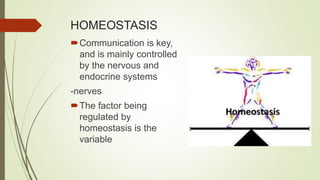
Communication is key,
and is mainly controlled
by the nervous and
endocrine systems
-nerves
The factor being
regulated by
homeostasis is the
variable
HOMEOSTASIS
All homeostatic
control mechanisms
have at least three
components;
1.A receptor
2.A control center
3.An effector
A RECEPTOR
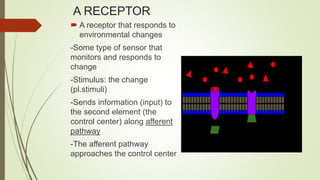
 A receptor that responds to
environmental changes
-Some type of sensor that
monitors and responds to
change
-Stimulus: the change
(pl.stimuli)
-Sends information (input) to
the second element (the
control center) along afferent
pathway
-The afferent pathway
approaches the control center
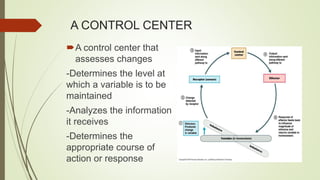
A CONTROL CENTER
A control center that
assesses changes
-Determines the level at
which a variable is to be
maintained
-Analyzes the information
it receives
-Determines the
appropriate course of
action or response
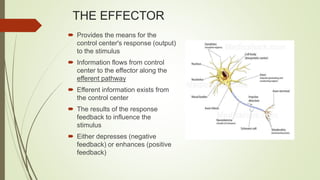
THE EFFECTOR
 Provides the means for the
control center's response (output)
to the stimulus
 Information flows from control
center to the effector along the
efferent pathway
 Efferent information exists from
the control center
 The results of the response
feedback to influence the
stimulus
 Either depresses (negative
feedback) or enhances (positive
feedback)
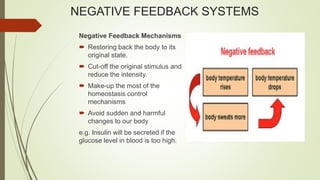
NEGATIVE FEEDBACK SYSTEMS
Negative Feedback Mechanisms
 Restoring back the body to its
original state.
 Cut-off the original stimulus and
reduce the intensity.
 Make-up the most of the
homeostasis control
mechanisms
 Avoid sudden and harmful
changes to our body
e.g. Insulin will be secreted if the
glucose level in blood is too high.
POSITIVE FEEDBACK SYSTEM
Tend to increase the
original disturbance
(stimulus) and to push
the variable farther from
its original value
Rare in the body
Events that occur
explosively
Ex. Blood clotting, birth
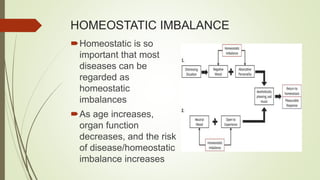
HOMEOSTATIC IMBALANCE
Homeostatic is so
important that most
diseases can be
regarded as
homeostatic
imbalances
As age increases,
organ function
decreases, and the risk
of disease/homeostatic
imbalance increases
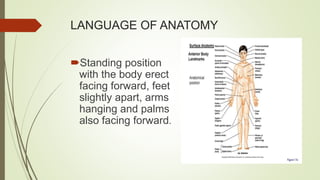
LANGUAGE OF ANATOMY
Standing position
with the body erect
facing forward, feet
slightly apart, arms
hanging and palms
also facing forward.
DIRECTIONAL TERMS
Explain and locate precisely where
the body structure and it's relation to
another.
TERM DEFINITION
Superior (Cranial) Toward head end, above
Inferior (Caudal) Away head end, below
Anterior (Ventral) Front of the body
Posterior (Dorsal) Behind the body
Medial Midline of the b, inner
Lateral Away from the midline, outer
Intermediate Between medial and lateral
Proximal Close to body origin
Distal Away from body origin
Superficial (External) Toward body surface
Deep (Internal) Away body surface
DIRECTIONAL TERMS
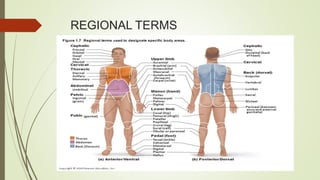
REGIONAL TERMS
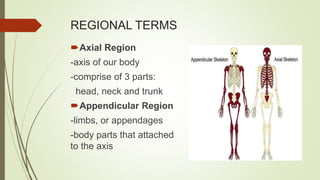
REGIONAL TERMS
Axial Region
-axis of our body
-comprise of 3 parts:
head, neck and trunk
Appendicular Region
-limbs, or appendages
-body parts that attached
to the axis
BODY PLANES AND SECTIONS
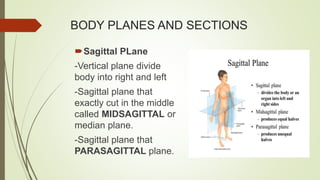
Sagittal PLane
-Vertical plane divide
body into right and left
-Sagittal plane that
exactly cut in the middle
called MIDSAGITTAL or
median plane.
-Sagittal plane that
PARASAGITTAL plane.
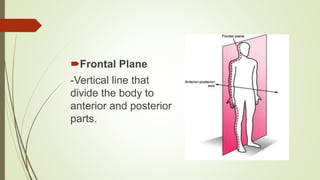
Frontal Plane
-Vertical line that
divide the body to
anterior and posterior
parts.
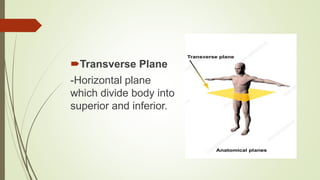
Transverse Plane
-Horizontal plane
which divide body into
superior and inferior.
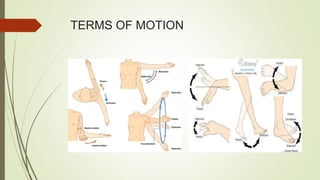
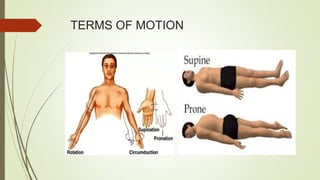
TERMS OF MOTION
TERMS OF MOTION
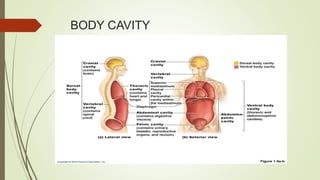
BODY CAVITY
BODY CAVITY
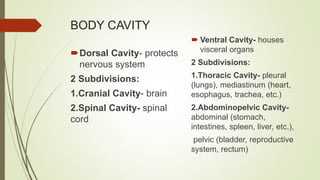
Dorsal Cavity- protects
nervous system
2 Subdivisions:
1.Cranial Cavity- brain
2.Spinal Cavity- spinal
cord
 Ventral Cavity- houses
visceral organs
2 Subdivisions:
1.Thoracic Cavity- pleural
(lungs), mediastinum (heart,
esophagus, trachea, etc.)
2.Abdominopelvic Cavity-
abdominal (stomach,
intestines, spleen, liver, etc.),
pelvic (bladder, reproductive
system, rectum)
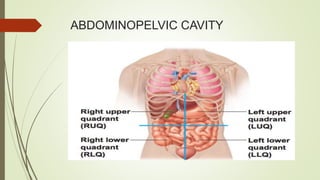
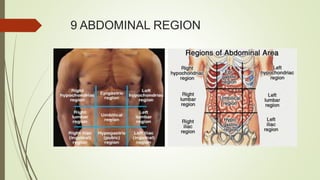
ABDOMINOPELVIC CAVITY
9 ABDOMINAL REGION
OTHER BODY CAVITIES
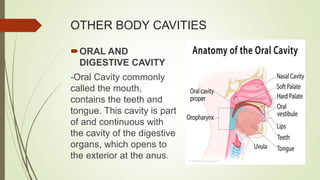
ORAL AND
DIGESTIVE CAVITY
-Oral Cavity commonly
called the mouth,
contains the teeth and
tongue. This cavity is part
of and continuous with
the cavity of the digestive
organs, which opens to
the exterior at the anus.
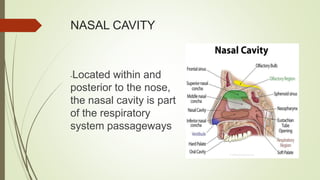
NASAL CAVITY
-Located within and
posterior to the nose,
the nasal cavity is part
of the respiratory
system passageways
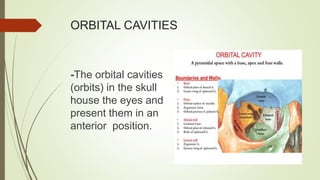
ORBITAL CAVITIES
-The orbital cavities
(orbits) in the skull
house the eyes and
present them in an
anterior position.
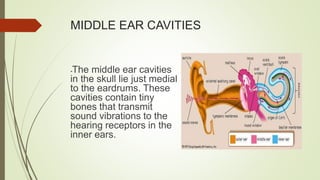
MIDDLE EAR CAVITIES
-The middle ear cavities
in the skull lie just medial
to the eardrums. These
cavities contain tiny
bones that transmit
sound vibrations to the
hearing receptors in the
inner ears.
SYNOVIAL CAVITIES
- Synovial cavities are joint
cavities. They are enclosed
within fibrous capsules that
surround freely movable joints of
the body (such as the elbow and
knee joints). Like the serous
membranes, membranes lining
synovial cavities secrete a
lubricating fluid that reduces
friction as the bones move
across one another.
REFERENCES
Marieb,E.N. (2019).Essentials of Human Anatomy
and Physiology.Jurong,Singapore:Pearson
Education South Asia Pte Ltd.
Copyright © 2003 Pearson Education, Inc. publishing
as Benjamin Cummings

HUMAN BODY AN OVERVIEW 1.pptx

  • 1.
  • 2.
    COURSE DESCRIPTION: The coursedeals with the combined study of the structures and functions of the human body, the relationship between Human Anatomy and Physiology, and this includes the definition of terms. Correlation of human biologic structure and normal physiologic functions, basic regulatory mechanisms which promotes homeostasis, familiarization of some physiologic parameters which serves as indicators for the organisms state of health.
  • 3.
    LEARNING OUTCOMES: At theend of the course, the students should be able to: KNOWLEDGE 1.Enumerate the different systems and each part of the human body and their function. 2.Define the different anatomical terms and its application to human anatomy and physiology. 3.Explain the different processes that are taken placed in human body.
  • 4.
    LEARNING OUTCOMES VALUES 1.Imbibe theimportance of Human Anatomy and Physiology in the value of healthy lifestyle and how this lifestyle can lead to good life. 2.Imbibe the importance of their knowledge in Human Anatomy and Physiology in the holistic caring of their future patients. 3.Imbibe the importance of Human Anatomy and Physiology in educating their future patients.
  • 5.
    LEARNING OUTCOMES SKILLS 1.Apply differentAnatomical Terms in their succeeding subjects, courses, and Nursing Clinical Areas. 2.Locate the different parts of the Human Body. 3.Illustrate how the relationship of Human Anatomy and Physiology affect our body systems.
  • 6.
    GRADING SYSTEM No.of Units:5 Units Midterm Exam: 50% Final Exam: 50% MIDTERM: LECTURE: 60% Quizzes…………....30% Class Standing…..30% (Recitation, Projects, Performance Tasks) Long Exam……….40%
  • 7.
    GRADING SYSTEM LABORATORY: 40% Quizzes/PracticalExam……25% (Recitation, Projects, Etc.) Class Standing……………….25% (Recitation, Projects, Etc.) Laboratory Activity/Performance Tasks………25%
  • 8.
    GRADING SYSTEM FINALS: LECTURE: 60% Quizzes……………30% ClassStanding…..30% (Recitation, Projects, Performance Tasks) Long Exam……….40%
  • 9.
    GRADING SYSTEM LABORATORY: 40% Quizzes/PracticalExam……25% (Recitation, Projects, Etc.) Class Standing……………….25% (Recitation, Projects, Etc.) Laboratory Activity/Performance Tasks…..25% Long Exam/Practical Exam…………….……25%
  • 10.
    RULES IN HUMANANATOMY AND PHYSIOLOGY CLASS Don’t be late. A 15 minute late is considered absent. Always take the exam on the day itself. There will be no special exam except for extreme cases. Put your cellphones in a silent mode during class hours.
  • 11.
    Use of personalelectronic devices are not allowed without permission during class hours. Confiscated personal electronic devices will be turned to the Discipline Officer. Policy on cheating will be strictly observed during exams. “No Sleeping” inside my class. You may go out from the class for your personal things, just raise your hand and go out through the backdoor.
  • 12.
    INSTRUCTIONAL MATERIALS: Textbook: Essentialsof Human Anatomy and Physiology by Elaine Marieb(2019) Laboratory Manual: Human Anatomy and Physiology Coloring Book by Elaine Marieb Any Human Anatomy Atlas Human Torso Model Human Skeletal Model Microscopic Slides
  • 13.
    HUMAN BODY: ANORIENTATION ANATOMY: The study of the structure and shape of the body and its parts and their relationships to one another. MACROSCOPIC/GROSS ANATOMY: The study of large body structures (e.g. heart, lungs, kidneys, etc.) It can be further divided into:
  • 14.
    MACROSCOPIC/GROSS ANATOMY 1.Regional Anatomy -allstructures(muscles, bones, blood vessels, nerves etc.) in one particular region such as abdomen or leg 2.Systematic Anatomy -system by system 3.Surface Anatomy -study of external body structures
  • 15.
    MICROSCOPIC ANATOMY: Thestudy of body structures too small to be seen with the naked eye. 1.Cytology -Study of body cells 2.Histology -Study of body tissues
  • 16.
    DEVELOPMENTAL ANATOMY -Structural changesto the body throughout lifespan 1.Embryology -Development which occur before birth
  • 17.
    PHYSIOLOGY: The studyof how the body and its parts work or function. SYSTEM PHYSIOLOGY -Study of body system’s function COMPARATIVE PHYSIOLOGY -Study of various characteristics of living organisms MEDICAL PHYSIOLOGY -Study of physiological dysfunction and diseases
  • 18.
    They are alwaysrelated The parts of the body form a well organized unit. PRINCIPLE OF COMPLEMENTARITY OF STRUCTURE AND FUNCTION -States that function is dependent on structure, and that the form of a structure relates to its function.
  • 19.
    Examples: 1.Bones can supportand protect body organs because they contain hard mineral deposits. 2.Blood flows in one direction because the heart has valves that prevent backflow.
  • 20.
  • 21.
    The Basics Each levelcontains progressively larger structures The structure in each level is composed of structures from the preceding level.
  • 22.
    Level 1- ChemicalLevel Smallest level of organization From atoms up to molecules Atom: The building blocks of all matter The smallest particle of a substance that can exist by itself or be combined with other atoms to form a molecule. Examples: H, H2O
  • 23.
    Level 2- CellularLevel Cells: The smallest unit of all living things. Example: Neurons
  • 24.
    Level 3- TissueLevel Tissue: It consist of groups of similar cells that have a common function 4 Basic Types of Tissue; 1.Epithelial Tissue 2.Connective Tissue 3.Muscular Tissue 4.Neural Tissue
  • 25.
    Level 4- OrganLevel Organ: The structure composed of two or more tissues types that performs a specific function. At this level, extremely complex functions become possible Example: Brain
  • 26.
    Level 5- OrganSystem Level Organ System: A group of organs that work together to accomplish a common purpose Example: Central Nervous System
  • 27.
    Level 6- OrganismalLevel Organism: An individual living thing composed of multiple organ systems working together Humans use 11 organ systems
  • 28.
    THE HUMAN ORGANSYSTEMS Please take note the structures involved and how each of these structures function both independently and together. Take note how the organ systems are interrelated
  • 29.
    INTEGUMENTARY SYSTEM Structures SKIN Epidermis Dermis Apocrine Gland SubcutaneousTissue Arrector Pili Muscle Eccrine Sweat Gland Melanocytes Hair Nails
  • 30.
    FUNCTIONS: Protect Fluid balance Absorption Synthesis ofVitamin D Sensation/Communication with external environment Thermoregulation Immunity Excretion
  • 31.
    SKELETAL SYSTEM STRUCTURES -Bones (206-Adult)(300-Pedia) -Joints: Point of articulation of two bones; provide ROM -Ligaments: Connects bone to bone -Cartilage: Supports and shapes; acts as a shock absorber -Bursae: Sacs filled with synovial fluid; cushion and reduce friction between joints
  • 32.
    Types of Joints Pivot Condyloid Balland Socket Hinge Plane/gliding Saddle
  • 33.
    FUNCTIONS OF SKELETALSYSTEM 1.Supports the body 2.Provides a framework for skeletal muscles 3.Protects some organs 4.Performs hematopoiesis HEMATOPOIESIS: Formation of blood cells
  • 34.
    MUSCULAR SYSTEM STRUCTURE: SkeletalMuscles FUNCTIONS: -To contract and to allow movement -Viewed as the “machines” of the body -Allows for locomotion, maintains posture, produces heat etc.
  • 35.
    NERVOUS SYSTEM STRUCTURE: Brain,spinal cord, nerves, sensory receptors (body’s fast-acting control system) FUNCTIONS: 1.Respond to external stimuli 2.Respond to internal stimuli 3.Assesses information and responds by Activating the appropriate body effectors (muscles or glands)
  • 36.
    ENDOCRINE SYSTEM STRUCTURE: Pituitary,Thyroid, Parathyroids, Adrenals, Thymus, and Pineal Glands, Pancreas, Ovaries/Testis FUNCTIONS: 1.Controls body activities (slower than the nervous system) 2.Produce and release hormones
  • 37.
    CARDIOVASCULAR SYSTEM STRUCTURE: Heartand Blood Vessels FUNCTIONS: 1.Carries oxygen, nutrients, hormones, and other Substances to and from tissue cells where exchanges are made 2.WBCs help protect the body from foreign invaders (bacteria, toxins, tumor cells)
  • 38.
    RESPIRATORY SYSTEM STRUCTURE: NasalPassages, Pharynx, Larynx (vocal cords), Trachea, Bronchi and Lungs FUNCTIONS: 1.Keeps body constantly supplied with oxygen 2.Removes carbon dioxide from the body 3.Thin walls of the air sacs allows gases to be trans- ported to and from the lungs
  • 39.
    LYMPHATIC SYSTEM STRUCTURE: LymphaticVessels, Lymph Nodes, Spleen, Tonsils FUNCTIONS: 1.Returns fluid leaked from the blood back to the blood vessels 2.Help cleanse the blood and house cells Involved in immunity 3.Compliments the Cardiovascular System
  • 40.
    DIGESTIVE SYTEM STRUCTURE: (Mouthto Anus) -Oral Cavity (Mouth), Esophagus, Stomach, Small and Large Intestines, Rectum, Anus FUNCTIONS: 1.Breakdown food 2.Deliver products to the blood for dispersal to the body cells 3,Reclaim water (large intestines)
  • 41.
    Liver is adigestive organ because it produces bile, which breakdown fats Pancreas delivers digestive enzymes to the small intestines, functionally a digestive organ
  • 42.
    URINARY/EXCRETORY SYSTEM STRUCTURE: Kidneys,Ureters, Bladder, Urethra FUNCTIONS: 1.Removes Nitrogen-containing wastes from the blood in the form of urine 2.Helps maintain salt and water balance (electrolyte) 3.Regulates the acid-base balance of the blood
  • 43.
    REPRODUCTIVE SYSTEM STRUCTURES: MALES: Testis,Scrotum, Penis, Accessory Glands And Duct System FEMALES: Ovaries, Uterine Tubes, Uterus, Vagina FUNCTIONS: -To produce offspring
  • 44.
    NECESSARY LIFE FUNCTION Whatthings must happen in individual organ systems and between multiple organ systems to allow the human body to function?
  • 45.
    THE BASIC IDEA All organisms must use and maintain necessary life functions  Organ systems are interdependent  It is important to establish which organ systems are most directly related to each life fnction
  • 47.
    WHAT MUST HAPPEN Maintain boundaries  Movement  Responsiveness  Digestion  Metabolism  Excretion  Reproduction  Growth
  • 48.
    MAINTAINING BOUNDARIES  Everyliving organism needs to maintain boundaries to keep “insides” distinct from “outsides”  Every individual cell has a membrane (most semi or selectively permeable) (Microscopic Anatomy)  The body is enclosed by the Integumentary System (Gross Anatomy) -Protects internal organs from drying out -Protects internal organs from bacteria Protects body from the damaging effects of heat, sunlight, chemical substances, and the external environment
  • 49.
    MOVEMENT  All activitiespromoted by the muscular system  Muscular system provides the muscles  Skeletal System provides the bones the muscles pull on as they work  Movement also occurs when substances are propelled through the internal organs of the cardiovascular, digestive and urinary systems
  • 50.
    RESPONSIVENESS  It isalso called as irritability  It is the ability to sense changes in the environment and react to them  The nervous system is the most responsible for responsiveness  However, all body cells are irritable to some extent
  • 51.
    DIGESTION  It isthe process of breaking down ingested food into simple molecules that can be absorbed into the blood  In the complex body this is performed by the digestive system
  • 52.
    METABOLISM  A broadterm that refers to all chemical reaction that occurs within body cells. It includes; -Breaking down complex molecules into smaller ones -Using Oxygen and nutrients to produce molecules of ATP (Adenosine Triphosphate, the energy-rich molecules that power cell activities)  Depends on the respiratory, digestive and cardiovascular system  Mainly regulated by hormones secreted by the glands on the endocrine system
  • 53.
    EXCRETION  It isthe process of removing excreta (wastes) from the body  Non- useful substances produced during digestion and metabolism must be removed  Several organ systems participate in excretion, including the digestive and urinary system
  • 54.
    REPRODUCTION  Responsible forthe production of offspring  Can occur at both the cellular and organismal levels Examples: Mitosis in cells, Human reproduction  Task of the reproductive system, regulated precisely by the hormones of the endocrine system
  • 55.
    GROWTH  An increasein size, usually accomplished by an increase number of cells  For growth to occur, cell constructing activities must occur at a faster rate than cell-destroying ones
  • 56.
    SURVIVAL NEEDS What arethe basic substances necessary for human survival?
  • 57.
    SURVIVAL NEEDS  Severalfactors necessary for maintaining life  Nutrients, oxygen, water, appropriate temperature and atmospheric  Must be present in appropriate amounts; too much or too little may be equally harmful
  • 58.
    NUTRIENTS Body takes in throughfood Contain the chemicals used for energy and cell building Proteins, carbohydrates, etc.
  • 59.
    OXYGEN The chemical reactions that releaseenergy from foods require oxygen Approximately 20% of the air we breathe is Oxygen (20.95%)
  • 60.
    WATER  60-80% bodyweight, 65- 75% in muscle, only 10% in fat  50-60% in most people, women have a lower percentage due to higher body fat  Single most abundant chemical substance in the body  Provides the fluid base for body secretions and excretions (secretion is an active process-particle movement/ excretion is a passive process-waste removal)  Chiefly ingested from foods and liquids  Lost by evaporation and body excretions
  • 61.
    BODY TEMPERATURE  Mustbe maintained around 37C or 98F  As temperature drops, metabolic reactions slow until they stop  As temperature rises, metabolic reactions speed up and can proceed too rapidly  At either extreme, death will occur  Most body heat is generated by the activity of skeletal muscles
  • 62.
    ATMOSPHERIC PRESSURE It isthe force exerted on the surface of the body by the weight of the air Breathing and the exchange of oxygen and carbon dioxide in the lungs depend on appropriate atmospheric pressure
  • 63.
  • 64.
    HOMEOSTASIS  A stateof body equilibrium or stable internal environment of the body  Literally means “unchanging” (Homeo=the same, stasis=standing still)  Dynamic state of equilibrium Examples: Blood pressure, waste accumulation, body temperature
  • 65.
    HOMEOSTASIS Communication is key, andis mainly controlled by the nervous and endocrine systems -nerves The factor being regulated by homeostasis is the variable
  • 66.
    HOMEOSTASIS All homeostatic control mechanisms haveat least three components; 1.A receptor 2.A control center 3.An effector
  • 67.
    A RECEPTOR  Areceptor that responds to environmental changes -Some type of sensor that monitors and responds to change -Stimulus: the change (pl.stimuli) -Sends information (input) to the second element (the control center) along afferent pathway -The afferent pathway approaches the control center
  • 68.
    A CONTROL CENTER Acontrol center that assesses changes -Determines the level at which a variable is to be maintained -Analyzes the information it receives -Determines the appropriate course of action or response
  • 69.
    THE EFFECTOR  Providesthe means for the control center's response (output) to the stimulus  Information flows from control center to the effector along the efferent pathway  Efferent information exists from the control center  The results of the response feedback to influence the stimulus  Either depresses (negative feedback) or enhances (positive feedback)
  • 70.
    NEGATIVE FEEDBACK SYSTEMS NegativeFeedback Mechanisms  Restoring back the body to its original state.  Cut-off the original stimulus and reduce the intensity.  Make-up the most of the homeostasis control mechanisms  Avoid sudden and harmful changes to our body e.g. Insulin will be secreted if the glucose level in blood is too high.
  • 71.
    POSITIVE FEEDBACK SYSTEM Tendto increase the original disturbance (stimulus) and to push the variable farther from its original value Rare in the body Events that occur explosively Ex. Blood clotting, birth
  • 72.
    HOMEOSTATIC IMBALANCE Homeostatic isso important that most diseases can be regarded as homeostatic imbalances As age increases, organ function decreases, and the risk of disease/homeostatic imbalance increases
  • 73.
    LANGUAGE OF ANATOMY Standingposition with the body erect facing forward, feet slightly apart, arms hanging and palms also facing forward.
  • 74.
    DIRECTIONAL TERMS Explain andlocate precisely where the body structure and it's relation to another.
  • 75.
    TERM DEFINITION Superior (Cranial)Toward head end, above Inferior (Caudal) Away head end, below Anterior (Ventral) Front of the body Posterior (Dorsal) Behind the body Medial Midline of the b, inner Lateral Away from the midline, outer Intermediate Between medial and lateral Proximal Close to body origin Distal Away from body origin Superficial (External) Toward body surface Deep (Internal) Away body surface
  • 76.
  • 77.
  • 78.
    REGIONAL TERMS Axial Region -axisof our body -comprise of 3 parts: head, neck and trunk Appendicular Region -limbs, or appendages -body parts that attached to the axis
  • 79.
    BODY PLANES ANDSECTIONS Sagittal PLane -Vertical plane divide body into right and left -Sagittal plane that exactly cut in the middle called MIDSAGITTAL or median plane. -Sagittal plane that PARASAGITTAL plane.
  • 80.
    Frontal Plane -Vertical linethat divide the body to anterior and posterior parts.
  • 81.
    Transverse Plane -Horizontal plane whichdivide body into superior and inferior.
  • 82.
  • 83.
  • 84.
  • 85.
    BODY CAVITY Dorsal Cavity-protects nervous system 2 Subdivisions: 1.Cranial Cavity- brain 2.Spinal Cavity- spinal cord  Ventral Cavity- houses visceral organs 2 Subdivisions: 1.Thoracic Cavity- pleural (lungs), mediastinum (heart, esophagus, trachea, etc.) 2.Abdominopelvic Cavity- abdominal (stomach, intestines, spleen, liver, etc.), pelvic (bladder, reproductive system, rectum)
  • 86.
  • 87.
  • 88.
    OTHER BODY CAVITIES ORALAND DIGESTIVE CAVITY -Oral Cavity commonly called the mouth, contains the teeth and tongue. This cavity is part of and continuous with the cavity of the digestive organs, which opens to the exterior at the anus.
  • 89.
    NASAL CAVITY -Located withinand posterior to the nose, the nasal cavity is part of the respiratory system passageways
  • 90.
    ORBITAL CAVITIES -The orbitalcavities (orbits) in the skull house the eyes and present them in an anterior position.
  • 91.
    MIDDLE EAR CAVITIES -Themiddle ear cavities in the skull lie just medial to the eardrums. These cavities contain tiny bones that transmit sound vibrations to the hearing receptors in the inner ears.
  • 92.
    SYNOVIAL CAVITIES - Synovialcavities are joint cavities. They are enclosed within fibrous capsules that surround freely movable joints of the body (such as the elbow and knee joints). Like the serous membranes, membranes lining synovial cavities secrete a lubricating fluid that reduces friction as the bones move across one another.
  • 93.
    REFERENCES Marieb,E.N. (2019).Essentials ofHuman Anatomy and Physiology.Jurong,Singapore:Pearson Education South Asia Pte Ltd. Copyright © 2003 Pearson Education, Inc. publishing as Benjamin Cummings