Physical Education
and
Health 11
Stress Management
WEEK 1-2
Stress is a reaction of the body and
mind to any unpleasant or challenging
events in life that requires attention or
action. It is a kind of reaction or change
that causes physical, emotional, or
psychological strain. Some responses
like being irritated, frightened or
anxious can cause headache or
stomachache.
Most people consider stress as a negative
experience. But in reality, it can also be positive
experience. Everyone experiences some degree
of stress in their lifetime, it is how we respond to
stress makes a big difference to our overall well-
being. The positive response of stress to our well-
being is called “Eustress” while the harmful
consequence of stress is called “Distress”.
Eustress or positive stress stimulates you to go on
thus you grow and improve. Who would not want
to grow and improve?
On the other hand, Distress or the negative
stress often causes poor performance and
even real physical diseases like cancer,
immune disorder, etc.
The perception of stress as positive or
negative response varies from person to
person. One single event might result to a
positive response to someone while it could
be negative response to another person.
What is Stress?
“The word “stress” is a commonly used term in today’s
vernacular, and most people appear to have an intuitive
sense of what it means.
refers to a collection of physiological, emotional,
behavioral, and cognitive reactions that occur in
response to environmental demands.
“stressor”  is any event or stimulus that causes stress.
However, what serves as a stressor for one
person may not be the same for another.
For example, being asked to attend a social
event may create stress for someone who
perceives that they lack the necessary social
skills to fit in, whereas another person who feels
comfortable in social situations may not
experience any stress. Stressors can take many
forms, ranging from the daily hassles of life to
significant life changes (Sherrod, 2019).
As we interact with the world around us, we must
make observations of environmental threats, challenges,
and demands and attempt to cope with any issues that
may come up. At times, environmental demands are easily
handled, such as when you have to press a button on a
key to unlock your car. However, at other times, the
demands of the environment can seem unmanageable,
such as when you have to take three exams on the
same day, and result in feelings of physical tension,
negative thought patterns, and unpleasant emotional
experiences (Sherrod,2019).
Body Responses to Stress
When threatened by environmental dangers, changes, or demands, humans
experience a variety of physiological and psychological changes. Once a threat has
been recognized and appraised as dangerous, the individual evaluates available
coping resources. If the demands of the situation are deemed to be greater than the
available coping resources, an “alarm” or “fightor-flight Response” is generated. During
the fight-or-flight response, the body prepares for action, generally consisting of either
confrontation or avoidance of the threat. The sympathetic nervous system is activated,
and hormones, including adrenaline and noradrenaline, are released into the blood
stream. Heart and respiration rates accelerate, and blood pressure increases, enabling
the body to quickly circulate oxygen-rich blood to the brain and large muscles of the
body. Blood is redirected away from the extremities to the core, and digestive
processes are slowed. Muscles tend to become tense, eyes dilate, and hearing
becomes more acute. Sweat glands activate to cool the body, and the skin often
becomes paler or flushed (Sherrod, 2019).
If the person is able to successfully
manage or avoid the stressor, the
body begins to return to
homeostasis. However, chronic
exposure to stress or recurrent
confrontations with stressful
stimuli can have a negative
consequences on the individual.
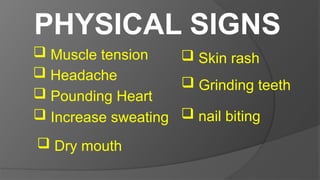
PHYSICAL SIGNS
 Muscle tension
 Headache
 Pounding Heart
 Increase sweating
 Dry mouth
 Skin rash
 Grinding teeth
 nail biting
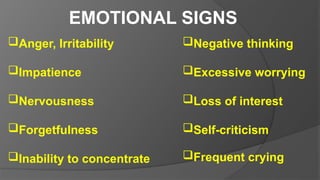
EMOTIONAL SIGNS
Anger, Irritability
Impatience
Nervousness
Forgetfulness
Inability to concentrate
Negative thinking
Excessive worrying
Loss of interest
Self-criticism
Frequent crying
Benefits and Costs of Stress
Although we generally think of stress as
something to avoid, stress is a natural, adaptive
response that serves a protective function. At
moderate levels, stress helps alert us to potential
threats in the environment and enables us to
focus our attention on resolving the threat
(Sherrod, 2019).
Although some stress is beneficial, prolonged, or intense stress
can be associated with a variety of negative physical and
psychological outcomes. For example, moderate amounts of
stress help to focus our attention, while excessive stress leads to
diminished attention, concentration, decision-making, and
shortterm memory. High stress can also lead to a variety of
emotional disturbances, including irritability, depression, and
anxiety disorders. Indeed, many researchers consider stress a
core component of the cause of emotional disorders. Chronic
high stress is associated with serious physical health concerns,
including cardiovascular disease, hypertension,
immunosuppression and more frequent illnesses, sexual
dysfunction, gastrointestinal disorders, and recurrent headaches.
It is important to recognize that
exceptionally low levels of stress can have
negative consequences as well. For
example, when arousal levels are too low,
people generally experience boredom,
poorer cognitive and physical
performance, procrastination, and lack of
attention to detail (Sherrod, 2019).
Stress
Management
The goal of stress management is not
to eliminate all stress. Rather, stress
management techniques are designed
to keep stress levels within an optimal
range. Engaging in healthy lifestyle
behaviors can help to reduce stress
and maximize the likelihood of living a
long, healthy life. The following stress
management techniques have been
consistently supported by empirical
research:
 physical activity
and exercise
 healthy eating
 adequate sleep
 relaxation, mindfulness
and meditation
 laughter, self-expression
and social support
 cognitive restructuring
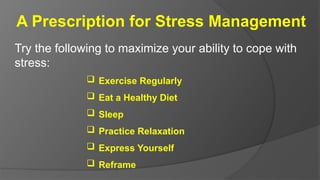
A Prescription for Stress Management
Try the following to maximize your ability to cope with
stress:
 Exercise Regularly
 Eat a Healthy Diet
 Sleep
 Practice Relaxation
 Express Yourself
 Reframe
THANK YOU
JAMES A. PURGAS
Health-Related Fitness,
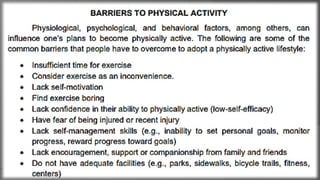
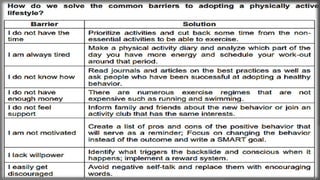
Barriers to Physical
Activity Participation
and One’s Diet
WEEK 3-4
In order to achieve a healthy lifestyle,
everyone must know how to embrace
physical fitness and the benefits from it.
Before engaging such physical activities, it
is necessary to take pre-cautionary
measures to avoid accident and that is to do
physical assessment first. Sometimes,
physical activity cannot go through because
of some barriers in achieving our goal and
health issues.
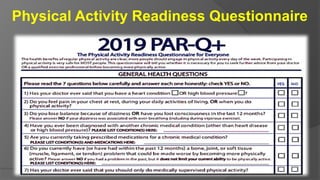
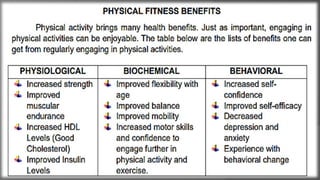
Physical Activity Readiness Questionnaire
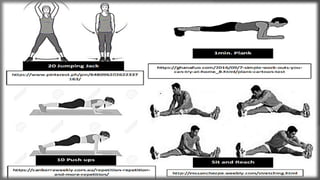
If you performed the illustrations with high
performance, then it means you are truly
motivated enough. If there are illustrations
that you were not able to perform well
then maybe you need to develop those
activities. Those illustrations are just some
of the activities present in HEALTH-
RELATED PHYSICAL FITNESS.
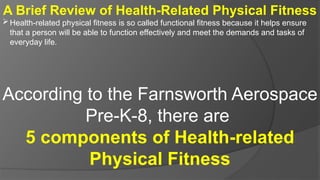
A Brief Review of Health-Related Physical Fitness
Health-related physical fitness is so called functional fitness because it helps ensure
that a person will be able to function effectively and meet the demands and tasks of
everyday life.
According to the Farnsworth Aerospace
Pre-K-8, there are
5 components of Health-related
Physical Fitness
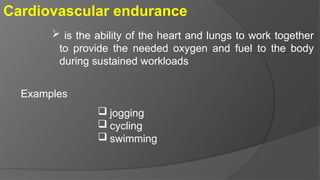
Cardiovascular endurance
 is the ability of the heart and lungs to work together
to provide the needed oxygen and fuel to the body
during sustained workloads
Examples
 jogging
 cycling
 swimming
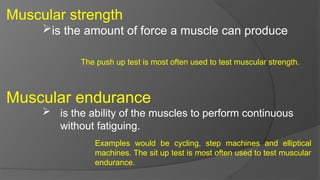
Muscular strength
is the amount of force a muscle can produce
The push up test is most often used to test muscular strength.
Muscular endurance
 is the ability of the muscles to perform continuous
without fatiguing.
Examples would be cycling, step machines and elliptical
machines. The sit up test is most often used to test muscular
endurance.
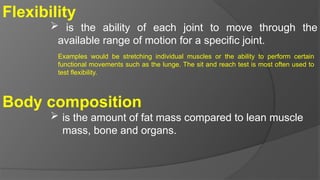
Flexibility
 is the ability of each joint to move through the
available range of motion for a specific joint.
Examples would be stretching individual muscles or the ability to perform certain
functional movements such as the lunge. The sit and reach test is most often used to
test flexibility.
Body composition
 is the amount of fat mass compared to lean muscle
mass, bone and organs.
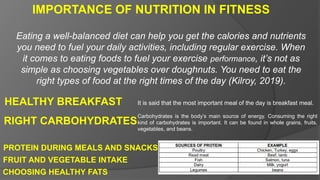
IMPORTANCE OF NUTRITION IN FITNESS
Eating a well-balanced diet can help you get the calories and nutrients
you need to fuel your daily activities, including regular exercise. When
it comes to eating foods to fuel your exercise performance, it’s not as
simple as choosing vegetables over doughnuts. You need to eat the
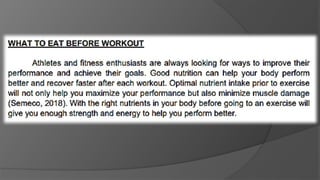
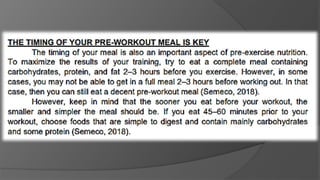
right types of food at the right times of the day (Kilroy, 2019).
HEALTHY BREAKFAST
RIGHT CARBOHYDRATES
It is said that the most important meal of the day is breakfast meal.
Carbohydrates is the body’s main source of energy. Consuming the right
kind of carbohydrates is important. It can be found in whole grains, fruits,
vegetables, and beans.
PROTEIN DURING MEALS AND SNACKS
FRUIT AND VEGETABLE INTAKE
CHOOSING HEALTHY FATS
PE-11-3rd-quarter-final.pptxdfdgffggfgfgfg

PE-11-3rd-quarter-final.pptxdfdgffggfgfgfg

  • 1.
  • 2.
    Stress is areaction of the body and mind to any unpleasant or challenging events in life that requires attention or action. It is a kind of reaction or change that causes physical, emotional, or psychological strain. Some responses like being irritated, frightened or anxious can cause headache or stomachache.
  • 3.
    Most people considerstress as a negative experience. But in reality, it can also be positive experience. Everyone experiences some degree of stress in their lifetime, it is how we respond to stress makes a big difference to our overall well- being. The positive response of stress to our well- being is called “Eustress” while the harmful consequence of stress is called “Distress”. Eustress or positive stress stimulates you to go on thus you grow and improve. Who would not want to grow and improve?
  • 4.
    On the otherhand, Distress or the negative stress often causes poor performance and even real physical diseases like cancer, immune disorder, etc. The perception of stress as positive or negative response varies from person to person. One single event might result to a positive response to someone while it could be negative response to another person.
  • 5.
    What is Stress? “Theword “stress” is a commonly used term in today’s vernacular, and most people appear to have an intuitive sense of what it means. refers to a collection of physiological, emotional, behavioral, and cognitive reactions that occur in response to environmental demands.
  • 6.
    “stressor”  isany event or stimulus that causes stress. However, what serves as a stressor for one person may not be the same for another. For example, being asked to attend a social event may create stress for someone who perceives that they lack the necessary social skills to fit in, whereas another person who feels comfortable in social situations may not experience any stress. Stressors can take many forms, ranging from the daily hassles of life to significant life changes (Sherrod, 2019).
  • 7.
    As we interactwith the world around us, we must make observations of environmental threats, challenges, and demands and attempt to cope with any issues that may come up. At times, environmental demands are easily handled, such as when you have to press a button on a key to unlock your car. However, at other times, the demands of the environment can seem unmanageable, such as when you have to take three exams on the same day, and result in feelings of physical tension, negative thought patterns, and unpleasant emotional experiences (Sherrod,2019).
  • 8.
    Body Responses toStress When threatened by environmental dangers, changes, or demands, humans experience a variety of physiological and psychological changes. Once a threat has been recognized and appraised as dangerous, the individual evaluates available coping resources. If the demands of the situation are deemed to be greater than the available coping resources, an “alarm” or “fightor-flight Response” is generated. During the fight-or-flight response, the body prepares for action, generally consisting of either confrontation or avoidance of the threat. The sympathetic nervous system is activated, and hormones, including adrenaline and noradrenaline, are released into the blood stream. Heart and respiration rates accelerate, and blood pressure increases, enabling the body to quickly circulate oxygen-rich blood to the brain and large muscles of the body. Blood is redirected away from the extremities to the core, and digestive processes are slowed. Muscles tend to become tense, eyes dilate, and hearing becomes more acute. Sweat glands activate to cool the body, and the skin often becomes paler or flushed (Sherrod, 2019).
  • 9.
    If the personis able to successfully manage or avoid the stressor, the body begins to return to homeostasis. However, chronic exposure to stress or recurrent confrontations with stressful stimuli can have a negative consequences on the individual.
  • 10.
    PHYSICAL SIGNS  Muscletension  Headache  Pounding Heart  Increase sweating  Dry mouth  Skin rash  Grinding teeth  nail biting
  • 11.
    EMOTIONAL SIGNS Anger, Irritability Impatience Nervousness Forgetfulness Inabilityto concentrate Negative thinking Excessive worrying Loss of interest Self-criticism Frequent crying
  • 13.
    Benefits and Costsof Stress Although we generally think of stress as something to avoid, stress is a natural, adaptive response that serves a protective function. At moderate levels, stress helps alert us to potential threats in the environment and enables us to focus our attention on resolving the threat (Sherrod, 2019).
  • 14.
    Although some stressis beneficial, prolonged, or intense stress can be associated with a variety of negative physical and psychological outcomes. For example, moderate amounts of stress help to focus our attention, while excessive stress leads to diminished attention, concentration, decision-making, and shortterm memory. High stress can also lead to a variety of emotional disturbances, including irritability, depression, and anxiety disorders. Indeed, many researchers consider stress a core component of the cause of emotional disorders. Chronic high stress is associated with serious physical health concerns, including cardiovascular disease, hypertension, immunosuppression and more frequent illnesses, sexual dysfunction, gastrointestinal disorders, and recurrent headaches.
  • 15.
    It is importantto recognize that exceptionally low levels of stress can have negative consequences as well. For example, when arousal levels are too low, people generally experience boredom, poorer cognitive and physical performance, procrastination, and lack of attention to detail (Sherrod, 2019).
  • 16.
    Stress Management The goal ofstress management is not to eliminate all stress. Rather, stress management techniques are designed to keep stress levels within an optimal range. Engaging in healthy lifestyle behaviors can help to reduce stress and maximize the likelihood of living a long, healthy life. The following stress management techniques have been consistently supported by empirical research:  physical activity and exercise  healthy eating  adequate sleep  relaxation, mindfulness and meditation  laughter, self-expression and social support  cognitive restructuring
  • 17.
    A Prescription forStress Management Try the following to maximize your ability to cope with stress:  Exercise Regularly  Eat a Healthy Diet  Sleep  Practice Relaxation  Express Yourself  Reframe
  • 19.
  • 20.
    Health-Related Fitness, Barriers toPhysical Activity Participation and One’s Diet WEEK 3-4
  • 21.
    In order toachieve a healthy lifestyle, everyone must know how to embrace physical fitness and the benefits from it. Before engaging such physical activities, it is necessary to take pre-cautionary measures to avoid accident and that is to do physical assessment first. Sometimes, physical activity cannot go through because of some barriers in achieving our goal and health issues.
  • 22.
  • 24.
    If you performedthe illustrations with high performance, then it means you are truly motivated enough. If there are illustrations that you were not able to perform well then maybe you need to develop those activities. Those illustrations are just some of the activities present in HEALTH- RELATED PHYSICAL FITNESS.
  • 26.
    A Brief Reviewof Health-Related Physical Fitness Health-related physical fitness is so called functional fitness because it helps ensure that a person will be able to function effectively and meet the demands and tasks of everyday life. According to the Farnsworth Aerospace Pre-K-8, there are 5 components of Health-related Physical Fitness
  • 27.
    Cardiovascular endurance  isthe ability of the heart and lungs to work together to provide the needed oxygen and fuel to the body during sustained workloads Examples  jogging  cycling  swimming
  • 28.
    Muscular strength is theamount of force a muscle can produce The push up test is most often used to test muscular strength. Muscular endurance  is the ability of the muscles to perform continuous without fatiguing. Examples would be cycling, step machines and elliptical machines. The sit up test is most often used to test muscular endurance.
  • 29.
    Flexibility  is theability of each joint to move through the available range of motion for a specific joint. Examples would be stretching individual muscles or the ability to perform certain functional movements such as the lunge. The sit and reach test is most often used to test flexibility. Body composition  is the amount of fat mass compared to lean muscle mass, bone and organs.
  • 32.
    IMPORTANCE OF NUTRITIONIN FITNESS Eating a well-balanced diet can help you get the calories and nutrients you need to fuel your daily activities, including regular exercise. When it comes to eating foods to fuel your exercise performance, it’s not as simple as choosing vegetables over doughnuts. You need to eat the right types of food at the right times of the day (Kilroy, 2019). HEALTHY BREAKFAST RIGHT CARBOHYDRATES It is said that the most important meal of the day is breakfast meal. Carbohydrates is the body’s main source of energy. Consuming the right kind of carbohydrates is important. It can be found in whole grains, fruits, vegetables, and beans. PROTEIN DURING MEALS AND SNACKS FRUIT AND VEGETABLE INTAKE CHOOSING HEALTHY FATS