COMPLEMENTARY,ALTERNATIVE
AND INTEGRATED HEALTH
PRACTICES
DR BHAVIN S MANDOWARA
MD MEDICINE RESIDENT
ā€“ā€œImagine a world - oriented toward healing rather
than disease, where physicians believed in the
natural healing capacity of human beings, and
emphasized prevention above treatment.
– In such a world, doctors and patients would
be partners working toward the same ends.ā€
OUTLINE
•LEARNING OBJECTIVES
•DEFINITION AND SCOPE
•TRMINOLOGY OF CAM PRACTICES
•PATTERN OF USE
•PRACTIONER BASED DISCIPLINES
•MIND-BODY INTERVENTIONS
•DIETARY SUPPLEMENTS
•PATIENT AND PROVIDER RESOURCES
•INTEGRATED MEDICINE
•TAKE HOME MESSAGES
•
WHY A PHYSICIAN SHOULD KNOW
ABOUT CAM ?
• Physicians are important sources for information
and guidance about health matters, but our
patients also rely on a wide range of other
sources including family and friends, cultural
traditions, alternative practitioners, and
increasingly the Internet, popular media, and
advertising. It is essential for physicians to
understand what patients are doing to seek
health, as this under-standing is important to
harness potential benefits and to help patients
avoid harm.
•
•
LEARNING OBJECTIVES
• COMPARE CAM TO CONVENTIONAL MEDICINE
• HOW CAM AND CONVENTIONAL MEDICINE CAN
BE USED TOGETHER (INTEGRATED MEDICINE)
• VARIOUS TYPES OF CAM
• HOW A PHYSICIAN USE HIS KNOWLEDGE OF CAM
• WHY ARE PATIENTS AND HEATH CARE
PRACTIONERS TURNING AWAY FROM
CONVENTIONAL MEDICINE
• REGULATIONS OF CAM
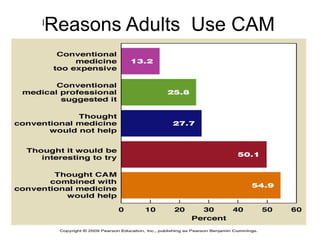
•Figure 17.1
l
Reasons Adults Use CAM
WHY ARE PEOPLE TURNING AWAY
FROM MAINSTREAM MEDICINE ?
• CAM offer optimism or greater personal attention
and provide 3 T’s : Time , Talk and Touch
• CAM is less expensive , have fewer side effects
and is more easily accessible
• Patient hasā€œself-helpā€ approach to health and
wellness
• It satisfies a search for ā€œNATURALā€ or less invasive
alternatives
• Promise of ā€œMIRACLE CURESā€ and quick results.
WHY ARE PEOPLE TURNING AWAY FROM
MAINSTREAM MEDICINE ?(…cont inued)
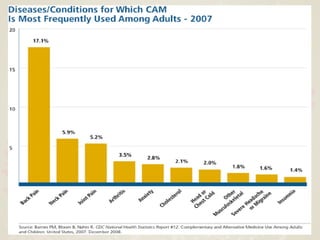
• Symptoms often poorly controlled by conventional
care, particularly back pain and other painful
musculoskeletal complaints, anxiety, and
insomnia.
• Failure or dissatisfaction with conventional healh
provider
• High health costs
• To treat side effects of drugs and treatment
• Focus on spirituality and emotional well being
• Ignorance and inadequate knowledge regarding
disease .
•
•
•
IS THERE A COMMON FRAME OF
REFERENCE WHICH WILL EXPLAIN BASIS OF
WORKING OF ALL MEDICAL SCIENCES?
Why do patients not tell their
physician about their CAM use?
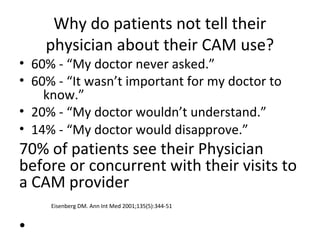
• 60% - ā€œMy doctor never asked.ā€
• 60% - ā€œIt wasn’t important for my doctor to
know.ā€
• 20% - ā€œMy doctor wouldn’t understand.ā€
• 14% - ā€œMy doctor would disapprove.ā€
70% of patients see their Physician
before or concurrent with their visits to
a CAM provider
Eisenberg DM. Ann Int Med 2001;135(5):344-51
•
DEFINITION AND SCOPE
•The phrase complementary and alternative
medicine (CAM) is used to describe group of
diverse medical and health care systems ,
practices and products that have historic origins
outside mainstream medicine .
•Alternative medicine is any practice that is
perceived by its users to have healing effects of
medicine but does not originate from evidence
based scientific method and is not a part of
biomedicine
•
DEFINITION AND SCOPE
• Alternative Medicine differs in that it is not
used as a complement but as a ā€œsubstituteā€
for conventional therapy .
• Complementary Medicine is alternative
medicine used together with conventional
medicine. i.e. it ā€œcomplementsā€ the
treatment
• Integrated medicine …discussed later
•
HOW MANY PEOPLE ARE USING CAM
WORLDWIDE ?
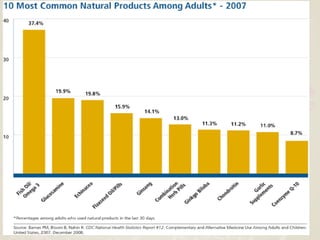
• In United states surveys, approximately 40% of
adults report using some form of complementary
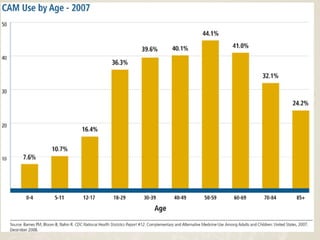
therapy or health practice. In the 2007 study, 38%
of adults and 12% of children had used one or
more modalities. These surveys yield the estimate
that non-vitamin and non-mineral dietary
supplements are used by approximately 18% of
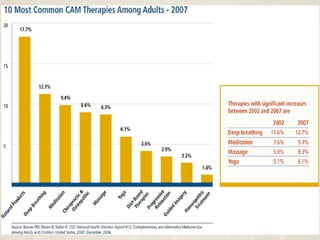
the population. The most prevalent mind-body
practices are relaxation techniques and
meditation, chiropractic, and therapeutic massage.
HOW MANY PEOPLE ARE USING CAM
WORLDWIDE ?
• Americans are willing to pay for these services;
the estimated out-of-pocket expenditure for
complementary health practices in 2007 was
$34 billion, representing 1.5% of total health
expenditures and 11% of out-of-pocket costs.
• 30,000 herbs on the market currently
• Estimates of $30-40 billion dollars spent annually.
• 600 Million Visits a Year to CAM Providers –
More Than to Primary Care Providers
•
Complementary and Alternative
MedicineCAM STATISTICS
Complementary and Alternative
Medicine
Complementary and Alternative
MedicineCAM STATISTICS
Complementary and Alternative
MedicineCAM STATISTICS
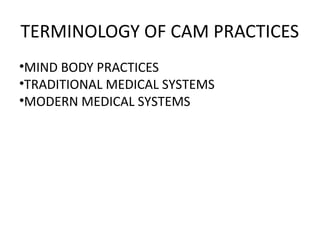
TERMINOLOGY OF CAM PRACTICES
•MIND BODY PRACTICES
•TRADITIONAL MEDICAL SYSTEMS
•MODERN MEDICAL SYSTEMS
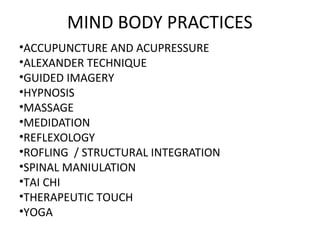
MIND BODY PRACTICES
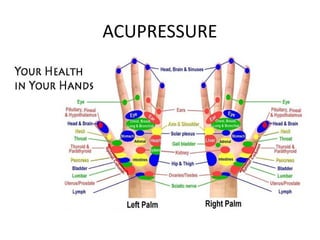
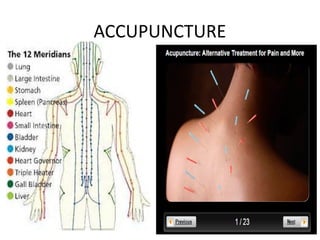
•ACCUPUNCTURE AND ACUPRESSURE
•ALEXANDER TECHNIQUE
•GUIDED IMAGERY
•HYPNOSIS
•MASSAGE
•MEDIDATION
•REFLEXOLOGY
•ROFLING / STRUCTURAL INTEGRATION
•SPINAL MANIULATION
•TAI CHI
•THERAPEUTIC TOUCH
•YOGA
TRADITIONAL MEDICAL SYSTEMS
•AYURVEDIC MEDICINE
•CURANDERISMO
•NATIVE AMERICAN MEDICINE
•SIDDHA MEDICINE
•TIBETIAN MEDICINE
•TRADITIONAL CHINESE MEDICINE
•UNANI MEDICINE
MODERN MEDICAL SYSTEMS
•ANTHROOSOHIC MEDICINE
•CHIROPRACTIC
•HOMEOPATHY
•NATUROPATHY
•OSTEOPATHY
ACCUPUNCTURE AND
ACUPRESSURE
ACCUPUNCTURE
STIMULATION OF DEFINED
ANATOMIC POINTS
ACUPRESSURE
INSERTION OF AND
MANIPULATION OF THIN
METALLIC NEEDLES
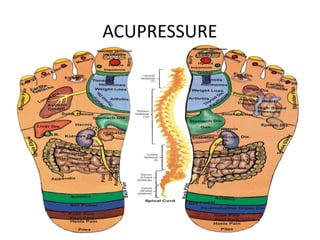
ACUPRESSURE
ACUPRESSURE
ACCUPUNCTURE
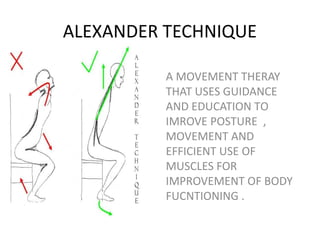
ALEXANDER TECHNIQUE
A MOVEMENT THERAY
THAT USES GUIDANCE
AND EDUCATION TO
IMROVE POSTURE ,
MOVEMENT AND
EFFICIENT USE OF
MUSCLES FOR
IMPROVEMENT OF BODY
FUCNTIONING .
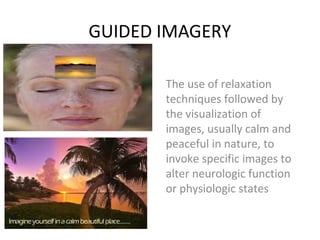
GUIDED IMAGERY
The use of relaxation
techniques followed by
the visualization of
images, usually calm and
peaceful in nature, to
invoke specific images to
alter neurologic function
or physiologic states
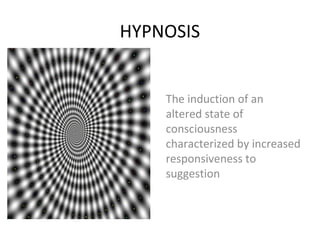
HYPNOSIS
The induction of an
altered state of
consciousness
characterized by increased
responsiveness to
suggestion
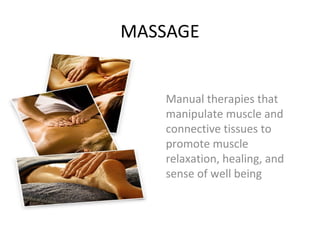
MASSAGE
Manual therapies that
manipulate muscle and
connective tissues to
promote muscle
relaxation, healing, and
sense of well being
MEDITATION
A group of practices,
largely based in Eastern
spiritual traditions,
intended to focus or
control attention and
obtain greater awareness
of the present moment, or
mindfulness
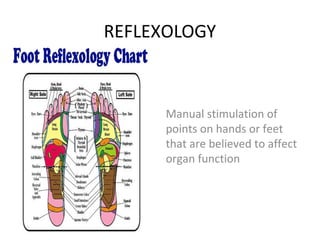
REFLEXOLOGY
Manual stimulation of
points on hands or feet
that are believed to affect
organ function
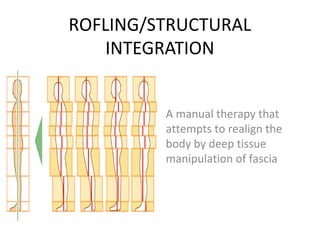
ROFLING/STRUCTURAL
INTEGRATION
A manual therapy that
attempts to realign the
body by deep tissue
manipulation of fascia
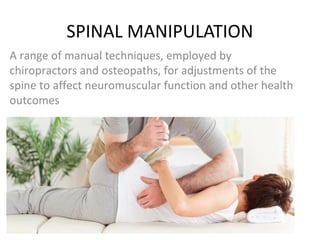
SPINAL MANIPULATION
A range of manual techniques, employed by
chiropractors and osteopaths, for adjustments of the
spine to affect neuromuscular function and other health
outcomes
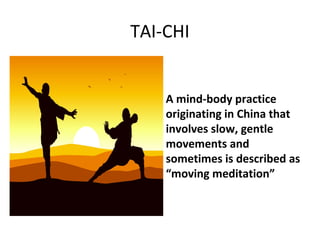
TAI-CHI
A mind-body practice
originating in China that
involves slow, gentle
movements and
sometimes is described as
ā€œmoving meditationā€
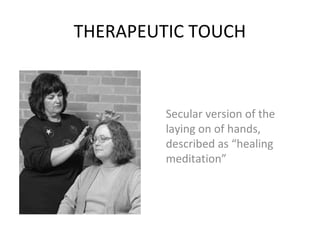
THERAPEUTIC TOUCH
Secular version of the
laying on of hands,
described as ā€œhealing
meditationā€
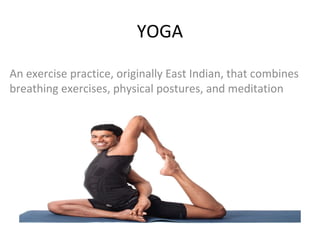
YOGA
An exercise practice, originally East Indian, that combines
breathing exercises, physical postures, and meditation
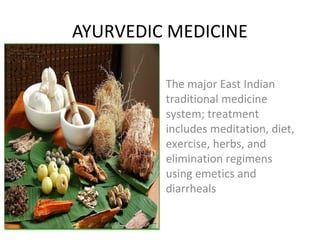
AYURVEDIC MEDICINE
The major East Indian
traditional medicine
system; treatment
includes meditation, diet,
exercise, herbs, and
elimination regimens
using emetics and
diarrheals
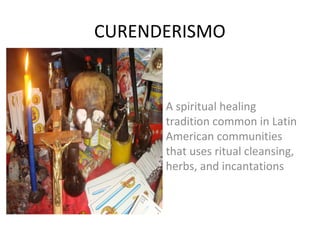
CURENDERISMO
A spiritual healing
tradition common in Latin
American communities
that uses ritual cleansing,
herbs, and incantations
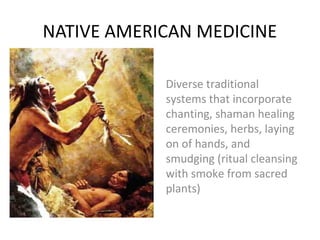
NATIVE AMERICAN MEDICINE
Diverse traditional
systems that incorporate
chanting, shaman healing
ceremonies, herbs, laying
on of hands, and
smudging (ritual cleansing
with smoke from sacred
plants)
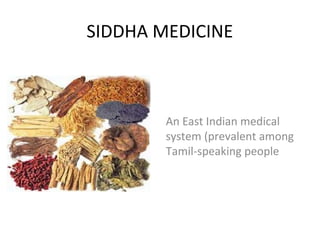
SIDDHA MEDICINE
An East Indian medical
system (prevalent among
Tamil-speaking people
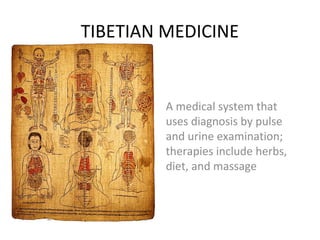
TIBETIAN MEDICINE
A medical system that
uses diagnosis by pulse
and urine examination;
therapies include herbs,
diet, and massage
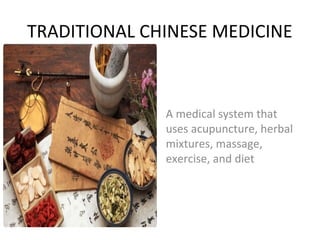
TRADITIONAL CHINESE MEDICINE
A medical system that
uses acupuncture, herbal
mixtures, massage,
exercise, and diet
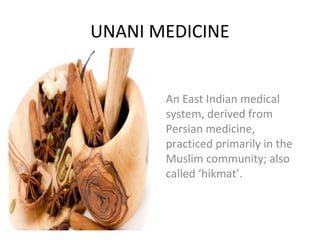
UNANI MEDICINE
An East Indian medical
system, derived from
Persian medicine,
practiced primarily in the
Muslim community; also
called ā€˜hikmat’.
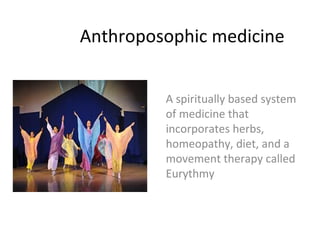
Anthroposophic medicine
A spiritually based system
of medicine that
incorporates herbs,
homeopathy, diet, and a
movement therapy called
Eurythmy
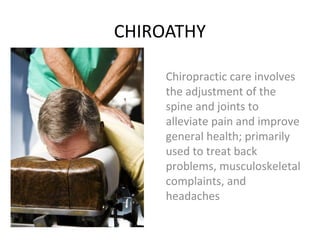
CHIROATHY
Chiropractic care involves
the adjustment of the
spine and joints to
alleviate pain and improve
general health; primarily
used to treat back
problems, musculoskeletal
complaints, and
headaches
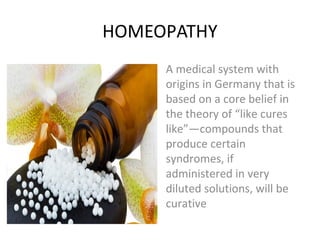
HOMEOPATHY
A medical system with
origins in Germany that is
based on a core belief in
the theory of ā€œlike cures
likeā€ā€”compounds that
produce certain
syndromes, if
administered in very
diluted solutions, will be
curative
HOMEOPATHY
Homeopathic medicine
Treating syndromes and conditions with
remedies that produce similar syndromes
and conditions in healthy people
Produces the symptoms it is given to treat
in order to stimulate the body’s natural
defenses to heal itself
Looks at individuals , not diseases
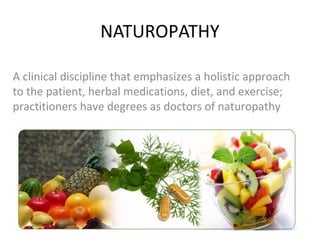
NATUROPATHY
A clinical discipline that emphasizes a holistic approach
to the patient, herbal medications, diet, and exercise;
practitioners have degrees as doctors of naturopathy
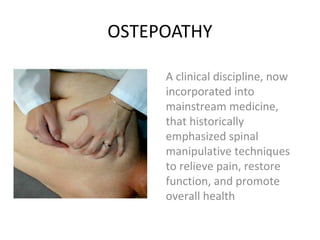
OSTEPOATHY
A clinical discipline, now
incorporated into
mainstream medicine,
that historically
emphasized spinal
manipulative techniques
to relieve pain, restore
function, and promote
overall health
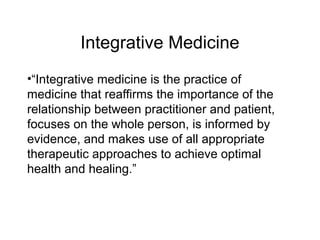
Integrative Medicine
ā€¢ā€œIntegrative medicine is the practice of
medicine that reaffirms the importance of the
relationship between practitioner and patient,
focuses on the whole person, is informed by
evidence, and makes use of all appropriate
therapeutic approaches to achieve optimal
health and healing.ā€

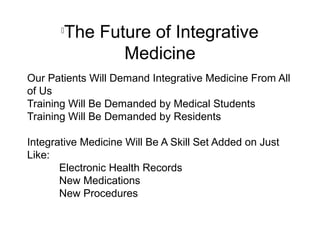
The Future of Integrative
Medicine
Our Patients Will Demand Integrative Medicine From All
of Us
Training Will Be Demanded by Medical Students
Training Will Be Demanded by Residents
Integrative Medicine Will Be A Skill Set Added on Just
Like:
Electronic Health Records
New Medications
New Procedures
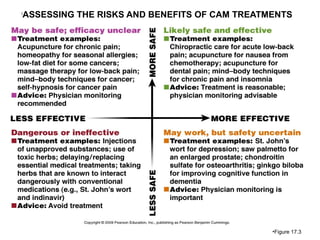
•Figure 17.3
l
ASSESSING THE RISKS AND BENEFITS OF CAM TREATMENTS
TAKE HOME MESSAGES
1.Be non-judgmental despite personal opinions
2. Build rapport by showing patient respect – if not, he may be afraid
to tell about CAM use
3. Understand that C.A.M. can be beneficial, when used correctly
4. Be aware that C.A.M. can be dangerous if it interacts or interferes
with conventional treatment
5. Be willing to teach the public about the positive and negative
information regarding C.A.M.
6. Be aware that use of C.A.M. is popular and increasing and must be
included in the history & physical
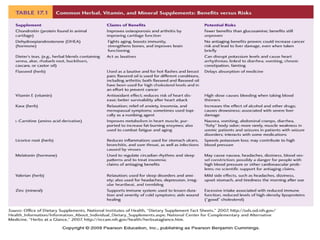
7. Know that Herbals, in particular, can have significant effect on
prescription drugs and body function
THANK YOUTHANK YOU

Complementary and alternative medicine

  • 1.
    COMPLEMENTARY,ALTERNATIVE AND INTEGRATED HEALTH PRACTICES DRBHAVIN S MANDOWARA MD MEDICINE RESIDENT
  • 2.
    ā€“ā€œImagine a world- oriented toward healing rather than disease, where physicians believed in the natural healing capacity of human beings, and emphasized prevention above treatment. – In such a world, doctors and patients would be partners working toward the same ends.ā€
  • 3.
    OUTLINE •LEARNING OBJECTIVES •DEFINITION ANDSCOPE •TRMINOLOGY OF CAM PRACTICES •PATTERN OF USE •PRACTIONER BASED DISCIPLINES •MIND-BODY INTERVENTIONS •DIETARY SUPPLEMENTS •PATIENT AND PROVIDER RESOURCES •INTEGRATED MEDICINE •TAKE HOME MESSAGES •
  • 4.
    WHY A PHYSICIANSHOULD KNOW ABOUT CAM ? • Physicians are important sources for information and guidance about health matters, but our patients also rely on a wide range of other sources including family and friends, cultural traditions, alternative practitioners, and increasingly the Internet, popular media, and advertising. It is essential for physicians to understand what patients are doing to seek health, as this under-standing is important to harness potential benefits and to help patients avoid harm. • •
  • 5.
    LEARNING OBJECTIVES • COMPARECAM TO CONVENTIONAL MEDICINE • HOW CAM AND CONVENTIONAL MEDICINE CAN BE USED TOGETHER (INTEGRATED MEDICINE) • VARIOUS TYPES OF CAM • HOW A PHYSICIAN USE HIS KNOWLEDGE OF CAM • WHY ARE PATIENTS AND HEATH CARE PRACTIONERS TURNING AWAY FROM CONVENTIONAL MEDICINE • REGULATIONS OF CAM
  • 6.
  • 7.
    WHY ARE PEOPLETURNING AWAY FROM MAINSTREAM MEDICINE ? • CAM offer optimism or greater personal attention and provide 3 T’s : Time , Talk and Touch • CAM is less expensive , have fewer side effects and is more easily accessible • Patient hasā€œself-helpā€ approach to health and wellness • It satisfies a search for ā€œNATURALā€ or less invasive alternatives • Promise of ā€œMIRACLE CURESā€ and quick results.
  • 8.
    WHY ARE PEOPLETURNING AWAY FROM MAINSTREAM MEDICINE ?(…cont inued) • Symptoms often poorly controlled by conventional care, particularly back pain and other painful musculoskeletal complaints, anxiety, and insomnia. • Failure or dissatisfaction with conventional healh provider • High health costs • To treat side effects of drugs and treatment • Focus on spirituality and emotional well being • Ignorance and inadequate knowledge regarding disease . • • •
  • 9.
    IS THERE ACOMMON FRAME OF REFERENCE WHICH WILL EXPLAIN BASIS OF WORKING OF ALL MEDICAL SCIENCES?
  • 10.
    Why do patientsnot tell their physician about their CAM use? • 60% - ā€œMy doctor never asked.ā€ • 60% - ā€œIt wasn’t important for my doctor to know.ā€ • 20% - ā€œMy doctor wouldn’t understand.ā€ • 14% - ā€œMy doctor would disapprove.ā€ 70% of patients see their Physician before or concurrent with their visits to a CAM provider Eisenberg DM. Ann Int Med 2001;135(5):344-51 •
  • 11.
    DEFINITION AND SCOPE •Thephrase complementary and alternative medicine (CAM) is used to describe group of diverse medical and health care systems , practices and products that have historic origins outside mainstream medicine . •Alternative medicine is any practice that is perceived by its users to have healing effects of medicine but does not originate from evidence based scientific method and is not a part of biomedicine •
  • 12.
    DEFINITION AND SCOPE •Alternative Medicine differs in that it is not used as a complement but as a ā€œsubstituteā€ for conventional therapy . • Complementary Medicine is alternative medicine used together with conventional medicine. i.e. it ā€œcomplementsā€ the treatment • Integrated medicine …discussed later •
  • 13.
    HOW MANY PEOPLEARE USING CAM WORLDWIDE ? • In United states surveys, approximately 40% of adults report using some form of complementary therapy or health practice. In the 2007 study, 38% of adults and 12% of children had used one or more modalities. These surveys yield the estimate that non-vitamin and non-mineral dietary supplements are used by approximately 18% of the population. The most prevalent mind-body practices are relaxation techniques and meditation, chiropractic, and therapeutic massage.
  • 14.
    HOW MANY PEOPLEARE USING CAM WORLDWIDE ? • Americans are willing to pay for these services; the estimated out-of-pocket expenditure for complementary health practices in 2007 was $34 billion, representing 1.5% of total health expenditures and 11% of out-of-pocket costs. • 30,000 herbs on the market currently • Estimates of $30-40 billion dollars spent annually. • 600 Million Visits a Year to CAM Providers – More Than to Primary Care Providers •
  • 15.
  • 16.
  • 17.
  • 18.
  • 19.
    TERMINOLOGY OF CAMPRACTICES •MIND BODY PRACTICES •TRADITIONAL MEDICAL SYSTEMS •MODERN MEDICAL SYSTEMS
  • 20.
    MIND BODY PRACTICES •ACCUPUNCTUREAND ACUPRESSURE •ALEXANDER TECHNIQUE •GUIDED IMAGERY •HYPNOSIS •MASSAGE •MEDIDATION •REFLEXOLOGY •ROFLING / STRUCTURAL INTEGRATION •SPINAL MANIULATION •TAI CHI •THERAPEUTIC TOUCH •YOGA
  • 21.
    TRADITIONAL MEDICAL SYSTEMS •AYURVEDICMEDICINE •CURANDERISMO •NATIVE AMERICAN MEDICINE •SIDDHA MEDICINE •TIBETIAN MEDICINE •TRADITIONAL CHINESE MEDICINE •UNANI MEDICINE
  • 22.
    MODERN MEDICAL SYSTEMS •ANTHROOSOHICMEDICINE •CHIROPRACTIC •HOMEOPATHY •NATUROPATHY •OSTEOPATHY
  • 23.
    ACCUPUNCTURE AND ACUPRESSURE ACCUPUNCTURE STIMULATION OFDEFINED ANATOMIC POINTS ACUPRESSURE INSERTION OF AND MANIPULATION OF THIN METALLIC NEEDLES
  • 24.
  • 25.
  • 26.
  • 27.
    ALEXANDER TECHNIQUE A MOVEMENTTHERAY THAT USES GUIDANCE AND EDUCATION TO IMROVE POSTURE , MOVEMENT AND EFFICIENT USE OF MUSCLES FOR IMPROVEMENT OF BODY FUCNTIONING .
  • 28.
    GUIDED IMAGERY The useof relaxation techniques followed by the visualization of images, usually calm and peaceful in nature, to invoke specific images to alter neurologic function or physiologic states
  • 29.
    HYPNOSIS The induction ofan altered state of consciousness characterized by increased responsiveness to suggestion
  • 30.
    MASSAGE Manual therapies that manipulatemuscle and connective tissues to promote muscle relaxation, healing, and sense of well being
  • 31.
    MEDITATION A group ofpractices, largely based in Eastern spiritual traditions, intended to focus or control attention and obtain greater awareness of the present moment, or mindfulness
  • 32.
    REFLEXOLOGY Manual stimulation of pointson hands or feet that are believed to affect organ function
  • 33.
    ROFLING/STRUCTURAL INTEGRATION A manual therapythat attempts to realign the body by deep tissue manipulation of fascia
  • 34.
    SPINAL MANIPULATION A rangeof manual techniques, employed by chiropractors and osteopaths, for adjustments of the spine to affect neuromuscular function and other health outcomes
  • 35.
    TAI-CHI A mind-body practice originatingin China that involves slow, gentle movements and sometimes is described as ā€œmoving meditationā€
  • 36.
    THERAPEUTIC TOUCH Secular versionof the laying on of hands, described as ā€œhealing meditationā€
  • 37.
    YOGA An exercise practice,originally East Indian, that combines breathing exercises, physical postures, and meditation
  • 38.
    AYURVEDIC MEDICINE The majorEast Indian traditional medicine system; treatment includes meditation, diet, exercise, herbs, and elimination regimens using emetics and diarrheals
  • 39.
    CURENDERISMO A spiritual healing traditioncommon in Latin American communities that uses ritual cleansing, herbs, and incantations
  • 40.
    NATIVE AMERICAN MEDICINE Diversetraditional systems that incorporate chanting, shaman healing ceremonies, herbs, laying on of hands, and smudging (ritual cleansing with smoke from sacred plants)
  • 41.
    SIDDHA MEDICINE An EastIndian medical system (prevalent among Tamil-speaking people
  • 42.
    TIBETIAN MEDICINE A medicalsystem that uses diagnosis by pulse and urine examination; therapies include herbs, diet, and massage
  • 43.
    TRADITIONAL CHINESE MEDICINE Amedical system that uses acupuncture, herbal mixtures, massage, exercise, and diet
  • 44.
    UNANI MEDICINE An EastIndian medical system, derived from Persian medicine, practiced primarily in the Muslim community; also called ā€˜hikmat’.
  • 45.
    Anthroposophic medicine A spirituallybased system of medicine that incorporates herbs, homeopathy, diet, and a movement therapy called Eurythmy
  • 46.
    CHIROATHY Chiropractic care involves theadjustment of the spine and joints to alleviate pain and improve general health; primarily used to treat back problems, musculoskeletal complaints, and headaches
  • 47.
    HOMEOPATHY A medical systemwith origins in Germany that is based on a core belief in the theory of ā€œlike cures likeā€ā€”compounds that produce certain syndromes, if administered in very diluted solutions, will be curative
  • 48.
    HOMEOPATHY Homeopathic medicine Treating syndromesand conditions with remedies that produce similar syndromes and conditions in healthy people Produces the symptoms it is given to treat in order to stimulate the body’s natural defenses to heal itself Looks at individuals , not diseases
  • 49.
    NATUROPATHY A clinical disciplinethat emphasizes a holistic approach to the patient, herbal medications, diet, and exercise; practitioners have degrees as doctors of naturopathy
  • 50.
    OSTEPOATHY A clinical discipline,now incorporated into mainstream medicine, that historically emphasized spinal manipulative techniques to relieve pain, restore function, and promote overall health
  • 51.
    Integrative Medicine ā€¢ā€œIntegrative medicineis the practice of medicine that reaffirms the importance of the relationship between practitioner and patient, focuses on the whole person, is informed by evidence, and makes use of all appropriate therapeutic approaches to achieve optimal health and healing.ā€
  • 52.
     The Future ofIntegrative Medicine Our Patients Will Demand Integrative Medicine From All of Us Training Will Be Demanded by Medical Students Training Will Be Demanded by Residents Integrative Medicine Will Be A Skill Set Added on Just Like: Electronic Health Records New Medications New Procedures
  • 53.
    •Figure 17.3 l ASSESSING THERISKS AND BENEFITS OF CAM TREATMENTS
  • 55.
    TAKE HOME MESSAGES 1.Benon-judgmental despite personal opinions 2. Build rapport by showing patient respect – if not, he may be afraid to tell about CAM use 3. Understand that C.A.M. can be beneficial, when used correctly 4. Be aware that C.A.M. can be dangerous if it interacts or interferes with conventional treatment 5. Be willing to teach the public about the positive and negative information regarding C.A.M. 6. Be aware that use of C.A.M. is popular and increasing and must be included in the history & physical 7. Know that Herbals, in particular, can have significant effect on prescription drugs and body function
  • 56.

Editor's Notes

  • #52Ā Acupuncture Consult in the HTU