Stress and Its Management
Stress Definitions Stress —a complex series of reactions, both psychological and physical, in response to demanding or threatening situations Stressors —events that produce physical and psychological demands on a person
Stress Definitions (continued) Distress —events or situations that produce negative or unwanted outcomes and are difficult to control Eustress —events or situations that create demands on a person that result in positive outcomes (e.g., becoming a new parent, accepting a desired job)  Eustress can still have negative effects on the body and mind because it requires physical and psychological adjustments.
Response to Stress Each person appraises a situation according to previous experiences and personality. Some situations can have positive, neutral, or negative outcomes for different people.
Physiological Stressors Exercise Illness Injury Exposure to pollutants Exposure to extreme temperatures
Psychological Stressors Extreme emotions Difficult social situations Troublesome thoughts and  relationships
Physical Responses to Stress Release of stress hormones Cortisol, epinephrine, and norepinephrine Release of endorphins Physical adaptations Increased heart and breathing rates, blood pressure, sweating, blood clotting ability, and size of pupils Decreased GI tract movements and saliva production
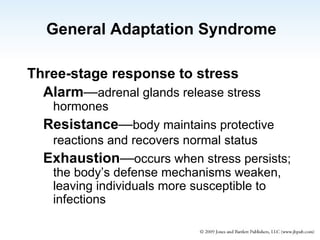
General Adaptation Syndrome Three-stage response to stress Alarm — adrenal glands release stress hormones Resistance — body maintains protective reactions and recovers normal status   Exhaustion — occurs when stress persists; the body’s defense mechanisms weaken, leaving individuals more susceptible to infections
Psychological Responses Typically, stressed out people feel: Depressed and anxious Frustrated Irritable and angry The “stressed out” person may:  Eat too much food Abuse substances Have difficulty focusing attention, making decisions, and sleeping
Psychoneuroimmunology A field of medical research that studies the relationships between the nervous and immune systems. Stress changes the normal balance and functioning of the immune system. Certain chronic health conditions are linked to stress and may worsen or recur during periods of increased stress (e.g., ulcers, headaches).
Personality, Disease, and Stress People who only see negative aspects of stressor may be more vulnerable to stress than those who make more positive appraisals of the situation. People who are less vulnerable to stress have personalities that act as buffers. -  These individuals generally have more positive outlooks on life.
Personality, Disease, and Stress (continued) People who harbor feelings of anger, hostility, resentment, suspicion, and mistrust have a higher risk of cardiovascular disease than people who do not have these feelings.  “Type A” persons are not necessarily at risk. Chronic stress increases the risk of cardiovascular disease, particularly stroke.
Personality, Disease, and Stress (continued) Stress responses can reduce effectiveness of immune system. Most scientific studies, however, do not show association between personality and cancer onset. Cancer patients with optimistic outlooks and fighting spirits tend to survive longer than cancer patients without these characteristics.
Coping Strategies Coping strategies are behavioral responses and thought processes that people use to deal actively with sources of stress. Problem-focused  (e.g., planning, confronting, problem solving, time management, journal writing) Emotion-focused  (e.g., use of defense mechanisms, humor) Social support  (e.g., seeking assistance from friends, relative, support groups, spiritual help, pets)
Relaxation Techniques Deep breathing Progressive muscle relaxation Meditation Imagery Self-talk Physical exercise Tai chi  Yoga
Across the Life Span Common childhood stressors Divorce of parents Death or separation of close family member Move to new neighborhood Serious illness of close family member Common adolescent stressors Physical and social changes Common stressors of the elderly Financial situation Social isolation Death of spouse or friends

Chapter 3

  • 1.
    Stress and ItsManagement
  • 2.
    Stress Definitions Stress—a complex series of reactions, both psychological and physical, in response to demanding or threatening situations Stressors —events that produce physical and psychological demands on a person
  • 3.
    Stress Definitions (continued)Distress —events or situations that produce negative or unwanted outcomes and are difficult to control Eustress —events or situations that create demands on a person that result in positive outcomes (e.g., becoming a new parent, accepting a desired job) Eustress can still have negative effects on the body and mind because it requires physical and psychological adjustments.
  • 4.
    Response to StressEach person appraises a situation according to previous experiences and personality. Some situations can have positive, neutral, or negative outcomes for different people.
  • 5.
    Physiological Stressors ExerciseIllness Injury Exposure to pollutants Exposure to extreme temperatures
  • 6.
    Psychological Stressors Extremeemotions Difficult social situations Troublesome thoughts and relationships
  • 7.
    Physical Responses toStress Release of stress hormones Cortisol, epinephrine, and norepinephrine Release of endorphins Physical adaptations Increased heart and breathing rates, blood pressure, sweating, blood clotting ability, and size of pupils Decreased GI tract movements and saliva production
  • 8.
    General Adaptation SyndromeThree-stage response to stress Alarm — adrenal glands release stress hormones Resistance — body maintains protective reactions and recovers normal status Exhaustion — occurs when stress persists; the body’s defense mechanisms weaken, leaving individuals more susceptible to infections
  • 9.
    Psychological Responses Typically,stressed out people feel: Depressed and anxious Frustrated Irritable and angry The “stressed out” person may: Eat too much food Abuse substances Have difficulty focusing attention, making decisions, and sleeping
  • 10.
    Psychoneuroimmunology A fieldof medical research that studies the relationships between the nervous and immune systems. Stress changes the normal balance and functioning of the immune system. Certain chronic health conditions are linked to stress and may worsen or recur during periods of increased stress (e.g., ulcers, headaches).
  • 11.
    Personality, Disease, andStress People who only see negative aspects of stressor may be more vulnerable to stress than those who make more positive appraisals of the situation. People who are less vulnerable to stress have personalities that act as buffers. - These individuals generally have more positive outlooks on life.
  • 12.
    Personality, Disease, andStress (continued) People who harbor feelings of anger, hostility, resentment, suspicion, and mistrust have a higher risk of cardiovascular disease than people who do not have these feelings. “Type A” persons are not necessarily at risk. Chronic stress increases the risk of cardiovascular disease, particularly stroke.
  • 13.
    Personality, Disease, andStress (continued) Stress responses can reduce effectiveness of immune system. Most scientific studies, however, do not show association between personality and cancer onset. Cancer patients with optimistic outlooks and fighting spirits tend to survive longer than cancer patients without these characteristics.
  • 14.
    Coping Strategies Copingstrategies are behavioral responses and thought processes that people use to deal actively with sources of stress. Problem-focused (e.g., planning, confronting, problem solving, time management, journal writing) Emotion-focused (e.g., use of defense mechanisms, humor) Social support (e.g., seeking assistance from friends, relative, support groups, spiritual help, pets)
  • 15.
    Relaxation Techniques Deepbreathing Progressive muscle relaxation Meditation Imagery Self-talk Physical exercise Tai chi Yoga
  • 16.
    Across the LifeSpan Common childhood stressors Divorce of parents Death or separation of close family member Move to new neighborhood Serious illness of close family member Common adolescent stressors Physical and social changes Common stressors of the elderly Financial situation Social isolation Death of spouse or friends