Managing Stress What You Need to Know Provided By Nevada Cancer Institute Department of Outreach and Education
NVCI Mission The mission of Nevada Cancer Institute is to reduce the burden  of cancer for Nevada, the nation and the world through innovative and collaborative research, education and patient care. The mission of the Outreach and Education Department of NVCI  is to provide  awareness, education, and support  to the public as  it pertains to cancer risks,   detection, and treatment.
NVCI Programming Culinary Health Fund Project Just Move It  Native American Program Lance Armstrong Foundation (LAF) Survivorship Multicultural Health and Wellness Program Patient Navigation Smoking Cessation Sun Safety Community Education Programs
What We Will Cover - Causes of Stress -How Stress Leads To Disease -Types of Stress -Coping Techniques
Reducing The Burden of Cancer Reducing the Burden of Cancer  Managing stress  = Healthy lifestyle  = Stronger immune system  =  Disease prevention
Causes of Stress
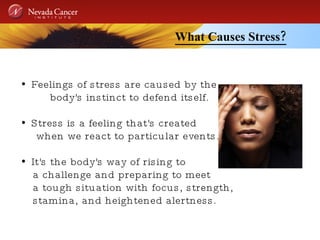
What Causes Stress? Feelings of stress are caused by the body's instinct to defend itself. Stress is a feeling that's created  when we react to particular events.  It's the body's way of rising to a challenge and preparing to meet a tough situation with focus, strength,  stamina, and heightened alertness.
Stressors The events that provoke stress are called  stressors,  and they cover a whole range of situations   The human body responds to stressors by activating the nervous system and specific hormones.  The  hypothalamus  signals the  adrenal glands  to produce more of the hormones  adrenaline and  cortisol   and release them into the bloodstream. These hormones speed up heart rate, breathing rate, blood pressure and metabolism.
Life’s Stressors Some significant stressors include: Major life event such as wedding, death, or birth. Change or loss of job Change in one’s financial situation whether positive or not Illness or diagnosis of a loved one or self Change in residence Change in quality of life whether perceived or real
Thinking Makes It So Whether perceived or real  means your belief about something influences how your mind and body, your physiology and mental state, affect your overall health. If you believe your quality of life is positive or not, it will be…. I’m sure you’ve heard that saying “ thinking makes it so”
Stress and Disease
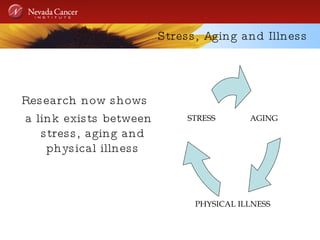
Stress, Aging and Illness Research now shows  a link exists between stress, aging and physical illness AGING PHYSICAL ILLNESS STRESS
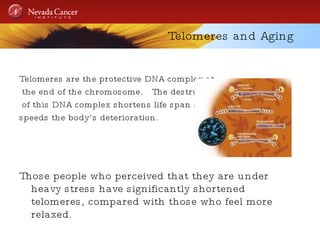
Telomeres and Aging Telomeres are the protective DNA complex at the end of the chromosome.  The destruction of this DNA complex shortens life span and  speeds the body’s deterioration.  Those people who perceived that they are under heavy stress have significantly shortened telomeres, compared with those who feel more relaxed.
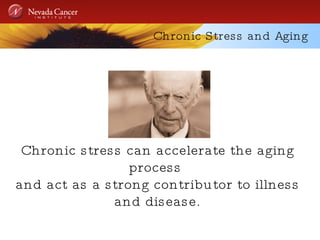
Chronic Stress and Aging Chronic stress can accelerate the aging process  and act as a strong contributor to illness and disease.
The Physiology of Stress Blood vessels open wider to let more blood flow to large muscle groups, putting our muscles on alert.  Pupils dilate to improve vision. The liver releases some of its stored glucose to increase the body's energy. And sweat is produced to cool the body.  All of these physical changes prepare a person to react quickly and effectively to handle the pressure of the moment.
Stress Response
Stress Response This natural reaction is known as the  stress response . Working properly, the body's stress response enhances a person's ability to perform well under pressure. But the stress response can also cause problems when it overreacts or fails to turn off and reset itself properly.
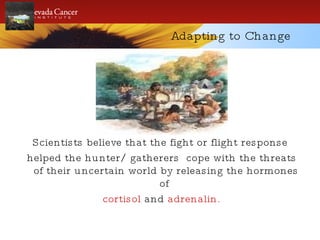
Adapting to Change Scientists believe that the fight or flight response helped the hunter/ gatherers  cope with the threats of their uncertain world by releasing the hormones of  cortisol  and  adrenalin.
Research On Stress UCLA scientists found that the stress hormone  cortisol suppresses immune cells ability to activate an enzyme that keeps immune cells young known as telomerase UCLA David Geffen School of Medicine  UCLA Jonsson Cancer Center
Recent Studies Show… Free radicals increase during old age, resulting in biochemical alterations.  Oxidative stress is considered a key contributor to the aging process. Mendoza-Nunez, Ruiz-Ramos, and Sanchez-Rodriguez Gerontology Research, UNAM Mexico City, Mexico  -  2007
Although new evidence suggests that stress speeds up the aging process by  harming DNA, there is good news! We have the ability to impact our stress levels and offset the affect of stress on us. Those who learn to manage their stress well  do not show the same amount of damage to their telomeres .
CDC And NIOSH The Centers for Disease Control  and the  National Institute for Occupational Safety and Health have recently dedicated themselves to studying Stress
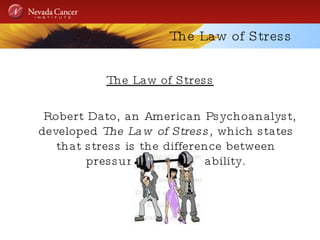
The Law of Stress The Law of Stress Robert Dato, an American Psychoanalyst, developed  The   Law of Stress , which states that stress is the difference between pressure and adaptability.
What is Stress? So What Is Stress….. Really? In practical terms, stress is the inability to adapt under  pressure
Stress Statistics Disabling Stress has doubled over the last six years 72% of Americans experience frequent stress-related physical or mental conditions Unmanaged stress is a higher risk factor for cancer and heart disease than either cigarette smoking or high cholesterol
What Makes Stress Worsen Lack of control Lack of predictability Lack of social affiliation-no one to talk with No outlet for frustration caused by stressor Interpret things as getting worse with no way to change it Dr. Robert Sapolsky, Stress Researcher,  Stanford University
Types of Stress
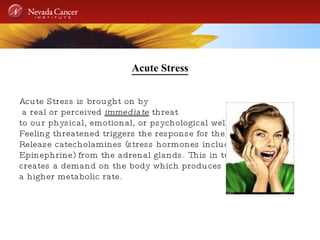
Acute Stress Acute Stress is brought on by a real or perceived  immediate  threat  to our physical, emotional, or psychological well being. Feeling threatened triggers the response for the body to Release catecholamines (stress hormones including Epinephrine) from the adrenal glands. This in turn creates a demand on the body which produces a higher metabolic rate.
Chronic Stress Researchers have now discovered that long-term activation of stress can have a hazardous, even lethal effect on the body, increasing obesity, heart disease, depression, sleep disorders and anxiety. Chronic stress should not be taken lightly  or accepted as   normal.
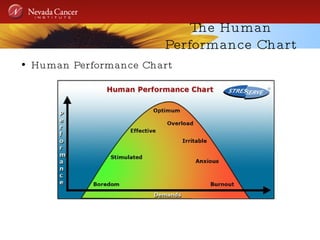
The Human Performance Chart Human Performance Chart
Early Warning Signs Poor emotional control  Constant insomnia Chronic fatigue Susceptibility to illness Excessive moodiness Exaggerated anxiety Withdrawal from responsibility
CDC And NIOSH The Centers for Disease Control  and the  National Institute for Occupational Safety and Health Have recently dedicated themselves to studying Stress
Stress and Disease Some experts believe that stress may cause 50% of all disease Scientific research has shown that stress: is a leading cause of both cancer and heart disease is a contributing factor in death lowers the immune system contributes to unhappiness
Stress and Disease Scientific research has shown that stress is also a factor in: obesity  memory loss migraines  ulcers chronic insomnia  tooth decay digestive problems  colds  high blood pressure  asthma
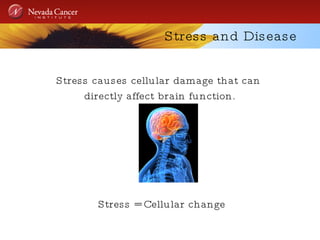
Stress and Disease Stress causes cellular damage that can  directly affect brain function. Stress = Cellular change
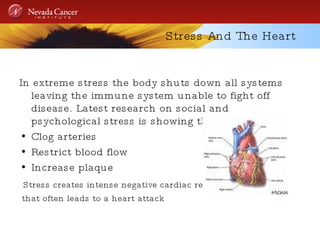
Stress And The Heart In extreme stress the body shuts down all systems leaving the immune system unable to fight off disease. Latest research on social and psychological stress is showing that it can: Clog arteries Restrict blood flow Increase plaque  Stress creates intense negative cardiac response that often leads to a heart attack
Dangerous stress = Cellular changes This change in brain function can result in: Loss of appetite Loss of interest in sex Loss of desire or ability to move These set of conditions are known as sickness behavior.  There is speculation by the medical community that this is the body’s way of conserving energy in order to fight disease.
Reactions to Stress How we react to stressful events  can greatly affect our health physically, mentally and emotionally . The body sends signals that tell you when you are stressed.  Learning to recognize those signals gives us the power to respond to stress in ways that work for us and not against us.
Listening… You can learn to listen to those signals. Changing reactions to events allows the opportunity to improve outcomes of stressful situations.
Coping Techniques
Stress Less Strategies Identify sources of stress Reduce exposure to those sources Prepare three personal strategies for dealing with stress  (see next slide) Practice responding, not reacting Notice differences in your stress level
Stress Less Strategies Examples of stress less personal strategies WHEN I AM STRESSED I WILL: Take a few deep breaths and calm my mind Respond not react to an immediate problem Ask for help when I need it Take a hot bath before making any decisions (if possible) Take a long walk Write down the challenge and list three solutions Wait three days if possible before acting upon situation
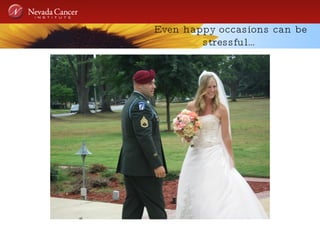
Even happy occasions can be stressful…
That’s why vacationing and relaxing is so important…
Things To Do in Las Vegas Red Rock State Park Spa Day at Green Valley Ranch
Lifestyle Factors Other lifestyle factors that can promote good health include: Time management Rejuvenate emotionally and spiritually daily (i.e. prayer, meditation, quiet time, affirmations) Let go of what you can’t control Laugh often These factors have been known to boost the immune system and increase overall well-being.
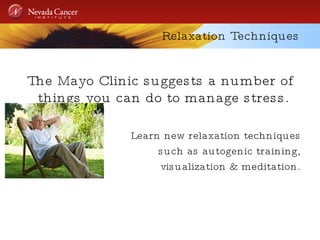
Relaxation Techniques The Mayo Clinic suggests a number of things you can do to manage stress.  Learn new relaxation techniques such as autogenic training, visualization & meditation.
Stress Less Tips Tips For Managing Your Own Stress  Reclaim some healthy time management skills Prepare to the best of your ability for events that may be challenging Simplify your life Prioritize what’s important to you Learn to say “no” when necessary  Widen your circle Organize your time
Stress Less Tips Tips For Managing Your Own Stress  Don’t worry about what you can’t control Work to resolve any conflicts Set realistic goals Exercise on a regular basis Get proper nutrition in your diet Get plenty of rest Meditate Practice relaxation techniques on a regular basis
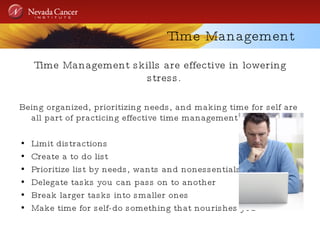
Time Management Time Management skills are effective in lowering stress.  Being organized, prioritizing needs, and making time for self are all part of practicing effective time management.  Limit distractions  Create a to do list Prioritize list by needs, wants and nonessentials Delegate tasks you can pass on to another Break larger tasks into smaller ones Make time for self-do something that nourishes you
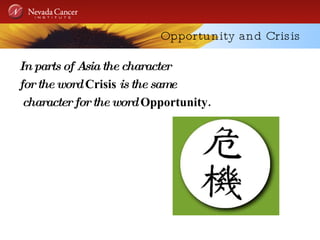
Opportunity and Crisis In parts of Asia the character  for the word  Crisis  is the same character for the word  Opportunity.
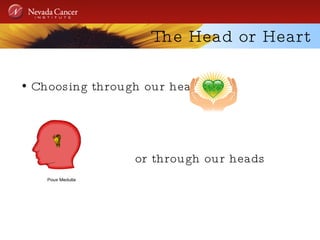
The Head or Heart Choosing through our hearts  or through our heads
Intention Intention is defined as the state of  one's mind at the time one carries out an action.   Pay attention to your true intention. Your intention will influence your outcome. Intention shifts the energy of what you experience.
The Power of SILENCE The Power of Silence Practice silence by listening to your heart In silence we allow the inner world to come forward and tune out the outer world; the source of external stimuli. In silence we rejuvenate our inner spirit, nourishing ourselves  The practice of silence lets us  clear the subconscious mind as thoughts come up Recognize our spiritual self
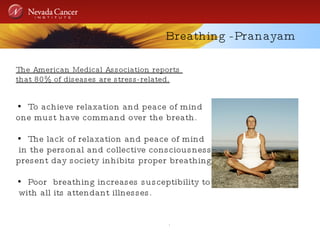
Breathing -Pranayam The American Medical Association reports  that 80% of diseases are stress-related. To achieve relaxation and peace of mind  one must have command over the breath.  The lack of relaxation and peace of mind  in the personal and collective consciousness of  present day society inhibits proper breathing. Poor  breathing increases susceptibility to stress, with all its attendant illnesses. .
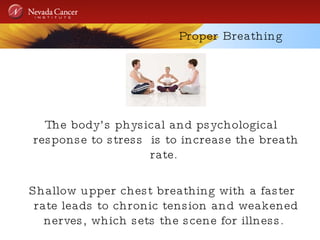
Proper Breathing The body’s physical and psychological response to stress  is to increase the breath rate.  Shallow upper chest breathing with a faster rate leads to chronic tension and weakened nerves, which sets the scene for illness.
Guided Imagery Guided Imagery:  Guided imagery is a program of directed thoughts and suggestions that guide your imagination toward a relaxed, focused state. It is based on the concept that your mind and body are connected as one. Guided Imagery is often used to ease stress while promoting relaxation through visualization in a safe way with no known risks.
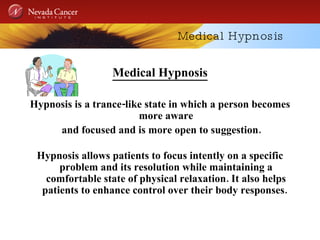
Medical Hypnosis Medical Hypnosis Hypnosis is a trance-like state in which a person becomes more aware and focused and is more open to suggestion. Hypnosis allows patients to focus intently on a specific problem and its resolution while maintaining a comfortable state of physical relaxation. It also helps patients to enhance control over their body responses.
Meditation Meditation:  Meditation is focused awareness achieved through various scientifically researched techniques. Meditation can be practiced for various reasons--for example, with an intent to increase physical relaxation, mental calmness, and psychological balance; to cope With one or more diseases and conditions; and for overall wellness.
A pleasant environment can contribute to a relaxing life…
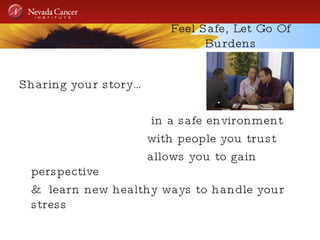
Feel Safe, Let Go Of Burdens Sharing your story…  in a safe environment with people you trust allows you to gain perspective &  learn new healthy ways to handle your stress
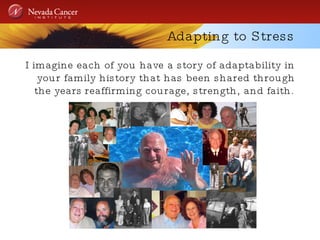
Adapting to Stress I imagine each of you have a story of adaptability in your family history that has been shared through the years   reaffirming courage, strength, and faith.
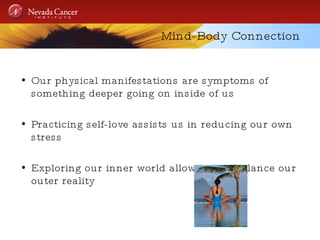
Mind-Body Connection Our physical manifestations are symptoms of something deeper going on inside of us Practicing self-love assists us in reducing our own stress  Exploring our inner world allows us to balance our outer reality
Reducing Stress Reduces Illness Your ability to reduce your stress  has a direct affect on your ability to lower your risk for diseases, especially cancer and heart disease.  Manage Stress =  Healthy Lifestyle =  Stronger Immune System = Disease Prevention
Any Questions?
Resources National Institute of Health  www.nih.gov   Mayo Clinic  www.mayoclinic.com Nevada Cancer Institute  www.nevadacancerinstitute.org   American Society of Clinical Oncology  www.asco.org   American Institute of Stress  http://www.stress.org
NEVADA CANCER INSTITUTE Laurrana Leigon D.Div. C.Cht. COMMUNITY HEALTH EDUCATOR NEVADA CANCER INSTITUTE 10000 W. Charleston Blvd.  Las Vegas, Nevada  89135 www.nevadacancerinstitute.org Email:  [email_address]   702-822-5433 main 702-822-5286 direct
Thank You

Stress Management Conference

  • 1.
    Managing Stress WhatYou Need to Know Provided By Nevada Cancer Institute Department of Outreach and Education
  • 2.
    NVCI Mission Themission of Nevada Cancer Institute is to reduce the burden of cancer for Nevada, the nation and the world through innovative and collaborative research, education and patient care. The mission of the Outreach and Education Department of NVCI is to provide awareness, education, and support to the public as it pertains to cancer risks, detection, and treatment.
  • 3.
    NVCI Programming CulinaryHealth Fund Project Just Move It Native American Program Lance Armstrong Foundation (LAF) Survivorship Multicultural Health and Wellness Program Patient Navigation Smoking Cessation Sun Safety Community Education Programs
  • 4.
    What We WillCover - Causes of Stress -How Stress Leads To Disease -Types of Stress -Coping Techniques
  • 5.
    Reducing The Burdenof Cancer Reducing the Burden of Cancer Managing stress = Healthy lifestyle = Stronger immune system = Disease prevention
  • 6.
  • 7.
    What Causes Stress?Feelings of stress are caused by the body's instinct to defend itself. Stress is a feeling that's created when we react to particular events. It's the body's way of rising to a challenge and preparing to meet a tough situation with focus, strength, stamina, and heightened alertness.
  • 8.
    Stressors The eventsthat provoke stress are called stressors, and they cover a whole range of situations The human body responds to stressors by activating the nervous system and specific hormones. The hypothalamus signals the adrenal glands to produce more of the hormones adrenaline and cortisol and release them into the bloodstream. These hormones speed up heart rate, breathing rate, blood pressure and metabolism.
  • 9.
    Life’s Stressors Somesignificant stressors include: Major life event such as wedding, death, or birth. Change or loss of job Change in one’s financial situation whether positive or not Illness or diagnosis of a loved one or self Change in residence Change in quality of life whether perceived or real
  • 10.
    Thinking Makes ItSo Whether perceived or real means your belief about something influences how your mind and body, your physiology and mental state, affect your overall health. If you believe your quality of life is positive or not, it will be…. I’m sure you’ve heard that saying “ thinking makes it so”
  • 11.
  • 12.
    Stress, Aging andIllness Research now shows a link exists between stress, aging and physical illness AGING PHYSICAL ILLNESS STRESS
  • 13.
    Telomeres and AgingTelomeres are the protective DNA complex at the end of the chromosome. The destruction of this DNA complex shortens life span and speeds the body’s deterioration. Those people who perceived that they are under heavy stress have significantly shortened telomeres, compared with those who feel more relaxed.
  • 14.
    Chronic Stress andAging Chronic stress can accelerate the aging process and act as a strong contributor to illness and disease.
  • 15.
    The Physiology ofStress Blood vessels open wider to let more blood flow to large muscle groups, putting our muscles on alert. Pupils dilate to improve vision. The liver releases some of its stored glucose to increase the body's energy. And sweat is produced to cool the body. All of these physical changes prepare a person to react quickly and effectively to handle the pressure of the moment.
  • 16.
  • 17.
    Stress Response Thisnatural reaction is known as the stress response . Working properly, the body's stress response enhances a person's ability to perform well under pressure. But the stress response can also cause problems when it overreacts or fails to turn off and reset itself properly.
  • 18.
    Adapting to ChangeScientists believe that the fight or flight response helped the hunter/ gatherers cope with the threats of their uncertain world by releasing the hormones of cortisol and adrenalin.
  • 19.
    Research On StressUCLA scientists found that the stress hormone cortisol suppresses immune cells ability to activate an enzyme that keeps immune cells young known as telomerase UCLA David Geffen School of Medicine UCLA Jonsson Cancer Center
  • 20.
    Recent Studies Show…Free radicals increase during old age, resulting in biochemical alterations. Oxidative stress is considered a key contributor to the aging process. Mendoza-Nunez, Ruiz-Ramos, and Sanchez-Rodriguez Gerontology Research, UNAM Mexico City, Mexico - 2007
  • 21.
    Although new evidencesuggests that stress speeds up the aging process by harming DNA, there is good news! We have the ability to impact our stress levels and offset the affect of stress on us. Those who learn to manage their stress well do not show the same amount of damage to their telomeres .
  • 22.
    CDC And NIOSHThe Centers for Disease Control and the National Institute for Occupational Safety and Health have recently dedicated themselves to studying Stress
  • 23.
    The Law ofStress The Law of Stress Robert Dato, an American Psychoanalyst, developed The Law of Stress , which states that stress is the difference between pressure and adaptability.
  • 24.
    What is Stress?So What Is Stress….. Really? In practical terms, stress is the inability to adapt under pressure
  • 25.
    Stress Statistics DisablingStress has doubled over the last six years 72% of Americans experience frequent stress-related physical or mental conditions Unmanaged stress is a higher risk factor for cancer and heart disease than either cigarette smoking or high cholesterol
  • 26.
    What Makes StressWorsen Lack of control Lack of predictability Lack of social affiliation-no one to talk with No outlet for frustration caused by stressor Interpret things as getting worse with no way to change it Dr. Robert Sapolsky, Stress Researcher, Stanford University
  • 27.
  • 28.
    Acute Stress AcuteStress is brought on by a real or perceived immediate threat to our physical, emotional, or psychological well being. Feeling threatened triggers the response for the body to Release catecholamines (stress hormones including Epinephrine) from the adrenal glands. This in turn creates a demand on the body which produces a higher metabolic rate.
  • 29.
    Chronic Stress Researchershave now discovered that long-term activation of stress can have a hazardous, even lethal effect on the body, increasing obesity, heart disease, depression, sleep disorders and anxiety. Chronic stress should not be taken lightly or accepted as normal.
  • 30.
    The Human PerformanceChart Human Performance Chart
  • 31.
    Early Warning SignsPoor emotional control Constant insomnia Chronic fatigue Susceptibility to illness Excessive moodiness Exaggerated anxiety Withdrawal from responsibility
  • 32.
    CDC And NIOSHThe Centers for Disease Control and the National Institute for Occupational Safety and Health Have recently dedicated themselves to studying Stress
  • 33.
    Stress and DiseaseSome experts believe that stress may cause 50% of all disease Scientific research has shown that stress: is a leading cause of both cancer and heart disease is a contributing factor in death lowers the immune system contributes to unhappiness
  • 34.
    Stress and DiseaseScientific research has shown that stress is also a factor in: obesity memory loss migraines ulcers chronic insomnia tooth decay digestive problems colds high blood pressure asthma
  • 35.
    Stress and DiseaseStress causes cellular damage that can directly affect brain function. Stress = Cellular change
  • 36.
    Stress And TheHeart In extreme stress the body shuts down all systems leaving the immune system unable to fight off disease. Latest research on social and psychological stress is showing that it can: Clog arteries Restrict blood flow Increase plaque Stress creates intense negative cardiac response that often leads to a heart attack
  • 37.
    Dangerous stress =Cellular changes This change in brain function can result in: Loss of appetite Loss of interest in sex Loss of desire or ability to move These set of conditions are known as sickness behavior. There is speculation by the medical community that this is the body’s way of conserving energy in order to fight disease.
  • 38.
    Reactions to StressHow we react to stressful events can greatly affect our health physically, mentally and emotionally . The body sends signals that tell you when you are stressed. Learning to recognize those signals gives us the power to respond to stress in ways that work for us and not against us.
  • 39.
    Listening… You canlearn to listen to those signals. Changing reactions to events allows the opportunity to improve outcomes of stressful situations.
  • 40.
  • 41.
    Stress Less StrategiesIdentify sources of stress Reduce exposure to those sources Prepare three personal strategies for dealing with stress (see next slide) Practice responding, not reacting Notice differences in your stress level
  • 42.
    Stress Less StrategiesExamples of stress less personal strategies WHEN I AM STRESSED I WILL: Take a few deep breaths and calm my mind Respond not react to an immediate problem Ask for help when I need it Take a hot bath before making any decisions (if possible) Take a long walk Write down the challenge and list three solutions Wait three days if possible before acting upon situation
  • 43.
    Even happy occasionscan be stressful…
  • 44.
    That’s why vacationingand relaxing is so important…
  • 45.
    Things To Doin Las Vegas Red Rock State Park Spa Day at Green Valley Ranch
  • 46.
    Lifestyle Factors Otherlifestyle factors that can promote good health include: Time management Rejuvenate emotionally and spiritually daily (i.e. prayer, meditation, quiet time, affirmations) Let go of what you can’t control Laugh often These factors have been known to boost the immune system and increase overall well-being.
  • 47.
    Relaxation Techniques TheMayo Clinic suggests a number of things you can do to manage stress. Learn new relaxation techniques such as autogenic training, visualization & meditation.
  • 48.
    Stress Less TipsTips For Managing Your Own Stress Reclaim some healthy time management skills Prepare to the best of your ability for events that may be challenging Simplify your life Prioritize what’s important to you Learn to say “no” when necessary Widen your circle Organize your time
  • 49.
    Stress Less TipsTips For Managing Your Own Stress Don’t worry about what you can’t control Work to resolve any conflicts Set realistic goals Exercise on a regular basis Get proper nutrition in your diet Get plenty of rest Meditate Practice relaxation techniques on a regular basis
  • 50.
    Time Management TimeManagement skills are effective in lowering stress. Being organized, prioritizing needs, and making time for self are all part of practicing effective time management. Limit distractions Create a to do list Prioritize list by needs, wants and nonessentials Delegate tasks you can pass on to another Break larger tasks into smaller ones Make time for self-do something that nourishes you
  • 51.
    Opportunity and CrisisIn parts of Asia the character for the word Crisis is the same character for the word Opportunity.
  • 52.
    The Head orHeart Choosing through our hearts or through our heads
  • 53.
    Intention Intention isdefined as the state of one's mind at the time one carries out an action. Pay attention to your true intention. Your intention will influence your outcome. Intention shifts the energy of what you experience.
  • 54.
    The Power ofSILENCE The Power of Silence Practice silence by listening to your heart In silence we allow the inner world to come forward and tune out the outer world; the source of external stimuli. In silence we rejuvenate our inner spirit, nourishing ourselves The practice of silence lets us clear the subconscious mind as thoughts come up Recognize our spiritual self
  • 55.
    Breathing -Pranayam TheAmerican Medical Association reports that 80% of diseases are stress-related. To achieve relaxation and peace of mind one must have command over the breath. The lack of relaxation and peace of mind in the personal and collective consciousness of present day society inhibits proper breathing. Poor breathing increases susceptibility to stress, with all its attendant illnesses. .
  • 56.
    Proper Breathing Thebody’s physical and psychological response to stress is to increase the breath rate. Shallow upper chest breathing with a faster rate leads to chronic tension and weakened nerves, which sets the scene for illness.
  • 57.
    Guided Imagery GuidedImagery: Guided imagery is a program of directed thoughts and suggestions that guide your imagination toward a relaxed, focused state. It is based on the concept that your mind and body are connected as one. Guided Imagery is often used to ease stress while promoting relaxation through visualization in a safe way with no known risks.
  • 58.
    Medical Hypnosis MedicalHypnosis Hypnosis is a trance-like state in which a person becomes more aware and focused and is more open to suggestion. Hypnosis allows patients to focus intently on a specific problem and its resolution while maintaining a comfortable state of physical relaxation. It also helps patients to enhance control over their body responses.
  • 59.
    Meditation Meditation: Meditation is focused awareness achieved through various scientifically researched techniques. Meditation can be practiced for various reasons--for example, with an intent to increase physical relaxation, mental calmness, and psychological balance; to cope With one or more diseases and conditions; and for overall wellness.
  • 60.
    A pleasant environmentcan contribute to a relaxing life…
  • 61.
    Feel Safe, LetGo Of Burdens Sharing your story… in a safe environment with people you trust allows you to gain perspective & learn new healthy ways to handle your stress
  • 62.
    Adapting to StressI imagine each of you have a story of adaptability in your family history that has been shared through the years reaffirming courage, strength, and faith.
  • 63.
    Mind-Body Connection Ourphysical manifestations are symptoms of something deeper going on inside of us Practicing self-love assists us in reducing our own stress Exploring our inner world allows us to balance our outer reality
  • 64.
    Reducing Stress ReducesIllness Your ability to reduce your stress has a direct affect on your ability to lower your risk for diseases, especially cancer and heart disease. Manage Stress = Healthy Lifestyle = Stronger Immune System = Disease Prevention
  • 65.
  • 66.
    Resources National Instituteof Health www.nih.gov Mayo Clinic www.mayoclinic.com Nevada Cancer Institute www.nevadacancerinstitute.org American Society of Clinical Oncology www.asco.org American Institute of Stress http://www.stress.org
  • 67.
    NEVADA CANCER INSTITUTELaurrana Leigon D.Div. C.Cht. COMMUNITY HEALTH EDUCATOR NEVADA CANCER INSTITUTE 10000 W. Charleston Blvd. Las Vegas, Nevada 89135 www.nevadacancerinstitute.org Email: [email_address] 702-822-5433 main 702-822-5286 direct
  • 68.