Emotion, Stress, and Health chapter 13
Overview Nature of emotion Emotion and culture Nature of stress Stress and emotion How to cope chapter 13
Emotion A state of arousal involving facial and bodily changes, brain activation, cognitive appraisals, subjective feelings, and tendencies toward action, all shaped by cultural rules chapter 13
The body Primary emotions Emotions considered to be universal and biologically based, usually thought to include fear, anger, sadness, joy, surprise, disgust, and contempt Secondary emotion Emotions that develop with cognitive maturity and vary across individuals and cultures chapter 13
Your turn Which of the following is a primary emotion? 1.  Love 2.  Suspicion 3.  Joy 4.  Jealousy chapter 13
Universal expressions of emotion Facial expressions for primary emotions are universal. Even members of remote cultures can recognize facial expressions in people who are foreign to them. Facial feedback Process by which the facial muscles send messages to the brain about the basic emotion being expressed chapter 13
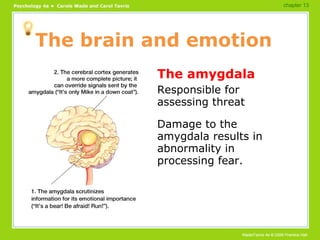
The brain and emotion The amygdala Responsible for assessing threat Damage to the amygdala results in abnormality in processing fear. chapter 13
The brain and emotion Mirror neurons A class of neurons, distributed throughout the brain, that fire when an animal sees or hears an action  and  carries out the same action on its own Far more evolved and varied in humans than in other animals Help us recognize others’ intentions chapter 13
Hormones and emotion When experiencing an intense emotion, two hormones are released. Epinephrine Norepinephrine Results in increased alertness and arousal At high levels, can create sensation of being out of control emotionally chapter 13
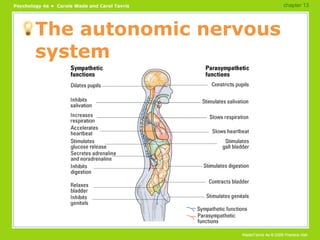
The autonomic nervous system chapter 13
How thoughts create emotions Perceptions and attributions are involved in emotions. How one reacts to an event depends on how he/she explains it. For example, how one reacts to being ignored or winning the silver instead of the gold medal Philosophy of life is also influential. chapter 13
Culture and emotion Culture determines what people feel angry, sad, lonely, happy, ashamed or disgusted about. Some cultures have words for specific emotions unknown to other cultures.. E.g.,  schadenfreude Some cultures don’t have words for emotions that seem universal to others. Tahitian and sadness Differences in secondary emotions appear to be reflected in differences in languages. chapter 13
Rules of emotional regulation Display rules When, where, and how emotions are to be expressed or when they should be squelched Emotion work Acting out an emotion we do not feel or trying to create the right emotion for the occasion Body language The nonverbal signals of body movement, posture, and gaze that people constantly express chapter 13
Gender and emotion In North America women. . . smile more than men. gaze at listeners more. have more emotionally expressive faces. use more expressive body movements. touch others more. acknowledge weakness and emotions more. Compared to women, men only express anger to strangers more. chapter 13
Factors influencing emotional expressiveness Gender roles Cultural norms The specific situation chapter 13
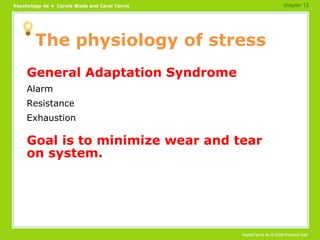
The physiology of stress General Adaptation Syndrome Alarm Resistance Exhaustion Goal is to minimize wear and tear on system. chapter 13
Your turn During which phase of the General Adaptation Syndrome is a person most vulnerable to disease? 1. Alarm 2. Resistance 3. Exhaustion chapter 13
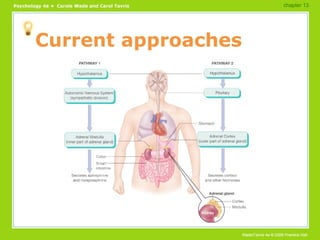
Current approaches chapter 13
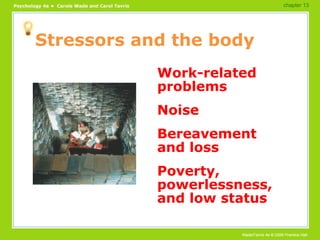
Stressors and the body Work-related problems Noise Bereavement and loss Poverty, powerlessness, and low status chapter 13
Explanatory styles Optimists: Take better care of themselves when sick Cope better Draw on friends in hard times chapter 13
The sense of control Locus of control A general expectation about whether the results of your actions are under your own control ( internal locus ) or beyond your control ( external locus ) Feelings of control can reduce or even eliminate the relationship between stressors and health. chapter 13
Your turn Suppose you have several difficult exams coming up soon.  If your thought is “There’s no way I can study enough to get an A in psychology,” then what is your locus of control? 1.  Internal 2.  External chapter 13
Benefits of control When exposed to cold viruses, those who are out of control are more likely to develop colds. Low-income individuals with high levels of control report similar quality of life to high-income individuals. Managers and executives have fewer illnesses. African-Americans reporting more control have fewer problems with hypertension. Nursing home residents with greater control are more alert, happier, and live longer. chapter 13
Limits of control Primary control:  an effort to modify reality by changing other people, the situation, or events A “fighting back” philosophy Western cultures Secondary control:  an effort to accept reality by changing your own attitudes, goals, or emotions A “learn to live with it” philosophy Eastern cultures chapter 13
Emotions and illness Hostility and heart disease Type A personality:  determined to achieve, sense of time urgency, irritable, quick to respond to threat or challenge, impatient with obstacles. Type B personality:  calmer, less intense Cynical or antagonistic hostility is a major risk factor for heart disease chapter 13
Positive emotions Longitudinal study of 180 Catholic nuns found that longevity was related to frequency of positive emotions Happiness Interest Love Hope Etc. Nuns whose life stories contained the most positive emotion words lived an average of nine years longer. chapter 13
Emotional inhibition A personality trait involving a tendency to deny feelings of anger, anxiety, or fear; stressful situations cause heart rate and blood pressure to rise sharply People with this trait are more likely to fall ill than people who can acknowledge feelings. chapter 13
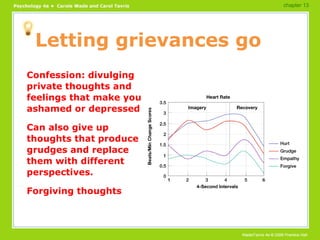
Letting grievances go Confession: divulging private thoughts and feelings that make you ashamed or depressed Can also give up thoughts that produce grudges and replace them with different perspectives. Forgiving thoughts chapter 13
Cooling off Relaxation training Learning to alternately tense and relax muscles, lie or sit quietly, or meditate by clearing the mind Lowers stress hormones, enhances immune function Massage therapy Exercise chapter 13
Solving the problem Emotion-focused and problem-focused coping Effective cognitive coping methods Reappraising the situation Learning from the experience Making social comparisons Cultivating a sense of humor chapter 13
Looking outward Friends can help People who have network of close connections live longer than those who do not. After heart attack, those with no close contacts were twice as likely to die. Relationships can also cause stress. Giving support to others can be a valuable source of comfort. chapter 13
When friends aren’t helpful Many are stressed by the responsibility of caring for others. In close relationships, the support person may also be the source of stress. Married couples who argue in a hostile way have increased elevations of stress hormones and weakened immune systems. Friends may be unsupportive or block your progress toward a goal. chapter 13

Health Psychology PowerPoint

  • 1.
    Emotion, Stress, andHealth chapter 13
  • 2.
    Overview Nature ofemotion Emotion and culture Nature of stress Stress and emotion How to cope chapter 13
  • 3.
    Emotion A stateof arousal involving facial and bodily changes, brain activation, cognitive appraisals, subjective feelings, and tendencies toward action, all shaped by cultural rules chapter 13
  • 4.
    The body Primaryemotions Emotions considered to be universal and biologically based, usually thought to include fear, anger, sadness, joy, surprise, disgust, and contempt Secondary emotion Emotions that develop with cognitive maturity and vary across individuals and cultures chapter 13
  • 5.
    Your turn Whichof the following is a primary emotion? 1. Love 2. Suspicion 3. Joy 4. Jealousy chapter 13
  • 6.
    Your turn Whichof the following is a primary emotion? 1. Love 2. Suspicion 3. Joy 4. Jealousy chapter 13
  • 7.
    Universal expressions ofemotion Facial expressions for primary emotions are universal. Even members of remote cultures can recognize facial expressions in people who are foreign to them. Facial feedback Process by which the facial muscles send messages to the brain about the basic emotion being expressed chapter 13
  • 8.
    The brain andemotion The amygdala Responsible for assessing threat Damage to the amygdala results in abnormality in processing fear. chapter 13
  • 9.
    The brain andemotion Mirror neurons A class of neurons, distributed throughout the brain, that fire when an animal sees or hears an action and carries out the same action on its own Far more evolved and varied in humans than in other animals Help us recognize others’ intentions chapter 13
  • 10.
    Hormones and emotionWhen experiencing an intense emotion, two hormones are released. Epinephrine Norepinephrine Results in increased alertness and arousal At high levels, can create sensation of being out of control emotionally chapter 13
  • 11.
    The autonomic nervoussystem chapter 13
  • 12.
    How thoughts createemotions Perceptions and attributions are involved in emotions. How one reacts to an event depends on how he/she explains it. For example, how one reacts to being ignored or winning the silver instead of the gold medal Philosophy of life is also influential. chapter 13
  • 13.
    Culture and emotionCulture determines what people feel angry, sad, lonely, happy, ashamed or disgusted about. Some cultures have words for specific emotions unknown to other cultures.. E.g., schadenfreude Some cultures don’t have words for emotions that seem universal to others. Tahitian and sadness Differences in secondary emotions appear to be reflected in differences in languages. chapter 13
  • 14.
    Rules of emotionalregulation Display rules When, where, and how emotions are to be expressed or when they should be squelched Emotion work Acting out an emotion we do not feel or trying to create the right emotion for the occasion Body language The nonverbal signals of body movement, posture, and gaze that people constantly express chapter 13
  • 15.
    Gender and emotionIn North America women. . . smile more than men. gaze at listeners more. have more emotionally expressive faces. use more expressive body movements. touch others more. acknowledge weakness and emotions more. Compared to women, men only express anger to strangers more. chapter 13
  • 16.
    Factors influencing emotionalexpressiveness Gender roles Cultural norms The specific situation chapter 13
  • 17.
    The physiology ofstress General Adaptation Syndrome Alarm Resistance Exhaustion Goal is to minimize wear and tear on system. chapter 13
  • 18.
    Your turn Duringwhich phase of the General Adaptation Syndrome is a person most vulnerable to disease? 1. Alarm 2. Resistance 3. Exhaustion chapter 13
  • 19.
    Your turn Duringwhich phase of the General Adaptation Syndrome is a person most vulnerable to disease? 1. Alarm 2. Resistance 3. Exhaustion chapter 13
  • 20.
  • 21.
    Stressors and thebody Work-related problems Noise Bereavement and loss Poverty, powerlessness, and low status chapter 13
  • 22.
    Explanatory styles Optimists:Take better care of themselves when sick Cope better Draw on friends in hard times chapter 13
  • 23.
    The sense ofcontrol Locus of control A general expectation about whether the results of your actions are under your own control ( internal locus ) or beyond your control ( external locus ) Feelings of control can reduce or even eliminate the relationship between stressors and health. chapter 13
  • 24.
    Your turn Supposeyou have several difficult exams coming up soon. If your thought is “There’s no way I can study enough to get an A in psychology,” then what is your locus of control? 1. Internal 2. External chapter 13
  • 25.
    Your turn Supposeyou have several difficult exams coming up soon. If your thought is “There’s no way I can study enough to get an A in psychology,” then what is your locus of control? 1. Internal 2. External chapter 13
  • 26.
    Benefits of controlWhen exposed to cold viruses, those who are out of control are more likely to develop colds. Low-income individuals with high levels of control report similar quality of life to high-income individuals. Managers and executives have fewer illnesses. African-Americans reporting more control have fewer problems with hypertension. Nursing home residents with greater control are more alert, happier, and live longer. chapter 13
  • 27.
    Limits of controlPrimary control: an effort to modify reality by changing other people, the situation, or events A “fighting back” philosophy Western cultures Secondary control: an effort to accept reality by changing your own attitudes, goals, or emotions A “learn to live with it” philosophy Eastern cultures chapter 13
  • 28.
    Emotions and illnessHostility and heart disease Type A personality: determined to achieve, sense of time urgency, irritable, quick to respond to threat or challenge, impatient with obstacles. Type B personality: calmer, less intense Cynical or antagonistic hostility is a major risk factor for heart disease chapter 13
  • 29.
    Positive emotions Longitudinalstudy of 180 Catholic nuns found that longevity was related to frequency of positive emotions Happiness Interest Love Hope Etc. Nuns whose life stories contained the most positive emotion words lived an average of nine years longer. chapter 13
  • 30.
    Emotional inhibition Apersonality trait involving a tendency to deny feelings of anger, anxiety, or fear; stressful situations cause heart rate and blood pressure to rise sharply People with this trait are more likely to fall ill than people who can acknowledge feelings. chapter 13
  • 31.
    Letting grievances goConfession: divulging private thoughts and feelings that make you ashamed or depressed Can also give up thoughts that produce grudges and replace them with different perspectives. Forgiving thoughts chapter 13
  • 32.
    Cooling off Relaxationtraining Learning to alternately tense and relax muscles, lie or sit quietly, or meditate by clearing the mind Lowers stress hormones, enhances immune function Massage therapy Exercise chapter 13
  • 33.
    Solving the problemEmotion-focused and problem-focused coping Effective cognitive coping methods Reappraising the situation Learning from the experience Making social comparisons Cultivating a sense of humor chapter 13
  • 34.
    Looking outward Friendscan help People who have network of close connections live longer than those who do not. After heart attack, those with no close contacts were twice as likely to die. Relationships can also cause stress. Giving support to others can be a valuable source of comfort. chapter 13
  • 35.
    When friends aren’thelpful Many are stressed by the responsibility of caring for others. In close relationships, the support person may also be the source of stress. Married couples who argue in a hostile way have increased elevations of stress hormones and weakened immune systems. Friends may be unsupportive or block your progress toward a goal. chapter 13