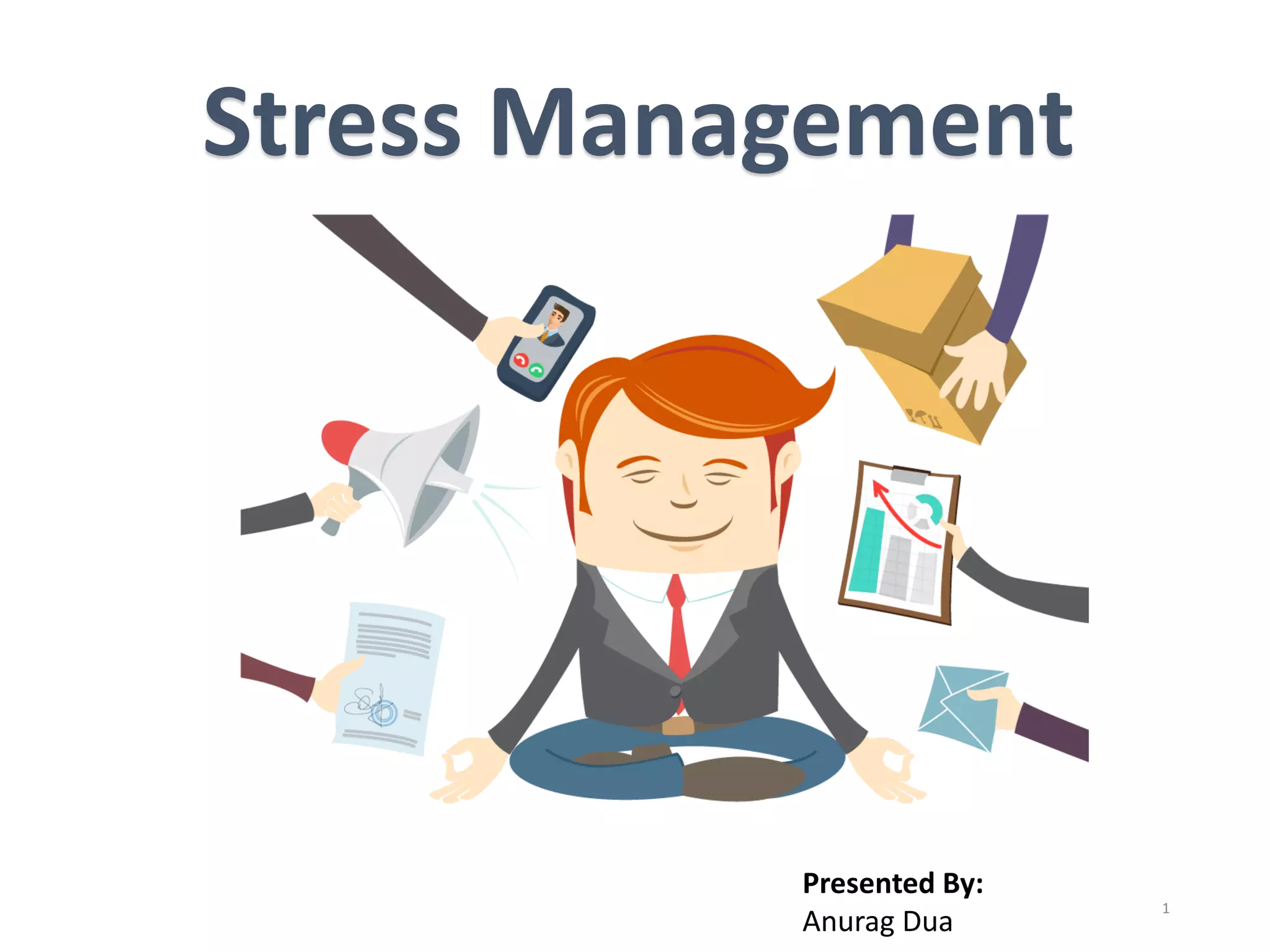
Stress Management
1
Presented By:
Anurag Dua
Contents:
1. Stress Defined
2. Stressors
3. Types of Stress
4. The Individual
5. Symptoms of Stress
6. Stress Control Strategy
7. Stress Management Techniques
2
What is Stress?
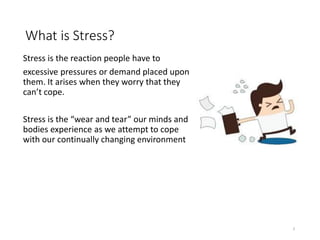
Stress is the reaction people have to
excessive pressures or demand placed upon
them. It arises when they worry that they
can’t cope.
Stress is the “wear and tear” our minds and
bodies experience as we attempt to cope
with our continually changing environment
3
Definition:
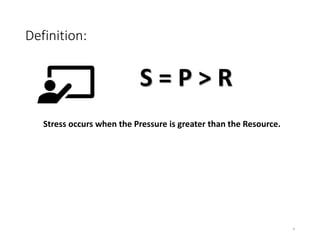
S = P > R
Stress occurs when the Pressure is greater than the Resource.
4
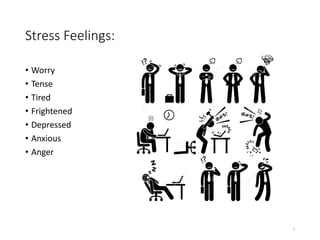
Stress Feelings:
• Worry
• Tense
• Tired
• Frightened
• Depressed
• Anxious
• Anger
5
Types of Stressors?
• External
• Internal
6
External Stressors
• Physical Environment
• Social Interaction
• Organizational
• Major Life Events
• Daily Hassles
7
Physical Environment:
➢Noise
➢Bright Light
➢Heat
➢Confined Space
8
Organizational:
❑ Rules
❑ Regulations
❑ Deadlines
Social Interaction:
❖ Rudeness
❖ Bossiness
❖ Aggressiveness by others
❖ Bullying
Major Life Events:
o Birth
o Death
o Job Lost
o Promotion
o Marital Status change
Daily Hassles:
✓ Commuting
✓ Misplaced Keys/Items
✓ Mechanical Breakdown
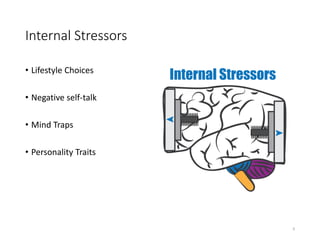
Internal Stressors
• Lifestyle Choices
• Negative self-talk
• Mind Traps
• Personality Traits
9
Lifestyle Choices:
➢Caffeine
➢Lack of Sleep
➢Overloaded Schedule
10
Negative Self-Talk:
❖ Pessimistic thinking
❖ Self criticism
❖ Over analyzing
Mind Traps:
❑ Unrealistic Expectations
❑ Taking things Personally
❑ All or Nothing thinking
❑ Exaggeration
❑ Rigid thinking
Personality Traits:
o Perfectionists
o Workaholics
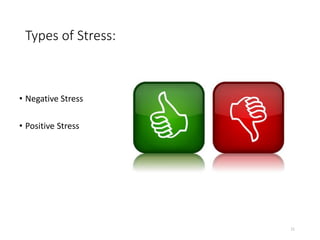
Types of Stress:
• Negative Stress
• Positive Stress
11
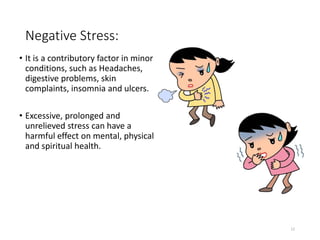
Negative Stress:
• It is a contributory factor in minor
conditions, such as Headaches,
digestive problems, skin
complaints, insomnia and ulcers.
• Excessive, prolonged and
unrelieved stress can have a
harmful effect on mental, physical
and spiritual health.
12
Positive Stress:
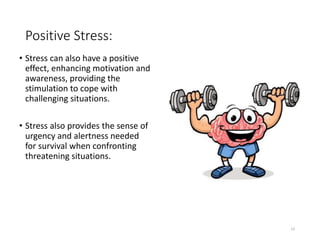
• Stress can also have a positive
effect, enhancing motivation and
awareness, providing the
stimulation to cope with
challenging situations.
• Stress also provides the sense of
urgency and alertness needed
for survival when confronting
threatening situations.
13
The Individual
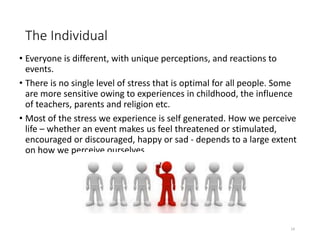
• Everyone is different, with unique perceptions, and reactions to
events.
• There is no single level of stress that is optimal for all people. Some
are more sensitive owing to experiences in childhood, the influence
of teachers, parents and religion etc.
• Most of the stress we experience is self generated. How we perceive
life – whether an event makes us feel threatened or stimulated,
encouraged or discouraged, happy or sad - depends to a large extent
on how we perceive ourselves.
14
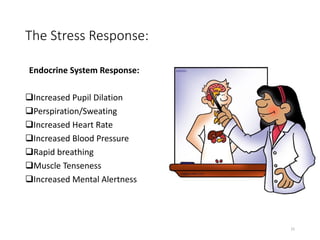
The Stress Response:
Endocrine System Response:
❑Increased Pupil Dilation
❑Perspiration/Sweating
❑Increased Heart Rate
❑Increased Blood Pressure
❑Rapid breathing
❑Muscle Tenseness
❑Increased Mental Alertness
15
General Adaptation Syndrome:
• Alarm Response: This is the “Fight or Flight” response that prepares the
body for immediate action.
• Adaptation Phase: Body prepares for long-term protection. This phase is
common and not necessarily harmful but must include periods of
relaxation and rest to counterbalance the stress response.
• Exhaustion: In chronic stress situations, sufferers enter the exhaustion
phase: emotional, physical and mental resources suffer heavily, the body
experiences ‘adrenal exhaustion’ leading to decreased stress tolerance,
progressive mental and physical exhaustion, illness and collapse.
16
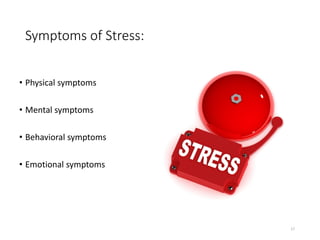
Symptoms of Stress:
• Physical symptoms
• Mental symptoms
• Behavioral symptoms
• Emotional symptoms
17
Physical Symptoms:
➢Fatigue
➢Sleep disorders
➢Digestion problems
➢Headaches
➢Aches & Pains
➢Sweating & Trembling
➢Dizziness
➢Breathlessness
➢Tingling hands & feet
18
Mental Symptoms:
❖ Lack of Concentration
❖ Memory lapses
❖ Improper decision making
❖ Confusion
❖ Disorientation
❖ Panic attacks
Behavioral Symptoms:
➢Appetite changes
➢Eating disorders
➢Increased intake of Alcohol
and/or Smoking
➢Restlessness
➢Fidgeting
➢Nail biting
➢Hypochondria
19
Emotional Symptoms:
❖ Bouts of depression
❖ Impatience
❖ Fits of rage
❖ Tearfulness
❖ Deterioration of personal
hygiene and appearance
Self Help
20
Recognize the Problem:
• The most important point is to
recognize the source of the negative
stress.
• This is not an admission of weakness or
inability to cope! It is a way to identify
the problem and plan measures to
overcome it.
21
Stress Control:
A B C Strategy
22
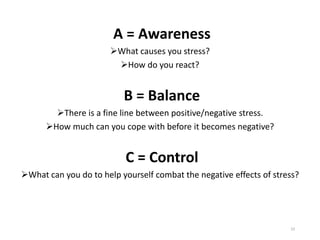
A = Awareness
➢What causes you stress?
➢How do you react?
B = Balance
➢There is a fine line between positive/negative stress.
➢How much can you cope with before it becomes negative?
C = Control
➢What can you do to help yourself combat the negative effects of stress?
23
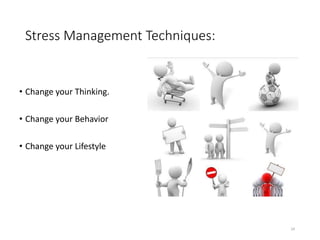
Stress Management Techniques:
• Change your Thinking.
• Change your Behavior
• Change your Lifestyle
24
Change your Thinking:
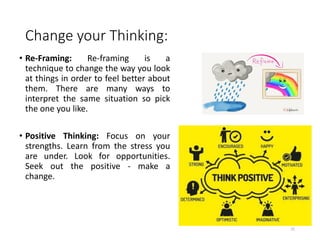
• Re-Framing: Re-framing is a
technique to change the way you look
at things in order to feel better about
them. There are many ways to
interpret the same situation so pick
the one you like.
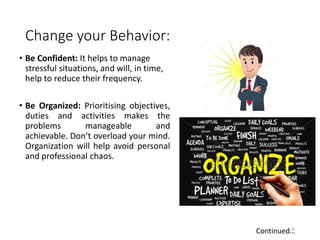
• Positive Thinking: Focus on your
strengths. Learn from the stress you
are under. Look for opportunities.
Seek out the positive - make a
change.
25
Change your Behavior:
• Be Confident: It helps to manage
stressful situations, and will, in time,
help to reduce their frequency.
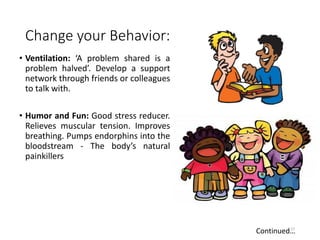
• Be Organized: Prioritising objectives,
duties and activities makes the
problems manageable and
achievable. Don’t overload your mind.
Organization will help avoid personal
and professional chaos.
26
Continued…
Change your Behavior:
• Ventilation: ‘A problem shared is a
problem halved’. Develop a support
network through friends or colleagues
to talk with.
• Humor and Fun: Good stress reducer.
Relieves muscular tension. Improves
breathing. Pumps endorphins into the
bloodstream - The body’s natural
painkillers
27
Continued…
Change your Behavior:
• Diversion & Distractions: Take time
out.Get away from things that bother
you. Calm down. Think logically.
28
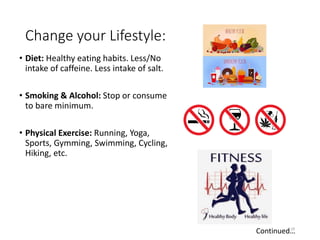
Change your Lifestyle:
• Diet: Healthy eating habits. Less/No
intake of caffeine. Less intake of salt.
• Smoking & Alcohol: Stop or consume
to bare minimum.
• Physical Exercise: Running, Yoga,
Sports, Gymming, Swimming, Cycling,
Hiking, etc.
29
Continued…
Change your Lifestyle:
• Proper Sleep: Good stress reducer.
Wake refreshed after night’s sleep.
Plenty of daytime energy.
• Leisure-time: Interest. Gives you a
‘break’ from stresses. Provides outlet
for relief. Provides social contact
• Body Relaxation: Lowers blood
pressure. Combats fatigue. Promotes
sleep. Reduces pain. Eases muscle
tension. Increase concentration.
Increase productivity.
30
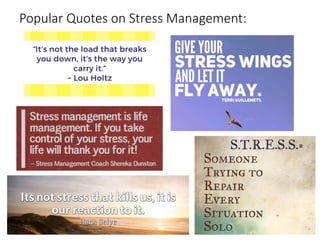
Popular Quotes on Stress Management:
31
32
Anurag Dua

Stress management

  • 1.
  • 2.
    Contents: 1. Stress Defined 2.Stressors 3. Types of Stress 4. The Individual 5. Symptoms of Stress 6. Stress Control Strategy 7. Stress Management Techniques 2
  • 3.
    What is Stress? Stressis the reaction people have to excessive pressures or demand placed upon them. It arises when they worry that they can’t cope. Stress is the “wear and tear” our minds and bodies experience as we attempt to cope with our continually changing environment 3
  • 4.
    Definition: S = P> R Stress occurs when the Pressure is greater than the Resource. 4
  • 5.
    Stress Feelings: • Worry •Tense • Tired • Frightened • Depressed • Anxious • Anger 5
  • 6.
    Types of Stressors? •External • Internal 6
  • 7.
    External Stressors • PhysicalEnvironment • Social Interaction • Organizational • Major Life Events • Daily Hassles 7
  • 8.
    Physical Environment: ➢Noise ➢Bright Light ➢Heat ➢ConfinedSpace 8 Organizational: ❑ Rules ❑ Regulations ❑ Deadlines Social Interaction: ❖ Rudeness ❖ Bossiness ❖ Aggressiveness by others ❖ Bullying Major Life Events: o Birth o Death o Job Lost o Promotion o Marital Status change Daily Hassles: ✓ Commuting ✓ Misplaced Keys/Items ✓ Mechanical Breakdown
  • 9.
    Internal Stressors • LifestyleChoices • Negative self-talk • Mind Traps • Personality Traits 9
  • 10.
    Lifestyle Choices: ➢Caffeine ➢Lack ofSleep ➢Overloaded Schedule 10 Negative Self-Talk: ❖ Pessimistic thinking ❖ Self criticism ❖ Over analyzing Mind Traps: ❑ Unrealistic Expectations ❑ Taking things Personally ❑ All or Nothing thinking ❑ Exaggeration ❑ Rigid thinking Personality Traits: o Perfectionists o Workaholics
  • 11.
    Types of Stress: •Negative Stress • Positive Stress 11
  • 12.
    Negative Stress: • Itis a contributory factor in minor conditions, such as Headaches, digestive problems, skin complaints, insomnia and ulcers. • Excessive, prolonged and unrelieved stress can have a harmful effect on mental, physical and spiritual health. 12
  • 13.
    Positive Stress: • Stresscan also have a positive effect, enhancing motivation and awareness, providing the stimulation to cope with challenging situations. • Stress also provides the sense of urgency and alertness needed for survival when confronting threatening situations. 13
  • 14.
    The Individual • Everyoneis different, with unique perceptions, and reactions to events. • There is no single level of stress that is optimal for all people. Some are more sensitive owing to experiences in childhood, the influence of teachers, parents and religion etc. • Most of the stress we experience is self generated. How we perceive life – whether an event makes us feel threatened or stimulated, encouraged or discouraged, happy or sad - depends to a large extent on how we perceive ourselves. 14
  • 15.
    The Stress Response: EndocrineSystem Response: ❑Increased Pupil Dilation ❑Perspiration/Sweating ❑Increased Heart Rate ❑Increased Blood Pressure ❑Rapid breathing ❑Muscle Tenseness ❑Increased Mental Alertness 15
  • 16.
    General Adaptation Syndrome: •Alarm Response: This is the “Fight or Flight” response that prepares the body for immediate action. • Adaptation Phase: Body prepares for long-term protection. This phase is common and not necessarily harmful but must include periods of relaxation and rest to counterbalance the stress response. • Exhaustion: In chronic stress situations, sufferers enter the exhaustion phase: emotional, physical and mental resources suffer heavily, the body experiences ‘adrenal exhaustion’ leading to decreased stress tolerance, progressive mental and physical exhaustion, illness and collapse. 16
  • 17.
    Symptoms of Stress: •Physical symptoms • Mental symptoms • Behavioral symptoms • Emotional symptoms 17
  • 18.
    Physical Symptoms: ➢Fatigue ➢Sleep disorders ➢Digestionproblems ➢Headaches ➢Aches & Pains ➢Sweating & Trembling ➢Dizziness ➢Breathlessness ➢Tingling hands & feet 18 Mental Symptoms: ❖ Lack of Concentration ❖ Memory lapses ❖ Improper decision making ❖ Confusion ❖ Disorientation ❖ Panic attacks
  • 19.
    Behavioral Symptoms: ➢Appetite changes ➢Eatingdisorders ➢Increased intake of Alcohol and/or Smoking ➢Restlessness ➢Fidgeting ➢Nail biting ➢Hypochondria 19 Emotional Symptoms: ❖ Bouts of depression ❖ Impatience ❖ Fits of rage ❖ Tearfulness ❖ Deterioration of personal hygiene and appearance
  • 20.
  • 21.
    Recognize the Problem: •The most important point is to recognize the source of the negative stress. • This is not an admission of weakness or inability to cope! It is a way to identify the problem and plan measures to overcome it. 21
  • 22.
    Stress Control: A BC Strategy 22
  • 23.
    A = Awareness ➢Whatcauses you stress? ➢How do you react? B = Balance ➢There is a fine line between positive/negative stress. ➢How much can you cope with before it becomes negative? C = Control ➢What can you do to help yourself combat the negative effects of stress? 23
  • 24.
    Stress Management Techniques: •Change your Thinking. • Change your Behavior • Change your Lifestyle 24
  • 25.
    Change your Thinking: •Re-Framing: Re-framing is a technique to change the way you look at things in order to feel better about them. There are many ways to interpret the same situation so pick the one you like. • Positive Thinking: Focus on your strengths. Learn from the stress you are under. Look for opportunities. Seek out the positive - make a change. 25
  • 26.
    Change your Behavior: •Be Confident: It helps to manage stressful situations, and will, in time, help to reduce their frequency. • Be Organized: Prioritising objectives, duties and activities makes the problems manageable and achievable. Don’t overload your mind. Organization will help avoid personal and professional chaos. 26 Continued…
  • 27.
    Change your Behavior: •Ventilation: ‘A problem shared is a problem halved’. Develop a support network through friends or colleagues to talk with. • Humor and Fun: Good stress reducer. Relieves muscular tension. Improves breathing. Pumps endorphins into the bloodstream - The body’s natural painkillers 27 Continued…
  • 28.
    Change your Behavior: •Diversion & Distractions: Take time out.Get away from things that bother you. Calm down. Think logically. 28
  • 29.
    Change your Lifestyle: •Diet: Healthy eating habits. Less/No intake of caffeine. Less intake of salt. • Smoking & Alcohol: Stop or consume to bare minimum. • Physical Exercise: Running, Yoga, Sports, Gymming, Swimming, Cycling, Hiking, etc. 29 Continued…
  • 30.
    Change your Lifestyle: •Proper Sleep: Good stress reducer. Wake refreshed after night’s sleep. Plenty of daytime energy. • Leisure-time: Interest. Gives you a ‘break’ from stresses. Provides outlet for relief. Provides social contact • Body Relaxation: Lowers blood pressure. Combats fatigue. Promotes sleep. Reduces pain. Eases muscle tension. Increase concentration. Increase productivity. 30
  • 31.
    Popular Quotes onStress Management: 31
  • 32.