ESOP

    ESOP: Employee Stock
     Ownership Plan
What is ESOP?
   ESOP may be defined as a part of Employee
    benefit plan under which employees buy, at a ‘fair’
    value, the stock of the company and they may
    become owners of the company for which they
    work.
   The concept of ESOP was introduced by lawyer
    and investment banker Louis Kelso of USA in
    1950’s.
   In India, ESOP comes under existence in 1987.
   ESOP may comes under AS-15 of ICAI, which is
    Retirement benefits in Employer’s financial
    statement.
What is need for ESOP?

   To buy the shares of a departing owner.
   To borrow money at a lower after-tax cost.
   To create an additional employee benefit.
   Capital appreciation.
   Incentive based retirement.
   Tax advantage.
   Company reduces its tax liability.
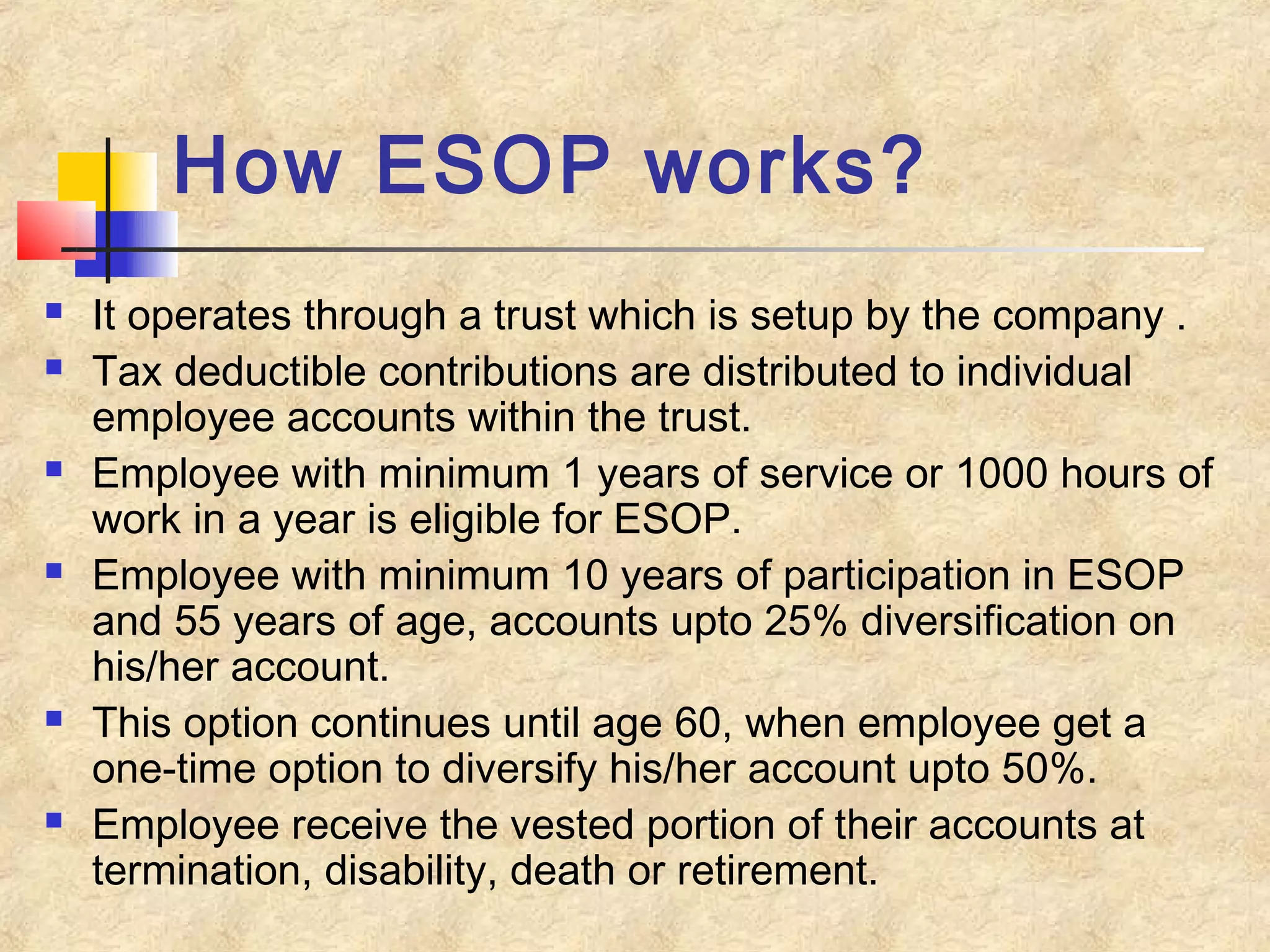
How ESOP works?
   It operates through a trust which is setup by the company .
   Tax deductible contributions are distributed to individual
    employee accounts within the trust.
   Employee with minimum 1 years of service or 1000 hours of
    work in a year is eligible for ESOP.
   Employee with minimum 10 years of participation in ESOP
    and 55 years of age, accounts upto 25% diversification on
    his/her account.
   This option continues until age 60, when employee get a
    one-time option to diversify his/her account upto 50%.
   Employee receive the vested portion of their accounts at
    termination, disability, death or retirement.
Major Indian companies using ESOP

           Wipro
           Infosys
           Dabur
           P&G
           HLL
           ONGC
           Tata technologies
           ICICI Bank
           Bharti tele-ventures
ESOP with respect to Wipro

   WIPRO’s employees together have stock
    options for 50 lakh equity shares of a
    nominal value of Rs.2 each. The plan covers
    executive and non-executive directors but
    excludes promoter directors. The staff
    turnover at WIPRO is as low as 4-5 percent
    against an industry rate of 18-20 percent.
    This shows the biggest advantage of ESOP,
    that is, employee retention.
Caveats of ESOP

   Investors object why employees should be given a
    stake in the company at fair market value. It dilutes the
    per share worth of existing investors.
   Law does not allow ESOP to be used in partnerships.
   Plan committee members can be held responsible if
    they knowingly participate in improper transactions.
   As value of stock appreciates substantially ESOP may
    not have sufficient funds to repurchase stock.
   With decrease in value of the company ESOP seems to
    be less attractive to the employees.
Conclusion
   Though having some threats, ESOP is
    advantageous. It is used by the
    companies to Reward, Retain, Attract
    talent, Create a sense of Ownership in the
    company and a Retirement benefit
    scheme. Hence, it improves the corporate
    performance as a whole.
Presented By:


              Group 6
             Section D
           MBA (General)
          Batch 2006-2008

Employee Stock Option Plan

  • 1.
    ESOP  ESOP: Employee Stock Ownership Plan
  • 2.
    What is ESOP?  ESOP may be defined as a part of Employee benefit plan under which employees buy, at a ‘fair’ value, the stock of the company and they may become owners of the company for which they work.  The concept of ESOP was introduced by lawyer and investment banker Louis Kelso of USA in 1950’s.  In India, ESOP comes under existence in 1987.  ESOP may comes under AS-15 of ICAI, which is Retirement benefits in Employer’s financial statement.
  • 3.
    What is needfor ESOP?  To buy the shares of a departing owner.  To borrow money at a lower after-tax cost.  To create an additional employee benefit.  Capital appreciation.  Incentive based retirement.  Tax advantage.  Company reduces its tax liability.
  • 4.
    How ESOP works?  It operates through a trust which is setup by the company .  Tax deductible contributions are distributed to individual employee accounts within the trust.  Employee with minimum 1 years of service or 1000 hours of work in a year is eligible for ESOP.  Employee with minimum 10 years of participation in ESOP and 55 years of age, accounts upto 25% diversification on his/her account.  This option continues until age 60, when employee get a one-time option to diversify his/her account upto 50%.  Employee receive the vested portion of their accounts at termination, disability, death or retirement.
  • 5.
    Major Indian companiesusing ESOP  Wipro  Infosys  Dabur  P&G  HLL  ONGC  Tata technologies  ICICI Bank  Bharti tele-ventures
  • 6.
    ESOP with respectto Wipro  WIPRO’s employees together have stock options for 50 lakh equity shares of a nominal value of Rs.2 each. The plan covers executive and non-executive directors but excludes promoter directors. The staff turnover at WIPRO is as low as 4-5 percent against an industry rate of 18-20 percent. This shows the biggest advantage of ESOP, that is, employee retention.
  • 7.
    Caveats of ESOP  Investors object why employees should be given a stake in the company at fair market value. It dilutes the per share worth of existing investors.  Law does not allow ESOP to be used in partnerships.  Plan committee members can be held responsible if they knowingly participate in improper transactions.  As value of stock appreciates substantially ESOP may not have sufficient funds to repurchase stock.  With decrease in value of the company ESOP seems to be less attractive to the employees.
  • 8.
    Conclusion  Though having some threats, ESOP is advantageous. It is used by the companies to Reward, Retain, Attract talent, Create a sense of Ownership in the company and a Retirement benefit scheme. Hence, it improves the corporate performance as a whole.
  • 9.
    Presented By: Group 6 Section D MBA (General) Batch 2006-2008