Submitted By:
 Anurag Dua
 MBA (G) – 2008
 A0101906052
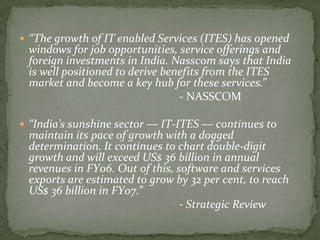
 “The growth of IT enabled Services (ITES) has opened
 windows for job opportunities, service offerings and
 foreign investments in India. Nasscom says that India
 is well positioned to derive benefits from the ITES
 market and become a key hub for these services.”
                                 - NASSCOM

 “India’s sunshine sector — IT-ITES — continues to
 maintain its pace of growth with a dogged
 determination. It continues to chart double-digit
 growth and will exceed US$ 36 billion in annual
 revenues in FY06. Out of this, software and services
 exports are estimated to grow by 32 per cent, to reach
 US$ 36 billion in FY07.”
                                 - Strategic Review
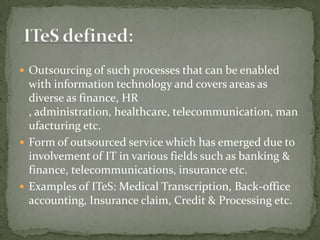
 Outsourcing of such processes that can be enabled
  with information technology and covers areas as
  diverse as finance, HR
  , administration, healthcare, telecommunication, man
  ufacturing etc.
 Form of outsourced service which has emerged due to
  involvement of IT in various fields such as banking &
  finance, telecommunications, insurance etc.
 Examples of ITeS: Medical Transcription, Back-office
  accounting, Insurance claim, Credit & Processing etc.
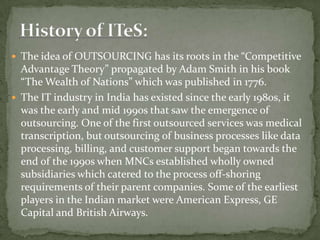
 The idea of OUTSOURCING has its roots in the “Competitive
  Advantage Theory” propagated by Adam Smith in his book
  “The Wealth of Nations” which was published in 1776.
 The IT industry in India has existed since the early 1980s, it
  was the early and mid 1990s that saw the emergence of
  outsourcing. One of the first outsourced services was medical
  transcription, but outsourcing of business processes like data
  processing, billing, and customer support began towards the
  end of the 1990s when MNCs established wholly owned
  subsidiaries which catered to the process off-shoring
  requirements of their parent companies. Some of the earliest
  players in the Indian market were American Express, GE
  Capital and British Airways.
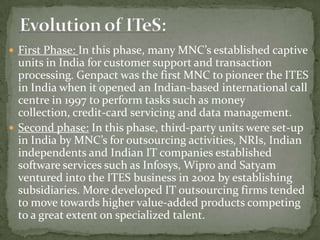
 First Phase: In this phase, many MNC’s established captive
  units in India for customer support and transaction
  processing. Genpact was the first MNC to pioneer the ITES
  in India when it opened an Indian-based international call
  centre in 1997 to perform tasks such as money
  collection, credit-card servicing and data management.
 Second phase: In this phase, third-party units were set-up
  in India by MNC’s for outsourcing activities, NRIs, Indian
  independents and Indian IT companies established
  software services such as Infosys, Wipro and Satyam
  ventured into the ITES business in 2002 by establishing
  subsidiaries. More developed IT outsourcing firms tended
  to move towards higher value-added products competing
  to a great extent on specialized talent.
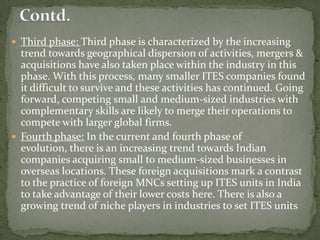
 Third phase: Third phase is characterized by the increasing
  trend towards geographical dispersion of activities, mergers &
  acquisitions have also taken place within the industry in this
  phase. With this process, many smaller ITES companies found
  it difficult to survive and these activities has continued. Going
  forward, competing small and medium-sized industries with
  complementary skills are likely to merge their operations to
  compete with larger global firms.
 Fourth phase: In the current and fourth phase of
  evolution, there is an increasing trend towards Indian
  companies acquiring small to medium-sized businesses in
  overseas locations. These foreign acquisitions mark a contrast
  to the practice of foreign MNCs setting up ITES units in India
  to take advantage of their lower costs here. There is also a
  growing trend of niche players in industries to set ITES units
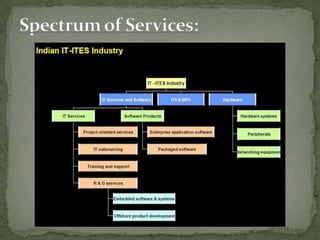
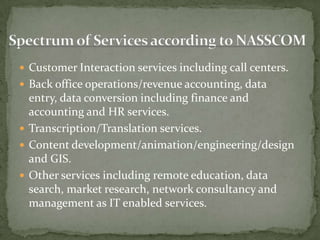
 Customer Interaction services including call centers.
 Back office operations/revenue accounting, data
  entry, data conversion including finance and
  accounting and HR services.
 Transcription/Translation services.
 Content development/animation/engineering/design
  and GIS.
 Other services including remote education, data
  search, market research, network consultancy and
  management as IT enabled services.
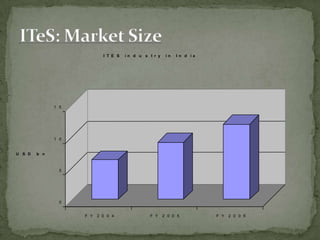
I T E S   in d u s t r y    in   In d ia


              1 5


              1 0


U S D   b n


                5


                0


                    F Y   2 0 0 4               F Y    2 0 0 5         F Y   2 0 0 6
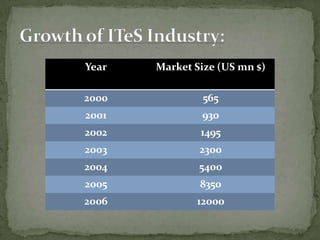
Year   Market Size (US mn $)

2000           565
2001           930
2002           1495
2003           2300
2004           5400
2005           8350
2006          12000
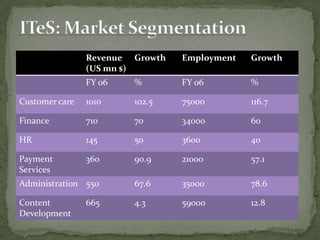
Revenue Growth   Employment   Growth
                (US mn $)
                FY 06   %        FY 06        %

Customer care   1010    102.5    75000        116.7

Finance         710     70       34000        60

HR              145     50       3600         40

Payment         360     90.9     21000        57.1
Services
Administration 550      67.6     35000        78.6

Content         665     4.3      59000        12.8
Development
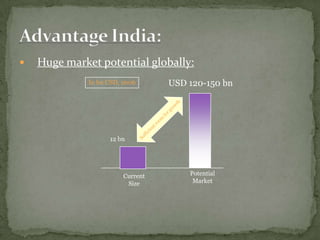
   Huge market potential globally:
              In bn USD, 2006      USD 120-150 bn


                    12 bn


                         Current       Potential
                          Size          Market
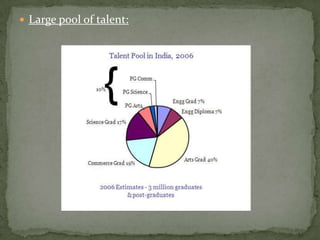
 Large pool of talent:
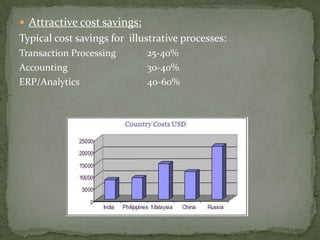
 Attractive cost savings:
Typical cost savings for illustrative processes:
Transaction Processing       25-40%
Accounting                   30-40%
ERP/Analytics                40-60%
 Infrastructure:


a)   SEZ, IT Parks
b)   Expansion of road network
c)   Lower land costs
d)   Internet facility easily available
e)   Bandwidth sharing among multiple entities.
f)   Broadband, Fixed and Wireless users on the increase
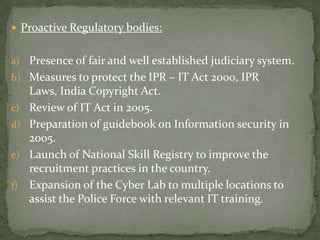
 Proactive Regulatory bodies:


a) Presence of fair and well established judiciary system.
b) Measures to protect the IPR – IT Act 2000, IPR
     Laws, India Copyright Act.
c)   Review of IT Act in 2005.
d)   Preparation of guidebook on Information security in
     2005.
e)   Launch of National Skill Registry to improve the
     recruitment practices in the country.
f)   Expansion of the Cyber Lab to multiple locations to
     assist the Police Force with relevant IT training.
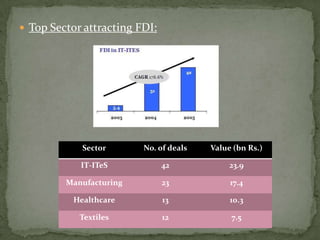
 Top Sector attracting FDI:


             Sector      No. of deals   Value (bn Rs.)

            IT-ITeS            42            23.9

         Manufacturing         23            17.4

           Healthcare          13            10.3

            Textiles           12            7.5
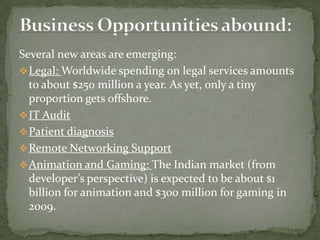
Several new areas are emerging:
 Legal: Worldwide spending on legal services amounts
  to about $250 million a year. As yet, only a tiny
  proportion gets offshore.
 IT Audit
 Patient diagnosis
 Remote Networking Support
 Animation and Gaming: The Indian market (from
  developer’s perspective) is expected to be about $1
  billion for animation and $300 million for gaming in
  2009.
Thank You.

IT Enabled Services

  • 1.
    Submitted By: AnuragDua MBA (G) – 2008 A0101906052
  • 2.
     “The growthof IT enabled Services (ITES) has opened windows for job opportunities, service offerings and foreign investments in India. Nasscom says that India is well positioned to derive benefits from the ITES market and become a key hub for these services.” - NASSCOM  “India’s sunshine sector — IT-ITES — continues to maintain its pace of growth with a dogged determination. It continues to chart double-digit growth and will exceed US$ 36 billion in annual revenues in FY06. Out of this, software and services exports are estimated to grow by 32 per cent, to reach US$ 36 billion in FY07.” - Strategic Review
  • 3.
     Outsourcing ofsuch processes that can be enabled with information technology and covers areas as diverse as finance, HR , administration, healthcare, telecommunication, man ufacturing etc.  Form of outsourced service which has emerged due to involvement of IT in various fields such as banking & finance, telecommunications, insurance etc.  Examples of ITeS: Medical Transcription, Back-office accounting, Insurance claim, Credit & Processing etc.
  • 4.
     The ideaof OUTSOURCING has its roots in the “Competitive Advantage Theory” propagated by Adam Smith in his book “The Wealth of Nations” which was published in 1776.  The IT industry in India has existed since the early 1980s, it was the early and mid 1990s that saw the emergence of outsourcing. One of the first outsourced services was medical transcription, but outsourcing of business processes like data processing, billing, and customer support began towards the end of the 1990s when MNCs established wholly owned subsidiaries which catered to the process off-shoring requirements of their parent companies. Some of the earliest players in the Indian market were American Express, GE Capital and British Airways.
  • 5.
     First Phase:In this phase, many MNC’s established captive units in India for customer support and transaction processing. Genpact was the first MNC to pioneer the ITES in India when it opened an Indian-based international call centre in 1997 to perform tasks such as money collection, credit-card servicing and data management.  Second phase: In this phase, third-party units were set-up in India by MNC’s for outsourcing activities, NRIs, Indian independents and Indian IT companies established software services such as Infosys, Wipro and Satyam ventured into the ITES business in 2002 by establishing subsidiaries. More developed IT outsourcing firms tended to move towards higher value-added products competing to a great extent on specialized talent.
  • 6.
     Third phase:Third phase is characterized by the increasing trend towards geographical dispersion of activities, mergers & acquisitions have also taken place within the industry in this phase. With this process, many smaller ITES companies found it difficult to survive and these activities has continued. Going forward, competing small and medium-sized industries with complementary skills are likely to merge their operations to compete with larger global firms.  Fourth phase: In the current and fourth phase of evolution, there is an increasing trend towards Indian companies acquiring small to medium-sized businesses in overseas locations. These foreign acquisitions mark a contrast to the practice of foreign MNCs setting up ITES units in India to take advantage of their lower costs here. There is also a growing trend of niche players in industries to set ITES units
  • 8.
     Customer Interactionservices including call centers.  Back office operations/revenue accounting, data entry, data conversion including finance and accounting and HR services.  Transcription/Translation services.  Content development/animation/engineering/design and GIS.  Other services including remote education, data search, market research, network consultancy and management as IT enabled services.
  • 9.
    I T ES in d u s t r y in In d ia 1 5 1 0 U S D b n 5 0 F Y 2 0 0 4 F Y 2 0 0 5 F Y 2 0 0 6
  • 10.
    Year Market Size (US mn $) 2000 565 2001 930 2002 1495 2003 2300 2004 5400 2005 8350 2006 12000
  • 11.
    Revenue Growth Employment Growth (US mn $) FY 06 % FY 06 % Customer care 1010 102.5 75000 116.7 Finance 710 70 34000 60 HR 145 50 3600 40 Payment 360 90.9 21000 57.1 Services Administration 550 67.6 35000 78.6 Content 665 4.3 59000 12.8 Development
  • 12.
    Huge market potential globally: In bn USD, 2006 USD 120-150 bn 12 bn Current Potential Size Market
  • 13.
     Large poolof talent:
  • 14.
     Attractive costsavings: Typical cost savings for illustrative processes: Transaction Processing 25-40% Accounting 30-40% ERP/Analytics 40-60%
  • 15.
     Infrastructure: a) SEZ, IT Parks b) Expansion of road network c) Lower land costs d) Internet facility easily available e) Bandwidth sharing among multiple entities. f) Broadband, Fixed and Wireless users on the increase
  • 16.
     Proactive Regulatorybodies: a) Presence of fair and well established judiciary system. b) Measures to protect the IPR – IT Act 2000, IPR Laws, India Copyright Act. c) Review of IT Act in 2005. d) Preparation of guidebook on Information security in 2005. e) Launch of National Skill Registry to improve the recruitment practices in the country. f) Expansion of the Cyber Lab to multiple locations to assist the Police Force with relevant IT training.
  • 17.
     Top Sectorattracting FDI: Sector No. of deals Value (bn Rs.) IT-ITeS 42 23.9 Manufacturing 23 17.4 Healthcare 13 10.3 Textiles 12 7.5
  • 18.
    Several new areasare emerging:  Legal: Worldwide spending on legal services amounts to about $250 million a year. As yet, only a tiny proportion gets offshore.  IT Audit  Patient diagnosis  Remote Networking Support  Animation and Gaming: The Indian market (from developer’s perspective) is expected to be about $1 billion for animation and $300 million for gaming in 2009.
  • 21.