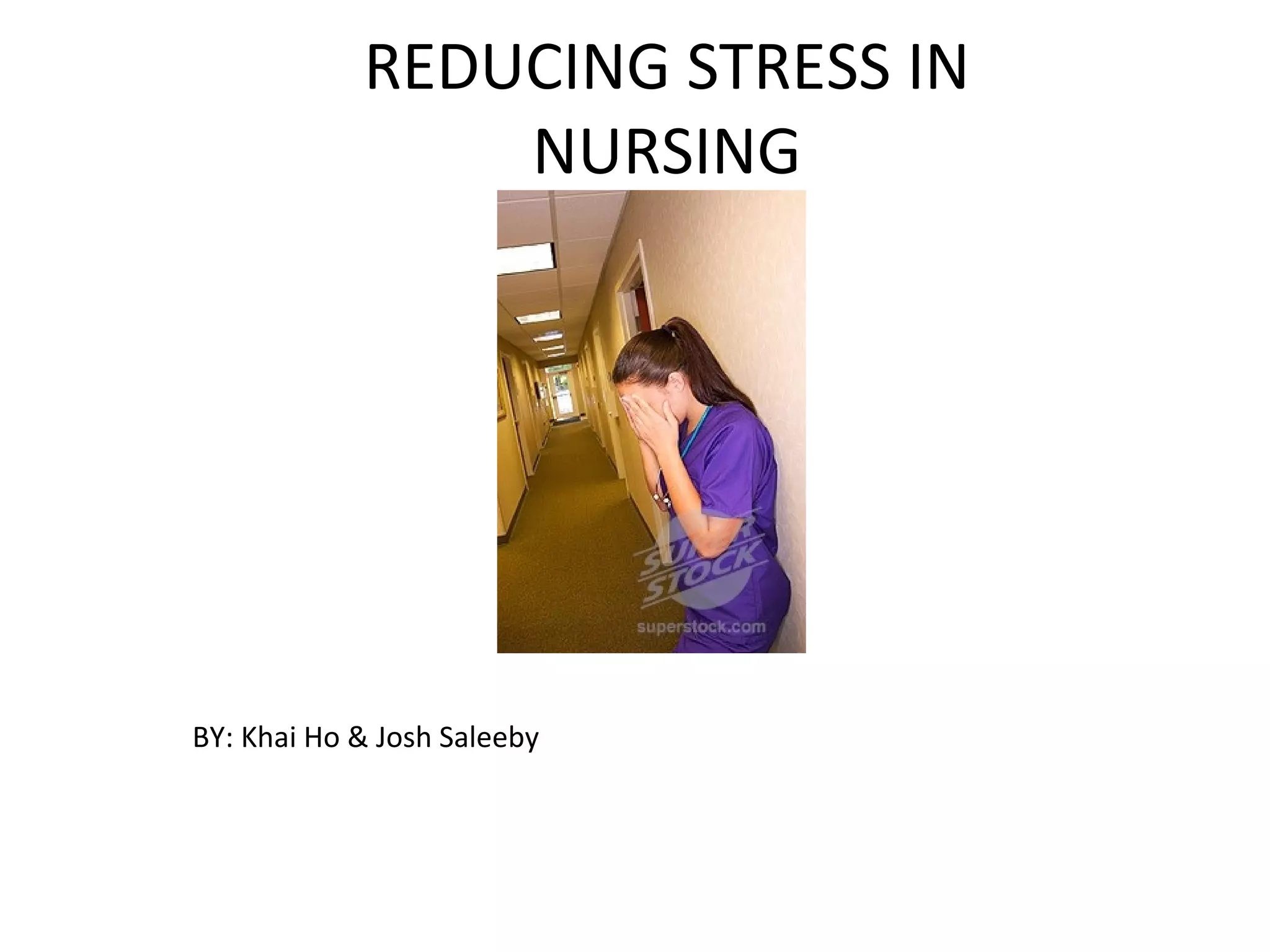
REDUCING STRESS IN NURSING BY: Khai Ho & Josh Saleeby
POSTER PRESENTATION: TOPIC:  Reducing Stress in Nursing SAMPLING POPULATION:  hospital base nurses SAMPLING METHOD:  Convenience sampling (research other related works, survey, and questionnaire)  ASSESSMENT TOOLS:
SA MPLING METHOD AND POPULATION 2003 Canadian Community Health Survey (CCHS), sampled all healthcare workers in Canada.  Of 413,00 participants in the health care survey 67%  of RN reported of have stress at work. Female rank higher at 46%. Age factor from 35-54 y/o ranked at 50%. Stress were higher for people with income of $60,000 or above compared to those with income of less than $20,000. 75% of nurses say that their stress are quite extreme and are dissatisfy with life. 54% say that they are in bad/poor health.
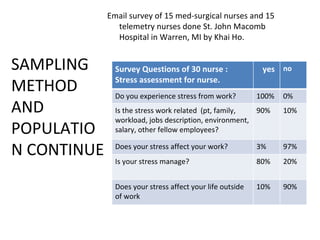
SAMPLING METHOD AND POPULATION CONTINUE Email survey of 15 med-surgical nurses and 15 telemetry nurses done St. John Macomb Hospital in Warren, MI by Khai Ho. Survey Questions of 30 nurse : Stress assessment for nurse. yes no Do you experience stress from work? 100% 0% Is the stress work related  (pt, family, workload, jobs description, environment, salary, other fellow employees? 90% 10% Does your stress affect your work? 3% 97% Is your stress manage? 80% 20% Does your stress affect your life outside of work 10% 90%
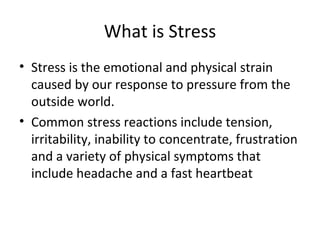
What is Stress Stress is the emotional and physical strain caused by our response to pressure from the outside world.  Common stress reactions include tension, irritability, inability to concentrate, frustration and a variety of physical symptoms that include headache and a fast heartbeat
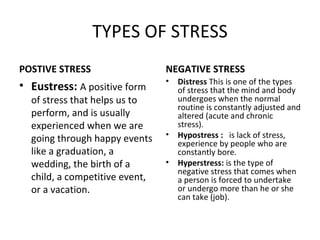
TYPES OF STRESS POSTIVE STRESS Eustress:  A positive form of stress that helps us to perform, and is usually experienced when we are going through happy events like a graduation, a wedding, the birth of a child, a competitive event, or a vacation.  NEGATIVE STRESS Distress  This is one of the types of stress that the mind and body undergoes when the normal routine is constantly adjusted and altered (acute and chronic stress).  Hypostress :  is lack of stress, experience by people who are constantly bore. Hyperstress:  is the type of negative stress that comes when a person is forced to undertake or undergo more than he or she can take (job).
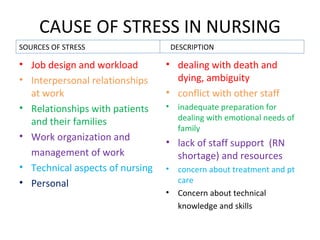
CAUSE OF STRESS IN NURSING Job design and workload Interpersonal relationships at work Relationships with patients and their families Work organization and management of work Technical aspects of nursing Personal dealing with death and dying, ambiguity conflict with other staff inadequate preparation for dealing with emotional needs of family lack of staff support  (RN shortage) and resources concern about treatment and pt care Concern about technical knowledge and skills SOURCES OF STRESS  DESCRIPTION
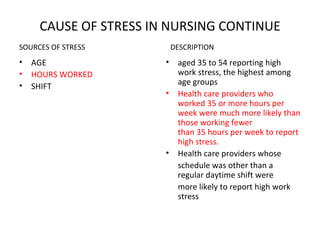
CAUSE OF STRESS IN NURSING CONTINUE AGE HOURS WORKED SHIFT aged 35 to 54 reporting high work stress, the highest among age groups Health care providers who worked 35 or more hours per week were much more likely than those working fewer than 35 hours per week to report high stress. Health care providers whose schedule was other than a regular daytime shift were more likely to report high work stress SOURCES OF STRESS  DESCRIPTION
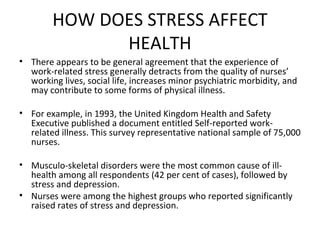
HOW DOES STRESS AFFECT HEALTH There appears to be general agreement that the experience of work-related stress generally detracts from the quality of nurses’ working lives, social life, increases minor psychiatric morbidity, and may contribute to some forms of physical illness. For example, in 1993, the United Kingdom Health and Safety Executive published a document entitled Self-reported work-related illness. This survey representative national sample of 75,000 nurses.  Musculo-skeletal disorders were the most common cause of ill-health among all respondents (42 per cent of cases), followed by stress and depression.  Nurses were among the highest groups who reported significantly raised rates of stress and depression.
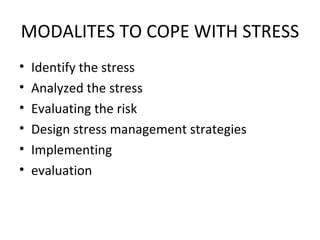
MODALITES TO COPE WITH STRESS Identify the stress Analyzed the stress Evaluating the risk Design stress management strategies Implementing evaluation
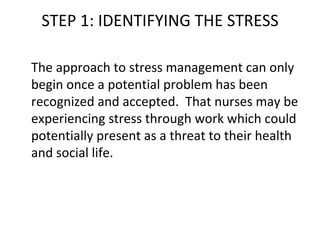
STEP 1: IDENTIFYING THE STRESS The approach to stress management can only begin once a potential problem has been recognized and accepted.  That nurses may be experiencing stress through work which could potentially present as a threat to their health and social life.
SIGNS OF STRESS Availability to work, sickness or absence Accident or incident Disciplinary action or compliant  Seeking help from fellow employee or counseling Low attitude and esteem for the job Frustration, irritability, anger
STEP 2: ANALYZE THE STRESS Sources of stress (where, when and why) Where is the stress coming from When did the stress start Why did the stress happen What types of stress it is
STEP 3: EVALUATING THE STRESS Can the stress endanger my ability to work and take care pt? Can the stress be a hazardous to my social life and family? Is the stress affecting my ability to work, concentrate, or make decisions? Is the stress causing my personality change (depression, labile affect, dull, suicidal, frustration, anger, anxious, anxiety)? Is the stress changing my usual habits (exercise or diet) Does the stress affect my relationship with my fellow employees ?
STEP4: DESIGNING STRESS MANAGEMENT STRATEGIES In designing stress management strategies, attention should focus on the total work system, which includes the organizational, social and physical environments, the technology in use, the work systems, and the people involved.
STEP4: DESIGN STRESS MANAGEMENT STRATEGIES CONTINUE Types of strategy:  This would involve what type of stress you are experiencing, what your symptoms are (anger, depression, sad, anxiety), and the level of your stress Target:  Who are what should the intervention be aim at (individual, or organization)  Agency:  Who is responsible for caring out the intervention (RN, or the organization All interventions must have  objectives or goals to be achieved!!!!  The Total System Matrix
TYPES OF COPING MECHANISMS Goals setting, self esteem enhancement, active listening Remedial Action Practice, preventative maintenance.  Set priorities in your life. Avoid negative people. Use time wisely.  Stop saying negative things to yourself.  Develop your sense of humor. 
REMDIAL ACTION: Change your thinking:  (Reframing and  Positive thinking) Change your behavior  (be assertive, get organized/time management, ventilation, humor, diversion and distraction Change your life style:  (diet, exercise drink water, pet therapy, music therapy, sleep, nature walks, guide imagery, leisure, and pacing
COPING MECHANISM FOR NURSE AT WORK Reframing:  is finding ways to see the problem from a different perspective Be assertive:  standing up for your personal rights and expressing your thoughts, feelings and beliefs directly, honestly and spontaneously in ways that don’t infringe on the rights of others Ventilation:  let your anger out, talk about it, write it down diversion and distraction:  take a vacation or a short walk, it gives you time to catch your breath and think about the problem objectively. Group therapy or interaction:  allows every ones to speak, provide compromise
STEP 5: IMPLEMENTING Start by understanding your objectives or goals Start with the a more reachable goal and work from there Prevent further stress
STEP 6: EVALUATION Were the objectives achieved Was the stress reduced or eliminated  Do you feel like your old self before the stress Is your quality of life improved (work, social, family, personal) Was the intervention affected or does it need changes
References Kathryn Wilkins. (November 2007). Work stress among health care providers. Retrieved November 12, 2007 from Statistics Canada. Website:  http://www.statcan.ca/english/freepub/82-003-XIE/2006011/articles/10367-en.pdf (October 2003). Results of the September 2002 Survey of Registered Professional Nurses, Volume II. Retrieved November 12, 2007 from Office of the Profession “New York State Educational Department”. Website:  http://www.op.nysed.gov/nursing-survey-final-regents-report-nov.htm (2007). Coping With Stress. Retrieved November 12,2007 from Holistic Online. Website:  http://www.holisticonline.com/stress/stress_home.htm

stress in nursing

  • 1.
    REDUCING STRESS INNURSING BY: Khai Ho & Josh Saleeby
  • 2.
    POSTER PRESENTATION: TOPIC: Reducing Stress in Nursing SAMPLING POPULATION: hospital base nurses SAMPLING METHOD: Convenience sampling (research other related works, survey, and questionnaire) ASSESSMENT TOOLS:
  • 3.
    SA MPLING METHODAND POPULATION 2003 Canadian Community Health Survey (CCHS), sampled all healthcare workers in Canada. Of 413,00 participants in the health care survey 67% of RN reported of have stress at work. Female rank higher at 46%. Age factor from 35-54 y/o ranked at 50%. Stress were higher for people with income of $60,000 or above compared to those with income of less than $20,000. 75% of nurses say that their stress are quite extreme and are dissatisfy with life. 54% say that they are in bad/poor health.
  • 4.
    SAMPLING METHOD ANDPOPULATION CONTINUE Email survey of 15 med-surgical nurses and 15 telemetry nurses done St. John Macomb Hospital in Warren, MI by Khai Ho. Survey Questions of 30 nurse : Stress assessment for nurse. yes no Do you experience stress from work? 100% 0% Is the stress work related (pt, family, workload, jobs description, environment, salary, other fellow employees? 90% 10% Does your stress affect your work? 3% 97% Is your stress manage? 80% 20% Does your stress affect your life outside of work 10% 90%
  • 5.
    What is StressStress is the emotional and physical strain caused by our response to pressure from the outside world. Common stress reactions include tension, irritability, inability to concentrate, frustration and a variety of physical symptoms that include headache and a fast heartbeat
  • 6.
    TYPES OF STRESSPOSTIVE STRESS Eustress: A positive form of stress that helps us to perform, and is usually experienced when we are going through happy events like a graduation, a wedding, the birth of a child, a competitive event, or a vacation. NEGATIVE STRESS Distress This is one of the types of stress that the mind and body undergoes when the normal routine is constantly adjusted and altered (acute and chronic stress). Hypostress : is lack of stress, experience by people who are constantly bore. Hyperstress: is the type of negative stress that comes when a person is forced to undertake or undergo more than he or she can take (job).
  • 7.
    CAUSE OF STRESSIN NURSING Job design and workload Interpersonal relationships at work Relationships with patients and their families Work organization and management of work Technical aspects of nursing Personal dealing with death and dying, ambiguity conflict with other staff inadequate preparation for dealing with emotional needs of family lack of staff support (RN shortage) and resources concern about treatment and pt care Concern about technical knowledge and skills SOURCES OF STRESS DESCRIPTION
  • 8.
    CAUSE OF STRESSIN NURSING CONTINUE AGE HOURS WORKED SHIFT aged 35 to 54 reporting high work stress, the highest among age groups Health care providers who worked 35 or more hours per week were much more likely than those working fewer than 35 hours per week to report high stress. Health care providers whose schedule was other than a regular daytime shift were more likely to report high work stress SOURCES OF STRESS DESCRIPTION
  • 9.
    HOW DOES STRESSAFFECT HEALTH There appears to be general agreement that the experience of work-related stress generally detracts from the quality of nurses’ working lives, social life, increases minor psychiatric morbidity, and may contribute to some forms of physical illness. For example, in 1993, the United Kingdom Health and Safety Executive published a document entitled Self-reported work-related illness. This survey representative national sample of 75,000 nurses. Musculo-skeletal disorders were the most common cause of ill-health among all respondents (42 per cent of cases), followed by stress and depression. Nurses were among the highest groups who reported significantly raised rates of stress and depression.
  • 10.
    MODALITES TO COPEWITH STRESS Identify the stress Analyzed the stress Evaluating the risk Design stress management strategies Implementing evaluation
  • 11.
    STEP 1: IDENTIFYINGTHE STRESS The approach to stress management can only begin once a potential problem has been recognized and accepted. That nurses may be experiencing stress through work which could potentially present as a threat to their health and social life.
  • 12.
    SIGNS OF STRESSAvailability to work, sickness or absence Accident or incident Disciplinary action or compliant Seeking help from fellow employee or counseling Low attitude and esteem for the job Frustration, irritability, anger
  • 13.
    STEP 2: ANALYZETHE STRESS Sources of stress (where, when and why) Where is the stress coming from When did the stress start Why did the stress happen What types of stress it is
  • 14.
    STEP 3: EVALUATINGTHE STRESS Can the stress endanger my ability to work and take care pt? Can the stress be a hazardous to my social life and family? Is the stress affecting my ability to work, concentrate, or make decisions? Is the stress causing my personality change (depression, labile affect, dull, suicidal, frustration, anger, anxious, anxiety)? Is the stress changing my usual habits (exercise or diet) Does the stress affect my relationship with my fellow employees ?
  • 15.
    STEP4: DESIGNING STRESSMANAGEMENT STRATEGIES In designing stress management strategies, attention should focus on the total work system, which includes the organizational, social and physical environments, the technology in use, the work systems, and the people involved.
  • 16.
    STEP4: DESIGN STRESSMANAGEMENT STRATEGIES CONTINUE Types of strategy: This would involve what type of stress you are experiencing, what your symptoms are (anger, depression, sad, anxiety), and the level of your stress Target: Who are what should the intervention be aim at (individual, or organization) Agency: Who is responsible for caring out the intervention (RN, or the organization All interventions must have objectives or goals to be achieved!!!! The Total System Matrix
  • 17.
    TYPES OF COPINGMECHANISMS Goals setting, self esteem enhancement, active listening Remedial Action Practice, preventative maintenance.  Set priorities in your life. Avoid negative people. Use time wisely.  Stop saying negative things to yourself.  Develop your sense of humor. 
  • 18.
    REMDIAL ACTION: Changeyour thinking: (Reframing and Positive thinking) Change your behavior (be assertive, get organized/time management, ventilation, humor, diversion and distraction Change your life style: (diet, exercise drink water, pet therapy, music therapy, sleep, nature walks, guide imagery, leisure, and pacing
  • 19.
    COPING MECHANISM FORNURSE AT WORK Reframing: is finding ways to see the problem from a different perspective Be assertive: standing up for your personal rights and expressing your thoughts, feelings and beliefs directly, honestly and spontaneously in ways that don’t infringe on the rights of others Ventilation: let your anger out, talk about it, write it down diversion and distraction: take a vacation or a short walk, it gives you time to catch your breath and think about the problem objectively. Group therapy or interaction: allows every ones to speak, provide compromise
  • 20.
    STEP 5: IMPLEMENTINGStart by understanding your objectives or goals Start with the a more reachable goal and work from there Prevent further stress
  • 21.
    STEP 6: EVALUATIONWere the objectives achieved Was the stress reduced or eliminated Do you feel like your old self before the stress Is your quality of life improved (work, social, family, personal) Was the intervention affected or does it need changes
  • 22.
    References Kathryn Wilkins.(November 2007). Work stress among health care providers. Retrieved November 12, 2007 from Statistics Canada. Website: http://www.statcan.ca/english/freepub/82-003-XIE/2006011/articles/10367-en.pdf (October 2003). Results of the September 2002 Survey of Registered Professional Nurses, Volume II. Retrieved November 12, 2007 from Office of the Profession “New York State Educational Department”. Website: http://www.op.nysed.gov/nursing-survey-final-regents-report-nov.htm (2007). Coping With Stress. Retrieved November 12,2007 from Holistic Online. Website: http://www.holisticonline.com/stress/stress_home.htm