SRADHANJALI BISWAL
NURSING TUTOR
KALINGA INSTITUTE OF NURSING SCIENCES
Richard Rahe and others established the view that stress is caused by
distinct , measurable life stressors, and further, that these life stressors
can be ranked by the medium degree of stress they produce . Thus
Stress was traditionally conceptualized to be a result of externally
cause beyond the control of those experiencing stress.
More recently, however it has been argued that external circumstance
don't have any intrinsic capacity to produced stress, but instead their
effect is mediated by the individual’s perceptions, capacities, and
understanding.
STRESS
DEFINITION
According to Selye (1956),
He defined stress in two different ways:
 One view states stress as the rate of wear and tear within
the body.
 Other describes stress as the state manifested by a specific
syndrome which consists of all the non-specifically induced
changes within a biological system.
According to Concise Oxford Dictionary,
 Stress is defined as a constraining or impulsing force
and as an effort or demand upon Physical or mental
energy.
According to Burgess (1997)
 He define stress in two different ways :
Stress is a stimulus that upsets an individuals
balance or homeostasis.
Stress is an individual’s response to a stressful
stimulus .
According to Sohafer (2000),
Stress is the arousal of mind and body in response to
demands made upon them.
TYPES OF STRESS
Usually stress is divided into two types:-
1.DISTRESS :-
 Distress or negative stress has negative implications and
is usually perceived to be potentially overwhelming and
out of a persons control.
For example :- 1.Difficult work environment –
here individual due to stress losses his motivation to work.
2.Any illness and accidents – In this type of physical
illness the person perceives pain which causes stress.
2. EUSTRESS :-
 Eustress or positive stress , is the positive emotional or
cognitive response to stress that is healthy , it gives a feeling
of fulfillment or happiness.
 Eustress has a positive correlation with life satisfaction and
hope because it fosters challenge and motivation towards a
goal.
E.g :-Marriage , Birth of a baby ,Promotion in job
CAUSES OF STRESS
According to Brian Luke Seaward,
“ Situations , circumstances or any stimulus that is perceived to be
a threat is referred to as a stressor ,or that which causes or promotes
stress.”
 The causes of stress is known as stressors and there are literally
many different types of Stressors.
Stressor :- It is a biological, psychological, social, or chemical factor
that causes physical or emotional tension and may be a factor in the
etiology of certain illness.
 Stressors can be broken down roughly into either :-
1. External Stressors
2. Internal Stressors
I .EXTERNAL CAUSES
External causes of stress may be positive events such as-
•Major life changes like, marriage
•Financial problems
•Problems at work
•Environment
II. INTERNAL CAUSES
Internal causes of stress comes from inside of us and determine our
body’s ability to respond and deal with the external stress ,
including factors or stressors.
•Fear
•Uncertainty and lack of control
•Belief
•Unrealistic expectations / perfectionism
•Rigid thinking , Lack of flexibility
ADAPTATION TO STRESS
ADAPTATION :-
Roy (1976) defined adaptive response as behavior that maintains
the integrity of the individual.
MALADAPTATION :-
When behavior disrupts the integrity of the individual , it is perceived as
maladaptation . Maladaptation responses by the individual are
considered to be negative or healthy.
GENERAL THEORETICAL FRAMEWORK FOR
UNDERSTANDING STRESS :
Various 20th century researcher contributed to several different concepts
includes :
•Stress as a Biological Model
•Stress as a Environmental Model
•Stress as a Transactional Model
STRESS AS A BIOLOGICAL
MODEL
 In 1956 ,Hans Selye published the results of his research concerning
the physiological response to stress a biological system to a change
imposed on it .
He revised his definition of stress and called it ,
“The state manifested by a specific syndrome which consists of all the
non-specifically induced changes within a biological system.”
[Selye ,1976]
These symptoms has come to know as the “fight or flight” syndrome .
Selye , called this “General Adaptation Model “or GAS
General Adaptation Syndrome [GAS]
Alarm
Resistance
Exhaustion
Stressor
1.Alarm Reaction Stage
•The function at this stage is to mobilize the body’s resources
‘Fight & Flight’
•The initial response can also decreases the effectiveness of the immune
system making person more susceptible to illness during this phase.
•Adrenaline is secreted into the blood stream.
•Body reaction includes
Pupils dilate
Hearing sharpens
Saliva decreases
Digestion slows
Muscles tighten
HYPOTHALAMUS
STIMULATES
SYMPATHETIC NERVOUS SYSTEM
INNERVATES
ADRENAL
MEDULLA
CARDIO-
VASCULAR
SYSTEM
G.I
SYSTEM
LIVER
URINARY
SYSTEM
SWEAT
GLANDS
FATS
EYE
LACRIMAL
GLANDS
RESPIRATORY
SYSTEM
EPINEPHRINE
AND NOR-
EPINEPHRINE
RELEASED
SECRETIONS
INCREASED
CARDIAC
OUTPUT,HEART
RATE,BP
INCREASES
GYCOGENESIS
INCREASE
&GYLCOGEN
DECREASES
INCREASED URETER
MOTILITY,BLADDER
MUSCLES
CONTRACTS
INCREASED
SECRETIONS
LIPOLYSIS
GASTRIC
&INTESTINAL
MOTILITY
INCREASED
PUPILS
DIALATED
RESPIRATION RATE
INCREASED &
BRONCHIOLES
DIALATED
HYPOTHALAMUS
STIMULATES
GONADOTROPHINACTH
THYROTROPIC
HORMONE
PITUITARY GLANDS
GROWTH
HORMONE
ADH
RELEASES
STIMULATES
ADRENAL CORTEX
RELEASES
GLUCO
CORTICOID
MINERALO
CORTICOID
IMMUNE
RESPONSE
INCREASED
GLUCONEO
GENESIS
INCREASED
RETENTION
OF SODIUM
& WATER
INCREASED BP
FLUID RETENTION
DIRECT EFFECT
ON PROTEIN ,LIPID
METABOLISM
INCREASED SERUM
GLUCOSE AND
FREE FATTY ACIDS
STIMULATES
THYROID GLAND
INCREASED
BASAL METABOLIC RATE
INITIALLY INCREASED
SEX HORMONE SECRECTIONS
LATER WITH SUSTAINED
STRESS DECREASE
SECRETIONS
DECREASED LIBIDO
AND IMPOTENCE
SUSTAINED STRESS RESPONSE : “FIGHT OR FLIGHT” SYNDROME
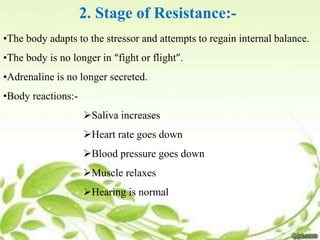
2. Stage of Resistance:-
•The body adapts to the stressor and attempts to regain internal balance.
•The body is no longer in “fight or flight”.
•Adrenaline is no longer secreted.
•Body reactions:-
Saliva increases
Heart rate goes down
Blood pressure goes down
Muscle relaxes
Hearing is normal
3.Stage of Exhaustion
•This stage occur when their is prolonged exposure to the stressor to
which the body has become adjusted.
•The adaptive energy is depleted, & the individual can no longer draw
from the resources for adaptation described in first two stages.
•Without intervention for reversal, exhaustion, and in some case death
ensues.
STRESS AS AN ENVIRONMENT
 A second concept defines stress as the ‘thing or ‘event’ that trigger
the adaptive physiological and psychological response in an individual.
The event creates change in the life pattern of the individual requires
significant adjustment in lifestyle and available personal resources.
The change may be :-
1.Positive Change :- e.g.- Outstanding personal achievement
2.Negative Change :- e.g.- Fired from job
The Social Readjustment Rating Scale
An inventory of common stressors
This Social Readjustment Rating Scale was created by Thomas
Holmes & Richard Rahe, University of Washington School of Medicine,
in the late1960s to provide a standardized measure of the impact of a
wide range of common stressors.
Using the Scale
To use the scale, simply add up the values for all of the listed life
events that have occurred to you within the past year. If a particular event
has happened to you more than once within the last 12 months, multiply
the value by the number of occurrences. Enter your value total at the end
of the list.
THE SCALE
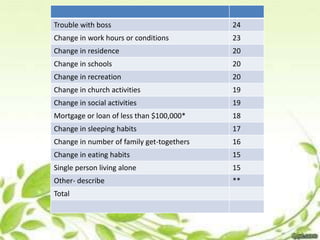
Each life event is assigned a value in arbitrary “life changing units”
chosen to reflect the relative amount of stress the event causes in the
population studied.
Stress is cumulative, so to estimate the total stress you are
experiencing, add up the values corresponding to the events that have
occurred in your life over the past year.
Life Event Value
Death of Spouse 100
Divorce 73
Marital separation 65
Jail term 63
Death of close family member 63
Personal injury or illness 53
Marriage 50
Fired 47
Marital reconciliation 45
Retirement 45
Change in health of family member 44
Pregnancy 40
Sex difficulties 39
Gain of new family member 39
Business readjustment 39
Change in financial state 38
Death of close friend 37
Change to a different line of work 36
Change in number of arguments with
spouse
35
Home Mortgage over $100,000* 31
Change in responsibilities at work 30
Son or daughter leaving home 29
Trouble with in-laws 29
Outstanding personal achievement 29
Spouse begins or stops work 28
Begin or end school 26
Change in living conditions 26
Revision of personal habits 25
Trouble with boss 24
Change in work hours or conditions 23
Change in residence 20
Change in schools 20
Change in recreation 20
Change in church activities 19
Change in social activities 19
Mortgage or loan of less than $100,000* 18
Change in sleeping habits 17
Change in number of family get-togethers 16
Change in eating habits 15
Single person living alone 15
Other- describe **
Total
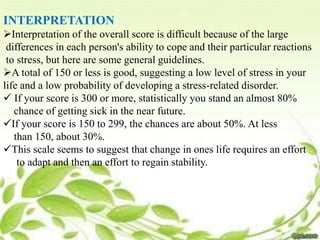
INTERPRETATION
Interpretation of the overall score is difficult because of the large
differences in each person's ability to cope and their particular reactions
to stress, but here are some general guidelines.
A total of 150 or less is good, suggesting a low level of stress in your
life and a low probability of developing a stress-related disorder.
 If your score is 300 or more, statistically you stand an almost 80%
chance of getting sick in the near future.
If your score is 150 to 299, the chances are about 50%. At less
than 150, about 30%.
This scale seems to suggest that change in ones life requires an effort
to adapt and then an effort to regain stability.
STRESS AS A TRANSACTION BETWEEN
THE INDIVIDUALAND ENVIRONMENT
This concept of stress emphasizes the relationship between the
individuals and the environment. Personal characteristics and the nature
of the environment are considered.
This illustration parallels the modern concept of the etiology of
diseased .no longer is causation viewed solely as an external entity;
Whether or not illness occurs depends also on the receiving organism
susceptibility.
PRECIPITATING EVENT
Lazarus and Folkman(1984)define stress as a relationship
between the person and the environment that is a appraised by
the person as taxing or exceeding his or her resources and
endangering his or her well-being.
•A precipitating event is a stimulus arising from the internal or
external environment and is perceived by the individual in a
specific manner.
• Cognitive appraisal is an individuals evaluation of the personal
significance of the event or occurrence.
INDIVIDUAL’S PERCEPITION OF THE EVENT:-
1-Primary Appraisal:-
Lazarus and folkman (1980) defined three types of primary appraisal:-
1-Irrelevant
2-Benign-positive
3-Stressful
1-Irrelevant:-
An event is judged irrelevant when the outcome hold no significance
for the individuals.
2-Being- positive:-
Being – positive outcome is one that is perceived as producing
pleasure for the individual.
3-Stressful Appraisal:-
Stressful Appraisals include
a)Harm/loss:- This appraisals refer to damage or loss already
experienced by the individual.
b)Threatening Appraisal:- This appraisals are perceived as anticipated
harm or losses.
c)Challenging Appraisal:- when an event is appraised as challenging,
the individual focuses on potential for gain or growth rather than on
rises associated with the event.
SECONDARY APPRAISAL:-
Secondary appraisal is an assessment of skills, resources, and
knowledge that the person posses to deal with the situations .
 The individual evaluates by considering the following :-
 which coping strategies are available to me ?
Will the options I choose be effective in this situation ?
Do I have the ability to use that strategy in an
effective manner ?
 The interaction between the primary appraisal of the event that
has occurred and the secondary appraisal of available coping
strategies determines the quality of the individuals adaptation
response to stress.
PREDISPOSING FACTORS:-
Predisposing factors strongly influencing whether the response
is adaptive or maladaptive .
Types of predisposing factors include:-
 Genetic factors
Past experiences
Existing conditions
GENETIC INFLUENCES:-
Genetic influences are those circumstances of an individual’s life
that are acquired through heredity.
E.g.- Family history of physical and psychological conditions
(strengths and weakness ) and temperament (behavioral
characteristics present at birth that evolve with development)
B) PAST EXPERIENCES:-
Past experiences are occurrence that result in learned patterns that can
influence an individual’s adaptation response. They include previous
exposure to the stressors or other stressors, learned coping responses,
and degree of adaptation to previous stressors.
C) EXISTING CONDITIONS:-
Existing conditions in corporate vulnerabilities that influences the
adequacy of the individual’s physical, psychological and social
resources for dealing with adaptive demand.
E.g.;- Current health status, motivation ,developmental
maturity, severity and duration of the stressor, finance and
education resources, age, existing coping strategies.
Precipitating factors
Cognitive appraisals
Primary
Being positive Stress appraisalsIrrelevant
Harm/loss ChallengeThreat
Secondary appraisal
Quality Of Response
Adaptive
Maladaptive
STRESS MANAGEMENT
Stress management refers to the wide spectrum of techniques and
psychotherapies aimed at controlling a person’s levels of stress,
especially chronic stress ,usually for the purpose of improving
everyday functioning. It involves the use of coping strategies in
response to stressful situations.
Coping:-
A problem solving process a strategy that the person use to manage
the out-of-ordinary events or situations with which he/she is
presented .Successfully cleaning with problems.
Adaptive Coping:-
Coping strategies are adaptive when they protect the individual
from harm (or additional harm) or strengthen the individual ability
to meet challenging situation.
Maladaptive Coping:-
Coping strategies are considered maladaptive when they conflict
being experienced goes unresolved or intensifies.
Adaptive Coping Strategies:-
Awareness:- The initial step in managing stress
is awareness to become aware of
the factors that cause stress and the
feelings associated with a stressful
response.
•Stress can be controlled only
when one recognized that it is
being experienced. As one become
aware of stressor he or she can
omit, avoid or accept them.
v
Relaxation:-
Individuals experience relaxation
in different ways. Some individual
relax by engaging in large motor
activities, such as sports, jogging
and physical exercise.
•Still other use techniques such as
breathing exercises and progressive
relaxation to relieve stress.
Meditation:-
Practiced 20 minutes once or
twice daily, meditation has
been shown to produced a
lasting reduction in blood
pressure and other stress-
related symptoms [Davis,
Eshelman, & Mchay 2008]
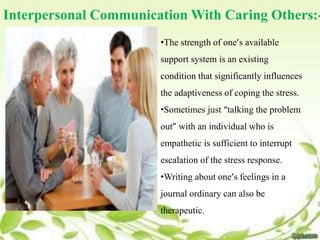
Interpersonal Communication With Caring Others:-
•The strength of one’s available
support system is an existing
condition that significantly influences
the adaptiveness of coping the stress.
•Sometimes just “talking the problem
out” with an individual who is
empathetic is sufficient to interrupt
escalation of the stress response.
•Writing about one’s feelings in a
journal ordinary can also be
therapeutic.
PROBLEM SOLVING:-
An extremely adaptive coping strategy is to view the situation
objectively (or to seek assistance from another individual to accomplish
this if the anxiety level is to high to concentrate.)
•After an objective assessment of the situation, the problem solving/
decision making model can be instituted as follows:-
Assess the facts of the situation.
Formulates goals for resolution of the stressful situation.
Determine the risk and benefits of each alternative.
Select an alternative.
Implement the alternative method.
Evaluate the outcome of the alternative implemented.
Of the first choice is in effective, select and implement
a second option.

PETS:-
•Studies show that those who care for pets, especially dog and cats,
and able to cape with the stressor of life [Allen, Blascovich, &
Mendes, 2002]
•It gives an animal an institute sense of being earned for and at the
same time gives the individual the claiming felling of warmth,
affection and interdependence with a reliable, trusting being.
Biofeedback is the use of instrumentation to become aware of processes in your
Body that you usually do not notice and to help bring them under voluntary control.
•Biofeedback machine gives immediate information about an individual’s own
biological conditions , such as muscles tension , skin surface temperature ,
brain wave activity , skin conductivity , blood pressure , and heart rate (Sadock and
Sadock).
•Mental imagery uses the
imagination in an effort to reduce the
body’s
Response to stress .
•The frame of reference is very
personal , based on what each
individual
considers to be a relaxing
environment
•Some might select a scene at the
seashore , or mountain atmosphere,
or floating through the air on a fluffy
white cloud .
•The information is most useful when
taped and played back at a time
when the individual wishes to
achieve relaxation.
Stress produced numerous physical and mental symptoms which
vary according to each individual’s situational factors . Although
life provides numerous demands that can prove difficult to handle
but with the help of different coping strategies we can manage
anxiety and maintain overall wellbeing.
JN Vyas,SS Nathawat,Manilal Gada, VK Razadan ,Essentials of
Postgraduate Psychiatric , 1st Edition , Paras Medical Publisher,
page no-72-79
Mary C. Townsend , Psychiatric Mental Health Nursing ,7th Edition
Jaypee Brothers medical Publishers, Page no-2-10
Gail W.Stuart & Michele T.Laraia ,Principles and Practice of
Psychiatric Nursing , 8th Edition, Elsevier Publications
page no- 64-73

STRESS

  • 2.
    SRADHANJALI BISWAL NURSING TUTOR KALINGAINSTITUTE OF NURSING SCIENCES
  • 3.
    Richard Rahe andothers established the view that stress is caused by distinct , measurable life stressors, and further, that these life stressors can be ranked by the medium degree of stress they produce . Thus Stress was traditionally conceptualized to be a result of externally cause beyond the control of those experiencing stress. More recently, however it has been argued that external circumstance don't have any intrinsic capacity to produced stress, but instead their effect is mediated by the individual’s perceptions, capacities, and understanding.
  • 4.
    STRESS DEFINITION According to Selye(1956), He defined stress in two different ways:  One view states stress as the rate of wear and tear within the body.  Other describes stress as the state manifested by a specific syndrome which consists of all the non-specifically induced changes within a biological system.
  • 5.
    According to ConciseOxford Dictionary,  Stress is defined as a constraining or impulsing force and as an effort or demand upon Physical or mental energy.
  • 6.
    According to Burgess(1997)  He define stress in two different ways : Stress is a stimulus that upsets an individuals balance or homeostasis. Stress is an individual’s response to a stressful stimulus .
  • 7.
    According to Sohafer(2000), Stress is the arousal of mind and body in response to demands made upon them.
  • 8.
    TYPES OF STRESS Usuallystress is divided into two types:- 1.DISTRESS :-  Distress or negative stress has negative implications and is usually perceived to be potentially overwhelming and out of a persons control. For example :- 1.Difficult work environment – here individual due to stress losses his motivation to work. 2.Any illness and accidents – In this type of physical illness the person perceives pain which causes stress.
  • 9.
    2. EUSTRESS :- Eustress or positive stress , is the positive emotional or cognitive response to stress that is healthy , it gives a feeling of fulfillment or happiness.  Eustress has a positive correlation with life satisfaction and hope because it fosters challenge and motivation towards a goal. E.g :-Marriage , Birth of a baby ,Promotion in job
  • 10.
    CAUSES OF STRESS Accordingto Brian Luke Seaward, “ Situations , circumstances or any stimulus that is perceived to be a threat is referred to as a stressor ,or that which causes or promotes stress.”  The causes of stress is known as stressors and there are literally many different types of Stressors. Stressor :- It is a biological, psychological, social, or chemical factor that causes physical or emotional tension and may be a factor in the etiology of certain illness.  Stressors can be broken down roughly into either :- 1. External Stressors 2. Internal Stressors
  • 11.
    I .EXTERNAL CAUSES Externalcauses of stress may be positive events such as- •Major life changes like, marriage •Financial problems •Problems at work •Environment
  • 12.
    II. INTERNAL CAUSES Internalcauses of stress comes from inside of us and determine our body’s ability to respond and deal with the external stress , including factors or stressors. •Fear •Uncertainty and lack of control •Belief •Unrealistic expectations / perfectionism •Rigid thinking , Lack of flexibility
  • 13.
    ADAPTATION TO STRESS ADAPTATION:- Roy (1976) defined adaptive response as behavior that maintains the integrity of the individual. MALADAPTATION :- When behavior disrupts the integrity of the individual , it is perceived as maladaptation . Maladaptation responses by the individual are considered to be negative or healthy.
  • 14.
    GENERAL THEORETICAL FRAMEWORKFOR UNDERSTANDING STRESS : Various 20th century researcher contributed to several different concepts includes : •Stress as a Biological Model •Stress as a Environmental Model •Stress as a Transactional Model
  • 15.
    STRESS AS ABIOLOGICAL MODEL  In 1956 ,Hans Selye published the results of his research concerning the physiological response to stress a biological system to a change imposed on it . He revised his definition of stress and called it , “The state manifested by a specific syndrome which consists of all the non-specifically induced changes within a biological system.” [Selye ,1976] These symptoms has come to know as the “fight or flight” syndrome . Selye , called this “General Adaptation Model “or GAS
  • 16.
    General Adaptation Syndrome[GAS] Alarm Resistance Exhaustion Stressor
  • 17.
    1.Alarm Reaction Stage •Thefunction at this stage is to mobilize the body’s resources ‘Fight & Flight’ •The initial response can also decreases the effectiveness of the immune system making person more susceptible to illness during this phase. •Adrenaline is secreted into the blood stream. •Body reaction includes Pupils dilate Hearing sharpens Saliva decreases Digestion slows Muscles tighten
  • 18.
    HYPOTHALAMUS STIMULATES SYMPATHETIC NERVOUS SYSTEM INNERVATES ADRENAL MEDULLA CARDIO- VASCULAR SYSTEM G.I SYSTEM LIVER URINARY SYSTEM SWEAT GLANDS FATS EYE LACRIMAL GLANDS RESPIRATORY SYSTEM EPINEPHRINE ANDNOR- EPINEPHRINE RELEASED SECRETIONS INCREASED CARDIAC OUTPUT,HEART RATE,BP INCREASES GYCOGENESIS INCREASE &GYLCOGEN DECREASES INCREASED URETER MOTILITY,BLADDER MUSCLES CONTRACTS INCREASED SECRETIONS LIPOLYSIS GASTRIC &INTESTINAL MOTILITY INCREASED PUPILS DIALATED RESPIRATION RATE INCREASED & BRONCHIOLES DIALATED
  • 19.
    HYPOTHALAMUS STIMULATES GONADOTROPHINACTH THYROTROPIC HORMONE PITUITARY GLANDS GROWTH HORMONE ADH RELEASES STIMULATES ADRENAL CORTEX RELEASES GLUCO CORTICOID MINERALO CORTICOID IMMUNE RESPONSE INCREASED GLUCONEO GENESIS INCREASED RETENTION OFSODIUM & WATER INCREASED BP FLUID RETENTION DIRECT EFFECT ON PROTEIN ,LIPID METABOLISM INCREASED SERUM GLUCOSE AND FREE FATTY ACIDS STIMULATES THYROID GLAND INCREASED BASAL METABOLIC RATE INITIALLY INCREASED SEX HORMONE SECRECTIONS LATER WITH SUSTAINED STRESS DECREASE SECRETIONS DECREASED LIBIDO AND IMPOTENCE SUSTAINED STRESS RESPONSE : “FIGHT OR FLIGHT” SYNDROME
  • 20.
    2. Stage ofResistance:- •The body adapts to the stressor and attempts to regain internal balance. •The body is no longer in “fight or flight”. •Adrenaline is no longer secreted. •Body reactions:- Saliva increases Heart rate goes down Blood pressure goes down Muscle relaxes Hearing is normal
  • 21.
    3.Stage of Exhaustion •Thisstage occur when their is prolonged exposure to the stressor to which the body has become adjusted. •The adaptive energy is depleted, & the individual can no longer draw from the resources for adaptation described in first two stages. •Without intervention for reversal, exhaustion, and in some case death ensues.
  • 22.
    STRESS AS ANENVIRONMENT  A second concept defines stress as the ‘thing or ‘event’ that trigger the adaptive physiological and psychological response in an individual. The event creates change in the life pattern of the individual requires significant adjustment in lifestyle and available personal resources. The change may be :- 1.Positive Change :- e.g.- Outstanding personal achievement 2.Negative Change :- e.g.- Fired from job
  • 23.
    The Social ReadjustmentRating Scale An inventory of common stressors This Social Readjustment Rating Scale was created by Thomas Holmes & Richard Rahe, University of Washington School of Medicine, in the late1960s to provide a standardized measure of the impact of a wide range of common stressors. Using the Scale To use the scale, simply add up the values for all of the listed life events that have occurred to you within the past year. If a particular event has happened to you more than once within the last 12 months, multiply the value by the number of occurrences. Enter your value total at the end of the list.
  • 24.
    THE SCALE Each lifeevent is assigned a value in arbitrary “life changing units” chosen to reflect the relative amount of stress the event causes in the population studied. Stress is cumulative, so to estimate the total stress you are experiencing, add up the values corresponding to the events that have occurred in your life over the past year.
  • 25.
    Life Event Value Deathof Spouse 100 Divorce 73 Marital separation 65 Jail term 63 Death of close family member 63 Personal injury or illness 53 Marriage 50 Fired 47 Marital reconciliation 45 Retirement 45 Change in health of family member 44 Pregnancy 40
  • 26.
    Sex difficulties 39 Gainof new family member 39 Business readjustment 39 Change in financial state 38 Death of close friend 37 Change to a different line of work 36 Change in number of arguments with spouse 35 Home Mortgage over $100,000* 31 Change in responsibilities at work 30 Son or daughter leaving home 29 Trouble with in-laws 29 Outstanding personal achievement 29 Spouse begins or stops work 28 Begin or end school 26 Change in living conditions 26 Revision of personal habits 25
  • 27.
    Trouble with boss24 Change in work hours or conditions 23 Change in residence 20 Change in schools 20 Change in recreation 20 Change in church activities 19 Change in social activities 19 Mortgage or loan of less than $100,000* 18 Change in sleeping habits 17 Change in number of family get-togethers 16 Change in eating habits 15 Single person living alone 15 Other- describe ** Total
  • 28.
    INTERPRETATION Interpretation of theoverall score is difficult because of the large differences in each person's ability to cope and their particular reactions to stress, but here are some general guidelines. A total of 150 or less is good, suggesting a low level of stress in your life and a low probability of developing a stress-related disorder.  If your score is 300 or more, statistically you stand an almost 80% chance of getting sick in the near future. If your score is 150 to 299, the chances are about 50%. At less than 150, about 30%. This scale seems to suggest that change in ones life requires an effort to adapt and then an effort to regain stability.
  • 29.
    STRESS AS ATRANSACTION BETWEEN THE INDIVIDUALAND ENVIRONMENT This concept of stress emphasizes the relationship between the individuals and the environment. Personal characteristics and the nature of the environment are considered. This illustration parallels the modern concept of the etiology of diseased .no longer is causation viewed solely as an external entity; Whether or not illness occurs depends also on the receiving organism susceptibility.
  • 30.
    PRECIPITATING EVENT Lazarus andFolkman(1984)define stress as a relationship between the person and the environment that is a appraised by the person as taxing or exceeding his or her resources and endangering his or her well-being. •A precipitating event is a stimulus arising from the internal or external environment and is perceived by the individual in a specific manner. • Cognitive appraisal is an individuals evaluation of the personal significance of the event or occurrence.
  • 31.
    INDIVIDUAL’S PERCEPITION OFTHE EVENT:- 1-Primary Appraisal:- Lazarus and folkman (1980) defined three types of primary appraisal:- 1-Irrelevant 2-Benign-positive 3-Stressful 1-Irrelevant:- An event is judged irrelevant when the outcome hold no significance for the individuals. 2-Being- positive:- Being – positive outcome is one that is perceived as producing pleasure for the individual.
  • 32.
    3-Stressful Appraisal:- Stressful Appraisalsinclude a)Harm/loss:- This appraisals refer to damage or loss already experienced by the individual. b)Threatening Appraisal:- This appraisals are perceived as anticipated harm or losses. c)Challenging Appraisal:- when an event is appraised as challenging, the individual focuses on potential for gain or growth rather than on rises associated with the event.
  • 33.
    SECONDARY APPRAISAL:- Secondary appraisalis an assessment of skills, resources, and knowledge that the person posses to deal with the situations .  The individual evaluates by considering the following :-  which coping strategies are available to me ? Will the options I choose be effective in this situation ? Do I have the ability to use that strategy in an effective manner ?
  • 34.
     The interactionbetween the primary appraisal of the event that has occurred and the secondary appraisal of available coping strategies determines the quality of the individuals adaptation response to stress. PREDISPOSING FACTORS:- Predisposing factors strongly influencing whether the response is adaptive or maladaptive . Types of predisposing factors include:-  Genetic factors Past experiences Existing conditions
  • 35.
    GENETIC INFLUENCES:- Genetic influencesare those circumstances of an individual’s life that are acquired through heredity. E.g.- Family history of physical and psychological conditions (strengths and weakness ) and temperament (behavioral characteristics present at birth that evolve with development)
  • 36.
    B) PAST EXPERIENCES:- Pastexperiences are occurrence that result in learned patterns that can influence an individual’s adaptation response. They include previous exposure to the stressors or other stressors, learned coping responses, and degree of adaptation to previous stressors.
  • 37.
    C) EXISTING CONDITIONS:- Existingconditions in corporate vulnerabilities that influences the adequacy of the individual’s physical, psychological and social resources for dealing with adaptive demand. E.g.;- Current health status, motivation ,developmental maturity, severity and duration of the stressor, finance and education resources, age, existing coping strategies.
  • 38.
    Precipitating factors Cognitive appraisals Primary Beingpositive Stress appraisalsIrrelevant Harm/loss ChallengeThreat Secondary appraisal Quality Of Response Adaptive Maladaptive
  • 39.
    STRESS MANAGEMENT Stress managementrefers to the wide spectrum of techniques and psychotherapies aimed at controlling a person’s levels of stress, especially chronic stress ,usually for the purpose of improving everyday functioning. It involves the use of coping strategies in response to stressful situations. Coping:- A problem solving process a strategy that the person use to manage the out-of-ordinary events or situations with which he/she is presented .Successfully cleaning with problems.
  • 40.
    Adaptive Coping:- Coping strategiesare adaptive when they protect the individual from harm (or additional harm) or strengthen the individual ability to meet challenging situation. Maladaptive Coping:- Coping strategies are considered maladaptive when they conflict being experienced goes unresolved or intensifies.
  • 41.
    Adaptive Coping Strategies:- Awareness:-The initial step in managing stress is awareness to become aware of the factors that cause stress and the feelings associated with a stressful response. •Stress can be controlled only when one recognized that it is being experienced. As one become aware of stressor he or she can omit, avoid or accept them.
  • 42.
    v Relaxation:- Individuals experience relaxation indifferent ways. Some individual relax by engaging in large motor activities, such as sports, jogging and physical exercise. •Still other use techniques such as breathing exercises and progressive relaxation to relieve stress.
  • 43.
    Meditation:- Practiced 20 minutesonce or twice daily, meditation has been shown to produced a lasting reduction in blood pressure and other stress- related symptoms [Davis, Eshelman, & Mchay 2008]
  • 44.
    Interpersonal Communication WithCaring Others:- •The strength of one’s available support system is an existing condition that significantly influences the adaptiveness of coping the stress. •Sometimes just “talking the problem out” with an individual who is empathetic is sufficient to interrupt escalation of the stress response. •Writing about one’s feelings in a journal ordinary can also be therapeutic.
  • 45.
    PROBLEM SOLVING:- An extremelyadaptive coping strategy is to view the situation objectively (or to seek assistance from another individual to accomplish this if the anxiety level is to high to concentrate.) •After an objective assessment of the situation, the problem solving/ decision making model can be instituted as follows:- Assess the facts of the situation. Formulates goals for resolution of the stressful situation. Determine the risk and benefits of each alternative. Select an alternative. Implement the alternative method. Evaluate the outcome of the alternative implemented. Of the first choice is in effective, select and implement a second option. 
  • 46.
    PETS:- •Studies show thatthose who care for pets, especially dog and cats, and able to cape with the stressor of life [Allen, Blascovich, & Mendes, 2002] •It gives an animal an institute sense of being earned for and at the same time gives the individual the claiming felling of warmth, affection and interdependence with a reliable, trusting being.
  • 48.
    Biofeedback is theuse of instrumentation to become aware of processes in your Body that you usually do not notice and to help bring them under voluntary control. •Biofeedback machine gives immediate information about an individual’s own biological conditions , such as muscles tension , skin surface temperature , brain wave activity , skin conductivity , blood pressure , and heart rate (Sadock and Sadock).
  • 49.
    •Mental imagery usesthe imagination in an effort to reduce the body’s Response to stress . •The frame of reference is very personal , based on what each individual considers to be a relaxing environment •Some might select a scene at the seashore , or mountain atmosphere, or floating through the air on a fluffy white cloud . •The information is most useful when taped and played back at a time when the individual wishes to achieve relaxation.
  • 50.
    Stress produced numerousphysical and mental symptoms which vary according to each individual’s situational factors . Although life provides numerous demands that can prove difficult to handle but with the help of different coping strategies we can manage anxiety and maintain overall wellbeing.
  • 51.
    JN Vyas,SS Nathawat,ManilalGada, VK Razadan ,Essentials of Postgraduate Psychiatric , 1st Edition , Paras Medical Publisher, page no-72-79 Mary C. Townsend , Psychiatric Mental Health Nursing ,7th Edition Jaypee Brothers medical Publishers, Page no-2-10 Gail W.Stuart & Michele T.Laraia ,Principles and Practice of Psychiatric Nursing , 8th Edition, Elsevier Publications page no- 64-73