

By
Mr. LOGANATHAN.N
Lecturer
M. Sc (Mental health nursing)
“Stress as the nonspecific
response of the body to any demand
made upon it.”
HansSelye
“Stress is considered to the
process of adjusting to circumstances
that disrupt, or threaten to disrupt, a
person’s equilibrium.”
Lazavus& Forlmen(1984)
Stressor is defined as an internal
or external event or situation that
creates the potential for physiologic,
emotional, cognitive, or behavioral
changes in an individual
Brunner and Suddarth
According to “selye” there are two
types –
1. Distress or damaging stress.
2. Eustress or stress that protects
health.
Eustress is motivating energy, such
as happiness, hopefulness and
purposeful movement.
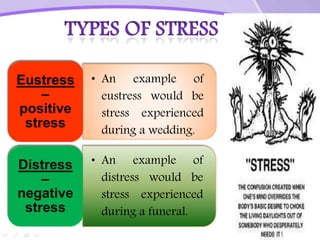
• An example of
eustress would be
stress experienced
during a wedding.
Eustress
–
positive
stress
• An example of
distress would be
stress experienced
during a funeral.
Distress
–
negative
stress
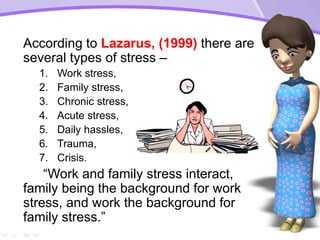
According to Lazarus, (1999) there are
several types of stress –
1. Work stress,
2. Family stress,
3. Chronic stress,
4. Acute stress,
5. Daily hassles,
6. Trauma,
7. Crisis.
“Work and family stress interact,
family being the background for work
stress, and work the background for
family stress.”
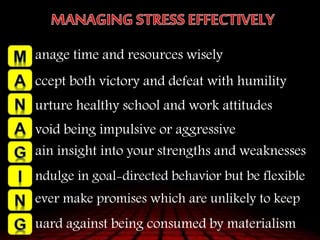
anage time and resources wisely
ccept both victory and defeat with humility
urture healthy school and work attitudes
void being impulsive or aggressive
ain insight into your strengths and weaknesses
ndulge in goal-directed behavior but be flexible
ever make promises which are unlikely to keep
uard against being consumed by materialism
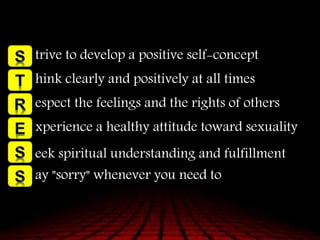
trive to develop a positive self-concept
hink clearly and positively at all times
espect the feelings and the rights of others
xperience a healthy attitude toward sexuality
eek spiritual understanding and fulfillment
ay "sorry" whenever you need to
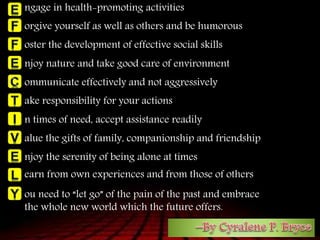
ngage in health-promoting activities
orgive yourself as well as others and be humorous
oster the development of effective social skills
njoy nature and take good care of environment
ommunicate effectively and not aggressively
ake responsibility for your actions
n times of need, accept assistance readily
alue the gifts of family, companionship and friendship
njoy the serenity of being alone at times
earn from own experiences and from those of others
ou need to “let go” of the pain of the past and embrace
the whole new world which the future offers.
STRESS
MANAGEMENT
STRESS
MANAGEMENT
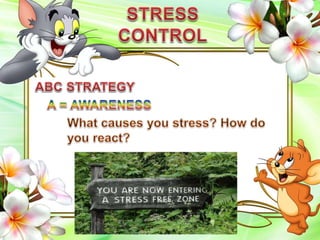
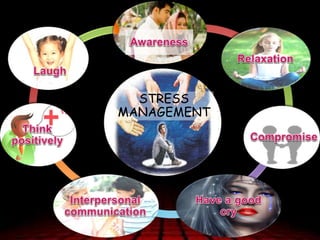
The initial step in managing
stress is awareness. As one
becomes aware of stressors he or
she can omit, avoid or accept them.
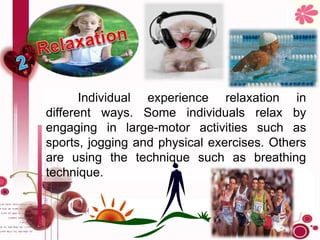
Individual experience relaxation in
different ways. Some individuals relax by
engaging in large-motor activities such as
sports, jogging and physical exercises. Others
are using the technique such as breathing
technique.
Consider co- operation or
compromise rather than confrontation. A
little give and take on both sides may
reduce the strains and help you feel more
comfortable.
A good cry during periods of stress can
be a healthy way to bring relief to your
anxiety, at it might prevent a headache or
other physical consequences of “botting”
things up.
With a caring others the strength of
one’s available support system is an
existing condition that significantly
influences the adaptiveness of coping with
stress sometimes just “ talking the problem
out” with an individual who is empathetic is
sufficient to interpret escalation
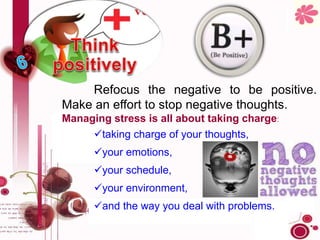
Refocus the negative to be positive.
Make an effort to stop negative thoughts.
Managing stress is all about taking charge:
taking charge of your thoughts,
your emotions,
your schedule,
your environment,
and the way you deal with problems.
Maintain your sense of humor,
including the ability to laugh at yourself.
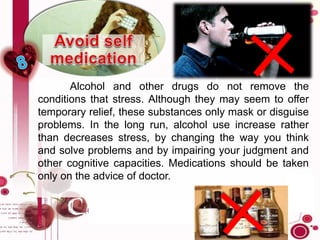
Alcohol and other drugs do not remove the
conditions that stress. Although they may seem to offer
temporary relief, these substances only mask or disguise
problems. In the long run, alcohol use increase rather
than decreases stress, by changing the way you think
and solve problems and by impairing your judgment and
other cognitive capacities. Medications should be taken
only on the advice of doctor.
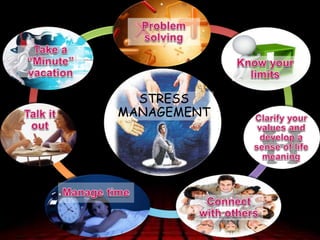
There are many circumstances in life beyond
your control, consider the fact that we live in an
imperfect world. Know your limits. If a problem is
beyond our control and cannot be changed at the
moment, don’t fight the situation. Learn to accept what
is, for now, until such time when you can change things.
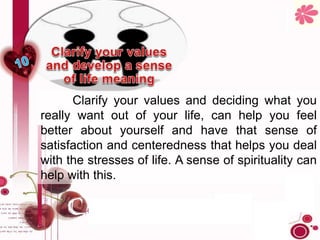
Clarify your values and deciding what you
really want out of your life, can help you feel
better about yourself and have that sense of
satisfaction and centeredness that helps you deal
with the stresses of life. A sense of spirituality can
help with this.
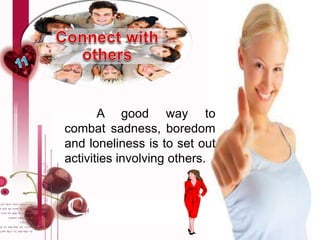
A good way to
combat sadness, boredom
and loneliness is to set out
activities involving others.
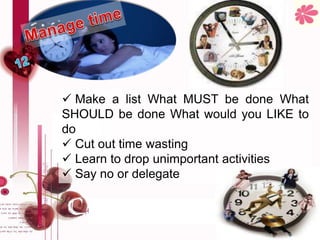
 Make a list What MUST be done What
SHOULD be done What would you LIKE to
do
 Cut out time wasting
 Learn to drop unimportant activities
 Say no or delegate
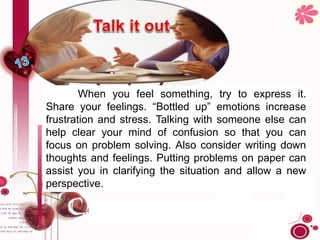
When you feel something, try to express it.
Share your feelings. “Bottled up” emotions increase
frustration and stress. Talking with someone else can
help clear your mind of confusion so that you can
focus on problem solving. Also consider writing down
thoughts and feelings. Putting problems on paper can
assist you in clarifying the situation and allow a new
perspective.
Imagining a quiet country scene can take you
out of the turmoil of a stressful situation. When you
have the opportunity, take a moment to close your eyes
and imagine a place where you feel relaxed and
comfortable. Notice all the details of your chosen place,
including pleasant sounds, smells and temperature or
change your mental “channel” by reading a good book
or playing relaxing music to create a sense of peace
and tranquility.
An extremely adaptive coping strategy is to view
the situation is to view the situation objectively. After an
objective assessment of the situation the problem solving 
decision making model can be instituted as follow;
1.assess the fact of the situation
2.formulate the goal for resolution
3.study the alternatives
4.determine the risks and benefits
5.select an alternative
6.implement the alternative selected
7.evaluated the outcome
Stress management
Stress management

Stress management

  • 1.
    By Mr. LOGANATHAN.N Lecturer M. Sc(Mental health nursing)
  • 2.
    “Stress as thenonspecific response of the body to any demand made upon it.” HansSelye “Stress is considered to the process of adjusting to circumstances that disrupt, or threaten to disrupt, a person’s equilibrium.” Lazavus& Forlmen(1984)
  • 3.
    Stressor is definedas an internal or external event or situation that creates the potential for physiologic, emotional, cognitive, or behavioral changes in an individual Brunner and Suddarth
  • 4.
    According to “selye”there are two types – 1. Distress or damaging stress. 2. Eustress or stress that protects health. Eustress is motivating energy, such as happiness, hopefulness and purposeful movement.
  • 5.
    • An exampleof eustress would be stress experienced during a wedding. Eustress – positive stress • An example of distress would be stress experienced during a funeral. Distress – negative stress
  • 6.
    According to Lazarus,(1999) there are several types of stress – 1. Work stress, 2. Family stress, 3. Chronic stress, 4. Acute stress, 5. Daily hassles, 6. Trauma, 7. Crisis. “Work and family stress interact, family being the background for work stress, and work the background for family stress.”
  • 11.
    anage time andresources wisely ccept both victory and defeat with humility urture healthy school and work attitudes void being impulsive or aggressive ain insight into your strengths and weaknesses ndulge in goal-directed behavior but be flexible ever make promises which are unlikely to keep uard against being consumed by materialism
  • 12.
    trive to developa positive self-concept hink clearly and positively at all times espect the feelings and the rights of others xperience a healthy attitude toward sexuality eek spiritual understanding and fulfillment ay "sorry" whenever you need to
  • 13.
    ngage in health-promotingactivities orgive yourself as well as others and be humorous oster the development of effective social skills njoy nature and take good care of environment ommunicate effectively and not aggressively ake responsibility for your actions n times of need, accept assistance readily alue the gifts of family, companionship and friendship njoy the serenity of being alone at times earn from own experiences and from those of others ou need to “let go” of the pain of the past and embrace the whole new world which the future offers.
  • 14.
  • 15.
  • 16.
    The initial stepin managing stress is awareness. As one becomes aware of stressors he or she can omit, avoid or accept them.
  • 17.
    Individual experience relaxationin different ways. Some individuals relax by engaging in large-motor activities such as sports, jogging and physical exercises. Others are using the technique such as breathing technique.
  • 18.
    Consider co- operationor compromise rather than confrontation. A little give and take on both sides may reduce the strains and help you feel more comfortable.
  • 19.
    A good cryduring periods of stress can be a healthy way to bring relief to your anxiety, at it might prevent a headache or other physical consequences of “botting” things up.
  • 20.
    With a caringothers the strength of one’s available support system is an existing condition that significantly influences the adaptiveness of coping with stress sometimes just “ talking the problem out” with an individual who is empathetic is sufficient to interpret escalation
  • 21.
    Refocus the negativeto be positive. Make an effort to stop negative thoughts. Managing stress is all about taking charge: taking charge of your thoughts, your emotions, your schedule, your environment, and the way you deal with problems.
  • 22.
    Maintain your senseof humor, including the ability to laugh at yourself.
  • 23.
    Alcohol and otherdrugs do not remove the conditions that stress. Although they may seem to offer temporary relief, these substances only mask or disguise problems. In the long run, alcohol use increase rather than decreases stress, by changing the way you think and solve problems and by impairing your judgment and other cognitive capacities. Medications should be taken only on the advice of doctor.
  • 24.
    There are manycircumstances in life beyond your control, consider the fact that we live in an imperfect world. Know your limits. If a problem is beyond our control and cannot be changed at the moment, don’t fight the situation. Learn to accept what is, for now, until such time when you can change things.
  • 25.
    Clarify your valuesand deciding what you really want out of your life, can help you feel better about yourself and have that sense of satisfaction and centeredness that helps you deal with the stresses of life. A sense of spirituality can help with this.
  • 26.
    A good wayto combat sadness, boredom and loneliness is to set out activities involving others.
  • 27.
     Make alist What MUST be done What SHOULD be done What would you LIKE to do  Cut out time wasting  Learn to drop unimportant activities  Say no or delegate
  • 28.
    When you feelsomething, try to express it. Share your feelings. “Bottled up” emotions increase frustration and stress. Talking with someone else can help clear your mind of confusion so that you can focus on problem solving. Also consider writing down thoughts and feelings. Putting problems on paper can assist you in clarifying the situation and allow a new perspective.
  • 29.
    Imagining a quietcountry scene can take you out of the turmoil of a stressful situation. When you have the opportunity, take a moment to close your eyes and imagine a place where you feel relaxed and comfortable. Notice all the details of your chosen place, including pleasant sounds, smells and temperature or change your mental “channel” by reading a good book or playing relaxing music to create a sense of peace and tranquility.
  • 30.
    An extremely adaptivecoping strategy is to view the situation is to view the situation objectively. After an objective assessment of the situation the problem solving decision making model can be instituted as follow; 1.assess the fact of the situation 2.formulate the goal for resolution 3.study the alternatives 4.determine the risks and benefits 5.select an alternative 6.implement the alternative selected 7.evaluated the outcome