STREPTOCOCCUS
CONTENTS
08-07-2015 2
• MORPHOLOGY
• CLASSIFICATION
• CULTURAL CHARACTERISTICS
• BIOCHEMICAL REACTIONS
• RESISTENCE & ANTIGENIC STRUCTURE
• TOXINS AND OTHER VIRULENCE FACTORS
• PATHOGENICITY
• LAB DIAGNOSIS
• TREATMENT AND PROPHYLAXIS
introduction
08-07-2015 3
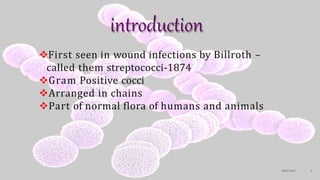
First seen in wound infections by Billroth –
called them streptococci-1874
Gram Positive cocci
Arranged in chains
Part of normal flora of humans and animals
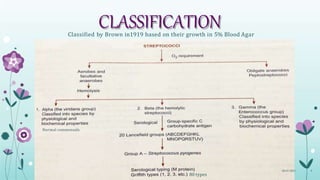
CLASSIFICATION
Classified by Brown in1919 based on their growth in 5% Blood Agar
Normal commensals
80 types
08-07-2015 4
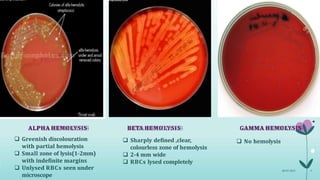
ALPHA HEMOLYSIS GAMMA HEMOLYSIS
 Greenish discolouration
with partial hemolysis
 Small zone of lysis(1-2mm)
with indefinite margins
 Unlysed RBCs seen under
microscope
BETA HEMOLYSIS
 Sharply defined ,clear,
colourless zone of hemolysis
 2-4 mm wide
 RBCs lysed completely
 No hemolysis
08-07-2015 5
STREPTOCOCCUS PYOGENES
MORPHOLOGY
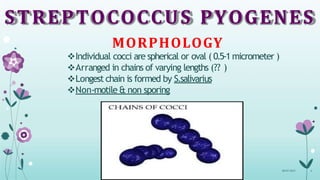
Individual cocci are spherical or oval ( 0.5-1micrometer )
Arranged in chains of varying lengths (?? )
Longest chain is formed by S.salivarius
Non-motile & non sporing
08-07-2015 6
CULTURAL CHARACTERISTICS
08-07-2015 7
 Aerobes as well as facultative anaerobes
 Grown best at 37°C ( 22-42°C )
Grows in media rich in fermentable carbohydrates or enriched
media with blood or serum
 ON BLOOD AGAR
 Shows beta hemolysis
 Virulent strains form matt colonies
 Avirulent strains form glossy colonies
 Some strains with capsule form mucoid colonies
 ON LIQUID MEDIA
 Growth occur asagranular turbidity withapowdery depositin
glucose or serum broth
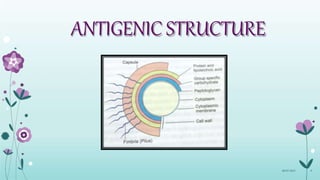
ANTIGENIC STRUCTURE
08-07-2015 9
TOXINS AND VIRULENCE FACTORS
 S.Pyogenes forms several exotoxins and enzymes that contributes its
virulence.
 M Protein also act as a virulence factor by inhibiting phagocytosis
 HEMOLYSIN
 PYROGENIC EXOTOXIN
 STREPTOKINASE (FIBRINOLYSIN)
 DEOXYRIBONUCLEASES
 NADase
 HYALURONIDASE
SERUM OPACITY FACTOR
1. HEMOLYSINS
2 types STREPTOLYSIN O AND S
STREPTOLYSIN O
 Oxygen labile & heat labile
 Inactive in oxidized form but reactivated on treating with mild reducing agents
 Lethal on i.v injection and is cardiotoxic & leucotoxic activity
 Its antigenic and antistreptolysin O appears in sera following its infection
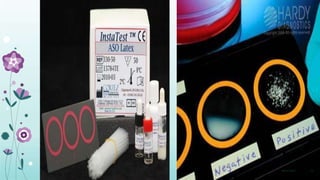
 ASO TITRE
 Earlier done by hemolysis inhibition test
 Now done by serological method of latex
agglutination
 ASO titer > 200 units is significant & suggests a recent
or recurrent infection with streptococci
08-07-2015 10
08-07-2015 11
 STREPTOLYSIN S
 Soluble in serum,thus the name
 Oxygen stable hemolysin
 Responsible for hemolysis seen in blood agar
 It’s a protein but is not antigenic
 Non specifically inhibited by serum lipoproteins
 STREPTOLYSIN S AND O ARE PRODUCED BY GROUPS
A,C & G
2.PYROGENIC EXOTOXIN
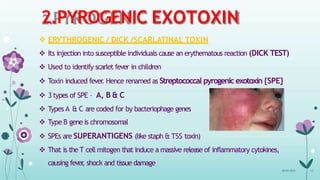
 ERYTHROGENIC / DICK /SCARLATINAL TOXIN
 Its injection into susceptible individuals cause an erythematous reaction (DICK TEST)
 Used to identify scarlet fever in children
 Toxin induced fever
. Hence renamed as Streptococcal pyrogenic exotoxin {SPE}
 3 types of SPE – A, B & C
 Types A & C are coded for by bacteriophage genes
 Type B gene is chromosomal
 SPEs are SUPERANTIGENS (like staph & TSS toxin)
 That is the T cell mitogen that induce a massive release of inflammatory cytokines,
causing fever
, shock and tissue damage
08-07-2015 13
3. STREPTOKINASE (Fibrinolysin)
 Promotes lysis of fibrin clots by activating a plasminogen
 Antigenic protein
 Antistreptokinase antibodies provide retrospective evidence of strept. Infection
 BIOLOGICAL ROLE : It breaks down the fibrin barrier around the lesion &
facilitate spreading of infection
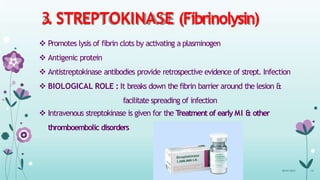
 Intravenous streptokinase is given for the T
reatment of early MI & other
thromboembolic disorders
08-07-2015 14
4. DEOXYRIBONUCLEASES (Streptodornaseor DNAase)
Causes depolymerization of DNA
Pyogenic exudates contain large amount of DNA derived from nuclei of
necrotic cells
Helps to liquefy the thick pus & hence responsible for the thin serous character
of streptococcal exudates.
 4 antigenically distinct DNAases are recognized -A,B,C & D
 B is the most antigenic in humans
 Demo. Of ANTI-DNAase B antibody is used in the retrospective diagnosis of
S.p infection
THERAPEUTIC APPLICATION:
 Liquefying localized collection of thick exudates as in empyema, a preparation
of streptokinase and streptodornase are used
08-07-2015 15
5. NICOTINAMIDE ADENINE DINUCLEOTIDASE
08-07-2015 16
NADase acts on co-enzyme NAD and liberates nicotinamide
Antigenic
Leucotoxic
6.HYALURONIDASE
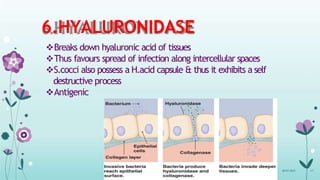
Breaks down hyaluronic acid of tissues
Thus favours spread of infection along intercellular spaces
S.cocci also possess a H.acid capsule & thus it exhibits a self
destructive process
Antigenic
08-07-2015 17
7.SERUM OPACITY FACTOR
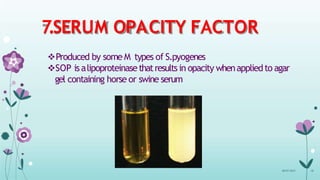
Produced by some M types of S.pyogenes
SOP isalipoproteinasethatresultsin opacity whenappliedto agar
gel containing horse or swine serum
08-07-2015 18
8.OTHER ENZYMES
08-07-2015 19
 Many strains also produce
 PROTEINASE
 PHOSPHATASE
 ESTERASES
 N-ACETYL GLUCOSAMINIDASE
 NEURAMINIDASE
Their extend of pathogenicity is unknown
PATHOGENECITY
 SUPPURATIVE STREPTOCOCCAL DISEASES
1.RESPIRATORY INFECTIONS
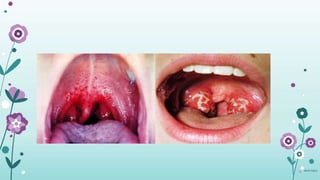
Primary site of invasion by S.pyogenes (lower M type) is the throat
SORE THROAT is the most common streptococcal infection
Produce tonsillitis or pharyngitis
Virulent group A streptococci adhere to pharyngeal epithelium by means of the
lipoteichoic acid covering the surface pili
The glycoprotein fibronectin on the epithelial cells serve as the receptor to
lipoteichoic acid ligand
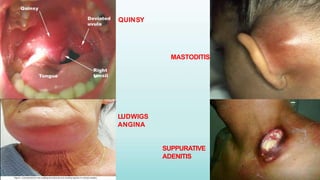
From throat s.coccimayspreadto surrounding tissues,leadingto suppurative
complicationslikeotitismedia,mastoditis,quinsy
,Ludwig’sanginaand
suppurative adenitis
Rarely lead to meningitis & S.pneumonia 08-07-2015 21
08-07-22015
08-07-2015 23
QUINSY
MASTODITIS
LUDWIGS
ANGINA
SUPPURATIVE
ADENITIS
2.SKIN & SOFT TISSUE INFECTION
 2Typical Streptococcal skin infections are :
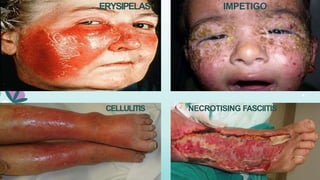
ERYSIPELAS
 It’s a diffuse infection involving superficial lymphatics
 Affected skin is red, swollen & indurated
 Rare & seen in older patients
IMPETIGO
Caused by the higher numbered M type of streptococci
Tiny blisters are the first symptom of impetigo. When the blisters burst,
theskin underneath themismoist,red,andmayoozefluid.Next, a tan
or yellow-browncrustcovers thewetareas,makingitlook likethey've
been coated with honey or brown sugar
.
08-07-2015 23
CELLULITIS
 It usually affects a limb but can occur anywhere on the body.
 Symptoms and signs are usually localized to the affected area but patients
can become generally unwell with fevers, with chills & rigor (bacteremia)
 Redness, Swelling, Increased warmth, T
enderness, Blistering, Abscess,
Erosions and ulceration
NECROTISING FASCIITIS
Caused by mixed aerobic & anaerobic bacterial infection
Some strains of S.pyogenes may alone be responsible ( M type 1&3 )
Notoriety under the name FLESH EATING BACTERIA
Extensive necrosis of subcut. & muscular tissues assoc. with severe
systemic infection with DIC and MSF.
08-07-2015 24
ERYSIPELAS IMPETIGO
CELLULITIS NECROTISING FASCIITIS
S.Pyogenes are isolated from the lesion
Rising titres of ASO and anti-DNAase B are demonstrated
Vancomycin is the drug of choice in life-threatening cases as
penicillin mayn’t be effective.
Soft tissue infection with some M types of S.pyogenes cause a
TSS resembling staphylococcal TSS
08-07-2015 26
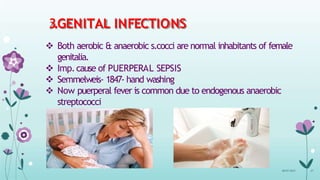
3.GENITAL INFECTIONS
 Both aerobic & anaerobic s.cocci are normal inhabitants of female
genitalia.
 Imp.cause of PUERPERAL SEPSIS
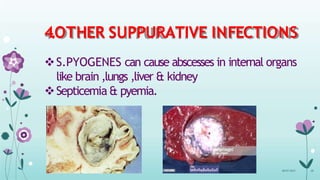
 Semmelweis- 1847- hand washing
 Now puerperal fever is common due to endogenous anaerobic
streptococci
08-07-2015 27
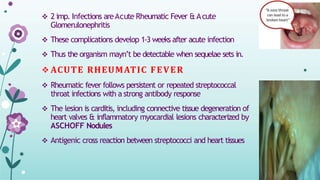
4.OTHER SUPPURATIVE INFECTIONS
S.PYOGENES can cause abscesses in internal organs
like brain ,lungs ,liver & kidney
Septicemia & pyemia.
08-07-2015 28
 2 imp. Infections areAcute Rheumatic Fever & Acute
Glomerulonephritis
 These complications develop 1-3 weeks after acute infection
 Thus the organism mayn’t be detectable when sequelae sets in.
 ACUTE RHEUMATIC FEVER
 Rheumatic fever follows persistent or repeated streptococcal
throat infections with a strong antibody response
 The lesion is carditis, including connective tissue degeneration of
heart valves & inflammatory myocardial lesions characterized by
ASCHOFF Nodules
 Antigenic cross reaction between streptococci and heart tissues
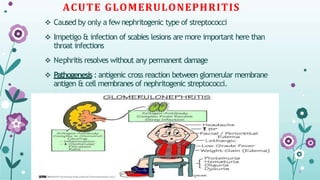
ACUTE GLOMERULONEPHRITIS
 Caused by only a few nephritogenic type of streptococci
 Impetigo & infection of scabies lesions are more important here than
throat infections
 Nephritis resolves without any permanent damage
 Pathogenesis : antigenic cross reaction between glomerular membrane
antigen & cell membranes of nephritogenic streptococci.
EPIDEMIOLOGY
 Main source of S.p is human upper respiratory tract (3) of patients and
carriers
 Symptomless infection is common
 Transmission by direct contact or through contaminated fingers,
dust or fomites
 Streptococcal skin infection is common & spread by non-biting insects
 Streptococcal RTI are frequent in children at 5-8 years of age
 Crowding is an imp. Factor
 Outbreaks of infection are common in hostels and army camps
08-07-324015
LAB DIAGNOSIS
 In acute infections, diagnosis is established by culture
 In non-suppurative complications are diagnosed by demo. Of antibodies
1) SPECIMEN
 Throat swab, pus swab or exudates are collected
 In RF & GN serum is collected for serology



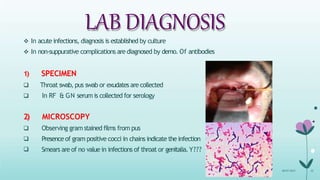
2) MICROSCOPY
Observing gramstained films from pus
Presence of gram positive cocci in chains indicate the infection
Smears are of no value in infections of throat or genitalia.Y???
08-07-2015 32
3)


CULTURE
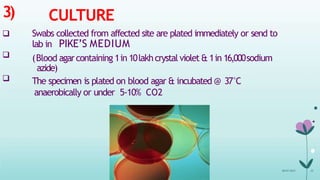
 Swabs collected from affected site are plated immediately or send to
lab in PIKE’S MEDIUM
(Blood agarcontaining 1in 10lakhcrystal violet & 1in 16,000sodium
azide)
The specimen is plated on blood agar & incubated @ 37°C
anaerobically or under 5-10% CO2
08-07-2015 33
4)IDENTIFICATION
 Hemolytic strept. are grouped by the Lancefield
technique using specific antisera
 RAPID DIAGNOSTIC TEST KITS
Used for the detection of streptococcal group A antigen from
throat swabs
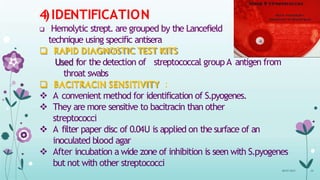
 BACITRACIN SENSITIVITY :
 A convenient method for identification of S.pyogenes.
 They are more sensitive to bacitracin than other
streptococci
 A filter paper disc of 0.04U is applied on the surface of an
inoculated blood agar
 After incubation a wide zone of inhibition is seen with S.pyogenes
but not with other streptococci
08-07-2015 34
4) SEROLOGY
08-07-2015 35
 Diagnosis of RF & GN can be made by demonstrating high levels of antibody to
streptococcal toxins
 Standard test isASO TITRATION
 ASO titres > 200 indicates prior streptococcal infection
 High levels found in ARF but in GN the titres are often low
 ANTI-DNAase B estimation
 Titres >300 are taken significant
 Mainly used in diagnosis of streptococcal pyoderma for which ASO titres is of much less
value
 STREPTOENZYME TEST
 A passive hemagglutination test using erythrocytes sensitized with a crude preparation of
extracellular antigens of streptococci
 Very sensitive and specific test
 Becomes positive after all types of streptococcal tests
TYPING
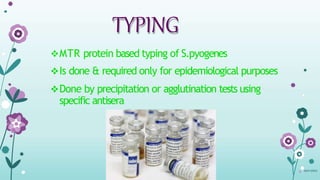
MTR protein based typing of S.pyogenes
Is done & required only for epidemiological purposes
Done by precipitation or agglutination tests using
specific antisera
08-07-329015
TREATMENT
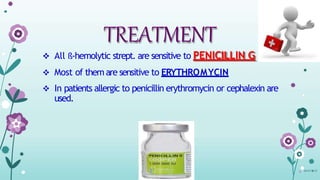
 All ß-hemolytic strept. are sensitive to PENICILLIN G
 Most of themare sensitive to ERYTHROMYCIN
 In patients allergic to penicillin erythromycin or cephalexin are
used.
08-07-4
2015
PROPHYLAXIS
The indication of prophylaxis is only in the prevention of
Rheumatic fever
Achieved by long termadministration of PENICILLIN in
children who have developed early signs of rheumatic fever
.
This prevents streptococcal reinfection and further damage to
heart
Antibiotic prophylaxis is not useful for glomerulonephritis as this
complication follows a single streptococcal infection &
reinfection don’t occur .
08-07-2015 38
OTHER HEMOLYTIC STREPTOCOCCI
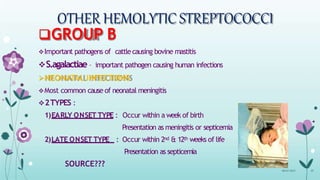
GROUP B
Important pathogens of cattlecausing bovine mastitis
S.agalactiae – important pathogen causing human infections
NEONATAL INFECTIONS
Most common cause of neonatal meningitis
2TYPES :
1)EARLY ONSET TYPE : Occur within a week of birth
Presentation as meningitis or septicemia
2)LATE ONSET TYPE : Occur within 2nd & 12th weeks of life
Presentation as septicemia
SOURCE???
08-07-2015 39
 Other neonatal infections include osteoarthritis, osteomyelitis,
respiratory infections, peritonitis, omphalitis & endocarditis
 ADULT INFECTIONS
PEURPERAL SEPSIS & PNEUMONIA
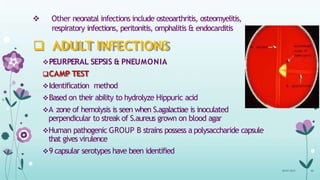
CAMP TEST
Identification method
Based on their ability to hydrolyze Hippuric acid
A zone of hemolysis is seen when S.agalactiae is inoculated
perpendicular to streak of S.aureus grown on blood agar
Human pathogenic GROUP B strains possess a polysaccharide capsule
that gives virulence
9 capsular serotypes have been identified
08-07-2015 40
GROUP C
Human pathogens isolated belongs to S.equisimilis species
DISEASES : URTI, endocarditis, osteomyelitis, brain abscess, pneumonia
& puerperal sepsis
Strains are tolerant to penicillin but GENTAMICIN is recommended in
serious cases
It mainly produces streptolysin O ,streptokinase
S.equisimilis is the source of STREPTOKINASE used for THROMBOLYTIC
therapy in patients
08-07-2015 41
GROUP D ( Non-enterococcal)
Shows gamma hemolysis
Normal inhabitants of colon
Causes UTI & Endocarditis
08-07-2015 42
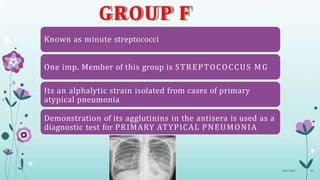
GROUP F
Known as minute streptococci
One imp. Member of this group is STREPTOCOCCUS MG
Its an alphalytic strain isolated from cases of primary
atypical pneumonia
Demonstration of its agglutinins in the antisera is used as a
diagnostic test for PRIMARY ATYPICAL PNEUMONIA
08-07-2015 43
OTHER GROUPS
08-07-2015 44
GROUP G & O -
GROUP H&K
GROUP R
Normal commensals of throat
May occasionaly cause tonsillitis endocarditis & UTI
- Infective endocarditis
- Meningitis , Septicemia, & RTI in persons in contact
with infected pigs & meat
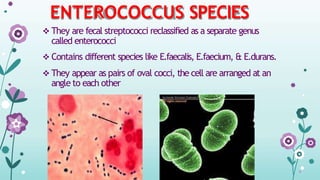
ENTEROCOCCUS SPECIES
 They are fecal streptococci reclassified as a separate genus
called enterococci
 Contains different species like E.faecalis, E.faecium, & E.durans.
 They appear as pairs of oval cocci, the cell are arranged at an
angle to each other
 They are relatively resistant, surviving at 60°C for 30 minutes
 On Mac Conkey medium – produce tiny pink colonies
 Identified by its ability to ferment mannitol, sucrose, sorbitol & esculin
 They are frequently isolated from UTI & wound infection
 Also cause endocarditis, biliary tract infection, septicemia & intra-
abdominal abscess
 Antibiotic sensitivity is done before treatment
 Intrinsically resistant to cephalosporins
 VANCOMYCIN is used
 But, recently VANCOMYCIN-RESISTANT-STRAINS ( VRE) are
observed
 Mechanism of resistance -Alteration in D-alanyl-D-alanine chain in cell
wall
STREPTOCOCCI VIRIDANS
Normally resident in mouth & URT
Alpha lysis on blood agar – hence the name
Not grouped by Lancefield scheme (S.sangius)
Classified into many species like :
S.mitis, S.mutans, S.salivarius & S.sangius based on biochemical
properties
 Risks in people with pre-existing cardiac lesions
 Causes bacterial endocarditis
 Following dentalprocedures, they causebacteremia& get
implanted on damaged or prosthetic valves or in congenital
HD & grow to form vegetation
 Thus penicillin prophylaxis is indicated before the procedure
 But antibiotic sensitivity is determined for proper treatment
STREPTOCOCCUS MUTANTS
 Normal flora of oral cavity
 Can cause dental caries & endocarditis in patients with risk factors
 It has a polysaccharide coat that allows it to stick to the teeth & to
damaged heart valves & invade the bloodstream
 Normal body defenses are adequate to prevent this infection
 PREVENTION
 Maintenance of good oral hygiene, regular dental checkups &
prophylactic antibiotics prior to dental work on people with damaged
heart valves.

streptococci-160611101831.pptx

  • 1.
  • 2.
    CONTENTS 08-07-2015 2 • MORPHOLOGY •CLASSIFICATION • CULTURAL CHARACTERISTICS • BIOCHEMICAL REACTIONS • RESISTENCE & ANTIGENIC STRUCTURE • TOXINS AND OTHER VIRULENCE FACTORS • PATHOGENICITY • LAB DIAGNOSIS • TREATMENT AND PROPHYLAXIS
  • 3.
    introduction 08-07-2015 3 First seenin wound infections by Billroth – called them streptococci-1874 Gram Positive cocci Arranged in chains Part of normal flora of humans and animals
  • 4.
    CLASSIFICATION Classified by Brownin1919 based on their growth in 5% Blood Agar Normal commensals 80 types 08-07-2015 4
  • 5.
    ALPHA HEMOLYSIS GAMMAHEMOLYSIS  Greenish discolouration with partial hemolysis  Small zone of lysis(1-2mm) with indefinite margins  Unlysed RBCs seen under microscope BETA HEMOLYSIS  Sharply defined ,clear, colourless zone of hemolysis  2-4 mm wide  RBCs lysed completely  No hemolysis 08-07-2015 5
  • 6.
    STREPTOCOCCUS PYOGENES MORPHOLOGY Individual cocciare spherical or oval ( 0.5-1micrometer ) Arranged in chains of varying lengths (?? ) Longest chain is formed by S.salivarius Non-motile & non sporing 08-07-2015 6
  • 7.
    CULTURAL CHARACTERISTICS 08-07-2015 7 Aerobes as well as facultative anaerobes  Grown best at 37°C ( 22-42°C ) Grows in media rich in fermentable carbohydrates or enriched media with blood or serum  ON BLOOD AGAR  Shows beta hemolysis  Virulent strains form matt colonies  Avirulent strains form glossy colonies  Some strains with capsule form mucoid colonies  ON LIQUID MEDIA  Growth occur asagranular turbidity withapowdery depositin glucose or serum broth
  • 8.
  • 9.
    TOXINS AND VIRULENCEFACTORS  S.Pyogenes forms several exotoxins and enzymes that contributes its virulence.  M Protein also act as a virulence factor by inhibiting phagocytosis  HEMOLYSIN  PYROGENIC EXOTOXIN  STREPTOKINASE (FIBRINOLYSIN)  DEOXYRIBONUCLEASES  NADase  HYALURONIDASE SERUM OPACITY FACTOR
  • 10.
    1. HEMOLYSINS 2 typesSTREPTOLYSIN O AND S STREPTOLYSIN O  Oxygen labile & heat labile  Inactive in oxidized form but reactivated on treating with mild reducing agents  Lethal on i.v injection and is cardiotoxic & leucotoxic activity  Its antigenic and antistreptolysin O appears in sera following its infection  ASO TITRE  Earlier done by hemolysis inhibition test  Now done by serological method of latex agglutination  ASO titer > 200 units is significant & suggests a recent or recurrent infection with streptococci 08-07-2015 10
  • 11.
  • 12.
     STREPTOLYSIN S Soluble in serum,thus the name  Oxygen stable hemolysin  Responsible for hemolysis seen in blood agar  It’s a protein but is not antigenic  Non specifically inhibited by serum lipoproteins  STREPTOLYSIN S AND O ARE PRODUCED BY GROUPS A,C & G
  • 13.
    2.PYROGENIC EXOTOXIN  ERYTHROGENIC/ DICK /SCARLATINAL TOXIN  Its injection into susceptible individuals cause an erythematous reaction (DICK TEST)  Used to identify scarlet fever in children  Toxin induced fever . Hence renamed as Streptococcal pyrogenic exotoxin {SPE}  3 types of SPE – A, B & C  Types A & C are coded for by bacteriophage genes  Type B gene is chromosomal  SPEs are SUPERANTIGENS (like staph & TSS toxin)  That is the T cell mitogen that induce a massive release of inflammatory cytokines, causing fever , shock and tissue damage 08-07-2015 13
  • 14.
    3. STREPTOKINASE (Fibrinolysin) Promotes lysis of fibrin clots by activating a plasminogen  Antigenic protein  Antistreptokinase antibodies provide retrospective evidence of strept. Infection  BIOLOGICAL ROLE : It breaks down the fibrin barrier around the lesion & facilitate spreading of infection  Intravenous streptokinase is given for the T reatment of early MI & other thromboembolic disorders 08-07-2015 14
  • 15.
    4. DEOXYRIBONUCLEASES (StreptodornaseorDNAase) Causes depolymerization of DNA Pyogenic exudates contain large amount of DNA derived from nuclei of necrotic cells Helps to liquefy the thick pus & hence responsible for the thin serous character of streptococcal exudates.  4 antigenically distinct DNAases are recognized -A,B,C & D  B is the most antigenic in humans  Demo. Of ANTI-DNAase B antibody is used in the retrospective diagnosis of S.p infection THERAPEUTIC APPLICATION:  Liquefying localized collection of thick exudates as in empyema, a preparation of streptokinase and streptodornase are used 08-07-2015 15
  • 16.
    5. NICOTINAMIDE ADENINEDINUCLEOTIDASE 08-07-2015 16 NADase acts on co-enzyme NAD and liberates nicotinamide Antigenic Leucotoxic
  • 17.
    6.HYALURONIDASE Breaks down hyaluronicacid of tissues Thus favours spread of infection along intercellular spaces S.cocci also possess a H.acid capsule & thus it exhibits a self destructive process Antigenic 08-07-2015 17
  • 18.
    7.SERUM OPACITY FACTOR Producedby some M types of S.pyogenes SOP isalipoproteinasethatresultsin opacity whenappliedto agar gel containing horse or swine serum 08-07-2015 18
  • 19.
    8.OTHER ENZYMES 08-07-2015 19 Many strains also produce  PROTEINASE  PHOSPHATASE  ESTERASES  N-ACETYL GLUCOSAMINIDASE  NEURAMINIDASE Their extend of pathogenicity is unknown
  • 20.
    PATHOGENECITY  SUPPURATIVE STREPTOCOCCALDISEASES 1.RESPIRATORY INFECTIONS Primary site of invasion by S.pyogenes (lower M type) is the throat SORE THROAT is the most common streptococcal infection Produce tonsillitis or pharyngitis Virulent group A streptococci adhere to pharyngeal epithelium by means of the lipoteichoic acid covering the surface pili The glycoprotein fibronectin on the epithelial cells serve as the receptor to lipoteichoic acid ligand From throat s.coccimayspreadto surrounding tissues,leadingto suppurative complicationslikeotitismedia,mastoditis,quinsy ,Ludwig’sanginaand suppurative adenitis Rarely lead to meningitis & S.pneumonia 08-07-2015 21
  • 21.
  • 22.
  • 23.
    2.SKIN & SOFTTISSUE INFECTION  2Typical Streptococcal skin infections are : ERYSIPELAS  It’s a diffuse infection involving superficial lymphatics  Affected skin is red, swollen & indurated  Rare & seen in older patients IMPETIGO Caused by the higher numbered M type of streptococci Tiny blisters are the first symptom of impetigo. When the blisters burst, theskin underneath themismoist,red,andmayoozefluid.Next, a tan or yellow-browncrustcovers thewetareas,makingitlook likethey've been coated with honey or brown sugar . 08-07-2015 23
  • 24.
    CELLULITIS  It usuallyaffects a limb but can occur anywhere on the body.  Symptoms and signs are usually localized to the affected area but patients can become generally unwell with fevers, with chills & rigor (bacteremia)  Redness, Swelling, Increased warmth, T enderness, Blistering, Abscess, Erosions and ulceration NECROTISING FASCIITIS Caused by mixed aerobic & anaerobic bacterial infection Some strains of S.pyogenes may alone be responsible ( M type 1&3 ) Notoriety under the name FLESH EATING BACTERIA Extensive necrosis of subcut. & muscular tissues assoc. with severe systemic infection with DIC and MSF. 08-07-2015 24
  • 25.
  • 26.
    S.Pyogenes are isolatedfrom the lesion Rising titres of ASO and anti-DNAase B are demonstrated Vancomycin is the drug of choice in life-threatening cases as penicillin mayn’t be effective. Soft tissue infection with some M types of S.pyogenes cause a TSS resembling staphylococcal TSS 08-07-2015 26
  • 27.
    3.GENITAL INFECTIONS  Bothaerobic & anaerobic s.cocci are normal inhabitants of female genitalia.  Imp.cause of PUERPERAL SEPSIS  Semmelweis- 1847- hand washing  Now puerperal fever is common due to endogenous anaerobic streptococci 08-07-2015 27
  • 28.
    4.OTHER SUPPURATIVE INFECTIONS S.PYOGENEScan cause abscesses in internal organs like brain ,lungs ,liver & kidney Septicemia & pyemia. 08-07-2015 28
  • 29.
     2 imp.Infections areAcute Rheumatic Fever & Acute Glomerulonephritis  These complications develop 1-3 weeks after acute infection  Thus the organism mayn’t be detectable when sequelae sets in.  ACUTE RHEUMATIC FEVER  Rheumatic fever follows persistent or repeated streptococcal throat infections with a strong antibody response  The lesion is carditis, including connective tissue degeneration of heart valves & inflammatory myocardial lesions characterized by ASCHOFF Nodules  Antigenic cross reaction between streptococci and heart tissues
  • 30.
    ACUTE GLOMERULONEPHRITIS  Causedby only a few nephritogenic type of streptococci  Impetigo & infection of scabies lesions are more important here than throat infections  Nephritis resolves without any permanent damage  Pathogenesis : antigenic cross reaction between glomerular membrane antigen & cell membranes of nephritogenic streptococci.
  • 31.
    EPIDEMIOLOGY  Main sourceof S.p is human upper respiratory tract (3) of patients and carriers  Symptomless infection is common  Transmission by direct contact or through contaminated fingers, dust or fomites  Streptococcal skin infection is common & spread by non-biting insects  Streptococcal RTI are frequent in children at 5-8 years of age  Crowding is an imp. Factor  Outbreaks of infection are common in hostels and army camps 08-07-324015
  • 32.
    LAB DIAGNOSIS  Inacute infections, diagnosis is established by culture  In non-suppurative complications are diagnosed by demo. Of antibodies 1) SPECIMEN  Throat swab, pus swab or exudates are collected  In RF & GN serum is collected for serology    2) MICROSCOPY Observing gramstained films from pus Presence of gram positive cocci in chains indicate the infection Smears are of no value in infections of throat or genitalia.Y??? 08-07-2015 32
  • 33.
    3)   CULTURE  Swabs collectedfrom affected site are plated immediately or send to lab in PIKE’S MEDIUM (Blood agarcontaining 1in 10lakhcrystal violet & 1in 16,000sodium azide) The specimen is plated on blood agar & incubated @ 37°C anaerobically or under 5-10% CO2 08-07-2015 33
  • 34.
    4)IDENTIFICATION  Hemolytic strept.are grouped by the Lancefield technique using specific antisera  RAPID DIAGNOSTIC TEST KITS Used for the detection of streptococcal group A antigen from throat swabs  BACITRACIN SENSITIVITY :  A convenient method for identification of S.pyogenes.  They are more sensitive to bacitracin than other streptococci  A filter paper disc of 0.04U is applied on the surface of an inoculated blood agar  After incubation a wide zone of inhibition is seen with S.pyogenes but not with other streptococci 08-07-2015 34
  • 35.
    4) SEROLOGY 08-07-2015 35 Diagnosis of RF & GN can be made by demonstrating high levels of antibody to streptococcal toxins  Standard test isASO TITRATION  ASO titres > 200 indicates prior streptococcal infection  High levels found in ARF but in GN the titres are often low  ANTI-DNAase B estimation  Titres >300 are taken significant  Mainly used in diagnosis of streptococcal pyoderma for which ASO titres is of much less value  STREPTOENZYME TEST  A passive hemagglutination test using erythrocytes sensitized with a crude preparation of extracellular antigens of streptococci  Very sensitive and specific test  Becomes positive after all types of streptococcal tests
  • 36.
    TYPING MTR protein basedtyping of S.pyogenes Is done & required only for epidemiological purposes Done by precipitation or agglutination tests using specific antisera 08-07-329015
  • 37.
    TREATMENT  All ß-hemolyticstrept. are sensitive to PENICILLIN G  Most of themare sensitive to ERYTHROMYCIN  In patients allergic to penicillin erythromycin or cephalexin are used. 08-07-4 2015
  • 38.
    PROPHYLAXIS The indication ofprophylaxis is only in the prevention of Rheumatic fever Achieved by long termadministration of PENICILLIN in children who have developed early signs of rheumatic fever . This prevents streptococcal reinfection and further damage to heart Antibiotic prophylaxis is not useful for glomerulonephritis as this complication follows a single streptococcal infection & reinfection don’t occur . 08-07-2015 38
  • 39.
    OTHER HEMOLYTIC STREPTOCOCCI GROUPB Important pathogens of cattlecausing bovine mastitis S.agalactiae – important pathogen causing human infections NEONATAL INFECTIONS Most common cause of neonatal meningitis 2TYPES : 1)EARLY ONSET TYPE : Occur within a week of birth Presentation as meningitis or septicemia 2)LATE ONSET TYPE : Occur within 2nd & 12th weeks of life Presentation as septicemia SOURCE??? 08-07-2015 39
  • 40.
     Other neonatalinfections include osteoarthritis, osteomyelitis, respiratory infections, peritonitis, omphalitis & endocarditis  ADULT INFECTIONS PEURPERAL SEPSIS & PNEUMONIA CAMP TEST Identification method Based on their ability to hydrolyze Hippuric acid A zone of hemolysis is seen when S.agalactiae is inoculated perpendicular to streak of S.aureus grown on blood agar Human pathogenic GROUP B strains possess a polysaccharide capsule that gives virulence 9 capsular serotypes have been identified 08-07-2015 40
  • 41.
    GROUP C Human pathogensisolated belongs to S.equisimilis species DISEASES : URTI, endocarditis, osteomyelitis, brain abscess, pneumonia & puerperal sepsis Strains are tolerant to penicillin but GENTAMICIN is recommended in serious cases It mainly produces streptolysin O ,streptokinase S.equisimilis is the source of STREPTOKINASE used for THROMBOLYTIC therapy in patients 08-07-2015 41
  • 42.
    GROUP D (Non-enterococcal) Shows gamma hemolysis Normal inhabitants of colon Causes UTI & Endocarditis 08-07-2015 42
  • 43.
    GROUP F Known asminute streptococci One imp. Member of this group is STREPTOCOCCUS MG Its an alphalytic strain isolated from cases of primary atypical pneumonia Demonstration of its agglutinins in the antisera is used as a diagnostic test for PRIMARY ATYPICAL PNEUMONIA 08-07-2015 43
  • 44.
    OTHER GROUPS 08-07-2015 44 GROUPG & O - GROUP H&K GROUP R Normal commensals of throat May occasionaly cause tonsillitis endocarditis & UTI - Infective endocarditis - Meningitis , Septicemia, & RTI in persons in contact with infected pigs & meat
  • 45.
    ENTEROCOCCUS SPECIES  Theyare fecal streptococci reclassified as a separate genus called enterococci  Contains different species like E.faecalis, E.faecium, & E.durans.  They appear as pairs of oval cocci, the cell are arranged at an angle to each other
  • 46.
     They arerelatively resistant, surviving at 60°C for 30 minutes  On Mac Conkey medium – produce tiny pink colonies  Identified by its ability to ferment mannitol, sucrose, sorbitol & esculin  They are frequently isolated from UTI & wound infection  Also cause endocarditis, biliary tract infection, septicemia & intra- abdominal abscess  Antibiotic sensitivity is done before treatment  Intrinsically resistant to cephalosporins  VANCOMYCIN is used  But, recently VANCOMYCIN-RESISTANT-STRAINS ( VRE) are observed  Mechanism of resistance -Alteration in D-alanyl-D-alanine chain in cell wall
  • 47.
    STREPTOCOCCI VIRIDANS Normally residentin mouth & URT Alpha lysis on blood agar – hence the name Not grouped by Lancefield scheme (S.sangius) Classified into many species like : S.mitis, S.mutans, S.salivarius & S.sangius based on biochemical properties  Risks in people with pre-existing cardiac lesions  Causes bacterial endocarditis  Following dentalprocedures, they causebacteremia& get implanted on damaged or prosthetic valves or in congenital HD & grow to form vegetation  Thus penicillin prophylaxis is indicated before the procedure  But antibiotic sensitivity is determined for proper treatment
  • 48.
    STREPTOCOCCUS MUTANTS  Normalflora of oral cavity  Can cause dental caries & endocarditis in patients with risk factors  It has a polysaccharide coat that allows it to stick to the teeth & to damaged heart valves & invade the bloodstream  Normal body defenses are adequate to prevent this infection  PREVENTION  Maintenance of good oral hygiene, regular dental checkups & prophylactic antibiotics prior to dental work on people with damaged heart valves.