STREAM FLOW
ARSALAN SARDAR
2016-MSGS-7
MSc Geological Sciences
Department of Engineering Geology
University of Engineering and Technology Lahore
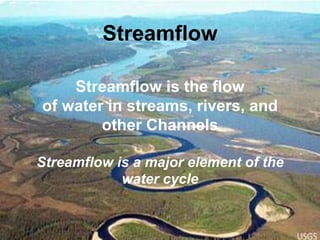
Streamflow is the flow
of water in streams, rivers, and
other Channels
Streamflow is a major element of the
water cycle
Streamflow
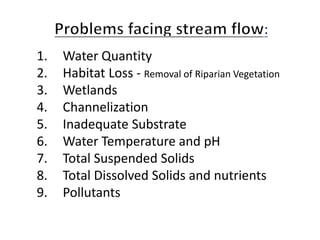
1. Water Quantity
2. Habitat Loss - Removal of Riparian Vegetation
3. Wetlands
4. Channelization
5. Inadequate Substrate
6. Water Temperature and pH
7. Total Suspended Solids
8. Total Dissolved Solids and nutrients
9. Pollutants
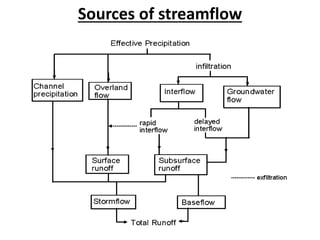
Sources of streamflow
Streamflow generation
• Streamflow is generated by three
mechanisms
1. Hortonian overland flow
2. Subsurface flow
3. Saturation overland flow
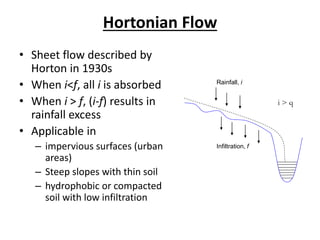
Hortonian Flow
• Sheet flow described by
Horton in 1930s
• When i<f, all i is absorbed
• When i > f, (i-f) results in
rainfall excess
• Applicable in
– impervious surfaces (urban
areas)
– Steep slopes with thin soil
– hydrophobic or compacted
soil with low infiltration
Rainfall, i
Infiltration, f
i > q
Subsurface flow
• Lateral movement of water occurring through the
soil above the water table
• primary mechanism for stream flow generation when
f>i
– Matrix/translatory flow
• Lateral flow of old water displaced by precipitation inputs
• Porosity and permeability higher near the ground
– Macropore flow
• Movement of water through large conduits in the soil
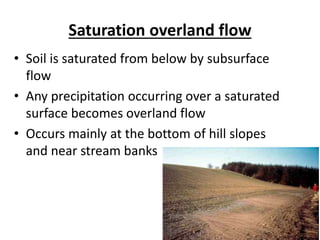
Saturation overland flow
• Soil is saturated from below by subsurface
flow
• Any precipitation occurring over a saturated
surface becomes overland flow
• Occurs mainly at the bottom of hill slopes
and near stream banks
STAGE-DISCHARGE RELATIONSHIP
• STAGE MEASUREMENTS
• Stage measurements are mainly made with
gauges.
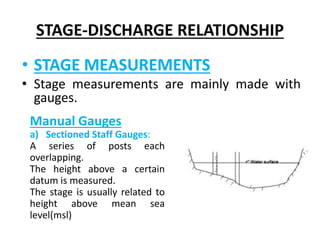
Manual Gauges
a) Sectioned Staff Gauges:
A series of posts each
overlapping.
The height above a certain
datum is measured.
The stage is usually related to
height above mean sea
level(msl)
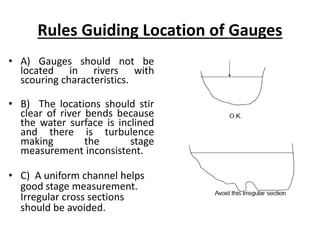
Rules Guiding Location of Gauges
• A) Gauges should not be
located in rivers with
scouring characteristics.
• B) The locations should stir
clear of river bends because
the water surface is inclined
and there is turbulence
making the stage
measurement inconsistent.
• C) A uniform channel helps
good stage measurement.
Irregular cross sections
should be avoided.
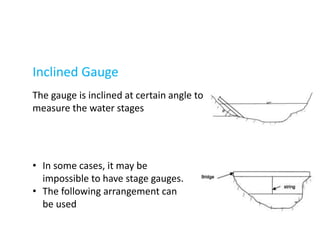
Inclined Gauge
The gauge is inclined at certain angle to
measure the water stages
• In some cases, it may be
impossible to have stage gauges.
• The following arrangement can
be used
Recording Gauges
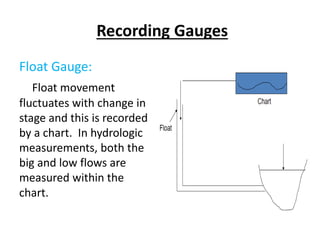
Float Gauge:
Float movement
fluctuates with change in
stage and this is recorded
by a chart. In hydrologic
measurements, both the
big and low flows are
measured within the
chart.
b) Digital Recorders
• They have clocks and used when for example
hourly measurements are desired usually
where stages do not increase and decrease
steeply.
• The recorder should be placed at a height
more than the expected peak stage.
• To know the maximum stage expected, an
ordinary gauge can be used for some time.
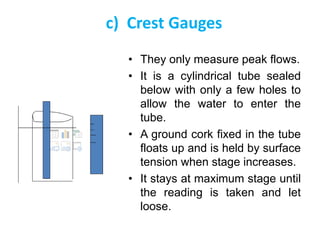
c) Crest Gauges
• They only measure peak flows.
• It is a cylindrical tube sealed
below with only a few holes to
allow the water to enter the
tube.
• A ground cork fixed in the tube
floats up and is held by surface
tension when stage increases.
• It stays at maximum stage until
the reading is taken and let
loose.
DISCHARGE MEASUREMENTS
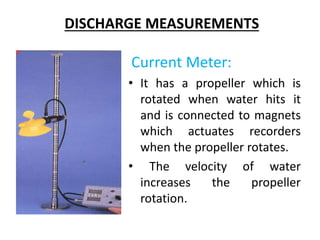
Current Meter:
• It has a propeller which is
rotated when water hits it
and is connected to magnets
which actuates recorders
when the propeller rotates.
• The velocity of water
increases the propeller
rotation.

Stream flow by Arslan

  • 1.
    STREAM FLOW ARSALAN SARDAR 2016-MSGS-7 MScGeological Sciences Department of Engineering Geology University of Engineering and Technology Lahore
  • 2.
    Streamflow is theflow of water in streams, rivers, and other Channels Streamflow is a major element of the water cycle Streamflow
  • 10.
    1. Water Quantity 2.Habitat Loss - Removal of Riparian Vegetation 3. Wetlands 4. Channelization 5. Inadequate Substrate 6. Water Temperature and pH 7. Total Suspended Solids 8. Total Dissolved Solids and nutrients 9. Pollutants
  • 11.
  • 12.
    Streamflow generation • Streamflowis generated by three mechanisms 1. Hortonian overland flow 2. Subsurface flow 3. Saturation overland flow
  • 13.
    Hortonian Flow • Sheetflow described by Horton in 1930s • When i<f, all i is absorbed • When i > f, (i-f) results in rainfall excess • Applicable in – impervious surfaces (urban areas) – Steep slopes with thin soil – hydrophobic or compacted soil with low infiltration Rainfall, i Infiltration, f i > q
  • 14.
    Subsurface flow • Lateralmovement of water occurring through the soil above the water table • primary mechanism for stream flow generation when f>i – Matrix/translatory flow • Lateral flow of old water displaced by precipitation inputs • Porosity and permeability higher near the ground – Macropore flow • Movement of water through large conduits in the soil
  • 15.
    Saturation overland flow •Soil is saturated from below by subsurface flow • Any precipitation occurring over a saturated surface becomes overland flow • Occurs mainly at the bottom of hill slopes and near stream banks
  • 16.
    STAGE-DISCHARGE RELATIONSHIP • STAGEMEASUREMENTS • Stage measurements are mainly made with gauges. Manual Gauges a) Sectioned Staff Gauges: A series of posts each overlapping. The height above a certain datum is measured. The stage is usually related to height above mean sea level(msl)
  • 17.
    Rules Guiding Locationof Gauges • A) Gauges should not be located in rivers with scouring characteristics. • B) The locations should stir clear of river bends because the water surface is inclined and there is turbulence making the stage measurement inconsistent. • C) A uniform channel helps good stage measurement. Irregular cross sections should be avoided.
  • 18.
    Inclined Gauge The gaugeis inclined at certain angle to measure the water stages • In some cases, it may be impossible to have stage gauges. • The following arrangement can be used
  • 19.
    Recording Gauges Float Gauge: Floatmovement fluctuates with change in stage and this is recorded by a chart. In hydrologic measurements, both the big and low flows are measured within the chart.
  • 20.
    b) Digital Recorders •They have clocks and used when for example hourly measurements are desired usually where stages do not increase and decrease steeply. • The recorder should be placed at a height more than the expected peak stage. • To know the maximum stage expected, an ordinary gauge can be used for some time.
  • 21.
    c) Crest Gauges •They only measure peak flows. • It is a cylindrical tube sealed below with only a few holes to allow the water to enter the tube. • A ground cork fixed in the tube floats up and is held by surface tension when stage increases. • It stays at maximum stage until the reading is taken and let loose.
  • 22.
    DISCHARGE MEASUREMENTS Current Meter: •It has a propeller which is rotated when water hits it and is connected to magnets which actuates recorders when the propeller rotates. • The velocity of water increases the propeller rotation.