RATHINAVEL K
Reg No : 3382014
Ist M.Sc Applied Geology
University of madras
Guindy campus
Chennai 25
 Stratigraphy is the study of temporal relationships
in sedimentary rock bodies and reflects changes in the
balance between rates at which space is produced
and filled.
 Stratigraphical geology has its aim, the description
and classification of rocks with a view to arranging
them in chronological order in which they were laid
down on surface if the earth.
 In order to learn about a strata of a rock formation
we must know about the important principles in
stratigraphy.
STRATIGRAPHY
PRINCIPLES OF STRATIGRAPHY
 Principle of Lithology
 Principle of superposition
 Principle of fossil content
 Original horizontality
 Cross – cutting relationships
 Principle of lateral continuity
 Inclusion
 Faunal succession
 Uniformitarianism
 Correlation
Principles Of Lithology
 This principle involves in identifying the rocks
according to their lithology.
 The lithological characters of the different
formations are persistent over the area in which they
are exposed. Though there may be variations when
followed over some distance.
 Each lithological unit may comprise a number of
individual beds having more or less the same
characters. When it is spoken of as a formation given
a local name to Distinguish it from a similar formation
of age or belonging to another area.
 For example,
The Barkar sandstone, Kamthi sandstone,
Bhander sandstone
Attock slate, and cumbum slate
The Vempalle limestone and Megalaodon
limestone etc.
This lithology is often help in Correlation
method
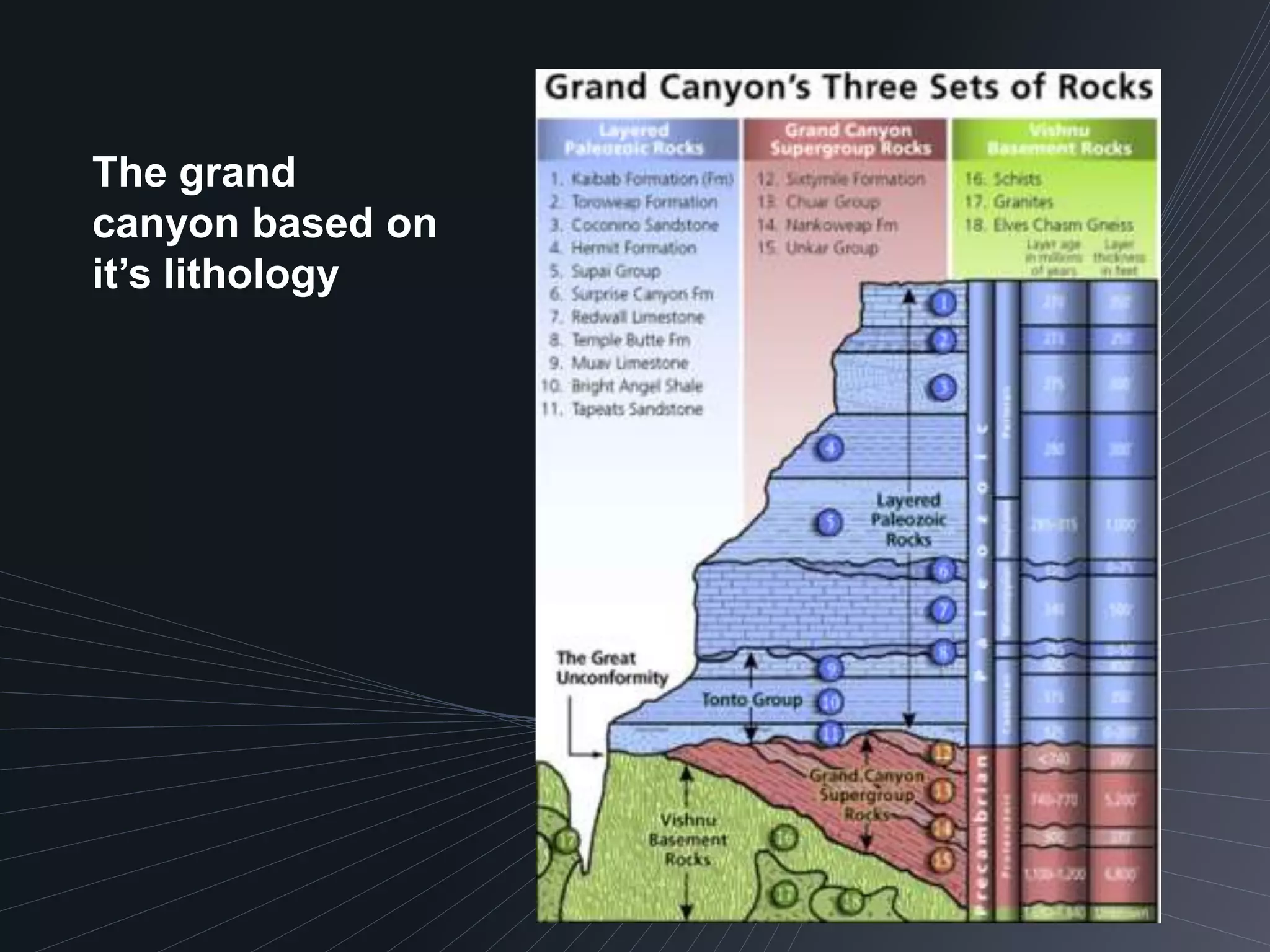
The grand
canyon based on
it’s lithology
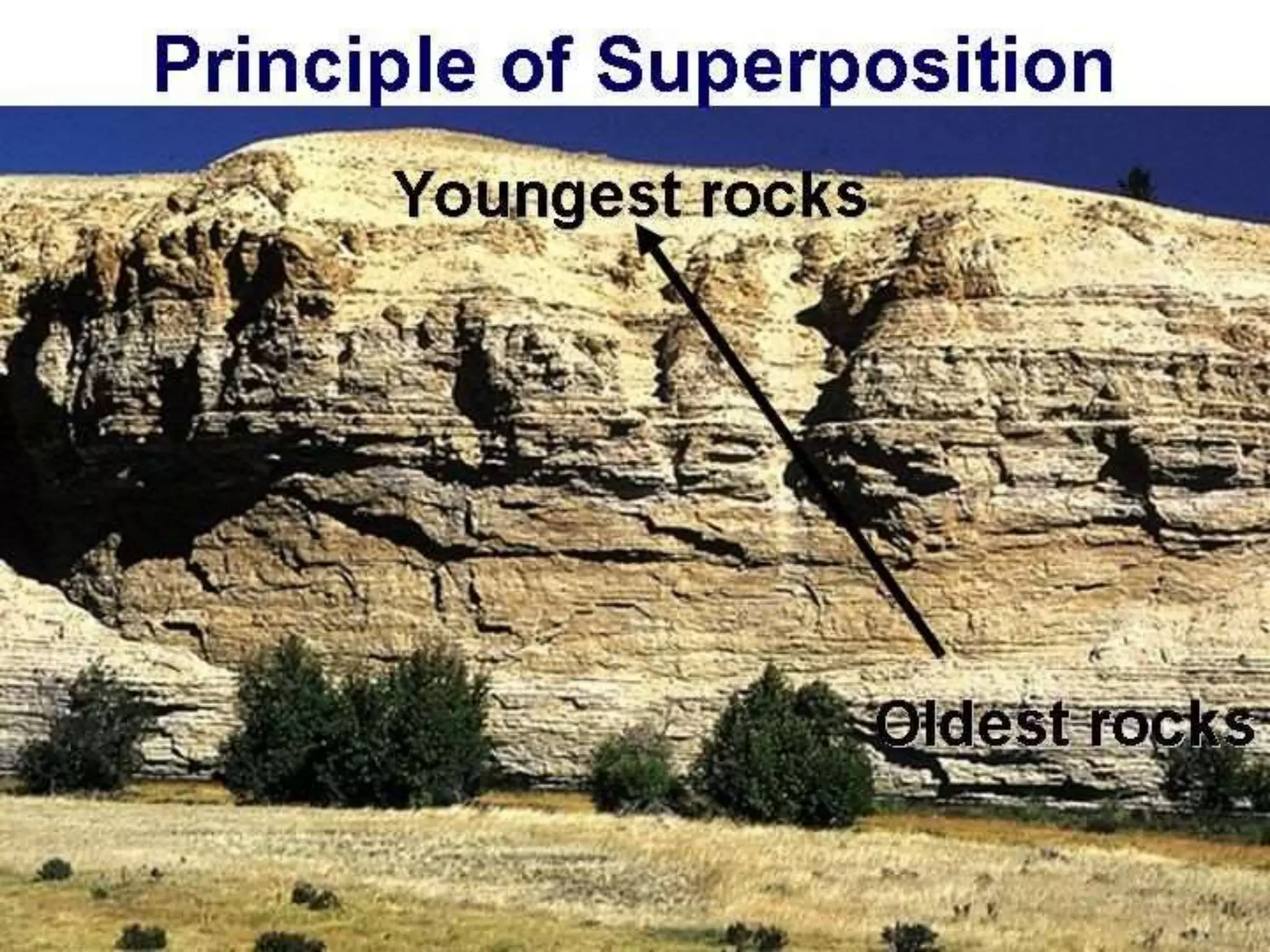
Principle of superposition
 This law states that in a sequence of
sedimentary layers, each layer must be younger
than the one below and older than one above it,
nicholas steno 1667.
 Because of earths gravity, deposition of
sediment will occur depositing older layers first
followed by successively younger layers.
 Thus , in a sequence of layers that have not
been overturned by a later deformational event.
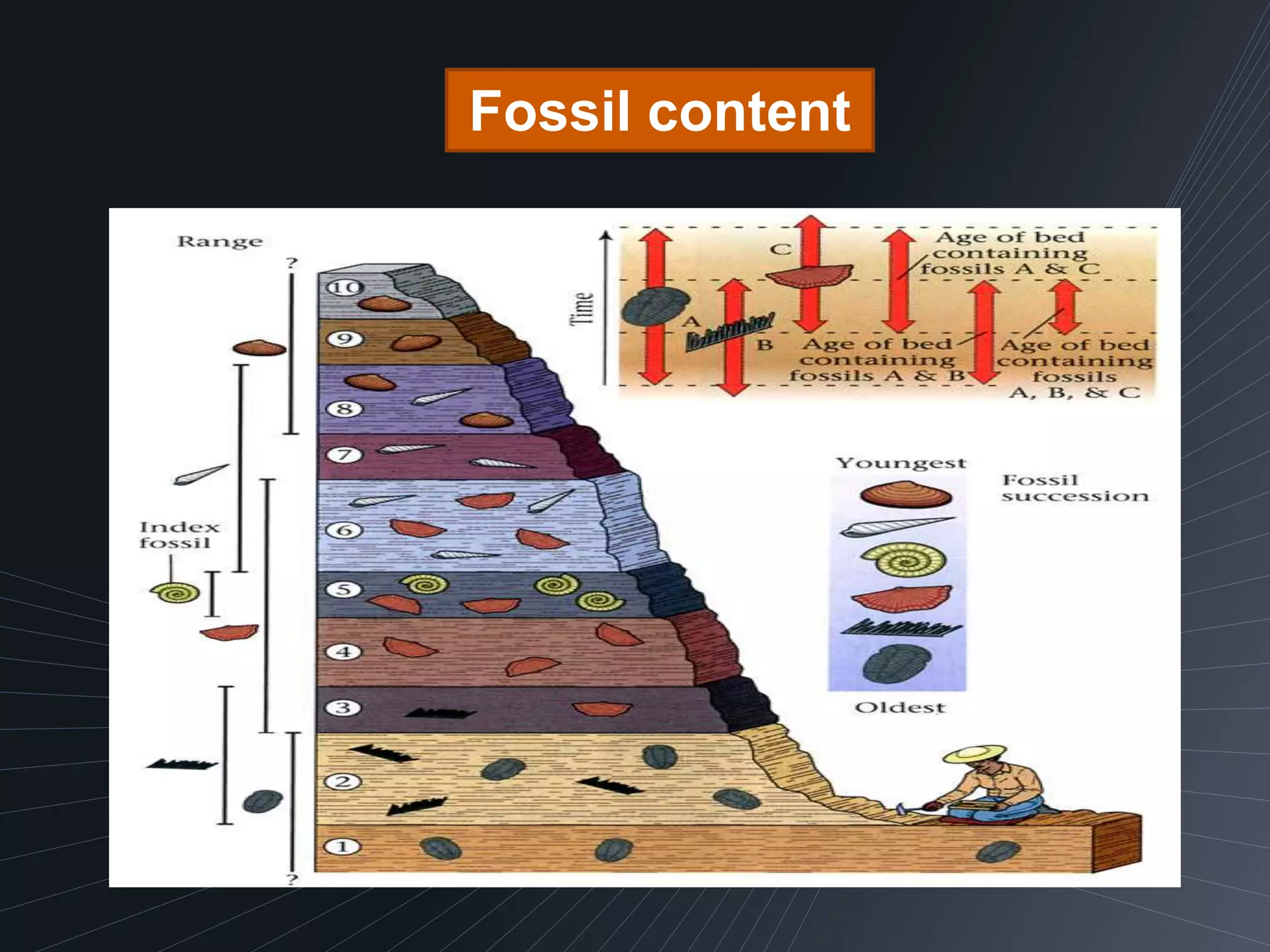
Principle of Fossil content
 Each formation has not only distinct Petrological
characters but also encloses a fossil assemblage
which is characteristic and different from that of the
underlying and overlying formations.
 Animals and vegetable organisms of each
geological age bear special characters not found in
those of other ages.
 For example of graptolites and ammonites are so
highly specialised in morphological characters and so
restricted in range of time that they are highly valuable
indicators of very small sub divisions of geologic time.
Fossil content
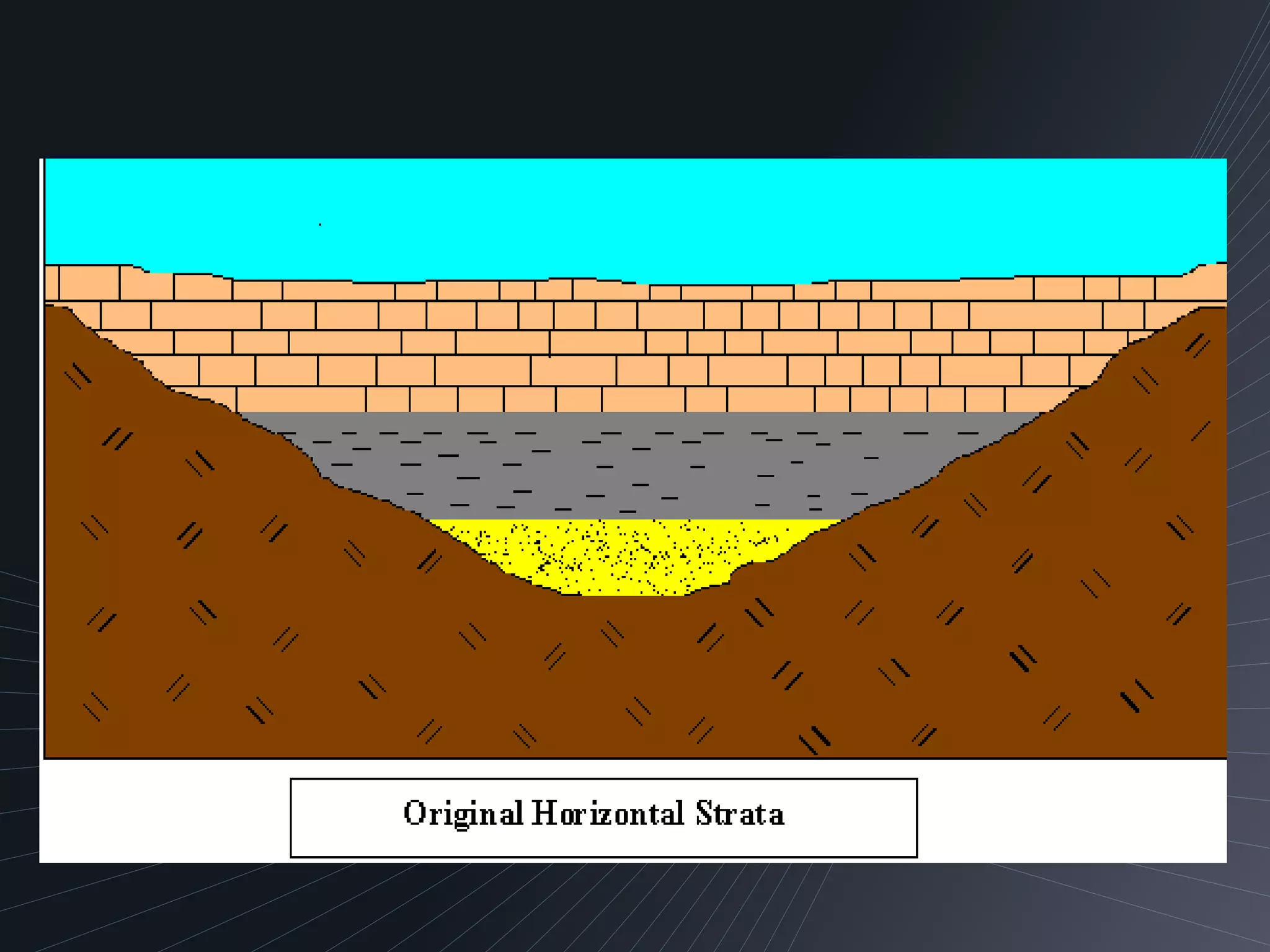
 Layers of rocks deposited from above, such
as sediments and lava flows, are originally laid down
horizontally, parallel to the surface.
 The exception to this principle is at the margins of
basins, where the strata can slope slightly downward
into the basin.
Principle of Original Horizontality
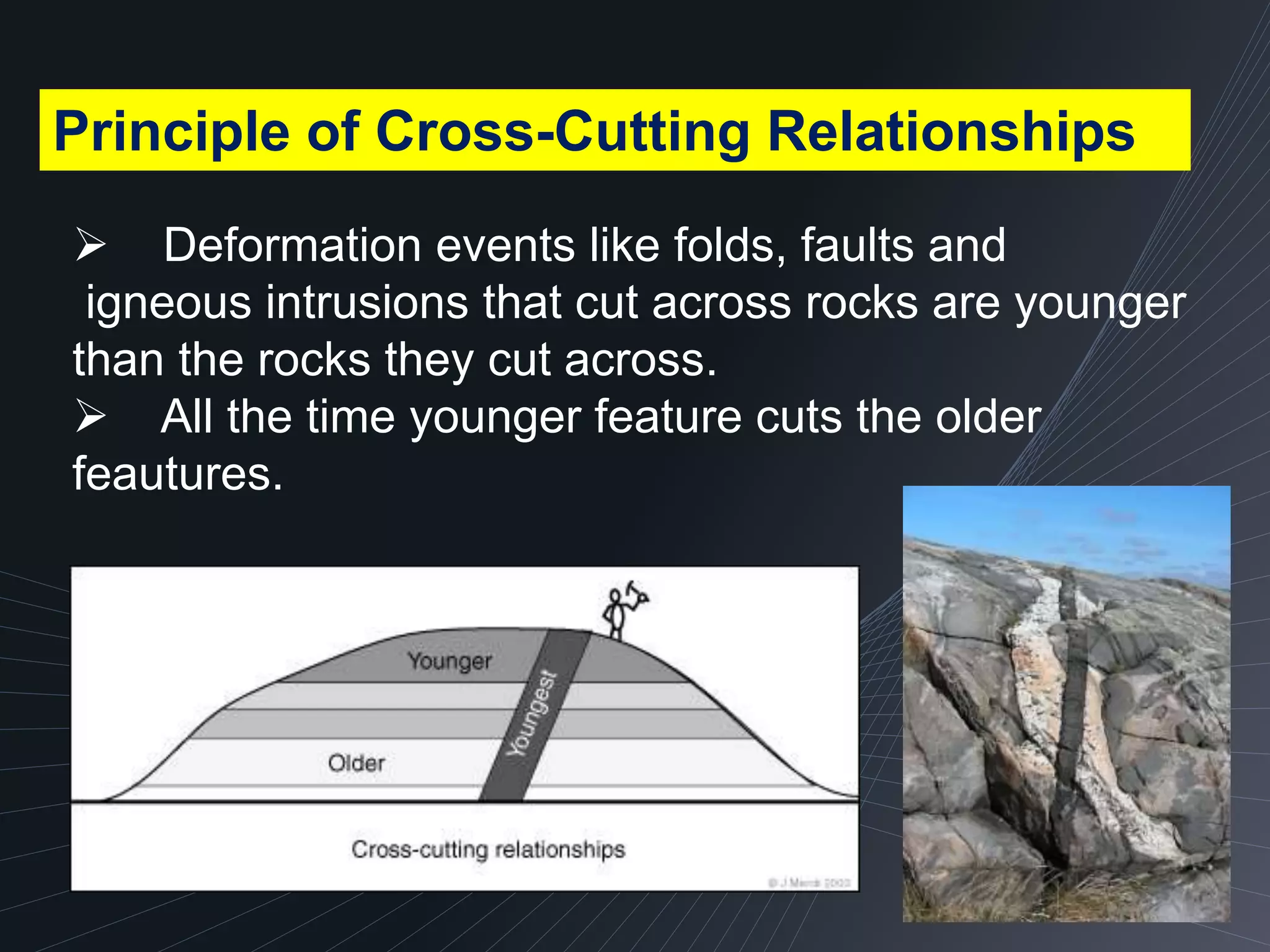
 Deformation events like folds, faults and
igneous intrusions that cut across rocks are younger
than the rocks they cut across.
 All the time younger feature cuts the older
feautures.
Principle of Cross-Cutting Relationships
 Within the depositional basin, strata are
continuous in all directions until they thin out at the
edge of that basin.
 All strata eventually end, either by hitting a
geographic barrier, such as a ridge, or when the
depositional process extends too far from its source,
either a sediment source or a volcano.
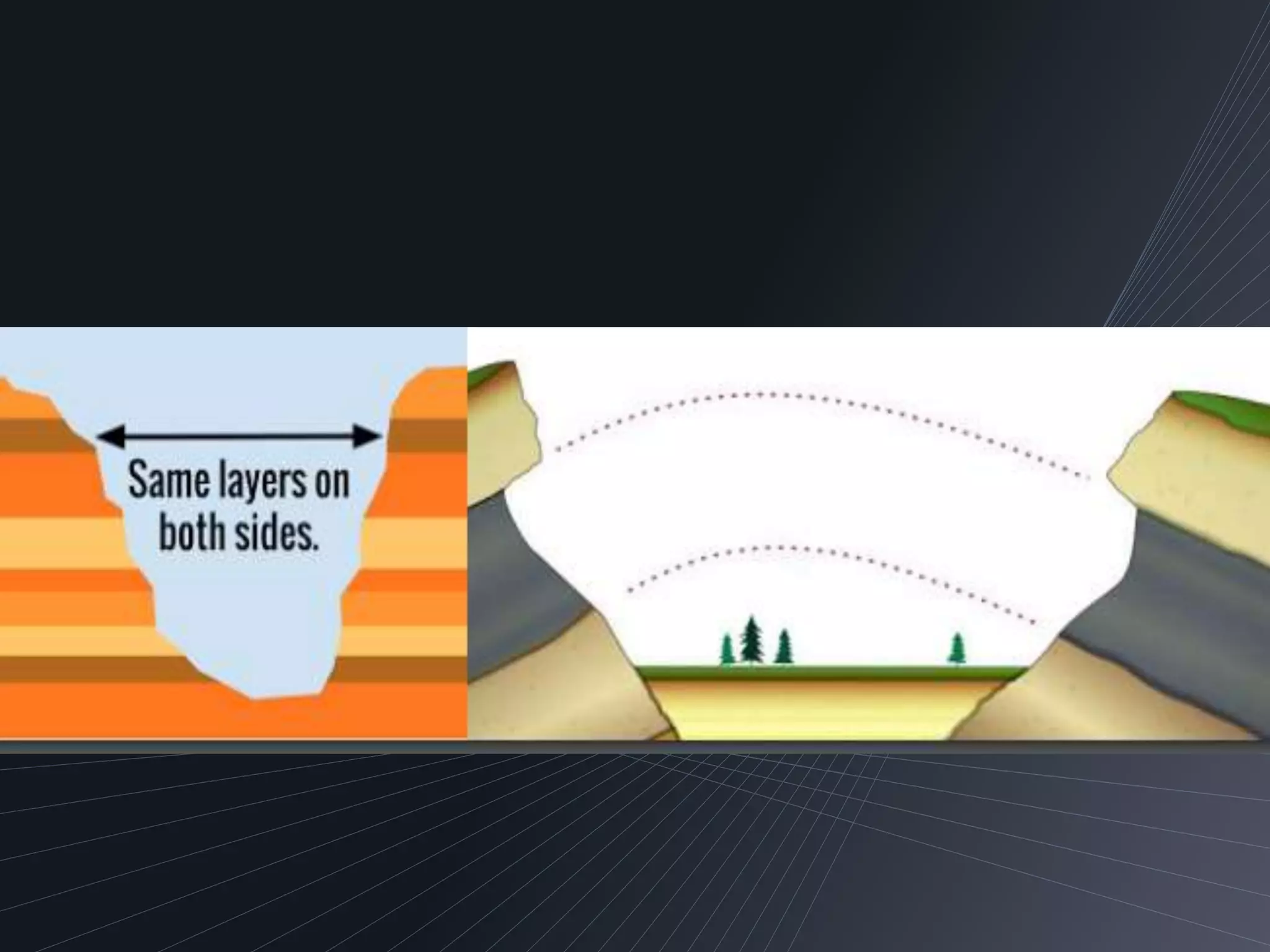
 Strata that are cut by a canyon later remain
continuous on either side of the canyon.
Principle of Lateral Continuity
 When one rock formation contains pieces
or inclusions of another rock, the included rock is
older than the host rock.
 Often useful for distinguished between a lava
flow and a sill.
 If the enclosing rock is an igneous rock, the
inclusions are called xenoliths.
 This principle is often useful for
distinguishing between a lava flow and a sill.
Principle of Inclusions
Inclusions
 It is based on the observation that sedimentary
rock strata contain fossilized Flora and Fauna, and
that these fossils succeed each other vertically in a
specific, reliable order that can be identified over
wide horizontal distances.
 The fossil content of rocks together with
the Law Of Superposition helps to determine the
time sequence in which sedimentary rocks were
laid down.
The principle of faunal succession
 Was postulated by James Hutton (1726-1797)
 He examined rocks in Scotland and noted that
features like mud cracks, ripple marks, graded
bedding, etc. Where the same features that could be
seen forming in modern environments, and that past
geologic events can be explained by phenomena
and forces observable today
 Hutton concluded that processes are currently
operating on the earth must be the same processes
that operated in the past.
 Later on stated as “ The present is the key to the
past ”.
Uniformitarianism
Hypothesis according which geological changes on
Earth are due, mainly, to processes and continuous
changes like those that are observed today.
Correlation
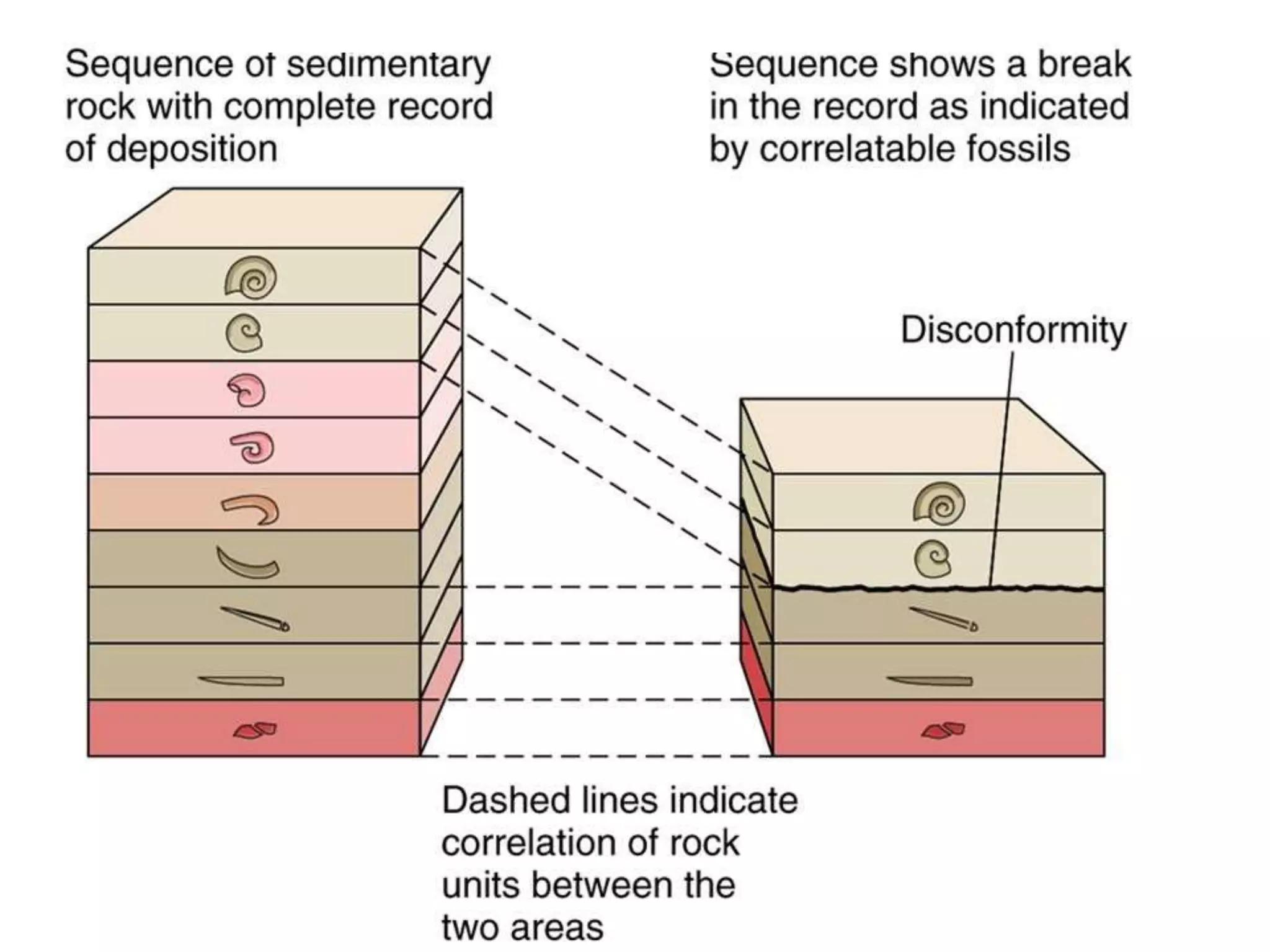
 Correlation is the process of establishing which
sedimentary strata are of the same age but
geographically separate.
 Correlation can be determined by using
magnetic polarity reversals, rock types, unique rock
sequences, or index fossils.
 There are three main types of correlation:
i). Lithostratigraphic
ii). Chronostratigraphic
iii). Biostratigraphic.
Lithostratigraphic Correlation
 Lithostratigraphic correlation establishes a similar
age of strata based on the lithology that is
the composition and physical properties of that strata.
 Lithostratigraphic correlation can be used to
correlate whole formations long distances or can be used
to correlate smaller strata within formations to trace their
extent and regional depositional environments.
 For example, the Navajo Sandstone, which
makes up the prominent walls of Zion National
Park, is the same Navajo Sandstone in
Canyonlands because the lithology of the two are
identical even though they are hundreds of miles
apart.
 Extensions of the same Navajo Sandstone
formation are found miles away in other parts of
southern Utah, including Capitol Reef and
Arches National Parks
Stevens Arch in the Navajo
Sandstone at Coyote Gulch
some 125 miles away from
Zion National Park
View of Navajo
Sandstone from
Angel’s Landing in Zion
National Park
Units used in lithostratigraphic correlation
Supergroup
Group
Formation
Member
bed
Chronostratigraphic Correlation
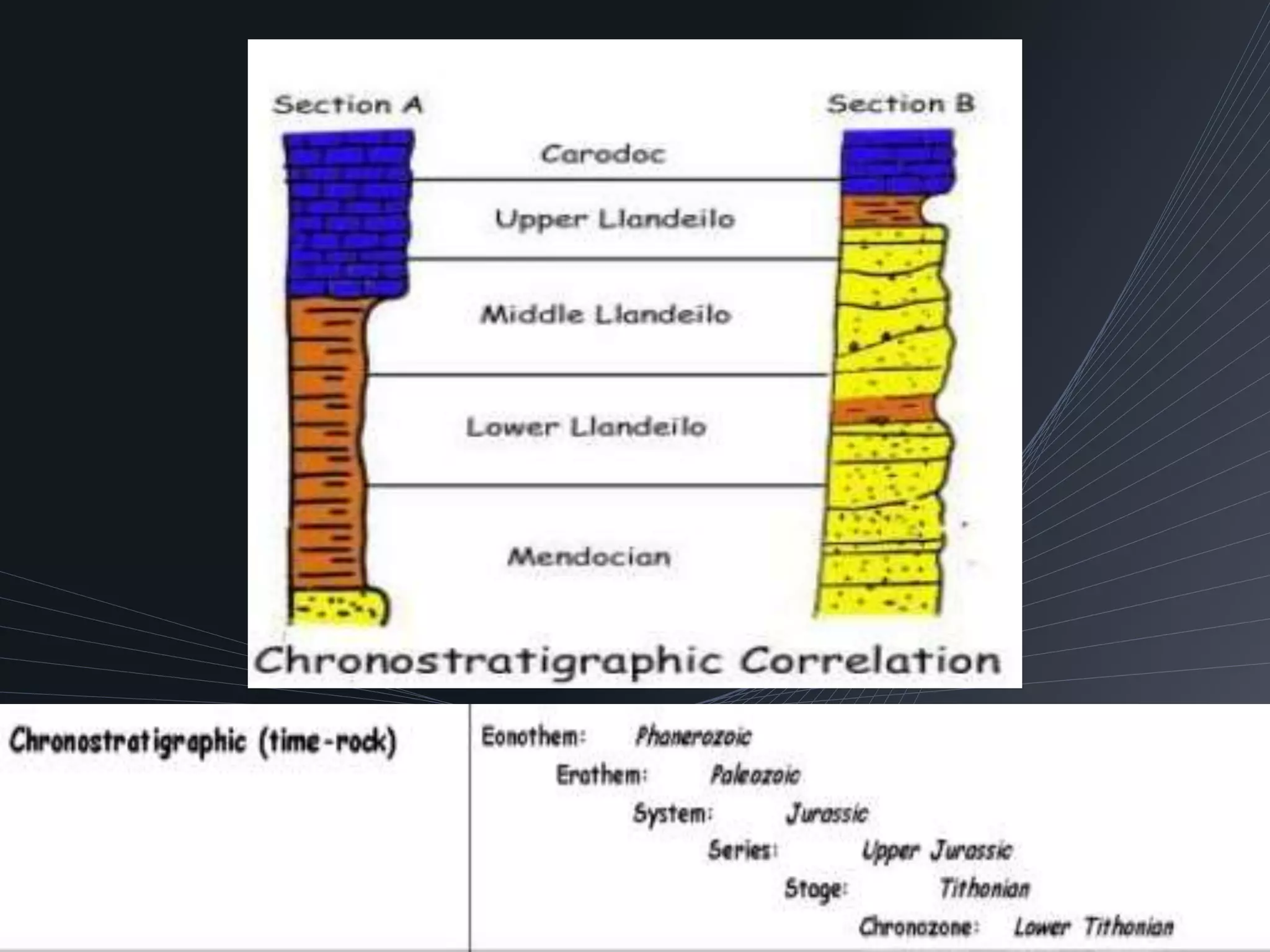
Chronostratigraphic correlation matches rocks of
the same age, even though they are made of different
lithologies. Different lithologies of sedimentary rocks
can form at the same time at different geographic
locations because depositional environments vary
geographically.
The figure of the geologic time scale, represents
time flowing continuously from the beginning of the
Earth, with the time units presented in an unbroken
sequence. But that does not mean there are rocks
available for study for all of these time units.
 On the figure of the Permian El Capitan Reef at Guadalupe National
Monument in West Texas, the red line shows a chronostratigraphic
time line that represents a snapshot in time. Shallow-water
marine lagoon/back reef area is light blue, the main Capitan reef is
dark blue, and deep-water marine siltstone is yellow. All three of these
unique lithologies were forming at the same time in Permian along this
red timeline.
Biostratigraphic correlation uses index fossils to
determine strata ages. Index fossils represent
assemblages or groups of organisms that were
uniquely present during specific intervals of geologic
time.
 Some of the best fossils for Biostratigraphic
correlation are microfossils, most of which came from
single-celled organisms. As with microscopic
organisms today, they were widely distributed across
many environments throughout the world.
Biostratigraphic Correlation
Foraminifera, single celled organisms with
calcareous shells, are an example of an especially
useful index fossil for
the Cretaceous Period and Cenozoic Era.
 Conodonts are another example of microfossils
useful for biostratigraphic correlation of
the Cambrian through Triassic Periods.
Units used in Biostratigraphic correlation
Geologic time has been subdivided into a series of
divisions by geologists.
Eon is the largest division of time, followed
by era, period, epoch, and age.
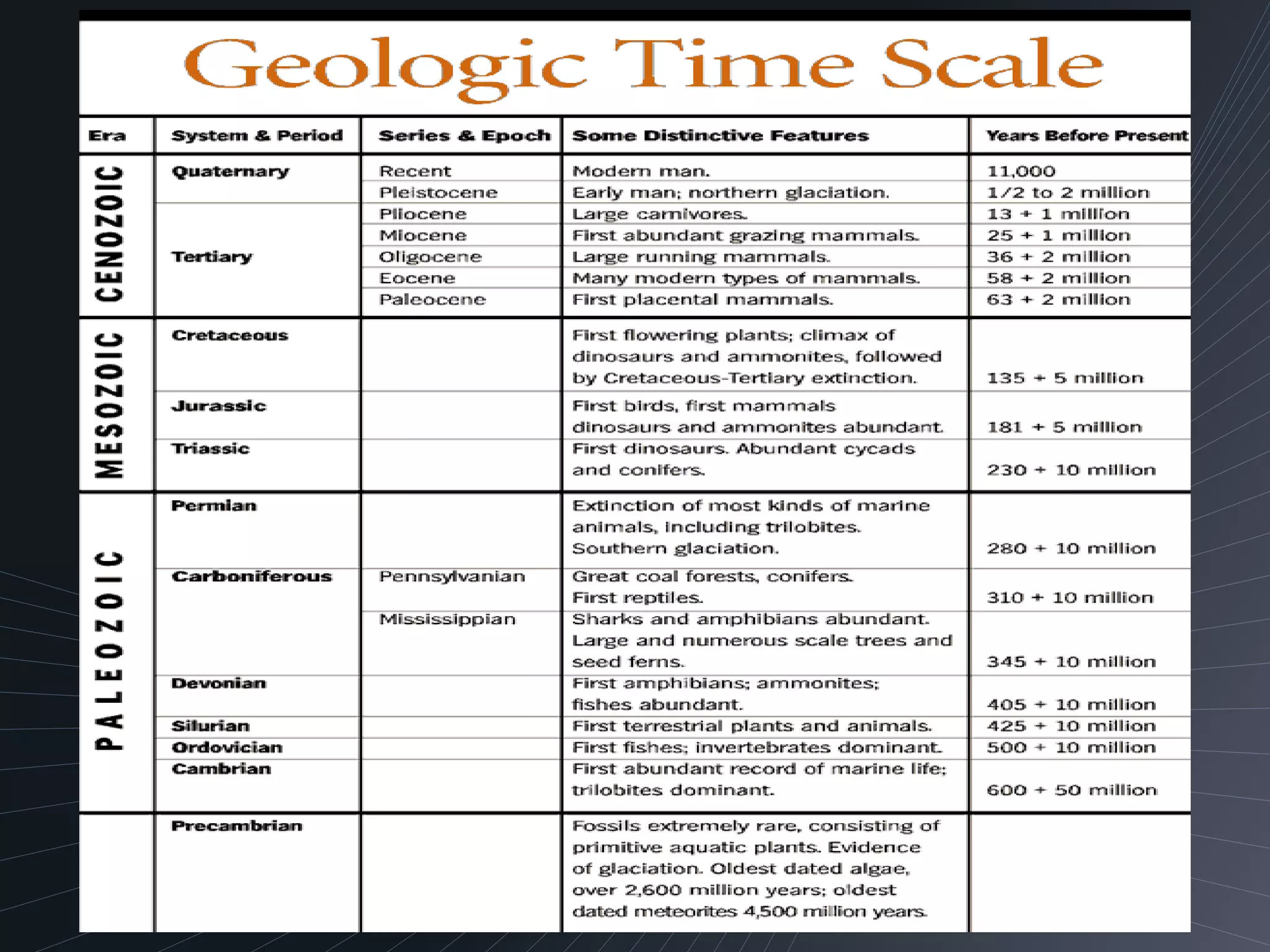
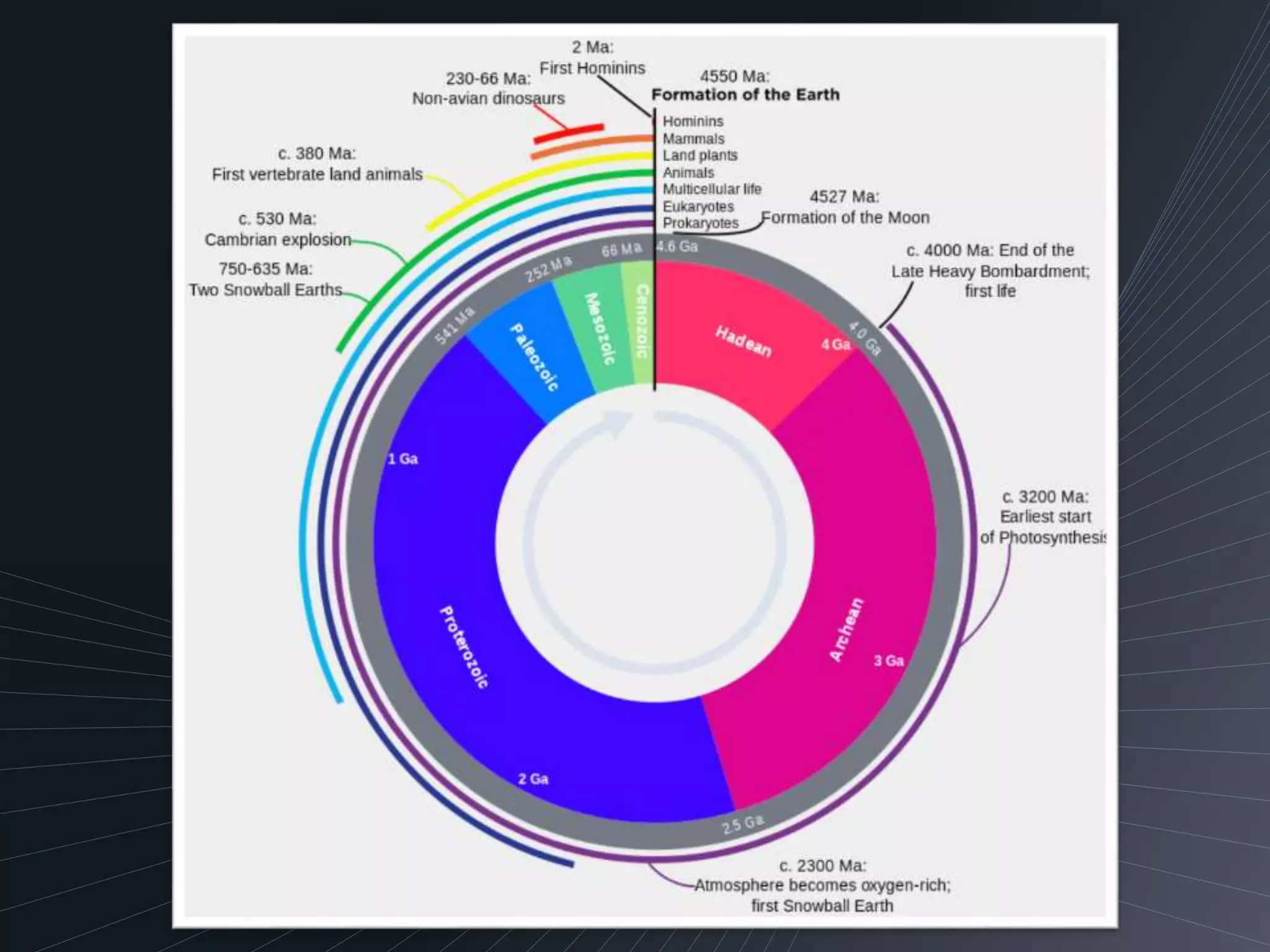
The figure of the geologic time scale, represents
time flowing continuously from the beginning of the
Earth, with the time units presented in an unbroken
sequence. But that does not mean there are rocks
available for study for all of these time units.
Geologic Time Scale
Principles of stratigraphy are geological tools that helps
in determine the relative age, numbers of existing
events, field relations and that can be estimated from
one outcrop or from different.
conclusion
REFERENCES
• Geology of Burma and India , 6th edition by M.S.KRISHNAN (1943)
Page 76 – 81.
•https://opengeology.org/textbook/7-geologic-
time/#:~:text=7.1.&text=Stratigraphy%20is%20the%20study%20of%20layered%2
0sedimentary%20rocks.&text=Principle%20of%20Superposition%3AIn%20an,lay
ers%20above%20them%20are%20younger.
•https://www2.slideshare.net/wwlittle/principles-of-stratigraphy?qid=f21eef9b-
776d-490f-9608-6bb7d4d50182&v=&b=&from_search=1
•https://www2.slideshare.net/sharikshamsudhien/concepts-of-stratigraphy
Principles of Stratigraphy with Geo time scale

Principles of Stratigraphy with Geo time scale

  • 1.
    RATHINAVEL K Reg No: 3382014 Ist M.Sc Applied Geology University of madras Guindy campus Chennai 25
  • 2.
     Stratigraphy isthe study of temporal relationships in sedimentary rock bodies and reflects changes in the balance between rates at which space is produced and filled.  Stratigraphical geology has its aim, the description and classification of rocks with a view to arranging them in chronological order in which they were laid down on surface if the earth.  In order to learn about a strata of a rock formation we must know about the important principles in stratigraphy. STRATIGRAPHY
  • 3.
    PRINCIPLES OF STRATIGRAPHY Principle of Lithology  Principle of superposition  Principle of fossil content  Original horizontality  Cross – cutting relationships  Principle of lateral continuity  Inclusion  Faunal succession  Uniformitarianism  Correlation
  • 4.
    Principles Of Lithology This principle involves in identifying the rocks according to their lithology.  The lithological characters of the different formations are persistent over the area in which they are exposed. Though there may be variations when followed over some distance.  Each lithological unit may comprise a number of individual beds having more or less the same characters. When it is spoken of as a formation given a local name to Distinguish it from a similar formation of age or belonging to another area.
  • 5.
     For example, TheBarkar sandstone, Kamthi sandstone, Bhander sandstone Attock slate, and cumbum slate The Vempalle limestone and Megalaodon limestone etc. This lithology is often help in Correlation method
  • 6.
    The grand canyon basedon it’s lithology
  • 7.
    Principle of superposition This law states that in a sequence of sedimentary layers, each layer must be younger than the one below and older than one above it, nicholas steno 1667.  Because of earths gravity, deposition of sediment will occur depositing older layers first followed by successively younger layers.  Thus , in a sequence of layers that have not been overturned by a later deformational event.
  • 9.
    Principle of Fossilcontent  Each formation has not only distinct Petrological characters but also encloses a fossil assemblage which is characteristic and different from that of the underlying and overlying formations.  Animals and vegetable organisms of each geological age bear special characters not found in those of other ages.  For example of graptolites and ammonites are so highly specialised in morphological characters and so restricted in range of time that they are highly valuable indicators of very small sub divisions of geologic time.
  • 10.
  • 11.
     Layers ofrocks deposited from above, such as sediments and lava flows, are originally laid down horizontally, parallel to the surface.  The exception to this principle is at the margins of basins, where the strata can slope slightly downward into the basin. Principle of Original Horizontality
  • 13.
     Deformation eventslike folds, faults and igneous intrusions that cut across rocks are younger than the rocks they cut across.  All the time younger feature cuts the older feautures. Principle of Cross-Cutting Relationships
  • 14.
     Within thedepositional basin, strata are continuous in all directions until they thin out at the edge of that basin.  All strata eventually end, either by hitting a geographic barrier, such as a ridge, or when the depositional process extends too far from its source, either a sediment source or a volcano.  Strata that are cut by a canyon later remain continuous on either side of the canyon. Principle of Lateral Continuity
  • 16.
     When onerock formation contains pieces or inclusions of another rock, the included rock is older than the host rock.  Often useful for distinguished between a lava flow and a sill.  If the enclosing rock is an igneous rock, the inclusions are called xenoliths.  This principle is often useful for distinguishing between a lava flow and a sill. Principle of Inclusions
  • 17.
  • 19.
     It isbased on the observation that sedimentary rock strata contain fossilized Flora and Fauna, and that these fossils succeed each other vertically in a specific, reliable order that can be identified over wide horizontal distances.  The fossil content of rocks together with the Law Of Superposition helps to determine the time sequence in which sedimentary rocks were laid down. The principle of faunal succession
  • 21.
     Was postulatedby James Hutton (1726-1797)  He examined rocks in Scotland and noted that features like mud cracks, ripple marks, graded bedding, etc. Where the same features that could be seen forming in modern environments, and that past geologic events can be explained by phenomena and forces observable today  Hutton concluded that processes are currently operating on the earth must be the same processes that operated in the past.  Later on stated as “ The present is the key to the past ”. Uniformitarianism
  • 22.
    Hypothesis according whichgeological changes on Earth are due, mainly, to processes and continuous changes like those that are observed today.
  • 23.
    Correlation  Correlation isthe process of establishing which sedimentary strata are of the same age but geographically separate.  Correlation can be determined by using magnetic polarity reversals, rock types, unique rock sequences, or index fossils.  There are three main types of correlation: i). Lithostratigraphic ii). Chronostratigraphic iii). Biostratigraphic.
  • 24.
    Lithostratigraphic Correlation  Lithostratigraphiccorrelation establishes a similar age of strata based on the lithology that is the composition and physical properties of that strata.  Lithostratigraphic correlation can be used to correlate whole formations long distances or can be used to correlate smaller strata within formations to trace their extent and regional depositional environments.
  • 25.
     For example,the Navajo Sandstone, which makes up the prominent walls of Zion National Park, is the same Navajo Sandstone in Canyonlands because the lithology of the two are identical even though they are hundreds of miles apart.  Extensions of the same Navajo Sandstone formation are found miles away in other parts of southern Utah, including Capitol Reef and Arches National Parks
  • 26.
    Stevens Arch inthe Navajo Sandstone at Coyote Gulch some 125 miles away from Zion National Park View of Navajo Sandstone from Angel’s Landing in Zion National Park
  • 27.
    Units used inlithostratigraphic correlation Supergroup Group Formation Member bed
  • 28.
    Chronostratigraphic Correlation Chronostratigraphic correlationmatches rocks of the same age, even though they are made of different lithologies. Different lithologies of sedimentary rocks can form at the same time at different geographic locations because depositional environments vary geographically. The figure of the geologic time scale, represents time flowing continuously from the beginning of the Earth, with the time units presented in an unbroken sequence. But that does not mean there are rocks available for study for all of these time units.
  • 29.
     On thefigure of the Permian El Capitan Reef at Guadalupe National Monument in West Texas, the red line shows a chronostratigraphic time line that represents a snapshot in time. Shallow-water marine lagoon/back reef area is light blue, the main Capitan reef is dark blue, and deep-water marine siltstone is yellow. All three of these unique lithologies were forming at the same time in Permian along this red timeline.
  • 31.
    Biostratigraphic correlation usesindex fossils to determine strata ages. Index fossils represent assemblages or groups of organisms that were uniquely present during specific intervals of geologic time.  Some of the best fossils for Biostratigraphic correlation are microfossils, most of which came from single-celled organisms. As with microscopic organisms today, they were widely distributed across many environments throughout the world. Biostratigraphic Correlation
  • 32.
    Foraminifera, single celledorganisms with calcareous shells, are an example of an especially useful index fossil for the Cretaceous Period and Cenozoic Era.  Conodonts are another example of microfossils useful for biostratigraphic correlation of the Cambrian through Triassic Periods.
  • 33.
    Units used inBiostratigraphic correlation
  • 35.
    Geologic time hasbeen subdivided into a series of divisions by geologists. Eon is the largest division of time, followed by era, period, epoch, and age. The figure of the geologic time scale, represents time flowing continuously from the beginning of the Earth, with the time units presented in an unbroken sequence. But that does not mean there are rocks available for study for all of these time units. Geologic Time Scale
  • 40.
    Principles of stratigraphyare geological tools that helps in determine the relative age, numbers of existing events, field relations and that can be estimated from one outcrop or from different. conclusion
  • 41.
    REFERENCES • Geology ofBurma and India , 6th edition by M.S.KRISHNAN (1943) Page 76 – 81. •https://opengeology.org/textbook/7-geologic- time/#:~:text=7.1.&text=Stratigraphy%20is%20the%20study%20of%20layered%2 0sedimentary%20rocks.&text=Principle%20of%20Superposition%3AIn%20an,lay ers%20above%20them%20are%20younger. •https://www2.slideshare.net/wwlittle/principles-of-stratigraphy?qid=f21eef9b- 776d-490f-9608-6bb7d4d50182&v=&b=&from_search=1 •https://www2.slideshare.net/sharikshamsudhien/concepts-of-stratigraphy