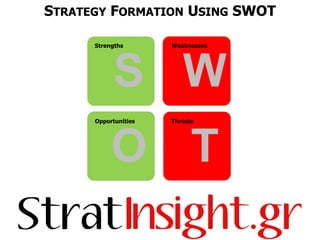
STRATEGY FORMATION USING SWOT
Framework Summary
SWOT Summary


Used to identify strategies that align, fit or match an object’s
resources and capabilities to the demands and realities of the
environment in which the object under the analysis operates in


Helps identify conversion and consonance strategies


The aim is to identify the extent to which strengths and
weaknesses are relevant to, or capable of dealing with, the
changes taking place in the business environment

Simple to understand


Versatile, adaptable and very popular
SWOT Summary


Can be used for companies, organisations, countries and persons

Can be used for specific scenarios, situations, products and services

SWOT analysis is really only useful if it is comparative. If it
examines strengths, weaknesses, opportunities and threats in
relation to competitors

SWOT is credited to Albert S. Humphrey who led a research
project at the Stanford Research Institute in the 1960s and 70s
Definitions


Strength
A resource or capability that enables the organisation to build a
generic capability to a standard better than similar organisation

Positive tangible and intangible attributes, internal to an
organization

Weakness
A resource or capability that limits the development of a strength

A resource or capability that is underdeveloped or absent from the
organisation, relative to similar organisations
Examples of Strengths and Weaknesses


Management
Human Resources
Values
Mission and Vision
Strategy
Available Financial Assets
Products and Services
Public Image and Perception
Distribution Channels
Properties of Strengths and Weaknesses


A strength and a weakness must be compared relative to
similar organisations and found exceptional (not ordinary)
in some way to be useful

They represent an advantage or disadvantage
Definitions


Opportunity
Is created by changes to key environmental forces independently
of the organisation

Positive trends and changes that represent the reason for an
organization to exist and develop

Threat
Is created by changes to key environmental forces independently
of the organisation

Jeopardises the future and profitability of the organisation’s
business
Examples of Opportunities and Threats


Government Policies
Competitors
Technology
Political
Financial
Environmental
Market
Population
Fashion
Properties of Opportunities and Threats


Opportunities and Threats must exhibit a change/shift/transformation
in some way to be useful


Opportunities and Threats are the forces that the
organisation cannot directly affect
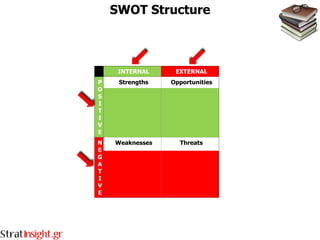
SWOT Structure
Warnings and Limitations of SWOT


Meaningless long lists
No prioritisation of items
Highly subjective
Subject to politics
Might miss out sensitive and controversial issues
Confuse symptoms with weaknesses and strategies with
opportunities
Confuse internal with external factors
Relies on brainstorming
SWOT Examples


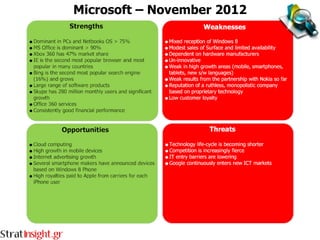
Microsoft –November 2012

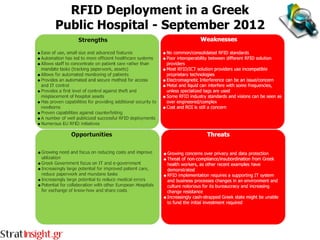
RFID Deployment in a Greek Public Hospital – September 2012

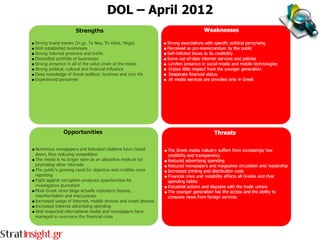
DOL (A Greek news and media company) - April 2012
Microsoft – November 2012
RFID Deployment in a Greek
Public Hospital - September 2012
DOL – April 2012
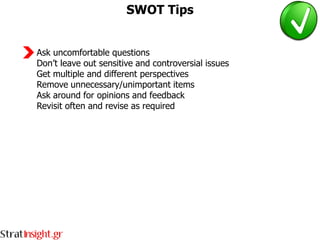
SWOT Tips


Ask uncomfortable questions
Don’t leave out sensitive and controversial issues
Get multiple and different perspectives
Remove unnecessary/unimportant items
Ask around for opinions and feedback
Revisit often and revise as required
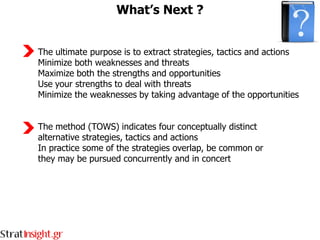
What’s Next ?


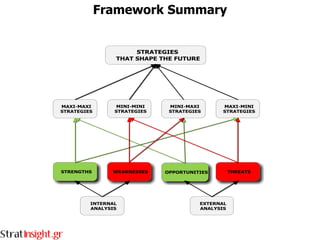
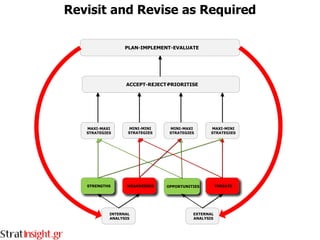
The ultimate purpose is to extract strategies, tactics and actions
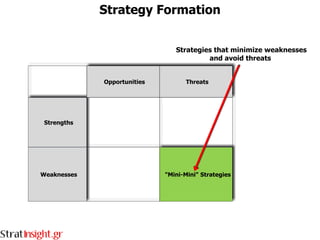
Minimize both weaknesses and threats
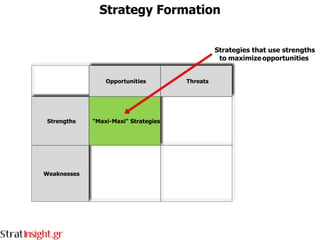
Maximize both the strengths and opportunities
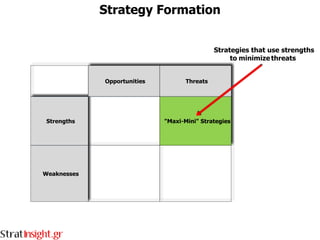
Use your strengths to deal with threats
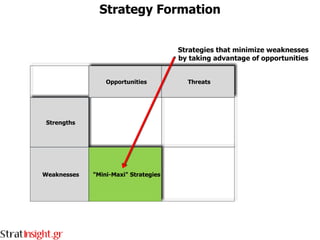
Minimize the weaknesses by taking advantage of the opportunities


The method (TOWS) indicates four conceptually distinct
alternative strategies, tactics and actions
In practice some of the strategies overlap, be common or
they may be pursued concurrently and in concert
Strategy Formation
Strategy Formation
Strategy Formation
Strategy Formation
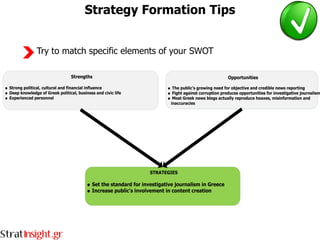
Strategy Formation Tips


Try to match specific elements of your SWOT
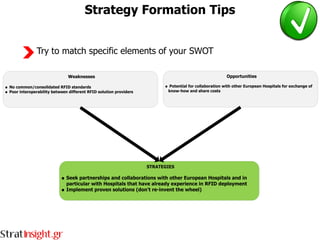
Strategy Formation Tips


Try to match specific elements of your SWOT
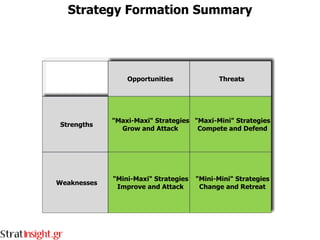
Strategy Formation Summary
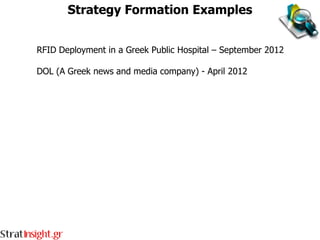
Strategy Formation Examples


RFID Deployment in a Greek Public Hospital – September 2012

DOL (A Greek news and media company) - April 2012
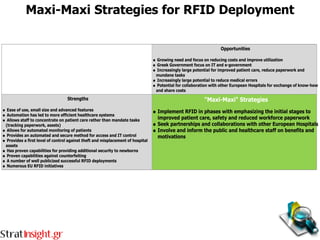
Maxi-Maxi Strategies for RFID Deployment
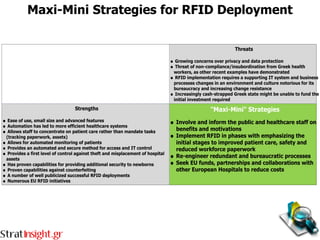
Maxi-Mini Strategies for RFID Deployment
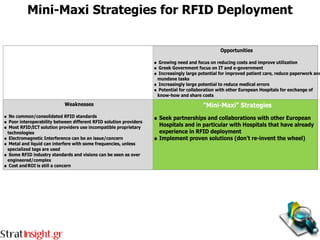
Mini-Maxi Strategies for RFID Deployment
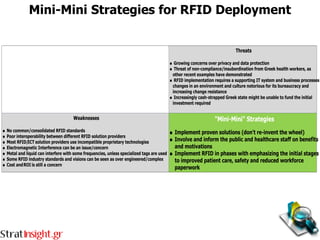
Mini-Mini Strategies for RFID Deployment
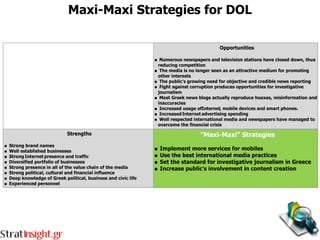
Maxi-Maxi Strategies for DOL
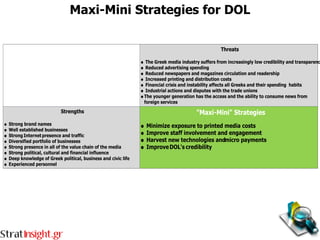
Maxi-Mini Strategies for DOL
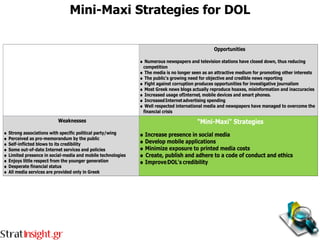
Mini-Maxi Strategies for DOL
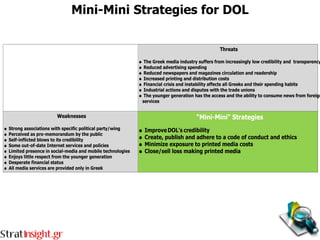
Mini-Mini Strategies for DOL
Revisit and Revise as Required
www.stratinsight.gr

info@stratinsight.gr

  December 2012

Strategy Formation using SWOT

  • 1.
  • 2.
  • 3.
    SWOT Summary Used toidentify strategies that align, fit or match an object’s resources and capabilities to the demands and realities of the environment in which the object under the analysis operates in Helps identify conversion and consonance strategies The aim is to identify the extent to which strengths and weaknesses are relevant to, or capable of dealing with, the changes taking place in the business environment Simple to understand Versatile, adaptable and very popular
  • 4.
    SWOT Summary Can beused for companies, organisations, countries and persons Can be used for specific scenarios, situations, products and services SWOT analysis is really only useful if it is comparative. If it examines strengths, weaknesses, opportunities and threats in relation to competitors SWOT is credited to Albert S. Humphrey who led a research project at the Stanford Research Institute in the 1960s and 70s
  • 5.
    Definitions Strength A resource orcapability that enables the organisation to build a generic capability to a standard better than similar organisation Positive tangible and intangible attributes, internal to an organization Weakness A resource or capability that limits the development of a strength A resource or capability that is underdeveloped or absent from the organisation, relative to similar organisations
  • 6.
    Examples of Strengthsand Weaknesses Management Human Resources Values Mission and Vision Strategy Available Financial Assets Products and Services Public Image and Perception Distribution Channels
  • 7.
    Properties of Strengthsand Weaknesses A strength and a weakness must be compared relative to similar organisations and found exceptional (not ordinary) in some way to be useful They represent an advantage or disadvantage
  • 8.
    Definitions Opportunity Is created bychanges to key environmental forces independently of the organisation Positive trends and changes that represent the reason for an organization to exist and develop Threat Is created by changes to key environmental forces independently of the organisation Jeopardises the future and profitability of the organisation’s business
  • 9.
    Examples of Opportunitiesand Threats Government Policies Competitors Technology Political Financial Environmental Market Population Fashion
  • 10.
    Properties of Opportunitiesand Threats Opportunities and Threats must exhibit a change/shift/transformation in some way to be useful Opportunities and Threats are the forces that the organisation cannot directly affect
  • 11.
  • 12.
    Warnings and Limitationsof SWOT Meaningless long lists No prioritisation of items Highly subjective Subject to politics Might miss out sensitive and controversial issues Confuse symptoms with weaknesses and strategies with opportunities Confuse internal with external factors Relies on brainstorming
  • 13.
    SWOT Examples Microsoft –November2012 RFID Deployment in a Greek Public Hospital – September 2012 DOL (A Greek news and media company) - April 2012
  • 14.
  • 15.
    RFID Deployment ina Greek Public Hospital - September 2012
  • 16.
  • 17.
    SWOT Tips Ask uncomfortablequestions Don’t leave out sensitive and controversial issues Get multiple and different perspectives Remove unnecessary/unimportant items Ask around for opinions and feedback Revisit often and revise as required
  • 18.
    What’s Next ? Theultimate purpose is to extract strategies, tactics and actions Minimize both weaknesses and threats Maximize both the strengths and opportunities Use your strengths to deal with threats Minimize the weaknesses by taking advantage of the opportunities The method (TOWS) indicates four conceptually distinct alternative strategies, tactics and actions In practice some of the strategies overlap, be common or they may be pursued concurrently and in concert
  • 19.
  • 20.
  • 21.
  • 22.
  • 23.
    Strategy Formation Tips Tryto match specific elements of your SWOT
  • 24.
    Strategy Formation Tips Tryto match specific elements of your SWOT
  • 25.
  • 26.
    Strategy Formation Examples RFIDDeployment in a Greek Public Hospital – September 2012 DOL (A Greek news and media company) - April 2012
  • 27.
    Maxi-Maxi Strategies forRFID Deployment
  • 28.
    Maxi-Mini Strategies forRFID Deployment
  • 29.
    Mini-Maxi Strategies forRFID Deployment
  • 30.
    Mini-Mini Strategies forRFID Deployment
  • 31.
  • 32.
  • 33.
  • 34.
  • 35.
    Revisit and Reviseas Required
  • 36.