SWOT
ANALYSIS
Presented By:
Mohammad Iqbal
Contents:
• Introduction
• SWOT
• Strength
• Weakness
• Opportunities
• Threats
• Conclusion
INTRODUCTION
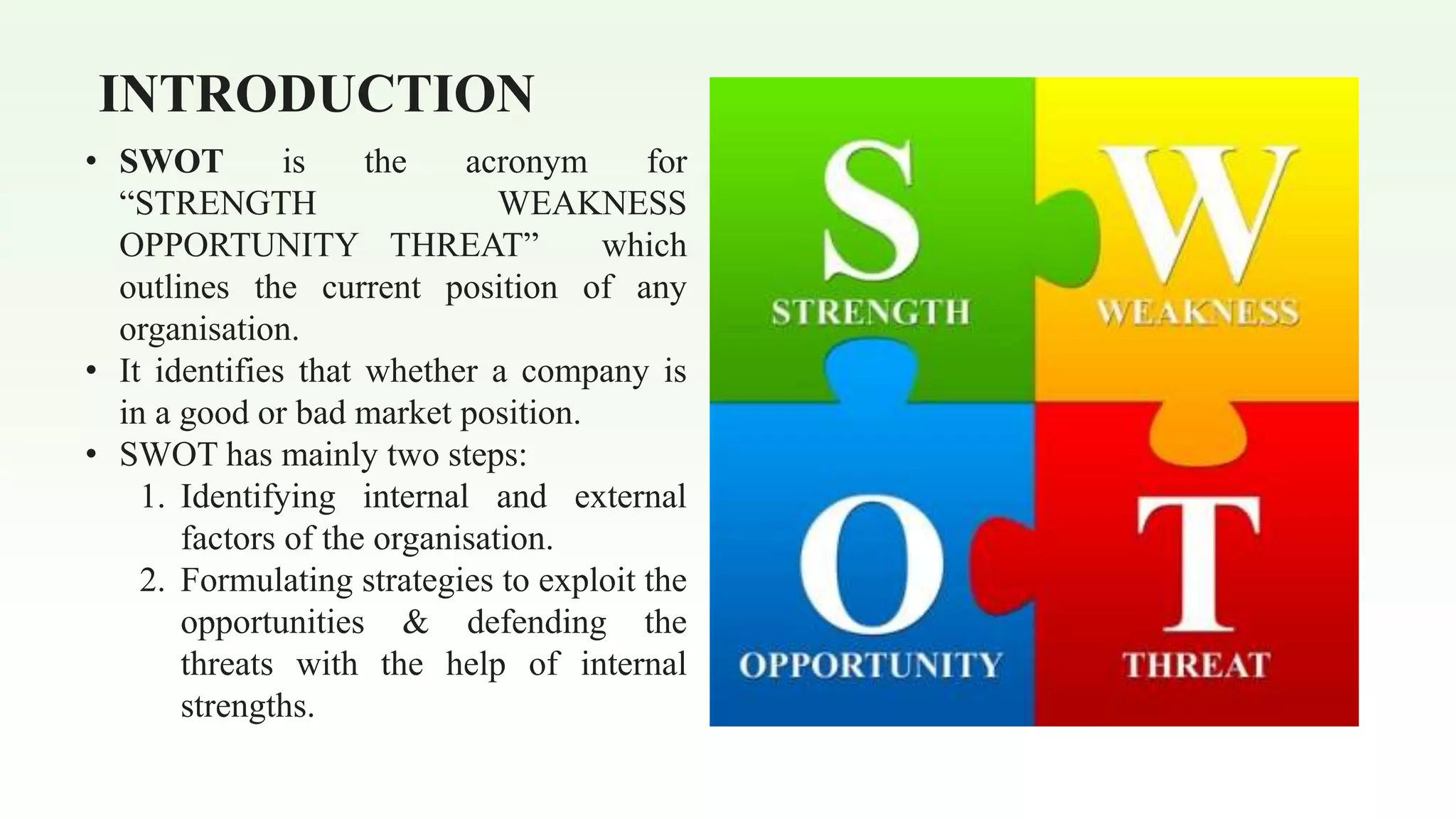
• SWOT is the acronym for
“STRENGTH WEAKNESS
OPPORTUNITY THREAT” which
outlines the current position of any
organisation.
• It identifies that whether a company is
in a good or bad market position.
• SWOT has mainly two steps:
1. Identifying internal and external
factors of the organisation.
2. Formulating strategies to exploit the
opportunities & defending the
threats with the help of internal
strengths.
What is SWOT Analysis?
• A SWOT Analysis is a strategic planning tool that involves the listing a companies
Strength , Weaknesses, Opportunities and Threats.
• It evaluate the business environment in a detail manner so as to take strategic decisions
for the future course of action.
STRENGTHS describe what an organization excels at
and separates it from the competition , a strong brand, loyal
customer base, a strong balance sheet, unique technology and so
on.
These are things that are within your control.
 What assets do you have in your team, such as
knowledge, education, network, skills, and reputation?
 What physical assets do you have, such as customers,
equipment, technology, cash, and patents?
 What competitive advantages do you have over your
competition?
WEAKNESSES are the factors that limit the growth of company
or restrict the company from moving in a desired direction.
Weaknesses are negative factors that detract from your strengths.
These are things that you might need to improve on to be
competitive.
Are there things that your business needs to be competitive?
What business processes need improvement?
Are there tangible assets that your company needs, such as
money or equipment?
Are there gaps on your team?
Is your location ideal for your success?
OPPORTUNITIES are those factors which act as the
favourable situations for the organisation. These situations
encourage the organisation to grow more and earn more
profits.
• Is your market growing and are there trends that will
encourage people to buy more of what you are selling?
• Are there upcoming events that your company may be
able to take advantage of to grow the business?
• Are there upcoming changes to regulations that might
impact your company positively?
• If your business is up and running, do customers think
highly of you?
THREATS are the external unfavourable conditions .They act
as barrier for the organisation in achieving its desired market
position
Threats are external factors that you have no control over.
• Do you have potential competitors who may enter your
market?
• Will suppliers always be able to supply the raw materials you
need at the prices you need?
• Could future developments in technology change how you do
business?
• Is consumer behavior changing in a way that could negatively
impact your business?
• Are there market trends that could become a threat?
EXAMPLE
STRENGTH
• Lower Tariff
• Very wide network
• Brand Name
WEAKNESS
• Late entry into
telecommunication sector
• Operation of mobile number
portability still not smooth
• Highly dependent upon data
consumption
THREATS
• Saturated market
• Highly competitive market
• Change Government Policy
• Rapid upgradation in
Technology
OPPORTUNITY
• Large scale availability
of smart phones
• Increasing rate of data
consumption
• International market
CONCLUSION
• SWOT Analysis can be used as a means of gathering
information from a range of perspectives that may be
able to use the results to strategic advantage by either
matching the strengths to opportunities or by
converting threats or weakness into strengths and
opportunities
• SWOT analysis provides a visual overview that
prompts discussion around a company’s situation. It is
a bird's-eye view meant to flesh out the viability of a
concept or strategy from the inside out.
SWOT

SWOT

  • 1.
  • 2.
    Contents: • Introduction • SWOT •Strength • Weakness • Opportunities • Threats • Conclusion
  • 3.
    INTRODUCTION • SWOT isthe acronym for “STRENGTH WEAKNESS OPPORTUNITY THREAT” which outlines the current position of any organisation. • It identifies that whether a company is in a good or bad market position. • SWOT has mainly two steps: 1. Identifying internal and external factors of the organisation. 2. Formulating strategies to exploit the opportunities & defending the threats with the help of internal strengths.
  • 4.
    What is SWOTAnalysis? • A SWOT Analysis is a strategic planning tool that involves the listing a companies Strength , Weaknesses, Opportunities and Threats. • It evaluate the business environment in a detail manner so as to take strategic decisions for the future course of action.
  • 5.
    STRENGTHS describe whatan organization excels at and separates it from the competition , a strong brand, loyal customer base, a strong balance sheet, unique technology and so on. These are things that are within your control.  What assets do you have in your team, such as knowledge, education, network, skills, and reputation?  What physical assets do you have, such as customers, equipment, technology, cash, and patents?  What competitive advantages do you have over your competition?
  • 6.
    WEAKNESSES are thefactors that limit the growth of company or restrict the company from moving in a desired direction. Weaknesses are negative factors that detract from your strengths. These are things that you might need to improve on to be competitive. Are there things that your business needs to be competitive? What business processes need improvement? Are there tangible assets that your company needs, such as money or equipment? Are there gaps on your team? Is your location ideal for your success?
  • 7.
    OPPORTUNITIES are thosefactors which act as the favourable situations for the organisation. These situations encourage the organisation to grow more and earn more profits. • Is your market growing and are there trends that will encourage people to buy more of what you are selling? • Are there upcoming events that your company may be able to take advantage of to grow the business? • Are there upcoming changes to regulations that might impact your company positively? • If your business is up and running, do customers think highly of you?
  • 8.
    THREATS are theexternal unfavourable conditions .They act as barrier for the organisation in achieving its desired market position Threats are external factors that you have no control over. • Do you have potential competitors who may enter your market? • Will suppliers always be able to supply the raw materials you need at the prices you need? • Could future developments in technology change how you do business? • Is consumer behavior changing in a way that could negatively impact your business? • Are there market trends that could become a threat?
  • 9.
    EXAMPLE STRENGTH • Lower Tariff •Very wide network • Brand Name WEAKNESS • Late entry into telecommunication sector • Operation of mobile number portability still not smooth • Highly dependent upon data consumption THREATS • Saturated market • Highly competitive market • Change Government Policy • Rapid upgradation in Technology OPPORTUNITY • Large scale availability of smart phones • Increasing rate of data consumption • International market
  • 10.
    CONCLUSION • SWOT Analysiscan be used as a means of gathering information from a range of perspectives that may be able to use the results to strategic advantage by either matching the strengths to opportunities or by converting threats or weakness into strengths and opportunities • SWOT analysis provides a visual overview that prompts discussion around a company’s situation. It is a bird's-eye view meant to flesh out the viability of a concept or strategy from the inside out.