© 2001 Prentice Hall 
Ch.7-1 
Strategic Management 
Concepts & Cases 
8th edition 
Fred R. David 
Chapter 7: 
Implementing Strategies: 
Management Issues 
PowerPoint Slides By: 
Anthony F. Chelte 
Western New England College
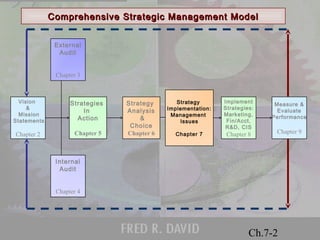
Comprehensive Strategic MMaannaaggeemmeenntt MMooddeell 
© 2001 Prentice Hall 
Ch.7-2 
Vision 
& 
Mission 
Statements 
Chapter 2 
External 
Audit 
Chapter 3 
Strategies 
In 
Action 
Chapter 5 
Internal 
Audit 
Chapter 4 
Strategy 
Analysis 
& 
Choice 
Chapter 6 
Implement 
Strategies: 
Marketing, 
Fin/Acct, 
R&D, CIS 
Chapter 8 
Measure & 
Evaluate 
Performance 
Chapter 9 
Strategy 
Implementation: 
Management 
Issues 
Chapter 7
MMaannaaggeemmeenntt IIssssuueess 
“You want your people to run the business 
as if it were their own.” 
© 2001 Prentice Hall 
Ch.7-3 
—William Fulmer —
MMaannaaggeemmeenntt IIssssuueess 
“A management truism says structure 
follows strategy. However, this truism is 
often ignored. Too many organizations 
attempt to carry out a new strategy with 
an old structure.” 
© 2001 Prentice Hall 
Ch.7-4 
—Dale McConkey—
MMaannaaggeemmeenntt IIssssuueess 
“In most organizations, the top performers 
are paid too little and the worst 
performers too much.” 
© 2001 Prentice Hall 
Ch.7-5 
—Cass Bettinger—
MMaannaaggeemmeenntt IIssssuueess 
Successful strategy formulation 
© 2001 Prentice Hall 
Ch.7-6 
does NOT guarantee 
successful strategy implementation!
MMaannaaggeemmeenntt IIssssuueess 
© 2001 Prentice Hall 
Ch.7-7 
Strategy Implementation 
—more difficult to “do” something 
Strategy Formulation 
—easier to say “going to do it”
MMaannaaggeemmeenntt IIssssuueess 
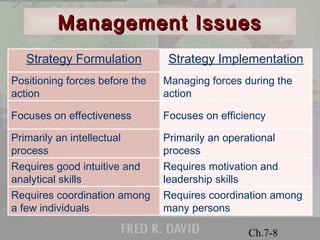
Strategy Formulation Strategy Implementation 
Focuses on effectiveness Focuses on efficiency 
Requires coordination among 
many persons 
© 2001 Prentice Hall 
Ch.7-8 
Requires coordination among 
a few individuals 
Requires motivation and 
leadership skills 
Requires good intuitive and 
analytical skills 
Primarily an operational 
process 
Primarily an intellectual 
process 
Managing forces during the 
action 
Positioning forces before the 
action
MMaannaaggeemmeenntt IIssssuueess 
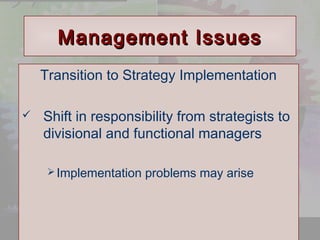
Transition to Strategy Implementation 
 Shift in responsibility from strategists to 
divisional and functional managers 
Implementation problems may arise 
© 2001 Prentice Hall 
Ch.7-9
MMaannaaggeemmeenntt IIssssuueess 
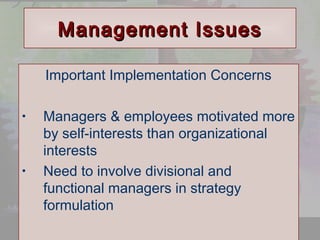
Important Implementation Concerns 
• Managers & employees motivated more 
by self-interests than organizational 
interests 
© 2001 Prentice Hall 
Ch.7-10 
• Need to involve divisional and 
functional managers in strategy 
formulation
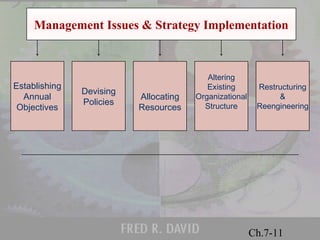
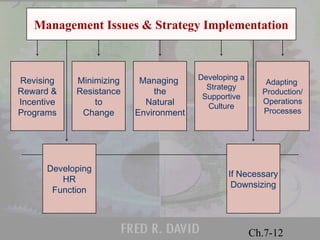
Management Issues & Strategy Implementation 
© 2001 Prentice Hall 
Ch.7-11 
Establishing 
Annual 
Objectives 
Devising 
Policies Allocating 
Resources 
Altering 
Existing 
Organizational 
Structure 
Restructuring 
& 
Reengineering
Management Issues & Strategy Implementation 
© 2001 Prentice Hall 
Ch.7-12 
Revising 
Reward & 
Incentive 
Programs 
Minimizing 
Resistance 
to 
Change 
Managing 
the 
Natural 
Environment 
Developing a 
Strategy 
Supportive 
Culture 
Adapting 
Production/ 
Operations 
Processes 
Developing 
HR 
Function 
If Necessary 
Downsizing
Management Issues & Strategy 
© 2001 Prentice Hall 
Ch.7-13 
Implementation 
• Basis for allocating 
resources 
• Mechanism for evaluating 
managers 
• Monitor progress toward 
long-term objectives 
• Establish organizational, 
divisional, and 
departmental priorities 
Establishing 
Annual 
Objectives
Management Issues & Strategy 
© 2001 Prentice Hall 
Ch.7-14 
Implementation 
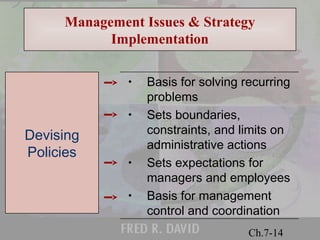
• Basis for solving recurring 
problems 
• Sets boundaries, 
constraints, and limits on 
administrative actions 
• Sets expectations for 
managers and employees 
• Basis for management 
control and coordination 
Devising 
Policies
Management Issues & Strategy 
© 2001 Prentice Hall 
Ch.7-15 
Implementation 
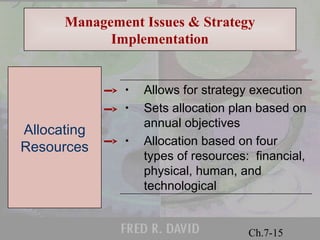
• Allows for strategy execution 
• Sets allocation plan based on 
annual objectives 
• Allocation based on four 
types of resources: financial, 
physical, human, and 
technological 
Allocating 
Resources
Management Issues & Strategy 
© 2001 Prentice Hall 
Ch.7-16 
Implementation 
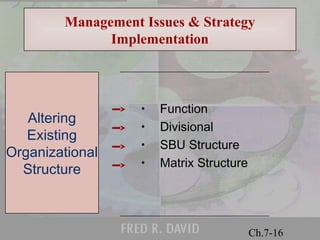
• Function 
• Divisional 
• SBU Structure 
• Matrix Structure 
Altering 
Existing 
Organizational 
Structure
Management Issues & Strategy 
© 2001 Prentice Hall 
Ch.7-17 
Implementation 
• Reducing size of firm 
 Employees 
 Divisions or units 
 Hierarchical levels 
• Benchmarking against 
competitors 
 Ratios out of line 
• Primary benefit = cost 
reduction 
Restructuring
Management Issues & Strategy 
© 2001 Prentice Hall 
Ch.7-18 
Implementation 
• Employee/customer 
well-being 
 Redesign work 
 Redesign jobs 
 Redesign processes 
• Improvement in: 
 Costs 
 Quality 
 Service 
 Speed 
Reengineering
Management Issues & Strategy 
© 2001 Prentice Hall 
Ch.7-19 
Implementation 
• Pay-for-performance plans 
• Flexibility in compensation 
systems is necessary 
• Dual bonus system 
 Annual objectives 
 Long-term objectives 
• Profit Sharing 
Revising 
Reward & 
Incentive 
Programs
Management Issues & Strategy 
© 2001 Prentice Hall 
Ch.7-20 
Implementation 
• Raises anxiety/fear 
• Force change strategy 
• Educative change strategy 
• Rational or self-interest 
change strategy 
 Most desirable 
Managing 
Resistance 
To 
Change
Management Issues & Strategy 
© 2001 Prentice Hall 
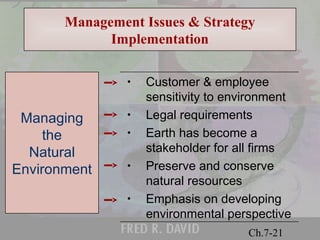
Ch.7-21 
Implementation 
• Customer & employee 
sensitivity to environment 
• Legal requirements 
• Earth has become a 
stakeholder for all firms 
• Preserve and conserve 
natural resources 
• Emphasis on developing 
environmental perspective 
Managing 
the 
Natural 
Environment
Management Issues & Strategy 
© 2001 Prentice Hall 
Ch.7-22 
Implementation 
• Triangulation as method to 
determine changes in a 
firm’s culture that could 
benefit strategy 
• Weak linkages between 
strategic management and 
organizational culture can 
jeopardize performance 
and success 
Creating a 
Strategy- 
Supportive 
Culture
Management Issues & Strategy 
© 2001 Prentice Hall 
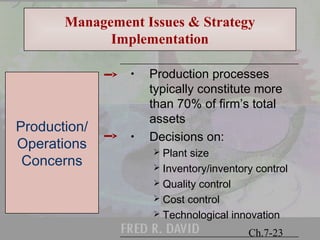
Ch.7-23 
Implementation 
• Production processes 
typically constitute more 
than 70% of firm’s total 
assets 
• Decisions on: 
 Plant size 
 Inventory/inventory control 
 Quality control 
 Cost control 
 Technological innovation 
Production/ 
Operations 
Concerns
Management Issues & Strategy 
© 2001 Prentice Hall 
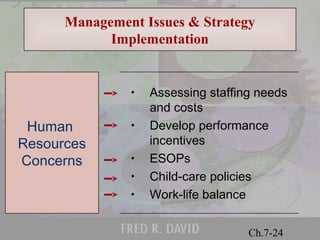
Ch.7-24 
Implementation 
• Assessing staffing needs 
and costs 
• Develop performance 
incentives 
• ESOPs 
• Child-care policies 
• Work-life balance 
Human 
Resources 
Concerns
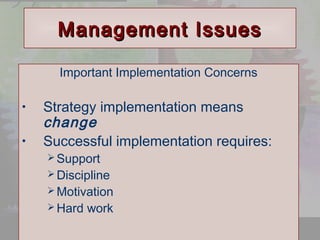
MMaannaaggeemmeenntt IIssssuueess 
Important Implementation Concerns 
© 2001 Prentice Hall 
Ch.7-25 
• Strategy implementation means 
change 
• Successful implementation requires: 
Support 
Discipline 
Motivation 
Hard work
KKeeyy TTeerrmmss && CCoonncceeppttss 
© 2001 Prentice Hall 
Ch.7-26 
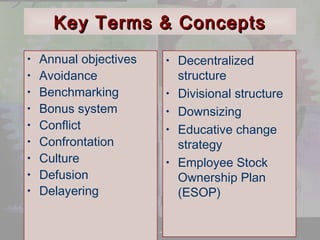
• Annual objectives 
• Avoidance 
• Benchmarking 
• Bonus system 
• Conflict 
• Confrontation 
• Culture 
• Defusion 
• Delayering 
• Decentralized 
structure 
• Divisional structure 
• Downsizing 
• Educative change 
strategy 
• Employee Stock 
Ownership Plan 
(ESOP)
KKeeyy TTeerrmmss && CCoonncceeppttss 
© 2001 Prentice Hall 
Ch.7-27 
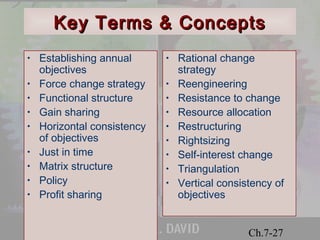
• Establishing annual 
objectives 
• Force change strategy 
• Functional structure 
• Gain sharing 
• Horizontal consistency 
of objectives 
• Just in time 
• Matrix structure 
• Policy 
• Profit sharing 
• Rational change 
strategy 
• Reengineering 
• Resistance to change 
• Resource allocation 
• Restructuring 
• Rightsizing 
• Self-interest change 
• Triangulation 
• Vertical consistency of 
objectives

Implementing Strategies:Management Issues

  • 1.
    © 2001 PrenticeHall Ch.7-1 Strategic Management Concepts & Cases 8th edition Fred R. David Chapter 7: Implementing Strategies: Management Issues PowerPoint Slides By: Anthony F. Chelte Western New England College
  • 2.
    Comprehensive Strategic MMaannaaggeemmeennttMMooddeell © 2001 Prentice Hall Ch.7-2 Vision & Mission Statements Chapter 2 External Audit Chapter 3 Strategies In Action Chapter 5 Internal Audit Chapter 4 Strategy Analysis & Choice Chapter 6 Implement Strategies: Marketing, Fin/Acct, R&D, CIS Chapter 8 Measure & Evaluate Performance Chapter 9 Strategy Implementation: Management Issues Chapter 7
  • 3.
    MMaannaaggeemmeenntt IIssssuueess “Youwant your people to run the business as if it were their own.” © 2001 Prentice Hall Ch.7-3 —William Fulmer —
  • 4.
    MMaannaaggeemmeenntt IIssssuueess “Amanagement truism says structure follows strategy. However, this truism is often ignored. Too many organizations attempt to carry out a new strategy with an old structure.” © 2001 Prentice Hall Ch.7-4 —Dale McConkey—
  • 5.
    MMaannaaggeemmeenntt IIssssuueess “Inmost organizations, the top performers are paid too little and the worst performers too much.” © 2001 Prentice Hall Ch.7-5 —Cass Bettinger—
  • 6.
    MMaannaaggeemmeenntt IIssssuueess Successfulstrategy formulation © 2001 Prentice Hall Ch.7-6 does NOT guarantee successful strategy implementation!
  • 7.
    MMaannaaggeemmeenntt IIssssuueess ©2001 Prentice Hall Ch.7-7 Strategy Implementation —more difficult to “do” something Strategy Formulation —easier to say “going to do it”
  • 8.
    MMaannaaggeemmeenntt IIssssuueess StrategyFormulation Strategy Implementation Focuses on effectiveness Focuses on efficiency Requires coordination among many persons © 2001 Prentice Hall Ch.7-8 Requires coordination among a few individuals Requires motivation and leadership skills Requires good intuitive and analytical skills Primarily an operational process Primarily an intellectual process Managing forces during the action Positioning forces before the action
  • 9.
    MMaannaaggeemmeenntt IIssssuueess Transitionto Strategy Implementation  Shift in responsibility from strategists to divisional and functional managers Implementation problems may arise © 2001 Prentice Hall Ch.7-9
  • 10.
    MMaannaaggeemmeenntt IIssssuueess ImportantImplementation Concerns • Managers & employees motivated more by self-interests than organizational interests © 2001 Prentice Hall Ch.7-10 • Need to involve divisional and functional managers in strategy formulation
  • 11.
    Management Issues &Strategy Implementation © 2001 Prentice Hall Ch.7-11 Establishing Annual Objectives Devising Policies Allocating Resources Altering Existing Organizational Structure Restructuring & Reengineering
  • 12.
    Management Issues &Strategy Implementation © 2001 Prentice Hall Ch.7-12 Revising Reward & Incentive Programs Minimizing Resistance to Change Managing the Natural Environment Developing a Strategy Supportive Culture Adapting Production/ Operations Processes Developing HR Function If Necessary Downsizing
  • 13.
    Management Issues &Strategy © 2001 Prentice Hall Ch.7-13 Implementation • Basis for allocating resources • Mechanism for evaluating managers • Monitor progress toward long-term objectives • Establish organizational, divisional, and departmental priorities Establishing Annual Objectives
  • 14.
    Management Issues &Strategy © 2001 Prentice Hall Ch.7-14 Implementation • Basis for solving recurring problems • Sets boundaries, constraints, and limits on administrative actions • Sets expectations for managers and employees • Basis for management control and coordination Devising Policies
  • 15.
    Management Issues &Strategy © 2001 Prentice Hall Ch.7-15 Implementation • Allows for strategy execution • Sets allocation plan based on annual objectives • Allocation based on four types of resources: financial, physical, human, and technological Allocating Resources
  • 16.
    Management Issues &Strategy © 2001 Prentice Hall Ch.7-16 Implementation • Function • Divisional • SBU Structure • Matrix Structure Altering Existing Organizational Structure
  • 17.
    Management Issues &Strategy © 2001 Prentice Hall Ch.7-17 Implementation • Reducing size of firm  Employees  Divisions or units  Hierarchical levels • Benchmarking against competitors  Ratios out of line • Primary benefit = cost reduction Restructuring
  • 18.
    Management Issues &Strategy © 2001 Prentice Hall Ch.7-18 Implementation • Employee/customer well-being  Redesign work  Redesign jobs  Redesign processes • Improvement in:  Costs  Quality  Service  Speed Reengineering
  • 19.
    Management Issues &Strategy © 2001 Prentice Hall Ch.7-19 Implementation • Pay-for-performance plans • Flexibility in compensation systems is necessary • Dual bonus system  Annual objectives  Long-term objectives • Profit Sharing Revising Reward & Incentive Programs
  • 20.
    Management Issues &Strategy © 2001 Prentice Hall Ch.7-20 Implementation • Raises anxiety/fear • Force change strategy • Educative change strategy • Rational or self-interest change strategy  Most desirable Managing Resistance To Change
  • 21.
    Management Issues &Strategy © 2001 Prentice Hall Ch.7-21 Implementation • Customer & employee sensitivity to environment • Legal requirements • Earth has become a stakeholder for all firms • Preserve and conserve natural resources • Emphasis on developing environmental perspective Managing the Natural Environment
  • 22.
    Management Issues &Strategy © 2001 Prentice Hall Ch.7-22 Implementation • Triangulation as method to determine changes in a firm’s culture that could benefit strategy • Weak linkages between strategic management and organizational culture can jeopardize performance and success Creating a Strategy- Supportive Culture
  • 23.
    Management Issues &Strategy © 2001 Prentice Hall Ch.7-23 Implementation • Production processes typically constitute more than 70% of firm’s total assets • Decisions on:  Plant size  Inventory/inventory control  Quality control  Cost control  Technological innovation Production/ Operations Concerns
  • 24.
    Management Issues &Strategy © 2001 Prentice Hall Ch.7-24 Implementation • Assessing staffing needs and costs • Develop performance incentives • ESOPs • Child-care policies • Work-life balance Human Resources Concerns
  • 25.
    MMaannaaggeemmeenntt IIssssuueess ImportantImplementation Concerns © 2001 Prentice Hall Ch.7-25 • Strategy implementation means change • Successful implementation requires: Support Discipline Motivation Hard work
  • 26.
    KKeeyy TTeerrmmss &&CCoonncceeppttss © 2001 Prentice Hall Ch.7-26 • Annual objectives • Avoidance • Benchmarking • Bonus system • Conflict • Confrontation • Culture • Defusion • Delayering • Decentralized structure • Divisional structure • Downsizing • Educative change strategy • Employee Stock Ownership Plan (ESOP)
  • 27.
    KKeeyy TTeerrmmss &&CCoonncceeppttss © 2001 Prentice Hall Ch.7-27 • Establishing annual objectives • Force change strategy • Functional structure • Gain sharing • Horizontal consistency of objectives • Just in time • Matrix structure • Policy • Profit sharing • Rational change strategy • Reengineering • Resistance to change • Resource allocation • Restructuring • Rightsizing • Self-interest change • Triangulation • Vertical consistency of objectives