4-1
Analyzing aAnalyzing a
Company’s ResourcesCompany’s Resources
and Competitive Positionand Competitive Position
44
Chapter
Screen graphics created by:
Jana F. Kuzmicki, Ph.D.
Troy State University-Florida and Western Region
““Before executives canBefore executives can
chart a new strategy, theychart a new strategy, they
must reach commonmust reach common
understanding of theunderstanding of the
company’s current position.”company’s current position.”
W. Chan Kim and Renee Mauborgne
4-3
Chapter RoadmapChapter Roadmap
 Question 1: How Well Is the Company’s Present Strategy
Working?
 Question 2: What Are the Company’s Resource Strengths and
Weaknesses and Its External Opportunities and Threats?
 Question 3: Are the Company’s Prices and Costs
Competitive?
 Question 4: Is the Company Competitively Stronger or
Weaker than Key Rivals?
 Question 5: What Strategic Issues and Problems Merit Front-
Burner Managerial Attention?
4-4
Company Situation Analysis:Company Situation Analysis:
The Key QuestionsThe Key Questions
1. How well is the company’s
present strategy working?
2. What are the company’s resource
strengths and weaknesses and its
external opportunities and threats?
3. Are the company’s prices and
costs competitive?
4. Is the company competitively stronger
or weaker than key rivals?
5. What strategic issues merit
front-burner managerial attention?
4-5
Fig. 4.1: Identifying the Components ofFig. 4.1: Identifying the Components of
a Single-Business Company’s Strategya Single-Business Company’s Strategy
4-6
Q #1: How Well Is the Company’sQ #1: How Well Is the Company’s
Present Strategy Working?Present Strategy Working?
 Identify competitive approach
 Low-cost leadership
 Differentiation
 Focus on a particular market niche
 Determine competitive scope
 Geographic market coverage
 Operating stages in industry’s production/distribution chain
 Examine recent strategic moves
 Identify functional strategies
Key Issues
4-7
Approaches to Assess How WellApproaches to Assess How Well
the Present Strategy Is Workingthe Present Strategy Is Working
 Qualitative assessment –
What is the strategy?
 Completeness
 Internal consistency
 Rationale
 Relevance
 Quantitative assessment – What
are the results?
 Is company achieving its
financial and strategic
objectives?
 Is company an above-average
industry performer?
4-8
Key Indicators of How WellKey Indicators of How Well
the Strategy Is Workingthe Strategy Is Working
 Trend in sales and market share
 Acquiring and/or retaining customers
 Trend in profit margins
 Trend in net profits, ROI, and EVA
 Overall financial strength and credit ranking
 Efforts at continuous improvement activities
 Trend in stock price and stockholder value
 Image and reputation with customers
 Leadership role(s) – Technology, quality, innovation,
e-commerce, etc.
4-9
 S W O TS W O T represents the first letter in
 SS trengths
 WW eaknesses
 OO pportunities
 TT hreats
 For a company’s strategy to be well-conceived, it must be
 Matched to its resource strengths and weaknesses
 Aimed at capturing its best market opportunities and erecting
defenses against external threats to its well-being
S W
O T
Q #2: What Are the Company’s Strengths,Q #2: What Are the Company’s Strengths,
Weaknesses, Opportunities and Threats ?Weaknesses, Opportunities and Threats ?
4-10
Identifying Resource StrengthsIdentifying Resource Strengths
and Competitive Capabilitiesand Competitive Capabilities
 A strength is something a firm does well or an attribute that
enhances its competitiveness
 Valuable competencies or know-how
 Valuable physical assets
 Valuable human assets
 Valuable organizational assets
 Valuable intangible assets
 Important competitive capabilities
 An attribute that places a company in a position of market advantage
 Alliances or cooperative ventures with partners
Resource strengths and competitive
capabilities are competitive assets!
4-11
Competencies vs. Core CompetenciesCompetencies vs. Core Competencies
vs. Distinctive Competenciesvs. Distinctive Competencies
 A competence is the product of organizational learning and
experience and represents real proficiency in performing an
internal activity
 A core competence is a well-performed
internal activity central (not peripheral or incidental)
to a company’s competitiveness and profitability
 A distinctive competence is a competitively valuable activity a
company performs better than its rivals
4-12
Company CompetenciesCompany Competencies
and Capabilitiesand Capabilities
 Stem from skills, expertise, and
experience usually representing an
 Accumulation of learning over time and
 Gradual buildup of real proficiency in
performing an activity
 Involve deliberate efforts to develop the ability to do
something, often entailing
 Selecting people with requisite knowledge and skills
 Upgrading or expanding individual abilities
 Molding work products of individuals into a cooperative effort to
create organizational ability
 A conscious effort to create intellectual capital
4-13
A competence becomes a core competence when the
well-performed activity is central to a company’s
competitiveness and profitability
Often, a core competence results from collaboration
among different parts of a company
Typically, core competencies reside in a company’s
people, not in assets on a balance sheet
A core competence gives a company a
potentially valuable competitive capability
and represents a definite competitive asset
Core Competencies -- ACore Competencies -- A
Valuable Company ResourceValuable Company Resource
4-14
Examples: Core CompetenciesExamples: Core Competencies
 Expertise in integrating multiple technologies
to create families of new products
 Know-how in creating operating systems
for cost efficient supply chain management
 Speeding new/next-generation products to market
 Better after-sale service capability
 Skills in manufacturing a high quality product
 System to fill customer orders accurately and swiftly
4-15
Distinctive Competence -- ADistinctive Competence -- A
Competitively Superior ResourceCompetitively Superior Resource
 A distinctive competence is a competitively significant
activity that a company performs better than its competitors
 A distinctive competence
 Represents a competitively valuable
capability rivals do not have
 Presents attractive potential for
being a cornerstone of strategy
 Can provide a competitive edge in the marketplace —because it
represents a competitively superior resource strength
# 1
4-16
Examples: DistinctiveExamples: Distinctive
CompetenciesCompetencies
 Sharp Corporation
 Expertise in flat-panel display technology
 Toyota and Honda
 Low-cost, high-quality manufacturing
capability and short design-to-market cycles
 Intel
 Ability to design and manufacture
ever more powerful microprocessors for PCs
 Wal-Mart
 Low-cost distribution and use of
state-of-the-art retail technology
4-17
To qualify as competitively valuable or to be the basis for
sustainable competitive advantage, a “resource” must
pass 4 tests:
1. Is the resource hard to copy?
2. Does the resource have staying power –
is it durable?
3. Is the resource really competitively superior?
4. Can the resource be trumped by
the different capabilities of rivals?
Determining the CompetitiveDetermining the Competitive
Value of a Company ResourceValue of a Company Resource
4-18
 A weakness is something a firm lacks, does poorly, or a
condition placing it at a disadvantage
 Resource weaknesses relate to
 Inferior or unproven skills,
expertise, or intellectual capital
 Lack of important physical,
organizational, or intangible assets
 Missing capabilities in key areas
Resource weaknesses and deficiencies
are competitive liabilities!
Identifying Resource WeaknessesIdentifying Resource Weaknesses
and Competitive Deficienciesand Competitive Deficiencies
4-19
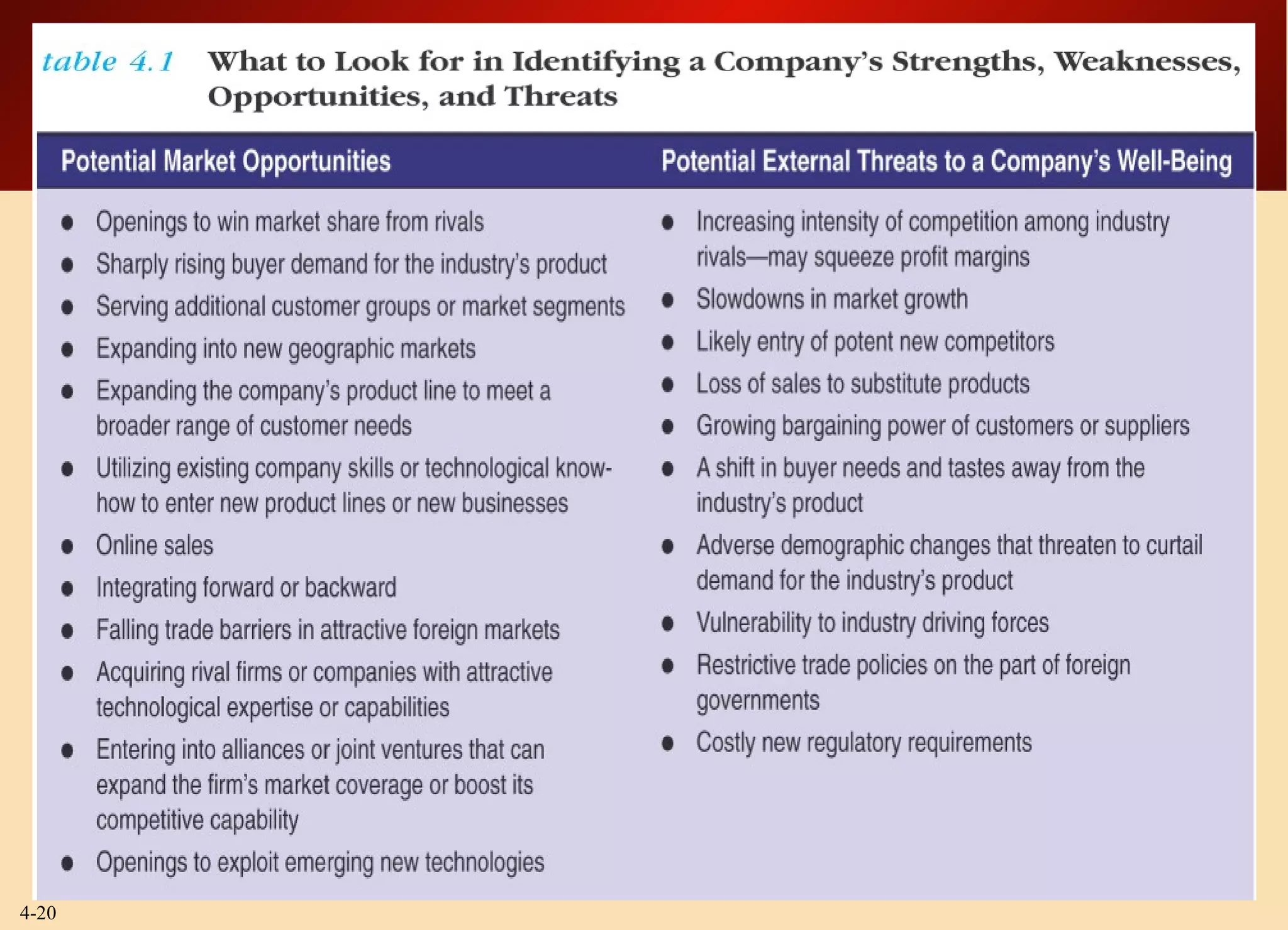
4-20
4-21
Opportunities most relevant to a
company are those offering
 Good match with its financial and
organizational resource capabilities
 Best prospects for profitable
long-term growth
 Potential for competitive advantage
Identifying a Company’sIdentifying a Company’s
Market OpportunitiesMarket Opportunities
4-22
Identifying External ThreatsIdentifying External Threats
 Emergence of cheaper/better technologies
 Introduction of better products by rivals
 Entry of lower-cost foreign competitors
 Onerous regulations
 Rise in interest rates
 Potential of a hostile takeover
 Unfavorable demographic shifts
 Adverse shifts in foreign exchange rates
 Political upheaval in a country
4-23
Role of SWOT Analysis inRole of SWOT Analysis in
Crafting a Better StrategyCrafting a Better Strategy
 The most important part of S W O TS W O T analysis is not
developing the 4 lists of strengths, weaknesses, opportunities,
and threats, but rather
 Using the 4 lists to draw conclusions
about a company’s overall situation and
 Acting on the conclusions to
 Better match a company’s strategy to its
resource strengths and market opportunities,
 Correct the important weaknesses, and
 Defend against external threats
4-24
Fig. 4.2: The Three StepsFig. 4.2: The Three Steps
of SWOT Analysisof SWOT Analysis
4-25
Q #4: Are the Company’sQ #4: Are the Company’s
Prices and Costs Competitive?Prices and Costs Competitive?
 Assessing whether a firm’s costs are competitive with those of
rivals is a crucial part of company analysis
 Key analytical tools
 Value chain analysis
 Benchmarking
4-26
The Concept of aThe Concept of a
Company Value ChainCompany Value Chain
 A company’s business consists of all activities undertaken in
designing, producing, marketing, delivering, and supporting its
product or service
 A company’s value chain consists of a linked set of value-
creating activities performed internally
 The value chain contains two types of activities
 Primary activities – where most of
the value for customers is created
 Support activities – facilitate
performance of the primary activities
4-27
Fig. 4.3: RepresentativeFig. 4.3: Representative
Company Value ChainCompany Value Chain
4-28
Characteristics ofCharacteristics of
Value Chain AnalysisValue Chain Analysis
 Combined costs of all activities in a company’s value chain
define the company’s internal cost structure
 Compares a firm’s costs activity
by activity against costs of key rivals
 From raw materials purchase to
 Price paid by ultimate customer
 Pinpoints which internal activities are a
source of cost advantage or disadvantage
4-29
Why Do ValueWhy Do Value
Chains of Rivals Differ?Chains of Rivals Differ?
 Several factors can cause differences
in value chains of rival companies
 Internal operations
 Strategy
 Approaches used in execution of the strategy
 Underlying economics of the activities
 Differences complicate task of assessing
rivals’ relative cost positions
4-30
The Value Chain SystemThe Value Chain System
for an Entire Industryfor an Entire Industry
 Assessing a company’s cost competitiveness involves
comparing costs all along the industry’s value chain
 Suppliers’ value chains are relevant because
 Costs, performance features, and quality of inputs
provided by suppliers influence a firm’s own costs
and product performance
 Forward channel allies’ value chains are relevant because
 Costs and margins are part of price paid
by ultimate end-user
 Activities performed affect end-user satisfaction
4-31
Fig. 4.4: Representative ValueFig. 4.4: Representative Value
Chain for an Entire IndustryChain for an Entire Industry
4-32
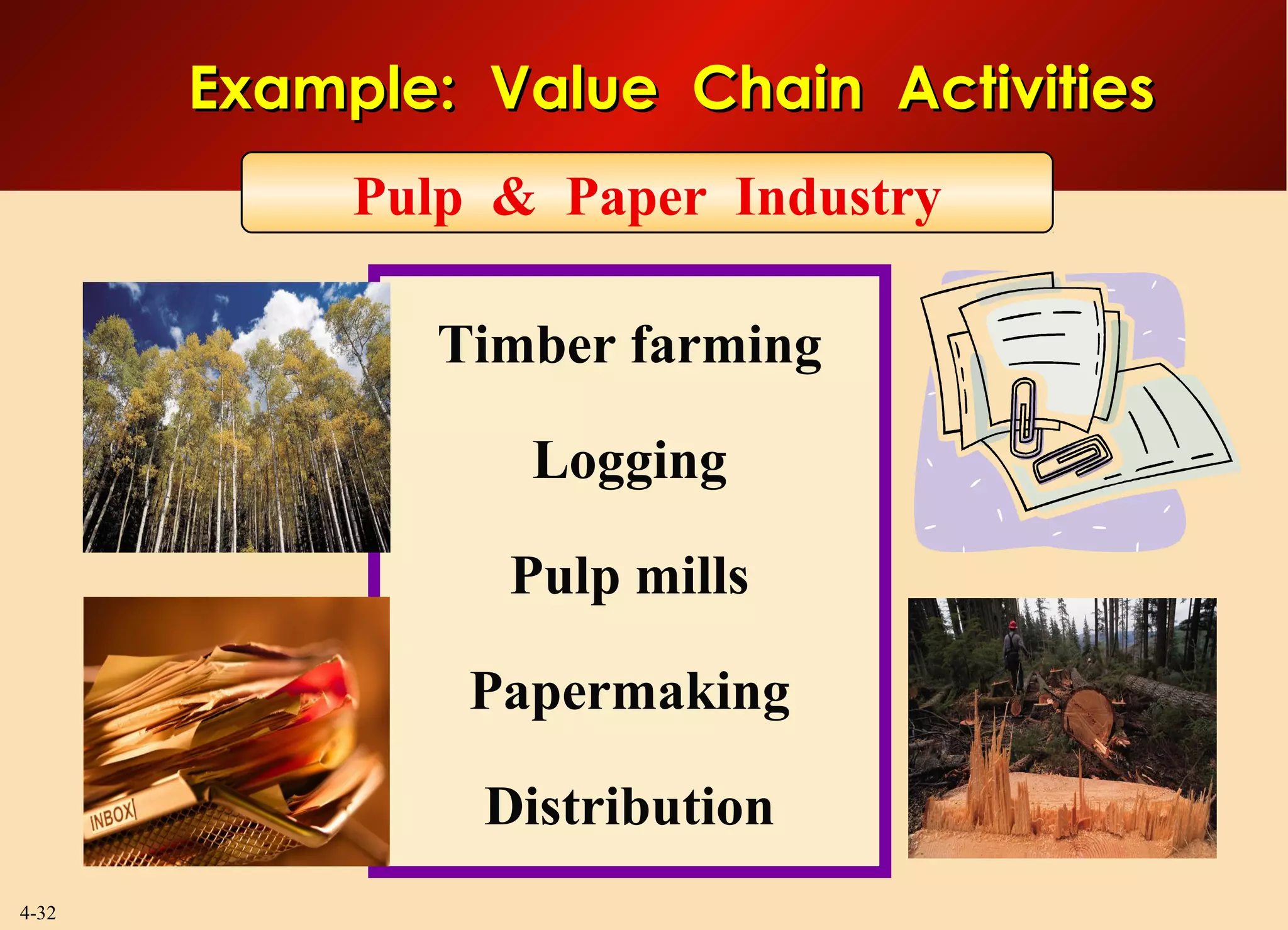
Example: Value Chain ActivitiesExample: Value Chain Activities
Timber farming
Logging
Pulp mills
Papermaking
Distribution
Pulp & Paper Industry
4-33
Home Appliance Industry
Parts and components manufacture
Assembly
Wholesale distribution
Retail sales
Example: Value Chain ActivitiesExample: Value Chain Activities
4-34
Processing of basic ingredients
Syrup manufacture
Bottling and can filling
Wholesale distribution
Advertising
Retailing
Albertson’s
Example: Value Chain ActivitiesExample: Value Chain Activities
Soft Drink Industry
4-35
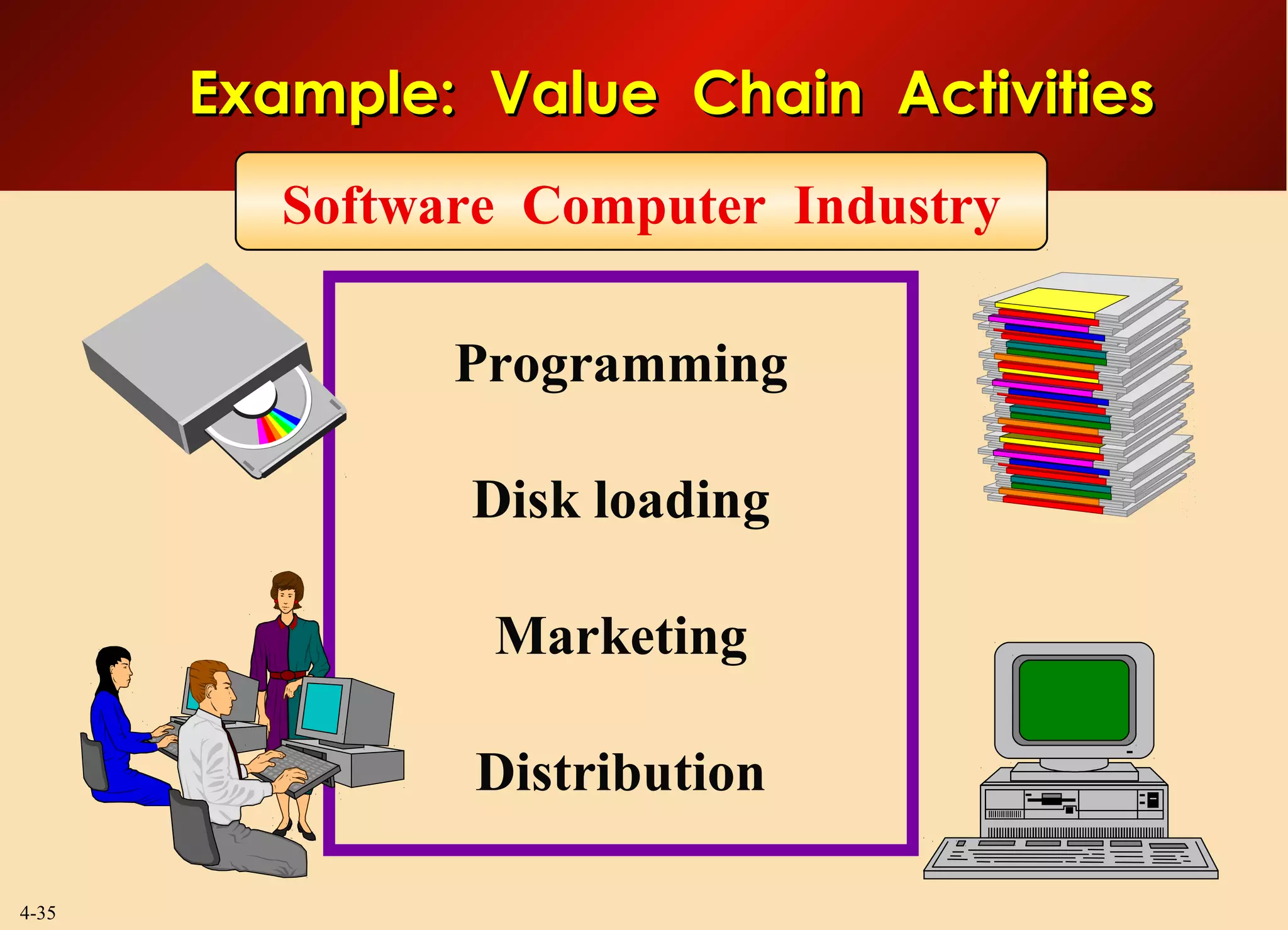
Programming
Disk loading
Marketing
Distribution
Example: Value Chain ActivitiesExample: Value Chain Activities
Software Computer Industry
4-36
Developing Data to Measure aDeveloping Data to Measure a
Company’s Cost CompetitivenessCompany’s Cost Competitiveness
 After identifying key value chain activities, the next step
involves breaking down departmental cost accounting data into
costs of performing specific activities
 Appropriate degree of disaggregation depends on
 Economics of activities
 Value of comparing narrowly defined
versus broadly defined activities
 Guideline – Develop separate cost estimates for activities
 Having different economics
 Representing a significant or growing proportion of costs
4-37
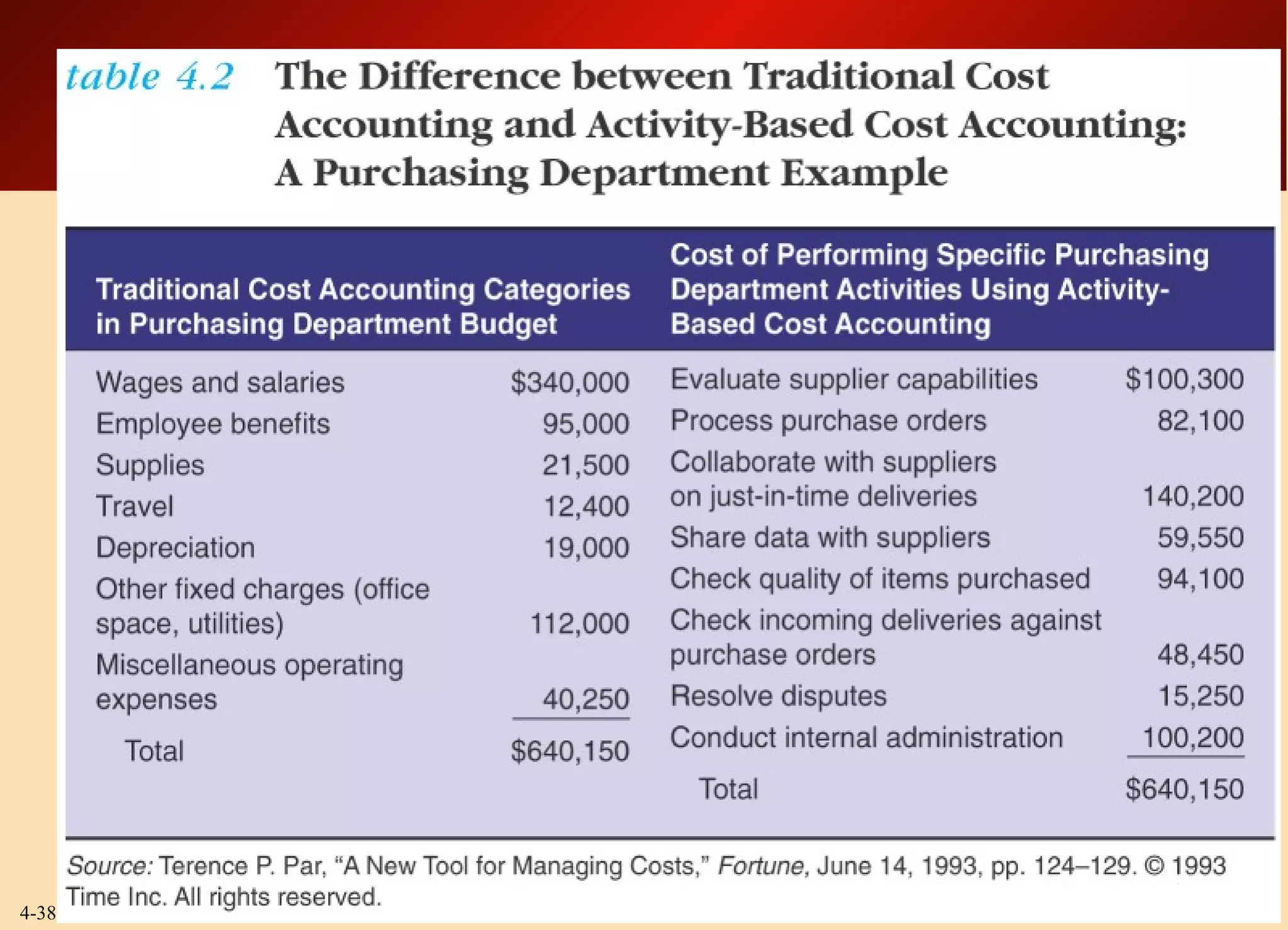
Activity-Based Costing: A KeyActivity-Based Costing: A Key
Tool in Analyzing CostsTool in Analyzing Costs
 Determining whether a company’s costs are in line with those
of rivals requires
 Measuring how a company’s costs compare with those of rivals
activity-by-activity
 Requires having accounting data to measure cost
of each value chain activity
 Activity-based costing entails
 Defining expense categories according
to specific activities performed and
 Assigning costs to the activity
responsible for creating the cost
4-38
4-39
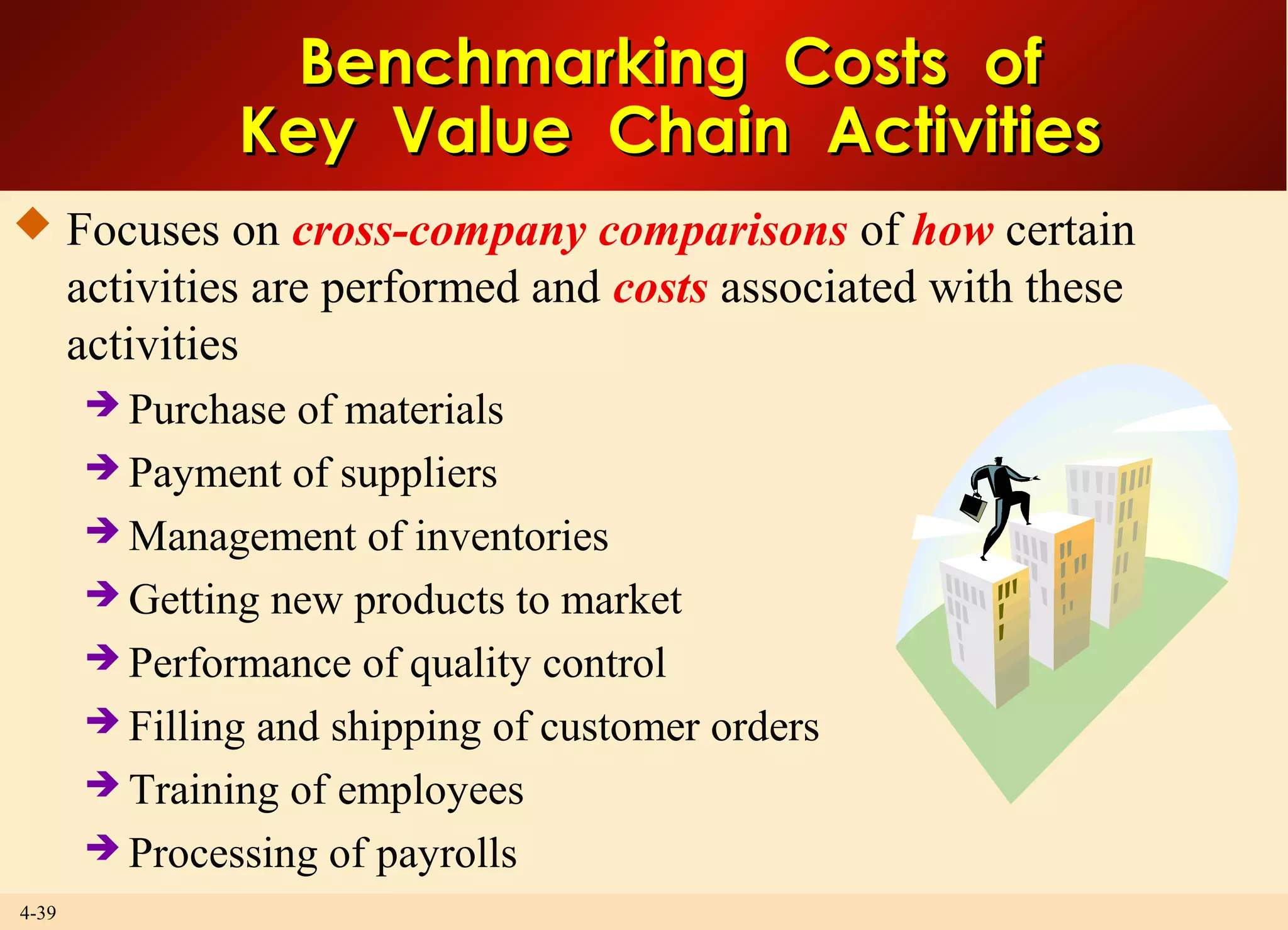
Benchmarking Costs ofBenchmarking Costs of
Key Value Chain ActivitiesKey Value Chain Activities
 Focuses on cross-company comparisons of how certain
activities are performed and costs associated with these
activities
 Purchase of materials
 Payment of suppliers
 Management of inventories
 Getting new products to market
 Performance of quality control
 Filling and shipping of customer orders
 Training of employees
 Processing of payrolls
4-40
Objectives of BenchmarkingObjectives of Benchmarking
 Identify best practices in performing an activity
 Understand the best practices in performing
an activity – learn what is the “best” way
to do a particular activity from those
demonstrating they are “best-in-world”
 Learn how other firms achieve lower costs
 Take action to improve company’s cost competitiveness
4-41
Ethical Standards inEthical Standards in
Benchmarking: Do’s and Don’tsBenchmarking: Do’s and Don’ts
 Avoid talk about pricing or competitively
sensitive costs
 Don’t ask rivals for sensitive data
 Don’t share proprietary data without clearance
 Have impartial third party assemble and present competitively
sensitive cost data with no names attached
 Don’t disparage a rival’s business to outsiders based on data
obtained
4-42
What Determines if aWhat Determines if a
Company Is Cost Competitive?Company Is Cost Competitive?
 Cost competitiveness depends on how well a company
manages its value chain relative to how well competitors
manage their value chains
 When costs are out-of-line, high-cost activities can exist in
any of three areas in the industry value chain
1. Suppliers’ activities
2. Company’s own internal activities
3. Forward channel activities
Activities,
Costs, &
Margins of
Forward
Channel Allies
Internally
Performed
Activities,
Costs, &
Margins
Activities,
Costs, &
Margins of
Suppliers
Buyer/User
Value
Chains
4-43
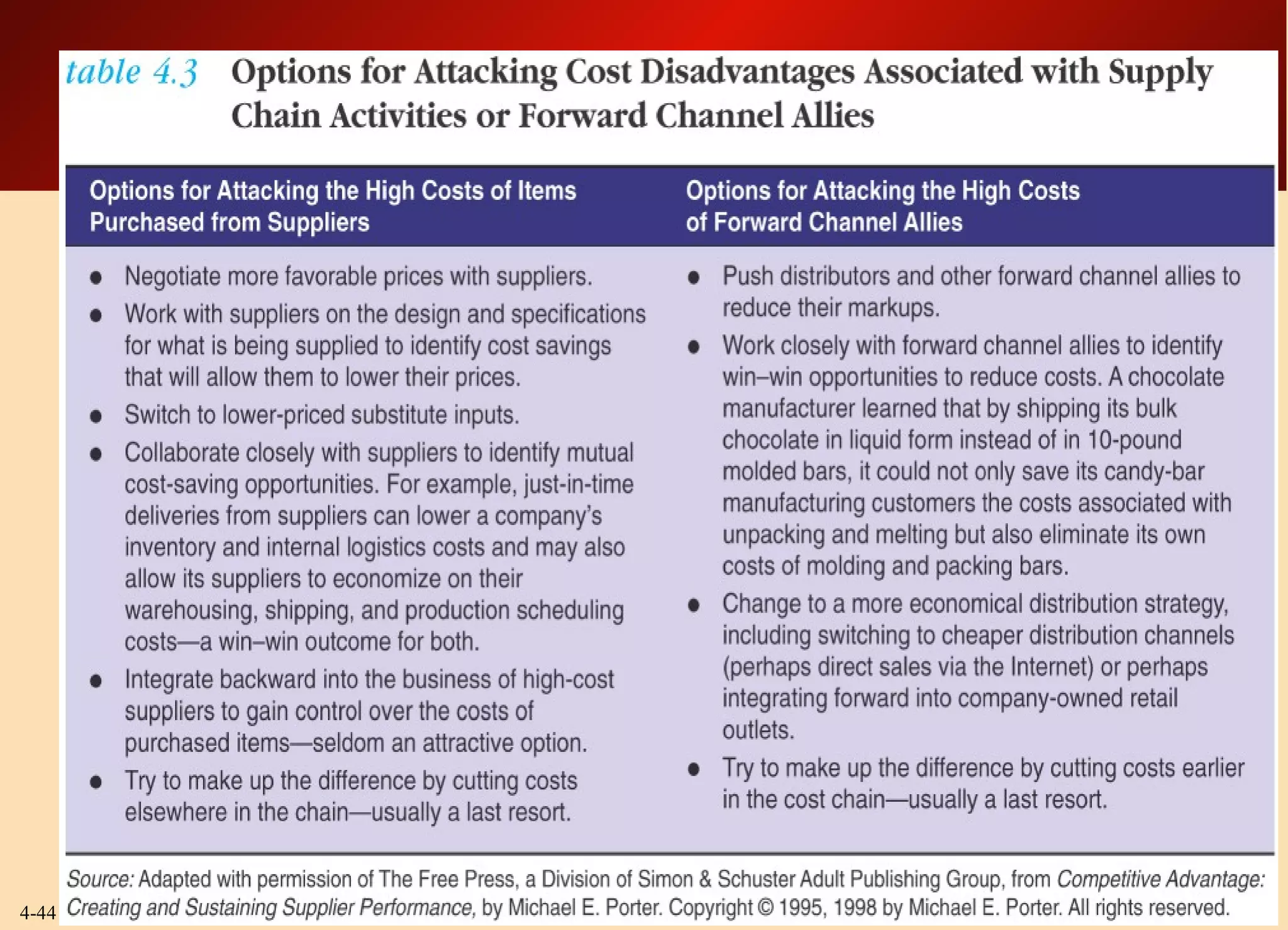
Options to CorrectOptions to Correct
Internal Cost DisadvantagesInternal Cost Disadvantages
 Implement use of best practices throughout company
 Eliminate some cost-producing activities altogether by revamping
value chain system
 Relocate high-cost activities to lower-cost geographic areas
 See if high-cost activities can be performed
cheaper by outside vendors/suppliers
 Invest in cost-saving technology
 Innovate around troublesome cost components
 Simplify product design
 Make up difference by achieving savings in backward or forward
portions of value chain system
4-44
4-45
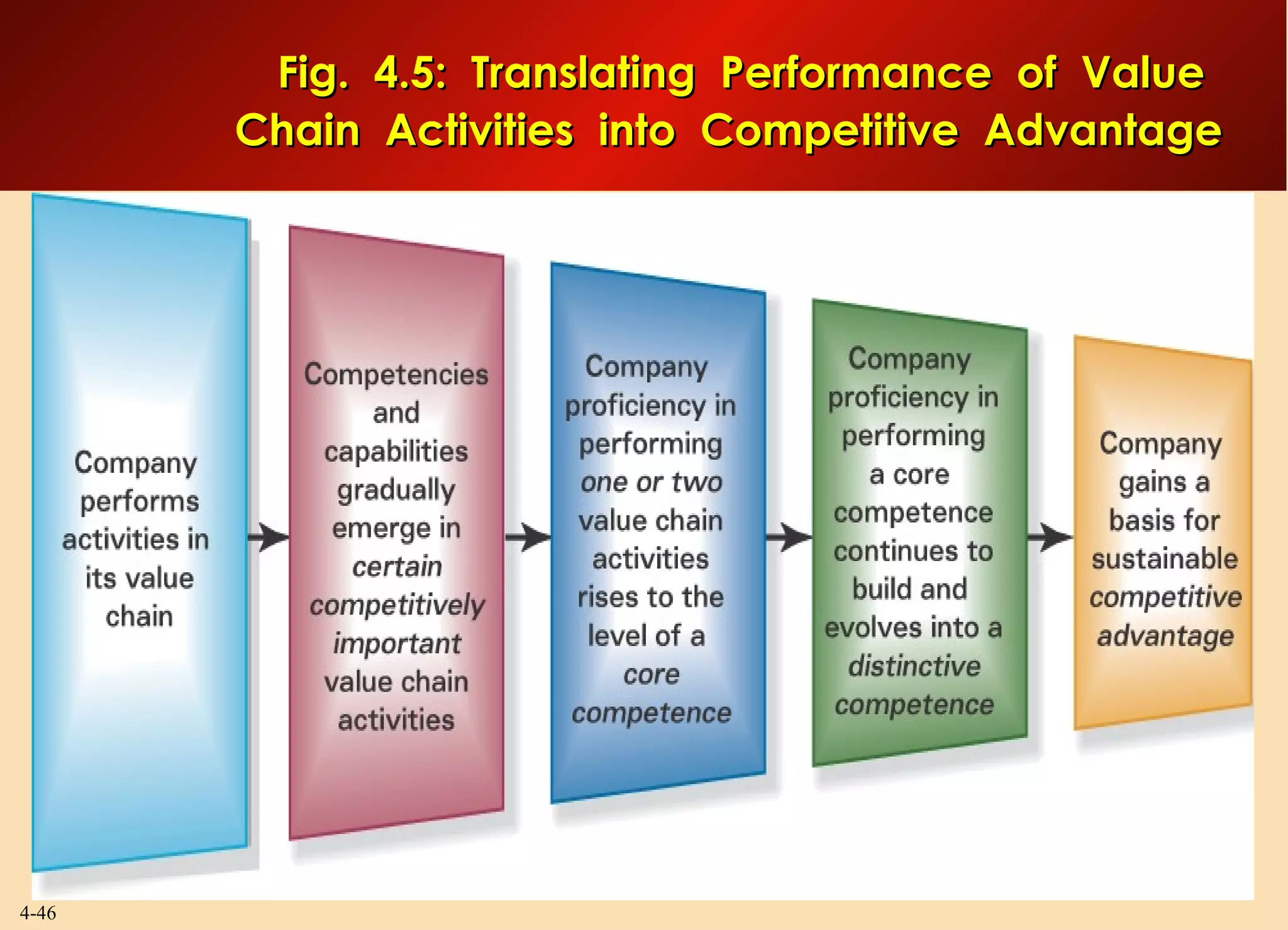
Translating Performance of Value ChainTranslating Performance of Value Chain
Activities to Competitive AdvantageActivities to Competitive Advantage
 A company can create competitive advantage by managing its
value chain to
 Integrate knowledge and skills of employees in competitively
valuable ways
 Leverage economies of learning / experience
 Coordinate related activities in ways
that build valuable capabilities
 Build dominating expertise
in a value chain activity critical
to customer satisfaction or market success
4-46
Fig. 4.5: Translating Performance of ValueFig. 4.5: Translating Performance of Value
Chain Activities into Competitive AdvantageChain Activities into Competitive Advantage
4-47
Q. #4: Is the Company StrongerQ. #4: Is the Company Stronger
or Weaker than Key Rivals?or Weaker than Key Rivals?
 Overall competitive position involves
answering two questions
 How does a company rank relative
to competitors on each important
factor that determines market success?
 Does a company have a net
competitive advantage or disadvantage
vis-à-vis major competitors?
4-48
Assessing a Company’sAssessing a Company’s
Competitive Strength vs. Key RivalsCompetitive Strength vs. Key Rivals
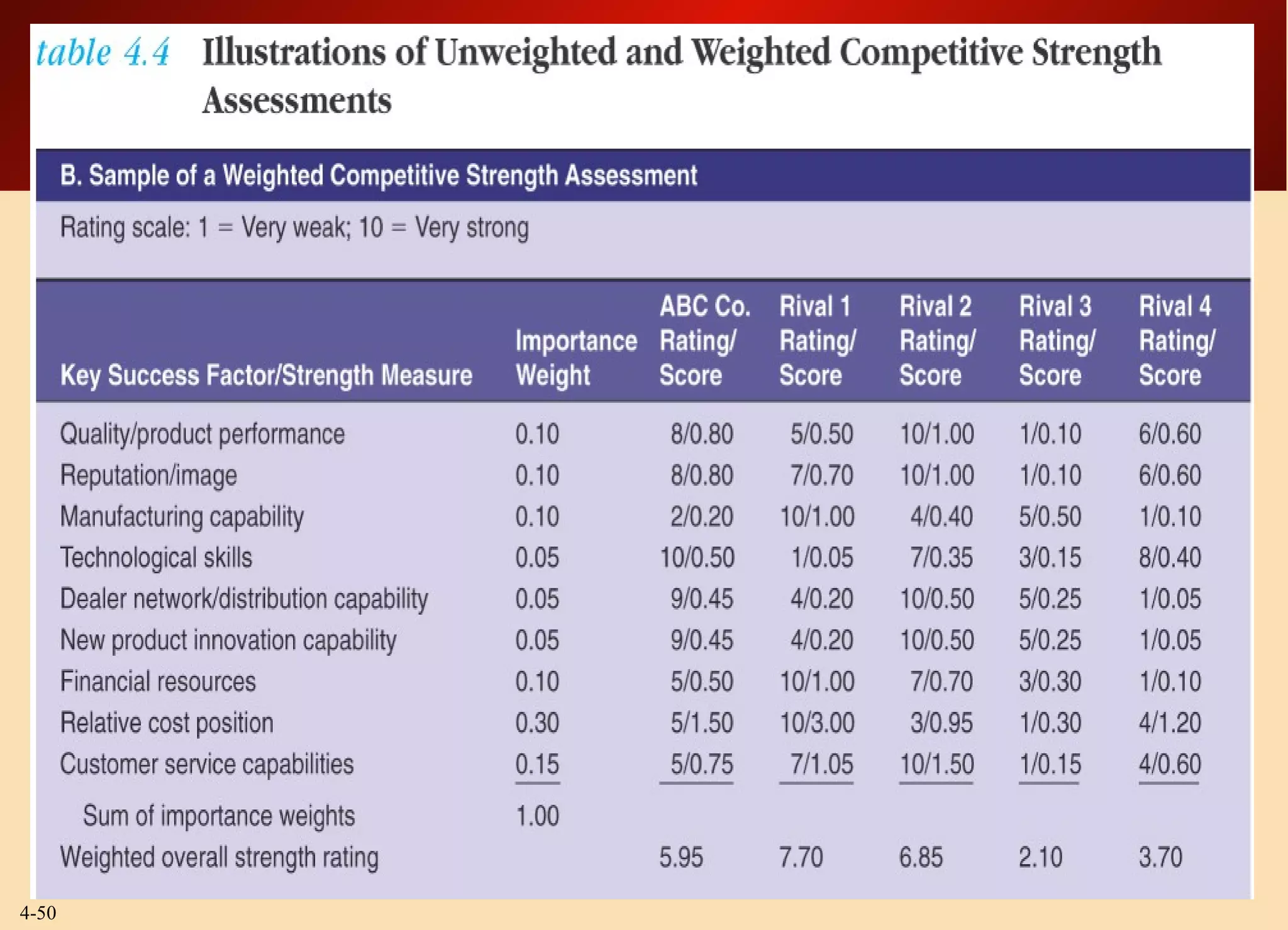
1. List industry key success factors and other relevant measures
of competitive strength
2. Rate firm and key rivals on each factor using rating scale of 1
to 10 (1 = very weak; 5 = average; 10 = very strong)
3. Decide whether to use a weighted or unweighted rating system
(a weighted system is superior because chosen strength measures
are unlikely to be equally important)
4. Sum individual ratings to get an overall measure of
competitive strength for each rival
5. Based on overall strength ratings, determine overall
competitive position of firm
4-49
4-50
4-51
Why Do a CompetitiveWhy Do a Competitive
Strength Assessment ?Strength Assessment ?
 Reveals strength of firm’s competitive position
vis-à-vis key rivals
 Shows how firm stacks up against rivals, measure-by-measure
– pinpoints firm’s competitive strengths and competitive
weaknesses
 Indicates whether firm is at a competitive advantage /
disadvantage against each rival
 Identifies possible offensive attacks (pit company strengths
against rivals’ weaknesses)
 Identifies possible defensive actions (a need to correct
competitive weaknesses)
4-52
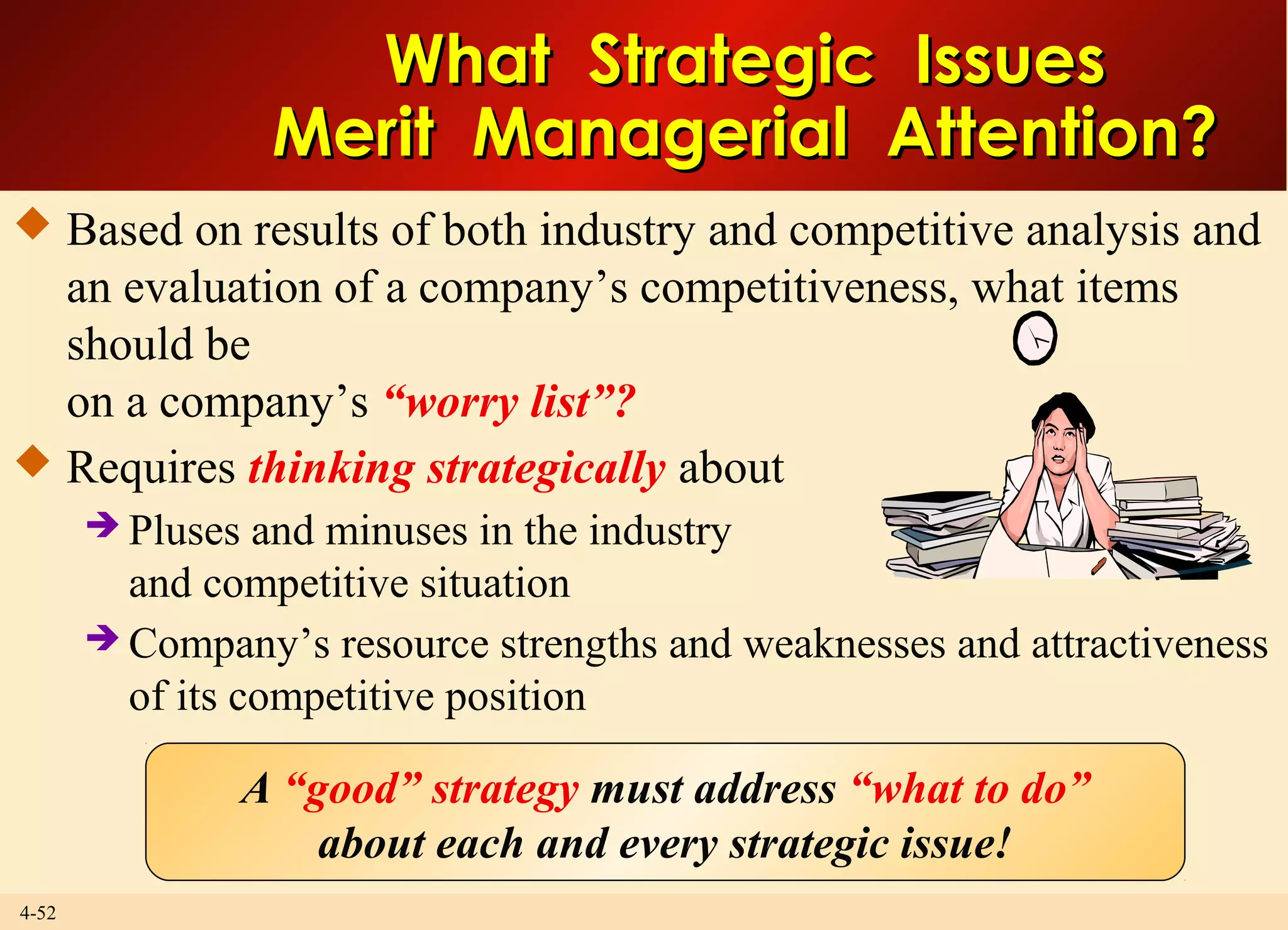
What Strategic IssuesWhat Strategic Issues
Merit Managerial Attention?Merit Managerial Attention?
 Based on results of both industry and competitive analysis and
an evaluation of a company’s competitiveness, what items
should be
on a company’s “worry list”?
 Requires thinking strategically about
 Pluses and minuses in the industry
and competitive situation
 Company’s resource strengths and weaknesses and attractiveness
of its competitive position
A “good” strategy must address “what to do”
about each and every strategic issue!
4-53
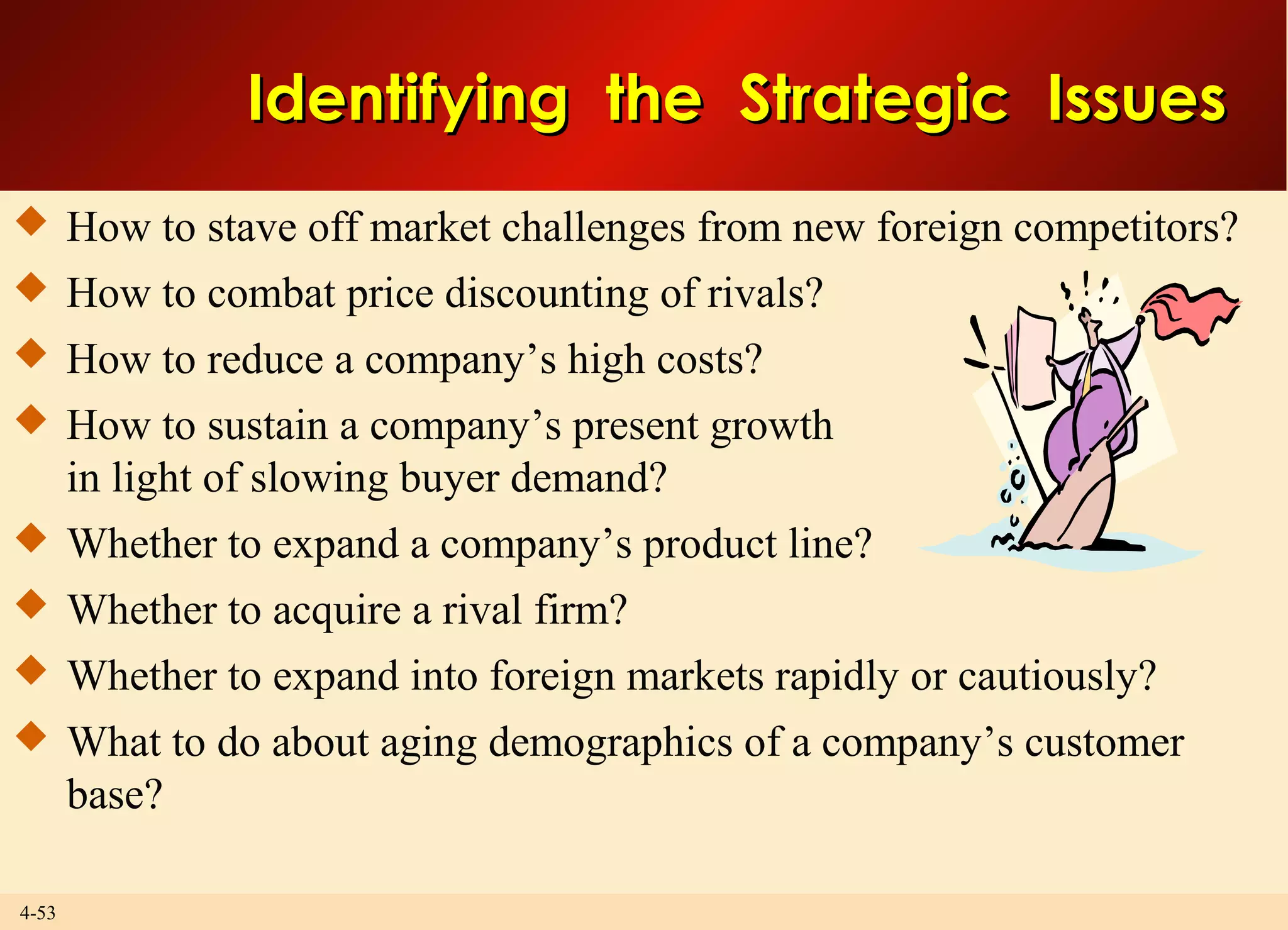
Identifying the Strategic IssuesIdentifying the Strategic Issues
 How to stave off market challenges from new foreign competitors?
 How to combat price discounting of rivals?
 How to reduce a company’s high costs?
 How to sustain a company’s present growth
in light of slowing buyer demand?
 Whether to expand a company’s product line?
 Whether to acquire a rival firm?
 Whether to expand into foreign markets rapidly or cautiously?
 What to do about aging demographics of a company’s customer
base?
4-54
 A well-stated issue involves such phrases as
 “How to . . . ?”
 “Whether to . . . ?”
 “What should be done about . . . ?”
 Issues need to be precise, specific,
and “cut straight to the chase”
 Issues on the “the worry list”
raise questions about
 What actions need to be considered
 What to think about doing
Stating the IssuesStating the Issues
Clearly and PreciselyClearly and Precisely

Analyzing company's resources and competitive position

  • 1.
    4-1 Analyzing aAnalyzing a Company’sResourcesCompany’s Resources and Competitive Positionand Competitive Position 44 Chapter Screen graphics created by: Jana F. Kuzmicki, Ph.D. Troy State University-Florida and Western Region
  • 2.
    ““Before executives canBeforeexecutives can chart a new strategy, theychart a new strategy, they must reach commonmust reach common understanding of theunderstanding of the company’s current position.”company’s current position.” W. Chan Kim and Renee Mauborgne
  • 3.
    4-3 Chapter RoadmapChapter Roadmap Question 1: How Well Is the Company’s Present Strategy Working?  Question 2: What Are the Company’s Resource Strengths and Weaknesses and Its External Opportunities and Threats?  Question 3: Are the Company’s Prices and Costs Competitive?  Question 4: Is the Company Competitively Stronger or Weaker than Key Rivals?  Question 5: What Strategic Issues and Problems Merit Front- Burner Managerial Attention?
  • 4.
    4-4 Company Situation Analysis:CompanySituation Analysis: The Key QuestionsThe Key Questions 1. How well is the company’s present strategy working? 2. What are the company’s resource strengths and weaknesses and its external opportunities and threats? 3. Are the company’s prices and costs competitive? 4. Is the company competitively stronger or weaker than key rivals? 5. What strategic issues merit front-burner managerial attention?
  • 5.
    4-5 Fig. 4.1: Identifyingthe Components ofFig. 4.1: Identifying the Components of a Single-Business Company’s Strategya Single-Business Company’s Strategy
  • 6.
    4-6 Q #1: HowWell Is the Company’sQ #1: How Well Is the Company’s Present Strategy Working?Present Strategy Working?  Identify competitive approach  Low-cost leadership  Differentiation  Focus on a particular market niche  Determine competitive scope  Geographic market coverage  Operating stages in industry’s production/distribution chain  Examine recent strategic moves  Identify functional strategies Key Issues
  • 7.
    4-7 Approaches to AssessHow WellApproaches to Assess How Well the Present Strategy Is Workingthe Present Strategy Is Working  Qualitative assessment – What is the strategy?  Completeness  Internal consistency  Rationale  Relevance  Quantitative assessment – What are the results?  Is company achieving its financial and strategic objectives?  Is company an above-average industry performer?
  • 8.
    4-8 Key Indicators ofHow WellKey Indicators of How Well the Strategy Is Workingthe Strategy Is Working  Trend in sales and market share  Acquiring and/or retaining customers  Trend in profit margins  Trend in net profits, ROI, and EVA  Overall financial strength and credit ranking  Efforts at continuous improvement activities  Trend in stock price and stockholder value  Image and reputation with customers  Leadership role(s) – Technology, quality, innovation, e-commerce, etc.
  • 9.
    4-9  S WO TS W O T represents the first letter in  SS trengths  WW eaknesses  OO pportunities  TT hreats  For a company’s strategy to be well-conceived, it must be  Matched to its resource strengths and weaknesses  Aimed at capturing its best market opportunities and erecting defenses against external threats to its well-being S W O T Q #2: What Are the Company’s Strengths,Q #2: What Are the Company’s Strengths, Weaknesses, Opportunities and Threats ?Weaknesses, Opportunities and Threats ?
  • 10.
    4-10 Identifying Resource StrengthsIdentifyingResource Strengths and Competitive Capabilitiesand Competitive Capabilities  A strength is something a firm does well or an attribute that enhances its competitiveness  Valuable competencies or know-how  Valuable physical assets  Valuable human assets  Valuable organizational assets  Valuable intangible assets  Important competitive capabilities  An attribute that places a company in a position of market advantage  Alliances or cooperative ventures with partners Resource strengths and competitive capabilities are competitive assets!
  • 11.
    4-11 Competencies vs. CoreCompetenciesCompetencies vs. Core Competencies vs. Distinctive Competenciesvs. Distinctive Competencies  A competence is the product of organizational learning and experience and represents real proficiency in performing an internal activity  A core competence is a well-performed internal activity central (not peripheral or incidental) to a company’s competitiveness and profitability  A distinctive competence is a competitively valuable activity a company performs better than its rivals
  • 12.
    4-12 Company CompetenciesCompany Competencies andCapabilitiesand Capabilities  Stem from skills, expertise, and experience usually representing an  Accumulation of learning over time and  Gradual buildup of real proficiency in performing an activity  Involve deliberate efforts to develop the ability to do something, often entailing  Selecting people with requisite knowledge and skills  Upgrading or expanding individual abilities  Molding work products of individuals into a cooperative effort to create organizational ability  A conscious effort to create intellectual capital
  • 13.
    4-13 A competence becomesa core competence when the well-performed activity is central to a company’s competitiveness and profitability Often, a core competence results from collaboration among different parts of a company Typically, core competencies reside in a company’s people, not in assets on a balance sheet A core competence gives a company a potentially valuable competitive capability and represents a definite competitive asset Core Competencies -- ACore Competencies -- A Valuable Company ResourceValuable Company Resource
  • 14.
    4-14 Examples: Core CompetenciesExamples:Core Competencies  Expertise in integrating multiple technologies to create families of new products  Know-how in creating operating systems for cost efficient supply chain management  Speeding new/next-generation products to market  Better after-sale service capability  Skills in manufacturing a high quality product  System to fill customer orders accurately and swiftly
  • 15.
    4-15 Distinctive Competence --ADistinctive Competence -- A Competitively Superior ResourceCompetitively Superior Resource  A distinctive competence is a competitively significant activity that a company performs better than its competitors  A distinctive competence  Represents a competitively valuable capability rivals do not have  Presents attractive potential for being a cornerstone of strategy  Can provide a competitive edge in the marketplace —because it represents a competitively superior resource strength # 1
  • 16.
    4-16 Examples: DistinctiveExamples: Distinctive CompetenciesCompetencies Sharp Corporation  Expertise in flat-panel display technology  Toyota and Honda  Low-cost, high-quality manufacturing capability and short design-to-market cycles  Intel  Ability to design and manufacture ever more powerful microprocessors for PCs  Wal-Mart  Low-cost distribution and use of state-of-the-art retail technology
  • 17.
    4-17 To qualify ascompetitively valuable or to be the basis for sustainable competitive advantage, a “resource” must pass 4 tests: 1. Is the resource hard to copy? 2. Does the resource have staying power – is it durable? 3. Is the resource really competitively superior? 4. Can the resource be trumped by the different capabilities of rivals? Determining the CompetitiveDetermining the Competitive Value of a Company ResourceValue of a Company Resource
  • 18.
    4-18  A weaknessis something a firm lacks, does poorly, or a condition placing it at a disadvantage  Resource weaknesses relate to  Inferior or unproven skills, expertise, or intellectual capital  Lack of important physical, organizational, or intangible assets  Missing capabilities in key areas Resource weaknesses and deficiencies are competitive liabilities! Identifying Resource WeaknessesIdentifying Resource Weaknesses and Competitive Deficienciesand Competitive Deficiencies
  • 19.
  • 20.
  • 21.
    4-21 Opportunities most relevantto a company are those offering  Good match with its financial and organizational resource capabilities  Best prospects for profitable long-term growth  Potential for competitive advantage Identifying a Company’sIdentifying a Company’s Market OpportunitiesMarket Opportunities
  • 22.
    4-22 Identifying External ThreatsIdentifyingExternal Threats  Emergence of cheaper/better technologies  Introduction of better products by rivals  Entry of lower-cost foreign competitors  Onerous regulations  Rise in interest rates  Potential of a hostile takeover  Unfavorable demographic shifts  Adverse shifts in foreign exchange rates  Political upheaval in a country
  • 23.
    4-23 Role of SWOTAnalysis inRole of SWOT Analysis in Crafting a Better StrategyCrafting a Better Strategy  The most important part of S W O TS W O T analysis is not developing the 4 lists of strengths, weaknesses, opportunities, and threats, but rather  Using the 4 lists to draw conclusions about a company’s overall situation and  Acting on the conclusions to  Better match a company’s strategy to its resource strengths and market opportunities,  Correct the important weaknesses, and  Defend against external threats
  • 24.
    4-24 Fig. 4.2: TheThree StepsFig. 4.2: The Three Steps of SWOT Analysisof SWOT Analysis
  • 25.
    4-25 Q #4: Arethe Company’sQ #4: Are the Company’s Prices and Costs Competitive?Prices and Costs Competitive?  Assessing whether a firm’s costs are competitive with those of rivals is a crucial part of company analysis  Key analytical tools  Value chain analysis  Benchmarking
  • 26.
    4-26 The Concept ofaThe Concept of a Company Value ChainCompany Value Chain  A company’s business consists of all activities undertaken in designing, producing, marketing, delivering, and supporting its product or service  A company’s value chain consists of a linked set of value- creating activities performed internally  The value chain contains two types of activities  Primary activities – where most of the value for customers is created  Support activities – facilitate performance of the primary activities
  • 27.
    4-27 Fig. 4.3: RepresentativeFig.4.3: Representative Company Value ChainCompany Value Chain
  • 28.
    4-28 Characteristics ofCharacteristics of ValueChain AnalysisValue Chain Analysis  Combined costs of all activities in a company’s value chain define the company’s internal cost structure  Compares a firm’s costs activity by activity against costs of key rivals  From raw materials purchase to  Price paid by ultimate customer  Pinpoints which internal activities are a source of cost advantage or disadvantage
  • 29.
    4-29 Why Do ValueWhyDo Value Chains of Rivals Differ?Chains of Rivals Differ?  Several factors can cause differences in value chains of rival companies  Internal operations  Strategy  Approaches used in execution of the strategy  Underlying economics of the activities  Differences complicate task of assessing rivals’ relative cost positions
  • 30.
    4-30 The Value ChainSystemThe Value Chain System for an Entire Industryfor an Entire Industry  Assessing a company’s cost competitiveness involves comparing costs all along the industry’s value chain  Suppliers’ value chains are relevant because  Costs, performance features, and quality of inputs provided by suppliers influence a firm’s own costs and product performance  Forward channel allies’ value chains are relevant because  Costs and margins are part of price paid by ultimate end-user  Activities performed affect end-user satisfaction
  • 31.
    4-31 Fig. 4.4: RepresentativeValueFig. 4.4: Representative Value Chain for an Entire IndustryChain for an Entire Industry
  • 32.
    4-32 Example: Value ChainActivitiesExample: Value Chain Activities Timber farming Logging Pulp mills Papermaking Distribution Pulp & Paper Industry
  • 33.
    4-33 Home Appliance Industry Partsand components manufacture Assembly Wholesale distribution Retail sales Example: Value Chain ActivitiesExample: Value Chain Activities
  • 34.
    4-34 Processing of basicingredients Syrup manufacture Bottling and can filling Wholesale distribution Advertising Retailing Albertson’s Example: Value Chain ActivitiesExample: Value Chain Activities Soft Drink Industry
  • 35.
    4-35 Programming Disk loading Marketing Distribution Example: ValueChain ActivitiesExample: Value Chain Activities Software Computer Industry
  • 36.
    4-36 Developing Data toMeasure aDeveloping Data to Measure a Company’s Cost CompetitivenessCompany’s Cost Competitiveness  After identifying key value chain activities, the next step involves breaking down departmental cost accounting data into costs of performing specific activities  Appropriate degree of disaggregation depends on  Economics of activities  Value of comparing narrowly defined versus broadly defined activities  Guideline – Develop separate cost estimates for activities  Having different economics  Representing a significant or growing proportion of costs
  • 37.
    4-37 Activity-Based Costing: AKeyActivity-Based Costing: A Key Tool in Analyzing CostsTool in Analyzing Costs  Determining whether a company’s costs are in line with those of rivals requires  Measuring how a company’s costs compare with those of rivals activity-by-activity  Requires having accounting data to measure cost of each value chain activity  Activity-based costing entails  Defining expense categories according to specific activities performed and  Assigning costs to the activity responsible for creating the cost
  • 38.
  • 39.
    4-39 Benchmarking Costs ofBenchmarkingCosts of Key Value Chain ActivitiesKey Value Chain Activities  Focuses on cross-company comparisons of how certain activities are performed and costs associated with these activities  Purchase of materials  Payment of suppliers  Management of inventories  Getting new products to market  Performance of quality control  Filling and shipping of customer orders  Training of employees  Processing of payrolls
  • 40.
    4-40 Objectives of BenchmarkingObjectivesof Benchmarking  Identify best practices in performing an activity  Understand the best practices in performing an activity – learn what is the “best” way to do a particular activity from those demonstrating they are “best-in-world”  Learn how other firms achieve lower costs  Take action to improve company’s cost competitiveness
  • 41.
    4-41 Ethical Standards inEthicalStandards in Benchmarking: Do’s and Don’tsBenchmarking: Do’s and Don’ts  Avoid talk about pricing or competitively sensitive costs  Don’t ask rivals for sensitive data  Don’t share proprietary data without clearance  Have impartial third party assemble and present competitively sensitive cost data with no names attached  Don’t disparage a rival’s business to outsiders based on data obtained
  • 42.
    4-42 What Determines ifaWhat Determines if a Company Is Cost Competitive?Company Is Cost Competitive?  Cost competitiveness depends on how well a company manages its value chain relative to how well competitors manage their value chains  When costs are out-of-line, high-cost activities can exist in any of three areas in the industry value chain 1. Suppliers’ activities 2. Company’s own internal activities 3. Forward channel activities Activities, Costs, & Margins of Forward Channel Allies Internally Performed Activities, Costs, & Margins Activities, Costs, & Margins of Suppliers Buyer/User Value Chains
  • 43.
    4-43 Options to CorrectOptionsto Correct Internal Cost DisadvantagesInternal Cost Disadvantages  Implement use of best practices throughout company  Eliminate some cost-producing activities altogether by revamping value chain system  Relocate high-cost activities to lower-cost geographic areas  See if high-cost activities can be performed cheaper by outside vendors/suppliers  Invest in cost-saving technology  Innovate around troublesome cost components  Simplify product design  Make up difference by achieving savings in backward or forward portions of value chain system
  • 44.
  • 45.
    4-45 Translating Performance ofValue ChainTranslating Performance of Value Chain Activities to Competitive AdvantageActivities to Competitive Advantage  A company can create competitive advantage by managing its value chain to  Integrate knowledge and skills of employees in competitively valuable ways  Leverage economies of learning / experience  Coordinate related activities in ways that build valuable capabilities  Build dominating expertise in a value chain activity critical to customer satisfaction or market success
  • 46.
    4-46 Fig. 4.5: TranslatingPerformance of ValueFig. 4.5: Translating Performance of Value Chain Activities into Competitive AdvantageChain Activities into Competitive Advantage
  • 47.
    4-47 Q. #4: Isthe Company StrongerQ. #4: Is the Company Stronger or Weaker than Key Rivals?or Weaker than Key Rivals?  Overall competitive position involves answering two questions  How does a company rank relative to competitors on each important factor that determines market success?  Does a company have a net competitive advantage or disadvantage vis-à-vis major competitors?
  • 48.
    4-48 Assessing a Company’sAssessinga Company’s Competitive Strength vs. Key RivalsCompetitive Strength vs. Key Rivals 1. List industry key success factors and other relevant measures of competitive strength 2. Rate firm and key rivals on each factor using rating scale of 1 to 10 (1 = very weak; 5 = average; 10 = very strong) 3. Decide whether to use a weighted or unweighted rating system (a weighted system is superior because chosen strength measures are unlikely to be equally important) 4. Sum individual ratings to get an overall measure of competitive strength for each rival 5. Based on overall strength ratings, determine overall competitive position of firm
  • 49.
  • 50.
  • 51.
    4-51 Why Do aCompetitiveWhy Do a Competitive Strength Assessment ?Strength Assessment ?  Reveals strength of firm’s competitive position vis-à-vis key rivals  Shows how firm stacks up against rivals, measure-by-measure – pinpoints firm’s competitive strengths and competitive weaknesses  Indicates whether firm is at a competitive advantage / disadvantage against each rival  Identifies possible offensive attacks (pit company strengths against rivals’ weaknesses)  Identifies possible defensive actions (a need to correct competitive weaknesses)
  • 52.
    4-52 What Strategic IssuesWhatStrategic Issues Merit Managerial Attention?Merit Managerial Attention?  Based on results of both industry and competitive analysis and an evaluation of a company’s competitiveness, what items should be on a company’s “worry list”?  Requires thinking strategically about  Pluses and minuses in the industry and competitive situation  Company’s resource strengths and weaknesses and attractiveness of its competitive position A “good” strategy must address “what to do” about each and every strategic issue!
  • 53.
    4-53 Identifying the StrategicIssuesIdentifying the Strategic Issues  How to stave off market challenges from new foreign competitors?  How to combat price discounting of rivals?  How to reduce a company’s high costs?  How to sustain a company’s present growth in light of slowing buyer demand?  Whether to expand a company’s product line?  Whether to acquire a rival firm?  Whether to expand into foreign markets rapidly or cautiously?  What to do about aging demographics of a company’s customer base?
  • 54.
    4-54  A well-statedissue involves such phrases as  “How to . . . ?”  “Whether to . . . ?”  “What should be done about . . . ?”  Issues need to be precise, specific, and “cut straight to the chase”  Issues on the “the worry list” raise questions about  What actions need to be considered  What to think about doing Stating the IssuesStating the Issues Clearly and PreciselyClearly and Precisely