Chapter 5
Culture, Management
Style, and Business
Systems
Copyright © 2016 McGraw-Hill Education. All rights reserved. No reproduction or
distribution without the prior written consent of McGraw-Hill Education.
Learning Objectives
LO1 The necessity for adapting to cultural differences
LO2 How and why management styles vary around
the world
LO3 The extent and implications of gender bias in
other countries
LO4 The importance of cultural differences in
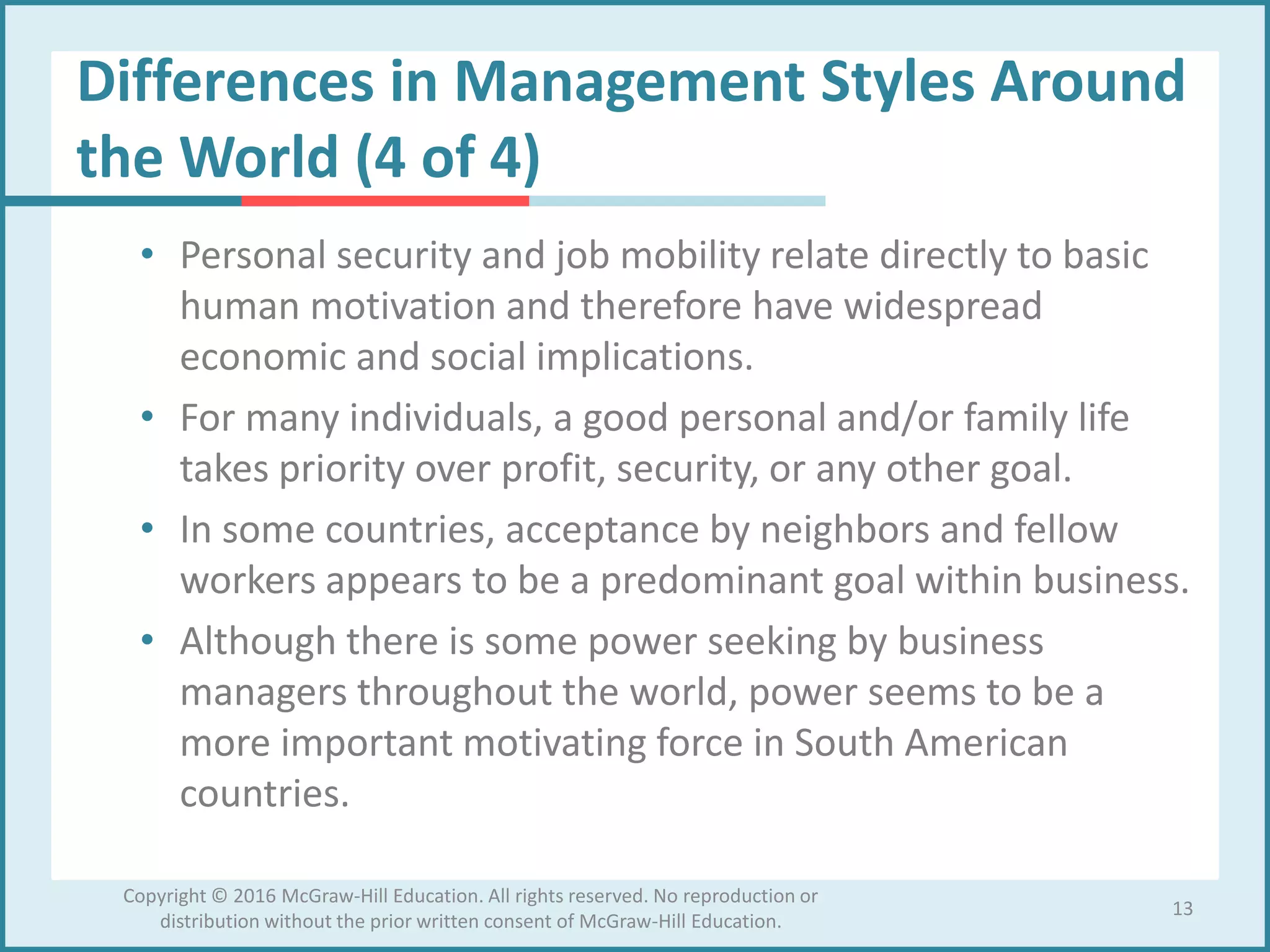
business ethics
LO5 The differences between relationship-oriented
and information-oriented cultures
2
Copyright © 2016 McGraw-Hill Education. All rights reserved. No reproduction or
distribution without the prior written consent of McGraw-Hill Education.
Business Customs in Global Marketing
 Business etiquette is largely driven by cultural
norms.
 Cultural analysis often pinpoints market
opportunities and gives companies a competitive
edge.
3
Copyright © 2016 McGraw-Hill Education. All rights reserved. No reproduction or
distribution without the prior written consent of McGraw-Hill Education.
Required Adaptation
 Adaptation is a key concept in international marketing.
 To successfully deal with individuals, firms, or authorities
in foreign countries, managers should exhibit:
• open tolerance
• flexibility
• humility
• justice/fairness
• ability to adjust to varying tempos
• curiosity/interest
• knowledge of the country
• liking for others
• ability to command respect
• ability to integrate oneself into the environment
4
Copyright © 2016 McGraw-Hill Education. All rights reserved. No reproduction or
distribution without the prior written consent of McGraw-Hill Education.
Cultural Imperatives, Electives,
and Exclusives (1 of 2)
 Cultural imperatives:
• business customs and expectations that must be met,
conformed to, recognized, and accommodated if
relationships are to be successful
 Cultural electives:
• areas of behavior or customs that cultural aliens may
wish to conform to or participate in but that are not
required
5
Copyright © 2016 McGraw-Hill Education. All rights reserved. No reproduction or
distribution without the prior written consent of McGraw-Hill Education.
Cultural Imperatives, Electives
and Exclusives (2 of 2)
 Cultural exclusives:
• customs or behavior patterns reserved exclusively for the
locals and from which the foreigner is barred and must not
participate
6
Copyright © 2016 McGraw-Hill Education. All rights reserved. No reproduction or
distribution without the prior written consent of McGraw-Hill Education.
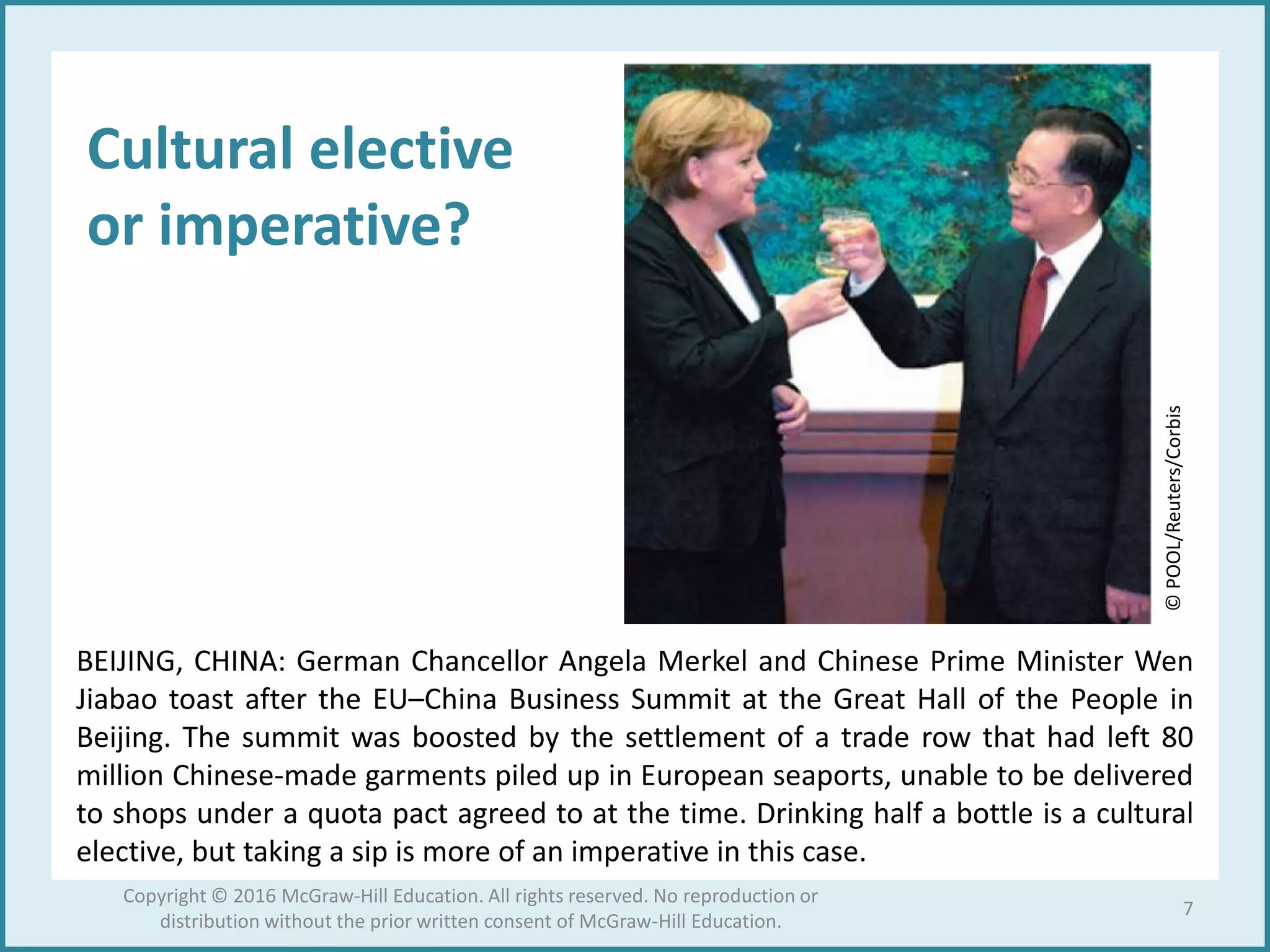
Cultural elective
or imperative?
BEIJING, CHINA: German Chancellor Angela Merkel and Chinese Prime Minister Wen
Jiabao toast after the EU–China Business Summit at the Great Hall of the People in
Beijing. The summit was boosted by the settlement of a trade row that had left 80
million Chinese-made garments piled up in European seaports, unable to be delivered
to shops under a quota pact agreed to at the time. Drinking half a bottle is a cultural
elective, but taking a sip is more of an imperative in this case.
©POOL/Reuters/Corbis
7
Copyright © 2016 McGraw-Hill Education. All rights reserved. No reproduction or
distribution without the prior written consent of McGraw-Hill Education.
American Culture and Management Style
 There are at least three reasons to focus briefly on
American culture and management style:
1. For Americans, it is important to be aware of the
elements of culture influencing decisions and behaviors.
2. For those new to American culture, it is useful to better
understand business associates from the U.S., as the U.S.
market is the biggest export market in the world.
3. Since the late 1990s, American business culture has been
exported around the world.
8
Copyright © 2016 McGraw-Hill Education. All rights reserved. No reproduction or
distribution without the prior written consent of McGraw-Hill Education.
The Impact of American Culture
 Ways in which U.S. culture has influenced management
style include, but are not limited to, the following:
1. “Master of destiny” viewpoint
2. Independent enterprise as the instrument of social action
3. Personnel selection and reward based on merit
4. Decisions based on objective analysis
5. Wide sharing in decision making
6. Never-ending quest for improvement
7. Competition produces efficiency
9
Copyright © 2016 McGraw-Hill Education. All rights reserved. No reproduction or
distribution without the prior written consent of McGraw-Hill Education.
Differences in Management Styles Around
the World (1 of 4)
 Authority and Decision Making
• In high-PDI countries subordinates are not likely to
contradict bosses, but in low-PDI countries they often do
• Three typical patterns exist:
1. Top-level management decisions
2. Decentralized decisions
3. Committee or group decisions
• Top-level management decision making is generally found
in situations in which family or close ownership gives
absolute control to owners, and businesses are small
enough to allow such centralized decision making.
10
Copyright © 2016 McGraw-Hill Education. All rights reserved. No reproduction or
distribution without the prior written consent of McGraw-Hill Education.
Differences in Management Styles Around
the World (2 of 4)
• Decentralized decision making allows executives at
different levels of management to exercise authority over
their own functions.
• Committee decision making is by group or consensus.
Committees may operate on a centralized or decentralized
basis, but the concept of committee management implies
something quite different from the individualized
functioning of the top management and decentralized
decision-making arrangements.
11
Copyright © 2016 McGraw-Hill Education. All rights reserved. No reproduction or
distribution without the prior written consent of McGraw-Hill Education.
Differences in Management Styles Around
the World (3 of 4)
 Management Objectives and Aspirations
• Security and mobility
• Personal life
• Affiliation and social acceptance
• Power and achievement
12
Copyright © 2016 McGraw-Hill Education. All rights reserved. No reproduction or
distribution without the prior written consent of McGraw-Hill Education.
Differences in Management Styles Around
the World (4 of 4)
• Personal security and job mobility relate directly to basic
human motivation and therefore have widespread
economic and social implications.
• For many individuals, a good personal and/or family life
takes priority over profit, security, or any other goal.
• In some countries, acceptance by neighbors and fellow
workers appears to be a predominant goal within business.
• Although there is some power seeking by business
managers throughout the world, power seems to be a
more important motivating force in South American
countries.
13
Copyright © 2016 McGraw-Hill Education. All rights reserved. No reproduction or
distribution without the prior written consent of McGraw-Hill Education.
Exhibit 5.1
Annual Hours Worked
Source: OECD, Labor Market Indicators, 2012.
2000 2010
United Kingdom 1700 1647
Canada 1775 1702
Germany 1473 1419
Netherlands 1435 1377
Japan 1821 1733
Norway 1455 1414
United States 1814 1778
S. Korea 2512 2193
Mexico 1888 1866
Italy 1861 1778
14
Copyright © 2016 McGraw-Hill Education. All rights reserved. No reproduction or
distribution without the prior written consent of McGraw-Hill Education.
Communication Styles
 Differences in Communication Styles
• Face-to-face communication
• Internet communication
 According to Edward T. Hall, the symbolic meanings of time,
space, things, friendships, and agreements vary across
cultures
 Hall places eleven cultures along a high-context/low-context
continuum
 Communication in a high-context culture depends heavily on
the contextual (who says it, when it is said, how it is said) or
nonverbal aspects of communication
 Communication in a low-context culture depends more on
explicit, verbally expressed communications
15
Copyright © 2016 McGraw-Hill Education. All rights reserved. No reproduction or
distribution without the prior written consent of McGraw-Hill Education.
Note: Patterned after E. T. Hall.
Exhibit 5.2
Context, Communication, and Cultures: Edward Hall’s Scale
16
Copyright © 2016 McGraw-Hill Education. All rights reserved. No reproduction or
distribution without the prior written consent of McGraw-Hill Education.
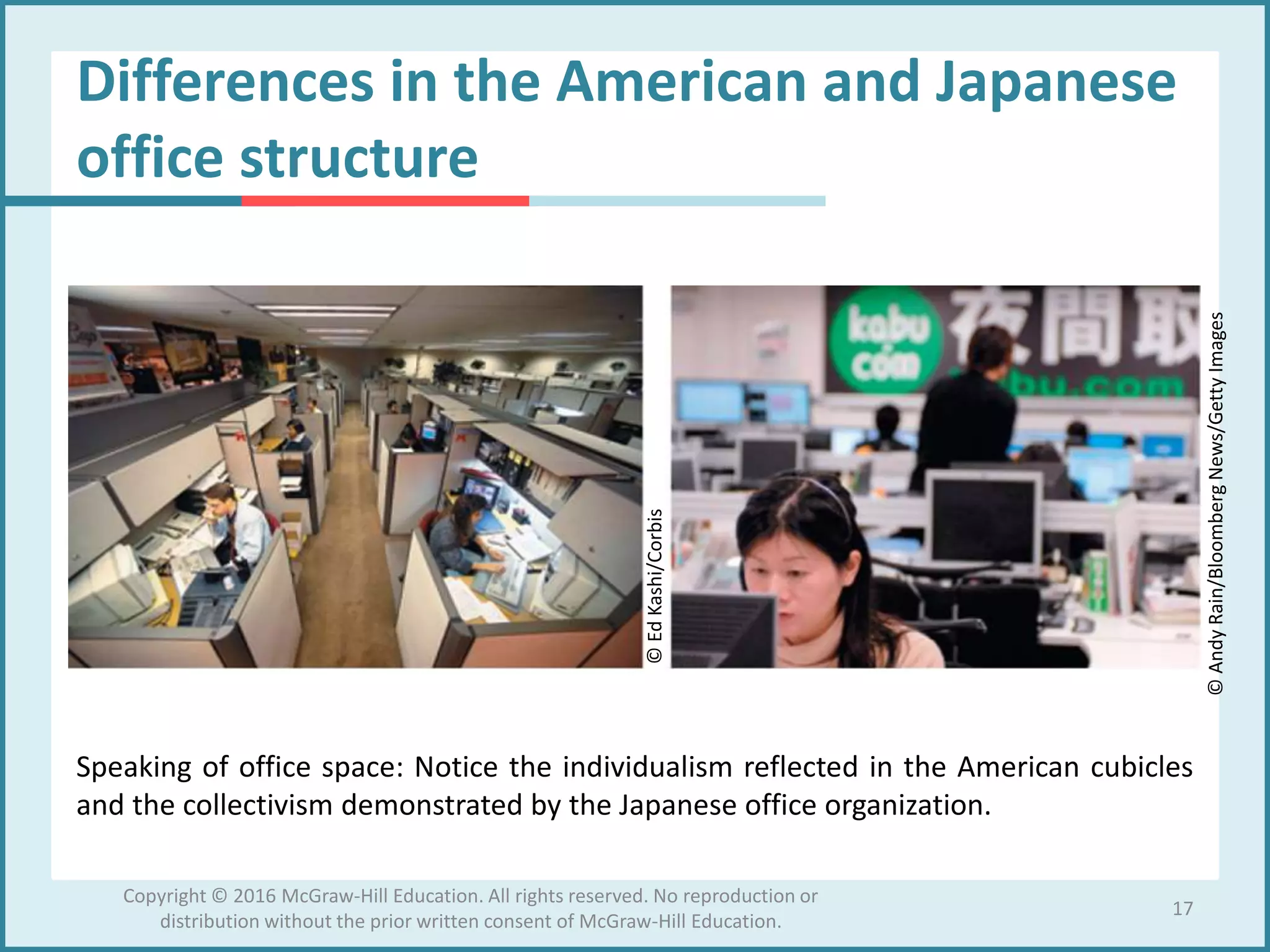
Differences in the American and Japanese
office structure
Speaking of office space: Notice the individualism reflected in the American cubicles
and the collectivism demonstrated by the Japanese office organization.
©EdKashi/Corbis
©AndyRain/BloombergNews/GettyImages
17
Copyright © 2016 McGraw-Hill Education. All rights reserved. No reproduction or
distribution without the prior written consent of McGraw-Hill Education.
Formality and Tempo
 Level of formality in addressing business clients by
first name
 Level of formality in addressing your boss by first
name
 Tempo or speed in getting “down to business”
 Perception of time varies in many cultures
18
Copyright © 2016 McGraw-Hill Education. All rights reserved. No reproduction or
distribution without the prior written consent of McGraw-Hill Education.
P-Time versus M-Time
 M-time, or monochronic time, typifies most North Americans,
Swiss, Germans, and Scandinavians.
 Monochronic time divides time into small units and is concerned
with promptness. M-time is used in a linear way, and it is
experienced as almost tangible, in that one saves time, wastes time,
bides time, spends time, and loses time.
 Most low-context cultures operate on M-time, concentrating on
one thing at a time.
 P-time, or polychronic time, is more dominant in high-context
cultures.
 P-time is characterized by multi-tasking and by “a great involvement
with people.”
19
Copyright © 2016 McGraw-Hill Education. All rights reserved. No reproduction or
distribution without the prior written consent of McGraw-Hill Education.
Overall
Pace
Country Walking 60
Feet
Postal
Service
Public
Clocks
1 Switzerland 3 2 1
2 Ireland 1 3 11
3 Germany 5 1 8
4 Japan 7 4 6
5 Italy 10 12 2
6 England 4 9 13
7 Sweden 13 5 7
8 Austria 23 8 9
9 Netherlands 2 14 25
10 Hong Kong 14 6 14
11 France 8 18 10
Exhibit 5.3
(1 of 3)
Speed Is
Relative
Rank of 31 countries for overall pace of life [combination of three measures: (1) minutes
downtown pedestrians take to walk 60 feet, (2) minutes it takes a postal clerk to
complete a stamp-purchase transaction, and (3) accuracy in minutes of public clocks].
Source: Robert
Levine, “The Pace
of Life in 31
Countries,”
American
Demographics,
November 1997.
Reprinted with
permission of
Robert Levine.
20
Copyright © 2016 McGraw-Hill Education. All rights reserved. No reproduction or
distribution without the prior written consent of McGraw-Hill Education.
Source: Robert Levine,
“The Pace of Life in 31
Countries,” American
Demographics,
November 1997.
Reprinted with
permission of Robert
Levine.
Overall
Pace
Country Walking 60
Feet
Postal
Service
Public
Clocks
12 Poland 12 15 8
13 Costa Rica 16 10 15
14 Taiwan 18 7 21
15 Singapore 25 11 4
16 United
States
6 23 20
17 Canada 11 21 22
18 South Korea 20 20 16
19 Hungary 19 19 18
20 Czech
Republic
21 17 23
21 Greece 14 13 29
Exhibit 5.3
(2 of 3)
Speed Is
Relative
Rank of 31 countries for overall pace of life [combination of three measures: (1) minutes
downtown pedestrians take to walk 60 feet, (2) minutes it takes a postal clerk to
complete a stamp-purchase transaction, and (3) accuracy in minutes of public clocks].
21
Copyright © 2016 McGraw-Hill Education. All rights reserved. No reproduction or
distribution without the prior written consent of McGraw-Hill Education.
Source: Robert Levine,
“The Pace of Life in 31
Countries,” American
Demographics, November
1997. Reprinted with
permission of Robert
Levine.
Overall
Pace
Country Walking 60
Feet
Postal
Service
Public
Clocks
22 Kenya 9 30 24
23 China 24 25 12
24 Bulgaria 27 22 17
25 Romania 30 29 5
26 Jordan 28 27 19
27 Syria 29 28 27
28 El
Salvador
22 16 31
29 Brazil 31 24 28
30 Indonesia 26 26 30
31 Mexico 17 31 26
Exhibit 5.3
(3 of 3)
Speed Is
Relative
Rank of 31 countries for overall pace of life [combination of three measures: (1) minutes
downtown pedestrians take to walk 60 feet, (2) minutes it takes a postal clerk to
complete a stamp-purchase transaction, and (3) accuracy in minutes of public clocks].
22
Copyright © 2016 McGraw-Hill Education. All rights reserved. No reproduction or
distribution without the prior written consent of McGraw-Hill Education.
Negotiations Emphasis
 Differences with respect to the product, its price and
terms, services associated with the product, and finally,
friendship between vendors and customers
 Negotiating process is complicated, and the risk of
misunderstanding increases when negotiating with
someone from another culture
 Attitudes brought to the negotiating table by each
individual are affected by many cultural factors and
customs often unknown to the other participants and
perhaps unrecognized by the individuals themselves
23
Copyright © 2016 McGraw-Hill Education. All rights reserved. No reproduction or
distribution without the prior written consent of McGraw-Hill Education.
Market Orientation
 American companies are embracing the market
orientation philosophy
 Other countries are still in the traditional production,
product, and selling orientations
24
Copyright © 2016 McGraw-Hill Education. All rights reserved. No reproduction or
distribution without the prior written consent of McGraw-Hill Education.
Gender Bias in International Business
 The gender bias against women managers exists in
some countries
• Women are not easily accepted in upper-level
management roles in Asia, the Middle East, and Latin
America (although this is changing)
 Gender bias poses significant challenges in cross-
cultural negotiations
25
Copyright © 2016 McGraw-Hill Education. All rights reserved. No reproduction or
distribution without the prior written consent of McGraw-Hill Education.
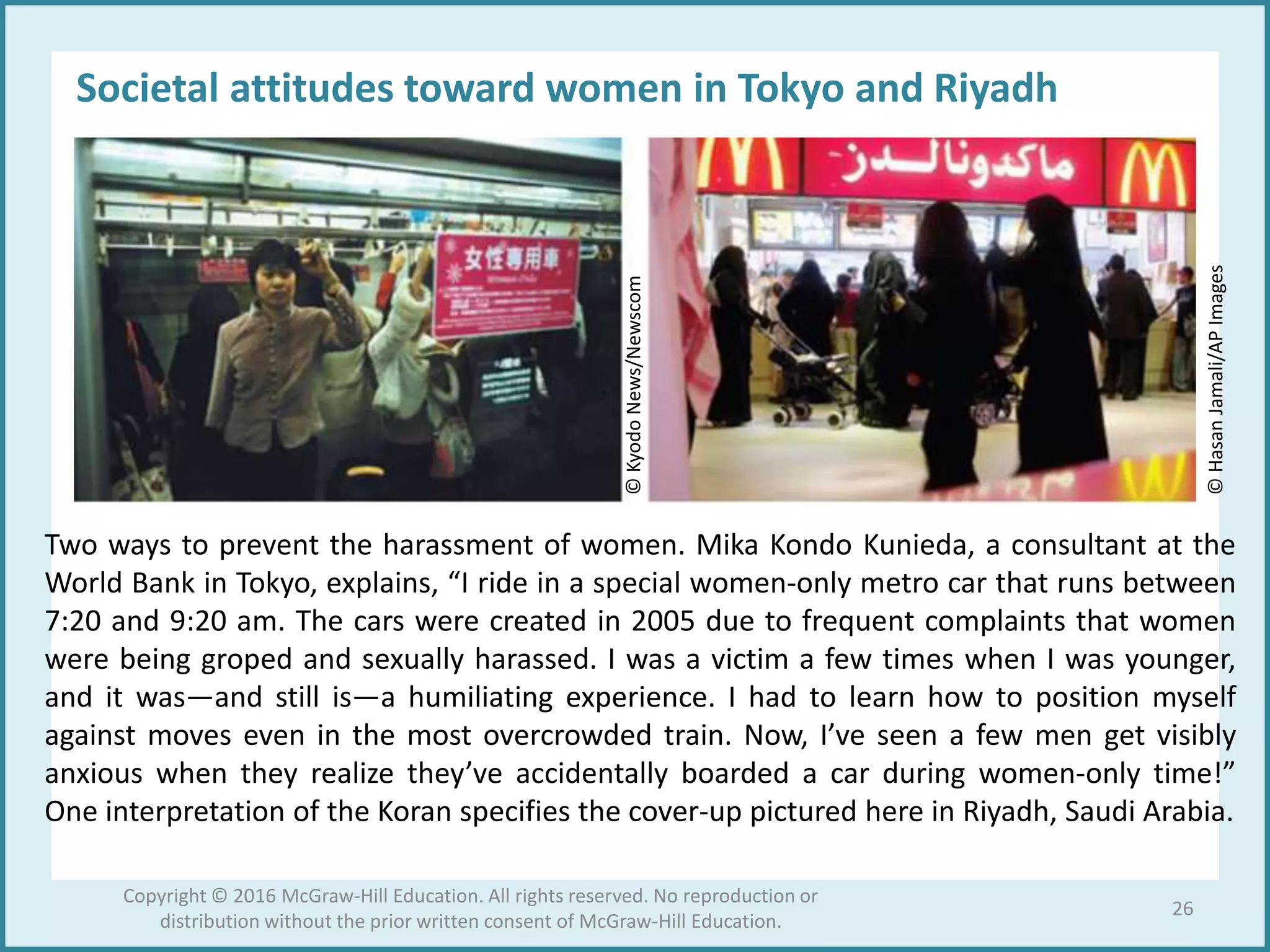
Societal attitudes toward women in Tokyo and Riyadh
Two ways to prevent the harassment of women. Mika Kondo Kunieda, a consultant at the
World Bank in Tokyo, explains, “I ride in a special women-only metro car that runs between
7:20 and 9:20 am. The cars were created in 2005 due to frequent complaints that women
were being groped and sexually harassed. I was a victim a few times when I was younger,
and it was—and still is—a humiliating experience. I had to learn how to position myself
against moves even in the most overcrowded train. Now, I’ve seen a few men get visibly
anxious when they realize they’ve accidentally boarded a car during women-only time!”
One interpretation of the Koran specifies the cover-up pictured here in Riyadh, Saudi Arabia.
©KyodoNews/Newscom
©HasanJamali/APImages
26
Copyright © 2016 McGraw-Hill Education. All rights reserved. No reproduction or
distribution without the prior written consent of McGraw-Hill Education.
Source: “All Aboard: The World in 2012,” The Economist. Copyright © The Economist Newspaper Limited,
London, November 17, 2011.
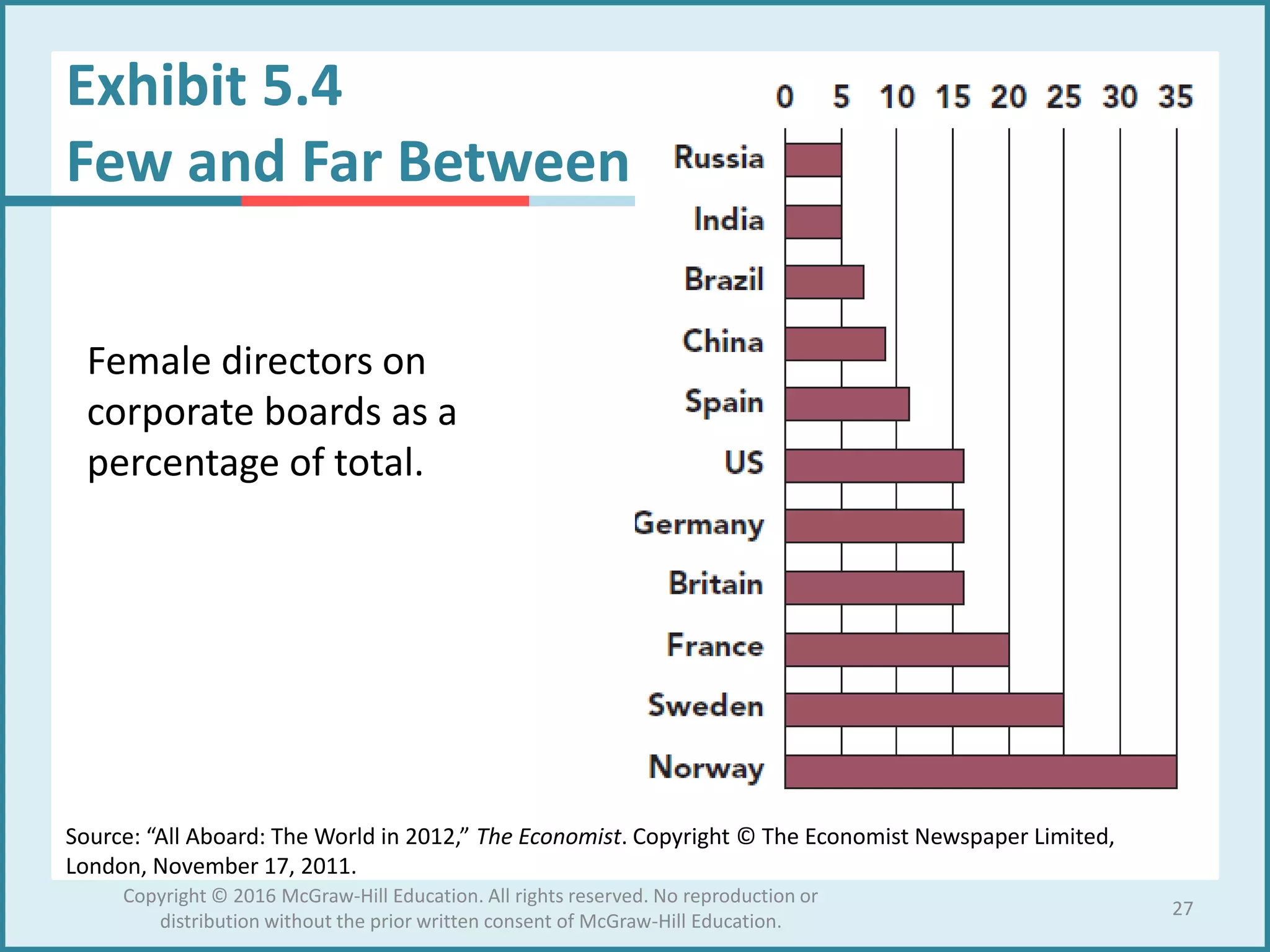
Exhibit 5.4
Few and Far Between
Female directors on
corporate boards as a
percentage of total.
27
Copyright © 2016 McGraw-Hill Education. All rights reserved. No reproduction or
distribution without the prior written consent of McGraw-Hill Education.
Business Ethics (1 of 2)
 Business ethics is complex in the international
marketplace because value judgments differ widely
among culturally diverse groups.
 Corruption is varyingly defined from culture to
culture.
28
Copyright © 2016 McGraw-Hill Education. All rights reserved. No reproduction or
distribution without the prior written consent of McGraw-Hill Education.
Business Ethics (2 of 2)
 Different levels of corruption, bribery, and fraud exist
worldwide.
 Bribery creates a major conflict between ethics and
profitability.
 The international organization Transparency
International is curbing corruption through
international and national coalitions encouraging
governments to establish and implement effective
laws, policies, and anti-corruption programs.
29
Copyright © 2016 McGraw-Hill Education. All rights reserved. No reproduction or
distribution without the prior written consent of McGraw-Hill Education.
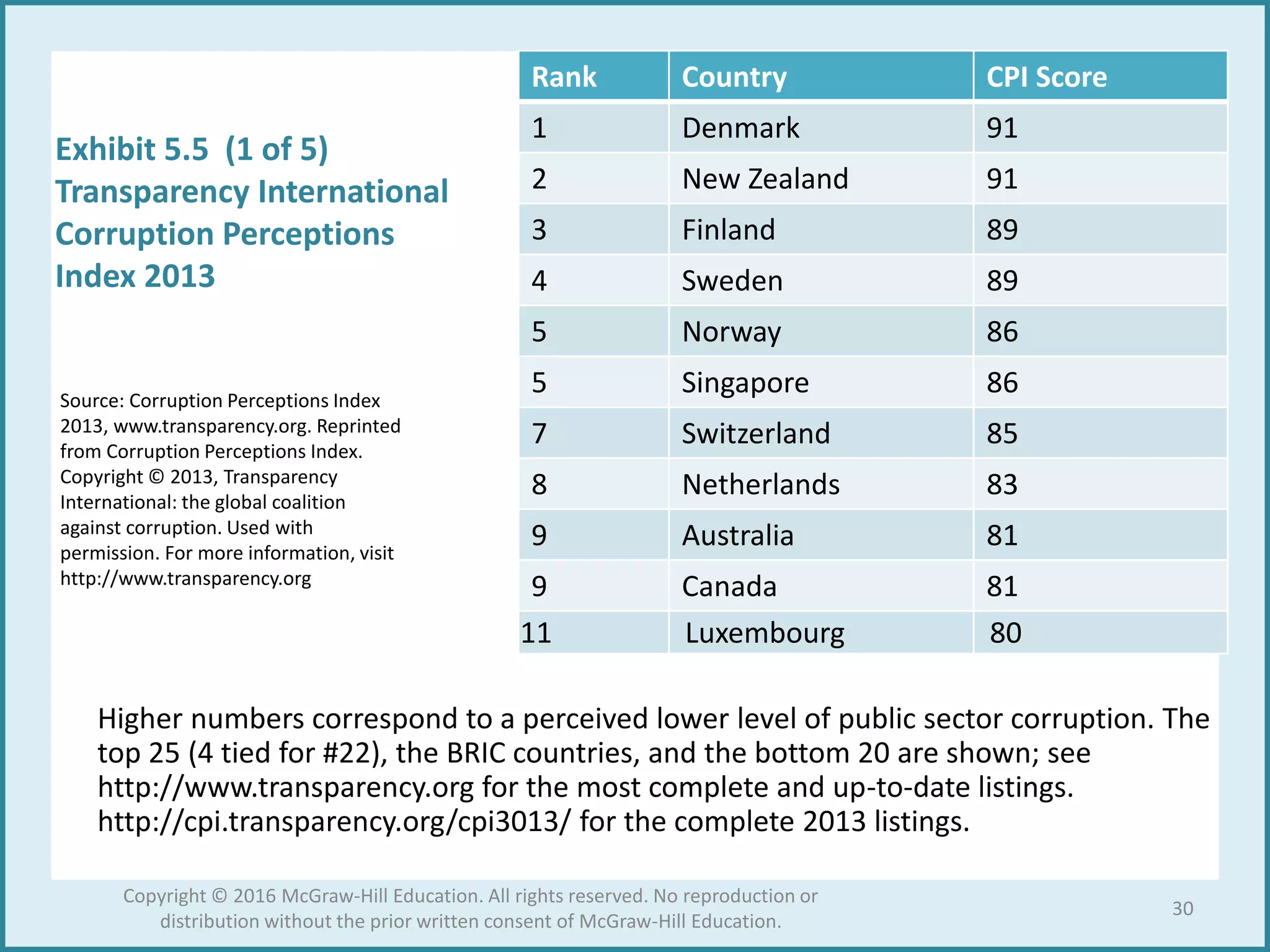
Rank Country CPI Score
1 Denmark 91
2 New Zealand 91
3 Finland 89
4 Sweden 89
5 Norway 86
5 Singapore 86
7 Switzerland 85
8 Netherlands 83
9 Australia 81
9 Canada 81
11 Luxembourg 80
Source: Corruption Perceptions Index
2013, www.transparency.org. Reprinted
from Corruption Perceptions Index.
Copyright © 2013, Transparency
International: the global coalition
against corruption. Used with
permission. For more information, visit
http://www.transparency.org
Exhibit 5.5 (1 of 5)
Transparency International
Corruption Perceptions
Index 2013
Higher numbers correspond to a perceived lower level of public sector corruption. The
top 25 (4 tied for #22), the BRIC countries, and the bottom 20 are shown; see
http://www.transparency.org for the most complete and up-to-date listings.
http://cpi.transparency.org/cpi3013/ for the complete 2013 listings.
30
Copyright © 2016 McGraw-Hill Education. All rights reserved. No reproduction or
distribution without the prior written consent of McGraw-Hill Education.
Rank Country CPI Score
12 Germany 78
12 Iceland 78
14 United Kingdom 76
15 Barbados 75
15 Belgium 75
15 Hong Kong 75
18 Japan 74
19 United States 73
19 Uruguay 73
21 Ireland 72
22 Bahamas 71
Source: Corruption Perceptions
Index 2013, www.transparency.org.
Reprinted from Corruption
Perceptions Index. Copyright ©
2013, Transparency International:
the global coalition against
corruption. Used with permission.
For more information, visit
http://www.transparency.org
Exhibit 5.5 (2 of 5)
Transparency
International
Corruption
Perceptions Index
2013
Higher numbers correspond to a perceived lower level of public sector corruption.
The top 25 (4 tied for #22), the BRIC countries, and the bottom 20 are shown; see
http://www.transparency.org for the most complete and up-to-date listings.
http://cpi.transparency.org/cpi3013/ for the complete 2013 listings.
31
Copyright © 2016 McGraw-Hill Education. All rights reserved. No reproduction or
distribution without the prior written consent of McGraw-Hill Education.
Rank Country CPI Score
22 Chile 71
22 France 71
22 Santa Lucia 71
BRIC Countries
72 Brazil 42
80 China 40
94 India 36
127 Russia 28
Bottom 20
153 Angola 23
154 Republic of Congo 22
Source: Corruption Perceptions
Index 2013, www.transparency.org.
Reprinted from Corruption
Perceptions Index. Copyright ©
2013, Transparency International:
the global coalition against
corruption. Used with permission.
For more information, visit
http://www.transparency.org
Exhibit 5.5 (3 of 5)
Transparency
International
Corruption
Perceptions Index
2013
Higher numbers correspond to a perceived lower level of public sector corruption.
The top 25 (4 tied for #22), the BRIC countries, and the bottom 20 are shown; see
http://www.transparency.org for the most complete and up-to-date listings.
http://cpi.transparency.org/cpi3013/ for the complete 2013 listings.
32
Copyright © 2016 McGraw-Hill Education. All rights reserved. No reproduction or
distribution without the prior written consent of McGraw-Hill Education.
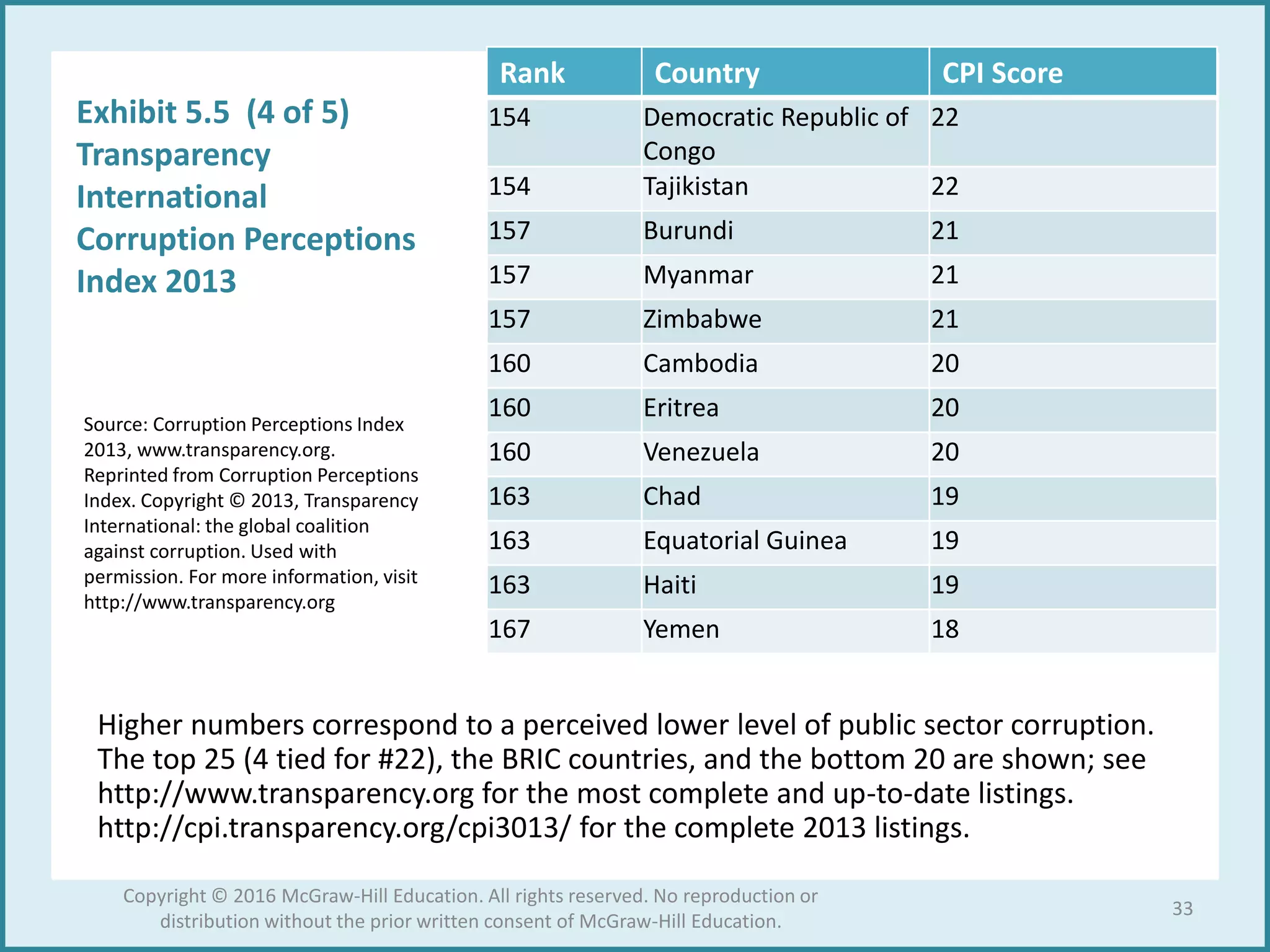
Rank Country CPI Score
154 Democratic Republic of
Congo
22
154 Tajikistan 22
157 Burundi 21
157 Myanmar 21
157 Zimbabwe 21
160 Cambodia 20
160 Eritrea 20
160 Venezuela 20
163 Chad 19
163 Equatorial Guinea 19
163 Haiti 19
167 Yemen 18
Source: Corruption Perceptions Index
2013, www.transparency.org.
Reprinted from Corruption Perceptions
Index. Copyright © 2013, Transparency
International: the global coalition
against corruption. Used with
permission. For more information, visit
http://www.transparency.org
Exhibit 5.5 (4 of 5)
Transparency
International
Corruption Perceptions
Index 2013
Higher numbers correspond to a perceived lower level of public sector corruption.
The top 25 (4 tied for #22), the BRIC countries, and the bottom 20 are shown; see
http://www.transparency.org for the most complete and up-to-date listings.
http://cpi.transparency.org/cpi3013/ for the complete 2013 listings.
33
Copyright © 2016 McGraw-Hill Education. All rights reserved. No reproduction or
distribution without the prior written consent of McGraw-Hill Education.
Rank Country CPI Score
168 Syria 17
168 Turkmenistan 17
168 Uzbekistan 17
171 Iraq 16
172 Libya 15
173 South Sudan 14
174 Sudan 11
175 Afghanistan 8
175 North Korea 8
175 Somalia 8
Source: Corruption Perceptions Index
2013, www.transparency.org. Reprinted
from Corruption Perceptions Index.
Copyright © 2013, Transparency
International: the global coalition against
corruption. Used with permission. For
more information, visit
http://www.transparency.org
Exhibit 5.5 (5 of 5)
Transparency
International
Corruption
Perceptions Index
2013
Higher numbers correspond to a perceived lower level of public sector corruption.
The top 25 (4 tied for #22), the BRIC countries, and the bottom 20 are shown; see
http://www.transparency.org for the most complete and up-to-date listings.
http://cpi.transparency.org/cpi3013/ for the complete 2013 listings.
34
Copyright © 2016 McGraw-Hill Education. All rights reserved. No reproduction or
distribution without the prior written consent of McGraw-Hill Education.
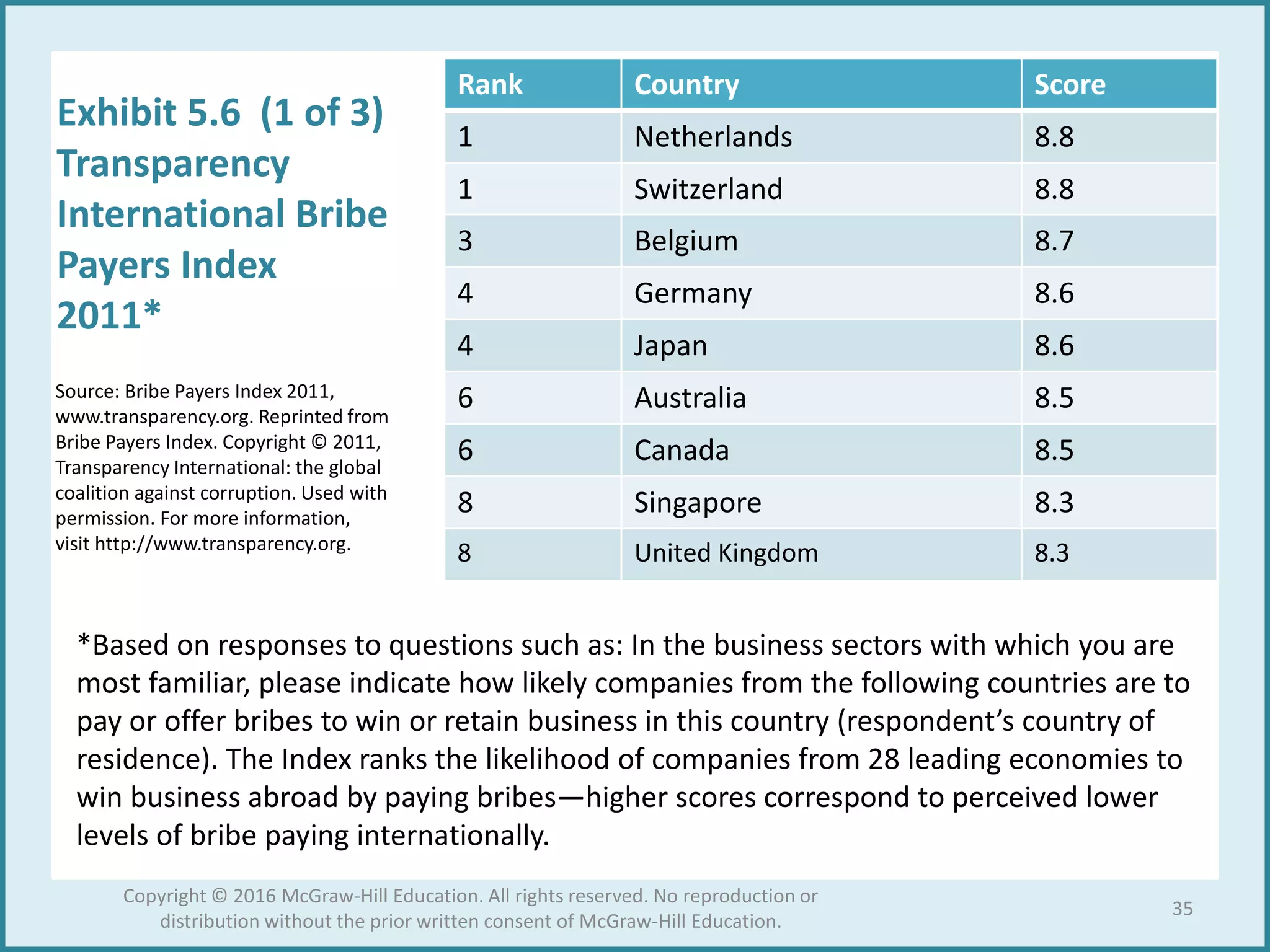
Rank Country Score
1 Netherlands 8.8
1 Switzerland 8.8
3 Belgium 8.7
4 Germany 8.6
4 Japan 8.6
6 Australia 8.5
6 Canada 8.5
8 Singapore 8.3
8 United Kingdom 8.3
Source: Bribe Payers Index 2011,
www.transparency.org. Reprinted from
Bribe Payers Index. Copyright © 2011,
Transparency International: the global
coalition against corruption. Used with
permission. For more information,
visit http://www.transparency.org.
Exhibit 5.6 (1 of 3)
Transparency
International Bribe
Payers Index
2011*
*Based on responses to questions such as: In the business sectors with which you are
most familiar, please indicate how likely companies from the following countries are to
pay or offer bribes to win or retain business in this country (respondent’s country of
residence). The Index ranks the likelihood of companies from 28 leading economies to
win business abroad by paying bribes—higher scores correspond to perceived lower
levels of bribe paying internationally.
35
Copyright © 2016 McGraw-Hill Education. All rights reserved. No reproduction or
distribution without the prior written consent of McGraw-Hill Education.
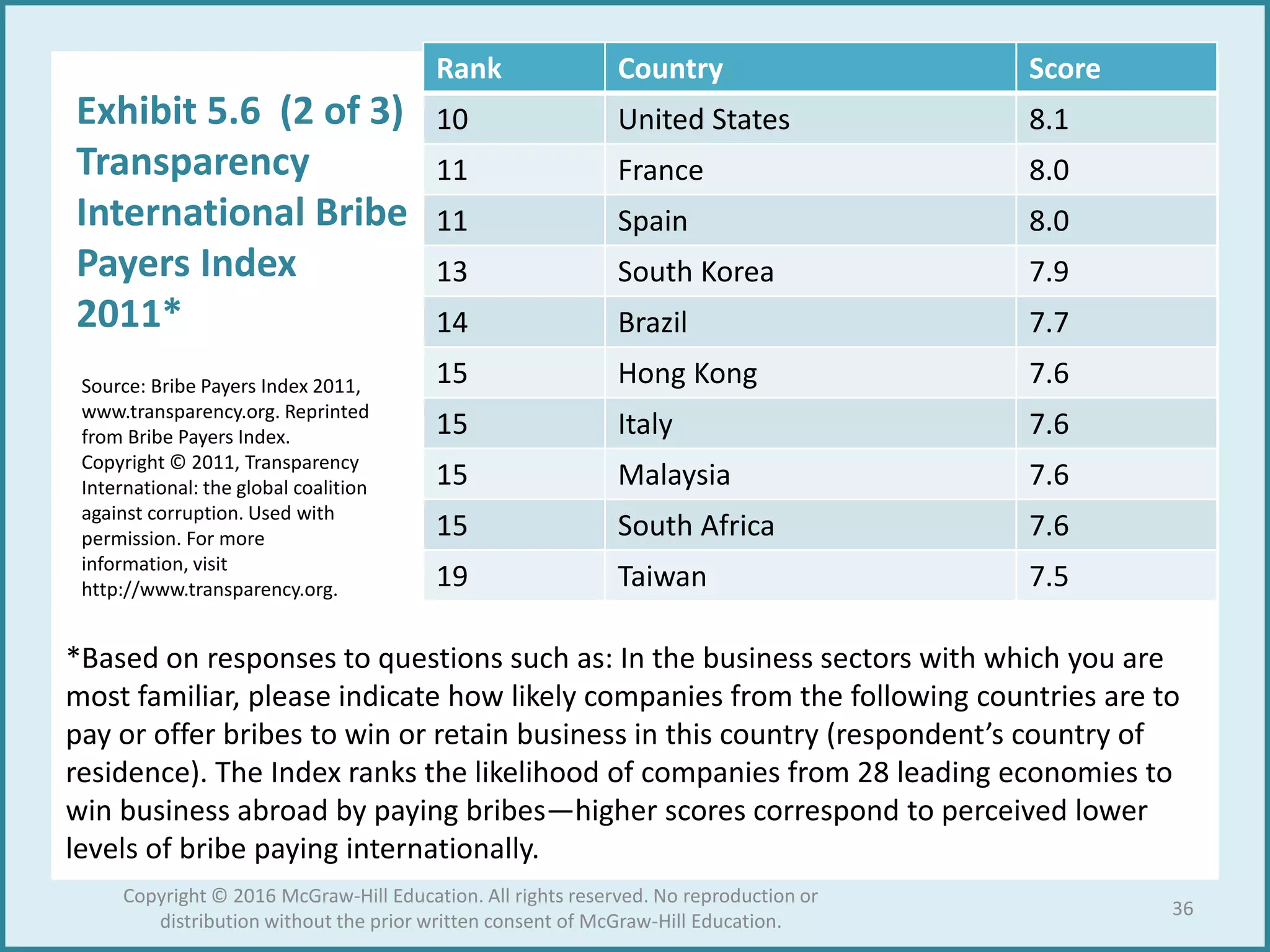
Rank Country Score
10 United States 8.1
11 France 8.0
11 Spain 8.0
13 South Korea 7.9
14 Brazil 7.7
15 Hong Kong 7.6
15 Italy 7.6
15 Malaysia 7.6
15 South Africa 7.6
19 Taiwan 7.5
Source: Bribe Payers Index 2011,
www.transparency.org. Reprinted
from Bribe Payers Index.
Copyright © 2011, Transparency
International: the global coalition
against corruption. Used with
permission. For more
information, visit
http://www.transparency.org.
Exhibit 5.6 (2 of 3)
Transparency
International Bribe
Payers Index
2011*
*Based on responses to questions such as: In the business sectors with which you are
most familiar, please indicate how likely companies from the following countries are to
pay or offer bribes to win or retain business in this country (respondent’s country of
residence). The Index ranks the likelihood of companies from 28 leading economies to
win business abroad by paying bribes—higher scores correspond to perceived lower
levels of bribe paying internationally.
36
Copyright © 2016 McGraw-Hill Education. All rights reserved. No reproduction or
distribution without the prior written consent of McGraw-Hill Education.
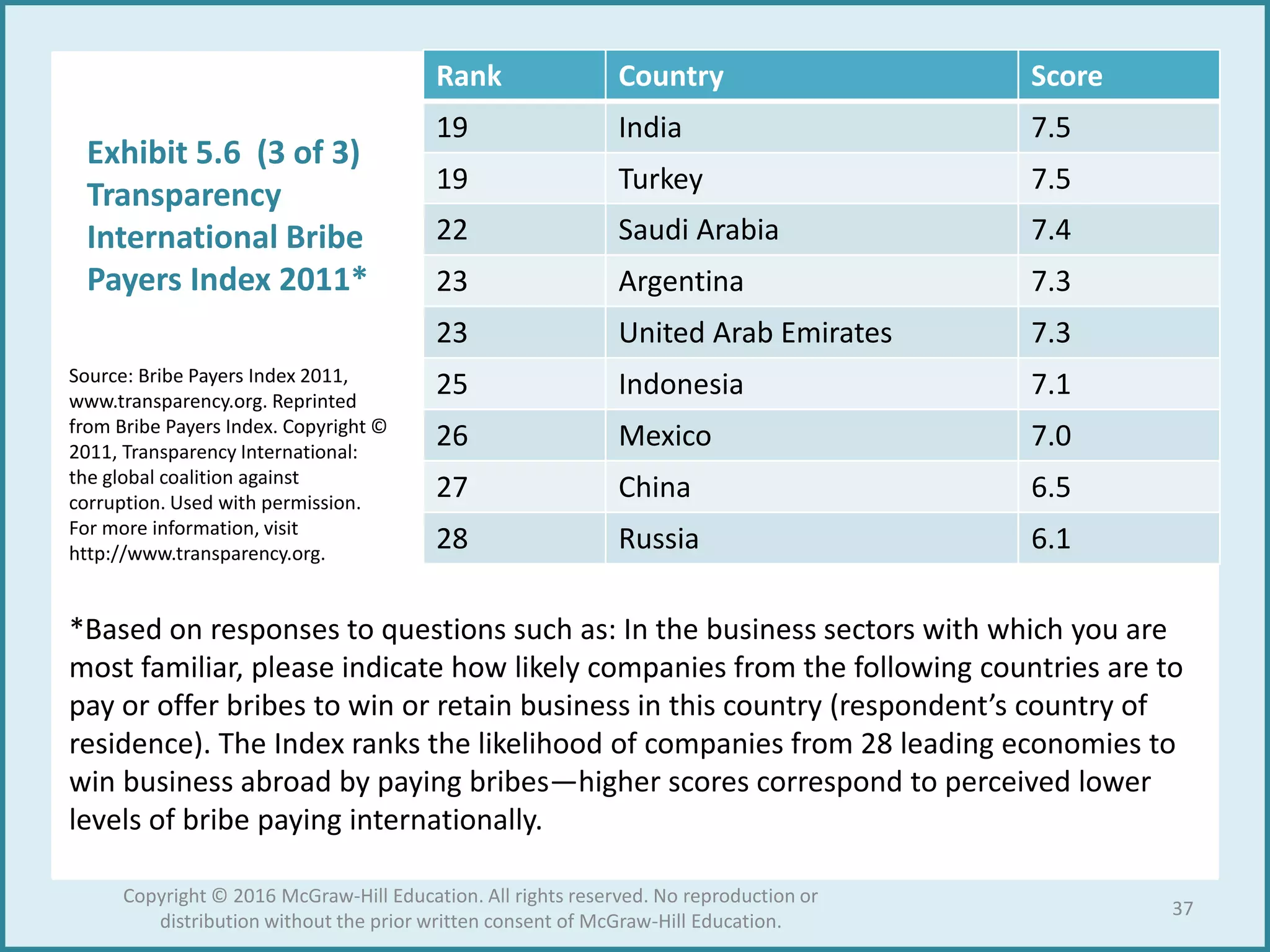
Rank Country Score
19 India 7.5
19 Turkey 7.5
22 Saudi Arabia 7.4
23 Argentina 7.3
23 United Arab Emirates 7.3
25 Indonesia 7.1
26 Mexico 7.0
27 China 6.5
28 Russia 6.1
Source: Bribe Payers Index 2011,
www.transparency.org. Reprinted
from Bribe Payers Index. Copyright ©
2011, Transparency International:
the global coalition against
corruption. Used with permission.
For more information, visit
http://www.transparency.org.
Exhibit 5.6 (3 of 3)
Transparency
International Bribe
Payers Index 2011*
*Based on responses to questions such as: In the business sectors with which you are
most familiar, please indicate how likely companies from the following countries are to
pay or offer bribes to win or retain business in this country (respondent’s country of
residence). The Index ranks the likelihood of companies from 28 leading economies to
win business abroad by paying bribes—higher scores correspond to perceived lower
levels of bribe paying internationally.
37
Copyright © 2016 McGraw-Hill Education. All rights reserved. No reproduction or
distribution without the prior written consent of McGraw-Hill Education.
Bribery: Variations on a Theme (1 of 3)
 Bribery
• Voluntarily offered payment by someone seeking
unlawful advantage
 Extortion
• Payments are extracted under duress by someone in
authority from a person seeking only what they are
lawfully entitled to
38
Copyright © 2016 McGraw-Hill Education. All rights reserved. No reproduction or
distribution without the prior written consent of McGraw-Hill Education.
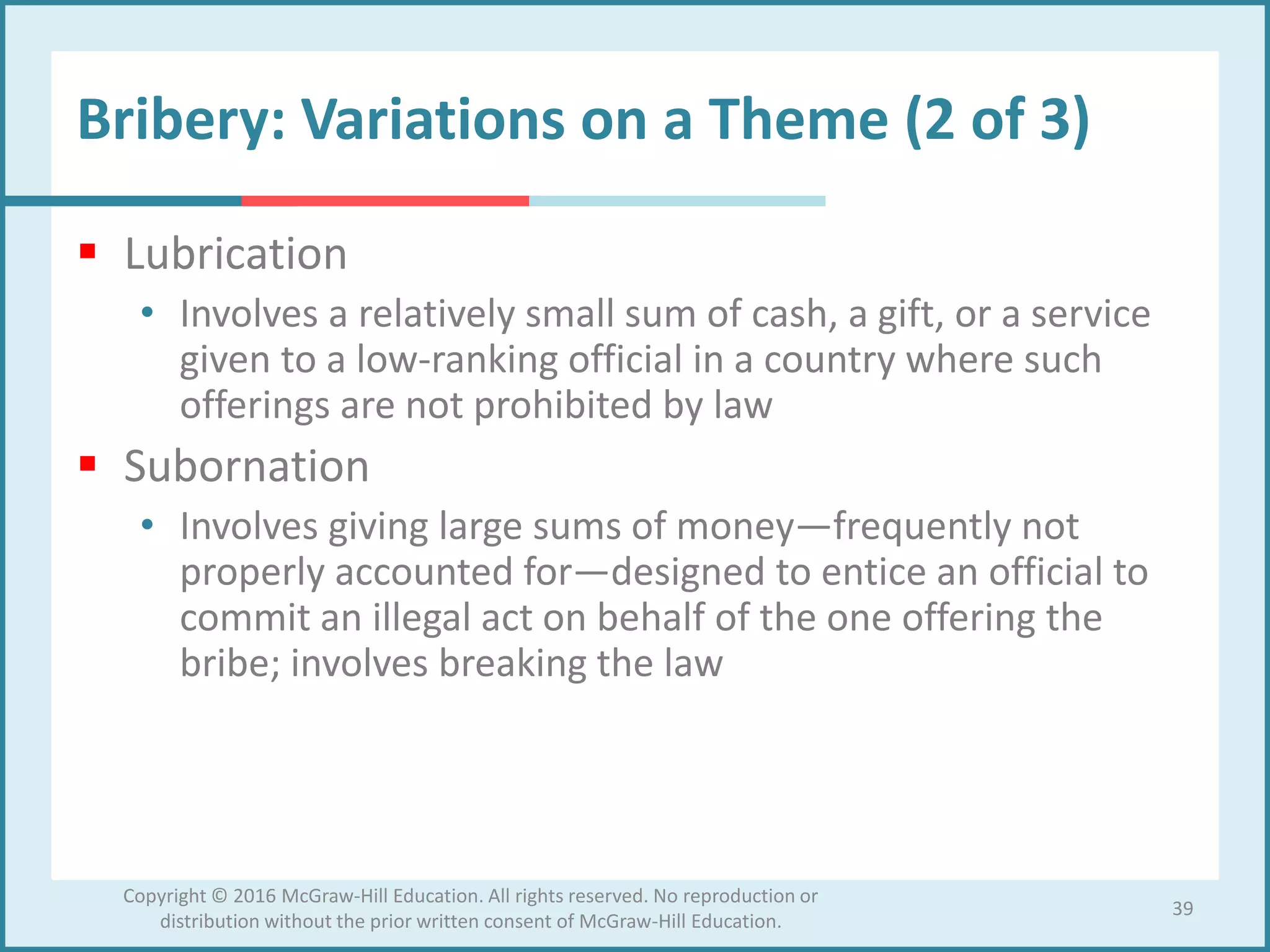
Bribery: Variations on a Theme (2 of 3)
 Lubrication
• Involves a relatively small sum of cash, a gift, or a service
given to a low-ranking official in a country where such
offerings are not prohibited by law
 Subornation
• Involves giving large sums of money—frequently not
properly accounted for—designed to entice an official to
commit an illegal act on behalf of the one offering the
bribe; involves breaking the law
39
Copyright © 2016 McGraw-Hill Education. All rights reserved. No reproduction or
distribution without the prior written consent of McGraw-Hill Education.
Bribery: Variations on a Theme (3 of 3)
 Agent Fees
• When a businessperson is uncertain of a country’s rules
and regulations, an agent may be hired to represent the
company in that country
• It’s often a legal and useful procedure
• If a part of that agent’s fee is used to pay bribes, the
intermediary’s fees are being used unlawfully
40
Copyright © 2016 McGraw-Hill Education. All rights reserved. No reproduction or
distribution without the prior written consent of McGraw-Hill Education.
Ethical Decisions
 Difficulties arise in making decisions, establishing
policies, and engaging in business operations in five
broad areas:
• employment practices and policies
• consumer protection
• environmental protection
• political payments and involvement in political affairs of
the country
• basic human rights and fundamental freedoms
41
Copyright © 2016 McGraw-Hill Education. All rights reserved. No reproduction or
distribution without the prior written consent of McGraw-Hill Education.
A Framework for Ethical Principles
(1) Utilitarian ethics
Does the action optimize the “common good” or
benefits of all constituencies? And, who are the
pertinent constituencies?
(2) Rights of the parties
Does the action respect the rights of the individuals
involved?
(3) Justice or fairness
Does the action respect the canons of justice or
fairness to all parties involved?
42
Copyright © 2016 McGraw-Hill Education. All rights reserved. No reproduction or
distribution without the prior written consent of McGraw-Hill Education.
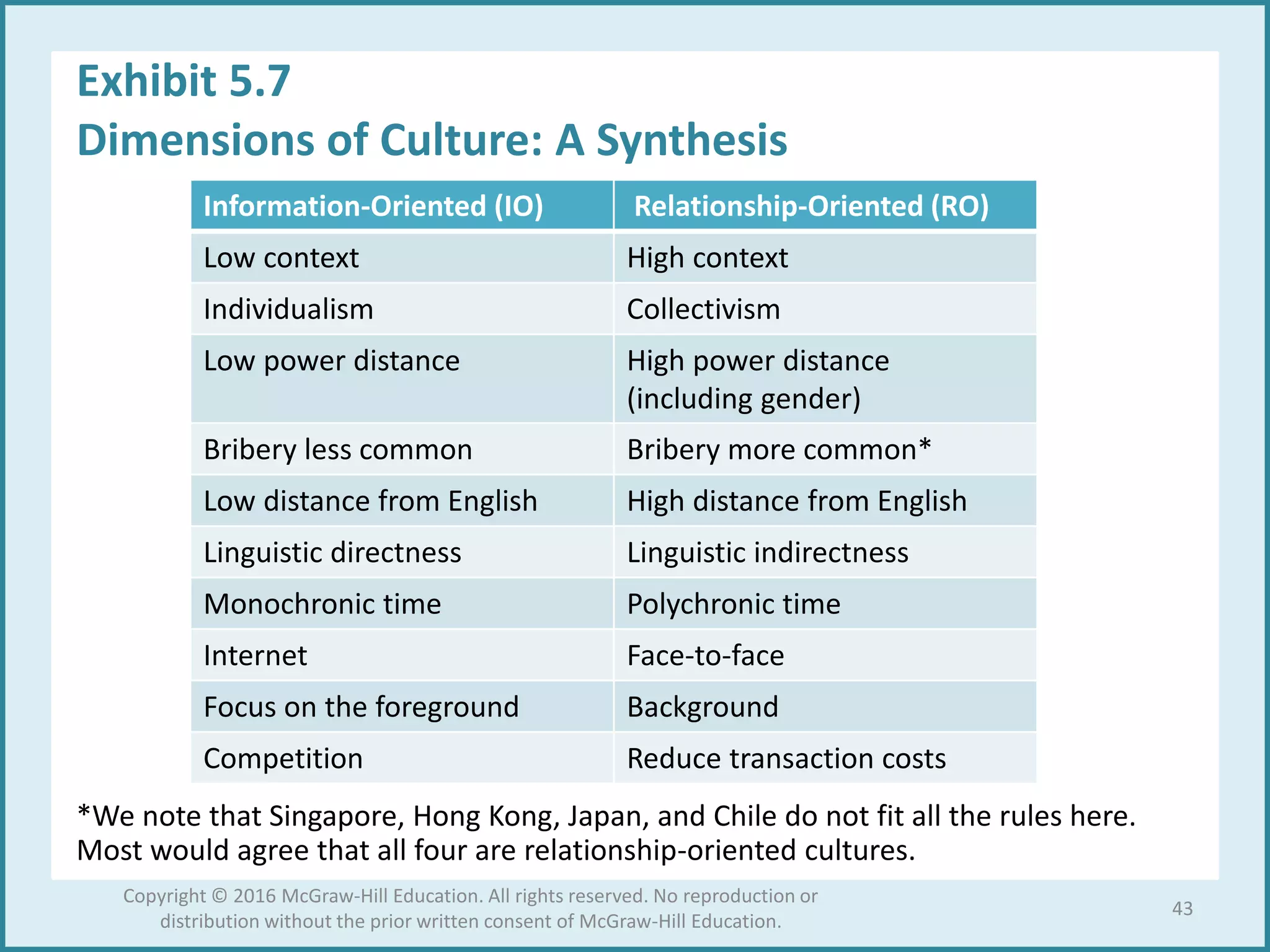
Information-Oriented (IO) Relationship-Oriented (RO)
Low context High context
Individualism Collectivism
Low power distance High power distance
(including gender)
Bribery less common Bribery more common*
Low distance from English High distance from English
Linguistic directness Linguistic indirectness
Monochronic time Polychronic time
Internet Face-to-face
Focus on the foreground Background
Competition Reduce transaction costs
Exhibit 5.7
Dimensions of Culture: A Synthesis
*We note that Singapore, Hong Kong, Japan, and Chile do not fit all the rules here.
Most would agree that all four are relationship-oriented cultures.
43
Copyright © 2016 McGraw-Hill Education. All rights reserved. No reproduction or
distribution without the prior written consent of McGraw-Hill Education.
Summary (1 of 2)
 Management styles differ around the world. Some cultures
appear to emphasize the importance of information and
competition, while others focus more on relationships and
transaction cost reductions.
 Business behavior is derived in large part from the basic
cultural environment in which the business operates and, as
such, is subject to the extreme diversity encountered among
various cultures and subcultures.
 Environmental considerations significantly affect the
attitudes, behavior, and outlook of foreign businesspeople.
44
Copyright © 2016 McGraw-Hill Education. All rights reserved. No reproduction or
distribution without the prior written consent of McGraw-Hill Education.
Summary (2 of 2)
 Varying motivational patterns inevitably affect
methods of doing business in different countries.
 International variation characterizes contact level,
ethical orientation, negotiation outlook, and nearly
every part of doing business.
 Sensitivity, however, is not enough; the international
trader must be constantly alert and prepared to
adapt when necessary.
45
Copyright © 2016 McGraw-Hill Education. All rights reserved. No reproduction or
distribution without the prior written consent of McGraw-Hill Education.

Chapter 5 PowerPoint

  • 1.
    Chapter 5 Culture, Management Style,and Business Systems Copyright © 2016 McGraw-Hill Education. All rights reserved. No reproduction or distribution without the prior written consent of McGraw-Hill Education.
  • 2.
    Learning Objectives LO1 Thenecessity for adapting to cultural differences LO2 How and why management styles vary around the world LO3 The extent and implications of gender bias in other countries LO4 The importance of cultural differences in business ethics LO5 The differences between relationship-oriented and information-oriented cultures 2 Copyright © 2016 McGraw-Hill Education. All rights reserved. No reproduction or distribution without the prior written consent of McGraw-Hill Education.
  • 3.
    Business Customs inGlobal Marketing  Business etiquette is largely driven by cultural norms.  Cultural analysis often pinpoints market opportunities and gives companies a competitive edge. 3 Copyright © 2016 McGraw-Hill Education. All rights reserved. No reproduction or distribution without the prior written consent of McGraw-Hill Education.
  • 4.
    Required Adaptation  Adaptationis a key concept in international marketing.  To successfully deal with individuals, firms, or authorities in foreign countries, managers should exhibit: • open tolerance • flexibility • humility • justice/fairness • ability to adjust to varying tempos • curiosity/interest • knowledge of the country • liking for others • ability to command respect • ability to integrate oneself into the environment 4 Copyright © 2016 McGraw-Hill Education. All rights reserved. No reproduction or distribution without the prior written consent of McGraw-Hill Education.
  • 5.
    Cultural Imperatives, Electives, andExclusives (1 of 2)  Cultural imperatives: • business customs and expectations that must be met, conformed to, recognized, and accommodated if relationships are to be successful  Cultural electives: • areas of behavior or customs that cultural aliens may wish to conform to or participate in but that are not required 5 Copyright © 2016 McGraw-Hill Education. All rights reserved. No reproduction or distribution without the prior written consent of McGraw-Hill Education.
  • 6.
    Cultural Imperatives, Electives andExclusives (2 of 2)  Cultural exclusives: • customs or behavior patterns reserved exclusively for the locals and from which the foreigner is barred and must not participate 6 Copyright © 2016 McGraw-Hill Education. All rights reserved. No reproduction or distribution without the prior written consent of McGraw-Hill Education.
  • 7.
    Cultural elective or imperative? BEIJING,CHINA: German Chancellor Angela Merkel and Chinese Prime Minister Wen Jiabao toast after the EU–China Business Summit at the Great Hall of the People in Beijing. The summit was boosted by the settlement of a trade row that had left 80 million Chinese-made garments piled up in European seaports, unable to be delivered to shops under a quota pact agreed to at the time. Drinking half a bottle is a cultural elective, but taking a sip is more of an imperative in this case. ©POOL/Reuters/Corbis 7 Copyright © 2016 McGraw-Hill Education. All rights reserved. No reproduction or distribution without the prior written consent of McGraw-Hill Education.
  • 8.
    American Culture andManagement Style  There are at least three reasons to focus briefly on American culture and management style: 1. For Americans, it is important to be aware of the elements of culture influencing decisions and behaviors. 2. For those new to American culture, it is useful to better understand business associates from the U.S., as the U.S. market is the biggest export market in the world. 3. Since the late 1990s, American business culture has been exported around the world. 8 Copyright © 2016 McGraw-Hill Education. All rights reserved. No reproduction or distribution without the prior written consent of McGraw-Hill Education.
  • 9.
    The Impact ofAmerican Culture  Ways in which U.S. culture has influenced management style include, but are not limited to, the following: 1. “Master of destiny” viewpoint 2. Independent enterprise as the instrument of social action 3. Personnel selection and reward based on merit 4. Decisions based on objective analysis 5. Wide sharing in decision making 6. Never-ending quest for improvement 7. Competition produces efficiency 9 Copyright © 2016 McGraw-Hill Education. All rights reserved. No reproduction or distribution without the prior written consent of McGraw-Hill Education.
  • 10.
    Differences in ManagementStyles Around the World (1 of 4)  Authority and Decision Making • In high-PDI countries subordinates are not likely to contradict bosses, but in low-PDI countries they often do • Three typical patterns exist: 1. Top-level management decisions 2. Decentralized decisions 3. Committee or group decisions • Top-level management decision making is generally found in situations in which family or close ownership gives absolute control to owners, and businesses are small enough to allow such centralized decision making. 10 Copyright © 2016 McGraw-Hill Education. All rights reserved. No reproduction or distribution without the prior written consent of McGraw-Hill Education.
  • 11.
    Differences in ManagementStyles Around the World (2 of 4) • Decentralized decision making allows executives at different levels of management to exercise authority over their own functions. • Committee decision making is by group or consensus. Committees may operate on a centralized or decentralized basis, but the concept of committee management implies something quite different from the individualized functioning of the top management and decentralized decision-making arrangements. 11 Copyright © 2016 McGraw-Hill Education. All rights reserved. No reproduction or distribution without the prior written consent of McGraw-Hill Education.
  • 12.
    Differences in ManagementStyles Around the World (3 of 4)  Management Objectives and Aspirations • Security and mobility • Personal life • Affiliation and social acceptance • Power and achievement 12 Copyright © 2016 McGraw-Hill Education. All rights reserved. No reproduction or distribution without the prior written consent of McGraw-Hill Education.
  • 13.
    Differences in ManagementStyles Around the World (4 of 4) • Personal security and job mobility relate directly to basic human motivation and therefore have widespread economic and social implications. • For many individuals, a good personal and/or family life takes priority over profit, security, or any other goal. • In some countries, acceptance by neighbors and fellow workers appears to be a predominant goal within business. • Although there is some power seeking by business managers throughout the world, power seems to be a more important motivating force in South American countries. 13 Copyright © 2016 McGraw-Hill Education. All rights reserved. No reproduction or distribution without the prior written consent of McGraw-Hill Education.
  • 14.
    Exhibit 5.1 Annual HoursWorked Source: OECD, Labor Market Indicators, 2012. 2000 2010 United Kingdom 1700 1647 Canada 1775 1702 Germany 1473 1419 Netherlands 1435 1377 Japan 1821 1733 Norway 1455 1414 United States 1814 1778 S. Korea 2512 2193 Mexico 1888 1866 Italy 1861 1778 14 Copyright © 2016 McGraw-Hill Education. All rights reserved. No reproduction or distribution without the prior written consent of McGraw-Hill Education.
  • 15.
    Communication Styles  Differencesin Communication Styles • Face-to-face communication • Internet communication  According to Edward T. Hall, the symbolic meanings of time, space, things, friendships, and agreements vary across cultures  Hall places eleven cultures along a high-context/low-context continuum  Communication in a high-context culture depends heavily on the contextual (who says it, when it is said, how it is said) or nonverbal aspects of communication  Communication in a low-context culture depends more on explicit, verbally expressed communications 15 Copyright © 2016 McGraw-Hill Education. All rights reserved. No reproduction or distribution without the prior written consent of McGraw-Hill Education.
  • 16.
    Note: Patterned afterE. T. Hall. Exhibit 5.2 Context, Communication, and Cultures: Edward Hall’s Scale 16 Copyright © 2016 McGraw-Hill Education. All rights reserved. No reproduction or distribution without the prior written consent of McGraw-Hill Education.
  • 17.
    Differences in theAmerican and Japanese office structure Speaking of office space: Notice the individualism reflected in the American cubicles and the collectivism demonstrated by the Japanese office organization. ©EdKashi/Corbis ©AndyRain/BloombergNews/GettyImages 17 Copyright © 2016 McGraw-Hill Education. All rights reserved. No reproduction or distribution without the prior written consent of McGraw-Hill Education.
  • 18.
    Formality and Tempo Level of formality in addressing business clients by first name  Level of formality in addressing your boss by first name  Tempo or speed in getting “down to business”  Perception of time varies in many cultures 18 Copyright © 2016 McGraw-Hill Education. All rights reserved. No reproduction or distribution without the prior written consent of McGraw-Hill Education.
  • 19.
    P-Time versus M-Time M-time, or monochronic time, typifies most North Americans, Swiss, Germans, and Scandinavians.  Monochronic time divides time into small units and is concerned with promptness. M-time is used in a linear way, and it is experienced as almost tangible, in that one saves time, wastes time, bides time, spends time, and loses time.  Most low-context cultures operate on M-time, concentrating on one thing at a time.  P-time, or polychronic time, is more dominant in high-context cultures.  P-time is characterized by multi-tasking and by “a great involvement with people.” 19 Copyright © 2016 McGraw-Hill Education. All rights reserved. No reproduction or distribution without the prior written consent of McGraw-Hill Education.
  • 20.
    Overall Pace Country Walking 60 Feet Postal Service Public Clocks 1Switzerland 3 2 1 2 Ireland 1 3 11 3 Germany 5 1 8 4 Japan 7 4 6 5 Italy 10 12 2 6 England 4 9 13 7 Sweden 13 5 7 8 Austria 23 8 9 9 Netherlands 2 14 25 10 Hong Kong 14 6 14 11 France 8 18 10 Exhibit 5.3 (1 of 3) Speed Is Relative Rank of 31 countries for overall pace of life [combination of three measures: (1) minutes downtown pedestrians take to walk 60 feet, (2) minutes it takes a postal clerk to complete a stamp-purchase transaction, and (3) accuracy in minutes of public clocks]. Source: Robert Levine, “The Pace of Life in 31 Countries,” American Demographics, November 1997. Reprinted with permission of Robert Levine. 20 Copyright © 2016 McGraw-Hill Education. All rights reserved. No reproduction or distribution without the prior written consent of McGraw-Hill Education.
  • 21.
    Source: Robert Levine, “ThePace of Life in 31 Countries,” American Demographics, November 1997. Reprinted with permission of Robert Levine. Overall Pace Country Walking 60 Feet Postal Service Public Clocks 12 Poland 12 15 8 13 Costa Rica 16 10 15 14 Taiwan 18 7 21 15 Singapore 25 11 4 16 United States 6 23 20 17 Canada 11 21 22 18 South Korea 20 20 16 19 Hungary 19 19 18 20 Czech Republic 21 17 23 21 Greece 14 13 29 Exhibit 5.3 (2 of 3) Speed Is Relative Rank of 31 countries for overall pace of life [combination of three measures: (1) minutes downtown pedestrians take to walk 60 feet, (2) minutes it takes a postal clerk to complete a stamp-purchase transaction, and (3) accuracy in minutes of public clocks]. 21 Copyright © 2016 McGraw-Hill Education. All rights reserved. No reproduction or distribution without the prior written consent of McGraw-Hill Education.
  • 22.
    Source: Robert Levine, “ThePace of Life in 31 Countries,” American Demographics, November 1997. Reprinted with permission of Robert Levine. Overall Pace Country Walking 60 Feet Postal Service Public Clocks 22 Kenya 9 30 24 23 China 24 25 12 24 Bulgaria 27 22 17 25 Romania 30 29 5 26 Jordan 28 27 19 27 Syria 29 28 27 28 El Salvador 22 16 31 29 Brazil 31 24 28 30 Indonesia 26 26 30 31 Mexico 17 31 26 Exhibit 5.3 (3 of 3) Speed Is Relative Rank of 31 countries for overall pace of life [combination of three measures: (1) minutes downtown pedestrians take to walk 60 feet, (2) minutes it takes a postal clerk to complete a stamp-purchase transaction, and (3) accuracy in minutes of public clocks]. 22 Copyright © 2016 McGraw-Hill Education. All rights reserved. No reproduction or distribution without the prior written consent of McGraw-Hill Education.
  • 23.
    Negotiations Emphasis  Differenceswith respect to the product, its price and terms, services associated with the product, and finally, friendship between vendors and customers  Negotiating process is complicated, and the risk of misunderstanding increases when negotiating with someone from another culture  Attitudes brought to the negotiating table by each individual are affected by many cultural factors and customs often unknown to the other participants and perhaps unrecognized by the individuals themselves 23 Copyright © 2016 McGraw-Hill Education. All rights reserved. No reproduction or distribution without the prior written consent of McGraw-Hill Education.
  • 24.
    Market Orientation  Americancompanies are embracing the market orientation philosophy  Other countries are still in the traditional production, product, and selling orientations 24 Copyright © 2016 McGraw-Hill Education. All rights reserved. No reproduction or distribution without the prior written consent of McGraw-Hill Education.
  • 25.
    Gender Bias inInternational Business  The gender bias against women managers exists in some countries • Women are not easily accepted in upper-level management roles in Asia, the Middle East, and Latin America (although this is changing)  Gender bias poses significant challenges in cross- cultural negotiations 25 Copyright © 2016 McGraw-Hill Education. All rights reserved. No reproduction or distribution without the prior written consent of McGraw-Hill Education.
  • 26.
    Societal attitudes towardwomen in Tokyo and Riyadh Two ways to prevent the harassment of women. Mika Kondo Kunieda, a consultant at the World Bank in Tokyo, explains, “I ride in a special women-only metro car that runs between 7:20 and 9:20 am. The cars were created in 2005 due to frequent complaints that women were being groped and sexually harassed. I was a victim a few times when I was younger, and it was—and still is—a humiliating experience. I had to learn how to position myself against moves even in the most overcrowded train. Now, I’ve seen a few men get visibly anxious when they realize they’ve accidentally boarded a car during women-only time!” One interpretation of the Koran specifies the cover-up pictured here in Riyadh, Saudi Arabia. ©KyodoNews/Newscom ©HasanJamali/APImages 26 Copyright © 2016 McGraw-Hill Education. All rights reserved. No reproduction or distribution without the prior written consent of McGraw-Hill Education.
  • 27.
    Source: “All Aboard:The World in 2012,” The Economist. Copyright © The Economist Newspaper Limited, London, November 17, 2011. Exhibit 5.4 Few and Far Between Female directors on corporate boards as a percentage of total. 27 Copyright © 2016 McGraw-Hill Education. All rights reserved. No reproduction or distribution without the prior written consent of McGraw-Hill Education.
  • 28.
    Business Ethics (1of 2)  Business ethics is complex in the international marketplace because value judgments differ widely among culturally diverse groups.  Corruption is varyingly defined from culture to culture. 28 Copyright © 2016 McGraw-Hill Education. All rights reserved. No reproduction or distribution without the prior written consent of McGraw-Hill Education.
  • 29.
    Business Ethics (2of 2)  Different levels of corruption, bribery, and fraud exist worldwide.  Bribery creates a major conflict between ethics and profitability.  The international organization Transparency International is curbing corruption through international and national coalitions encouraging governments to establish and implement effective laws, policies, and anti-corruption programs. 29 Copyright © 2016 McGraw-Hill Education. All rights reserved. No reproduction or distribution without the prior written consent of McGraw-Hill Education.
  • 30.
    Rank Country CPIScore 1 Denmark 91 2 New Zealand 91 3 Finland 89 4 Sweden 89 5 Norway 86 5 Singapore 86 7 Switzerland 85 8 Netherlands 83 9 Australia 81 9 Canada 81 11 Luxembourg 80 Source: Corruption Perceptions Index 2013, www.transparency.org. Reprinted from Corruption Perceptions Index. Copyright © 2013, Transparency International: the global coalition against corruption. Used with permission. For more information, visit http://www.transparency.org Exhibit 5.5 (1 of 5) Transparency International Corruption Perceptions Index 2013 Higher numbers correspond to a perceived lower level of public sector corruption. The top 25 (4 tied for #22), the BRIC countries, and the bottom 20 are shown; see http://www.transparency.org for the most complete and up-to-date listings. http://cpi.transparency.org/cpi3013/ for the complete 2013 listings. 30 Copyright © 2016 McGraw-Hill Education. All rights reserved. No reproduction or distribution without the prior written consent of McGraw-Hill Education.
  • 31.
    Rank Country CPIScore 12 Germany 78 12 Iceland 78 14 United Kingdom 76 15 Barbados 75 15 Belgium 75 15 Hong Kong 75 18 Japan 74 19 United States 73 19 Uruguay 73 21 Ireland 72 22 Bahamas 71 Source: Corruption Perceptions Index 2013, www.transparency.org. Reprinted from Corruption Perceptions Index. Copyright © 2013, Transparency International: the global coalition against corruption. Used with permission. For more information, visit http://www.transparency.org Exhibit 5.5 (2 of 5) Transparency International Corruption Perceptions Index 2013 Higher numbers correspond to a perceived lower level of public sector corruption. The top 25 (4 tied for #22), the BRIC countries, and the bottom 20 are shown; see http://www.transparency.org for the most complete and up-to-date listings. http://cpi.transparency.org/cpi3013/ for the complete 2013 listings. 31 Copyright © 2016 McGraw-Hill Education. All rights reserved. No reproduction or distribution without the prior written consent of McGraw-Hill Education.
  • 32.
    Rank Country CPIScore 22 Chile 71 22 France 71 22 Santa Lucia 71 BRIC Countries 72 Brazil 42 80 China 40 94 India 36 127 Russia 28 Bottom 20 153 Angola 23 154 Republic of Congo 22 Source: Corruption Perceptions Index 2013, www.transparency.org. Reprinted from Corruption Perceptions Index. Copyright © 2013, Transparency International: the global coalition against corruption. Used with permission. For more information, visit http://www.transparency.org Exhibit 5.5 (3 of 5) Transparency International Corruption Perceptions Index 2013 Higher numbers correspond to a perceived lower level of public sector corruption. The top 25 (4 tied for #22), the BRIC countries, and the bottom 20 are shown; see http://www.transparency.org for the most complete and up-to-date listings. http://cpi.transparency.org/cpi3013/ for the complete 2013 listings. 32 Copyright © 2016 McGraw-Hill Education. All rights reserved. No reproduction or distribution without the prior written consent of McGraw-Hill Education.
  • 33.
    Rank Country CPIScore 154 Democratic Republic of Congo 22 154 Tajikistan 22 157 Burundi 21 157 Myanmar 21 157 Zimbabwe 21 160 Cambodia 20 160 Eritrea 20 160 Venezuela 20 163 Chad 19 163 Equatorial Guinea 19 163 Haiti 19 167 Yemen 18 Source: Corruption Perceptions Index 2013, www.transparency.org. Reprinted from Corruption Perceptions Index. Copyright © 2013, Transparency International: the global coalition against corruption. Used with permission. For more information, visit http://www.transparency.org Exhibit 5.5 (4 of 5) Transparency International Corruption Perceptions Index 2013 Higher numbers correspond to a perceived lower level of public sector corruption. The top 25 (4 tied for #22), the BRIC countries, and the bottom 20 are shown; see http://www.transparency.org for the most complete and up-to-date listings. http://cpi.transparency.org/cpi3013/ for the complete 2013 listings. 33 Copyright © 2016 McGraw-Hill Education. All rights reserved. No reproduction or distribution without the prior written consent of McGraw-Hill Education.
  • 34.
    Rank Country CPIScore 168 Syria 17 168 Turkmenistan 17 168 Uzbekistan 17 171 Iraq 16 172 Libya 15 173 South Sudan 14 174 Sudan 11 175 Afghanistan 8 175 North Korea 8 175 Somalia 8 Source: Corruption Perceptions Index 2013, www.transparency.org. Reprinted from Corruption Perceptions Index. Copyright © 2013, Transparency International: the global coalition against corruption. Used with permission. For more information, visit http://www.transparency.org Exhibit 5.5 (5 of 5) Transparency International Corruption Perceptions Index 2013 Higher numbers correspond to a perceived lower level of public sector corruption. The top 25 (4 tied for #22), the BRIC countries, and the bottom 20 are shown; see http://www.transparency.org for the most complete and up-to-date listings. http://cpi.transparency.org/cpi3013/ for the complete 2013 listings. 34 Copyright © 2016 McGraw-Hill Education. All rights reserved. No reproduction or distribution without the prior written consent of McGraw-Hill Education.
  • 35.
    Rank Country Score 1Netherlands 8.8 1 Switzerland 8.8 3 Belgium 8.7 4 Germany 8.6 4 Japan 8.6 6 Australia 8.5 6 Canada 8.5 8 Singapore 8.3 8 United Kingdom 8.3 Source: Bribe Payers Index 2011, www.transparency.org. Reprinted from Bribe Payers Index. Copyright © 2011, Transparency International: the global coalition against corruption. Used with permission. For more information, visit http://www.transparency.org. Exhibit 5.6 (1 of 3) Transparency International Bribe Payers Index 2011* *Based on responses to questions such as: In the business sectors with which you are most familiar, please indicate how likely companies from the following countries are to pay or offer bribes to win or retain business in this country (respondent’s country of residence). The Index ranks the likelihood of companies from 28 leading economies to win business abroad by paying bribes—higher scores correspond to perceived lower levels of bribe paying internationally. 35 Copyright © 2016 McGraw-Hill Education. All rights reserved. No reproduction or distribution without the prior written consent of McGraw-Hill Education.
  • 36.
    Rank Country Score 10United States 8.1 11 France 8.0 11 Spain 8.0 13 South Korea 7.9 14 Brazil 7.7 15 Hong Kong 7.6 15 Italy 7.6 15 Malaysia 7.6 15 South Africa 7.6 19 Taiwan 7.5 Source: Bribe Payers Index 2011, www.transparency.org. Reprinted from Bribe Payers Index. Copyright © 2011, Transparency International: the global coalition against corruption. Used with permission. For more information, visit http://www.transparency.org. Exhibit 5.6 (2 of 3) Transparency International Bribe Payers Index 2011* *Based on responses to questions such as: In the business sectors with which you are most familiar, please indicate how likely companies from the following countries are to pay or offer bribes to win or retain business in this country (respondent’s country of residence). The Index ranks the likelihood of companies from 28 leading economies to win business abroad by paying bribes—higher scores correspond to perceived lower levels of bribe paying internationally. 36 Copyright © 2016 McGraw-Hill Education. All rights reserved. No reproduction or distribution without the prior written consent of McGraw-Hill Education.
  • 37.
    Rank Country Score 19India 7.5 19 Turkey 7.5 22 Saudi Arabia 7.4 23 Argentina 7.3 23 United Arab Emirates 7.3 25 Indonesia 7.1 26 Mexico 7.0 27 China 6.5 28 Russia 6.1 Source: Bribe Payers Index 2011, www.transparency.org. Reprinted from Bribe Payers Index. Copyright © 2011, Transparency International: the global coalition against corruption. Used with permission. For more information, visit http://www.transparency.org. Exhibit 5.6 (3 of 3) Transparency International Bribe Payers Index 2011* *Based on responses to questions such as: In the business sectors with which you are most familiar, please indicate how likely companies from the following countries are to pay or offer bribes to win or retain business in this country (respondent’s country of residence). The Index ranks the likelihood of companies from 28 leading economies to win business abroad by paying bribes—higher scores correspond to perceived lower levels of bribe paying internationally. 37 Copyright © 2016 McGraw-Hill Education. All rights reserved. No reproduction or distribution without the prior written consent of McGraw-Hill Education.
  • 38.
    Bribery: Variations ona Theme (1 of 3)  Bribery • Voluntarily offered payment by someone seeking unlawful advantage  Extortion • Payments are extracted under duress by someone in authority from a person seeking only what they are lawfully entitled to 38 Copyright © 2016 McGraw-Hill Education. All rights reserved. No reproduction or distribution without the prior written consent of McGraw-Hill Education.
  • 39.
    Bribery: Variations ona Theme (2 of 3)  Lubrication • Involves a relatively small sum of cash, a gift, or a service given to a low-ranking official in a country where such offerings are not prohibited by law  Subornation • Involves giving large sums of money—frequently not properly accounted for—designed to entice an official to commit an illegal act on behalf of the one offering the bribe; involves breaking the law 39 Copyright © 2016 McGraw-Hill Education. All rights reserved. No reproduction or distribution without the prior written consent of McGraw-Hill Education.
  • 40.
    Bribery: Variations ona Theme (3 of 3)  Agent Fees • When a businessperson is uncertain of a country’s rules and regulations, an agent may be hired to represent the company in that country • It’s often a legal and useful procedure • If a part of that agent’s fee is used to pay bribes, the intermediary’s fees are being used unlawfully 40 Copyright © 2016 McGraw-Hill Education. All rights reserved. No reproduction or distribution without the prior written consent of McGraw-Hill Education.
  • 41.
    Ethical Decisions  Difficultiesarise in making decisions, establishing policies, and engaging in business operations in five broad areas: • employment practices and policies • consumer protection • environmental protection • political payments and involvement in political affairs of the country • basic human rights and fundamental freedoms 41 Copyright © 2016 McGraw-Hill Education. All rights reserved. No reproduction or distribution without the prior written consent of McGraw-Hill Education.
  • 42.
    A Framework forEthical Principles (1) Utilitarian ethics Does the action optimize the “common good” or benefits of all constituencies? And, who are the pertinent constituencies? (2) Rights of the parties Does the action respect the rights of the individuals involved? (3) Justice or fairness Does the action respect the canons of justice or fairness to all parties involved? 42 Copyright © 2016 McGraw-Hill Education. All rights reserved. No reproduction or distribution without the prior written consent of McGraw-Hill Education.
  • 43.
    Information-Oriented (IO) Relationship-Oriented(RO) Low context High context Individualism Collectivism Low power distance High power distance (including gender) Bribery less common Bribery more common* Low distance from English High distance from English Linguistic directness Linguistic indirectness Monochronic time Polychronic time Internet Face-to-face Focus on the foreground Background Competition Reduce transaction costs Exhibit 5.7 Dimensions of Culture: A Synthesis *We note that Singapore, Hong Kong, Japan, and Chile do not fit all the rules here. Most would agree that all four are relationship-oriented cultures. 43 Copyright © 2016 McGraw-Hill Education. All rights reserved. No reproduction or distribution without the prior written consent of McGraw-Hill Education.
  • 44.
    Summary (1 of2)  Management styles differ around the world. Some cultures appear to emphasize the importance of information and competition, while others focus more on relationships and transaction cost reductions.  Business behavior is derived in large part from the basic cultural environment in which the business operates and, as such, is subject to the extreme diversity encountered among various cultures and subcultures.  Environmental considerations significantly affect the attitudes, behavior, and outlook of foreign businesspeople. 44 Copyright © 2016 McGraw-Hill Education. All rights reserved. No reproduction or distribution without the prior written consent of McGraw-Hill Education.
  • 45.
    Summary (2 of2)  Varying motivational patterns inevitably affect methods of doing business in different countries.  International variation characterizes contact level, ethical orientation, negotiation outlook, and nearly every part of doing business.  Sensitivity, however, is not enough; the international trader must be constantly alert and prepared to adapt when necessary. 45 Copyright © 2016 McGraw-Hill Education. All rights reserved. No reproduction or distribution without the prior written consent of McGraw-Hill Education.

Editor's Notes

  • #4 What we learned in Chapter 4, particularly Hofstede’s cultural value dimensions, are applicable to business customs and how business is conducted in various countries. For example, in high power distance countries, authority and hierarchy need to be respected while conducting business.
  • #5 Unless marketers remain flexible by accepting differences in basic patterns of thinking, local business tempo, religious practices, political structure, and family loyalty, they are hampered, if not prevented, from reaching satisfactory conclusions to business transactions.
  • #6 Cultural imperatives are “must do” things in another culture, such as meeting and greeting, or exchange of business cards in Asian cultures (e.g., China, Japan and Korea). Cultural electives are optional activities that a foreigner may or may not want to engage in, such as drinking aperitifs (strong alcoholic drinks) before lunch in the Czech Republic or coffee in Saudi Arabia. No offense is taken if one refuses to participate in these cultural customs.
  • #7 In general, politics and religion are taboo in conversations in many cultures, particularly for foreigners. In Mexico, McDonald’s used the national symbol of the Mexican flag on paper placemats and insulted the people (as you treat anything with the national symbol with the utmost respect). These are cultural exclusives, things you never engage in or do when in another culture.
  • #9 For Americans, a self-awareness will help adapt to working with associates in other cultures. This knowledge will help everyone be more patient while conducting business across borders. American business culture has been exported around the world, just as in the 1980s Japanese management practices were imitated almost everywhere.
  • #10 American culture is based on a few basic premises, such as reward based on merit and not group performance. Decisions are made objectively not subjectively. Also, it is a competitive business environment where continuous improvement is the goal.
  • #11 In countries such as Mexico and Venezuela where a semi-feudal, land-equals-power heritage exists, management styles are characterized as autocratic and paternalistic. Decision-making participation by middle management tends to be deemphasized; dominant family members make decisions that tend to please the family members more than to increase productivity. This description is also true for government-owned companies in which professional managers have to follow decisions made by politicians, who generally lack any working knowledge about management.
  • #14 To the Japanese, personal life is company life. Many Japanese workers regard their work as the most important part of their overall lives. The Japanese work ethic—maintenance of a sense of purpose—derives from company loyalty and frequently results in the Japanese employee maintaining identity with the corporation.
  • #15 In Exhibit 5.1: Americans appear to be in the middle of hours worked, far above the northern Europeans and way below the South Koreans.
  • #17 High-context versus low-context culture score for different countries, based on Hall’s classification.
  • #18 The pictures demonstrate office space in the U.S. and Japan. The U.S. is more individualistic, with more space and higher walls between cubicles. Japan is more collectivistic.
  • #20 The American desire to get straight to the point and get down to business is a manifestation of an M-time culture, as are other indications of directness. The P-time system gives rise to looser time schedules, deeper involvement with individuals, and a wait-and-see-what-develops attitude. Some are similar to Japan, where appointments are adhered to with the greatest M-time precision but P-time is followed once a meeting begins.
  • #21 How fast does it take pedestrians to walk 60 feet downtown in different cultures? The longer it takes, the more polychronic the culture is. Accuracy of public clocks is also an indication of M-time versus P-time.
  • #26 Gender bias is an issue in international negotiations. Women may not be easily accepted in certain cultures (e.g., the Middle East and Latin America). This poses challenges in cross-cultural negotiations.
  • #28 Percent of women executives in different countries.
  • #41 The Foreign Corrupt Practices Act, which prohibits American executives and firms from bribing officials of foreign governments, has had a positive effect.