SWOT Analysis (Strengths, Weaknesses, Opportunities & Threats)   By: Atef Khayat, MD, MBA  2009
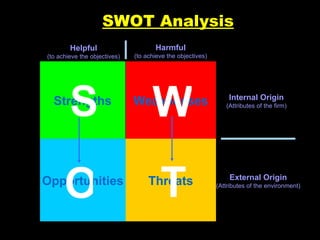
It is a scanning for the internal and external environment of the business. Environmental factors internal to the firm (within your control) usually can be classified as strengths ( S ) or weaknesses ( W ), and Those external to the firm (you can’t control) can be classified as opportunities ( O ) or threats ( T ). What is a SWOT Analysis?
Purpose The SWOT analysis provides information that is helpful in matching the firm's resources and capabilities to the competitive environment in which it operates. As a basic tool its mastery is a fundamental requirement for the marketer, entrepreneur or business person. It is a very important and useful tool to use in marketing Management, strategy formulation and selection. Also in other business applications.
SWOT Analysis Strengths Weaknesses Threats Opportunities Internal Origin (Attributes of the firm) S T O W External Origin (Attributes of the environment) Helpful (to achieve the objectives) Harmful (to achieve the objectives)
Strengths What do we do well? One’s strength is another’s weakness. A firm's strengths are its resources and capabilities that can be used for developing a  competitive advantage . Examples of such strengths include: Patents  Strong brand names  Good reputation among customers  Cost advantages from proprietary know-how  Exclusive access to natural resources  Good access to distribution networks skills, education or connections do you have that others don't have
Weaknesses What is wrong now? What should you avoid? One’s strength is another’s weakness. Be truthful so that weaknesses may be overcome as quickly as possible. The absence of certain strengths are a weakness. For example, the following may be considered weaknesses: Lack of patent protection  A weak brand name  Poor reputation among customers  High cost structure  Lack of access to best natural resources  Lack of access to key distribution channels
Weaknesses - Continued In some cases, a weakness may be the flip side of a strength. For example, a firm has a large amount of manufacturing capacity.  While this capacity may be considered a strength that competitors do not share, it also may be a considered a weakness if the large investment in manufacturing capacity prevents the firm from reacting quickly to changes in the strategic environment.
Opportunities The external environmental analysis may reveal certain new opportunities for profit and growth. Some examples of such opportunities include: An unfulfilled customer need  Arrival of new technologies  Loosening of regulations  Removal of international trade barriers
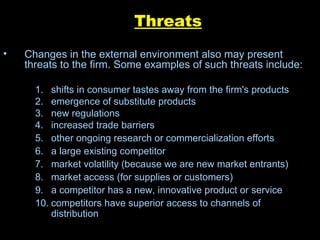
Threats Changes in the external environment also may present threats to the firm. Some examples of such threats include: shifts in consumer tastes away from the firm's products  emergence of substitute products  new regulations  increased trade barriers  other ongoing research or commercialization efforts a large existing competitor market volatility (because we are new market entrants) market access (for supplies or customers) a competitor has a new, innovative product or service competitors have superior access to channels of distribution
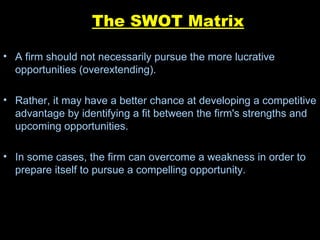
The SWOT Matrix A firm should not necessarily pursue the more lucrative opportunities (overextending).  Rather, it may have a better chance at developing a competitive advantage by identifying a fit between the firm's strengths and upcoming opportunities.  In some cases, the firm can overcome a weakness in order to prepare itself to pursue a compelling opportunity.
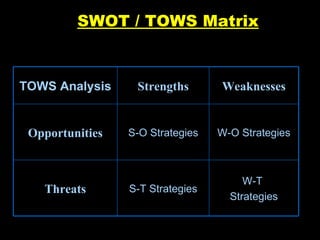
SWOT  / TOWS Matrix To develop strategies that take into account the SWOT profile, a matrix of these factors can be constructed. The SWOT matrix, can be changed into what is known as the  TOWS Matrix  that is shown on the next slide:
SWOT / TOWS Matrix W-T  Strategies S-T Strategies Threats W-O Strategies S-O Strategies Opportunities Weaknesses Strengths TOWS Analysis
SWOT / TOWS Matrix S-O strategies  pursue opportunities that  fit well the company's strengths. W-O strategies  overcome weaknesses to pursue opportunities. S-T strategies  identify ways that the firm can use its strengths to reduce its vulnerability to external threats. W-T strategies  make a defensive plan to prevent the firm's weaknesses from making it susceptible to external threats.
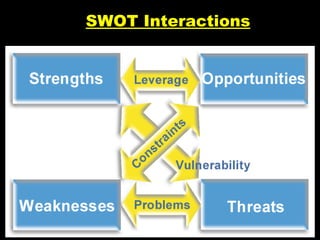
SWOT Interactions
Important Tips Be realistic about the strengths and weaknesses of your organization or group. Distinguish between where your organization is today, and where it could be in the future. Be specific: Avoid gray areas. Always analyze in relation to your core mission. Keep your SWOT short and simple. Avoid complexity and over analysis. Empower SWOT with a logical conceptual framework.
Common Mistakes Failure to lay the analysis out as a  grid. Not identifiable sources for external aspects (like a STEEP or Five Forces analysis). Confusing internal aspects with external aspects i.e, confusing strengths with opportunities and weaknesses with threats. Not using bullet points Too many bullet points Failure to make links (between strengths and opportunities and, weaknesses and threats)
Caution! SWOT analysis can be very subjective.. Two people rarely come-up with the same final version of SWOT. Do not rely on it too much. Use it as guide and not a prescription. SWOT analysis can be very subjective. Be realistic; no need to inflate strengths or be in denial about shortcomings. Be specific. Avoid grey areas. Always analyze in the context of your competitive environment.
Thanks, Kindly send me your comments on [email_address]

SWOT Analysis

  • 1.
    SWOT Analysis (Strengths,Weaknesses, Opportunities & Threats) By: Atef Khayat, MD, MBA 2009
  • 2.
    It is ascanning for the internal and external environment of the business. Environmental factors internal to the firm (within your control) usually can be classified as strengths ( S ) or weaknesses ( W ), and Those external to the firm (you can’t control) can be classified as opportunities ( O ) or threats ( T ). What is a SWOT Analysis?
  • 3.
    Purpose The SWOTanalysis provides information that is helpful in matching the firm's resources and capabilities to the competitive environment in which it operates. As a basic tool its mastery is a fundamental requirement for the marketer, entrepreneur or business person. It is a very important and useful tool to use in marketing Management, strategy formulation and selection. Also in other business applications.
  • 4.
    SWOT Analysis StrengthsWeaknesses Threats Opportunities Internal Origin (Attributes of the firm) S T O W External Origin (Attributes of the environment) Helpful (to achieve the objectives) Harmful (to achieve the objectives)
  • 5.
    Strengths What dowe do well? One’s strength is another’s weakness. A firm's strengths are its resources and capabilities that can be used for developing a competitive advantage . Examples of such strengths include: Patents Strong brand names Good reputation among customers Cost advantages from proprietary know-how Exclusive access to natural resources Good access to distribution networks skills, education or connections do you have that others don't have
  • 6.
    Weaknesses What iswrong now? What should you avoid? One’s strength is another’s weakness. Be truthful so that weaknesses may be overcome as quickly as possible. The absence of certain strengths are a weakness. For example, the following may be considered weaknesses: Lack of patent protection A weak brand name Poor reputation among customers High cost structure Lack of access to best natural resources Lack of access to key distribution channels
  • 7.
    Weaknesses - ContinuedIn some cases, a weakness may be the flip side of a strength. For example, a firm has a large amount of manufacturing capacity. While this capacity may be considered a strength that competitors do not share, it also may be a considered a weakness if the large investment in manufacturing capacity prevents the firm from reacting quickly to changes in the strategic environment.
  • 8.
    Opportunities The externalenvironmental analysis may reveal certain new opportunities for profit and growth. Some examples of such opportunities include: An unfulfilled customer need Arrival of new technologies Loosening of regulations Removal of international trade barriers
  • 9.
    Threats Changes inthe external environment also may present threats to the firm. Some examples of such threats include: shifts in consumer tastes away from the firm's products emergence of substitute products new regulations increased trade barriers other ongoing research or commercialization efforts a large existing competitor market volatility (because we are new market entrants) market access (for supplies or customers) a competitor has a new, innovative product or service competitors have superior access to channels of distribution
  • 10.
    The SWOT MatrixA firm should not necessarily pursue the more lucrative opportunities (overextending). Rather, it may have a better chance at developing a competitive advantage by identifying a fit between the firm's strengths and upcoming opportunities. In some cases, the firm can overcome a weakness in order to prepare itself to pursue a compelling opportunity.
  • 11.
    SWOT /TOWS Matrix To develop strategies that take into account the SWOT profile, a matrix of these factors can be constructed. The SWOT matrix, can be changed into what is known as the TOWS Matrix that is shown on the next slide:
  • 12.
    SWOT / TOWSMatrix W-T Strategies S-T Strategies Threats W-O Strategies S-O Strategies Opportunities Weaknesses Strengths TOWS Analysis
  • 13.
    SWOT / TOWSMatrix S-O strategies pursue opportunities that fit well the company's strengths. W-O strategies overcome weaknesses to pursue opportunities. S-T strategies identify ways that the firm can use its strengths to reduce its vulnerability to external threats. W-T strategies make a defensive plan to prevent the firm's weaknesses from making it susceptible to external threats.
  • 14.
  • 15.
    Important Tips Berealistic about the strengths and weaknesses of your organization or group. Distinguish between where your organization is today, and where it could be in the future. Be specific: Avoid gray areas. Always analyze in relation to your core mission. Keep your SWOT short and simple. Avoid complexity and over analysis. Empower SWOT with a logical conceptual framework.
  • 16.
    Common Mistakes Failureto lay the analysis out as a grid. Not identifiable sources for external aspects (like a STEEP or Five Forces analysis). Confusing internal aspects with external aspects i.e, confusing strengths with opportunities and weaknesses with threats. Not using bullet points Too many bullet points Failure to make links (between strengths and opportunities and, weaknesses and threats)
  • 17.
    Caution! SWOT analysiscan be very subjective.. Two people rarely come-up with the same final version of SWOT. Do not rely on it too much. Use it as guide and not a prescription. SWOT analysis can be very subjective. Be realistic; no need to inflate strengths or be in denial about shortcomings. Be specific. Avoid grey areas. Always analyze in the context of your competitive environment.
  • 18.
    Thanks, Kindly sendme your comments on [email_address]