S W O T trength eakness pportunity hreats
• The origins of the SWOT analysis technique is credited by Albert Humphrey, who 
led a research project at Stanford University in the 1960s and 1970s using data 
from many top companies. 
• The goal was to identify why corporate planning failed. 
• Humphrey and the original research team used the categories “What is good in the 
present is Satisfactory, good in the future is an Opportunity; bad in the present is 
a Fault and bad in the future is a Threat.”
Swot Analysis was earlier known 
as SOFT Analysis. 
Where F was for Fault ; which 
was replaced by W for Weakness 
In 1964 Urick and Orr at a conference changed the F to a 
W, and it has stuck as that, soFt to sWot
• The SWOT analysis is great for developing an understanding of an 
organization or situation and decision-making for all sorts of situations 
in business, organizations and for individuals. 
• The SWOT analysis approach headings provide a good framework for 
reviewing strategy, position and direction of a company, product, 
project or person (career). 
• Doing a SWOT analysis can be very simple, however its strengths lie in 
the flexibility and experienced application of a swot analysis. Remember 
the SWOT capture is only part of the picture.
A SWOT analysis can be used for: 
 Workshop sessions 
 Brainstorm meetings 
 Problem solving 
 Planning 
 Product evaluation 
 Competitor evaluation 
 Personal Development Planning 
 Decision Making
…A process generates information that is 
helpful in matching an organization or 
group’s goals, programs, and capacities to the 
social environment in which it operates. Note 
that in itself is only a data capture – the 
analysis follows.
Strengths 
• Positive tangible and intangible 
attributes, internal to an organization. 
• They are within the organization’s control. 
• A good first step before a more in-depth 
analysis or good summary of detailed 
findings
S • Uncontrollable 
• Strong follow-through 
• Clear 
• Writes well 
• Balanced work-life perspective 
• Multi-interested (e.g., work, recreational 
activities [e.g., curling, golf, etc.]) 
• Ambitious
Weaknesses 
• Factors that are within an organization’s 
control that weaken from its ability to 
attain the desired goal. 
• Slow revenue growth from key 
geographic region 
• Which areas might the organization 
improve?
W 
• Strong need to “get things done and off my list” 
with consequence of getting it done right. 
away, thereby undermining the benefits of 
more careful deliberation over time. 
• Compulsiveness sometimes causes me to be 
jealous being given tasks, i.e., stress of many 
tasks and need to do each carefully can lead 
me to think unkindly about the people and/or 
circumstance creating the task . 
• Can be impatient, i.e., not tolerate those who 
do not understand (“suffer fools poorly”) . 
• Time pressure causes stress and can lead to 
emotional “hijacking” . 
• Do not handle multiple immediately 
competing demands well.
Opportunities 
• External attractive factors that 
represent the reason for an 
organization to exist and develop. 
• What opportunities exist in the 
environment, which will boost the 
organization? Identify them by their 
“time frames”
O 
• To engage others in providing feedback about 
their experience of me. 
• To receive coaching in service of improving 
my leadership skills. 
• To learn from others in similar roles to mine. 
• To enhance my ability to manage the need to 
complete task quickly in order to be able to 
deliberate more carefully . 
• To enhance my equability about work-related 
tasks.
Threats 
• External factors, beyond an 
organization’s control, which could 
place the organization mission or 
operation at risk. 
• The organization may benefit by 
having contingency plans to address 
them if they should occur. 
• Classify them by their “seriousness” 
and “probability of occurrence”.
T 
• Time pressure, which can derail my plan for self-improvement 
because it catapults me back to my 
“usual” habits. 
• The multitude of everyday demands, which conspires 
against self-reflection.
• The concept of determining strengths, weaknesses, 
threats, and opportunities is the fundamental idea 
behind the SWOT model. 
• SWOT matrix is only a graphical representation of 
the SWOT framework. 
• The given is a schema of how SWOT works 
• You start at the top level and go down to details. 
When this is filled with content, it gets the shape of a 
matrix
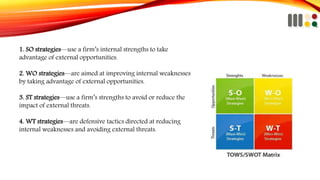
1. SO strategies—use a firm’s internal strengths to take 
advantage of external opportunities. 
2. WO strategies—are aimed at improving internal weaknesses 
by taking advantage of external opportunities. 
3. ST strategies—use a firm’s strengths to avoid or reduce the 
impact of external threats. 
4. WT strategies—are defensive tactics directed at reducing 
internal weaknesses and avoiding external threats.
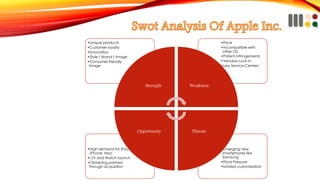
•Emerging new 
smartphones like 
Samsung 
•Price Pressure 
•Limited customization 
•High demand for iPad 
,iPhone, Mac 
•i-TV and Watch launch 
•Obtaining partners 
through acquisition 
•Price 
•Incompatible with 
other OS 
•Patent Infringements 
•Vendors Lock in 
•Less Service Centers 
•Unique products 
•Customer loyalty 
•Innovation 
•Style / Brand / Image 
•Consumer friendly 
Image 
Strength Weakness 
Opportunity Threats
Lets Do Swot Analysis of MindQuad & Our Self
Thank You!

Swot analysis

  • 1.
    S W OT trength eakness pportunity hreats
  • 2.
    • The originsof the SWOT analysis technique is credited by Albert Humphrey, who led a research project at Stanford University in the 1960s and 1970s using data from many top companies. • The goal was to identify why corporate planning failed. • Humphrey and the original research team used the categories “What is good in the present is Satisfactory, good in the future is an Opportunity; bad in the present is a Fault and bad in the future is a Threat.”
  • 3.
    Swot Analysis wasearlier known as SOFT Analysis. Where F was for Fault ; which was replaced by W for Weakness In 1964 Urick and Orr at a conference changed the F to a W, and it has stuck as that, soFt to sWot
  • 4.
    • The SWOTanalysis is great for developing an understanding of an organization or situation and decision-making for all sorts of situations in business, organizations and for individuals. • The SWOT analysis approach headings provide a good framework for reviewing strategy, position and direction of a company, product, project or person (career). • Doing a SWOT analysis can be very simple, however its strengths lie in the flexibility and experienced application of a swot analysis. Remember the SWOT capture is only part of the picture.
  • 5.
    A SWOT analysiscan be used for:  Workshop sessions  Brainstorm meetings  Problem solving  Planning  Product evaluation  Competitor evaluation  Personal Development Planning  Decision Making
  • 6.
    …A process generatesinformation that is helpful in matching an organization or group’s goals, programs, and capacities to the social environment in which it operates. Note that in itself is only a data capture – the analysis follows.
  • 7.
    Strengths • Positivetangible and intangible attributes, internal to an organization. • They are within the organization’s control. • A good first step before a more in-depth analysis or good summary of detailed findings
  • 8.
    S • Uncontrollable • Strong follow-through • Clear • Writes well • Balanced work-life perspective • Multi-interested (e.g., work, recreational activities [e.g., curling, golf, etc.]) • Ambitious
  • 9.
    Weaknesses • Factorsthat are within an organization’s control that weaken from its ability to attain the desired goal. • Slow revenue growth from key geographic region • Which areas might the organization improve?
  • 10.
    W • Strongneed to “get things done and off my list” with consequence of getting it done right. away, thereby undermining the benefits of more careful deliberation over time. • Compulsiveness sometimes causes me to be jealous being given tasks, i.e., stress of many tasks and need to do each carefully can lead me to think unkindly about the people and/or circumstance creating the task . • Can be impatient, i.e., not tolerate those who do not understand (“suffer fools poorly”) . • Time pressure causes stress and can lead to emotional “hijacking” . • Do not handle multiple immediately competing demands well.
  • 11.
    Opportunities • Externalattractive factors that represent the reason for an organization to exist and develop. • What opportunities exist in the environment, which will boost the organization? Identify them by their “time frames”
  • 12.
    O • Toengage others in providing feedback about their experience of me. • To receive coaching in service of improving my leadership skills. • To learn from others in similar roles to mine. • To enhance my ability to manage the need to complete task quickly in order to be able to deliberate more carefully . • To enhance my equability about work-related tasks.
  • 13.
    Threats • Externalfactors, beyond an organization’s control, which could place the organization mission or operation at risk. • The organization may benefit by having contingency plans to address them if they should occur. • Classify them by their “seriousness” and “probability of occurrence”.
  • 14.
    T • Timepressure, which can derail my plan for self-improvement because it catapults me back to my “usual” habits. • The multitude of everyday demands, which conspires against self-reflection.
  • 15.
    • The conceptof determining strengths, weaknesses, threats, and opportunities is the fundamental idea behind the SWOT model. • SWOT matrix is only a graphical representation of the SWOT framework. • The given is a schema of how SWOT works • You start at the top level and go down to details. When this is filled with content, it gets the shape of a matrix
  • 16.
    1. SO strategies—usea firm’s internal strengths to take advantage of external opportunities. 2. WO strategies—are aimed at improving internal weaknesses by taking advantage of external opportunities. 3. ST strategies—use a firm’s strengths to avoid or reduce the impact of external threats. 4. WT strategies—are defensive tactics directed at reducing internal weaknesses and avoiding external threats.
  • 17.
    •Emerging new smartphoneslike Samsung •Price Pressure •Limited customization •High demand for iPad ,iPhone, Mac •i-TV and Watch launch •Obtaining partners through acquisition •Price •Incompatible with other OS •Patent Infringements •Vendors Lock in •Less Service Centers •Unique products •Customer loyalty •Innovation •Style / Brand / Image •Consumer friendly Image Strength Weakness Opportunity Threats
  • 19.
    Lets Do SwotAnalysis of MindQuad & Our Self
  • 20.