Copyright © 2014 by The University of Kansas
SWOT Analysis: Strengths,
Weaknesses, Opportunities,
and Threats
Copyright © 2014 by The University of Kansas
What is a SWOT analysis and
why should you use one?
A SWOT analysis guides you to identify the positives
and negatives inside your organization (Strength &
Weakness) and outside of it, in the external
environment (Opportunity & Threat). Developing a full
awareness of your situation can help with both
strategic planning and decision -making.
Copyright © 2014 by The University of Kansas
When do you use SWOT?
You might use it to:
•Explore possibilities to problems.
•Make decisions for your initiative.
•Determine where change is possible.
•Adjust and refine plans mid-course.
Copyright © 2014 by The University of Kansas
What are the elements of a
SWOT analysis?
Copyright © 2014 by The University of Kansas
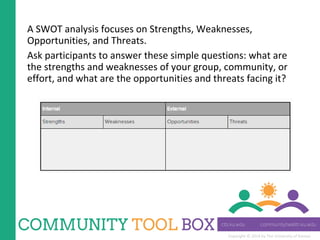
A SWOT analysis focuses on Strengths, Weaknesses,
Opportunities, and Threats.
Ask participants to answer these simple questions: what are
the strengths and weaknesses of your group, community, or
effort, and what are the opportunities and threats facing it?
Copyright © 2014 by The University of Kansas
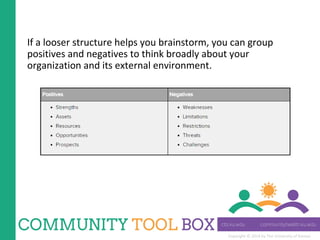
If a looser structure helps you brainstorm, you can group
positives and negatives to think broadly about your
organization and its external environment.
Copyright © 2014 by The University of Kansas
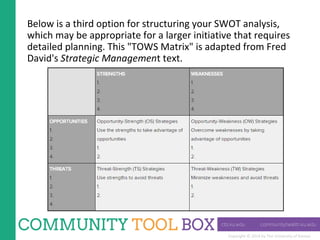
Below is a third option for structuring your SWOT analysis,
which may be appropriate for a larger initiative that requires
detailed planning. This "TOWS Matrix" is adapted from Fred
David's Strategic Management text.
Copyright © 2014 by The University of Kansas
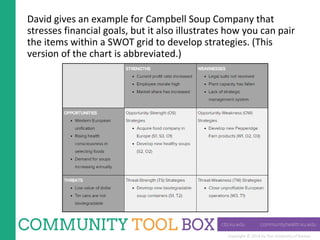
David gives an example for Campbell Soup Company that
stresses financial goals, but it also illustrates how you can pair
the items within a SWOT grid to develop strategies. (This
version of the chart is abbreviated.)
Copyright © 2014 by The University of Kansas
Listing Your Internal Factors:
Strengths and Weaknesses (S,
W)
General areas to consider
• Human resources - staff, volunteers, board members,
target population
• Physical resources - your location, building, equipment
• Financial - grants, funding agencies, other sources of
income
• Activities and processes - programs you run, systems you
employ
• Past experiences - building blocks for learning and
success, your reputation in the community
Copyright © 2014 by The University of Kansas
Listing External Factors:
Opportunities and Threats (O,
T)
Forces and facts that your group does not control include
• Future trends in your field or the culture
• The economy - local, national, or international
• Funding sources - foundations, donors, legislatures
• Demographics - changes in the age, race, gender, culture
of those you serve or in your area
• The physical environment (Is your building in a growing
part of town? Is the bus company cutting routes?)
• Legislation (Do new federal requirements make your job
harder...or easier?)
• Local, national or international events
Copyright © 2014 by The University of Kansas
How do you create a SWOT
analysis?
• Who develops the SWOT?
• When and where do you develop a SWOT analysis?
• How do you develop a SWOT analysis?
Copyright © 2014 by The University of Kansas
Steps for conducting a SWOT analysis:
•Designate a leader or group facilitator.
•Designate a recorder to back up the leader if your group is large.
•Introduce the SWOT method and its purpose in your organization.
•Let all participants introduce themselves.
•Have each group designate a recorder; direct them to create a SWOT
analysis.
•Reconvene the group at the agreed-upon time to share results.
•Discuss and record the results.
•Prepare a written summary of the SWOT analysis to give to participants.
Copyright © 2014 by The University of Kansas
How do you use your SWOT
analysis?
Use it to:
• Identify the issues or problems you intend to
change.
• Set or reaffirm goals.
• Create an action plan.
Copyright © 2014 by The University of Kansas
In Summary
A realistic recognition of the weaknesses and threats that exist for your
effort is the first step to countering them with a robust set of strategies
that build upon strengths and opportunities. A SWOT analysis identifies
your strengths, weaknesses, opportunities and threats to assist you in
making strategic plans and decisions

SWOT Analysis

  • 1.
    Copyright © 2014by The University of Kansas SWOT Analysis: Strengths, Weaknesses, Opportunities, and Threats
  • 2.
    Copyright © 2014by The University of Kansas What is a SWOT analysis and why should you use one? A SWOT analysis guides you to identify the positives and negatives inside your organization (Strength & Weakness) and outside of it, in the external environment (Opportunity & Threat). Developing a full awareness of your situation can help with both strategic planning and decision -making.
  • 3.
    Copyright © 2014by The University of Kansas When do you use SWOT? You might use it to: •Explore possibilities to problems. •Make decisions for your initiative. •Determine where change is possible. •Adjust and refine plans mid-course.
  • 4.
    Copyright © 2014by The University of Kansas What are the elements of a SWOT analysis?
  • 5.
    Copyright © 2014by The University of Kansas A SWOT analysis focuses on Strengths, Weaknesses, Opportunities, and Threats. Ask participants to answer these simple questions: what are the strengths and weaknesses of your group, community, or effort, and what are the opportunities and threats facing it?
  • 6.
    Copyright © 2014by The University of Kansas If a looser structure helps you brainstorm, you can group positives and negatives to think broadly about your organization and its external environment.
  • 7.
    Copyright © 2014by The University of Kansas Below is a third option for structuring your SWOT analysis, which may be appropriate for a larger initiative that requires detailed planning. This "TOWS Matrix" is adapted from Fred David's Strategic Management text.
  • 8.
    Copyright © 2014by The University of Kansas David gives an example for Campbell Soup Company that stresses financial goals, but it also illustrates how you can pair the items within a SWOT grid to develop strategies. (This version of the chart is abbreviated.)
  • 9.
    Copyright © 2014by The University of Kansas Listing Your Internal Factors: Strengths and Weaknesses (S, W) General areas to consider • Human resources - staff, volunteers, board members, target population • Physical resources - your location, building, equipment • Financial - grants, funding agencies, other sources of income • Activities and processes - programs you run, systems you employ • Past experiences - building blocks for learning and success, your reputation in the community
  • 10.
    Copyright © 2014by The University of Kansas Listing External Factors: Opportunities and Threats (O, T) Forces and facts that your group does not control include • Future trends in your field or the culture • The economy - local, national, or international • Funding sources - foundations, donors, legislatures • Demographics - changes in the age, race, gender, culture of those you serve or in your area • The physical environment (Is your building in a growing part of town? Is the bus company cutting routes?) • Legislation (Do new federal requirements make your job harder...or easier?) • Local, national or international events
  • 11.
    Copyright © 2014by The University of Kansas How do you create a SWOT analysis? • Who develops the SWOT? • When and where do you develop a SWOT analysis? • How do you develop a SWOT analysis?
  • 12.
    Copyright © 2014by The University of Kansas Steps for conducting a SWOT analysis: •Designate a leader or group facilitator. •Designate a recorder to back up the leader if your group is large. •Introduce the SWOT method and its purpose in your organization. •Let all participants introduce themselves. •Have each group designate a recorder; direct them to create a SWOT analysis. •Reconvene the group at the agreed-upon time to share results. •Discuss and record the results. •Prepare a written summary of the SWOT analysis to give to participants.
  • 13.
    Copyright © 2014by The University of Kansas How do you use your SWOT analysis? Use it to: • Identify the issues or problems you intend to change. • Set or reaffirm goals. • Create an action plan.
  • 14.
    Copyright © 2014by The University of Kansas In Summary A realistic recognition of the weaknesses and threats that exist for your effort is the first step to countering them with a robust set of strategies that build upon strengths and opportunities. A SWOT analysis identifies your strengths, weaknesses, opportunities and threats to assist you in making strategic plans and decisions