PRESENTATION ON SWOT
ANALYSIS
SUBMITTED TO:
Dr. B.P. GUPTA
SUBMITTED BY:
REKHA RANI
MBA (1st Sem.)
CT INSTITUTE OF MANAGEMENT AND
INFORMATION TECHNOLOGY , JALANDHAR
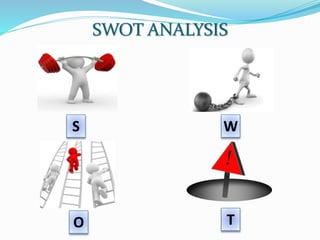
SWOT ANALYSIS
S W
O T
INTRODUCTION
SWOT analysis (strengths, weaknesses, opportunities,
and threats analysis) is a framework for identifying
and analyzing the internal and external factors that
can have an impact on the viability of a project,
product, place or person.
Strengths
Weaknesses
Opportunities
Threats
External
Internal
INTERNAL VS. EXTERNAL
Strengths and Weaknesses are considered internal
factors --- meaning you as the business owner can
control them. How you manage or market the
business controls whether it is a strength or weakness
Opportunities and Threats are considered external
factors --- meaning you have little control over them.
It is your job as a business owner to respond
appropriately .
STRENGTHS
Characteristics of the business or a
team that give it an advantage over
others in the industry.
Examples - Well-known brand name,
Lower costs [raw materials or
processes], Superior management
talent, Better marketing skills, Good
distribution skills, Committed
employees.
WEAKNESSES
Characteristics that place the firm
at a disadvantage relative to others.
Examples - Limited financial
resources, Limited distribution,
Higher costs, Out-of-date products
/ technology, Weak market image,
Poor marketing skills, Limited
management skills.
OPPORTUNITIES
Chances to make greater profits in the
environment - External attractive
factors that represent the reason for
an organization to exist & develop.
Examples - Rapid market growth,
Changing customer needs/tastes, New
uses for product discovered,
Economic boom, Sales decline for a
substitute product .
THREATS
External elements in the
environment that could cause
trouble for the business - External
factors, beyond an organization’s
control, which could place the
organization’s mission or operation
at risk.
Examples - Entry of foreign
competitors, Changing customer
needs/tastes, Rival firms, adopt new
strategies, Increased government
regulation, Economic downturn.
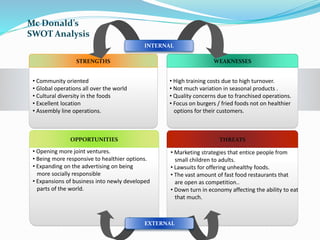
WEAKNESSES
• High training costs due to high turnover.
• Not much variation in seasonal products .
• Quality concerns due to franchised operations.
• Focus on burgers / fried foods not on healthier
options for their customers.
• Community oriented
• Global operations all over the world
• Cultural diversity in the foods
• Excellent location
• Assembly line operations.
STRENGTHS
INTERNAL
• Marketing strategies that entice people from
small children to adults.
• Lawsuits for offering unhealthy foods.
• The vast amount of fast food restaurants that
are open as competition..
• Down turn in economy affecting the ability to eat
that much.
THREATS
• Opening more joint ventures.
• Being more responsive to healthier options.
• Expanding on the advertising on being
more socially responsible
• Expansions of business into newly developed
parts of the world.
OPPORTUNITIES
EXTERNAL
Mc Donald’s
SWOT Analysis
CONCLUSION
SWOT helps a company to see itself for better and for
worse. Companies are inherently insular and inward
looking SWOTs are a means by which a company can
better understand what it does very well and where its
shortcomings are.
SWOT analysis has been a framework of choice among
many managers for along time because of its simplicity
and its portrayal of the essence of sound strategy
formulation - matching a firm's opportunities and
threats with its strengths and weaknesses.
QUERIES??
Presentation on SWOT Analysis

Presentation on SWOT Analysis

  • 1.
    PRESENTATION ON SWOT ANALYSIS SUBMITTEDTO: Dr. B.P. GUPTA SUBMITTED BY: REKHA RANI MBA (1st Sem.) CT INSTITUTE OF MANAGEMENT AND INFORMATION TECHNOLOGY , JALANDHAR
  • 2.
  • 3.
    INTRODUCTION SWOT analysis (strengths,weaknesses, opportunities, and threats analysis) is a framework for identifying and analyzing the internal and external factors that can have an impact on the viability of a project, product, place or person. Strengths Weaknesses Opportunities Threats External Internal
  • 4.
    INTERNAL VS. EXTERNAL Strengthsand Weaknesses are considered internal factors --- meaning you as the business owner can control them. How you manage or market the business controls whether it is a strength or weakness Opportunities and Threats are considered external factors --- meaning you have little control over them. It is your job as a business owner to respond appropriately .
  • 5.
    STRENGTHS Characteristics of thebusiness or a team that give it an advantage over others in the industry. Examples - Well-known brand name, Lower costs [raw materials or processes], Superior management talent, Better marketing skills, Good distribution skills, Committed employees.
  • 6.
    WEAKNESSES Characteristics that placethe firm at a disadvantage relative to others. Examples - Limited financial resources, Limited distribution, Higher costs, Out-of-date products / technology, Weak market image, Poor marketing skills, Limited management skills.
  • 7.
    OPPORTUNITIES Chances to makegreater profits in the environment - External attractive factors that represent the reason for an organization to exist & develop. Examples - Rapid market growth, Changing customer needs/tastes, New uses for product discovered, Economic boom, Sales decline for a substitute product .
  • 8.
    THREATS External elements inthe environment that could cause trouble for the business - External factors, beyond an organization’s control, which could place the organization’s mission or operation at risk. Examples - Entry of foreign competitors, Changing customer needs/tastes, Rival firms, adopt new strategies, Increased government regulation, Economic downturn.
  • 9.
    WEAKNESSES • High trainingcosts due to high turnover. • Not much variation in seasonal products . • Quality concerns due to franchised operations. • Focus on burgers / fried foods not on healthier options for their customers. • Community oriented • Global operations all over the world • Cultural diversity in the foods • Excellent location • Assembly line operations. STRENGTHS INTERNAL • Marketing strategies that entice people from small children to adults. • Lawsuits for offering unhealthy foods. • The vast amount of fast food restaurants that are open as competition.. • Down turn in economy affecting the ability to eat that much. THREATS • Opening more joint ventures. • Being more responsive to healthier options. • Expanding on the advertising on being more socially responsible • Expansions of business into newly developed parts of the world. OPPORTUNITIES EXTERNAL Mc Donald’s SWOT Analysis
  • 10.
    CONCLUSION SWOT helps acompany to see itself for better and for worse. Companies are inherently insular and inward looking SWOTs are a means by which a company can better understand what it does very well and where its shortcomings are. SWOT analysis has been a framework of choice among many managers for along time because of its simplicity and its portrayal of the essence of sound strategy formulation - matching a firm's opportunities and threats with its strengths and weaknesses.
  • 11.