Strategic Role of
HRM
Chapter 3
strategic plan
 A strategic plan is the company’s plan
for how it will match its internal
strengths and weaknesses with external
opportunities and threats in order to
maintain a competitive advantage
 strategy
A course of action the company can pursue
to achieve its strategic aims.
Strategic HR Planning –
What is this?
 Strategic human
resource planning. Human resource
planning is a process that identifies
current and future human resources
needs for an organization to achieve its
goals. Human resource planning should
serve as a link between human
resource management and the
overall strategic plan of an organization.
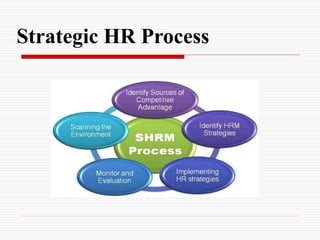
Strategic HR Process
Scanning the Environment
 The process begins with the scanning of the
environment, i.e. both the external and internal factors
of the organization. The external environment
encompasses the political, legal, technological,
economic, social and cultural forces that have a great
impact on the functioning of the business. The internal
factors include the organizational culture, hierarchy,
business processes, SWOT analysis, industrial relations,
etc. that play a crucial role in performing the business
operations.
 The role of the HR department is to collect all the
information about the immediate competitors – their
strategies, vision, mission, strengths, and weaknesses
Identify Sources of
Competitive Advantage
 The next step in the strategic human resource
management process is to identify the
parameters of competitive advantage that
could stem from diverse sources as product
quality, price, customer service, brand
positioning, delivery, etc.
 The HR department can help in gaining the
competitive advantage by conducting the
efficient training programs designed to enrich
the skills of the staff.
Identify HRM Strategies
 a) Learning as Socialization: This strategy includes the
techniques as training courses, coaching sessions, education
programs to ensure that the employees abide by the rules,
value and beliefs of an organization and are able to meet the
performance targets.
 b) Devolved Informal Learning: This strategy helps in
making the employees aware of the learning opportunities and
the career development.
 c) Engineering: This strategy focuses on creating and
developing communities of practice and social networks within
and outside the organization.
Implementing HR
Strategies:
 Once the strategy has been decided
the next step is to put it into the
action. The HR strategy can be
implemented by considering the HR
policies, plans, actions and practices
Monitor and Evaluation:
 The final step in the strategic human resource
management process is to compare the
performance of the HR strategy against the
pre-established standards.
 At this stage, certain activities are performed
to evaluate the outcomes of the strategic
decision: establishing the performance targets
and tolerance levels, analyzing the deviations,
executing the modifications.
 Thus, to have an effective HR strategy the firm
follow these steps systematically and ensures
that the purpose for which it is designed is
fulfilled.
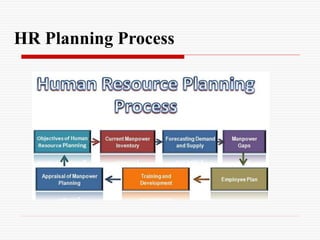
HR Planning Process
Determining the Objectives of Human
Resource Planning
 The objective for which the manpower planning
is to be done should be defined precisely, so as
to ensure that a right number of people for the
right kind of job are selected.
 The objectives can vary across the several
departments in the organization such as the
personnel demand may differ in marketing,
finance, production, HR department, based on
their roles or functions.
Analyzing Current
Manpower Inventory
 The next step is to analyze the current manpower supply
in the organization through the stored information about
the employees in terms of their experience, proficiency,
skills, etc. required to perform a particular job.
 Also, the future vacancies can be estimated, so as to
plan for the manpower from both the internal (within the
current employees) and the external (hiring candidates
from outside) sources. Thus, it is to be ensured that
reservoir of talent is maintained to meet any vacancy
arising in the near future.
Forecasting Demand and
Supply of Human Resources
 Once the inventory of talented
manpower is maintained; the next
step is to match the demand for the
manpower arising in the future with
the supply or available resources with
the organization.
 Here, the required skills of personnel
for a particular job are matched with
the job description and specification.
Analyzing the Manpower
Gaps
 After forecasting the demand and supply, the
manpower gaps can be easily evaluated. In
case the demand is more than the supply of
human resources, that means there is a deficit,
and thus, new candidates are to be hired.
 Whereas, if the Demand is less than supply,
there arises a surplus in the human resources,
and hence, the employees have to be removed
either in the form of termination, retirement,
layoff, transfer, etc.
Employment Plan/Action
Plan
 Once the manpower gaps are
evaluated, the action plan is to be
formulated accordingly. In a case of a
deficit, the firm may go either for
recruitment, training,
interdepartmental transfer plans
whereas in the case of a surplus, the
voluntary retirement schemes,
redeployment, transfer, layoff, could
be followed.
Training and Development
 The training is not only for the new
joiners’ but also for the existing
employees who are required to
update their skills from time to time.
 After the employment plan, the
training programs are conducted to
equip the new employees as well as
the old ones with the requisite skills
to be performed on a particular job.
Appraisal of Manpower
Planning
 Finally, the effectiveness of the manpower planning
process is to be evaluated. Here the human resource
plan is compared with its actual implementation to
ensure the availability of a number of employees for
several jobs.
 At this stage, the firm has to decide the success of the
plan and control the deficiencies, if any.
 Thus, human resource planning is a continuous process
that begins with the objectives of Human Resource
planning and ends with the appraisal or feedback and
control of the planning process.
Strategic Role of Human
Resource Managers
 Evolving Roles
 Recruitment and Selection
 Employee Training
 Compensation and Benefits
 Workplace Safety
 Employee Relations
Evolving Roles
 During the 1980s, personnel departments were responsible for
handing out applications, providing employees with insurance
enrollment forms and processing payroll. The role of the
personnel department was mainly administrative. Over the
next several decades, the role of personnel administration
became more involved with overall business goals. Companies
began to recruit human resources leaders who were capable of
strategic management. Personnel administration evolved into
human resources management. Human resources managers
are responsible for developing strategic solutions to
employment-related matters that affect the organization's
ability to meet its productivity and performance goals.
Recruitment and Selection
 Employee recruitment and selection is as much a part of
employee relations as it is a separate discipline unto
itself. Therefore, a human resources manager’s strategic
role is to combine elements of employee relations into
the employer’s recruitment and selection strategy.
Integrating employee recognition programs into
promotion-from-within policies is an effective form of
employee motivation that combines the employee
relations and recruitment and selection areas of human
resources.
Employee Training
 Human resources managers’ strategic role with respect
to employee training and development prepares the
workforce for future positions within the company.
Succession planning, promotion-from-within policies and
performance evaluation factor into the human resources
manager’s role. Training and development motivate
employees, and in some cases, improve employee
retention
Compensation and Benefits
 An employer's compensation and benefits structure
partly determines the company's business reputation
and image. In addition, the decisions that human
resources managers make regarding pay scales and
employee benefits can impact employee satisfaction, as
well as the organization’s ability to recruit talented
workers. Job evaluation, labor market conditions,
workforce shortages and budget constraints are factors
that HR managers consider in a strategic plan for pay
and benefit
Workplace Safety
 Creating a work environment free from unnecessary
hazards is a strategic role of every human resources
manager. Strategic development for workplace safety
entails risk management and mitigating potential losses
from on-the-job injuries and fatalities. Workers'
compensation insurance is an area in which a strategic
plan helps lower company expense for insurance
coverage. Reducing accidents through training
employees on the proper use of complex machinery and
equipment is one of the functional tasks associated with
creating a safe work environment
Employee Relations
 Some human resources managers believe that
strengthening the employer-employee relationship rests
solely in the employee relations areas of the HR
department. This isn’t true. Nevertheless, employee
relations is such a large part of every discipline –
including salaries, benefits, safety, training and
employee development – that sustaining an employee
relations program is an important element of human
resources strategy
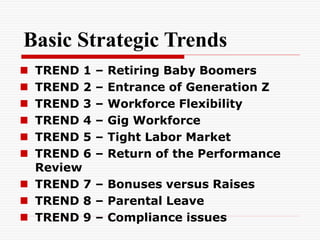
Basic Strategic Trends
 TREND 1 – Retiring Baby Boomers
 TREND 2 – Entrance of Generation Z
 TREND 3 – Workforce Flexibility
 TREND 4 – Gig Workforce
 TREND 5 – Tight Labor Market
 TREND 6 – Return of the Performance
Review
 TREND 7 – Bonuses versus Raises
 TREND 8 – Parental Leave
 TREND 9 – Compliance issues
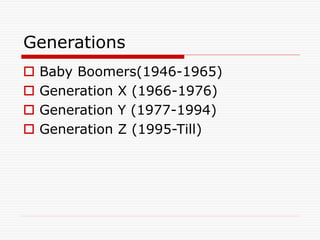
Generations
 Baby Boomers(1946-1965)
 Generation X (1966-1976)
 Generation Y (1977-1994)
 Generation Z (1995-Till)

Strategic planning

  • 1.
  • 2.
    strategic plan  Astrategic plan is the company’s plan for how it will match its internal strengths and weaknesses with external opportunities and threats in order to maintain a competitive advantage  strategy A course of action the company can pursue to achieve its strategic aims.
  • 3.
    Strategic HR Planning– What is this?  Strategic human resource planning. Human resource planning is a process that identifies current and future human resources needs for an organization to achieve its goals. Human resource planning should serve as a link between human resource management and the overall strategic plan of an organization.
  • 4.
  • 5.
    Scanning the Environment The process begins with the scanning of the environment, i.e. both the external and internal factors of the organization. The external environment encompasses the political, legal, technological, economic, social and cultural forces that have a great impact on the functioning of the business. The internal factors include the organizational culture, hierarchy, business processes, SWOT analysis, industrial relations, etc. that play a crucial role in performing the business operations.  The role of the HR department is to collect all the information about the immediate competitors – their strategies, vision, mission, strengths, and weaknesses
  • 6.
    Identify Sources of CompetitiveAdvantage  The next step in the strategic human resource management process is to identify the parameters of competitive advantage that could stem from diverse sources as product quality, price, customer service, brand positioning, delivery, etc.  The HR department can help in gaining the competitive advantage by conducting the efficient training programs designed to enrich the skills of the staff.
  • 7.
    Identify HRM Strategies a) Learning as Socialization: This strategy includes the techniques as training courses, coaching sessions, education programs to ensure that the employees abide by the rules, value and beliefs of an organization and are able to meet the performance targets.  b) Devolved Informal Learning: This strategy helps in making the employees aware of the learning opportunities and the career development.  c) Engineering: This strategy focuses on creating and developing communities of practice and social networks within and outside the organization.
  • 8.
    Implementing HR Strategies:  Oncethe strategy has been decided the next step is to put it into the action. The HR strategy can be implemented by considering the HR policies, plans, actions and practices
  • 9.
    Monitor and Evaluation: The final step in the strategic human resource management process is to compare the performance of the HR strategy against the pre-established standards.  At this stage, certain activities are performed to evaluate the outcomes of the strategic decision: establishing the performance targets and tolerance levels, analyzing the deviations, executing the modifications.  Thus, to have an effective HR strategy the firm follow these steps systematically and ensures that the purpose for which it is designed is fulfilled.
  • 10.
  • 11.
    Determining the Objectivesof Human Resource Planning  The objective for which the manpower planning is to be done should be defined precisely, so as to ensure that a right number of people for the right kind of job are selected.  The objectives can vary across the several departments in the organization such as the personnel demand may differ in marketing, finance, production, HR department, based on their roles or functions.
  • 12.
    Analyzing Current Manpower Inventory The next step is to analyze the current manpower supply in the organization through the stored information about the employees in terms of their experience, proficiency, skills, etc. required to perform a particular job.  Also, the future vacancies can be estimated, so as to plan for the manpower from both the internal (within the current employees) and the external (hiring candidates from outside) sources. Thus, it is to be ensured that reservoir of talent is maintained to meet any vacancy arising in the near future.
  • 13.
    Forecasting Demand and Supplyof Human Resources  Once the inventory of talented manpower is maintained; the next step is to match the demand for the manpower arising in the future with the supply or available resources with the organization.  Here, the required skills of personnel for a particular job are matched with the job description and specification.
  • 14.
    Analyzing the Manpower Gaps After forecasting the demand and supply, the manpower gaps can be easily evaluated. In case the demand is more than the supply of human resources, that means there is a deficit, and thus, new candidates are to be hired.  Whereas, if the Demand is less than supply, there arises a surplus in the human resources, and hence, the employees have to be removed either in the form of termination, retirement, layoff, transfer, etc.
  • 15.
    Employment Plan/Action Plan  Oncethe manpower gaps are evaluated, the action plan is to be formulated accordingly. In a case of a deficit, the firm may go either for recruitment, training, interdepartmental transfer plans whereas in the case of a surplus, the voluntary retirement schemes, redeployment, transfer, layoff, could be followed.
  • 16.
    Training and Development The training is not only for the new joiners’ but also for the existing employees who are required to update their skills from time to time.  After the employment plan, the training programs are conducted to equip the new employees as well as the old ones with the requisite skills to be performed on a particular job.
  • 17.
    Appraisal of Manpower Planning Finally, the effectiveness of the manpower planning process is to be evaluated. Here the human resource plan is compared with its actual implementation to ensure the availability of a number of employees for several jobs.  At this stage, the firm has to decide the success of the plan and control the deficiencies, if any.  Thus, human resource planning is a continuous process that begins with the objectives of Human Resource planning and ends with the appraisal or feedback and control of the planning process.
  • 18.
    Strategic Role ofHuman Resource Managers  Evolving Roles  Recruitment and Selection  Employee Training  Compensation and Benefits  Workplace Safety  Employee Relations
  • 19.
    Evolving Roles  Duringthe 1980s, personnel departments were responsible for handing out applications, providing employees with insurance enrollment forms and processing payroll. The role of the personnel department was mainly administrative. Over the next several decades, the role of personnel administration became more involved with overall business goals. Companies began to recruit human resources leaders who were capable of strategic management. Personnel administration evolved into human resources management. Human resources managers are responsible for developing strategic solutions to employment-related matters that affect the organization's ability to meet its productivity and performance goals.
  • 20.
    Recruitment and Selection Employee recruitment and selection is as much a part of employee relations as it is a separate discipline unto itself. Therefore, a human resources manager’s strategic role is to combine elements of employee relations into the employer’s recruitment and selection strategy. Integrating employee recognition programs into promotion-from-within policies is an effective form of employee motivation that combines the employee relations and recruitment and selection areas of human resources.
  • 21.
    Employee Training  Humanresources managers’ strategic role with respect to employee training and development prepares the workforce for future positions within the company. Succession planning, promotion-from-within policies and performance evaluation factor into the human resources manager’s role. Training and development motivate employees, and in some cases, improve employee retention
  • 22.
    Compensation and Benefits An employer's compensation and benefits structure partly determines the company's business reputation and image. In addition, the decisions that human resources managers make regarding pay scales and employee benefits can impact employee satisfaction, as well as the organization’s ability to recruit talented workers. Job evaluation, labor market conditions, workforce shortages and budget constraints are factors that HR managers consider in a strategic plan for pay and benefit
  • 23.
    Workplace Safety  Creatinga work environment free from unnecessary hazards is a strategic role of every human resources manager. Strategic development for workplace safety entails risk management and mitigating potential losses from on-the-job injuries and fatalities. Workers' compensation insurance is an area in which a strategic plan helps lower company expense for insurance coverage. Reducing accidents through training employees on the proper use of complex machinery and equipment is one of the functional tasks associated with creating a safe work environment
  • 24.
    Employee Relations  Somehuman resources managers believe that strengthening the employer-employee relationship rests solely in the employee relations areas of the HR department. This isn’t true. Nevertheless, employee relations is such a large part of every discipline – including salaries, benefits, safety, training and employee development – that sustaining an employee relations program is an important element of human resources strategy
  • 25.
    Basic Strategic Trends TREND 1 – Retiring Baby Boomers  TREND 2 – Entrance of Generation Z  TREND 3 – Workforce Flexibility  TREND 4 – Gig Workforce  TREND 5 – Tight Labor Market  TREND 6 – Return of the Performance Review  TREND 7 – Bonuses versus Raises  TREND 8 – Parental Leave  TREND 9 – Compliance issues
  • 26.
    Generations  Baby Boomers(1946-1965) Generation X (1966-1976)  Generation Y (1977-1994)  Generation Z (1995-Till)

Editor's Notes

  • #2 Successful Grant Writing
  • #4 Successful Grant Writing
  • #5 Successful Grant Writing
  • #11 Successful Grant Writing