Human Computer
Interaction
Introducing Evaluation
Today’s Learning Objective
• What is evaluation?
• What to evaluate?
• How to evaluate?
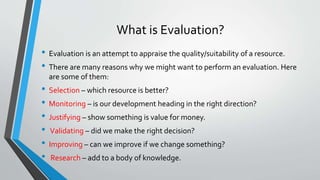
What is Evaluation?
• Evaluation is an attempt to appraise the quality/suitability of a resource.
• There are many reasons why we might want to perform an evaluation. Here
are some of them:
• Selection – which resource is better?
• Monitoring – is our development heading in the right direction?
• Justifying – show something is value for money.
• Validating – did we make the right decision?
• Improving – can we improve if we change something?
• Research – add to a body of knowledge.
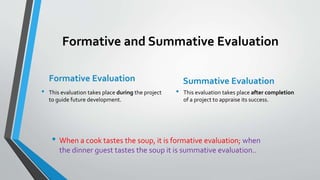
Formative and Summative Evaluation
Formative Evaluation
• This evaluation takes place during the project
to guide future development.
Summative Evaluation
• This evaluation takes place after completion
of a project to appraise its success.
• When a cook tastes the soup, it is formative evaluation; when
the dinner guest tastes the soup it is summative evaluation..
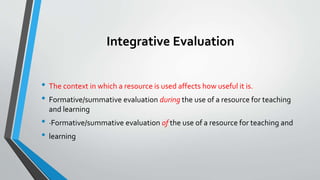
Integrative Evaluation
• The context in which a resource is used affects how useful it is.
• Formative/summative evaluation during the use of a resource for teaching
and learning
• ·Formative/summative evaluation of the use of a resource for teaching and
• learning
What to Evaluate?
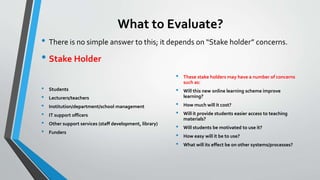
• There is no simple answer to this; it depends on “Stake holder” concerns.
What to Evaluate?
• Students
• Lecturers/teachers
• Institution/department/school management
• IT support officers
• Other support services (staff development, library)
• Funders
• These stake holders may have a number of concerns
such as:
• Will this new online learning scheme improve
learning?
• How much will it cost?
• Will it provide students easier access to teaching
materials?
• Will students be motivated to use it?
• How easy will it be to use?
• What will its effect be on other systems/processes?
• There is no simple answer to this; it depends on “Stake holder” concerns.
• Stake Holder
How to Evaluate?
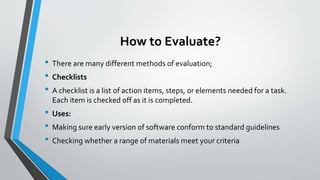
• There are many different methods of evaluation;
• Checklists
• A checklist is a list of action items, steps, or elements needed for a task.
Each item is checked off as it is completed.
• Uses:
• Making sure early version of software conform to standard guidelines
• Checking whether a range of materials meet your criteria
How to Evaluate?; Checklist
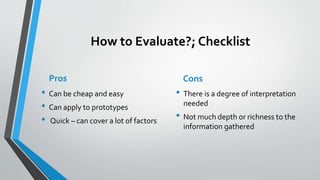
Pros
• Can be cheap and easy
• Can apply to prototypes
• Quick – can cover a lot of factors
Cons
• There is a degree of interpretation
needed
• Not much depth or richness to the
information gathered
How to Evaluate?; questionnaire
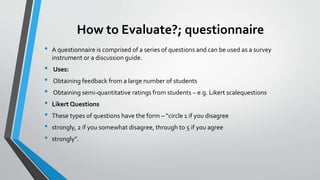
• A questionnaire is comprised of a series of questions and can be used as a survey
instrument or a discussion guide.
• Uses:
• Obtaining feedback from a large number of students
• Obtaining semi-quantitative ratings from students – e.g. Likert scalequestions
• Likert Questions
• These types of questions have the form – “circle 1 if you disagree
• strongly, 2 if you somewhat disagree, through to 5 if you agree
• strongly”.
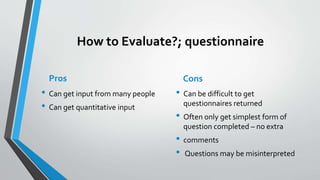
How to Evaluate?; questionnaire
Pros
• Can get input from many people
• Can get quantitative input
Cons
• Can be difficult to get
questionnaires returned
• Often only get simplest form of
question completed – no extra
• comments
• Questions may be misinterpreted
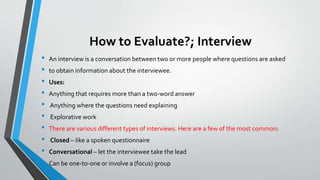
How to Evaluate?; Interview
• An interview is a conversation between two or more people where questions are asked
• to obtain information about the interviewee.
• Uses:
• Anything that requires more than a two-word answer
• Anything where the questions need explaining
• Explorative work
• There are various different types of interviews. Here are a few of the most common:
• Closed – like a spoken questionnaire
• Conversational – let the interviewee take the lead
• Can be one-to-one or involve a (focus) group
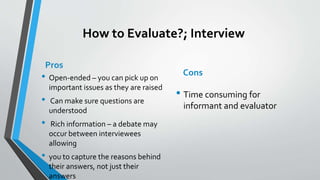
How to Evaluate?; Interview
Pros
• Open-ended – you can pick up on
important issues as they are raised
• Can make sure questions are
understood
• Rich information – a debate may
occur between interviewees
allowing
• you to capture the reasons behind
their answers, not just their
answers
Cons
• Time consuming for
informant and evaluator
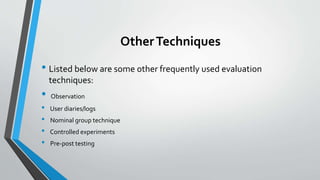
OtherTechniques
• Listed below are some other frequently used evaluation
techniques:
• Observation
• User diaries/logs
• Nominal group technique
• Controlled experiments
• Pre-post testing
DECIDE:
An evaluation framework
DECIDE: A FrameworkTo Guide Evaluation
• Determine the goals.
• Explore the questions.
• Choose the evaluation approach and methods.
• Identify the practical issues.
• Decide how to deal with the ethical issues.
• Evaluate, analyze, interpret and present the data
Determine the goals
• What are the high-level goals of the evaluation?
• Who wants it and why?
• The goals influence the approach used for the study.
• Some examples of goals:
 Identify the best metaphor on which to base the design.
 Check to ensure that the final interface is consistent.
 Investigate how technology affects working practices.
 Improve the usability of an existing product .
Explore the questions
• All evaluations need goals & questions to guide them.
• The goal of finding out why many customers prefer to purchase paper
airline tickets rather than e-tickets can be broken down into sub-questions:
• What are customers’ attitudes to these new tickets?
• Are they concerned about security?
• Is the interface for obtaining them poor?
• What questions might you ask about the design of a cell phone?
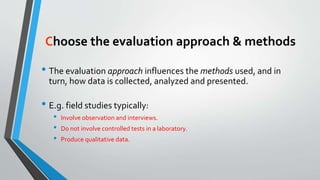
Choose the evaluation approach & methods
• The evaluation approach influences the methods used, and in
turn, how data is collected, analyzed and presented.
• E.g. field studies typically:
• Involve observation and interviews.
• Do not involve controlled tests in a laboratory.
• Produce qualitative data.
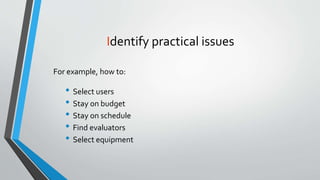
Identify practical issues
For example, how to:
• Select users
• Stay on budget
• Stay on schedule
• Find evaluators
• Select equipment
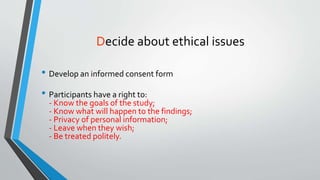
Decide about ethical issues
• Develop an informed consent form
• Participants have a right to:
- Know the goals of the study;
- Know what will happen to the findings;
- Privacy of personal information;
- Leave when they wish;
- Be treated politely.
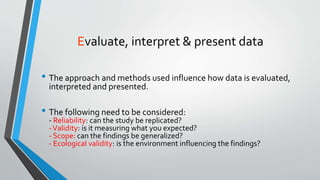
Evaluate, interpret & present data
• The approach and methods used influence how data is evaluated,
interpreted and presented.
• The following need to be considered:
- Reliability: can the study be replicated?
-Validity: is it measuring what you expected?
- Scope: can the findings be generalized?
- Ecological validity: is the environment influencing the findings?
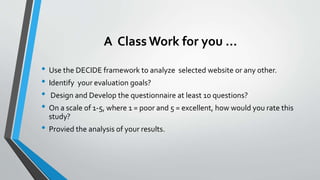
A Class Work for you …
• Use the DECIDE framework to analyze selected website or any other.
• Identify your evaluation goals?
• Design and Develop the questionnaire at least 10 questions?
• On a scale of 1-5, where 1 = poor and 5 = excellent, how would you rate this
study?
• Provied the analysis of your results.

Hci evaluationa frame work lec 14

  • 1.
  • 2.
    Today’s Learning Objective •What is evaluation? • What to evaluate? • How to evaluate?
  • 3.
    What is Evaluation? •Evaluation is an attempt to appraise the quality/suitability of a resource. • There are many reasons why we might want to perform an evaluation. Here are some of them: • Selection – which resource is better? • Monitoring – is our development heading in the right direction? • Justifying – show something is value for money. • Validating – did we make the right decision? • Improving – can we improve if we change something? • Research – add to a body of knowledge.
  • 4.
    Formative and SummativeEvaluation Formative Evaluation • This evaluation takes place during the project to guide future development. Summative Evaluation • This evaluation takes place after completion of a project to appraise its success. • When a cook tastes the soup, it is formative evaluation; when the dinner guest tastes the soup it is summative evaluation..
  • 5.
    Integrative Evaluation • Thecontext in which a resource is used affects how useful it is. • Formative/summative evaluation during the use of a resource for teaching and learning • ·Formative/summative evaluation of the use of a resource for teaching and • learning
  • 6.
    What to Evaluate? •There is no simple answer to this; it depends on “Stake holder” concerns.
  • 7.
    What to Evaluate? •Students • Lecturers/teachers • Institution/department/school management • IT support officers • Other support services (staff development, library) • Funders • These stake holders may have a number of concerns such as: • Will this new online learning scheme improve learning? • How much will it cost? • Will it provide students easier access to teaching materials? • Will students be motivated to use it? • How easy will it be to use? • What will its effect be on other systems/processes? • There is no simple answer to this; it depends on “Stake holder” concerns. • Stake Holder
  • 8.
    How to Evaluate? •There are many different methods of evaluation; • Checklists • A checklist is a list of action items, steps, or elements needed for a task. Each item is checked off as it is completed. • Uses: • Making sure early version of software conform to standard guidelines • Checking whether a range of materials meet your criteria
  • 9.
    How to Evaluate?;Checklist Pros • Can be cheap and easy • Can apply to prototypes • Quick – can cover a lot of factors Cons • There is a degree of interpretation needed • Not much depth or richness to the information gathered
  • 10.
    How to Evaluate?;questionnaire • A questionnaire is comprised of a series of questions and can be used as a survey instrument or a discussion guide. • Uses: • Obtaining feedback from a large number of students • Obtaining semi-quantitative ratings from students – e.g. Likert scalequestions • Likert Questions • These types of questions have the form – “circle 1 if you disagree • strongly, 2 if you somewhat disagree, through to 5 if you agree • strongly”.
  • 11.
    How to Evaluate?;questionnaire Pros • Can get input from many people • Can get quantitative input Cons • Can be difficult to get questionnaires returned • Often only get simplest form of question completed – no extra • comments • Questions may be misinterpreted
  • 12.
    How to Evaluate?;Interview • An interview is a conversation between two or more people where questions are asked • to obtain information about the interviewee. • Uses: • Anything that requires more than a two-word answer • Anything where the questions need explaining • Explorative work • There are various different types of interviews. Here are a few of the most common: • Closed – like a spoken questionnaire • Conversational – let the interviewee take the lead • Can be one-to-one or involve a (focus) group
  • 13.
    How to Evaluate?;Interview Pros • Open-ended – you can pick up on important issues as they are raised • Can make sure questions are understood • Rich information – a debate may occur between interviewees allowing • you to capture the reasons behind their answers, not just their answers Cons • Time consuming for informant and evaluator
  • 14.
    OtherTechniques • Listed beloware some other frequently used evaluation techniques: • Observation • User diaries/logs • Nominal group technique • Controlled experiments • Pre-post testing
  • 15.
  • 16.
    DECIDE: A FrameworkToGuide Evaluation • Determine the goals. • Explore the questions. • Choose the evaluation approach and methods. • Identify the practical issues. • Decide how to deal with the ethical issues. • Evaluate, analyze, interpret and present the data
  • 17.
    Determine the goals •What are the high-level goals of the evaluation? • Who wants it and why? • The goals influence the approach used for the study. • Some examples of goals:  Identify the best metaphor on which to base the design.  Check to ensure that the final interface is consistent.  Investigate how technology affects working practices.  Improve the usability of an existing product .
  • 18.
    Explore the questions •All evaluations need goals & questions to guide them. • The goal of finding out why many customers prefer to purchase paper airline tickets rather than e-tickets can be broken down into sub-questions: • What are customers’ attitudes to these new tickets? • Are they concerned about security? • Is the interface for obtaining them poor? • What questions might you ask about the design of a cell phone?
  • 19.
    Choose the evaluationapproach & methods • The evaluation approach influences the methods used, and in turn, how data is collected, analyzed and presented. • E.g. field studies typically: • Involve observation and interviews. • Do not involve controlled tests in a laboratory. • Produce qualitative data.
  • 20.
    Identify practical issues Forexample, how to: • Select users • Stay on budget • Stay on schedule • Find evaluators • Select equipment
  • 21.
    Decide about ethicalissues • Develop an informed consent form • Participants have a right to: - Know the goals of the study; - Know what will happen to the findings; - Privacy of personal information; - Leave when they wish; - Be treated politely.
  • 22.
    Evaluate, interpret &present data • The approach and methods used influence how data is evaluated, interpreted and presented. • The following need to be considered: - Reliability: can the study be replicated? -Validity: is it measuring what you expected? - Scope: can the findings be generalized? - Ecological validity: is the environment influencing the findings?
  • 23.
    A Class Workfor you … • Use the DECIDE framework to analyze selected website or any other. • Identify your evaluation goals? • Design and Develop the questionnaire at least 10 questions? • On a scale of 1-5, where 1 = poor and 5 = excellent, how would you rate this study? • Provied the analysis of your results.