Chapter3

                    Manpower Planning
    Objectives:
•   Understand the meaning, need & purpose of Human
    Resource Planning (HRP)
•   Understand benefits, advantages & disadvantages of HRP
•   Understand the various steps involved in Manpower
    Planning
•   Understand the intricacies in recruitment & selection of
    employees
•   Understand various aspects of internal & external
    recruitment
•   Understand all aspects of Job like definition, process,
    description and analysis
Chapter3

                   Manpower Planning
    Structure
3.1 Introduction               3.11 Objectives of
3.2 Meaning                       Recruitment
3.3 Meaning & definition       3.12 Internal Recruitment
3.4 The scope of HRM           3.13 Evaluation of internal
3.5 Need for HRP                  Recruitment
3.6 Process of HRP             3.14 External Recruitment
3.7 Benefits of HRP            3.15 Evaluation of external
                                  Recruitment
3.8 Steps in Manpower          3.16 Role of Computer in
   Planning                       Manpower Planning
3.9 Recruitment                3.17 Job Analysis
3.10 Recruitment Policy        3.18 Summary
Chapter3

                 Manpower Planning
3.1 Introduction
  “Manpower” or “Human Resources” may be
  thought of as “ the total knowledge, skills, creative
  abilities, talents, and aptitudes of an organization
  workforce, as well as the values, attitudes and
  benefits of the individual involved. It is the sum
  total of inherent abilities, acquired knowledge &
  skills represented by the talents & aptitudes of the
  employed persons”
  Of all the resources, Man in the most important,
  since it is the only resource that appreciates with
  usage and time.
Chapter3

                Manpower Planning
3.2 Meaning
• Manpower Planning and Human Resources
  Planning appear to be almost the same. However,
  HRP is broader-based.
• Manpower Planning is the “process by which a
  management determines how an organization
  should move from the current manpower position
  to its desired manpower position”
• Through planning, an organization strives to have
  the right number of the right kind of people at the
  right places at the right time to do things towards
  organizational effectiveness.
Chapter3

                       Manpower Planning
3.3 Meaning & Definition
• Human Resources Management refers to the set of programs,
    functions and activities designed and carried out to maximize both
    employee as well as organizational effectiveness.
• Manpower Planning involves:
 a) Forecasting future manpower requirements
 b) Determining existing manpower resources and assessing how
    optimally they are utilized
 c) Determining, quantatively and qualitatively, the future manpower
    requirements, based on projections of the present
 d) Planning the necessary programs of recruitment, selection, training,
    development, utilization, transfer, promotion, motivation and
    compensation to ensure that the future requirements are adequately
    met.
Chapter3

                     Manpower Planning
•   It must noted that Manpower Planning cannot be rigid &
    static. It needs to flexible with needs and dynamic with
    time.
•   Human Resource Planning is like a double-edged weapon.
    When used properly, it increases effectiveness of the
    organization and of the individual. If misused, HRP leads to
    disruption and disharmony of work leading to demotivation
    and loss in productivity.
•   HRP facilitates the organization to be productive and
    effective and the individual to develop his skills and
    abilities.
Chapter3

                Manpower Planning
3.4 The scope of HRM
    The scope of HRM is vast. It could be categorized
    into seven sections:
1. Introduction to HRM
2. Employee Hiring
3. Employee & Executive remuneration
4. Employee motivation
5. Employee maintenance
6. Human relation
7. Human Resources Management
Chapter3

                       Manpower Planning
3.5 Need for Human Resources Planning
     HRP is required by an organization for the one or more of the
     following reasons:
a)   Effective Planning to hire the right person for the right job.
b)   Replacement of personnel who leave the organization due to various
     reasons.
c)   Frequent labor turnover or attrition results in organizations needing
     more manpower.
d)   Expansion of the organization leads to requirement of more
     manpower
e)   Nature of work changing, leading to “outdatedness” of existing
     personnel, who may be either replaced or trained.
f)   To balance the task force within the organization so that there is a
     manpower distribution that is proportionate to the needs of the user
     departments.
Chapter3

                Manpower Planning
3.6 Process of HRP
    HRP consists of a crucial set of functions as
    follows:
a) Deciding Goals and Objectives
b) Estimating future organizational structure and
    manpower requirements
c) Auditing human resources
d) Planning job requirements and job descriptions
e) Developing a human resource plan.
Chapter3

                Manpower Planning
3.7 Benefits of Human Resource Planning
 The major benefits of HRP are:
• It checks the corporate plan of the organization.
• It offsets uncertainty and change.
• Facilitates in selecting the right person at the
  right time for the right job.
• Provides scope for advancement of employees
  through training & development.
Chapter3

                       Manpower Planning
 Advantages & Disadvantages of HRP:
  Advantages
• HRP is a systematic approach towards manpower requirements of an
   organization.
• HRP defines and demarcates functions which would otherwise be
   vague and overlapping leading to confusion.
• As a process, HRP brings clarity to steps and procedures that would
   lead to minimizing ineffectiveness.
  Disadvantages
• HRP cannot be totally depended on, since it deals with manpower on a
   moving time basis.
• HRP tends to go haywire when changes take place unanticipated. It
   does not have the provision to address such changes.
• Uncertainty and forecasting inaccuracies are more when it deals with
   human resources, which is driven by free will and hence unpredictable.
Chapter3

                   Manpower Planning
3.8 Steps in Manpower Planning
  There are three steps as guidance for Manpower Planning:
1.   Manpower Planning needs to integrate with financial
     planning of the organization. This is done through
     creating an organizational chart wherein hierarchies are
     depicted.
2.   Auditing the internal human resources in terms of
     experience, qualifications, positions held and determining
     whether the available human resources are optimally
     utilized.
3.   Formulating the recruitment plan, which constitutes a
     time-bound schedule of who needs to be recruited,
     when, in what position, where, etc.
Chapter3

                Manpower Planning
3.9 Recruitment
• The purpose of Recruitment is to build a pool of
  applicants.
• It consists of the process of searching for and
  obtaining application so as to seek the right
  person for the right job during the selection
  process.
• Recruitment precedes Selection process
• Recruitment is affected by internal as well as
  external factors of the organziation.
Chapter3

                 Manpower Planning
3.10 Recruitment Policy
• Recruitment policy is a part of the Personnel policy
  of the organization.
• It reflects the philosophy of hiring people related
  to the needs of the culture of the organization.
• Factors taken into account when framing a
  Recruitment Policy are: Govt. policies, personnel
  policies of competitors, industry practices,
  recruitment needs, selection criteria, etc.
Chapter3

                 Manpower Planning
3.11 Objectives of Recruitment
• To attract people with multiple skills & experiences
• To induct outsiders with a fresh new outlook
• To develop an organizational culture that
  promotes competence.
• To extract the best talent form the competitors to
  gain leverage over competitors.
• To fill in positions which are yet to be defined, for
  future positions.
Chapter3

                Manpower Planning
3.12 Internal Recruitment
•   Internal Recruitment seeks applications for
    positions from employees who are already
    working within the organization.
•   It is done through:
a) Present employees
b) Employee referrals
c) Former employees
d) Previous applications
Chapter3

                       Manpower Planning
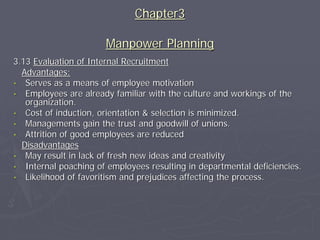
3.13 Evaluation of Internal Recruitment
  Advantages:
• Serves as a means of employee motivation
• Employees are already familiar with the culture and workings of the
   organization.
• Cost of induction, orientation & selection is minimized.
• Managements gain the trust and goodwill of unions.
• Attrition of good employees are reduced
  Disadvantages
• May result in lack of fresh new ideas and creativity
• Internal poaching of employees resulting in departmental deficiencies.
• Likelihood of favoritism and prejudices affecting the process.
Chapter3

              Manpower Planning
3.14 External Recruitment
• Sources of External Recruitment:
  professional/trade associations,
  advertisements, employment exchange,
  campus, placement agencies, walk-ins, talk-
  ins, etc.
Chapter3

                      Manpower Planning
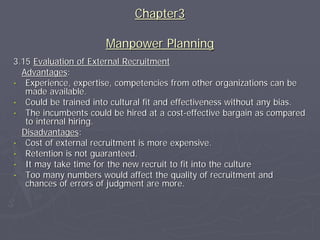
3.15 Evaluation of External Recruitment
  Advantages:
• Experience, expertise, competencies from other organizations can be
   made available.
• Could be trained into cultural fit and effectiveness without any bias.
• The incumbents could be hired at a cost-effective bargain as compared
   to internal hiring.
  Disadvantages:
• Cost of external recruitment is more expensive.
• Retention is not guaranteed.
• It may take time for the new recruit to fit into the culture
• Too many numbers would affect the quality of recruitment and
   chances of errors of judgment are more.
Chapter3

                   Manpower Planning
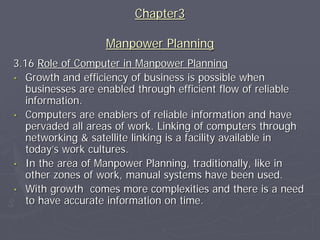
3.16 Role of Computer in Manpower Planning
• Growth and efficiency of business is possible when
   businesses are enabled through efficient flow of reliable
   information.
• Computers are enablers of reliable information and have
   pervaded all areas of work. Linking of computers through
   networking & satellite linking is a facility available in
   today’s work cultures.
• In the area of Manpower Planning, traditionally, like in
   other zones of work, manual systems have been used.
• With growth comes more complexities and there is a need
   to have accurate information on time.
Chapter3

                      Manpower Planning
•   In Manpower Planning, use of computers and linking them
    is very common in progressive organizations.
•   Use of software packages like PIS (Personnel information
    Systems) or HRIS (Human Resources Information Systems
    are very common.
•   These packages offer easy to up-to-date facilities of stored
    information about the manpower in detail.
•   Details such as name, employee number, background,
    qualifications, experience, movement within the
    organization, skills, competencies, critical incidents, etc are
    available in a structured format for easy access and ready
    use and processing.
•   Every user department can access information on
    Manpower for various end purposes.
Chapter3

                   Manpower Planning
3.17 Job Analysis
• Jobs are important both to the individual and to the
   organization.
• There was a time when jobs used to be seen as static,
   meaning once jobs were specified, flexibility to modify it
   was not allowed.
• The same job is seen and done differently by various job-
   holders.
• To understand the job and its dynamics, Job Analysis is
   resorted to.
• It consists of listing down all the basic processes that
   constitute the job, studying them and structuring them
   arrive at Job Specification.
Chapter3

               Manpower Planning
•   Job Terminologies – constitute terms that
    have specific meaning and context in
    Manpower Planning
    (refer to relevant page of course material)
•   Defining Job Analysis – formal and
    detailed information of jobs, including the
    knowledge and skills needed to perform
    them.
Chapter3

                  Manpower Planning
•   Job Analysis Information – the break-up of what
    the job constitutes of in terms of steps and
    procedures.
•   Uses of Job Analysis Information – for HRP,
    recruitment, selection, training, counseling,
    performance appraisal, job evaluation, job design,
    etc.
•   The Process of Job Analysis – organizational
    analysis, representative sample of positions,
    collection of analysis data, preparation of job
    description, preparation of job specification
Chapter3

               Manpower Planning
• Methods of collecting Job Analysis Data –
  job performance, personal observation,
  critical incidents, interviews, questionnaires,
  etc.
• Job Description is a written statement of
  what the job holder needs to do. It is simple
  worded and clear in its form and content.
  It’s main purpose is to differentiate one job
  from the other and thus creating clarity.
Chapter3

                  Manpower Planning
3.18 Summary
• We have covered the basic concepts of HRP, its various
   dimensions like objective, need, process, benefits, etc.
• Why Manpower Planning has emerged as a vital function in
   HRM
• We also covered recruitment – policies, interval vs.
   external forms of recruitment, advantages vs.
   disadvantages, types, etc.
• The role of computers in HRP was also covered.
• All aspects of Job like analysis, terminologies, methods,
   uses, Job description, etc were also covered.
“Like” us on Facebook: 
   p //                 /
http://www.facebook.com/welearnindia 

“Follow” us on Twitter:
http://twitter.com/WeLearnIndia
http://twitter com/WeLearnIndia

Watch informative videos on Youtube: 
http://www.youtube.com/WelingkarDLP

Man Power Planning

  • 1.
    Chapter3 Manpower Planning Objectives: • Understand the meaning, need & purpose of Human Resource Planning (HRP) • Understand benefits, advantages & disadvantages of HRP • Understand the various steps involved in Manpower Planning • Understand the intricacies in recruitment & selection of employees • Understand various aspects of internal & external recruitment • Understand all aspects of Job like definition, process, description and analysis
  • 2.
    Chapter3 Manpower Planning Structure 3.1 Introduction 3.11 Objectives of 3.2 Meaning Recruitment 3.3 Meaning & definition 3.12 Internal Recruitment 3.4 The scope of HRM 3.13 Evaluation of internal 3.5 Need for HRP Recruitment 3.6 Process of HRP 3.14 External Recruitment 3.7 Benefits of HRP 3.15 Evaluation of external Recruitment 3.8 Steps in Manpower 3.16 Role of Computer in Planning Manpower Planning 3.9 Recruitment 3.17 Job Analysis 3.10 Recruitment Policy 3.18 Summary
  • 3.
    Chapter3 Manpower Planning 3.1 Introduction “Manpower” or “Human Resources” may be thought of as “ the total knowledge, skills, creative abilities, talents, and aptitudes of an organization workforce, as well as the values, attitudes and benefits of the individual involved. It is the sum total of inherent abilities, acquired knowledge & skills represented by the talents & aptitudes of the employed persons” Of all the resources, Man in the most important, since it is the only resource that appreciates with usage and time.
  • 4.
    Chapter3 Manpower Planning 3.2 Meaning • Manpower Planning and Human Resources Planning appear to be almost the same. However, HRP is broader-based. • Manpower Planning is the “process by which a management determines how an organization should move from the current manpower position to its desired manpower position” • Through planning, an organization strives to have the right number of the right kind of people at the right places at the right time to do things towards organizational effectiveness.
  • 5.
    Chapter3 Manpower Planning 3.3 Meaning & Definition • Human Resources Management refers to the set of programs, functions and activities designed and carried out to maximize both employee as well as organizational effectiveness. • Manpower Planning involves: a) Forecasting future manpower requirements b) Determining existing manpower resources and assessing how optimally they are utilized c) Determining, quantatively and qualitatively, the future manpower requirements, based on projections of the present d) Planning the necessary programs of recruitment, selection, training, development, utilization, transfer, promotion, motivation and compensation to ensure that the future requirements are adequately met.
  • 6.
    Chapter3 Manpower Planning • It must noted that Manpower Planning cannot be rigid & static. It needs to flexible with needs and dynamic with time. • Human Resource Planning is like a double-edged weapon. When used properly, it increases effectiveness of the organization and of the individual. If misused, HRP leads to disruption and disharmony of work leading to demotivation and loss in productivity. • HRP facilitates the organization to be productive and effective and the individual to develop his skills and abilities.
  • 7.
    Chapter3 Manpower Planning 3.4 The scope of HRM The scope of HRM is vast. It could be categorized into seven sections: 1. Introduction to HRM 2. Employee Hiring 3. Employee & Executive remuneration 4. Employee motivation 5. Employee maintenance 6. Human relation 7. Human Resources Management
  • 8.
    Chapter3 Manpower Planning 3.5 Need for Human Resources Planning HRP is required by an organization for the one or more of the following reasons: a) Effective Planning to hire the right person for the right job. b) Replacement of personnel who leave the organization due to various reasons. c) Frequent labor turnover or attrition results in organizations needing more manpower. d) Expansion of the organization leads to requirement of more manpower e) Nature of work changing, leading to “outdatedness” of existing personnel, who may be either replaced or trained. f) To balance the task force within the organization so that there is a manpower distribution that is proportionate to the needs of the user departments.
  • 9.
    Chapter3 Manpower Planning 3.6 Process of HRP HRP consists of a crucial set of functions as follows: a) Deciding Goals and Objectives b) Estimating future organizational structure and manpower requirements c) Auditing human resources d) Planning job requirements and job descriptions e) Developing a human resource plan.
  • 10.
    Chapter3 Manpower Planning 3.7 Benefits of Human Resource Planning The major benefits of HRP are: • It checks the corporate plan of the organization. • It offsets uncertainty and change. • Facilitates in selecting the right person at the right time for the right job. • Provides scope for advancement of employees through training & development.
  • 11.
    Chapter3 Manpower Planning Advantages & Disadvantages of HRP: Advantages • HRP is a systematic approach towards manpower requirements of an organization. • HRP defines and demarcates functions which would otherwise be vague and overlapping leading to confusion. • As a process, HRP brings clarity to steps and procedures that would lead to minimizing ineffectiveness. Disadvantages • HRP cannot be totally depended on, since it deals with manpower on a moving time basis. • HRP tends to go haywire when changes take place unanticipated. It does not have the provision to address such changes. • Uncertainty and forecasting inaccuracies are more when it deals with human resources, which is driven by free will and hence unpredictable.
  • 12.
    Chapter3 Manpower Planning 3.8 Steps in Manpower Planning There are three steps as guidance for Manpower Planning: 1. Manpower Planning needs to integrate with financial planning of the organization. This is done through creating an organizational chart wherein hierarchies are depicted. 2. Auditing the internal human resources in terms of experience, qualifications, positions held and determining whether the available human resources are optimally utilized. 3. Formulating the recruitment plan, which constitutes a time-bound schedule of who needs to be recruited, when, in what position, where, etc.
  • 13.
    Chapter3 Manpower Planning 3.9 Recruitment • The purpose of Recruitment is to build a pool of applicants. • It consists of the process of searching for and obtaining application so as to seek the right person for the right job during the selection process. • Recruitment precedes Selection process • Recruitment is affected by internal as well as external factors of the organziation.
  • 14.
    Chapter3 Manpower Planning 3.10 Recruitment Policy • Recruitment policy is a part of the Personnel policy of the organization. • It reflects the philosophy of hiring people related to the needs of the culture of the organization. • Factors taken into account when framing a Recruitment Policy are: Govt. policies, personnel policies of competitors, industry practices, recruitment needs, selection criteria, etc.
  • 15.
    Chapter3 Manpower Planning 3.11 Objectives of Recruitment • To attract people with multiple skills & experiences • To induct outsiders with a fresh new outlook • To develop an organizational culture that promotes competence. • To extract the best talent form the competitors to gain leverage over competitors. • To fill in positions which are yet to be defined, for future positions.
  • 16.
    Chapter3 Manpower Planning 3.12 Internal Recruitment • Internal Recruitment seeks applications for positions from employees who are already working within the organization. • It is done through: a) Present employees b) Employee referrals c) Former employees d) Previous applications
  • 17.
    Chapter3 Manpower Planning 3.13 Evaluation of Internal Recruitment Advantages: • Serves as a means of employee motivation • Employees are already familiar with the culture and workings of the organization. • Cost of induction, orientation & selection is minimized. • Managements gain the trust and goodwill of unions. • Attrition of good employees are reduced Disadvantages • May result in lack of fresh new ideas and creativity • Internal poaching of employees resulting in departmental deficiencies. • Likelihood of favoritism and prejudices affecting the process.
  • 18.
    Chapter3 Manpower Planning 3.14 External Recruitment • Sources of External Recruitment: professional/trade associations, advertisements, employment exchange, campus, placement agencies, walk-ins, talk- ins, etc.
  • 19.
    Chapter3 Manpower Planning 3.15 Evaluation of External Recruitment Advantages: • Experience, expertise, competencies from other organizations can be made available. • Could be trained into cultural fit and effectiveness without any bias. • The incumbents could be hired at a cost-effective bargain as compared to internal hiring. Disadvantages: • Cost of external recruitment is more expensive. • Retention is not guaranteed. • It may take time for the new recruit to fit into the culture • Too many numbers would affect the quality of recruitment and chances of errors of judgment are more.
  • 20.
    Chapter3 Manpower Planning 3.16 Role of Computer in Manpower Planning • Growth and efficiency of business is possible when businesses are enabled through efficient flow of reliable information. • Computers are enablers of reliable information and have pervaded all areas of work. Linking of computers through networking & satellite linking is a facility available in today’s work cultures. • In the area of Manpower Planning, traditionally, like in other zones of work, manual systems have been used. • With growth comes more complexities and there is a need to have accurate information on time.
  • 21.
    Chapter3 Manpower Planning • In Manpower Planning, use of computers and linking them is very common in progressive organizations. • Use of software packages like PIS (Personnel information Systems) or HRIS (Human Resources Information Systems are very common. • These packages offer easy to up-to-date facilities of stored information about the manpower in detail. • Details such as name, employee number, background, qualifications, experience, movement within the organization, skills, competencies, critical incidents, etc are available in a structured format for easy access and ready use and processing. • Every user department can access information on Manpower for various end purposes.
  • 22.
    Chapter3 Manpower Planning 3.17 Job Analysis • Jobs are important both to the individual and to the organization. • There was a time when jobs used to be seen as static, meaning once jobs were specified, flexibility to modify it was not allowed. • The same job is seen and done differently by various job- holders. • To understand the job and its dynamics, Job Analysis is resorted to. • It consists of listing down all the basic processes that constitute the job, studying them and structuring them arrive at Job Specification.
  • 23.
    Chapter3 Manpower Planning • Job Terminologies – constitute terms that have specific meaning and context in Manpower Planning (refer to relevant page of course material) • Defining Job Analysis – formal and detailed information of jobs, including the knowledge and skills needed to perform them.
  • 24.
    Chapter3 Manpower Planning • Job Analysis Information – the break-up of what the job constitutes of in terms of steps and procedures. • Uses of Job Analysis Information – for HRP, recruitment, selection, training, counseling, performance appraisal, job evaluation, job design, etc. • The Process of Job Analysis – organizational analysis, representative sample of positions, collection of analysis data, preparation of job description, preparation of job specification
  • 25.
    Chapter3 Manpower Planning • Methods of collecting Job Analysis Data – job performance, personal observation, critical incidents, interviews, questionnaires, etc. • Job Description is a written statement of what the job holder needs to do. It is simple worded and clear in its form and content. It’s main purpose is to differentiate one job from the other and thus creating clarity.
  • 26.
    Chapter3 Manpower Planning 3.18 Summary • We have covered the basic concepts of HRP, its various dimensions like objective, need, process, benefits, etc. • Why Manpower Planning has emerged as a vital function in HRM • We also covered recruitment – policies, interval vs. external forms of recruitment, advantages vs. disadvantages, types, etc. • The role of computers in HRP was also covered. • All aspects of Job like analysis, terminologies, methods, uses, Job description, etc were also covered.
  • 27.
    “Like” us on Facebook:  p // / http://www.facebook.com/welearnindia  “Follow” us on Twitter: http://twitter.com/WeLearnIndia http://twitter com/WeLearnIndia Watch informative videos on Youtube:  http://www.youtube.com/WelingkarDLP