Human resource planning
HR planning
Planning is all about;
“Knowing where you are going and how you are going to get
there.”
Human Resource Planning is
“the process of determining an organization’s human resource
needs”.
HR planning
Human resource planning is a process by which an
organization ensures that
– it has the right number and kinds of people
– at the right place
– at the right time
– capable of effectively and efficiently completing those
tasks that will help the organization achieve its overall
strategic objectives
HR planning must be
• Linked to the organization’s overall strategy to
compete domestically and globally
• Translated into the number and types of workers
needed
Senior HRM staff need to lead top
management in planning for HRM issues.
An Organizational Framework
Mission statement
“A brief statement of the reason an organization is in business”
A mission statement defines what business the organization is in, including
– why it exists?
– who its customers are?
After developing mission statement,
– strategic goals are set by senior management and then define objectives for the
company. It also includes identifying the scope of its products or services.
Goals are generally defined for the next 5-20 years.
Linking Organizational Strategy to HR Planning
As the goals are set, the next step in the strategic planning
process begins i.e. the corporate assessment.
During a corporate assessment,
– SWOT (Strengths-Weaknesses-Opportunities-Threats) analysis
determines what is needed to meet objectives
– strengths and weaknesses and core competencies are identified
HRM determines what knowledge, skills, and abilities are
needed by the organization’s human resources through a job
analysis.
• Strengths
An organization’s best attributes and abilities.
• Weaknesses
Resources an organization lacks or activities it does poorly.
• Opportunities and threats
Agents, factors, or forces in an organization's external environment that are out of
its control, and can directly or indirectly affect is chances of success or failure.
• Opportunities
Elements that the project could exploit to its advantage
• Threats
Elements in the environment that could cause trouble for the business or project
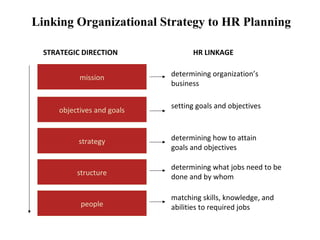
Linking Organizational Strategy to HR Planning
s
mission
objectives and goals
strategy
structure
people
STRATEGIC DIRECTION HR LINKAGE
determining organization’s
business
setting goals and objectives
determining how to attain
goals and objectives
determining what jobs need to be
done and by whom
matching skills, knowledge, and
abilities to required jobs
Linking Organizational Strategy to HR Planning
To ensure that appropriate personnel are available to meet the
requirements set during the strategic planning process, human
resource managers engage in employment planning.
The purpose of this planning effort is to determine what HRM
requirements exist for current and future supplies and demands
for workers.
1) Assessing current human resources
• Begins by developing a profile of the organization’s current
employees.
• This internal analysis includes information about the workers and
the skills they currently possess.
• Generating effective and detailed HR inventory report.
• The input to this report would be derived from forms completed by
employees and checked by supervisors.
• Such reports include a complete list of all employees by name,
education, training, prior employment, current position, performance
ratings, salary level, languages spoken, capabilities and specialized
skills.
• This input is valuable in determining what skills are currently
available in the organization.
• Inventory serves as a guide for supporting new organizational
pursuits or in altering the strategic direction.
• This report also has value in other HRM activities such as
selecting individuals for T&D, promotion and transfers.
• HRM must also find ways to ensure that employees are
retained, frequently called employee retention.
HUMAN RESOURCE INFORMATION SYSTEMS (HRIS)
“A computerized system that assists in the processing of HRM
information.”
• Implemented by the organizations to help the HR inventory.
• Also called human resource management system (HRMS).
• Designed to quickly fulfill the HR management information needs of the
organization.
• It’s a database system that’s keeps important information about employees
in a central and accessible location– even information on the global
workforce.
• Data can be retrieved and used to facilitate employment planning
decisions.
• Organizations can track most information about employees and jobs.
• This information can help an organization gain a competitive advantage.
• HRIS are now more user friendly.
• HR information systems (HRIS)
process employee information
quickly generate analyses and reports
provide compensation/benefits support
Succession planning
“Identification and development of potential successors for key positions in
an organization, through a systematic evaluation process and training.”
Succession planning includes the development of “Replacement Charts”. These are
the HRM organizational charts that
• portray middle- to upper-level management positions that may become
vacant in the near future
• list information about individuals who might qualify to fill the
positions/vacancies.
• Positions may become vacant due to retirements, promotions, transfers,
resignations or death of the incumbent.
• Employee morale is increased by 25%.
• Replacement charts looks similar to traditional organizational charts.
• Those individuals targeted for replacement are listed beneath with the
expected time in which they will be prepared to take on the needed
responsibility.
2) Determining the demand for labor
• A year by year analysis for every significant job level and type.
• The result is a human resource inventory covering specified years into the
future.
• Organizations usually require a diverse mix of people.
• Employees are not perfectly substitutable for one another within an
organization.
• Accurate estimates of future demands in both qualitative and quantitative
terms require more information than to determine for example “we need 25
new employees”.
• It is necessary to know what types of employees in terms of skills,
knowledge, and abilities are required.
3) Predicting the future labor supply
Forecasting of supply must also concern itself with the micro or unit level.
HR predicts the future labor supply.
– An increase in the supply of any unit’s human resources can come from a
combination of four sources:
• new hires
• contingent workers
• transfers-in
• individuals returning from leaves
– predicting these can range from simple to complex
– transfers are more difficult to predict since they depend on actions in other units
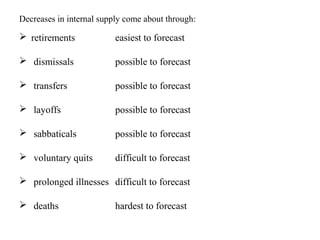
Decreases in internal supply come about through:
 retirements easiest to forecast
 dismissals possible to forecast
 transfers possible to forecast
 layoffs possible to forecast
 sabbaticals possible to forecast
 voluntary quits difficult to forecast
 prolonged illnesses difficult to forecast
 deaths hardest to forecast
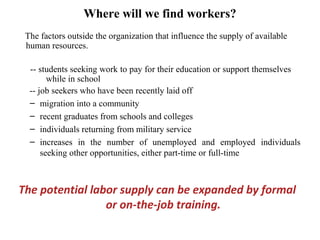
Where will we find workers?
The factors outside the organization that influence the supply of available
human resources.
-- students seeking work to pay for their education or support themselves
while in school
-- job seekers who have been recently laid off
– migration into a community
– recent graduates from schools and colleges
– individuals returning from military service
– increases in the number of unemployed and employed individuals
seeking other opportunities, either part-time or full-time
The potential labor supply can be expanded by formal
or on-the-job training.
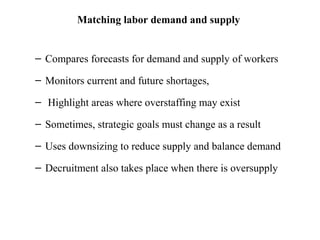
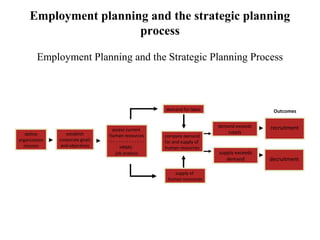
Matching labor demand and supply
– Compares forecasts for demand and supply of workers
– Monitors current and future shortages,
– Highlight areas where overstaffing may exist
– Sometimes, strategic goals must change as a result
– Uses downsizing to reduce supply and balance demand
– Decruitment also takes place when there is oversupply
Employment planning and the strategic planning
process
Employment Planning and the Strategic Planning Process
demand for labor
compare demand
for and supply of
human resources
recruitment
decruitment
define
organization
mission
establish
corporate goals
and objectives
demand exceeds
supply
supply exceeds
demand
assess current
human resources
-- - - - - - - - - - - - -
HRMS:
job analysis
Outcomes
supply of
human resources

Ch 3 hr planning act

  • 1.
  • 2.
    HR planning Planning isall about; “Knowing where you are going and how you are going to get there.” Human Resource Planning is “the process of determining an organization’s human resource needs”.
  • 3.
    HR planning Human resourceplanning is a process by which an organization ensures that – it has the right number and kinds of people – at the right place – at the right time – capable of effectively and efficiently completing those tasks that will help the organization achieve its overall strategic objectives
  • 4.
    HR planning mustbe • Linked to the organization’s overall strategy to compete domestically and globally • Translated into the number and types of workers needed Senior HRM staff need to lead top management in planning for HRM issues.
  • 5.
    An Organizational Framework Missionstatement “A brief statement of the reason an organization is in business” A mission statement defines what business the organization is in, including – why it exists? – who its customers are? After developing mission statement, – strategic goals are set by senior management and then define objectives for the company. It also includes identifying the scope of its products or services. Goals are generally defined for the next 5-20 years.
  • 6.
    Linking Organizational Strategyto HR Planning As the goals are set, the next step in the strategic planning process begins i.e. the corporate assessment. During a corporate assessment, – SWOT (Strengths-Weaknesses-Opportunities-Threats) analysis determines what is needed to meet objectives – strengths and weaknesses and core competencies are identified HRM determines what knowledge, skills, and abilities are needed by the organization’s human resources through a job analysis.
  • 7.
    • Strengths An organization’sbest attributes and abilities. • Weaknesses Resources an organization lacks or activities it does poorly. • Opportunities and threats Agents, factors, or forces in an organization's external environment that are out of its control, and can directly or indirectly affect is chances of success or failure. • Opportunities Elements that the project could exploit to its advantage • Threats Elements in the environment that could cause trouble for the business or project
  • 8.
    Linking Organizational Strategyto HR Planning s mission objectives and goals strategy structure people STRATEGIC DIRECTION HR LINKAGE determining organization’s business setting goals and objectives determining how to attain goals and objectives determining what jobs need to be done and by whom matching skills, knowledge, and abilities to required jobs
  • 9.
    Linking Organizational Strategyto HR Planning To ensure that appropriate personnel are available to meet the requirements set during the strategic planning process, human resource managers engage in employment planning. The purpose of this planning effort is to determine what HRM requirements exist for current and future supplies and demands for workers.
  • 10.
    1) Assessing currenthuman resources • Begins by developing a profile of the organization’s current employees. • This internal analysis includes information about the workers and the skills they currently possess. • Generating effective and detailed HR inventory report. • The input to this report would be derived from forms completed by employees and checked by supervisors. • Such reports include a complete list of all employees by name, education, training, prior employment, current position, performance ratings, salary level, languages spoken, capabilities and specialized skills.
  • 11.
    • This inputis valuable in determining what skills are currently available in the organization. • Inventory serves as a guide for supporting new organizational pursuits or in altering the strategic direction. • This report also has value in other HRM activities such as selecting individuals for T&D, promotion and transfers. • HRM must also find ways to ensure that employees are retained, frequently called employee retention.
  • 12.
    HUMAN RESOURCE INFORMATIONSYSTEMS (HRIS) “A computerized system that assists in the processing of HRM information.” • Implemented by the organizations to help the HR inventory. • Also called human resource management system (HRMS). • Designed to quickly fulfill the HR management information needs of the organization. • It’s a database system that’s keeps important information about employees in a central and accessible location– even information on the global workforce.
  • 13.
    • Data canbe retrieved and used to facilitate employment planning decisions. • Organizations can track most information about employees and jobs. • This information can help an organization gain a competitive advantage. • HRIS are now more user friendly. • HR information systems (HRIS) process employee information quickly generate analyses and reports provide compensation/benefits support
  • 14.
    Succession planning “Identification anddevelopment of potential successors for key positions in an organization, through a systematic evaluation process and training.” Succession planning includes the development of “Replacement Charts”. These are the HRM organizational charts that • portray middle- to upper-level management positions that may become vacant in the near future • list information about individuals who might qualify to fill the positions/vacancies. • Positions may become vacant due to retirements, promotions, transfers, resignations or death of the incumbent. • Employee morale is increased by 25%. • Replacement charts looks similar to traditional organizational charts. • Those individuals targeted for replacement are listed beneath with the expected time in which they will be prepared to take on the needed responsibility.
  • 15.
    2) Determining thedemand for labor • A year by year analysis for every significant job level and type. • The result is a human resource inventory covering specified years into the future. • Organizations usually require a diverse mix of people. • Employees are not perfectly substitutable for one another within an organization. • Accurate estimates of future demands in both qualitative and quantitative terms require more information than to determine for example “we need 25 new employees”. • It is necessary to know what types of employees in terms of skills, knowledge, and abilities are required.
  • 16.
    3) Predicting thefuture labor supply Forecasting of supply must also concern itself with the micro or unit level. HR predicts the future labor supply. – An increase in the supply of any unit’s human resources can come from a combination of four sources: • new hires • contingent workers • transfers-in • individuals returning from leaves – predicting these can range from simple to complex – transfers are more difficult to predict since they depend on actions in other units
  • 17.
    Decreases in internalsupply come about through:  retirements easiest to forecast  dismissals possible to forecast  transfers possible to forecast  layoffs possible to forecast  sabbaticals possible to forecast  voluntary quits difficult to forecast  prolonged illnesses difficult to forecast  deaths hardest to forecast
  • 18.
    Where will wefind workers? The factors outside the organization that influence the supply of available human resources. -- students seeking work to pay for their education or support themselves while in school -- job seekers who have been recently laid off – migration into a community – recent graduates from schools and colleges – individuals returning from military service – increases in the number of unemployed and employed individuals seeking other opportunities, either part-time or full-time The potential labor supply can be expanded by formal or on-the-job training.
  • 19.
    Matching labor demandand supply – Compares forecasts for demand and supply of workers – Monitors current and future shortages, – Highlight areas where overstaffing may exist – Sometimes, strategic goals must change as a result – Uses downsizing to reduce supply and balance demand – Decruitment also takes place when there is oversupply
  • 20.
    Employment planning andthe strategic planning process Employment Planning and the Strategic Planning Process demand for labor compare demand for and supply of human resources recruitment decruitment define organization mission establish corporate goals and objectives demand exceeds supply supply exceeds demand assess current human resources -- - - - - - - - - - - - - HRMS: job analysis Outcomes supply of human resources