© 2005 Prentice Hall Inc.
All rights reserved.
PowerPoint Presentation by Charlie Cook
The University of West Alabama
t e n t h e d i t i o n
Gary Dessler
Chapter 6 Part 2 Recruitment and Placement
Employee Testing and Selection
© 2005 Prentice Hall Inc. All rights reserved. 6–2
Employee testing and Selection
 Employment testing and Selection procedures are aptitude tests
and examinations that help a business predict the success of a
job candidate.
 Testing:
Employment testing is the practice of administrating
written, oral, or other tests as a means of determining the suitability
or desirability of job applicant.
Employee Selection:
The Process of interviewing and evaluating candidates for a
specific job and selecting an individual for employment based on
certain criteria.
© 2005 Prentice Hall Inc. All rights reserved. 6–3
Basic Testing Concepts
 Reliability
– The consistency of scores obtained by the same
person when retested with the identical or
equivalent tests.
– Are the test results stable over time?
 Test validity
– The accuracy with which a test, interview, and so
on measures what it purports to measure or fulfills
the function it was designed to fill.
– Does the test actually measure what we need for
it to measure?
© 2005 Prentice Hall Inc. All rights reserved. 6–4
Types of Validity
 Criterion validity
– A type of validity based on showing that scores on
the test (predictors) are related to job
performance (criterion).
• Are test scores in this class related to students’
knowledge of human resource management?
 Content validity
– A test that is content valid is one that contains a
fair sample of the tasks and skills actually needed
for the job in question.
• Do the test questions in this course relate to human
resource management topics?
• Is taking an HR course the same as doing HR?
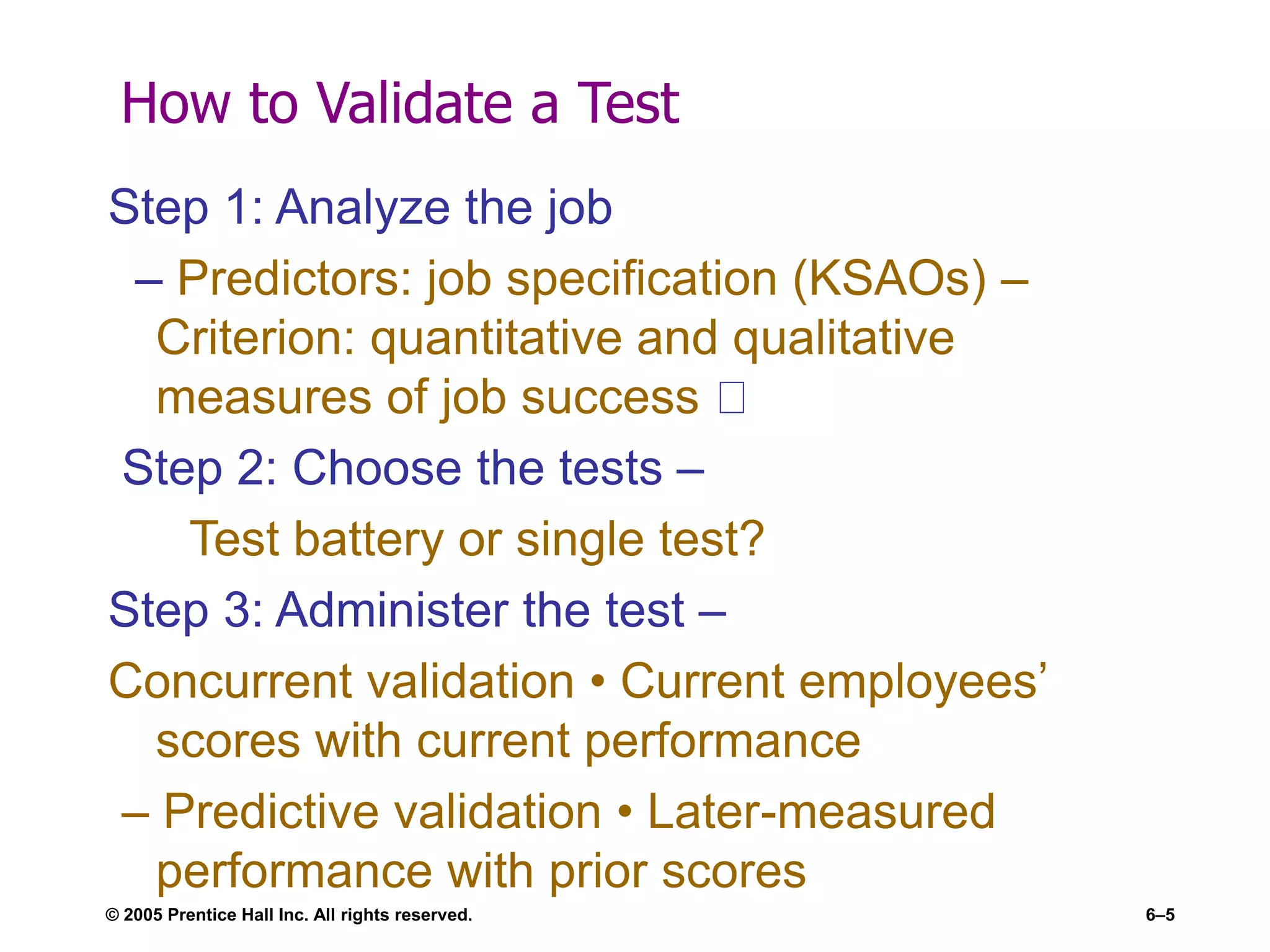
How to Validate a Test
Step 1: Analyze the job
– Predictors: job specification (KSAOs) –
Criterion: quantitative and qualitative
measures of job success
Step 2: Choose the tests –
Test battery or single test?
Step 3: Administer the test –
Concurrent validation • Current employees’
scores with current performance
– Predictive validation • Later-measured
performance with prior scores
© 2005 Prentice Hall Inc. All rights reserved. 6–5
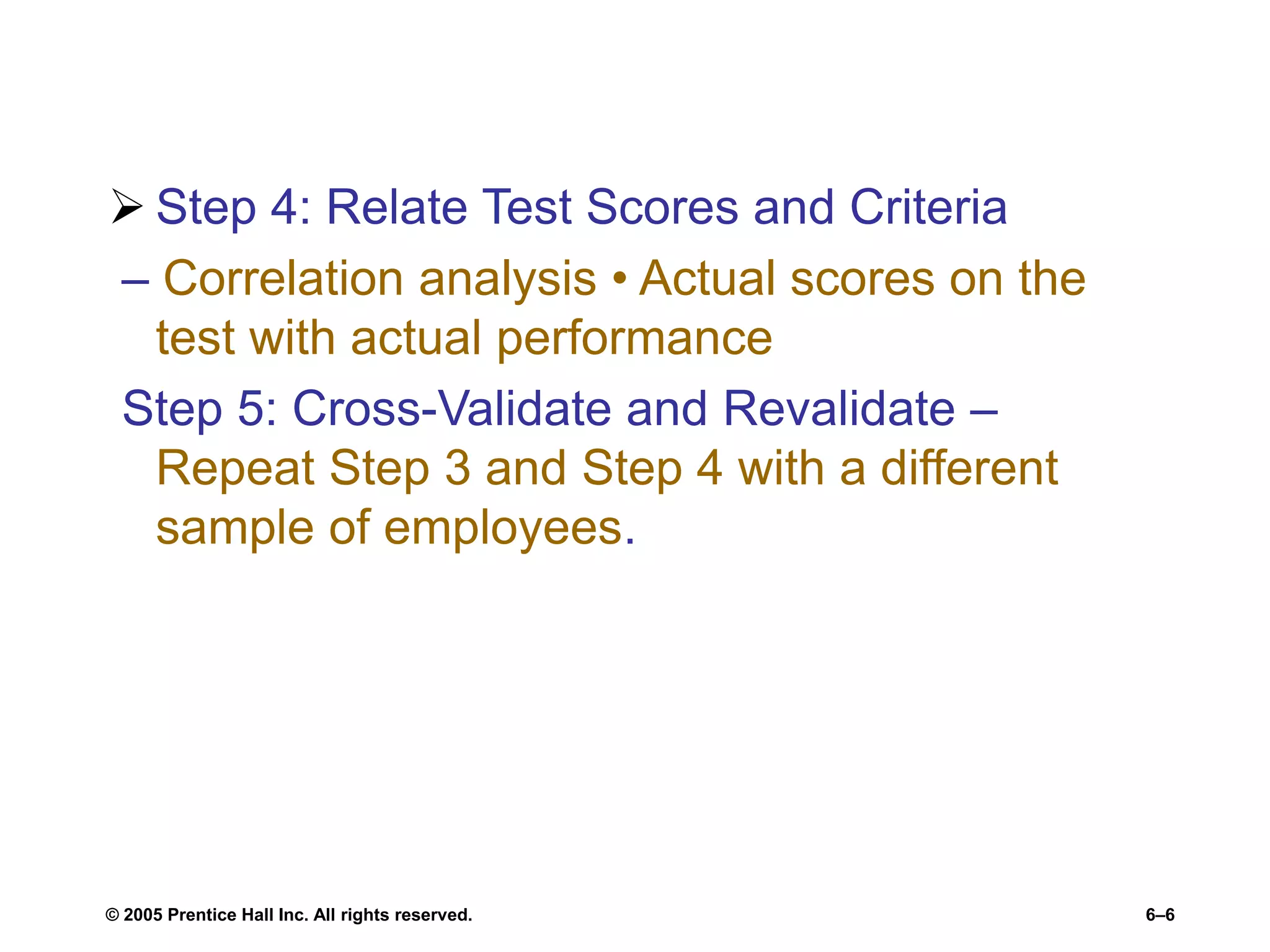
 Step 4: Relate Test Scores and Criteria
– Correlation analysis • Actual scores on the
test with actual performance
Step 5: Cross-Validate and Revalidate –
Repeat Step 3 and Step 4 with a different
sample of employees.
© 2005 Prentice Hall Inc. All rights reserved. 6–6
© 2005 Prentice Hall Inc. All rights reserved. 6–7
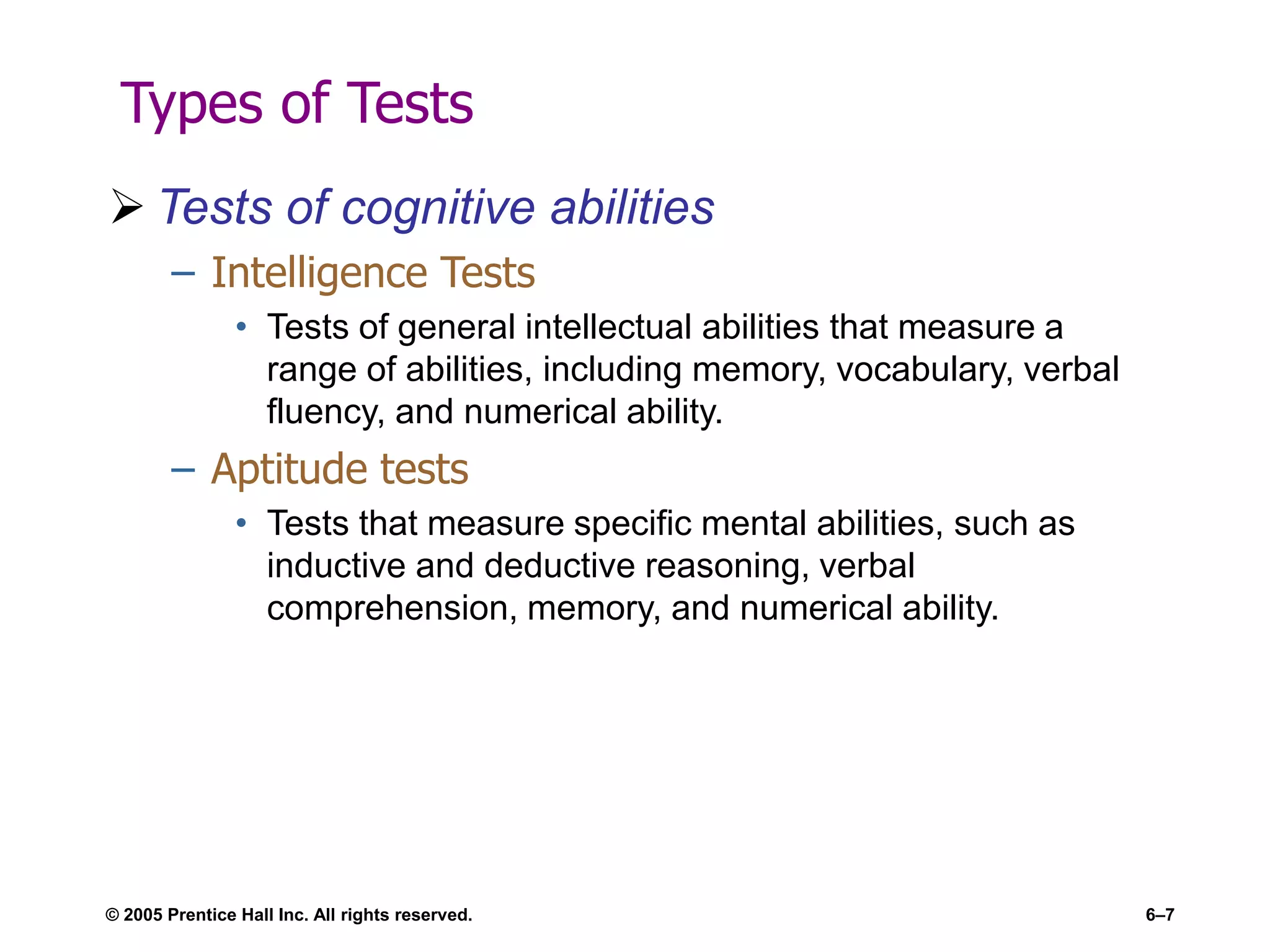
Types of Tests
 Tests of cognitive abilities
– Intelligence Tests
• Tests of general intellectual abilities that measure a
range of abilities, including memory, vocabulary, verbal
fluency, and numerical ability.
– Aptitude tests
• Tests that measure specific mental abilities, such as
inductive and deductive reasoning, verbal
comprehension, memory, and numerical ability.
© 2005 Prentice Hall Inc. All rights reserved. 6–8
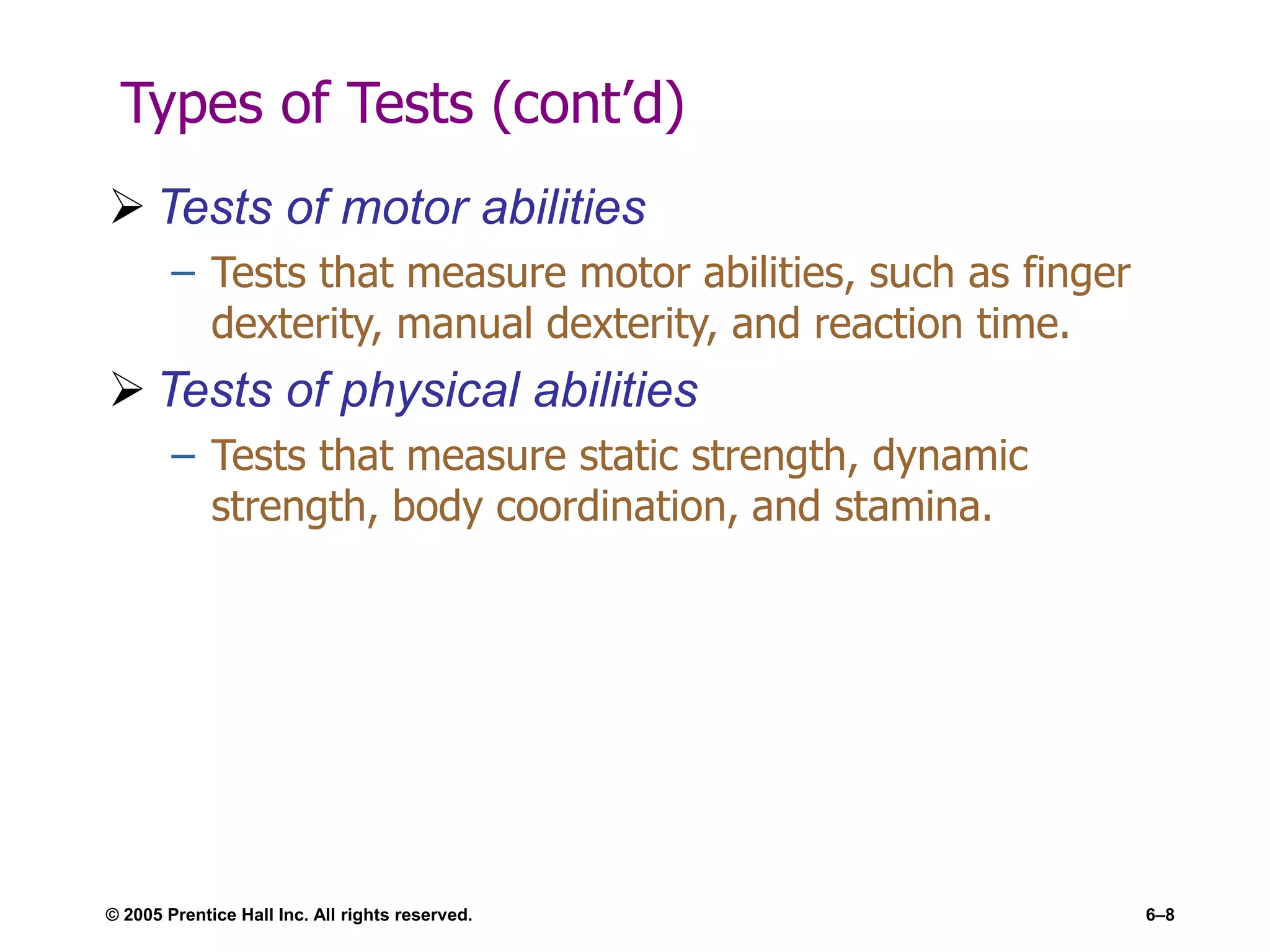
Types of Tests (cont’d)
 Tests of motor abilities
– Tests that measure motor abilities, such as finger
dexterity, manual dexterity, and reaction time.
 Tests of physical abilities
– Tests that measure static strength, dynamic
strength, body coordination, and stamina.
© 2005 Prentice Hall Inc. All rights reserved. 6–9
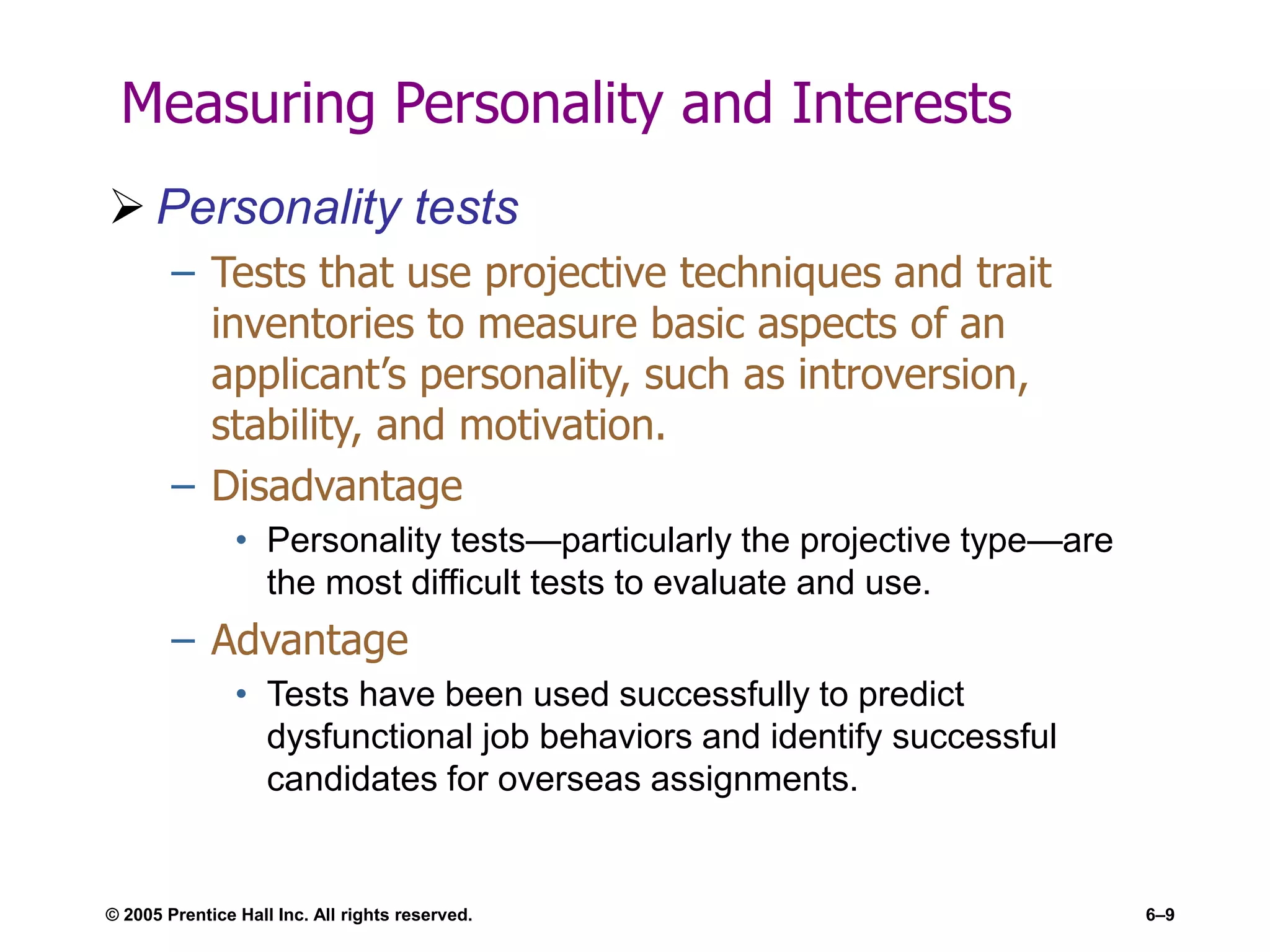
Measuring Personality and Interests
 Personality tests
– Tests that use projective techniques and trait
inventories to measure basic aspects of an
applicant’s personality, such as introversion,
stability, and motivation.
– Disadvantage
• Personality tests—particularly the projective type—are
the most difficult tests to evaluate and use.
– Advantage
• Tests have been used successfully to predict
dysfunctional job behaviors and identify successful
candidates for overseas assignments.
© 2005 Prentice Hall Inc. All rights reserved. 6–10
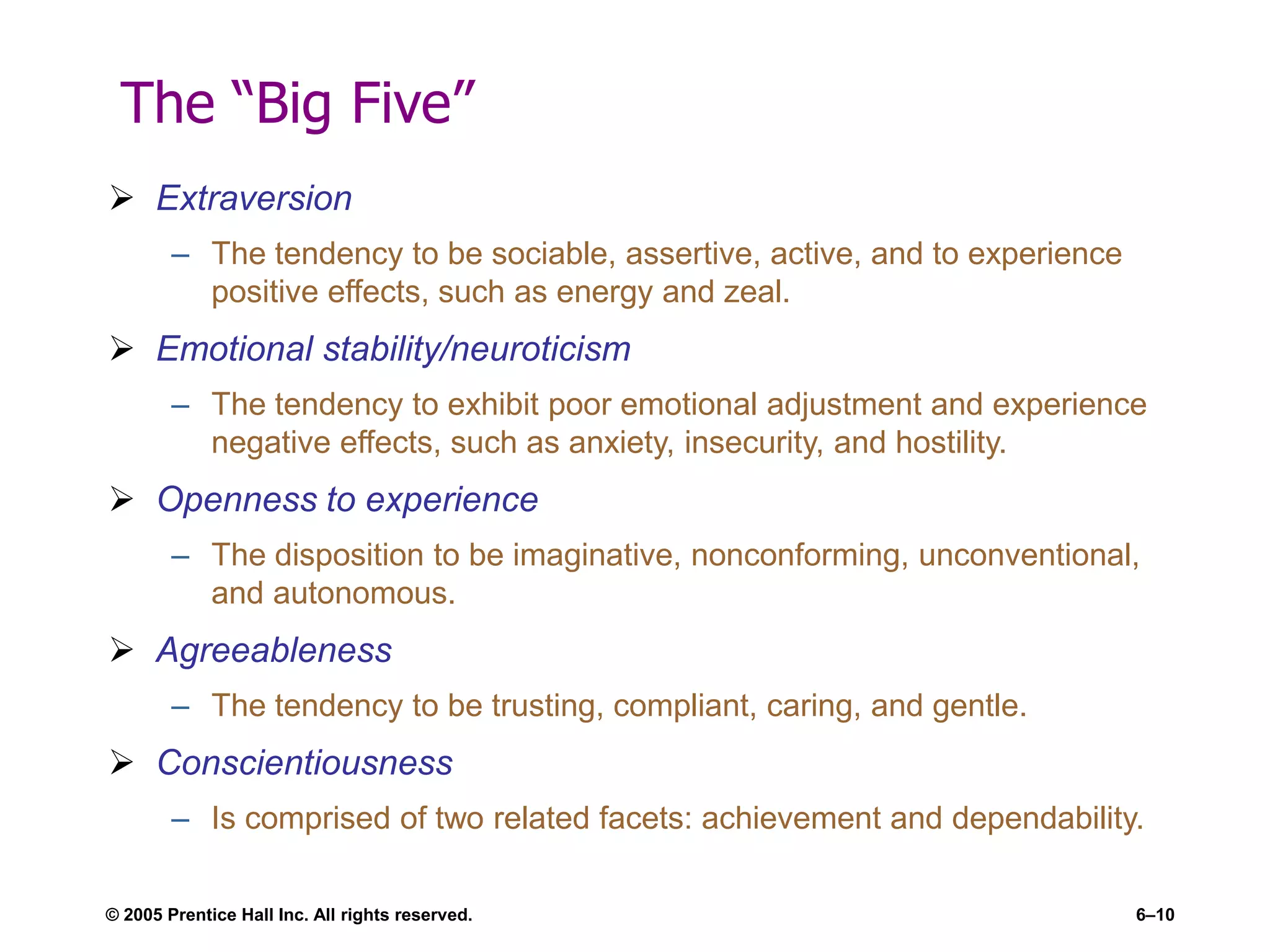
The “Big Five”
 Extraversion
– The tendency to be sociable, assertive, active, and to experience
positive effects, such as energy and zeal.
 Emotional stability/neuroticism
– The tendency to exhibit poor emotional adjustment and experience
negative effects, such as anxiety, insecurity, and hostility.
 Openness to experience
– The disposition to be imaginative, nonconforming, unconventional,
and autonomous.
 Agreeableness
– The tendency to be trusting, compliant, caring, and gentle.
 Conscientiousness
– Is comprised of two related facets: achievement and dependability.
© 2005 Prentice Hall Inc. All rights reserved. 6–11
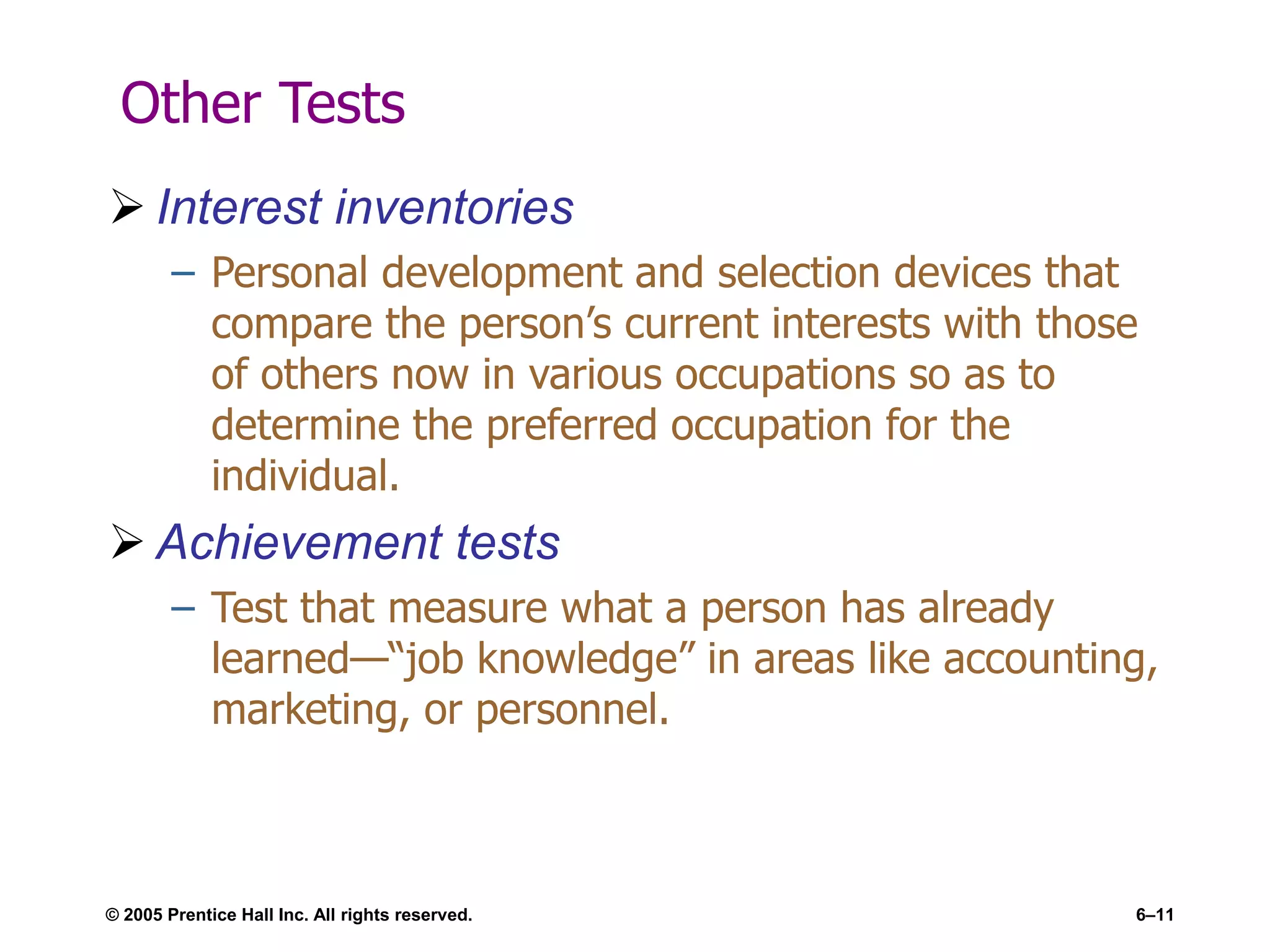
Other Tests
 Interest inventories
– Personal development and selection devices that
compare the person’s current interests with those
of others now in various occupations so as to
determine the preferred occupation for the
individual.
 Achievement tests
– Test that measure what a person has already
learned—“job knowledge” in areas like accounting,
marketing, or personnel.
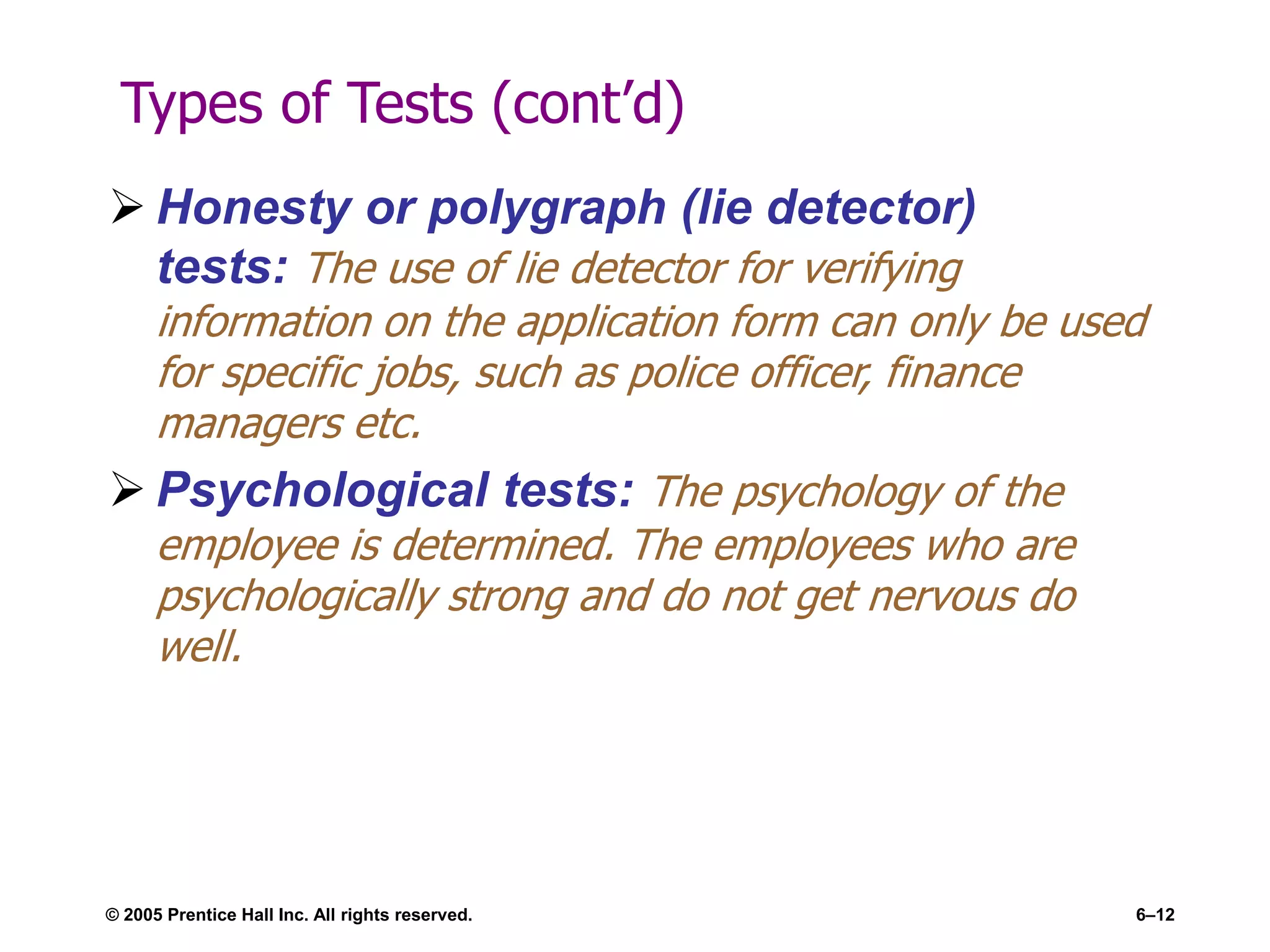
Types of Tests (cont’d)
 Honesty or polygraph (lie detector)
tests: The use of lie detector for verifying
information on the application form can only be used
for specific jobs, such as police officer, finance
managers etc.
 Psychological tests: The psychology of the
employee is determined. The employees who are
psychologically strong and do not get nervous do
well.
© 2005 Prentice Hall Inc. All rights reserved. 6–12
Types of Tests (cont’d)
 Graphology (Handwriting analysis)
tests: It has been said that an individual’s
handwriting can suggest the degree of energy,
inhibitions to be found in the writer
 Physical tests: To examine whether the candidate
is physically fit for the job
© 2005 Prentice Hall Inc. All rights reserved. 6–13
© 2005 Prentice Hall Inc. All rights reserved. 6–14
Other Tests (cont’d)
 Web-Based (Online) testing
– Eliminates costly and inefficient paper-and-pencil
testing processes.
– Allows for role-playing by applicants.
– Use of computer-based scoring eliminates rater
bias.
– Provides immediate scoring and feedback of
results to applicants.
– Can be readily customized for specific jobs.
© 2005 Prentice Hall Inc. All rights reserved. 6–15
Work Samples and Simulation
 Work samples and simulation
– Actual job tasks are used in testing applicants’
performance.
– Require applicants to perform tasks or work
activities that mirror the tasks employees perform
on the job.
 Work sampling technique
– A testing method based on measuring an
applicant’s performance on actual basic job tasks.
© 2005 Prentice Hall Inc. All rights reserved. 6–16
Work Simulations
 Management assessment center
– A simulation in which management candidates are
asked to perform realistic tasks in hypothetical
situations and are scored on their performance.
 Typical simulated exercises include:
– The in-basket
– Leaderless group discussion
– Management games
– Individual presentations
– Objective tests
– Structure interview
Typical simulated exercises include:
 The in-basket. This exercise confronts the candidate with an
accumulation of reports, memos, notes of incoming phone calls,
letters, and other materials collected in the actual or
computerized in-basket of the simulated job he or she is about
to start. The candidate must take appropriate action on each
item. Trained evaluators then review the candidate s efforts.
 Leaderless group discussion. Trainers give a leaderless
group a discussion question and tell members to arrive at a
group decision. They then evaluate each group member
interpersonal skills, acceptance by the group, leadership ability,
and individual influence
 Management games. Participants solve realistic problems as
members of simulated companies competing in a marketplace.
© 2005 Prentice Hall Inc. All rights reserved. 6–17
Typical simulated exercises include:
 Individual presentations. Here trainers
evaluate each participant s communication
skills and persuasiveness by having each
make an assigned oral presentation.
 Objective tests. An assessment center
typically includes tests of personality, mental
ability, interests, and achievements.
 The interview. Most also require an interview
between at least one trainer and each
participant, to assess the latter s interests,
past performance, and motivation
© 2005 Prentice Hall Inc. All rights reserved. 6–18
© 2005 Prentice Hall Inc. All rights reserved. 6–19
Background Investigations and Reference
Checks
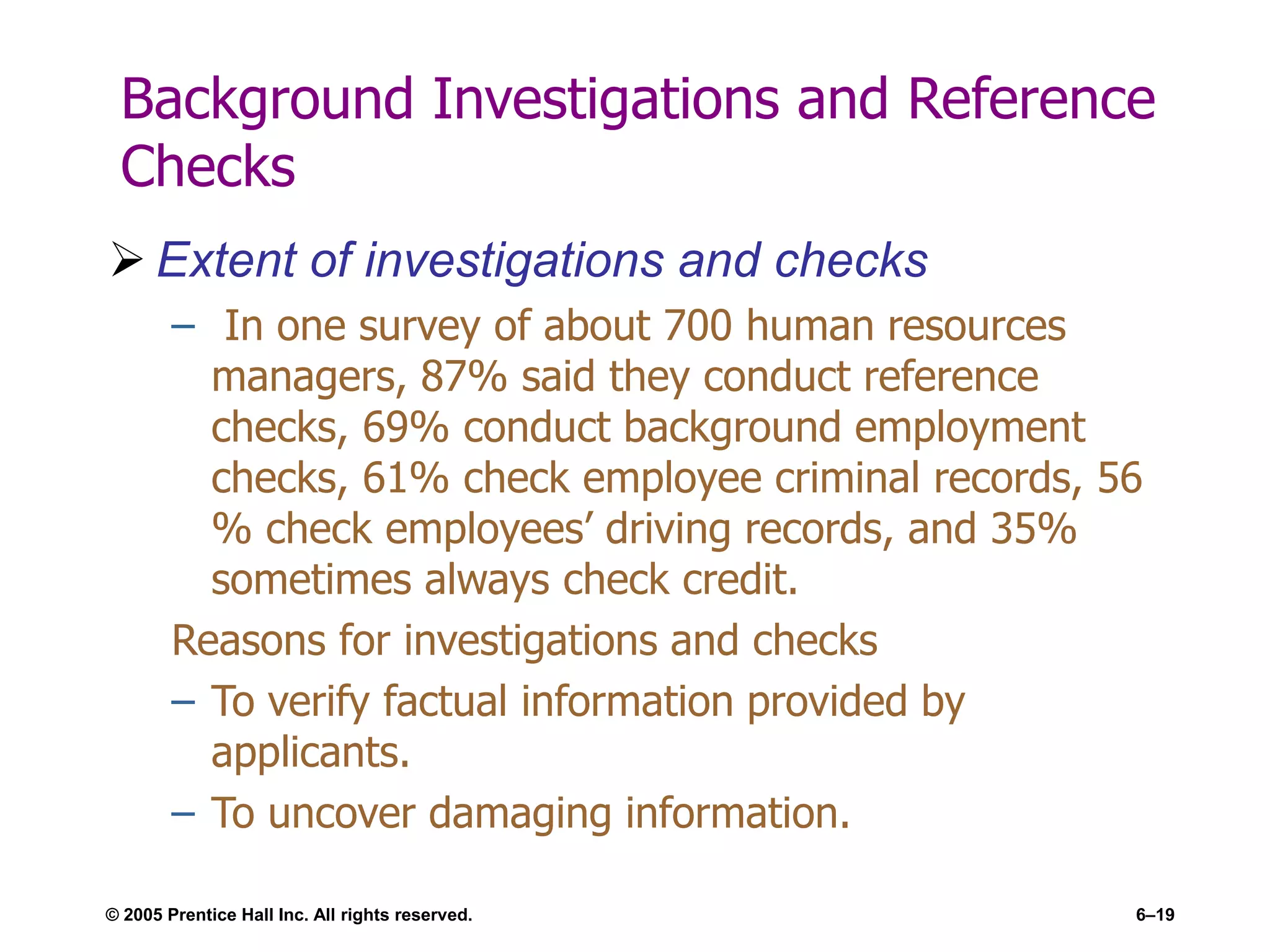
 Extent of investigations and checks
– In one survey of about 700 human resources
managers, 87% said they conduct reference
checks, 69% conduct background employment
checks, 61% check employee criminal records, 56
% check employees’ driving records, and 35%
sometimes always check credit.
Reasons for investigations and checks
– To verify factual information provided by
applicants.
– To uncover damaging information.
© 2005 Prentice Hall Inc. All rights reserved. 6–20
Background Investigations and Reference
Checks (cont’d)
 Sources of information for background
checks:
– Former employers
– Current supervisors
– Commercial credit rating companies
– Written references
© 2005 Prentice Hall Inc. All rights reserved. 6–21
Using Preemployment Information
Services
 Concerns about checking applicant histories
– Various equal employment laws discourage or
prohibit the use of such information in employee
screening.
– Courts view making employment decisions based
on someone’s arrest record as unfairly
discriminatory.
– The EEOC says a poor credit history should not by
itself preclude someone from getting a job.
© 2005 Prentice Hall Inc. All rights reserved. 6–22
Checking Background Information
 Step 1—Disclosure and authorization.
– Inform the employee/applicant that a report will
be requested and obtain written authorization.
– Before requesting consumer or investigative
reports form a consumer reporting agency, the
employer must disclose to the applicant or
employee that a report will be requested and that
the employee / applicant may receive a copy.
 Step 2—Certification.
– The employer must certify to the reporting agency
that the employer will comply with the federal and
state legal requirements
– The employer must certify to the reporting agency
that the employer will comply with the federal and
state legal requirements. (The reporting agency
will generally provide the employer with a form for
satisfying this requirement). The employer
certifies, among other things that the employer
made the disclosures outlined above in step 1 and
that it obtained written consent from the
employee or applicant.
© 2005 Prentice Hall Inc. All rights reserved. 6–23
 Step 3—Providing copies of reports.
– The employer must provide copies of the report to
the applicant or employee if adverse action is
contemplated.
 Under federal law, the employer must provide copies
of the report to the applicant or employee if adverse
action (such as withdrawing an offer of employment)
is contemplated. Under law, applicants or employees
must have the option of requesting a copy of the
report regardless of action.
© 2005 Prentice Hall Inc. All rights reserved. 6–24
© 2005 Prentice Hall Inc. All rights reserved. 6–25
Checking Background Information
(cont’d)
Step 4—Notice after adverse action.
– After the employer provides the employee or
applicant with copies of the consumer and
investigative reports and a reasonable period has
elapsed the employer may take an adverse action
(such as withdrawing an offer, or discussing or not
promoting the applicant or employee) If the
employer anticipate taking an adverse action, the
employee or applicant must receive an adverse
action notice.
WHY CAREFUL SELECTION IS IMPORTANT
 PERFORMANCE
 COST
 LEGAL OBLIGATIONS
 Person and Job/Organization Fit
© 2005 Prentice Hall Inc. All rights reserved. 6–26
Testing Program Guidelines
 1. Use tests as supplements.
 2. Validate the tests.
 3. Monitor your testing/selection program
 4. Keep accurate records.
 5. Use a certified psychologist.
 6. Manage test conditions.
 7. Revalidate periodically.
© 2005 Prentice Hall Inc. All rights reserved. 6–27
Why Careful Selection is Important
 The importance of selecting the right
employees
– Organizational performance always depends
in part on subordinates having the right skills
and attributes.
– Recruiting and hiring employees is costly.
– The legal implications of incompetent hiring •
EEO laws and court decisions related to
nondiscriminatory selection procedures •
The liability of negligent hiring of workers with
questionable backgrounds
© 2005 Prentice Hall Inc. All rights reserved. 6–28
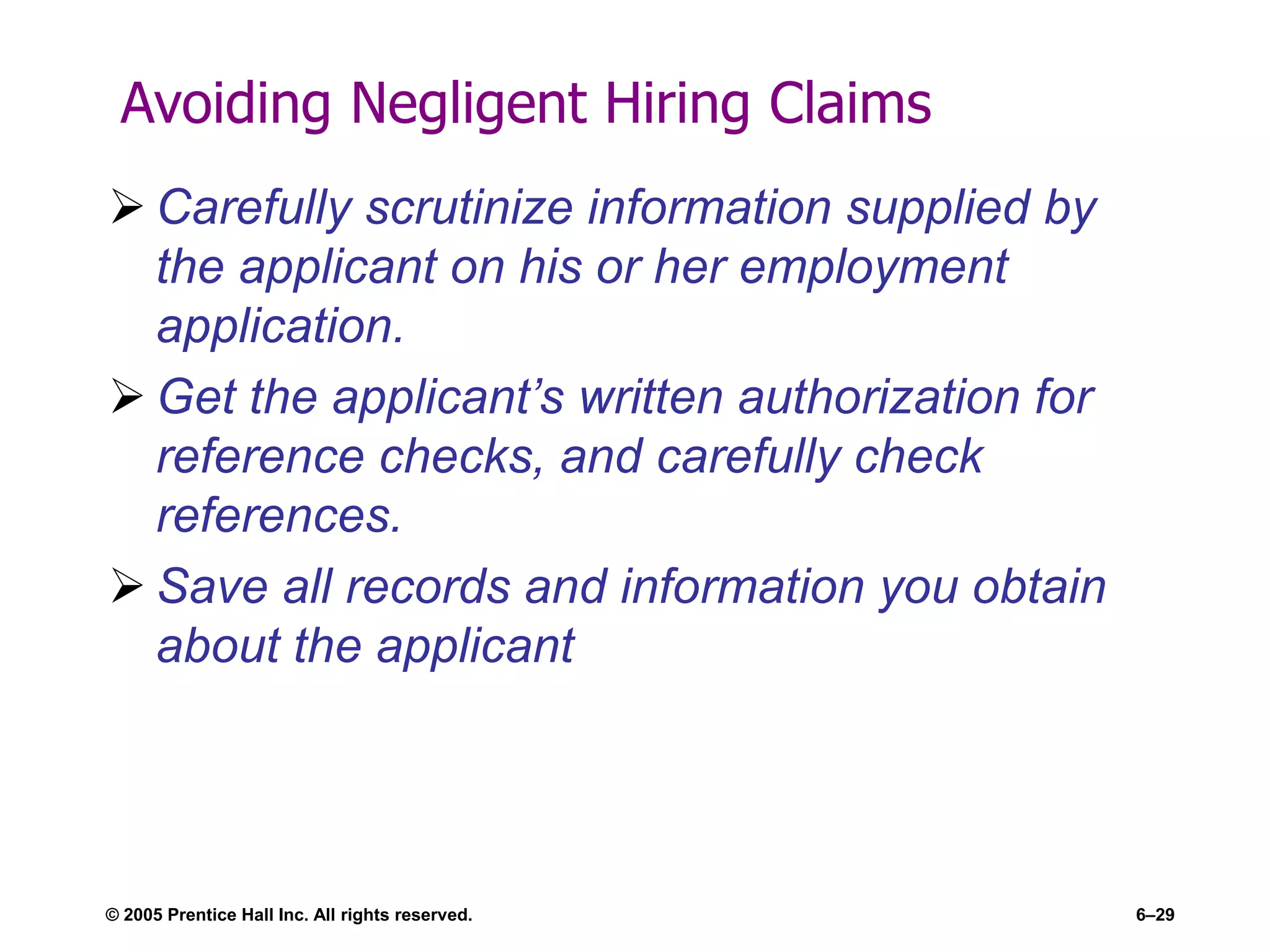
Avoiding Negligent Hiring Claims
 Carefully scrutinize information supplied by
the applicant on his or her employment
application.
 Get the applicant’s written authorization for
reference checks, and carefully check
references.
 Save all records and information you obtain
about the applicant
© 2005 Prentice Hall Inc. All rights reserved. 6–29
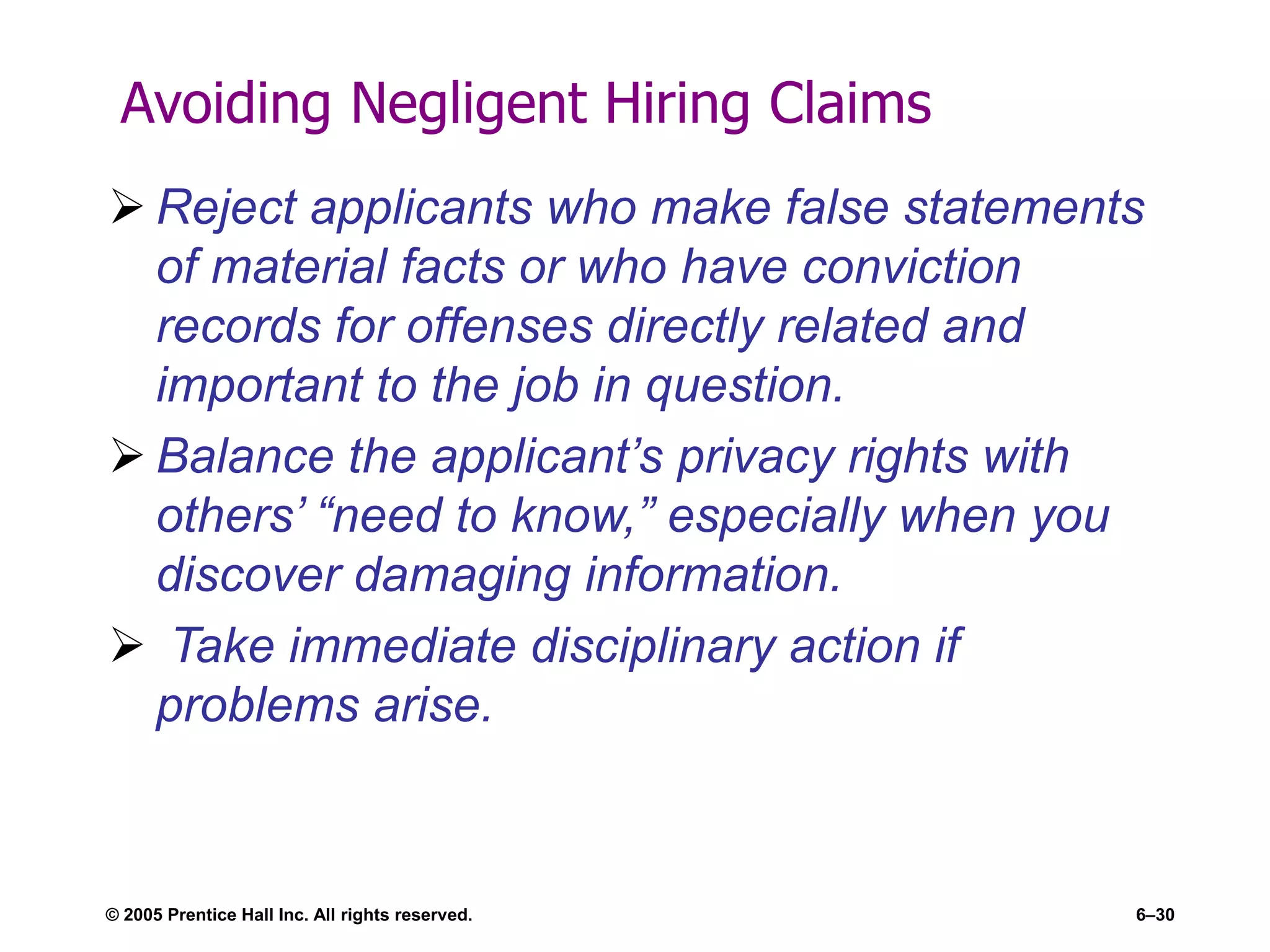
Avoiding Negligent Hiring Claims
 Reject applicants who make false statements
of material facts or who have conviction
records for offenses directly related and
important to the job in question.
 Balance the applicant’s privacy rights with
others’ “need to know,” especially when you
discover damaging information.
 Take immediate disciplinary action if
problems arise.
© 2005 Prentice Hall Inc. All rights reserved. 6–30

Testing and selection

  • 1.
    © 2005 PrenticeHall Inc. All rights reserved. PowerPoint Presentation by Charlie Cook The University of West Alabama t e n t h e d i t i o n Gary Dessler Chapter 6 Part 2 Recruitment and Placement Employee Testing and Selection
  • 2.
    © 2005 PrenticeHall Inc. All rights reserved. 6–2 Employee testing and Selection  Employment testing and Selection procedures are aptitude tests and examinations that help a business predict the success of a job candidate.  Testing: Employment testing is the practice of administrating written, oral, or other tests as a means of determining the suitability or desirability of job applicant. Employee Selection: The Process of interviewing and evaluating candidates for a specific job and selecting an individual for employment based on certain criteria.
  • 3.
    © 2005 PrenticeHall Inc. All rights reserved. 6–3 Basic Testing Concepts  Reliability – The consistency of scores obtained by the same person when retested with the identical or equivalent tests. – Are the test results stable over time?  Test validity – The accuracy with which a test, interview, and so on measures what it purports to measure or fulfills the function it was designed to fill. – Does the test actually measure what we need for it to measure?
  • 4.
    © 2005 PrenticeHall Inc. All rights reserved. 6–4 Types of Validity  Criterion validity – A type of validity based on showing that scores on the test (predictors) are related to job performance (criterion). • Are test scores in this class related to students’ knowledge of human resource management?  Content validity – A test that is content valid is one that contains a fair sample of the tasks and skills actually needed for the job in question. • Do the test questions in this course relate to human resource management topics? • Is taking an HR course the same as doing HR?
  • 5.
    How to Validatea Test Step 1: Analyze the job – Predictors: job specification (KSAOs) – Criterion: quantitative and qualitative measures of job success Step 2: Choose the tests – Test battery or single test? Step 3: Administer the test – Concurrent validation • Current employees’ scores with current performance – Predictive validation • Later-measured performance with prior scores © 2005 Prentice Hall Inc. All rights reserved. 6–5
  • 6.
     Step 4:Relate Test Scores and Criteria – Correlation analysis • Actual scores on the test with actual performance Step 5: Cross-Validate and Revalidate – Repeat Step 3 and Step 4 with a different sample of employees. © 2005 Prentice Hall Inc. All rights reserved. 6–6
  • 7.
    © 2005 PrenticeHall Inc. All rights reserved. 6–7 Types of Tests  Tests of cognitive abilities – Intelligence Tests • Tests of general intellectual abilities that measure a range of abilities, including memory, vocabulary, verbal fluency, and numerical ability. – Aptitude tests • Tests that measure specific mental abilities, such as inductive and deductive reasoning, verbal comprehension, memory, and numerical ability.
  • 8.
    © 2005 PrenticeHall Inc. All rights reserved. 6–8 Types of Tests (cont’d)  Tests of motor abilities – Tests that measure motor abilities, such as finger dexterity, manual dexterity, and reaction time.  Tests of physical abilities – Tests that measure static strength, dynamic strength, body coordination, and stamina.
  • 9.
    © 2005 PrenticeHall Inc. All rights reserved. 6–9 Measuring Personality and Interests  Personality tests – Tests that use projective techniques and trait inventories to measure basic aspects of an applicant’s personality, such as introversion, stability, and motivation. – Disadvantage • Personality tests—particularly the projective type—are the most difficult tests to evaluate and use. – Advantage • Tests have been used successfully to predict dysfunctional job behaviors and identify successful candidates for overseas assignments.
  • 10.
    © 2005 PrenticeHall Inc. All rights reserved. 6–10 The “Big Five”  Extraversion – The tendency to be sociable, assertive, active, and to experience positive effects, such as energy and zeal.  Emotional stability/neuroticism – The tendency to exhibit poor emotional adjustment and experience negative effects, such as anxiety, insecurity, and hostility.  Openness to experience – The disposition to be imaginative, nonconforming, unconventional, and autonomous.  Agreeableness – The tendency to be trusting, compliant, caring, and gentle.  Conscientiousness – Is comprised of two related facets: achievement and dependability.
  • 11.
    © 2005 PrenticeHall Inc. All rights reserved. 6–11 Other Tests  Interest inventories – Personal development and selection devices that compare the person’s current interests with those of others now in various occupations so as to determine the preferred occupation for the individual.  Achievement tests – Test that measure what a person has already learned—“job knowledge” in areas like accounting, marketing, or personnel.
  • 12.
    Types of Tests(cont’d)  Honesty or polygraph (lie detector) tests: The use of lie detector for verifying information on the application form can only be used for specific jobs, such as police officer, finance managers etc.  Psychological tests: The psychology of the employee is determined. The employees who are psychologically strong and do not get nervous do well. © 2005 Prentice Hall Inc. All rights reserved. 6–12
  • 13.
    Types of Tests(cont’d)  Graphology (Handwriting analysis) tests: It has been said that an individual’s handwriting can suggest the degree of energy, inhibitions to be found in the writer  Physical tests: To examine whether the candidate is physically fit for the job © 2005 Prentice Hall Inc. All rights reserved. 6–13
  • 14.
    © 2005 PrenticeHall Inc. All rights reserved. 6–14 Other Tests (cont’d)  Web-Based (Online) testing – Eliminates costly and inefficient paper-and-pencil testing processes. – Allows for role-playing by applicants. – Use of computer-based scoring eliminates rater bias. – Provides immediate scoring and feedback of results to applicants. – Can be readily customized for specific jobs.
  • 15.
    © 2005 PrenticeHall Inc. All rights reserved. 6–15 Work Samples and Simulation  Work samples and simulation – Actual job tasks are used in testing applicants’ performance. – Require applicants to perform tasks or work activities that mirror the tasks employees perform on the job.  Work sampling technique – A testing method based on measuring an applicant’s performance on actual basic job tasks.
  • 16.
    © 2005 PrenticeHall Inc. All rights reserved. 6–16 Work Simulations  Management assessment center – A simulation in which management candidates are asked to perform realistic tasks in hypothetical situations and are scored on their performance.  Typical simulated exercises include: – The in-basket – Leaderless group discussion – Management games – Individual presentations – Objective tests – Structure interview
  • 17.
    Typical simulated exercisesinclude:  The in-basket. This exercise confronts the candidate with an accumulation of reports, memos, notes of incoming phone calls, letters, and other materials collected in the actual or computerized in-basket of the simulated job he or she is about to start. The candidate must take appropriate action on each item. Trained evaluators then review the candidate s efforts.  Leaderless group discussion. Trainers give a leaderless group a discussion question and tell members to arrive at a group decision. They then evaluate each group member interpersonal skills, acceptance by the group, leadership ability, and individual influence  Management games. Participants solve realistic problems as members of simulated companies competing in a marketplace. © 2005 Prentice Hall Inc. All rights reserved. 6–17
  • 18.
    Typical simulated exercisesinclude:  Individual presentations. Here trainers evaluate each participant s communication skills and persuasiveness by having each make an assigned oral presentation.  Objective tests. An assessment center typically includes tests of personality, mental ability, interests, and achievements.  The interview. Most also require an interview between at least one trainer and each participant, to assess the latter s interests, past performance, and motivation © 2005 Prentice Hall Inc. All rights reserved. 6–18
  • 19.
    © 2005 PrenticeHall Inc. All rights reserved. 6–19 Background Investigations and Reference Checks  Extent of investigations and checks – In one survey of about 700 human resources managers, 87% said they conduct reference checks, 69% conduct background employment checks, 61% check employee criminal records, 56 % check employees’ driving records, and 35% sometimes always check credit. Reasons for investigations and checks – To verify factual information provided by applicants. – To uncover damaging information.
  • 20.
    © 2005 PrenticeHall Inc. All rights reserved. 6–20 Background Investigations and Reference Checks (cont’d)  Sources of information for background checks: – Former employers – Current supervisors – Commercial credit rating companies – Written references
  • 21.
    © 2005 PrenticeHall Inc. All rights reserved. 6–21 Using Preemployment Information Services  Concerns about checking applicant histories – Various equal employment laws discourage or prohibit the use of such information in employee screening. – Courts view making employment decisions based on someone’s arrest record as unfairly discriminatory. – The EEOC says a poor credit history should not by itself preclude someone from getting a job.
  • 22.
    © 2005 PrenticeHall Inc. All rights reserved. 6–22 Checking Background Information  Step 1—Disclosure and authorization. – Inform the employee/applicant that a report will be requested and obtain written authorization. – Before requesting consumer or investigative reports form a consumer reporting agency, the employer must disclose to the applicant or employee that a report will be requested and that the employee / applicant may receive a copy.
  • 23.
     Step 2—Certification. –The employer must certify to the reporting agency that the employer will comply with the federal and state legal requirements – The employer must certify to the reporting agency that the employer will comply with the federal and state legal requirements. (The reporting agency will generally provide the employer with a form for satisfying this requirement). The employer certifies, among other things that the employer made the disclosures outlined above in step 1 and that it obtained written consent from the employee or applicant. © 2005 Prentice Hall Inc. All rights reserved. 6–23
  • 24.
     Step 3—Providingcopies of reports. – The employer must provide copies of the report to the applicant or employee if adverse action is contemplated.  Under federal law, the employer must provide copies of the report to the applicant or employee if adverse action (such as withdrawing an offer of employment) is contemplated. Under law, applicants or employees must have the option of requesting a copy of the report regardless of action. © 2005 Prentice Hall Inc. All rights reserved. 6–24
  • 25.
    © 2005 PrenticeHall Inc. All rights reserved. 6–25 Checking Background Information (cont’d) Step 4—Notice after adverse action. – After the employer provides the employee or applicant with copies of the consumer and investigative reports and a reasonable period has elapsed the employer may take an adverse action (such as withdrawing an offer, or discussing or not promoting the applicant or employee) If the employer anticipate taking an adverse action, the employee or applicant must receive an adverse action notice.
  • 26.
    WHY CAREFUL SELECTIONIS IMPORTANT  PERFORMANCE  COST  LEGAL OBLIGATIONS  Person and Job/Organization Fit © 2005 Prentice Hall Inc. All rights reserved. 6–26
  • 27.
    Testing Program Guidelines 1. Use tests as supplements.  2. Validate the tests.  3. Monitor your testing/selection program  4. Keep accurate records.  5. Use a certified psychologist.  6. Manage test conditions.  7. Revalidate periodically. © 2005 Prentice Hall Inc. All rights reserved. 6–27
  • 28.
    Why Careful Selectionis Important  The importance of selecting the right employees – Organizational performance always depends in part on subordinates having the right skills and attributes. – Recruiting and hiring employees is costly. – The legal implications of incompetent hiring • EEO laws and court decisions related to nondiscriminatory selection procedures • The liability of negligent hiring of workers with questionable backgrounds © 2005 Prentice Hall Inc. All rights reserved. 6–28
  • 29.
    Avoiding Negligent HiringClaims  Carefully scrutinize information supplied by the applicant on his or her employment application.  Get the applicant’s written authorization for reference checks, and carefully check references.  Save all records and information you obtain about the applicant © 2005 Prentice Hall Inc. All rights reserved. 6–29
  • 30.
    Avoiding Negligent HiringClaims  Reject applicants who make false statements of material facts or who have conviction records for offenses directly related and important to the job in question.  Balance the applicant’s privacy rights with others’ “need to know,” especially when you discover damaging information.  Take immediate disciplinary action if problems arise. © 2005 Prentice Hall Inc. All rights reserved. 6–30