HRM Challenges and Managing
Strategic Organizational Review
Chapter 2
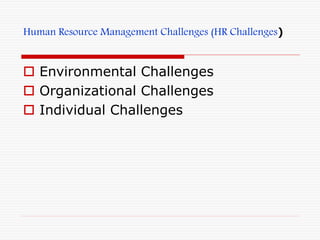
 Environmental Challenges
 Organizational Challenges
 Individual Challenges
Human Resource Management Challenges (HR Challenges)
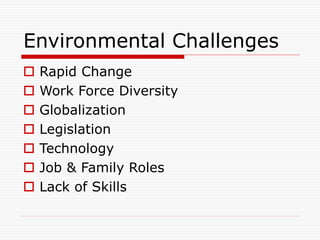
Environmental Challenges
 Rapid Change
 Work Force Diversity
 Globalization
 Legislation
 Technology
 Job & Family Roles
 Lack of Skills
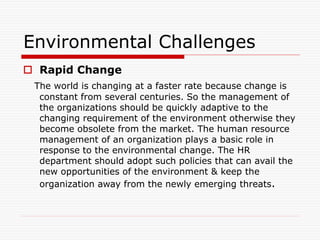
Environmental Challenges
 Rapid Change
The world is changing at a faster rate because change is
constant from several centuries. So the management of
the organizations should be quickly adaptive to the
changing requirement of the environment otherwise they
become obsolete from the market. The human resource
management of an organization plays a basic role in
response to the environmental change. The HR
department should adopt such policies that can avail the
new opportunities of the environment & keep the
organization away from the newly emerging threats.
Environmental Challenges
 Work Force Diversity
The changing environment provides both the
opportunities & threats to the human resource
management of the organization. The HR
manager should adopt such policies that can
make possible the diverse work force of
employees. Although on one hand diversity
creates big problem but in the long run, the
survival & performance of the organization is
flourished
Environmental Challenges
 Globalization
One of the serious issue that today’s
organizations are facing is the issue of
globalization. The world is converting into
global business and severe competition is
started between domestic & foreign companies.
Such competition results in the laying off the
effective workforce of the organization. The HR
department can play an important role in
keeping the culture of the organization as
global & wider.
Environmental Challenges
 Legislation
It is the old environmental challenge that is faced by
organization since many decades. There are certain labor
laws that are declared by the government for the
benefits of the working employees. Some of these laws
are disadvantageous to the interests of the organizations
so it is a one of the big challenges for the HRM to
implement all those labor laws within the organizations.
If any of such law is violated, serious actions are taken
by the relevant government authority that may result
into serious penalty for the management of the
organization.
Environmental Challenges
 Technology
The technology is also growing with great speed
especially in the field of computer & telecommunication.
New methods are emerging that quickly dominates the
older ones & makes them obsolete. Therefore the skills
required by the employees also changes with the
changing technology & this would compels the worker to
advance the skills three to four times throughout their
working lives. So there comes a burden on the HR
department to constantly update the skills & expertise of
their employees.
Environmental Challenges
 Job & Family Roles
In recent years, dual-career families are increasing in which
both the wife & husband work. This creates a serious burden
on the women that they have to give time to their families
also. In many organizations the policies of HR favors the
employment of more than 10 years. The working hours of the
organizations are also strict and tight for the employees.
Moreover, the selection & training procedures are two tough
and time consuming so most of the talented women hesitate to
join any organization which would result in the wastage of
talent and potential. Even working men also suffer from these
employment policies because they do not properly give time to
their families. So the challenges for the HRM increases with
this particular issue & special favorable working policies are
needed to be employed in all organizations.
Organizational Challenges
 Controlling Costs
 Improving Quality
 Developing Distinctive Capabilities
 Restructuring
Organizational Challenges
 Controlling Costs
 An organization can avail the competitive position by lowering
its cost & strengthening its cash flows. For this purpose, the
labor cost of the organization is minimized through effective
compensation system that adopts innovative reward strategies
for good performances. In this way the favorable behaviors of
the employees are rewarded so the organization would get the
ultimate advantage. Moreover the policies of compensation
should keep the labor cost under control. The effective
employees should be selected that keep with the organization
for a longer duration & proper training should also be provided
to these employees. The HR department should also restore
the work of the employees along with the improvement in the
health & safety issue of working environment. All of these
efforts would limit the cost of labor.
Organizational Challenges
 Improving Quality
The quality improvement can lead an
organization towards competitive
advantage. The total quality
management programs are employed
that improves all the processes within
the organization which would
ultimately result in the improvement
of the final product or service
Organizational Challenges
 Developing Distinctive
Capabilities
Another method of gaining competitive
advantage is to employ the people
that have distinct capabilities to
develop extra ordinary competence in
specific area.
Organizational Challenges
 Restructuring
Another technique is the restructuring
of the organization in which the
methods of performing different
functions are altered positively. In
case of HR department, the majority
of functions are still performed within
the organization
Individual Challenges
 01-Productivity
 02- Empowerment
 03- Brain drain
 04- Ethics & social responsibility
 05- Job insecurity
 06- Matching people & organization
Individual Challenges
 Productivity
 Productivity is defined as the measure of the value that
an employee can add to the final product or service of
the organization. The increased output per employee is
reflected as increased productivity. Ability & motivation
are two important factors that affect the employee
productivity. The ability of the employee can be
improved by the hiring & replacement along with the
proper training & career development. On the other high
quality of work life serves as accelerator to the
motivational factor of the employees.
Individual Challenges
 Empowerment
 In the modern days many organizations make
changes in such a way that their individual
employees exert more control on their work as
compared to their superiors. This individual
control of employees is called empowerment
which helps the employees to work with
enthusiasm, commitment & learn new skills
because they are more make normal decisions
about their work by themselves & hence enjoy
their work.
Individual Challenges
 Brain Drain
 One of the challenges for HRM is the
detachment of the key potential employees
from the organization which link with the
competitors for higher remunerations etc. In
such cases the organization loses its
intellectual property & in many situations the
leaving employees at the higher levels also
take with them the potential lower level
employees. This brain drainage is becoming
serious issue in the high-Tec companies.
Individual Challenges
 Ethics & Social Responsibility
 Under this challenge, the organizations make an effort to
benefit some portion of the society. This is now
considered to the social responsibility of the organization
to show favorable behavior towards the society. The
ethics serves as the basic principle for the socially
behavior of the organizations. Within organizations, the
HR departments develop a code of conduct & principles
of code of ethics that serve as the guidance for the
personal behavior of the employees of the organizations.
The employees also expect from the management to
show favorable decisions.
Individual Challenges
 Job Insecurity
 In the recent years, restructuring & downsizing
develops the sense of insecurity of job within
the employees of the organizations. Now many
employees only desire to get a steady job
rather than a job with promotional future.The
stock market also shows favorable results
when layoffs has been made. All these things
create a fear among employees about the
insecurity of their jobs which would hinder
their effective performance.
Individual Challenges
 Matching People & Organizations
It has been proved from the research that the HR
department contributes to the profitability of the
organization when it makes such policies of employee
selection in which those employees are selected &
retained that best suits the culture of the organization &
its objectives. In short it is an important challenge for
the HR department to hire and keep such employees
whose abilities & strengths would match the
requirements & circumstances of the organization.
HR’s Role in the Reengineering
Process
 These processes mean reframing and redesign of human
resource processes with the aim in order to achieve optimum personnel
and the whole company work performance.
 Shaping the process
 Creating job statements and role descriptions that reflect
the new corporate order
 Working out compensation issues
 Training the new work force
 Molding the new corporate culture
 Facilitate communication in the work force
HR’s Role in the
Reengineering Process
 Shaping the process:
Although senior management may lay down the general
guidelines and direction the reengineering effort will
take, HR often can play a major role in determining
whether it will succeed. HR helped create the selection
criteria for members of the steering committee. HR also
can interview and evaluate candidates. Even as the
process filters down through the organization, HR can
play a key role in determining how team leaders and
team members are selected.
HR’s Role in the
Reengineering Process
 Creating job statements and role
descriptions that reflect the new
corporate order:
It isn’t enough to plug existing job descriptions into new
positions created from reengineering. It isn’t enough to use
existing methodology to create new positions. Reengineering
requires serious introspection about what the company is
trying to achieve and what job and role responsibilities will
help realize the goals. “It’s a whole new way of thinking. The
idea is to write job statements instead of descriptions, to
outline roles vs. tasks, and to structure work around the
customer rather than a specific function or department,” says
Mary Layman, vice president of HR for CTB.
HR’s Role in the
Reengineering Process
 Working out compensation issues:
Pay scales and rewards must be structured to
create the desired results. For example, a
company that wants to focus on customer
service must measure and compensate the
work force based on that criteria. Likewise, HR
must think about whether it should pay
employees for specific tasks they should
perform from 8 a.m. to 5 p.m., or offer skill-
based or knowledge-based pay. “Too often,
there’s a disconnect between the basic strategy
and what HR actually does,” says Caldow
HR’s Role in the
Reengineering Process
 Training the new work force:
“A company may have award-winning training
programs, but they probably aren’t going to have a lot to
do with the overall reengineering strategy,” says William.
Experts agree that it’s important to provide plenty of
training on specific skills employees will need in the
newly reengineered company, but that teamwork,
decision making and trust building must also be heavily
emphasized over a period of time
HR’s Role in the
Reengineering Process
 Molding the new corporate culture:
Stories, ceremonies, awards and rituals all
have a major impact on how people behave.
Caldow insists that human resources can alter
thinking by helping form a new ethnography. It
must be consistent throughout the
organization, and it should be backed by plenty
of symbolism. Yet, the change won’t occur
overnight. It may take weeks or months before
a real breakthrough in thinking takes place.
HR’s Role in the
Reengineering Process
 Facilitate communication in the work
force:
Nothing is as frightening to a work force as
change, and nothing changes a work force as
much as reengineering. Newsletters, videos,
letters, E-mail messages, and companywide
and departmental meetings are all useful tools
in quelling anxiety. Moreover, good
communication can help a work force
understand how reengineering may benefit it in
the future
HR Role in managing Transfer
 A transfer involves the shifting of an employee from one
job to another without changing the responsibilities or
compensation”.
 Production Transfer
 Replacement Transfers
 Remedial Transfers
 Versatility Transfer
HR Role in managing Transfer
 Production Transfer:
Such transfers are resorted to when
there is a need of manpower in one
department and surplus manpower in
other department. Such transfers are
made to meet the company
requirements. The surplus employees in
one department/section might be
observed in other place where there is a
requirement.
HR Role in managing Transfer
 Replacement Transfers: This takes
place to replace a new employee who
has been in the organization for a
long time and there by giving some
relief to an old employee from the
heavy pressure of work
HR Role in managing Transfer
 Remedial Transfers: As the name
suggest, these transfers are made to
rectify the situation caused by faulty
selection and placement procedures.
Such transfers are made to rectify
mistakes in placement and
recruitments. If the initial placement
of an individual is faulty or has not
adjusted to work/job, his transfer to a
more appropriate job is desirable.
HR Role in managing Transfer
 Versatility Transfer:
Such transfers are made to increase versatility
of the employees from one job to another and
one department to another department.
Transfer (Job Rotation) are the tool to train the
employees. Each employee should provide a
varied and broader job experiences by moving
from one department to another. This is for
preparing the employee for promotion, this will
definitely help the employee to have job
enrichment
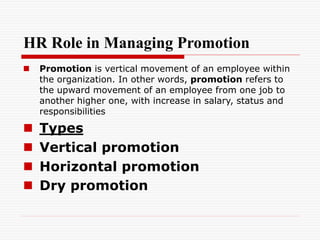
HR Role in Managing Promotion
 Promotion is vertical movement of an employee within
the organization. In other words, promotion refers to
the upward movement of an employee from one job to
another higher one, with increase in salary, status and
responsibilities
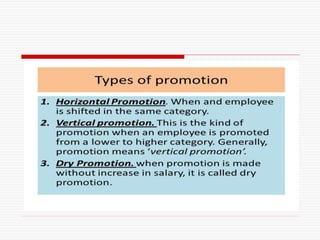
 Types
 Vertical promotion
 Horizontal promotion
 Dry promotion
Hrm challenges

Hrm challenges

  • 1.
    HRM Challenges andManaging Strategic Organizational Review Chapter 2
  • 2.
     Environmental Challenges Organizational Challenges  Individual Challenges Human Resource Management Challenges (HR Challenges)
  • 3.
    Environmental Challenges  RapidChange  Work Force Diversity  Globalization  Legislation  Technology  Job & Family Roles  Lack of Skills
  • 4.
    Environmental Challenges  RapidChange The world is changing at a faster rate because change is constant from several centuries. So the management of the organizations should be quickly adaptive to the changing requirement of the environment otherwise they become obsolete from the market. The human resource management of an organization plays a basic role in response to the environmental change. The HR department should adopt such policies that can avail the new opportunities of the environment & keep the organization away from the newly emerging threats.
  • 5.
    Environmental Challenges  WorkForce Diversity The changing environment provides both the opportunities & threats to the human resource management of the organization. The HR manager should adopt such policies that can make possible the diverse work force of employees. Although on one hand diversity creates big problem but in the long run, the survival & performance of the organization is flourished
  • 6.
    Environmental Challenges  Globalization Oneof the serious issue that today’s organizations are facing is the issue of globalization. The world is converting into global business and severe competition is started between domestic & foreign companies. Such competition results in the laying off the effective workforce of the organization. The HR department can play an important role in keeping the culture of the organization as global & wider.
  • 7.
    Environmental Challenges  Legislation Itis the old environmental challenge that is faced by organization since many decades. There are certain labor laws that are declared by the government for the benefits of the working employees. Some of these laws are disadvantageous to the interests of the organizations so it is a one of the big challenges for the HRM to implement all those labor laws within the organizations. If any of such law is violated, serious actions are taken by the relevant government authority that may result into serious penalty for the management of the organization.
  • 8.
    Environmental Challenges  Technology Thetechnology is also growing with great speed especially in the field of computer & telecommunication. New methods are emerging that quickly dominates the older ones & makes them obsolete. Therefore the skills required by the employees also changes with the changing technology & this would compels the worker to advance the skills three to four times throughout their working lives. So there comes a burden on the HR department to constantly update the skills & expertise of their employees.
  • 9.
    Environmental Challenges  Job& Family Roles In recent years, dual-career families are increasing in which both the wife & husband work. This creates a serious burden on the women that they have to give time to their families also. In many organizations the policies of HR favors the employment of more than 10 years. The working hours of the organizations are also strict and tight for the employees. Moreover, the selection & training procedures are two tough and time consuming so most of the talented women hesitate to join any organization which would result in the wastage of talent and potential. Even working men also suffer from these employment policies because they do not properly give time to their families. So the challenges for the HRM increases with this particular issue & special favorable working policies are needed to be employed in all organizations.
  • 10.
    Organizational Challenges  ControllingCosts  Improving Quality  Developing Distinctive Capabilities  Restructuring
  • 11.
    Organizational Challenges  ControllingCosts  An organization can avail the competitive position by lowering its cost & strengthening its cash flows. For this purpose, the labor cost of the organization is minimized through effective compensation system that adopts innovative reward strategies for good performances. In this way the favorable behaviors of the employees are rewarded so the organization would get the ultimate advantage. Moreover the policies of compensation should keep the labor cost under control. The effective employees should be selected that keep with the organization for a longer duration & proper training should also be provided to these employees. The HR department should also restore the work of the employees along with the improvement in the health & safety issue of working environment. All of these efforts would limit the cost of labor.
  • 12.
    Organizational Challenges  ImprovingQuality The quality improvement can lead an organization towards competitive advantage. The total quality management programs are employed that improves all the processes within the organization which would ultimately result in the improvement of the final product or service
  • 13.
    Organizational Challenges  DevelopingDistinctive Capabilities Another method of gaining competitive advantage is to employ the people that have distinct capabilities to develop extra ordinary competence in specific area.
  • 14.
    Organizational Challenges  Restructuring Anothertechnique is the restructuring of the organization in which the methods of performing different functions are altered positively. In case of HR department, the majority of functions are still performed within the organization
  • 15.
    Individual Challenges  01-Productivity 02- Empowerment  03- Brain drain  04- Ethics & social responsibility  05- Job insecurity  06- Matching people & organization
  • 16.
    Individual Challenges  Productivity Productivity is defined as the measure of the value that an employee can add to the final product or service of the organization. The increased output per employee is reflected as increased productivity. Ability & motivation are two important factors that affect the employee productivity. The ability of the employee can be improved by the hiring & replacement along with the proper training & career development. On the other high quality of work life serves as accelerator to the motivational factor of the employees.
  • 17.
    Individual Challenges  Empowerment In the modern days many organizations make changes in such a way that their individual employees exert more control on their work as compared to their superiors. This individual control of employees is called empowerment which helps the employees to work with enthusiasm, commitment & learn new skills because they are more make normal decisions about their work by themselves & hence enjoy their work.
  • 18.
    Individual Challenges  BrainDrain  One of the challenges for HRM is the detachment of the key potential employees from the organization which link with the competitors for higher remunerations etc. In such cases the organization loses its intellectual property & in many situations the leaving employees at the higher levels also take with them the potential lower level employees. This brain drainage is becoming serious issue in the high-Tec companies.
  • 19.
    Individual Challenges  Ethics& Social Responsibility  Under this challenge, the organizations make an effort to benefit some portion of the society. This is now considered to the social responsibility of the organization to show favorable behavior towards the society. The ethics serves as the basic principle for the socially behavior of the organizations. Within organizations, the HR departments develop a code of conduct & principles of code of ethics that serve as the guidance for the personal behavior of the employees of the organizations. The employees also expect from the management to show favorable decisions.
  • 20.
    Individual Challenges  JobInsecurity  In the recent years, restructuring & downsizing develops the sense of insecurity of job within the employees of the organizations. Now many employees only desire to get a steady job rather than a job with promotional future.The stock market also shows favorable results when layoffs has been made. All these things create a fear among employees about the insecurity of their jobs which would hinder their effective performance.
  • 21.
    Individual Challenges  MatchingPeople & Organizations It has been proved from the research that the HR department contributes to the profitability of the organization when it makes such policies of employee selection in which those employees are selected & retained that best suits the culture of the organization & its objectives. In short it is an important challenge for the HR department to hire and keep such employees whose abilities & strengths would match the requirements & circumstances of the organization.
  • 22.
    HR’s Role inthe Reengineering Process  These processes mean reframing and redesign of human resource processes with the aim in order to achieve optimum personnel and the whole company work performance.  Shaping the process  Creating job statements and role descriptions that reflect the new corporate order  Working out compensation issues  Training the new work force  Molding the new corporate culture  Facilitate communication in the work force
  • 23.
    HR’s Role inthe Reengineering Process  Shaping the process: Although senior management may lay down the general guidelines and direction the reengineering effort will take, HR often can play a major role in determining whether it will succeed. HR helped create the selection criteria for members of the steering committee. HR also can interview and evaluate candidates. Even as the process filters down through the organization, HR can play a key role in determining how team leaders and team members are selected.
  • 24.
    HR’s Role inthe Reengineering Process  Creating job statements and role descriptions that reflect the new corporate order: It isn’t enough to plug existing job descriptions into new positions created from reengineering. It isn’t enough to use existing methodology to create new positions. Reengineering requires serious introspection about what the company is trying to achieve and what job and role responsibilities will help realize the goals. “It’s a whole new way of thinking. The idea is to write job statements instead of descriptions, to outline roles vs. tasks, and to structure work around the customer rather than a specific function or department,” says Mary Layman, vice president of HR for CTB.
  • 25.
    HR’s Role inthe Reengineering Process  Working out compensation issues: Pay scales and rewards must be structured to create the desired results. For example, a company that wants to focus on customer service must measure and compensate the work force based on that criteria. Likewise, HR must think about whether it should pay employees for specific tasks they should perform from 8 a.m. to 5 p.m., or offer skill- based or knowledge-based pay. “Too often, there’s a disconnect between the basic strategy and what HR actually does,” says Caldow
  • 26.
    HR’s Role inthe Reengineering Process  Training the new work force: “A company may have award-winning training programs, but they probably aren’t going to have a lot to do with the overall reengineering strategy,” says William. Experts agree that it’s important to provide plenty of training on specific skills employees will need in the newly reengineered company, but that teamwork, decision making and trust building must also be heavily emphasized over a period of time
  • 27.
    HR’s Role inthe Reengineering Process  Molding the new corporate culture: Stories, ceremonies, awards and rituals all have a major impact on how people behave. Caldow insists that human resources can alter thinking by helping form a new ethnography. It must be consistent throughout the organization, and it should be backed by plenty of symbolism. Yet, the change won’t occur overnight. It may take weeks or months before a real breakthrough in thinking takes place.
  • 28.
    HR’s Role inthe Reengineering Process  Facilitate communication in the work force: Nothing is as frightening to a work force as change, and nothing changes a work force as much as reengineering. Newsletters, videos, letters, E-mail messages, and companywide and departmental meetings are all useful tools in quelling anxiety. Moreover, good communication can help a work force understand how reengineering may benefit it in the future
  • 29.
    HR Role inmanaging Transfer  A transfer involves the shifting of an employee from one job to another without changing the responsibilities or compensation”.  Production Transfer  Replacement Transfers  Remedial Transfers  Versatility Transfer
  • 30.
    HR Role inmanaging Transfer  Production Transfer: Such transfers are resorted to when there is a need of manpower in one department and surplus manpower in other department. Such transfers are made to meet the company requirements. The surplus employees in one department/section might be observed in other place where there is a requirement.
  • 31.
    HR Role inmanaging Transfer  Replacement Transfers: This takes place to replace a new employee who has been in the organization for a long time and there by giving some relief to an old employee from the heavy pressure of work
  • 32.
    HR Role inmanaging Transfer  Remedial Transfers: As the name suggest, these transfers are made to rectify the situation caused by faulty selection and placement procedures. Such transfers are made to rectify mistakes in placement and recruitments. If the initial placement of an individual is faulty or has not adjusted to work/job, his transfer to a more appropriate job is desirable.
  • 33.
    HR Role inmanaging Transfer  Versatility Transfer: Such transfers are made to increase versatility of the employees from one job to another and one department to another department. Transfer (Job Rotation) are the tool to train the employees. Each employee should provide a varied and broader job experiences by moving from one department to another. This is for preparing the employee for promotion, this will definitely help the employee to have job enrichment
  • 34.
    HR Role inManaging Promotion  Promotion is vertical movement of an employee within the organization. In other words, promotion refers to the upward movement of an employee from one job to another higher one, with increase in salary, status and responsibilities  Types  Vertical promotion  Horizontal promotion  Dry promotion

Editor's Notes

  • #2 Successful Grant Writing
  • #3 Successful Grant Writing
  • #4 Successful Grant Writing
  • #11 Successful Grant Writing
  • #16 Successful Grant Writing
  • #23 Successful Grant Writing
  • #30 Successful Grant Writing