HUMAN RESOURCES PLANNING
What is HR ? Any practice that deals with  enhancing competencies, commitment and culture building   can be considered as a HR practice. The practice could be a rule,a system, a process, an activity, an accepted or expected way of doing things.
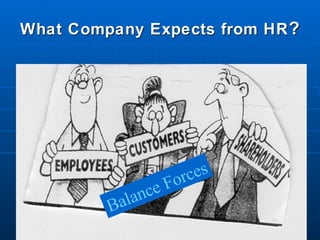
What Company Expects from HR ? Balance Forces
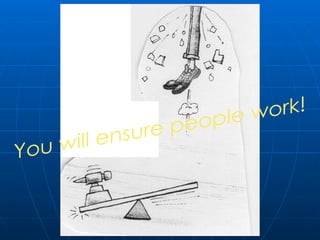
You will ensure people work!
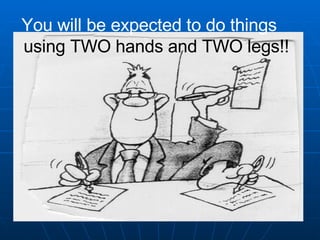
You will be expected to do things  using TWO hands and TWO legs!!
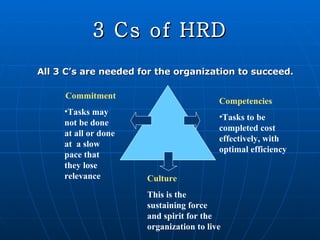
3 Cs of HRD All 3 C’s are needed for the organization to succeed. Commitment Tasks may not be done at all or done at  a slow pace that they lose relevance Culture This is the sustaining force and spirit for the organization to live Competencies Tasks to be completed cost effectively, with optimal efficiency
To facilitate the alignment of human capital with organizational goals. Ensuring that performance management systems & staffing are aimed at achieving the organizations objectives. HR MISSION I CONTRIBUTE TO IT BY
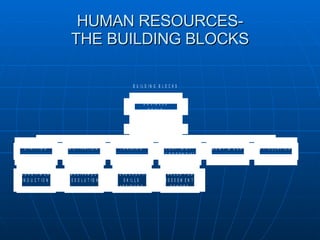
HUMAN RESOURCES- THE BUILDING BLOCKS
What is HR Planning ? The activity of planning human resources usually in connection with the overall strategic planning of the organization. Why HR Planning ? To provide linkage between different HR functions viz. compensation, benefits, staffing etc and the overall strategic goals of the organization .
Significance of HR Planning   Uncertainties can be managed through planning Helps the organization develop action plan for achievement of company’s objective for future For strategic implementation To minimize destruction/ disruption of organization process Helps to focus sharper at your competitive posture or position Focuses on short & long term people requirements .
Four Basic Aspects of HR Planning Planning for Future Needs  by deciding how many people with what skill the organization will need. Planning for Future Balance  by comparing the number of needed employees to the number of present employees who can be expected to stay with the organization, which leads to Planning for recruiting or laying off   employees Planning for the development  of the employees to be sure the organization has a steady supply of experienced and capable personnel.
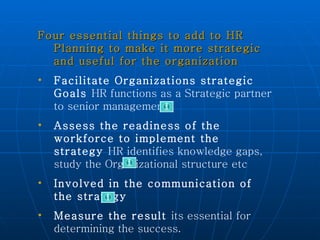
Four essential things to add to HR Planning to make it more strategic and useful for the organization  Facilitate Organizations strategic Goals  HR functions as a Strategic partner to senior management  Assess the readiness of the workforce to implement the strategy  HR identifies knowledge gaps, study the Organizational structure etc Involved in the communication of the strategy Measure the result  its essential for determining the success.
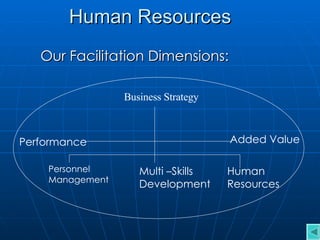
Human Resources Our Facilitation Dimensions: Business Strategy Performance  Added Value Personnel  Management Multi –Skills Development  Human  Resources
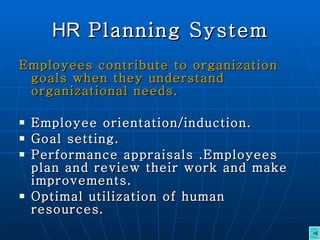
HR  Planning System Employees contribute to organization goals when they understand organizational needs. Employee orientation/induction. Goal setting. Performance appraisals .Employees plan and review their work and make improvements. Optimal utilization of human resources.
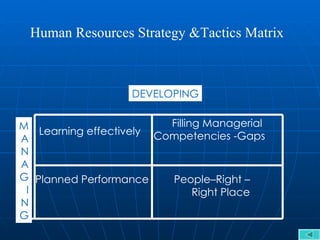
Human Resources Strategy &Tactics Matrix People–Right – Right Place Planned Performance  Learning effectively Filling Managerial  Competencies -Gaps M A N A G I N G DEVELOPING
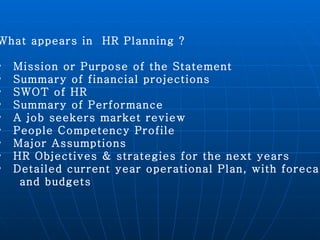
What appears in  HR Planning ? Mission or Purpose of the Statement  Summary of financial projections  SWOT of HR Summary of Performance  A job seekers market review People Competency Profile Major Assumptions HR Objectives & strategies for the next years Detailed current year operational Plan, with forecasts  and budgets
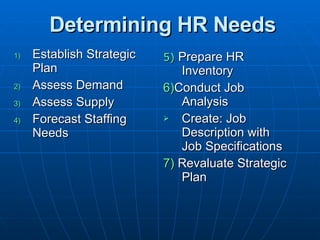
Determining HR Needs Establish Strategic Plan Assess Demand Assess Supply Forecast Staffing Needs 5)   Prepare HR Inventory 6) Conduct Job Analysis Create: Job Description with Job Specifications 7)  Revaluate Strategic Plan
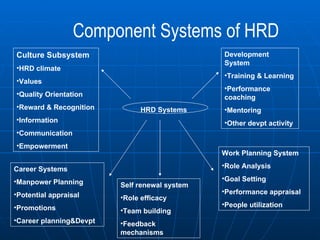
HRD Systems Component Systems of HRD Career Systems Manpower Planning Potential appraisal Promotions Career planning&Devpt Work Planning System Role Analysis Goal Setting Performance appraisal People utilization Development System Training & Learning Performance coaching Mentoring Other devpt activity Self renewal system Role efficacy Team building Feedback mechanisms Culture Subsystem HRD climate Values Quality Orientation Reward & Recognition Information Communication Empowerment
Thank You Ravi

Hr Planning 1 .124212956

  • 1.
  • 2.
    What is HR? Any practice that deals with enhancing competencies, commitment and culture building can be considered as a HR practice. The practice could be a rule,a system, a process, an activity, an accepted or expected way of doing things.
  • 3.
    What Company Expectsfrom HR ? Balance Forces
  • 4.
    You will ensurepeople work!
  • 5.
    You will beexpected to do things using TWO hands and TWO legs!!
  • 6.
    3 Cs ofHRD All 3 C’s are needed for the organization to succeed. Commitment Tasks may not be done at all or done at a slow pace that they lose relevance Culture This is the sustaining force and spirit for the organization to live Competencies Tasks to be completed cost effectively, with optimal efficiency
  • 7.
    To facilitate thealignment of human capital with organizational goals. Ensuring that performance management systems & staffing are aimed at achieving the organizations objectives. HR MISSION I CONTRIBUTE TO IT BY
  • 8.
    HUMAN RESOURCES- THEBUILDING BLOCKS
  • 9.
    What is HRPlanning ? The activity of planning human resources usually in connection with the overall strategic planning of the organization. Why HR Planning ? To provide linkage between different HR functions viz. compensation, benefits, staffing etc and the overall strategic goals of the organization .
  • 10.
    Significance of HRPlanning Uncertainties can be managed through planning Helps the organization develop action plan for achievement of company’s objective for future For strategic implementation To minimize destruction/ disruption of organization process Helps to focus sharper at your competitive posture or position Focuses on short & long term people requirements .
  • 11.
    Four Basic Aspectsof HR Planning Planning for Future Needs by deciding how many people with what skill the organization will need. Planning for Future Balance by comparing the number of needed employees to the number of present employees who can be expected to stay with the organization, which leads to Planning for recruiting or laying off employees Planning for the development of the employees to be sure the organization has a steady supply of experienced and capable personnel.
  • 12.
    Four essential thingsto add to HR Planning to make it more strategic and useful for the organization Facilitate Organizations strategic Goals HR functions as a Strategic partner to senior management Assess the readiness of the workforce to implement the strategy HR identifies knowledge gaps, study the Organizational structure etc Involved in the communication of the strategy Measure the result its essential for determining the success.
  • 13.
    Human Resources OurFacilitation Dimensions: Business Strategy Performance Added Value Personnel Management Multi –Skills Development Human Resources
  • 14.
    HR PlanningSystem Employees contribute to organization goals when they understand organizational needs. Employee orientation/induction. Goal setting. Performance appraisals .Employees plan and review their work and make improvements. Optimal utilization of human resources.
  • 15.
    Human Resources Strategy&Tactics Matrix People–Right – Right Place Planned Performance Learning effectively Filling Managerial Competencies -Gaps M A N A G I N G DEVELOPING
  • 16.
    What appears in HR Planning ? Mission or Purpose of the Statement Summary of financial projections SWOT of HR Summary of Performance A job seekers market review People Competency Profile Major Assumptions HR Objectives & strategies for the next years Detailed current year operational Plan, with forecasts and budgets
  • 17.
    Determining HR NeedsEstablish Strategic Plan Assess Demand Assess Supply Forecast Staffing Needs 5) Prepare HR Inventory 6) Conduct Job Analysis Create: Job Description with Job Specifications 7) Revaluate Strategic Plan
  • 18.
    HRD Systems ComponentSystems of HRD Career Systems Manpower Planning Potential appraisal Promotions Career planning&Devpt Work Planning System Role Analysis Goal Setting Performance appraisal People utilization Development System Training & Learning Performance coaching Mentoring Other devpt activity Self renewal system Role efficacy Team building Feedback mechanisms Culture Subsystem HRD climate Values Quality Orientation Reward & Recognition Information Communication Empowerment
  • 19.