Introduction to Human Resource Management HRM is a management function that helps managers recruit, select, train & develop members for an orgn. The main activities of  HRM are:
Human Resource Planning Recruitment, Selection & Induction Training & Development Performance appraisal Wage & Salary Administration Employee Welfare Industrial Relations
Importance of Human factor Output greater than input. Only animate source. Complex & unpredictable behavior. Each individual is distinct. Meaning of HRM:  is planning, organizing, directing & controlling of the procurement, development, compensation, integration, maintenance, separation of HR to the end that individual, organization & societal objectives are accomplished.
Importance of HRM Social Significance : providing employment Compensating employees Health & safety of employees Helping to make their own decisions Professional significance: Maintains dignity of employees Opportunity for personal development  Provides healthy relationship Improves working skill
Significance for individuals: -motivates -creating right attitude Comparative study of  PM/HRM/HPM PM is concerned with people at work & their relationships with each other. It is defined as a set of programmes, functions, & activities designed to maximise both personal & orgnl.goals.PM mainly focused on 3 major dimensions ie, Personnel aspect, Welfare aspect, Industrial aspect.
HRM have 2 different versions- hard & soft The ‘hard’ model focuses on close integration of human resources policies, systems & activities with business strategy in order to attain org.goals. The ‘soft’ version is ‘developmental humanism’ model emphasizing the importance of integrating HR policies with business objectives, treating employees as valued assets.
HPM This concept embodies that people are different from other resources like land, money, power etc which are inanimate & as such cannot be compared. Understand the potential of each individual & thus the mgmt can do the promotions, career growth etc.
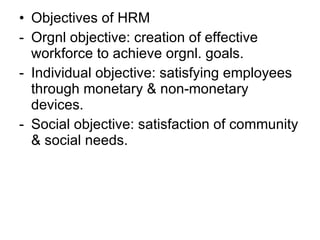
Objectives of HRM Orgnl objective: creation of effective workforce to achieve orgnl. goals. Individual objective: satisfying employees through monetary & non-monetary devices. Social objective: satisfaction of community & social needs.
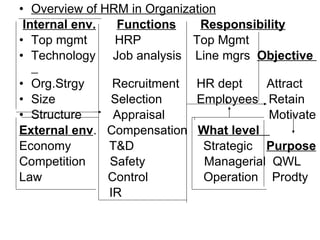
Overview of HRM in Organization Internal env.   Functions   Responsibility Top mgmt  HRP  Top Mgmt Technology  Job analysis  Line mgrs  Objective   Org.Strgy  Recruitment  HR dept  Attract Size  Selection  Employees  Retain Structure  Appraisal  Motivate External env .  Compensation  What level   Economy  T&D  Strategic  Purpose Competition  Safety  Managerial  QWL Law  Control  Operation  Prodty IR
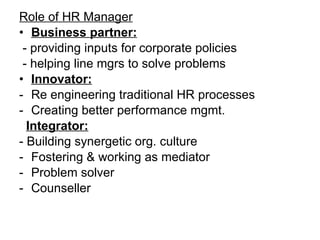
Role of HR Manager Business partner: - providing inputs for corporate policies - helping line mgrs to solve problems Innovator: Re engineering traditional HR processes Creating better performance mgmt. Integrator: - Building synergetic org. culture Fostering & working as mediator Problem solver Counseller
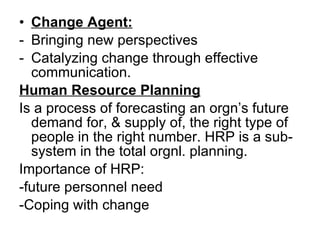
Change Agent: Bringing new perspectives Catalyzing change through effective communication. Human Resource Planning Is a process of forecasting an orgn’s future demand for, & supply of, the right type of people in the right number. HRP is a sub-system in the total orgnl. planning.  Importance of HRP: -future personnel need -Coping with change
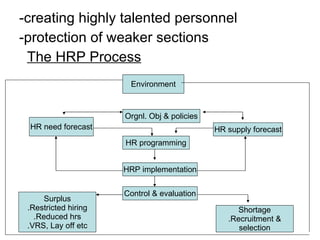
-creating highly talented personnel -protection of weaker sections The HRP Process Environment Orgnl. Obj & policies HR need forecast HR supply forecast HR programming HRP implementation Control & evaluation Surplus .Restricted hiring .Reduced hrs .VRS, Lay off etc Shortage .Recruitment & selection
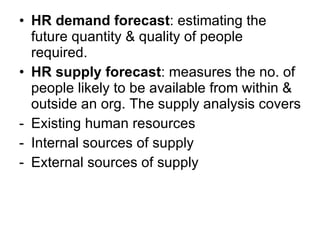
HR demand forecast : estimating the future quantity & quality of people required. HR supply forecast : measures the no. of people likely to be available from within & outside an org. The supply analysis covers  Existing human resources Internal sources of supply External sources of supply
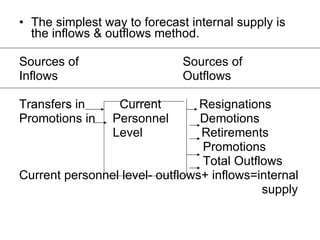
The simplest way to forecast internal supply is the inflows & outflows method. Sources of  Sources of  Inflows  Outflows Transfers in  Current  Resignations Promotions in  Personnel  Demotions Level  Retirements Promotions Total Outflows  Current personnel level- outflows+ inflows=internal  supply
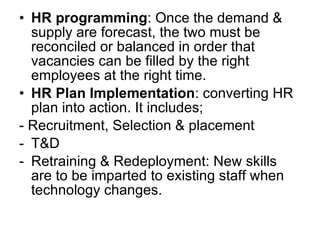
HR programming : Once the demand & supply are forecast, the two must be reconciled or balanced in order that vacancies can be filled by the right employees at the right time. HR Plan Implementation : converting HR plan into action. It includes; - Recruitment, Selection & placement T&D Retraining & Redeployment: New skills are to be imparted to existing staff when technology changes.
Retention Plan: covers actions which would help to reduce avoidable separations of employees. Downsizing Plan (Redundancy): where there is surplus workforce, trimming of labor force will be necessary. . Control & Evaluation:  The HR plan should include budgets, targets, & stds.It should also clarify responsibilities for implementation & control, & establish
reporting  procedures which will enable achievements to be monitored against the plan. JOB ANALYSIS:  is a process of collecting information about a job. The process of job analysis results in two sets of data: Job description Job specification
Contents: Job title: Name of the position & code Nature of the job. Duties specified to be performed Equipments & machineries used during performing his duties. Skills, Abilities & Knowledge required for the job. Physical effort / mental effort, hazards, supervision etc. Report, Records.
Use of Job Analysis: Helps in forming org. structure: Responsibility Authority Accountability 2. Helps manpower planning: Future job requirements Skill requirements 3. Recruitment: - Matching job requirements & skills
4. Orientation:  What is expected from the orgn. when he hold that post. 5. Performance Appraisal: -Performance std. fixes. Performance review 6. Career path planning: Broad outlook
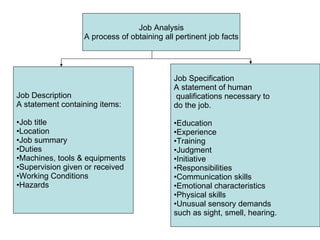
Job Analysis A process of obtaining all pertinent job facts Job Description A statement containing items: Job title Location Job summary Duties Machines, tools & equipments Supervision given or received Working Conditions Hazards Job Specification A statement of human qualifications necessary to  do the job. Education Experience Training Judgment Initiative Responsibilities Communication skills Emotional characteristics Physical skills Unusual sensory demands such as sight, smell, hearing.
Recruitment:  is the process of searching for prospective employees & stimulating them to apply for jobs in the orgn. Steps in Recruitment Process: 1.Recruitment  policy (mention the criteria) 2.Recruitment orgn: (a team is formed who has to do the activities) 3.A forecast of manpower. (how many people required)  4. Assessment.
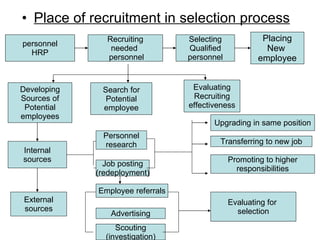
Place of recruitment in selection process personnel HRP Recruiting needed  personnel Selecting Qualified personnel Placing New  employee Developing Sources of Potential employees Search for Potential employee Evaluating Recruiting effectiveness Internal sources External sources Personnel research Job posting (redeployment) Employee referrals Advertising Scouting (investigation) Upgrading in same position Transferring to new job Promoting to higher responsibilities Evaluating for  selection
Sources of Recruitment Internal Sources: it refers to the sources of filling up a vacancy by the existing working force of an orgn. Some of the sources were promotions, transfers, up gradation. External Sources: mainly from outside ie, through Adv, employment exchanges, educational institutions, labor contracts etc.
Selection:  The selection procedure is the system of functions & devices adopted in a given company to ascertain whether the candidates specification are matched with the job specification & requirements or not. Significance of selection process:  if we   select right candidates; The employee contribution & commitment will be at optimum level. Employer-Employee relationship will be pleasing. Asset to the org.
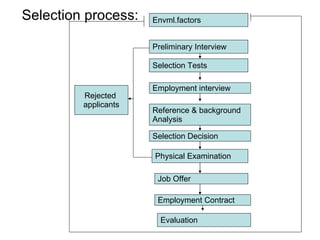
Selection process: Envml.factors Preliminary Interview Selection Tests Employment interview Reference & background Analysis Selection Decision Physical Examination Job Offer Employment Contract Evaluation Rejected  applicants
Environmental factors:   Both the internal & external factors affect the selection process. Preliminary Interview:  the applications received from job seekers would be subject to scrutiny so as to eliminate unqualified applicants. Selection tests:  Job seekers who pass the screening are called for tests. Different types of tests are used. 1. Ability tests (achievement test): to check how well an individual can perform task related job.
2.Aptitude test: a person’s potential to learn a given job. 3. Personality test: to measure a prospective employee’s motivation to function in a particular working envm. 4. Interest test: used to measure an individuals activity preferences. 5. Intelligence test: measure the IQ of a person.
Employment interview:  can be  one-to-one: only two participants; interviewer & interviewee sequential interview: usually utilizing the strength & knowledge-base of each interviewer, so that each interviewer can  ask questions in relation to his/her subject area of each candidate, as the candidate moves from room to room. Panel interview: consists of two or more interviewers & the figure may go up to as many as 15.
Reference & background checks:  many employers request names, addresses, & telephone numbers or references for the purpose of verifying information. Selection decision:  the most critical of all the steps. The HR manager plays a crucial role in  the final selection. Physical examination:  in some orgn. Fitness test is necessary. The reason is - To detect if the individual carries any infectious diseases.
Test whether an applicant is physically fit to perform the work. .  Job offer:  is the next step in selection process for those applicants who have crossed all previous hurdles. job offer is made through a letter of appointment. .   Contracts of employment:  After the acceptance of offer ,certain documents need to be executed by the employer which is called  attestation form.  This form contains

Module 1

  • 1.
    Introduction to HumanResource Management HRM is a management function that helps managers recruit, select, train & develop members for an orgn. The main activities of HRM are:
  • 2.
    Human Resource PlanningRecruitment, Selection & Induction Training & Development Performance appraisal Wage & Salary Administration Employee Welfare Industrial Relations
  • 3.
    Importance of Humanfactor Output greater than input. Only animate source. Complex & unpredictable behavior. Each individual is distinct. Meaning of HRM: is planning, organizing, directing & controlling of the procurement, development, compensation, integration, maintenance, separation of HR to the end that individual, organization & societal objectives are accomplished.
  • 4.
    Importance of HRMSocial Significance : providing employment Compensating employees Health & safety of employees Helping to make their own decisions Professional significance: Maintains dignity of employees Opportunity for personal development Provides healthy relationship Improves working skill
  • 5.
    Significance for individuals:-motivates -creating right attitude Comparative study of PM/HRM/HPM PM is concerned with people at work & their relationships with each other. It is defined as a set of programmes, functions, & activities designed to maximise both personal & orgnl.goals.PM mainly focused on 3 major dimensions ie, Personnel aspect, Welfare aspect, Industrial aspect.
  • 6.
    HRM have 2different versions- hard & soft The ‘hard’ model focuses on close integration of human resources policies, systems & activities with business strategy in order to attain org.goals. The ‘soft’ version is ‘developmental humanism’ model emphasizing the importance of integrating HR policies with business objectives, treating employees as valued assets.
  • 7.
    HPM This conceptembodies that people are different from other resources like land, money, power etc which are inanimate & as such cannot be compared. Understand the potential of each individual & thus the mgmt can do the promotions, career growth etc.
  • 8.
    Objectives of HRMOrgnl objective: creation of effective workforce to achieve orgnl. goals. Individual objective: satisfying employees through monetary & non-monetary devices. Social objective: satisfaction of community & social needs.
  • 9.
    Overview of HRMin Organization Internal env. Functions Responsibility Top mgmt HRP Top Mgmt Technology Job analysis Line mgrs Objective Org.Strgy Recruitment HR dept Attract Size Selection Employees Retain Structure Appraisal Motivate External env . Compensation What level Economy T&D Strategic Purpose Competition Safety Managerial QWL Law Control Operation Prodty IR
  • 10.
    Role of HRManager Business partner: - providing inputs for corporate policies - helping line mgrs to solve problems Innovator: Re engineering traditional HR processes Creating better performance mgmt. Integrator: - Building synergetic org. culture Fostering & working as mediator Problem solver Counseller
  • 11.
    Change Agent: Bringingnew perspectives Catalyzing change through effective communication. Human Resource Planning Is a process of forecasting an orgn’s future demand for, & supply of, the right type of people in the right number. HRP is a sub-system in the total orgnl. planning. Importance of HRP: -future personnel need -Coping with change
  • 12.
    -creating highly talentedpersonnel -protection of weaker sections The HRP Process Environment Orgnl. Obj & policies HR need forecast HR supply forecast HR programming HRP implementation Control & evaluation Surplus .Restricted hiring .Reduced hrs .VRS, Lay off etc Shortage .Recruitment & selection
  • 13.
    HR demand forecast: estimating the future quantity & quality of people required. HR supply forecast : measures the no. of people likely to be available from within & outside an org. The supply analysis covers Existing human resources Internal sources of supply External sources of supply
  • 14.
    The simplest wayto forecast internal supply is the inflows & outflows method. Sources of Sources of Inflows Outflows Transfers in Current Resignations Promotions in Personnel Demotions Level Retirements Promotions Total Outflows Current personnel level- outflows+ inflows=internal supply
  • 15.
    HR programming :Once the demand & supply are forecast, the two must be reconciled or balanced in order that vacancies can be filled by the right employees at the right time. HR Plan Implementation : converting HR plan into action. It includes; - Recruitment, Selection & placement T&D Retraining & Redeployment: New skills are to be imparted to existing staff when technology changes.
  • 16.
    Retention Plan: coversactions which would help to reduce avoidable separations of employees. Downsizing Plan (Redundancy): where there is surplus workforce, trimming of labor force will be necessary. . Control & Evaluation: The HR plan should include budgets, targets, & stds.It should also clarify responsibilities for implementation & control, & establish
  • 17.
    reporting procedureswhich will enable achievements to be monitored against the plan. JOB ANALYSIS: is a process of collecting information about a job. The process of job analysis results in two sets of data: Job description Job specification
  • 18.
    Contents: Job title:Name of the position & code Nature of the job. Duties specified to be performed Equipments & machineries used during performing his duties. Skills, Abilities & Knowledge required for the job. Physical effort / mental effort, hazards, supervision etc. Report, Records.
  • 19.
    Use of JobAnalysis: Helps in forming org. structure: Responsibility Authority Accountability 2. Helps manpower planning: Future job requirements Skill requirements 3. Recruitment: - Matching job requirements & skills
  • 20.
    4. Orientation: What is expected from the orgn. when he hold that post. 5. Performance Appraisal: -Performance std. fixes. Performance review 6. Career path planning: Broad outlook
  • 21.
    Job Analysis Aprocess of obtaining all pertinent job facts Job Description A statement containing items: Job title Location Job summary Duties Machines, tools & equipments Supervision given or received Working Conditions Hazards Job Specification A statement of human qualifications necessary to do the job. Education Experience Training Judgment Initiative Responsibilities Communication skills Emotional characteristics Physical skills Unusual sensory demands such as sight, smell, hearing.
  • 22.
    Recruitment: isthe process of searching for prospective employees & stimulating them to apply for jobs in the orgn. Steps in Recruitment Process: 1.Recruitment policy (mention the criteria) 2.Recruitment orgn: (a team is formed who has to do the activities) 3.A forecast of manpower. (how many people required) 4. Assessment.
  • 23.
    Place of recruitmentin selection process personnel HRP Recruiting needed personnel Selecting Qualified personnel Placing New employee Developing Sources of Potential employees Search for Potential employee Evaluating Recruiting effectiveness Internal sources External sources Personnel research Job posting (redeployment) Employee referrals Advertising Scouting (investigation) Upgrading in same position Transferring to new job Promoting to higher responsibilities Evaluating for selection
  • 24.
    Sources of RecruitmentInternal Sources: it refers to the sources of filling up a vacancy by the existing working force of an orgn. Some of the sources were promotions, transfers, up gradation. External Sources: mainly from outside ie, through Adv, employment exchanges, educational institutions, labor contracts etc.
  • 25.
    Selection: Theselection procedure is the system of functions & devices adopted in a given company to ascertain whether the candidates specification are matched with the job specification & requirements or not. Significance of selection process: if we select right candidates; The employee contribution & commitment will be at optimum level. Employer-Employee relationship will be pleasing. Asset to the org.
  • 26.
    Selection process: Envml.factorsPreliminary Interview Selection Tests Employment interview Reference & background Analysis Selection Decision Physical Examination Job Offer Employment Contract Evaluation Rejected applicants
  • 27.
    Environmental factors: Both the internal & external factors affect the selection process. Preliminary Interview: the applications received from job seekers would be subject to scrutiny so as to eliminate unqualified applicants. Selection tests: Job seekers who pass the screening are called for tests. Different types of tests are used. 1. Ability tests (achievement test): to check how well an individual can perform task related job.
  • 28.
    2.Aptitude test: aperson’s potential to learn a given job. 3. Personality test: to measure a prospective employee’s motivation to function in a particular working envm. 4. Interest test: used to measure an individuals activity preferences. 5. Intelligence test: measure the IQ of a person.
  • 29.
    Employment interview: can be one-to-one: only two participants; interviewer & interviewee sequential interview: usually utilizing the strength & knowledge-base of each interviewer, so that each interviewer can ask questions in relation to his/her subject area of each candidate, as the candidate moves from room to room. Panel interview: consists of two or more interviewers & the figure may go up to as many as 15.
  • 30.
    Reference & backgroundchecks: many employers request names, addresses, & telephone numbers or references for the purpose of verifying information. Selection decision: the most critical of all the steps. The HR manager plays a crucial role in the final selection. Physical examination: in some orgn. Fitness test is necessary. The reason is - To detect if the individual carries any infectious diseases.
  • 31.
    Test whether anapplicant is physically fit to perform the work. . Job offer: is the next step in selection process for those applicants who have crossed all previous hurdles. job offer is made through a letter of appointment. . Contracts of employment: After the acceptance of offer ,certain documents need to be executed by the employer which is called attestation form. This form contains