Strategic Management and Planning in a Global Environment Chapter 4 Part 2  Planning Challenges in the 21st Century
Define strategic management and describe its purpose. Explain the four stages of the strategic management process. Identify and explain the components of strategic analysis, as well as explain the value of conducting this analysis. Explain how an organization can develop a competitive advantage. Explain the purpose of strategy formulation and describe the two levels of strategic alternatives. LEARNING OBJECTIVES When you have finished studying this chapter, you should be able to:
Explain the role of strategy implementation. Explain the importance of evaluation and control of strategy and its implementation. Discuss the importance of strategic planning. LEARNING OBJECTIVES  (cont’d) When you have finished studying this chapter, you should be able to:
Strategic Planning  Strategic Planning The process by which an organization makes decisions and takes actions that affect its long-run performance. Strategic plan:  the output of the strategic planning process that provides direction by defining its strategic approach to business. Competitive Advantage Is a central concept of strategic planning. Can only be sustained if an organization continues to out innovate competitors.
Figure 4.1   The Strategic Management Process
Key Terms Strategic Management Overall, long-run management. Strategic Planning The process of making plans and decisions that are focused on long-run performance. Strategic Plan A comprehensive plan that provides overall direction for the organization.
Key Terms (cont’d) Strategic Analysis An assessment of the external and internal environments of an organization. Strategy Formulation Establishing strategy and tactics necessary to achieve the mission of the organization.
Benefits of Strategic Planning Economic Organizations that plan strategically outperform those that do not. Behavioral Identification of organizational and environmental conditions that may create problems in the long run. Better decisions as a result of the group decision-making process. Participation in the planning process increases participants understanding of how the plan is to be implemented and their willingness to change.
Strategic Analysis: Assessment in a Global Environment The purpose of strategic analysis is to evaluate the present situation of the organization. Analysis requires three primary activities: Assessing the mission of the organization Internal environmental analysis External environmental analysis
Figure 4. 2  The Components of Strategic Analysis
SWOT Analysis The combined internal and external strategic analysis is referred to as a  SWOT  analysis. S trengths W eaknesses O pportunities T hreats
Assessing the Mission of an Organization The mission of an organization reflects its fundamental reasons for existence. Though mission statements vary greatly, every mission statement should describe three primary aspects of an organization: The organization’s primary products or services. The organization’s primary target markets. The organization’s overall strategy for ensuring long-term success.
Key Terms Strategic Direction Direction of the organization toward success in the long run. Vision The ability to predict opportunities and threats in the future. A vision statement is intended to guide the organization in the future, what the organization wants to become or where it wants to be. Vision is derived from a careful analysis of the external and internal environments
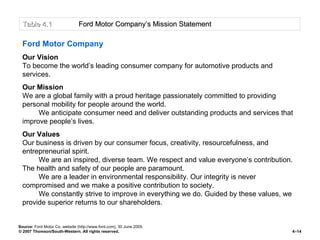
Table 4. 1  Ford Motor Company’s Mission Statement Ford Motor Company Our Vision To become the world’s leading consumer company for automotive products and services. Our Mission We are a global family with a proud heritage passionately committed to providing personal mobility for people around the world. We anticipate consumer need and deliver outstanding products and services that improve people’s lives. Our Values Our business is driven by our consumer focus, creativity, resourcefulness, and entrepreneurial spirit. We are an inspired, diverse team. We respect and value everyone’s contribution. The health and safety of our people are paramount. We are a leader in environmental responsibility. Our integrity is never compromised and we make a positive contribution to society. We constantly strive to improve in everything we do. Guided by these values, we provide superior returns to our shareholders. Source:  Ford Motor Co. website (http://www.ford.com), 30 June 2005.
External Analysis Purpose of External Analysis To identify aspects of the external environment that represent either an  opportunity  for or a  threat  to the organization. Opportunities:  Those environmental trends on which the organization can capitalize and improve its competitive position. Threats Conditions that jeopardize the organization’s ability to prosper and its competitive position in the long term.
External Analysis Factors General Environment Includes environmental forces that are beyond the influence of the organization and over which it has no (or little) control. Task Environment Includes environmental forces that are within the organization’s operating environment and may be influenced to some degree. Economic Environment The economic components of the general environment.
Figure 4. 3  Dimensions of the Global External Environment
Table 4.2 Sample Issues in the General Environment Economic •  Inflation rates •  Unemployment rates •  Wage rates •  Exchange rates •  Stock market fluctuations •  Per capita income •  GDP trends •  Economic development Sociocultural •  Norms and values •  Demographic trends •  Age groups •  Regional shifts in population •  Household composition •  Diversity •  Ecological awareness •  Life expectancy Technological •  Spending on research and development •  Internet availability •  Availability of information technology •  Production technology trends •  Productivity improvements •  Telecommunications infrastructure Political–Legal •  Tax laws •  Environmental protection •  International trade regulation •  Antitrust regulation •  Federal Reserve policy •  Intellectual property and patent laws
External Environment General Environment Economic factors Technological factors Socio-cultural factors Political-legal factors Task Environment Customer Profiles Competitive Structure Resource Availability
Figure 4. 4  Five Forces Model of Industry Analysis Source:  Adapted from Michael E. Porter, “How Competitive Forces Shape Strategy,”  Harvard Business Review  57, no. 2 (March/April 1979): 137–145.
Internal Analysis Purpose of Internal Analysis To identify the assets, resources, skills, and processes that represent either  strengths  or  weaknesses  for the organization. Strengths Aspects of the organization’s operations that represent potential  competitive advantages  or  distinctive competencies . Weaknesses Areas that are in need of improvement.
Table 4. 3 Internal Factors for Analysis Marketing  Operations Product, service  Productivity Brand equity  Quality Market research  Facilities Sales force  Supply chain Market share  Technology Size of market  Purchasing Distribution channels  Safety Price  Ecological issues Promotion Finance Profitability Revenue Asset utilization Debt/leverage Equity Per unit costs Profit margins Cash flow Human Resources Skills Selection Training and development Leadership Motivation Communication Rewards Other Factors Organization culture Overall control Information system Information technology Organizational structure
Strategy Formulation Answers the question: “Where does the organization want to be?” Steps in strategy formulation include: Casting the vision for the organization. Setting strategic goals. Identifying strategic alternatives. Evaluating and choosing strategies that provide a competitive advantage and optimize the performance of the organization in the long term.
Casting the Vision for the Organization The development of a vision for the organization is central to any strategic plan.  Vision versus Mission  A  vision statement  describes what the organization aspires to be in the long run. A  mission statement  describes the products, services, and target markets for an organization.
Setting Strategic Goals Goals Are very broad statements of the results that an organization wishes to achieve in the long run. Relate to the mission and vision of the organization and specify the level of performance that the organization wants to achieve. SMART goals are: Specific…Measurable…Achievable…Results-oriented…Timeline
Identifying Strategic Alternatives Strategic Alternatives Are developed in light of the organizational mission considering its strengths, weaknesses, opportunities, and threats, and its vision and strategic goals.  Grand Strategies Stability strategies:  intended to ensure continuity in the operations and performance of the organization. Growth strategies:  designed to increase the sales and profits of the organization. Retrenchment strategies:  designed to reverse negative sales and profitability trends.
Identifying Strategic Alternatives  (cont’d) Generic Strategies The primary ways in which an organization can compete in its chosen market(s). Cost leadership:  competing on the basis of price. Differentiation:  offering products or services that are differentiated from those of competitors in some way. Focus:  avoiding competing in broad markets by targeting a narrow market segment. Best-Cost provider:  competing on the basis of both low-cost and differentiation.
Figure 4. 5  Generic Strategies Matrix
Evaluating and Choosing Strategy Portfolio Assessment Provides a mechanism for evaluating an organization’s portfolio of business, products and services. Boston Consulting Group (BCG) Growth-Share matrix General Electric Industry Attractiveness –Business Strength matrix Decision Matrices A decision matrix provides a method for evaluating alternative strategies according to the criteria that the organization’s leaders consider more important.
Strategy Implementation: Focusing on Results The best-formulated strategy is virtually worthless if it cannot be implemented effectively. A direct, specific, clear strategy must be developed. Strategies must be established at all levels of the organization to align each part of the organization with the organization’s overall mission and goals. The organization’s system must be designed to ensure that strategies can be institutionalized in its culture.
Evaluation and Control: Achieving Effectiveness and Efficiency Strategic Control Involves monitoring the implementation of the strategic plan to ensure quality and effectiveness in terms of organizational performance. Feedforward controls Are designed to identify changes in the external environment or internal operations that affect organization’s ability to fulfill its mission and meet its strategic goals. Feedback Controls Compare the actual performance of the organization to its planned performance.
Information Technology and Strategic Planning Positive The increasing availability of information technology has had a tremendous impact on the ability of organizations to develop effective strategic plans. Negative Many organizations fail to use the information made available by management information systems to ensure effective strategic planning.
Institutionalizing Strategy Every member, work group, department, and division of the organization must subscribe to and support the organization’s strategy with its plans and actions. There must be a good fit between the chosen strategy and: the organizational structure the organizational culture the organizational leadership
The Importance of Organizational Culture Organizational Culture Refers to the shared, emotionally charged beliefs, values, and norms that bind people together. Helps people make sense of the systems within an organization. Guides the behavior of and gives meaning to the members of the organization.
Organizational Leadership The Importance of Leadership If an organization is to implement its strategy effectively, it must have the appropriate leadership. Without effective leadership, an organization is unlikely to realize the benefits of its selected strategy.
Implications for Leaders Understand the realities of the external environment in which you operate. Understand the importance of a thorough and accurate assessment of the current situation of the organization. A plan will be only as good as the analysis upon which it is based. Strategic vision is critical for ensuring a common strategic direction for the organization. Make sure that the mission statement is a working document that provides direction for the members of the organization.
Implications for Leaders (cont’d) Strategic goals serve as targets for achievement. Make sure that they are specific, measurable, results oriented, and have a established time for their achievement. Strategy should be designed to provide the organization with a distinctive competitive advantage in the long run. A strategic plan is meaningless if it is not implemented well. Provide for evaluation and control to be sure that operations are on track for accomplishment of the organization’s mission.

Chap04

  • 1.
    Strategic Management andPlanning in a Global Environment Chapter 4 Part 2 Planning Challenges in the 21st Century
  • 2.
    Define strategic managementand describe its purpose. Explain the four stages of the strategic management process. Identify and explain the components of strategic analysis, as well as explain the value of conducting this analysis. Explain how an organization can develop a competitive advantage. Explain the purpose of strategy formulation and describe the two levels of strategic alternatives. LEARNING OBJECTIVES When you have finished studying this chapter, you should be able to:
  • 3.
    Explain the roleof strategy implementation. Explain the importance of evaluation and control of strategy and its implementation. Discuss the importance of strategic planning. LEARNING OBJECTIVES (cont’d) When you have finished studying this chapter, you should be able to:
  • 4.
    Strategic Planning Strategic Planning The process by which an organization makes decisions and takes actions that affect its long-run performance. Strategic plan: the output of the strategic planning process that provides direction by defining its strategic approach to business. Competitive Advantage Is a central concept of strategic planning. Can only be sustained if an organization continues to out innovate competitors.
  • 5.
    Figure 4.1 The Strategic Management Process
  • 6.
    Key Terms StrategicManagement Overall, long-run management. Strategic Planning The process of making plans and decisions that are focused on long-run performance. Strategic Plan A comprehensive plan that provides overall direction for the organization.
  • 7.
    Key Terms (cont’d)Strategic Analysis An assessment of the external and internal environments of an organization. Strategy Formulation Establishing strategy and tactics necessary to achieve the mission of the organization.
  • 8.
    Benefits of StrategicPlanning Economic Organizations that plan strategically outperform those that do not. Behavioral Identification of organizational and environmental conditions that may create problems in the long run. Better decisions as a result of the group decision-making process. Participation in the planning process increases participants understanding of how the plan is to be implemented and their willingness to change.
  • 9.
    Strategic Analysis: Assessmentin a Global Environment The purpose of strategic analysis is to evaluate the present situation of the organization. Analysis requires three primary activities: Assessing the mission of the organization Internal environmental analysis External environmental analysis
  • 10.
    Figure 4. 2 The Components of Strategic Analysis
  • 11.
    SWOT Analysis Thecombined internal and external strategic analysis is referred to as a SWOT analysis. S trengths W eaknesses O pportunities T hreats
  • 12.
    Assessing the Missionof an Organization The mission of an organization reflects its fundamental reasons for existence. Though mission statements vary greatly, every mission statement should describe three primary aspects of an organization: The organization’s primary products or services. The organization’s primary target markets. The organization’s overall strategy for ensuring long-term success.
  • 13.
    Key Terms StrategicDirection Direction of the organization toward success in the long run. Vision The ability to predict opportunities and threats in the future. A vision statement is intended to guide the organization in the future, what the organization wants to become or where it wants to be. Vision is derived from a careful analysis of the external and internal environments
  • 14.
    Table 4. 1 Ford Motor Company’s Mission Statement Ford Motor Company Our Vision To become the world’s leading consumer company for automotive products and services. Our Mission We are a global family with a proud heritage passionately committed to providing personal mobility for people around the world. We anticipate consumer need and deliver outstanding products and services that improve people’s lives. Our Values Our business is driven by our consumer focus, creativity, resourcefulness, and entrepreneurial spirit. We are an inspired, diverse team. We respect and value everyone’s contribution. The health and safety of our people are paramount. We are a leader in environmental responsibility. Our integrity is never compromised and we make a positive contribution to society. We constantly strive to improve in everything we do. Guided by these values, we provide superior returns to our shareholders. Source: Ford Motor Co. website (http://www.ford.com), 30 June 2005.
  • 15.
    External Analysis Purposeof External Analysis To identify aspects of the external environment that represent either an opportunity for or a threat to the organization. Opportunities: Those environmental trends on which the organization can capitalize and improve its competitive position. Threats Conditions that jeopardize the organization’s ability to prosper and its competitive position in the long term.
  • 16.
    External Analysis FactorsGeneral Environment Includes environmental forces that are beyond the influence of the organization and over which it has no (or little) control. Task Environment Includes environmental forces that are within the organization’s operating environment and may be influenced to some degree. Economic Environment The economic components of the general environment.
  • 17.
    Figure 4. 3 Dimensions of the Global External Environment
  • 18.
    Table 4.2 SampleIssues in the General Environment Economic • Inflation rates • Unemployment rates • Wage rates • Exchange rates • Stock market fluctuations • Per capita income • GDP trends • Economic development Sociocultural • Norms and values • Demographic trends • Age groups • Regional shifts in population • Household composition • Diversity • Ecological awareness • Life expectancy Technological • Spending on research and development • Internet availability • Availability of information technology • Production technology trends • Productivity improvements • Telecommunications infrastructure Political–Legal • Tax laws • Environmental protection • International trade regulation • Antitrust regulation • Federal Reserve policy • Intellectual property and patent laws
  • 19.
    External Environment GeneralEnvironment Economic factors Technological factors Socio-cultural factors Political-legal factors Task Environment Customer Profiles Competitive Structure Resource Availability
  • 20.
    Figure 4. 4 Five Forces Model of Industry Analysis Source: Adapted from Michael E. Porter, “How Competitive Forces Shape Strategy,” Harvard Business Review 57, no. 2 (March/April 1979): 137–145.
  • 21.
    Internal Analysis Purposeof Internal Analysis To identify the assets, resources, skills, and processes that represent either strengths or weaknesses for the organization. Strengths Aspects of the organization’s operations that represent potential competitive advantages or distinctive competencies . Weaknesses Areas that are in need of improvement.
  • 22.
    Table 4. 3Internal Factors for Analysis Marketing Operations Product, service Productivity Brand equity Quality Market research Facilities Sales force Supply chain Market share Technology Size of market Purchasing Distribution channels Safety Price Ecological issues Promotion Finance Profitability Revenue Asset utilization Debt/leverage Equity Per unit costs Profit margins Cash flow Human Resources Skills Selection Training and development Leadership Motivation Communication Rewards Other Factors Organization culture Overall control Information system Information technology Organizational structure
  • 23.
    Strategy Formulation Answersthe question: “Where does the organization want to be?” Steps in strategy formulation include: Casting the vision for the organization. Setting strategic goals. Identifying strategic alternatives. Evaluating and choosing strategies that provide a competitive advantage and optimize the performance of the organization in the long term.
  • 24.
    Casting the Visionfor the Organization The development of a vision for the organization is central to any strategic plan. Vision versus Mission A vision statement describes what the organization aspires to be in the long run. A mission statement describes the products, services, and target markets for an organization.
  • 25.
    Setting Strategic GoalsGoals Are very broad statements of the results that an organization wishes to achieve in the long run. Relate to the mission and vision of the organization and specify the level of performance that the organization wants to achieve. SMART goals are: Specific…Measurable…Achievable…Results-oriented…Timeline
  • 26.
    Identifying Strategic AlternativesStrategic Alternatives Are developed in light of the organizational mission considering its strengths, weaknesses, opportunities, and threats, and its vision and strategic goals. Grand Strategies Stability strategies: intended to ensure continuity in the operations and performance of the organization. Growth strategies: designed to increase the sales and profits of the organization. Retrenchment strategies: designed to reverse negative sales and profitability trends.
  • 27.
    Identifying Strategic Alternatives (cont’d) Generic Strategies The primary ways in which an organization can compete in its chosen market(s). Cost leadership: competing on the basis of price. Differentiation: offering products or services that are differentiated from those of competitors in some way. Focus: avoiding competing in broad markets by targeting a narrow market segment. Best-Cost provider: competing on the basis of both low-cost and differentiation.
  • 28.
    Figure 4. 5 Generic Strategies Matrix
  • 29.
    Evaluating and ChoosingStrategy Portfolio Assessment Provides a mechanism for evaluating an organization’s portfolio of business, products and services. Boston Consulting Group (BCG) Growth-Share matrix General Electric Industry Attractiveness –Business Strength matrix Decision Matrices A decision matrix provides a method for evaluating alternative strategies according to the criteria that the organization’s leaders consider more important.
  • 30.
    Strategy Implementation: Focusingon Results The best-formulated strategy is virtually worthless if it cannot be implemented effectively. A direct, specific, clear strategy must be developed. Strategies must be established at all levels of the organization to align each part of the organization with the organization’s overall mission and goals. The organization’s system must be designed to ensure that strategies can be institutionalized in its culture.
  • 31.
    Evaluation and Control:Achieving Effectiveness and Efficiency Strategic Control Involves monitoring the implementation of the strategic plan to ensure quality and effectiveness in terms of organizational performance. Feedforward controls Are designed to identify changes in the external environment or internal operations that affect organization’s ability to fulfill its mission and meet its strategic goals. Feedback Controls Compare the actual performance of the organization to its planned performance.
  • 32.
    Information Technology andStrategic Planning Positive The increasing availability of information technology has had a tremendous impact on the ability of organizations to develop effective strategic plans. Negative Many organizations fail to use the information made available by management information systems to ensure effective strategic planning.
  • 33.
    Institutionalizing Strategy Everymember, work group, department, and division of the organization must subscribe to and support the organization’s strategy with its plans and actions. There must be a good fit between the chosen strategy and: the organizational structure the organizational culture the organizational leadership
  • 34.
    The Importance ofOrganizational Culture Organizational Culture Refers to the shared, emotionally charged beliefs, values, and norms that bind people together. Helps people make sense of the systems within an organization. Guides the behavior of and gives meaning to the members of the organization.
  • 35.
    Organizational Leadership TheImportance of Leadership If an organization is to implement its strategy effectively, it must have the appropriate leadership. Without effective leadership, an organization is unlikely to realize the benefits of its selected strategy.
  • 36.
    Implications for LeadersUnderstand the realities of the external environment in which you operate. Understand the importance of a thorough and accurate assessment of the current situation of the organization. A plan will be only as good as the analysis upon which it is based. Strategic vision is critical for ensuring a common strategic direction for the organization. Make sure that the mission statement is a working document that provides direction for the members of the organization.
  • 37.
    Implications for Leaders(cont’d) Strategic goals serve as targets for achievement. Make sure that they are specific, measurable, results oriented, and have a established time for their achievement. Strategy should be designed to provide the organization with a distinctive competitive advantage in the long run. A strategic plan is meaningless if it is not implemented well. Provide for evaluation and control to be sure that operations are on track for accomplishment of the organization’s mission.