Jordan University of Science and Tech.
Faculty of Medicine
Department of Public Health
Course: Advanced Health Care
Management
Submitted to:
Dr. Sireen Al-Khaledi
Belal Abul-Asal
Quality Coordinator
KAUH
NINTENDO
&
SONY
1. Thinking Strategically,
2. The Strategic Management Process,
3. Formulating Corporate-Level Strategy,
4. Formulating Business-Level Strategy,
5. Formulating Functional Level Strategy,
6. Strategy Implementation and Control
OUT LINE
Thinking Strategically
Strategic Management:
The set of Decisions and actions used to
formulate and implement strategies that
will provide a competitively superior
fit between the organization and its
environment so as to achieve
organizational goals.
Grand Strategy:
The general plan of major actions by
which an organization intends to
achieve its long-term goals.
Grand Strategy Categories:
• Growth
• Stability
• Retrenchment
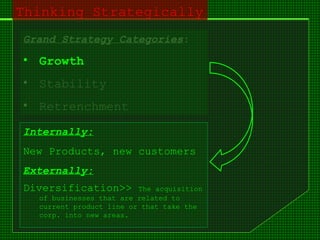
Thinking Strategically
Grand Strategy Categories:
• Growth
• Stability
• Retrenchment
Internally:
New Products, new customers
Externally:
Diversification>> The acquisition
of businesses that are related to
current product line or that take the
corp. into new areas.
Thinking Strategically
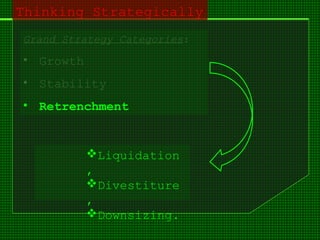
Grand Strategy Categories:
• Growth
• Stability
• Retrenchment
Thinking Strategically
Grand Strategy Categories:
• Growth
• Stability
• Retrenchment
Liquidation
,
Divestiture
,
Downsizing.
Thinking Strategically
Global Strategy:
A separate grand strategy includes
decisions and actions about the
corporate deal with the global
operations.
Important to Global Strategy:
Need for National Responsiveness,
Need for Global Integration.
Thinking Strategically
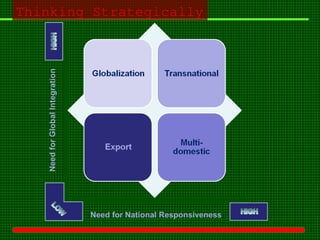
NeedforGlobalIntegration
Need for National Responsiveness
Thinking Strategically
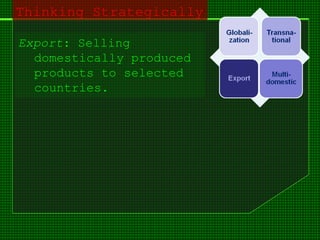
Export: Selling
domestically produced
products to selected
countries.
Thinking Strategically
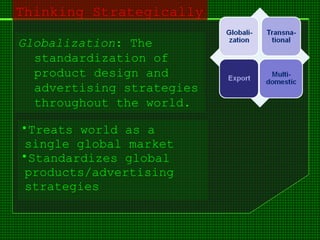
Globalization: The
standardization of
product design and
advertising strategies
throughout the world.
•Treats world as a
single global market
•Standardizes global
products/advertising
strategies
Thinking Strategically
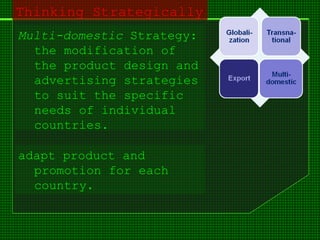
Multi-domestic Strategy:
the modification of
the product design and
advertising strategies
to suit the specific
needs of individual
countries.
adapt product and
promotion for each
country.
Thinking Strategically
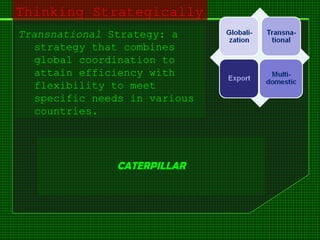
Transnational Strategy: a
strategy that combines
global coordination to
attain efficiency with
flexibility to meet
specific needs in various
countries.
CATERPILLAR
Thinking Strategically
Purpose of Strategy
Strategy is:
The plan of action that prescribes resource
allocation and other activities for...
- Dealing with environment,
- Achieving a competitive advantage, and
- Attaining organizational goals
Thinking Strategically
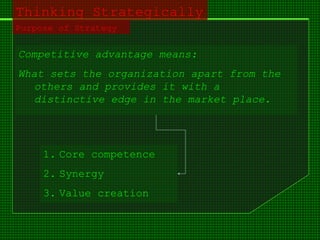
Purpose of Strategy
Competitive advantage means:
What sets the organization apart from the
others and provides it with a
distinctive edge in the market place.
1. Core competence
2. Synergy
3. Value creation
Thinking Strategically
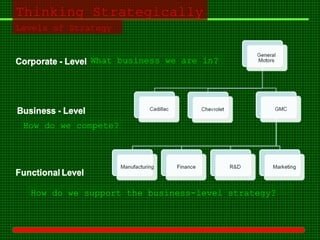
Levels of Strategy
What business we are in?
How do we compete?
How do we support the business-level strategy?
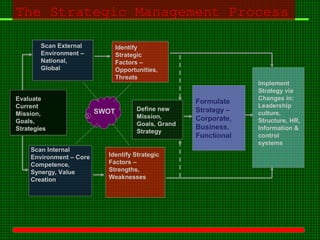
The Strategic Management Process
Implement
Strategy via
Changes in:
Leadership
culture,
Structure, HR,
Information &
control
systems
SWOT
Formulate
Strategy –
Corporate,
Business,
Functional
Define new

Mission,
Goals, Grand
Strategy
Identify Strategic
Factors –
Strengths,
Weaknesses
Identify
Strategic
Factors –
Opportunities,
Threats
Scan Internal
Environment – Core
Competence,
Synergy, Value
Creation
Evaluate
Current
Mission,
Goals,
Strategies
Scan External
Environment –
National,
Global
The Strategic Management Process
Strategy Formulation:
The stage of strategic management that
involves the planning and decision making
that lead to the establishment of the
organization’s goals and of a specific
strategic plan.
Strategy Implementation:
The stage of strategic management that
involves the use of managerial and
organizational tools to direct
resources toward achieving strategic
outcomes.
StrategyformulationVersusimplementation
The Strategic Management Process
Situation Analysis:
Analysis of the strengths, weaknesses,
opportunities and threats (SWOT) that
affect the organizational performance.
SituationAnalysis
The Strategic Management Process
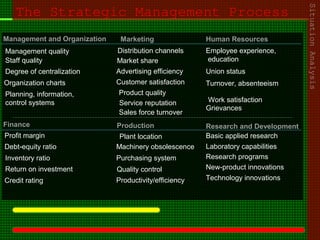
SituationAnalysis
Management and Organization
Management quality
Staff quality
Degree of centralization
Organization charts
Planning, information,
control systems
Finance
Profit margin
Debt-equity ratio
Inventory ratio
Return on investment
Credit rating
Marketing
Distribution channels
Market share
Advertising efficiency
Customer satisfaction
Product quality
Service reputation
Sales force turnover
Production
Plant location
Machinery obsolescence
Purchasing system
Quality control
Productivity/efficiency
Human Resources
Employee experience,
education
Union status
Turnover, absenteeism
Work satisfaction
Grievances
Research and Development
Basic applied research
Laboratory capabilities
Research programs
New-product innovations
Technology innovations
Formulating Corporate-Level str.
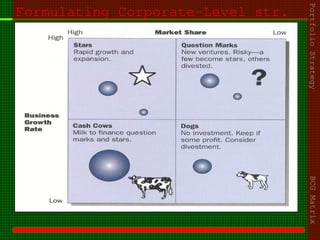
Portfolio Strategy:
The organization’s mix of SBUs and product
lines that fit together in such a way as
to provide the corporation with synergy
and competitive advantage.
PortfolioStrategyBCGMatrix
SBU (strategic business units):
A division of the organization that has a
unique business mission, product line,
competitors and markets relative to
other SBUs in the same corporation.
Formulating Corporate-Level str.
PortfolioStrategyBCGMatrix
System Alert !!!
You do not have access
to this area!!!
For more information,
contact Dr. Ekhlas Saad
Formulating Business-Level str.
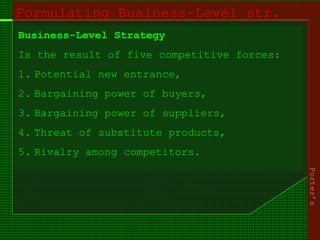
Business-Level Strategy
Is the result of five competitive forces:
1. Potential new entrance,
2. Bargaining power of buyers,
3. Bargaining power of suppliers,
4. Threat of substitute products,
5. Rivalry among competitors.
Porter’s
Formulating Business-Level str.
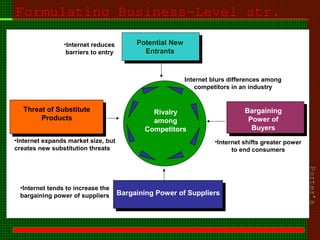
Porter’s
•Internet reduces
barriers to entry
•Internet expands market size, but
creates new substitution threats
•Internet tends to increase the
bargaining power of suppliers
•Internet shifts greater power
to end consumers
Internet blurs differences among
competitors in an industry
Bargaining
Power of
Buyers
Bargaining Power of Suppliers
Threat of Substitute
Products
Potential New
Entrants
Rivalry
among
Competitors
Formulating Business-Level str.
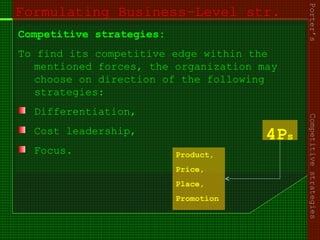
Competitive strategies:
To find its competitive edge within the
mentioned forces, the organization may
choose on direction of the following
strategies:
Differentiation,
Cost leadership,
Focus.
4Ps
Porter’sCompetitivestrategies
Product,
Price,
Place,
Promotion
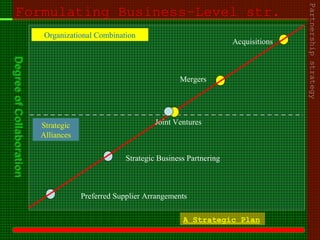
Formulating Business-Level str.
Partnershipstrategy
Organizational Combination
Strategic
Alliances
Preferred Supplier Arrangements
Strategic Business Partnering
Mergers
Acquisitions
Joint Ventures
A Strategic Plan
Formulating Functional Level str.
KAUH
Administrative (Services) department
Strategy Implementation and
Control
In this rapidly changing environment, it’s
common sense to find a :
Dynamic Approaches to implementing
strategies that are based on :
• Vision,
• Intuition
• Employees Participation
Strategy Implementation and
Control
Tips:> for Effective Strategy Implementation:
================================================
 Build commitment to the strategy,
 Pay attention to culture,
 Take advantage of employees’ skills and
knowledge,
 Commmmmunicate.
Manager’sShoptalk
Strategy Implementation and
Control
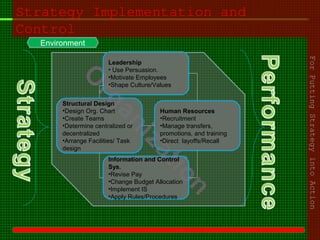
ForPuttingStrategyintoAction
Leadership
• Use Persuasion.
•Motivate Employees
•Shape Culture/Values
Information and Control
Sys.
•Revise Pay
•Change Budget Allocation
•Implement IS
•Apply Rules/Procedures
Human Resources
•Recruitment
•Manage transfers,
promotions, and training
•Direct layoffs/Recall
Structural Design
•Design Org. Chart
•Create Teams
•Determine centralized or
decentralized
•Arrange Facilities/ Task
design
Environment
Strategy Implementation and
Control
During turbulent times, ..........
Many managers feel confident that they
found the right formula, but they are
less optimistic about the use and dosage.
Strategy Implementation and
Control
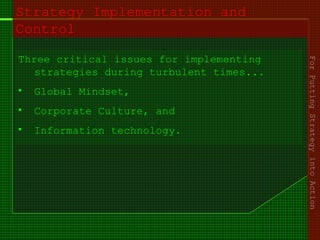
Three critical issues for implementing
strategies during turbulent times...
• Global Mindset,
• Corporate Culture, and
• Information technology.
ForPuttingStrategyintoAction
Jordan University of Science and Tech.
Faculty of Medicine
Department of Public Health
Course: Advanced Health Care Management
Picture
Not
Available
Belal Abul-Asal
KAUH
Dr. Ekhlas Saad
MOH

Strategy formulation and implementation- Balal

  • 1.
    Jordan University ofScience and Tech. Faculty of Medicine Department of Public Health Course: Advanced Health Care Management Submitted to: Dr. Sireen Al-Khaledi
  • 2.
  • 3.
  • 4.
    1. Thinking Strategically, 2.The Strategic Management Process, 3. Formulating Corporate-Level Strategy, 4. Formulating Business-Level Strategy, 5. Formulating Functional Level Strategy, 6. Strategy Implementation and Control OUT LINE
  • 5.
    Thinking Strategically Strategic Management: Theset of Decisions and actions used to formulate and implement strategies that will provide a competitively superior fit between the organization and its environment so as to achieve organizational goals. Grand Strategy: The general plan of major actions by which an organization intends to achieve its long-term goals.
  • 6.
    Grand Strategy Categories: •Growth • Stability • Retrenchment Thinking Strategically
  • 7.
    Grand Strategy Categories: •Growth • Stability • Retrenchment Internally: New Products, new customers Externally: Diversification>> The acquisition of businesses that are related to current product line or that take the corp. into new areas. Thinking Strategically
  • 8.
    Grand Strategy Categories: •Growth • Stability • Retrenchment Thinking Strategically
  • 9.
    Grand Strategy Categories: •Growth • Stability • Retrenchment Liquidation , Divestiture , Downsizing. Thinking Strategically
  • 10.
    Thinking Strategically Global Strategy: Aseparate grand strategy includes decisions and actions about the corporate deal with the global operations. Important to Global Strategy: Need for National Responsiveness, Need for Global Integration.
  • 11.
  • 12.
    Thinking Strategically Export: Selling domesticallyproduced products to selected countries.
  • 13.
    Thinking Strategically Globalization: The standardizationof product design and advertising strategies throughout the world. •Treats world as a single global market •Standardizes global products/advertising strategies
  • 14.
    Thinking Strategically Multi-domestic Strategy: themodification of the product design and advertising strategies to suit the specific needs of individual countries. adapt product and promotion for each country.
  • 15.
    Thinking Strategically Transnational Strategy:a strategy that combines global coordination to attain efficiency with flexibility to meet specific needs in various countries. CATERPILLAR
  • 16.
    Thinking Strategically Purpose ofStrategy Strategy is: The plan of action that prescribes resource allocation and other activities for... - Dealing with environment, - Achieving a competitive advantage, and - Attaining organizational goals
  • 17.
    Thinking Strategically Purpose ofStrategy Competitive advantage means: What sets the organization apart from the others and provides it with a distinctive edge in the market place. 1. Core competence 2. Synergy 3. Value creation
  • 18.
    Thinking Strategically Levels ofStrategy What business we are in? How do we compete? How do we support the business-level strategy?
  • 19.
    The Strategic ManagementProcess Implement Strategy via Changes in: Leadership culture, Structure, HR, Information & control systems SWOT Formulate Strategy – Corporate, Business, Functional Define new Mission, Goals, Grand Strategy Identify Strategic Factors – Strengths, Weaknesses Identify Strategic Factors – Opportunities, Threats Scan Internal Environment – Core Competence, Synergy, Value Creation Evaluate Current Mission, Goals, Strategies Scan External Environment – National, Global
  • 20.
    The Strategic ManagementProcess Strategy Formulation: The stage of strategic management that involves the planning and decision making that lead to the establishment of the organization’s goals and of a specific strategic plan. Strategy Implementation: The stage of strategic management that involves the use of managerial and organizational tools to direct resources toward achieving strategic outcomes. StrategyformulationVersusimplementation
  • 21.
    The Strategic ManagementProcess Situation Analysis: Analysis of the strengths, weaknesses, opportunities and threats (SWOT) that affect the organizational performance. SituationAnalysis
  • 22.
    The Strategic ManagementProcess SituationAnalysis Management and Organization Management quality Staff quality Degree of centralization Organization charts Planning, information, control systems Finance Profit margin Debt-equity ratio Inventory ratio Return on investment Credit rating Marketing Distribution channels Market share Advertising efficiency Customer satisfaction Product quality Service reputation Sales force turnover Production Plant location Machinery obsolescence Purchasing system Quality control Productivity/efficiency Human Resources Employee experience, education Union status Turnover, absenteeism Work satisfaction Grievances Research and Development Basic applied research Laboratory capabilities Research programs New-product innovations Technology innovations
  • 23.
    Formulating Corporate-Level str. PortfolioStrategy: The organization’s mix of SBUs and product lines that fit together in such a way as to provide the corporation with synergy and competitive advantage. PortfolioStrategyBCGMatrix SBU (strategic business units): A division of the organization that has a unique business mission, product line, competitors and markets relative to other SBUs in the same corporation.
  • 24.
  • 25.
    System Alert !!! Youdo not have access to this area!!! For more information, contact Dr. Ekhlas Saad
  • 26.
    Formulating Business-Level str. Business-LevelStrategy Is the result of five competitive forces: 1. Potential new entrance, 2. Bargaining power of buyers, 3. Bargaining power of suppliers, 4. Threat of substitute products, 5. Rivalry among competitors. Porter’s
  • 27.
    Formulating Business-Level str. Porter’s •Internetreduces barriers to entry •Internet expands market size, but creates new substitution threats •Internet tends to increase the bargaining power of suppliers •Internet shifts greater power to end consumers Internet blurs differences among competitors in an industry Bargaining Power of Buyers Bargaining Power of Suppliers Threat of Substitute Products Potential New Entrants Rivalry among Competitors
  • 28.
    Formulating Business-Level str. Competitivestrategies: To find its competitive edge within the mentioned forces, the organization may choose on direction of the following strategies: Differentiation, Cost leadership, Focus. 4Ps Porter’sCompetitivestrategies Product, Price, Place, Promotion
  • 29.
    Formulating Business-Level str. Partnershipstrategy OrganizationalCombination Strategic Alliances Preferred Supplier Arrangements Strategic Business Partnering Mergers Acquisitions Joint Ventures A Strategic Plan
  • 30.
    Formulating Functional Levelstr. KAUH Administrative (Services) department
  • 31.
    Strategy Implementation and Control Inthis rapidly changing environment, it’s common sense to find a : Dynamic Approaches to implementing strategies that are based on : • Vision, • Intuition • Employees Participation
  • 32.
    Strategy Implementation and Control Tips:>for Effective Strategy Implementation: ================================================  Build commitment to the strategy,  Pay attention to culture,  Take advantage of employees’ skills and knowledge,  Commmmmunicate. Manager’sShoptalk
  • 33.
    Strategy Implementation and Control ForPuttingStrategyintoAction Leadership •Use Persuasion. •Motivate Employees •Shape Culture/Values Information and Control Sys. •Revise Pay •Change Budget Allocation •Implement IS •Apply Rules/Procedures Human Resources •Recruitment •Manage transfers, promotions, and training •Direct layoffs/Recall Structural Design •Design Org. Chart •Create Teams •Determine centralized or decentralized •Arrange Facilities/ Task design Environment
  • 34.
    Strategy Implementation and Control Duringturbulent times, .......... Many managers feel confident that they found the right formula, but they are less optimistic about the use and dosage.
  • 35.
    Strategy Implementation and Control Threecritical issues for implementing strategies during turbulent times... • Global Mindset, • Corporate Culture, and • Information technology. ForPuttingStrategyintoAction
  • 36.
    Jordan University ofScience and Tech. Faculty of Medicine Department of Public Health Course: Advanced Health Care Management Picture Not Available Belal Abul-Asal KAUH Dr. Ekhlas Saad MOH