1
Future Strategic Profile &
Strategic Thinking Overview
2
Strategic Profile References
The Strategist CEO - How Visionary Executives Build
Organizations by Michel Robert
E-Strategy Pure & Simple – Connecting Your Internet Strategy
to Your Business Strategy by Michel Robert and Bernard Racine
Strategy Pure & Simple II – How Winning Companies Dominate
Their Competition by Michel Robert
Strategic Supremacy Pure & Simple – Don’t Change the Rules,
Change the Game by Michel Robert
Strategic Profile Introduction
 The Future Strategic Profile encompasses a broad array of
directional information about an organization’s future…..
3
Business Concept - organization’s reason for being or purpose
Driving Force - what drives the organization toward certain products, markets
and customers
Required Areas of Excellence - activities that require excellence exceeding
any competitor
Scope of future products, markets and users - breadth and depth
considerations
Guidelines for size, growth and profitability - detailed direction
Critical issues that must be managed
Strategic Profile Introduction –
Business Concept
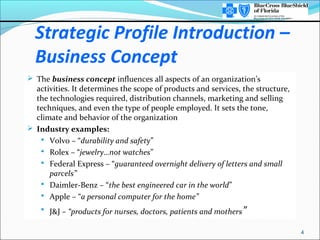
 The business concept influences all aspects of an organization’s
activities. It determines the scope of products and services, the structure,
the technologies required, distribution channels, marketing and selling
techniques, and even the type of people employed. It sets the tone,
climate and behavior of the organization
 Industry examples:
 Volvo – “durability and safety”
 Rolex – “jewelry…not watches”
 Federal Express – “guaranteed overnight delivery of letters and small
parcels”
 Daimler-Benz – “the best engineered car in the world”
 Apple – “a personal computer for the home”
 J&J – “products for nurses, doctors, patients and mothers”
4
Strategic Profile Introduction – Driving Force
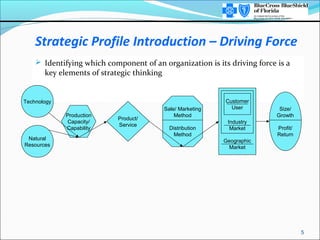
 Identifying which component of an organization is its driving force is a
key elements of strategic thinking
5
Technology
Natural
Resources
Production
Capacity/
Capability
Product/
Service
Sale/ Marketing
Method
Distribution
Method
Geographic
Market
Industry
Market
Customer
User Size/
Growth
Profit/
Return
Strategic Profile Introduction – Driving Force
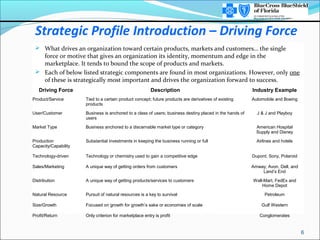
 What drives an organization toward certain products, markets and customers… the single
force or motive that gives an organization its identity, momentum and edge in the
marketplace. It tends to bound the scope of products and markets.
 Each of below listed strategic components are found in most organizations. However, only one
of these is strategically most important and drives the organization forward to success.
6
Driving Force Description Industry Example
Product/Service Tied to a certain product concept; future products are derivatives of existing
products
Automobile and Boeing
User/Customer Business is anchored to a class of users; business destiny placed in the hands of
users
J & J and Playboy
Market Type Business anchored to a discernable market type or category American Hospital
Supply and Disney
Production
Capacity/Capability
Substantial investments in keeping the business running or full Airlines and hotels
Technology-driven Technology or chemistry used to gain a competitive edge Dupont, Sony, Polaroid
Sales/Marketing A unique way of getting orders from customers Amway, Avon, Dell, and
Land’s End
Distribution A unique way of getting products/services to customers Wall-Mart, FedEx and
Home Depot
Natural Resource Pursuit of natural resources is a key to survival Petroleum
Size/Growth Focused on growth for growth’s sake or economies of scale Gulf Western
Profit/Return Only criterion for marketplace entry is profit Conglomerates
Strategic Profile Introduction – Driving Force
Notions
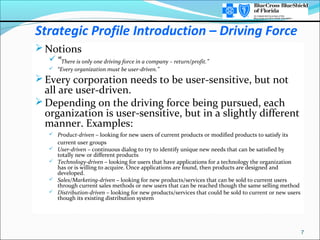
 “There is only one driving force in a company – return/profit.”
 “Every organization must be user-driven.”
Every corporation needs to be user-sensitive, but not
all are user-driven.
Depending on the driving force being pursued, each
organization is user-sensitive, but in a slightly different
manner. Examples:
 Product-driven – looking for new users of current products or modified products to satisfy its
current user groups
 User-driven – continuous dialog to try to identify unique new needs that can be satisfied by
totally new or different products
 Technology-driven – looking for users that have applications for a technology the organization
has or is willing to acquire. Once applications are found, then products are designed and
developed.
 Sales/Marketing-driven – looking for new products/services that can be sold to current users
through current sales methods or new users that can be reached though the same selling method
 Distribution-driven – looking for new products/services that could be sold to current or new users
though its existing distribution system
7
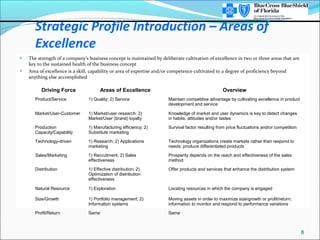
Strategic Profile Introduction – Areas of
Excellence
 The strength of a company’s business concept is maintained by deliberate cultivation of excellence in two or three areas that are
key to the sustained health of the business concept
 Area of excellence is a skill, capability or area of expertise and/or competence cultivated to a degree of proficiency beyond
anything else accomplished
8
Driving Force Areas of Excellence Overview
Product/Service 1) Quality; 2) Service Maintain competitive advantage by cultivating excellence in product
development and service
Market/User-Customer 1) Market/user research; 2)
Market/User (brand) loyalty
Knowledge of market and user dynamics is key to detect changes
in habits, attitudes and/or tastes
Production
Capacity/Capability
1) Manufacturing efficiency; 2)
Substitute marketing
Survival factor resulting from price fluctuations and/or competition
Technology-driven 1) Research; 2) Applications
marketing
Technology organizations create markets rather than respond to
needs; produce differentiated products
Sales/Marketing 1) Recruitment; 2) Sales
effectiveness
Prosperity depends on the reach and effectiveness of the sales
method
Distribution 1) Effective distribution; 2)
Optimization of distribution
effectiveness
Offer products and services that enhance the distribution system
Natural Resource 1) Exploration Locating resources in which the company is engaged
Size/Growth 1) Portfolio management; 2)
Information systems
Moving assets in order to maximize size/growth or profit/return;
information to monitor and respond to performance variations
Profit/Return Same Same
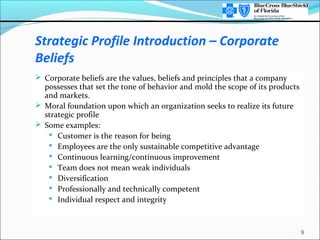
Strategic Profile Introduction – Corporate
Beliefs
 Corporate beliefs are the values, beliefs and principles that a company
possesses that set the tone of behavior and mold the scope of its products
and markets.
 Moral foundation upon which an organization seeks to realize its future
strategic profile
 Some examples:
 Customer is the reason for being
 Employees are the only sustainable competitive advantage
 Continuous learning/continuous improvement
 Team does not mean weak individuals
 Diversification
 Professionally and technically competent
 Individual respect and integrity
9
10
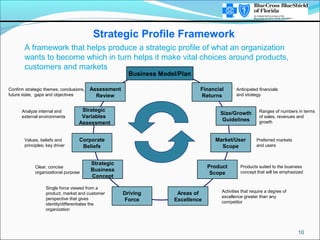
A framework that helps produce a strategic profile of what an organization
wants to become which in turn helps it make vital choices around products,
customers and markets
Assessment
Review
Confirm strategic themes, conclusions,
future state, gaps and objectives
Strategic
Variables
Assessment
Analyze internal and
external environments
Strategic
Business
Concept
Clear, concise
organizational purpose
Driving
Force
Single force viewed from a
product, market and customer
perspective that gives
identity/differentiates the
organization
Areas of
Excellence
Activities that require a degree of
excellence greater than any
competitor
Product
Scope
Products suited to the business
concept that will be emphasized
Market/User
Scope
Preferred markets
and users
Size/Growth
Guidelines
Ranges of numbers in terms
of sales, revenues and
growth
Financial
Returns
Anticipated financials
and strategy
Corporate
Beliefs
Values, beliefs and
principles; key driver
Business Model/Plan
Strategic Profile Framework
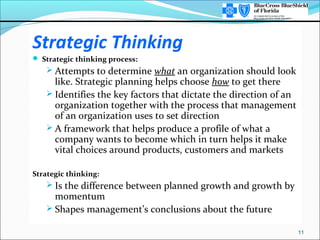
Strategic Thinking
 Strategic thinking process:
 Attempts to determine what an organization should look
like. Strategic planning helps choose how to get there
 Identifies the key factors that dictate the direction of an
organization together with the process that management
of an organization uses to set direction
 A framework that helps produce a profile of what a
company wants to become which in turn helps it make
vital choices around products, customers and markets
Strategic thinking:
 Is the difference between planned growth and growth by
momentum
 Shapes management’s conclusions about the future
11
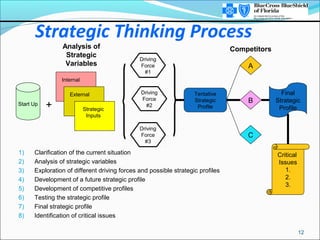
Strategic Thinking Process
12
Internal
External
Strategic
Inputs
Driving
Force
#1
Driving
Force
#2
Driving
Force
#3
Final
Strategic
Profile
Critical
Issues
1.
2.
3.
A
B
C
CompetitorsAnalysis of
Strategic
Variables
Tentative
Strategic
Profile
Start Up +
1) Clarification of the current situation
2) Analysis of strategic variables
3) Exploration of different driving forces and possible strategic profiles
4) Development of a future strategic profile
5) Development of competitive profiles
6) Testing the strategic profile
7) Final strategic profile
8) Identification of critical issues
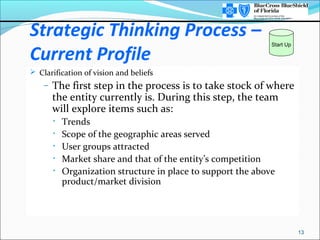
Strategic Thinking Process –
Current Profile
 Clarification of vision and beliefs
– The first step in the process is to take stock of where
the entity currently is. During this step, the team
will explore items such as:
• Trends
• Scope of the geographic areas served
• User groups attracted
• Market share and that of the entity’s competition
• Organization structure in place to support the above
product/market division
13
Start Up
Strategic Thinking Process – Analysis of
Strategic Variables
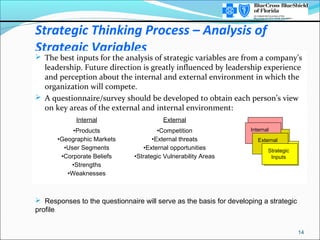
 The best inputs for the analysis of strategic variables are from a company’s
leadership. Future direction is greatly influenced by leadership experience
and perception about the internal and external environment in which the
organization will compete.
 A questionnaire/survey should be developed to obtain each person’s view
on key areas of the external and internal environment:
14
Internal
External
Strategic
Inputs
Internal External
•Products
•Geographic Markets
•User Segments
•Corporate Beliefs
•Strengths
•Weaknesses
•Competition
•External threats
•External opportunities
•Strategic Vulnerability Areas
 Responses to the questionnaire will serve as the basis for developing a strategic
profile
Internal
External
Strategic
Inputs
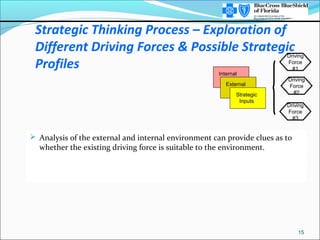
Strategic Thinking Process – Exploration of
Different Driving Forces & Possible Strategic
Profiles
 Analysis of the external and internal environment can provide clues as to
whether the existing driving force is suitable to the environment.
15
Internal
External
Strategic
Inputs
Driving
Force
#1
Driving
Force
#2
Driving
Force
#3
Strategic Thinking Process – Development of
the Future Strategic Profile
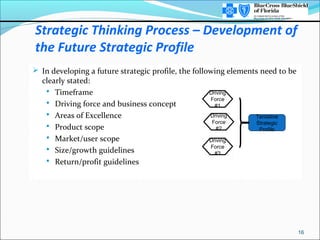
 In developing a future strategic profile, the following elements need to be
clearly stated:
 Timeframe
 Driving force and business concept
 Areas of Excellence
 Product scope
 Market/user scope
 Size/growth guidelines
 Return/profit guidelines
16
Driving
Force
#1
Driving
Force
#2
Driving
Force
#3
Tentative
Strategic
Profile
Strategic Thinking Process – Development of
Competitive Profiles
 It should be relatively easy to determine the driving force of
key competitors by assessing and analyzing their actions in
the marketplace.
 Knowledge of the competition’s driving force provides the
opportunity to anticipate what products, markets and user
groups its competition will pursue and which ones they
won’t.
17
A
B
C
Competitors
Strategic Thinking Process – Testing the
Strategic Profile
Test of the future strategic profile encompasses the following:
1. Versus the current start up situation
2. Versus the strategic inputs
3. Versus the competitive profiles
18
Strategic Thinking Process – Testing the
Strategic Profile
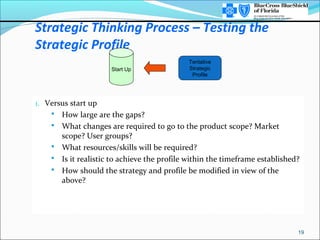
1. Versus start up
 How large are the gaps?
 What changes are required to go to the product scope? Market
scope? User groups?
 What resources/skills will be required?
 Is it realistic to achieve the profile within the timeframe established?
 How should the strategy and profile be modified in view of the
above?
19
Start Up
Tentative
Strategic
Profile
Strategic Thinking Process – Testing the
Strategic Profile
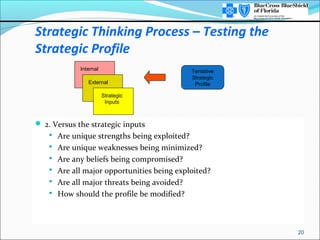
 2. Versus the strategic inputs
 Are unique strengths being exploited?
 Are unique weaknesses being minimized?
 Are any beliefs being compromised?
 Are all major opportunities being exploited?
 Are all major threats being avoided?
 How should the profile be modified?
20
Tentative
Strategic
Profile
Internal
External
Strategic
Inputs
Strategic Thinking Process – Testing the Strategic
Profile
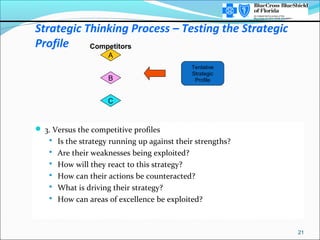
 3. Versus the competitive profiles
 Is the strategy running up against their strengths?
 Are their weaknesses being exploited?
 How will they react to this strategy?
 How can their actions be counteracted?
 What is driving their strategy?
 How can areas of excellence be exploited?
21
Tentative
Strategic
Profile
A
B
C
Competitors
Strategic Thinking Process – Final Strategic
Profile
 The profile test may surface a number of issues and provides the
opportunity to try to “shoot holes” in the team’s thinking
 Affords the team a final chance to reshape the strategy and profile
before final adoption
22
Final
Strategic
Profile
Strategic Thinking Process – Identification of
Critical Issues
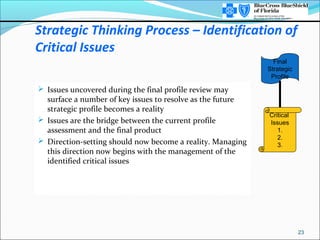
 Issues uncovered during the final profile review may
surface a number of key issues to resolve as the future
strategic profile becomes a reality
 Issues are the bridge between the current profile
assessment and the final product
 Direction-setting should now become a reality. Managing
this direction now begins with the management of the
identified critical issues
23
Final
Strategic
Profile
Critical
Issues
1.
2.
3.
Strategic Thinking Process – Approach
 PHASE I – Strategic profile kickoff and complete the provided survey.
Purpose of the survey is to extract each person’s best thinking on all key
elements of the company and its environment
 PHASE II – Using the completed questionnaires:
 Agree on the business concept
 Agree on the two or three most important strategic inputs
 Select two or three driving forces
 Develop profiles for each potential driving force and compare them to
the current driving force
 Select a tentative strategic profile
 Develop competitive profiles
 Test the profile and surface critical issues. Shape the final strategic
profile
 PHASE III – Address and resolve the critical issues
24

Strategic profile and strategic thinking overview

  • 1.
    1 Future Strategic Profile& Strategic Thinking Overview
  • 2.
    2 Strategic Profile References TheStrategist CEO - How Visionary Executives Build Organizations by Michel Robert E-Strategy Pure & Simple – Connecting Your Internet Strategy to Your Business Strategy by Michel Robert and Bernard Racine Strategy Pure & Simple II – How Winning Companies Dominate Their Competition by Michel Robert Strategic Supremacy Pure & Simple – Don’t Change the Rules, Change the Game by Michel Robert
  • 3.
    Strategic Profile Introduction The Future Strategic Profile encompasses a broad array of directional information about an organization’s future….. 3 Business Concept - organization’s reason for being or purpose Driving Force - what drives the organization toward certain products, markets and customers Required Areas of Excellence - activities that require excellence exceeding any competitor Scope of future products, markets and users - breadth and depth considerations Guidelines for size, growth and profitability - detailed direction Critical issues that must be managed
  • 4.
    Strategic Profile Introduction– Business Concept  The business concept influences all aspects of an organization’s activities. It determines the scope of products and services, the structure, the technologies required, distribution channels, marketing and selling techniques, and even the type of people employed. It sets the tone, climate and behavior of the organization  Industry examples:  Volvo – “durability and safety”  Rolex – “jewelry…not watches”  Federal Express – “guaranteed overnight delivery of letters and small parcels”  Daimler-Benz – “the best engineered car in the world”  Apple – “a personal computer for the home”  J&J – “products for nurses, doctors, patients and mothers” 4
  • 5.
    Strategic Profile Introduction– Driving Force  Identifying which component of an organization is its driving force is a key elements of strategic thinking 5 Technology Natural Resources Production Capacity/ Capability Product/ Service Sale/ Marketing Method Distribution Method Geographic Market Industry Market Customer User Size/ Growth Profit/ Return
  • 6.
    Strategic Profile Introduction– Driving Force  What drives an organization toward certain products, markets and customers… the single force or motive that gives an organization its identity, momentum and edge in the marketplace. It tends to bound the scope of products and markets.  Each of below listed strategic components are found in most organizations. However, only one of these is strategically most important and drives the organization forward to success. 6 Driving Force Description Industry Example Product/Service Tied to a certain product concept; future products are derivatives of existing products Automobile and Boeing User/Customer Business is anchored to a class of users; business destiny placed in the hands of users J & J and Playboy Market Type Business anchored to a discernable market type or category American Hospital Supply and Disney Production Capacity/Capability Substantial investments in keeping the business running or full Airlines and hotels Technology-driven Technology or chemistry used to gain a competitive edge Dupont, Sony, Polaroid Sales/Marketing A unique way of getting orders from customers Amway, Avon, Dell, and Land’s End Distribution A unique way of getting products/services to customers Wall-Mart, FedEx and Home Depot Natural Resource Pursuit of natural resources is a key to survival Petroleum Size/Growth Focused on growth for growth’s sake or economies of scale Gulf Western Profit/Return Only criterion for marketplace entry is profit Conglomerates
  • 7.
    Strategic Profile Introduction– Driving Force Notions  “There is only one driving force in a company – return/profit.”  “Every organization must be user-driven.” Every corporation needs to be user-sensitive, but not all are user-driven. Depending on the driving force being pursued, each organization is user-sensitive, but in a slightly different manner. Examples:  Product-driven – looking for new users of current products or modified products to satisfy its current user groups  User-driven – continuous dialog to try to identify unique new needs that can be satisfied by totally new or different products  Technology-driven – looking for users that have applications for a technology the organization has or is willing to acquire. Once applications are found, then products are designed and developed.  Sales/Marketing-driven – looking for new products/services that can be sold to current users through current sales methods or new users that can be reached though the same selling method  Distribution-driven – looking for new products/services that could be sold to current or new users though its existing distribution system 7
  • 8.
    Strategic Profile Introduction– Areas of Excellence  The strength of a company’s business concept is maintained by deliberate cultivation of excellence in two or three areas that are key to the sustained health of the business concept  Area of excellence is a skill, capability or area of expertise and/or competence cultivated to a degree of proficiency beyond anything else accomplished 8 Driving Force Areas of Excellence Overview Product/Service 1) Quality; 2) Service Maintain competitive advantage by cultivating excellence in product development and service Market/User-Customer 1) Market/user research; 2) Market/User (brand) loyalty Knowledge of market and user dynamics is key to detect changes in habits, attitudes and/or tastes Production Capacity/Capability 1) Manufacturing efficiency; 2) Substitute marketing Survival factor resulting from price fluctuations and/or competition Technology-driven 1) Research; 2) Applications marketing Technology organizations create markets rather than respond to needs; produce differentiated products Sales/Marketing 1) Recruitment; 2) Sales effectiveness Prosperity depends on the reach and effectiveness of the sales method Distribution 1) Effective distribution; 2) Optimization of distribution effectiveness Offer products and services that enhance the distribution system Natural Resource 1) Exploration Locating resources in which the company is engaged Size/Growth 1) Portfolio management; 2) Information systems Moving assets in order to maximize size/growth or profit/return; information to monitor and respond to performance variations Profit/Return Same Same
  • 9.
    Strategic Profile Introduction– Corporate Beliefs  Corporate beliefs are the values, beliefs and principles that a company possesses that set the tone of behavior and mold the scope of its products and markets.  Moral foundation upon which an organization seeks to realize its future strategic profile  Some examples:  Customer is the reason for being  Employees are the only sustainable competitive advantage  Continuous learning/continuous improvement  Team does not mean weak individuals  Diversification  Professionally and technically competent  Individual respect and integrity 9
  • 10.
    10 A framework thathelps produce a strategic profile of what an organization wants to become which in turn helps it make vital choices around products, customers and markets Assessment Review Confirm strategic themes, conclusions, future state, gaps and objectives Strategic Variables Assessment Analyze internal and external environments Strategic Business Concept Clear, concise organizational purpose Driving Force Single force viewed from a product, market and customer perspective that gives identity/differentiates the organization Areas of Excellence Activities that require a degree of excellence greater than any competitor Product Scope Products suited to the business concept that will be emphasized Market/User Scope Preferred markets and users Size/Growth Guidelines Ranges of numbers in terms of sales, revenues and growth Financial Returns Anticipated financials and strategy Corporate Beliefs Values, beliefs and principles; key driver Business Model/Plan Strategic Profile Framework
  • 11.
    Strategic Thinking  Strategicthinking process:  Attempts to determine what an organization should look like. Strategic planning helps choose how to get there  Identifies the key factors that dictate the direction of an organization together with the process that management of an organization uses to set direction  A framework that helps produce a profile of what a company wants to become which in turn helps it make vital choices around products, customers and markets Strategic thinking:  Is the difference between planned growth and growth by momentum  Shapes management’s conclusions about the future 11
  • 12.
    Strategic Thinking Process 12 Internal External Strategic Inputs Driving Force #1 Driving Force #2 Driving Force #3 Final Strategic Profile Critical Issues 1. 2. 3. A B C CompetitorsAnalysisof Strategic Variables Tentative Strategic Profile Start Up + 1) Clarification of the current situation 2) Analysis of strategic variables 3) Exploration of different driving forces and possible strategic profiles 4) Development of a future strategic profile 5) Development of competitive profiles 6) Testing the strategic profile 7) Final strategic profile 8) Identification of critical issues
  • 13.
    Strategic Thinking Process– Current Profile  Clarification of vision and beliefs – The first step in the process is to take stock of where the entity currently is. During this step, the team will explore items such as: • Trends • Scope of the geographic areas served • User groups attracted • Market share and that of the entity’s competition • Organization structure in place to support the above product/market division 13 Start Up
  • 14.
    Strategic Thinking Process– Analysis of Strategic Variables  The best inputs for the analysis of strategic variables are from a company’s leadership. Future direction is greatly influenced by leadership experience and perception about the internal and external environment in which the organization will compete.  A questionnaire/survey should be developed to obtain each person’s view on key areas of the external and internal environment: 14 Internal External Strategic Inputs Internal External •Products •Geographic Markets •User Segments •Corporate Beliefs •Strengths •Weaknesses •Competition •External threats •External opportunities •Strategic Vulnerability Areas  Responses to the questionnaire will serve as the basis for developing a strategic profile Internal External Strategic Inputs
  • 15.
    Strategic Thinking Process– Exploration of Different Driving Forces & Possible Strategic Profiles  Analysis of the external and internal environment can provide clues as to whether the existing driving force is suitable to the environment. 15 Internal External Strategic Inputs Driving Force #1 Driving Force #2 Driving Force #3
  • 16.
    Strategic Thinking Process– Development of the Future Strategic Profile  In developing a future strategic profile, the following elements need to be clearly stated:  Timeframe  Driving force and business concept  Areas of Excellence  Product scope  Market/user scope  Size/growth guidelines  Return/profit guidelines 16 Driving Force #1 Driving Force #2 Driving Force #3 Tentative Strategic Profile
  • 17.
    Strategic Thinking Process– Development of Competitive Profiles  It should be relatively easy to determine the driving force of key competitors by assessing and analyzing their actions in the marketplace.  Knowledge of the competition’s driving force provides the opportunity to anticipate what products, markets and user groups its competition will pursue and which ones they won’t. 17 A B C Competitors
  • 18.
    Strategic Thinking Process– Testing the Strategic Profile Test of the future strategic profile encompasses the following: 1. Versus the current start up situation 2. Versus the strategic inputs 3. Versus the competitive profiles 18
  • 19.
    Strategic Thinking Process– Testing the Strategic Profile 1. Versus start up  How large are the gaps?  What changes are required to go to the product scope? Market scope? User groups?  What resources/skills will be required?  Is it realistic to achieve the profile within the timeframe established?  How should the strategy and profile be modified in view of the above? 19 Start Up Tentative Strategic Profile
  • 20.
    Strategic Thinking Process– Testing the Strategic Profile  2. Versus the strategic inputs  Are unique strengths being exploited?  Are unique weaknesses being minimized?  Are any beliefs being compromised?  Are all major opportunities being exploited?  Are all major threats being avoided?  How should the profile be modified? 20 Tentative Strategic Profile Internal External Strategic Inputs
  • 21.
    Strategic Thinking Process– Testing the Strategic Profile  3. Versus the competitive profiles  Is the strategy running up against their strengths?  Are their weaknesses being exploited?  How will they react to this strategy?  How can their actions be counteracted?  What is driving their strategy?  How can areas of excellence be exploited? 21 Tentative Strategic Profile A B C Competitors
  • 22.
    Strategic Thinking Process– Final Strategic Profile  The profile test may surface a number of issues and provides the opportunity to try to “shoot holes” in the team’s thinking  Affords the team a final chance to reshape the strategy and profile before final adoption 22 Final Strategic Profile
  • 23.
    Strategic Thinking Process– Identification of Critical Issues  Issues uncovered during the final profile review may surface a number of key issues to resolve as the future strategic profile becomes a reality  Issues are the bridge between the current profile assessment and the final product  Direction-setting should now become a reality. Managing this direction now begins with the management of the identified critical issues 23 Final Strategic Profile Critical Issues 1. 2. 3.
  • 24.
    Strategic Thinking Process– Approach  PHASE I – Strategic profile kickoff and complete the provided survey. Purpose of the survey is to extract each person’s best thinking on all key elements of the company and its environment  PHASE II – Using the completed questionnaires:  Agree on the business concept  Agree on the two or three most important strategic inputs  Select two or three driving forces  Develop profiles for each potential driving force and compare them to the current driving force  Select a tentative strategic profile  Develop competitive profiles  Test the profile and surface critical issues. Shape the final strategic profile  PHASE III – Address and resolve the critical issues 24