Lecture 1: Introduction to  Strategic Management (Chapter 1) Instructor: Moses Acquaah, Ph.D. 377 Bryan Building Phone: (336) 334-5305 Email: acquaah@uncg.edu
Lecture Objectives By the end of this lecture, students should be able to: Explain the functions of management Define and explain strategy and strategic management Explain why strategic management is important Explain the strategic management process Describe the levels of organizational strategies  Discuss the misconceptions about strategy and strategic management
OBJECTIVE #1 Functions of Management Planning, Organizing, Leading; & Controlling (PLOC) Planning defining goals and objectives deciding what type of activities the company will engage in determining the resources needed to achieve the organization’s goals & objectives.
Functions of Management Leading Attracting people to the organization. Specifying job responsibilities Grouping jobs into work units Marshalling and allocation of resources Creating good working conditions
Functions of Management Organizing Directing, motivating, and communication with employees, individually & in groups.  Conflict resolution. Controlling Monitoring performance of people & units. Provision of feedback or information about progress. Identification of performance problems & actions to correct problems.
Disciplinary Focus Various disciplines in “management” emerge from the functions of management: Business Policy  (formally called  Strategic Planning ) from the  planning   function. Organizational Behavior  primarily from the  leading  function. Human Resources Management  primarily from the  organizing  function. Strategic Management , originated from Business Policy, but focuses on  overall management  –  PLOC   –   and beyond .
OBJECTIVE #2 What’s Strategy? Strategy is  management’s   overall plan and actions for deploying resources and skills taking into consideration opportunities and threats in the environment to achieve it’s mission, vision and objectives to establish a favorable competitive position . Strategy involves: An organization’s goals A series of related decisions & actions Takes into account key internal strengths & weaknesses and external opportunities threats Analysis, communication, coordination, & action
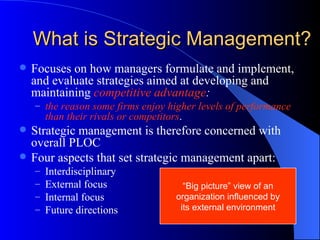
What is Strategic Management? Focuses on how managers formulate and implement, and evaluate strategies aimed at developing and maintaining  competitive advantage : the reason some firms enjoy higher levels of performance than their rivals or competitors . Strategic management is therefore concerned with overall PLOC Four aspects that set strategic management apart: Interdisciplinary External focus Internal focus Future directions “ Big picture” view of an organization influenced by its external environment
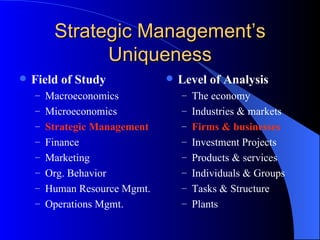
Strategic Management’s Uniqueness Field of Study Macroeconomics Microeconomics Strategic Management Finance Marketing Org. Behavior Human Resource Mgmt. Operations Mgmt. Level of Analysis The economy Industries & markets Firms & businesses Investment Projects Products & services Individuals & Groups Tasks & Structure Plants
OBJECTIVE #3 Importance of Strategic Management Gives every employee a role to play in making the firm successful Applies to all professional employees, not just those in management Allows decision-making, allocation of resources and management of people to be based on a firm’s strategic plan Success as a manager (as measured by your promotion, job security, and pay increases) is often determined by your efforts & departments contribution to overall organization’s success Makes a difference in performance levels Research suggest that successful companies use strategic management concepts & techniques Success evolves from “knowing what you’re doing” and often implies  having a strategic plan
Importance of Strategic Management Provides systematic approach to uncertainties that organizations face Competitive & global environment are dynamic (changing) Change, whether significant of minor, must be recognized and analyzed, & dealt with Strategic management allows for the analysis of the situation (identifying the sources of change in environment) Coordinates and focuses employees to achieve organization’s goals Allows for team effort which is coordinated for firm success Allows for development of a plan, communication, coordination, & cooperation among diverse depts & functions
OBJECTIVE #4 Strategic Management Process Establishing a mission, vision and objectives Environmental Analysis Internal Analysis Strategy Formulation Strategy Implementation Strategic Control and Performance Evaluation
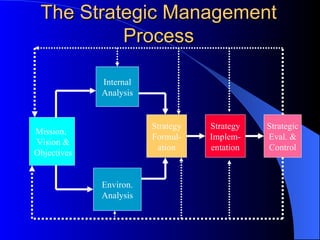
The Strategic Management Process Mission,  Vision & Objectives Internal Analysis Environ. Analysis Strategy Formul- ation Strategy Implem- entation Strategic Eval. & Control
Mission, Vision & Objectives A company’s  mission  is a statement of  the basic purpose or reason for its existence its values (role to stakeholders - customers, employees, society, etc.). The  vision  goes beyond the  mission  statement clarifies the long-term direction of the company (where the company is going) reflects management’s aspirations for the company
Mission, Vision & Objectives Objectives are yardsticks for tracking a company’s performance or end result. Financial  performance   objectives  (e.g., ROA, ROI, ROE, Dividend growth, Stock price, etc.). Strategic performance   objectives  (e.g., market share, growth, innovation leader, customer service, community & environmental responsibility, etc.)
Examples of Mission & Vision Southwest Airlines: Mission : To provide high quality service at a lower price in the airline industry. Vision : Opening air travel to a wider group of leisure travelers while infusing the organization with a sense of fun. Apple Computer: Mission : To bring the best personal computing products and support to consumers around the world. Vision : One person, one computer.
Financial & Strategic Objectives Alcan Aluminum Financial : To outperform the average return on equity of the S&P’s industrial stock index. Strategic : To be lowest-cost producer of aluminum. GE Financial : To achieve an average of 10 inventory turns and a corporate operation profits margin of 16% by 1998. Strategic : To become most competitive enterprise in the world by being #1 or #2 in market share in every business the company is in.
Environmental Analysis Involves the evaluation of the business environment of the organization. All external influences that impact a company’s decision and performance. Environment of firm classified by proximity into (1) Macro-environment; and  (2) Micro-environment or task environment.
Environmental Analysis The macro-environment consists of The international/national economy; changes in demographic structures; social and political trends; technology; and the natural environment. The micro-environment consists of The industry environment such as competitors, suppliers, customers; unions and employees; owners and shareholders, etc.
Internal Analysis Involves the evaluation of the inventory of the firm’s resources and capabilities. Resources/Capabilities can be classified as: Tangible resources:  Financial or physical assets Intangible resources:  brand name, reputation (product & firm), organizational culture, etc. Capabilities   or competencies:  managerial ability, specialized skill  & knowledge base of  employees, etc.
Strategy Formulation The strategy formulation process involves designing a course of action for addressing strategic issues facing the firm after going through the external and internal evaluation processes. Actual strategy of a company involves: Planned or Intended Actions  (Deliberate & purposeful actions). Reactive or Emergent Actions  (As-need reactions to unanticipated events in firm’s micro and macro environments).
Strategy Formulation Strategy formulation is concerned with the following parts of a company: Corporate (whole company) -- Corporate strategies: Deals with businesses company wants to be in & how to manage those businesses Businesses -- Competitive strategies: How to compete in specific business or industry Functional areas -- Functional strategies: short goal-directed decisions & actions of an organization’s various functional departments.
Strategy Implementation Strategy implementation is the process of putting a company’s various strategies into action development of programs, policies, budgets & procedures.  It can take several months to years to complete. Most difficult part of the strategy process. The job of implementing strategy involves managers at  all  levels
Strategic Control & Evaluation Process by which  desired outcomes  (mission, vision, & objectives) are compared with  realized outcomes  to determine if there are gaps. Initiate corrective actions by monitoring changes in environment - competitor actions, new market opportunities, customer needs & expectations.
Strategic Management Process On-going and continuous cycle of Situation Analysis : Internal evaluation & Environmental scanning Strategy formulation Strategy implementation Strategy evaluation
Misconceptions about Strategy & Strategic Management Strategy & strategic planning are dead Every organization  needs the focus and direction provided by its strategies and the strategic management process Strategy is strictly for top management Top management play a crucial role, but  everyone  in the organization has a part to play. Strategy is about planning Strategic management process shows that strategy is not only about planning, but also about doing.
Misconceptions about Strategy & Strategic Management Strategy is stable and constant Organizations compete in dynamic environments. Flexibility and change needed to respond to environmental opportunities & threats, & strength and weaknesses Strategic management outlines ultimate destination & route It establishes a systematic approach to analyzing relevant information & using it to design, implement, & evaluate appropriate strategies.

Strategic managment

  • 1.
    Lecture 1: Introductionto Strategic Management (Chapter 1) Instructor: Moses Acquaah, Ph.D. 377 Bryan Building Phone: (336) 334-5305 Email: acquaah@uncg.edu
  • 2.
    Lecture Objectives Bythe end of this lecture, students should be able to: Explain the functions of management Define and explain strategy and strategic management Explain why strategic management is important Explain the strategic management process Describe the levels of organizational strategies Discuss the misconceptions about strategy and strategic management
  • 3.
    OBJECTIVE #1 Functionsof Management Planning, Organizing, Leading; & Controlling (PLOC) Planning defining goals and objectives deciding what type of activities the company will engage in determining the resources needed to achieve the organization’s goals & objectives.
  • 4.
    Functions of ManagementLeading Attracting people to the organization. Specifying job responsibilities Grouping jobs into work units Marshalling and allocation of resources Creating good working conditions
  • 5.
    Functions of ManagementOrganizing Directing, motivating, and communication with employees, individually & in groups. Conflict resolution. Controlling Monitoring performance of people & units. Provision of feedback or information about progress. Identification of performance problems & actions to correct problems.
  • 6.
    Disciplinary Focus Variousdisciplines in “management” emerge from the functions of management: Business Policy (formally called Strategic Planning ) from the planning function. Organizational Behavior primarily from the leading function. Human Resources Management primarily from the organizing function. Strategic Management , originated from Business Policy, but focuses on overall management – PLOC – and beyond .
  • 7.
    OBJECTIVE #2 What’sStrategy? Strategy is management’s overall plan and actions for deploying resources and skills taking into consideration opportunities and threats in the environment to achieve it’s mission, vision and objectives to establish a favorable competitive position . Strategy involves: An organization’s goals A series of related decisions & actions Takes into account key internal strengths & weaknesses and external opportunities threats Analysis, communication, coordination, & action
  • 8.
    What is StrategicManagement? Focuses on how managers formulate and implement, and evaluate strategies aimed at developing and maintaining competitive advantage : the reason some firms enjoy higher levels of performance than their rivals or competitors . Strategic management is therefore concerned with overall PLOC Four aspects that set strategic management apart: Interdisciplinary External focus Internal focus Future directions “ Big picture” view of an organization influenced by its external environment
  • 9.
    Strategic Management’s UniquenessField of Study Macroeconomics Microeconomics Strategic Management Finance Marketing Org. Behavior Human Resource Mgmt. Operations Mgmt. Level of Analysis The economy Industries & markets Firms & businesses Investment Projects Products & services Individuals & Groups Tasks & Structure Plants
  • 10.
    OBJECTIVE #3 Importanceof Strategic Management Gives every employee a role to play in making the firm successful Applies to all professional employees, not just those in management Allows decision-making, allocation of resources and management of people to be based on a firm’s strategic plan Success as a manager (as measured by your promotion, job security, and pay increases) is often determined by your efforts & departments contribution to overall organization’s success Makes a difference in performance levels Research suggest that successful companies use strategic management concepts & techniques Success evolves from “knowing what you’re doing” and often implies having a strategic plan
  • 11.
    Importance of StrategicManagement Provides systematic approach to uncertainties that organizations face Competitive & global environment are dynamic (changing) Change, whether significant of minor, must be recognized and analyzed, & dealt with Strategic management allows for the analysis of the situation (identifying the sources of change in environment) Coordinates and focuses employees to achieve organization’s goals Allows for team effort which is coordinated for firm success Allows for development of a plan, communication, coordination, & cooperation among diverse depts & functions
  • 12.
    OBJECTIVE #4 StrategicManagement Process Establishing a mission, vision and objectives Environmental Analysis Internal Analysis Strategy Formulation Strategy Implementation Strategic Control and Performance Evaluation
  • 13.
    The Strategic ManagementProcess Mission, Vision & Objectives Internal Analysis Environ. Analysis Strategy Formul- ation Strategy Implem- entation Strategic Eval. & Control
  • 14.
    Mission, Vision &Objectives A company’s mission is a statement of the basic purpose or reason for its existence its values (role to stakeholders - customers, employees, society, etc.). The vision goes beyond the mission statement clarifies the long-term direction of the company (where the company is going) reflects management’s aspirations for the company
  • 15.
    Mission, Vision &Objectives Objectives are yardsticks for tracking a company’s performance or end result. Financial performance objectives (e.g., ROA, ROI, ROE, Dividend growth, Stock price, etc.). Strategic performance objectives (e.g., market share, growth, innovation leader, customer service, community & environmental responsibility, etc.)
  • 16.
    Examples of Mission& Vision Southwest Airlines: Mission : To provide high quality service at a lower price in the airline industry. Vision : Opening air travel to a wider group of leisure travelers while infusing the organization with a sense of fun. Apple Computer: Mission : To bring the best personal computing products and support to consumers around the world. Vision : One person, one computer.
  • 17.
    Financial & StrategicObjectives Alcan Aluminum Financial : To outperform the average return on equity of the S&P’s industrial stock index. Strategic : To be lowest-cost producer of aluminum. GE Financial : To achieve an average of 10 inventory turns and a corporate operation profits margin of 16% by 1998. Strategic : To become most competitive enterprise in the world by being #1 or #2 in market share in every business the company is in.
  • 18.
    Environmental Analysis Involvesthe evaluation of the business environment of the organization. All external influences that impact a company’s decision and performance. Environment of firm classified by proximity into (1) Macro-environment; and (2) Micro-environment or task environment.
  • 19.
    Environmental Analysis Themacro-environment consists of The international/national economy; changes in demographic structures; social and political trends; technology; and the natural environment. The micro-environment consists of The industry environment such as competitors, suppliers, customers; unions and employees; owners and shareholders, etc.
  • 20.
    Internal Analysis Involvesthe evaluation of the inventory of the firm’s resources and capabilities. Resources/Capabilities can be classified as: Tangible resources: Financial or physical assets Intangible resources: brand name, reputation (product & firm), organizational culture, etc. Capabilities or competencies: managerial ability, specialized skill & knowledge base of employees, etc.
  • 21.
    Strategy Formulation Thestrategy formulation process involves designing a course of action for addressing strategic issues facing the firm after going through the external and internal evaluation processes. Actual strategy of a company involves: Planned or Intended Actions (Deliberate & purposeful actions). Reactive or Emergent Actions (As-need reactions to unanticipated events in firm’s micro and macro environments).
  • 22.
    Strategy Formulation Strategyformulation is concerned with the following parts of a company: Corporate (whole company) -- Corporate strategies: Deals with businesses company wants to be in & how to manage those businesses Businesses -- Competitive strategies: How to compete in specific business or industry Functional areas -- Functional strategies: short goal-directed decisions & actions of an organization’s various functional departments.
  • 23.
    Strategy Implementation Strategyimplementation is the process of putting a company’s various strategies into action development of programs, policies, budgets & procedures. It can take several months to years to complete. Most difficult part of the strategy process. The job of implementing strategy involves managers at all levels
  • 24.
    Strategic Control &Evaluation Process by which desired outcomes (mission, vision, & objectives) are compared with realized outcomes to determine if there are gaps. Initiate corrective actions by monitoring changes in environment - competitor actions, new market opportunities, customer needs & expectations.
  • 25.
    Strategic Management ProcessOn-going and continuous cycle of Situation Analysis : Internal evaluation & Environmental scanning Strategy formulation Strategy implementation Strategy evaluation
  • 26.
    Misconceptions about Strategy& Strategic Management Strategy & strategic planning are dead Every organization needs the focus and direction provided by its strategies and the strategic management process Strategy is strictly for top management Top management play a crucial role, but everyone in the organization has a part to play. Strategy is about planning Strategic management process shows that strategy is not only about planning, but also about doing.
  • 27.
    Misconceptions about Strategy& Strategic Management Strategy is stable and constant Organizations compete in dynamic environments. Flexibility and change needed to respond to environmental opportunities & threats, & strength and weaknesses Strategic management outlines ultimate destination & route It establishes a systematic approach to analyzing relevant information & using it to design, implement, & evaluate appropriate strategies.