By-
Hrucha, Supreet, Jayesh, Jil, Darshan
STRATEGIC MANAGEMENT
CASE PRESENTATION
GOOGLE
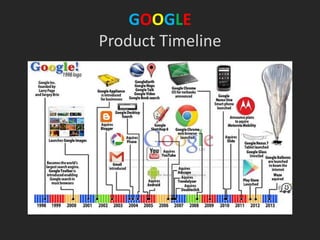
GOOGLE
Product Timeline
GOOGLE
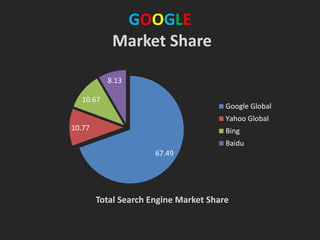
Market Share
67.49
10.77
10.67
8.13
Total Search Engine Market Share
Google Global
Yahoo Global
Bing
Baidu
GOOGLE
Product Offerings
GOOGLE
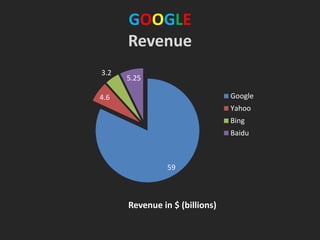
Revenue
59
4.6
3.2
5.25
Revenue in $ (billions)
Google
Yahoo
Bing
Baidu
GOOGLE
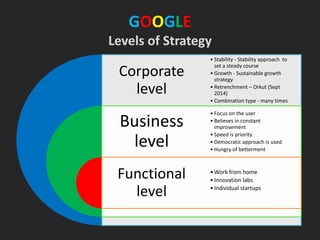
Levels of Strategy
Corporate
level
Business
level
Functional
level
• Stability - Stability approach to
set a steady course
• Growth - Sustainable growth
strategy
• Retrenchment – Orkut (Sept
2014)
• Combination type - many times
• Focus on the user
• Believes in constant
improvement
• Speed is priority
• Democratic approach is used
• Hungry of betterment
•Work from home
•Innovation labs
•Individual startups
GOOGLE
Primary Strategy
Focus on Differentiation through
• Robust data centers world over
• Unique page search algorithm
• Continuous improvement through innovation
GOOGLE
Secondary Strategy
Focus on growth and expansion
• Mergers & Acquisitions in related segments
(YouTube, Android, Motorola)
• Innovative products (Cloud computing,
Mobile computing, Gmail, Social Media, etc)
• Quick adoption of new technologies
• Forming strategic alliances to avail product collaborations
GOOGLE
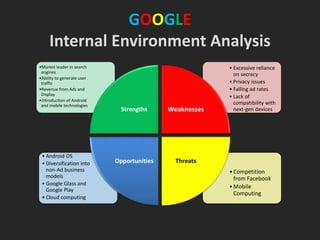
Internal Environment Analysis
•Competition
from Facebook
•Mobile
Computing
• Android OS
• Diversification into
non-Ad business
models
• Google Glass and
Google Play
• Cloud computing
• Excessive reliance
on secrecy
• Privacy issues
• Falling ad rates
• Lack of
compatibility with
next-gen devices
•Market leader in search
engines
•Ability to generate user
traffic
•Revenue from Ads and
Display
•Introduction of Android
and mobile technologies
Strengths Weaknesses
ThreatsOpportunities
GOOGLE
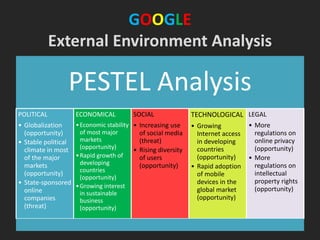
External Environment Analysis
PESTEL Analysis
POLITICAL
• Globalization
(opportunity)
• Stable political
climate in most
of the major
markets
(opportunity)
• State-sponsored
online
companies
(threat)
ECONOMICAL
•Economic stability
of most major
markets
(opportunity)
•Rapid growth of
developing
countries
(opportunity)
•Growing interest
in sustainable
business
(opportunity)
SOCIAL
• Increasing use
of social media
(threat)
• Rising diversity
of users
(opportunity)
TECHNOLOGICAL
• Growing
Internet access
in developing
countries
(opportunity)
• Rapid adoption
of mobile
devices in the
global market
(opportunity)
LEGAL
• More
regulations on
online privacy
(opportunity)
• More
regulations on
intellectual
property rights
(opportunity)
GOOGLE
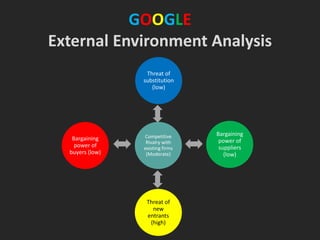
External Environment Analysis
Competitive
Rivalry with
existing firms
(Moderate)
Threat of
substitution
(low)
Bargaining
power of
suppliers
(low)
Threat of
new
entrants
(high)
Bargaining
power of
buyers (low)
GOOGLE
Product Portfolio
GOOGLE
Product Portfolio
GOOGLE
Product Portfolio
GOOGLE –

Strategic Management Google Case

  • 1.
    By- Hrucha, Supreet, Jayesh,Jil, Darshan STRATEGIC MANAGEMENT CASE PRESENTATION GOOGLE
  • 2.
  • 3.
    GOOGLE Market Share 67.49 10.77 10.67 8.13 Total SearchEngine Market Share Google Global Yahoo Global Bing Baidu
  • 4.
  • 5.
    GOOGLE Revenue 59 4.6 3.2 5.25 Revenue in $(billions) Google Yahoo Bing Baidu
  • 6.
    GOOGLE Levels of Strategy Corporate level Business level Functional level •Stability - Stability approach to set a steady course • Growth - Sustainable growth strategy • Retrenchment – Orkut (Sept 2014) • Combination type - many times • Focus on the user • Believes in constant improvement • Speed is priority • Democratic approach is used • Hungry of betterment •Work from home •Innovation labs •Individual startups
  • 7.
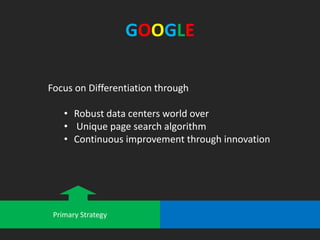
    GOOGLE Primary Strategy Focus onDifferentiation through • Robust data centers world over • Unique page search algorithm • Continuous improvement through innovation
  • 8.
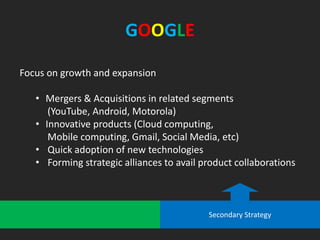
    GOOGLE Secondary Strategy Focus ongrowth and expansion • Mergers & Acquisitions in related segments (YouTube, Android, Motorola) • Innovative products (Cloud computing, Mobile computing, Gmail, Social Media, etc) • Quick adoption of new technologies • Forming strategic alliances to avail product collaborations
  • 9.
    GOOGLE Internal Environment Analysis •Competition fromFacebook •Mobile Computing • Android OS • Diversification into non-Ad business models • Google Glass and Google Play • Cloud computing • Excessive reliance on secrecy • Privacy issues • Falling ad rates • Lack of compatibility with next-gen devices •Market leader in search engines •Ability to generate user traffic •Revenue from Ads and Display •Introduction of Android and mobile technologies Strengths Weaknesses ThreatsOpportunities
  • 10.
    GOOGLE External Environment Analysis PESTELAnalysis POLITICAL • Globalization (opportunity) • Stable political climate in most of the major markets (opportunity) • State-sponsored online companies (threat) ECONOMICAL •Economic stability of most major markets (opportunity) •Rapid growth of developing countries (opportunity) •Growing interest in sustainable business (opportunity) SOCIAL • Increasing use of social media (threat) • Rising diversity of users (opportunity) TECHNOLOGICAL • Growing Internet access in developing countries (opportunity) • Rapid adoption of mobile devices in the global market (opportunity) LEGAL • More regulations on online privacy (opportunity) • More regulations on intellectual property rights (opportunity)
  • 11.
    GOOGLE External Environment Analysis Competitive Rivalrywith existing firms (Moderate) Threat of substitution (low) Bargaining power of suppliers (low) Threat of new entrants (high) Bargaining power of buyers (low)
  • 12.
  • 13.
  • 14.
  • 15.

Editor's Notes

  • #11 Google’s PESTEL/PESTLE analysis shows that most of the external factors in the firm’s remote/macro-environment are opportunities. The company must focus on exploiting these opportunities to maintain the company’s competitive advantage. For example, Google can use its culture of innovation to develop capabilities, such as improved responsiveness of Google products on mobile devices. In effectively addressing the opportunities identified in this PESTEL/PESTLE analysis, Google can expect stronger competitiveness and influence in the industry.