Marketing- Strategic 
Planning- IT 
Roll No: M140039MS 
Ajay Ram K P
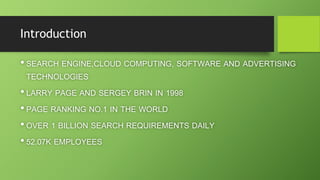
Introduction 
• SEARCH ENGINE,CLOUD COMPUTING, SOFTWARE AND ADVERTISING 
TECHNOLOGIES 
• LARRY PAGE AND SERGEY BRIN IN 1998 
• PAGE RANKING NO.1 IN THE WORLD 
• OVER 1 BILLION SEARCH REQUIREMENTS DAILY 
• 52.07K EMPLOYEES
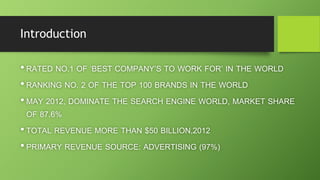
Introduction 
• RATED NO.1 OF ‘BEST COMPANY’S TO WORK FOR’ IN THE WORLD 
• RANKING NO. 2 OF THE TOP 100 BRANDS IN THE WORLD 
• MAY 2012, DOMINATE THE SEARCH ENGINE WORLD, MARKET SHARE 
OF 87.6% 
• TOTAL REVENUE MORE THAN $50 BILLION,2012 
• PRIMARY REVENUE SOURCE: ADVERTISING (97%)
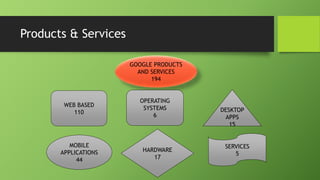
Products & Services 
GOOGLE PRODUCTS 
AND SERVICES 
194 
WEB BASED 
110 
OPERATING 
SYSTEMS 
6 
DESKTOP 
APPS 
15 
MOBILE 
APPLICATIONS 
44 
HARDWARE 
17 
SERVICES 
5
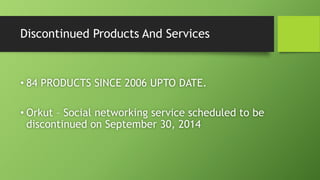
Discontinued Products And Services 
• 84 PRODUCTS SINCE 2006 UPTO DATE. 
• Orkut – Social networking service scheduled to be 
discontinued on September 30, 2014
: Vision & Mission 
• VISION 
• To make search engines so powerful they would 
understand “everything in the world” 
• MISSION 
• To organize the world’s information and make it 
accessible and useful.
‘s Marketing Strategy 
• Continues to focus on innovation and on the user 
experience. 
• FOCUS on SEARCH ENGINE marketing. 
• Indexing every website on the web, giving faster results with 
accuracy.
‘s Marketing Strategy 
• GOOGLE’S Ad-Sense and Ad-Word helped Google to 
generate huge revenue from the internet market. 
• DIFFERENTIATION FACTORS: 
• Robust data centers around the world 
• Unique page search algorithm 
• Ad-Sense & Ad-Word
‘s Marketing Strategy 
• Google’s secondary strategy is to focus on other related 
segments with innovative product development like- 
Social Media, Gmail, Google books, mobiles & cloud 
computing etc. 
• Growth strategy: 
Mergers & Acquisitions( YouTube, android, Motorola) 
This strategy is preferred because it allows Google to 
quickly adopt new technologies and process rather than 
to develop them internally.
‘s Marketing Strategy 
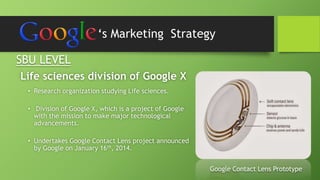
SBU LEVEL 
Life sciences division of Google X 
• Research organization studying Life sciences. 
• Division of Google X, which is a project of Google 
with the mission to make major technological 
advancements. 
• Undertakes Google Contact Lens project announced 
by Google on January 16th, 2014. 
Google Contact Lens Prototype
‘s Marketing Strategy 
CORPORATE LEVEL STRATEGY 
• To accelerate innovation and strengthen brand 
loyalty through transformational changes while 
creating an open source environment. 
ACTION 
PLAN
‘s Marketing Strategy 
BUSINESS LEVEL STRATEGY 
• Google currently pursues the generic business level strategy of 
differentiation. 
• Offering so many distinct products and services, Google is able to 
achieve a competitive advantage. 
• Google's web search engine differentiated itself from competing search engines by utilizing a 
patented system called PageRank.
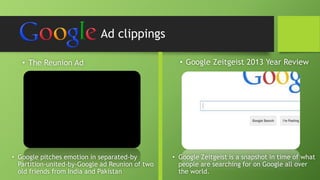
Ad clippings 
• The Reunion Ad • Google Zeitgeist 2013 Year Review 
• Google pitches emotion in separated-by 
Partition-united-by-Google ad Reunion of two 
old friends from India and Pakistan 
• Google Zeitgeist is a snapshot in time of what 
people are searching for on Google all over 
the world.
DOODLEs 
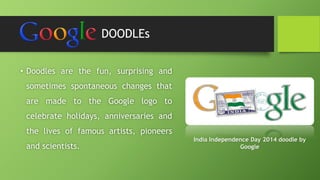
• Doodles are the fun, surprising and 
sometimes spontaneous changes that 
are made to the Google logo to 
celebrate holidays, anniversaries and 
the lives of famous artists, pioneers 
and scientists. 
India Independence Day 2014 doodle by 
Google
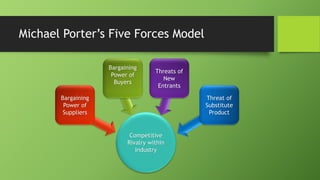
Michael Porter’s Five Forces Model 
Bargaining 
Power of 
Suppliers 
Bargaining 
Power of 
Buyers 
Threats of 
New 
Entrants 
Threat of 
Substitute 
Product 
Competitive 
Rivalry within 
Industry
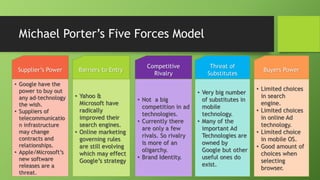
Michael Porter’s Five Forces Model 
• Google have the 
power to buy out 
any ad-technology 
the wish. 
• Suppliers of 
telecommunicatio 
n infrastructure 
may change 
contracts and 
relationships. 
• Apple/Microsoft’s 
new software 
releases are a 
threat. 
• Yahoo & 
Microsoft have 
radically 
improved their 
search engines. 
• Online marketing 
governing rules 
are still evolving 
which may effect 
Google’s strategy 
• Not a big 
competition in ad 
technologies. 
• Currently there 
are only a few 
rivals. So rivalry 
is more of an 
oligarchy. 
• Brand Identity. 
• Very big number 
of substitutes in 
mobile 
technology. 
• Many of the 
important Ad 
Technologies are 
owned by 
Google but other 
useful ones do 
exist. 
• Limited choices 
in search 
engine. 
• Limited choices 
in online Ad 
technology. 
• Limited choice 
in mobile OS. 
• Good amount of 
choices when 
selecting 
browser. 
Supplier’s Power Barriers to Entry 
Competitive 
Rivalry 
Threat of 
Substitutes 
Buyers Power
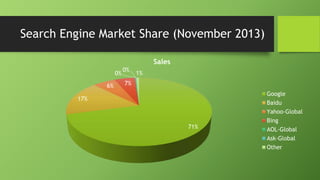
Search Engine Market Share (November 2013) 
71% 
17% 
0% 
0% 
6% 7% 
1% 
Sales 
Google 
Baidu 
Yahoo-Global 
Bing 
AOL-Global 
Ask-Global 
Other
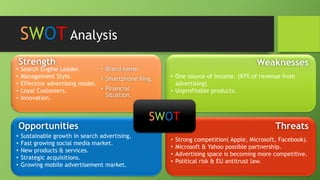
SWOT Analysis 
• Search Engine Leader. 
• Management Style. 
• Effective advertising model. 
• Loyal Customers. 
• Innovation. 
Weaknesses 
• One source of income. (97% of revenue from 
advertising) 
• Unprofitable products. 
• Brand name. 
• Smartphone King. 
• Financial 
Situation. 
• Sustainable growth in search advertising. 
• Fast growing social media market. 
• New products & services. 
• Strategic acquisitions. 
• Growing mobile advertisement market. 
SWOT 
• Strong competition( Apple, Microsoft, Facebook). 
• Microsoft & Yahoo possible partnership. 
• Advertising space is becoming more competitive. 
• Political risk & EU antitrust law. 
Strength 
Opportunities Threats
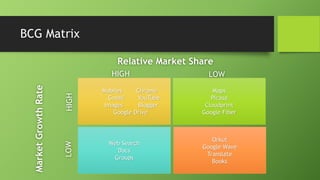
BCG Matrix 
Relative Market Share 
Mobiles Chrome 
Gmail YouTube 
Images Blogger 
Google Drive 
Maps 
Picasa 
Cloudprint 
Google Fiber 
Web Search 
Docs 
Groups 
Orkut 
Google Wave 
Translate 
Books 
Market Growth Rate 
HIGH LOW 
LOW HIGH
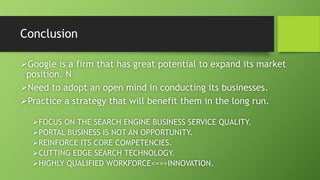
Conclusion 
Google is a firm that has great potential to expand its market 
position. N 
Need to adopt an open mind in conducting its businesses. 
Practice a strategy that will benefit them in the long run. 
FOCUS ON THE SEARCH ENGINE BUSINESS SERVICE QUALITY. 
PORTAL BUSINESS IS NOT AN OPPORTUNITY. 
REINFORCE ITS CORE COMPETENCIES. 
CUTTING EDGE SEARCH TECHNOLOGY. 
HIGHLY QUALIFIED WORKFORCE<==>INNOVATION.
THANK YOU…

Google Marketing Strategy

  • 1.
    Marketing- Strategic Planning-IT Roll No: M140039MS Ajay Ram K P
  • 2.
    Introduction • SEARCHENGINE,CLOUD COMPUTING, SOFTWARE AND ADVERTISING TECHNOLOGIES • LARRY PAGE AND SERGEY BRIN IN 1998 • PAGE RANKING NO.1 IN THE WORLD • OVER 1 BILLION SEARCH REQUIREMENTS DAILY • 52.07K EMPLOYEES
  • 3.
    Introduction • RATEDNO.1 OF ‘BEST COMPANY’S TO WORK FOR’ IN THE WORLD • RANKING NO. 2 OF THE TOP 100 BRANDS IN THE WORLD • MAY 2012, DOMINATE THE SEARCH ENGINE WORLD, MARKET SHARE OF 87.6% • TOTAL REVENUE MORE THAN $50 BILLION,2012 • PRIMARY REVENUE SOURCE: ADVERTISING (97%)
  • 4.
    Products & Services GOOGLE PRODUCTS AND SERVICES 194 WEB BASED 110 OPERATING SYSTEMS 6 DESKTOP APPS 15 MOBILE APPLICATIONS 44 HARDWARE 17 SERVICES 5
  • 5.
    Discontinued Products AndServices • 84 PRODUCTS SINCE 2006 UPTO DATE. • Orkut – Social networking service scheduled to be discontinued on September 30, 2014
  • 6.
    : Vision &Mission • VISION • To make search engines so powerful they would understand “everything in the world” • MISSION • To organize the world’s information and make it accessible and useful.
  • 7.
    ‘s Marketing Strategy • Continues to focus on innovation and on the user experience. • FOCUS on SEARCH ENGINE marketing. • Indexing every website on the web, giving faster results with accuracy.
  • 8.
    ‘s Marketing Strategy • GOOGLE’S Ad-Sense and Ad-Word helped Google to generate huge revenue from the internet market. • DIFFERENTIATION FACTORS: • Robust data centers around the world • Unique page search algorithm • Ad-Sense & Ad-Word
  • 9.
    ‘s Marketing Strategy • Google’s secondary strategy is to focus on other related segments with innovative product development like- Social Media, Gmail, Google books, mobiles & cloud computing etc. • Growth strategy: Mergers & Acquisitions( YouTube, android, Motorola) This strategy is preferred because it allows Google to quickly adopt new technologies and process rather than to develop them internally.
  • 10.
    ‘s Marketing Strategy SBU LEVEL Life sciences division of Google X • Research organization studying Life sciences. • Division of Google X, which is a project of Google with the mission to make major technological advancements. • Undertakes Google Contact Lens project announced by Google on January 16th, 2014. Google Contact Lens Prototype
  • 11.
    ‘s Marketing Strategy CORPORATE LEVEL STRATEGY • To accelerate innovation and strengthen brand loyalty through transformational changes while creating an open source environment. ACTION PLAN
  • 12.
    ‘s Marketing Strategy BUSINESS LEVEL STRATEGY • Google currently pursues the generic business level strategy of differentiation. • Offering so many distinct products and services, Google is able to achieve a competitive advantage. • Google's web search engine differentiated itself from competing search engines by utilizing a patented system called PageRank.
  • 13.
    Ad clippings •The Reunion Ad • Google Zeitgeist 2013 Year Review • Google pitches emotion in separated-by Partition-united-by-Google ad Reunion of two old friends from India and Pakistan • Google Zeitgeist is a snapshot in time of what people are searching for on Google all over the world.
  • 14.
    DOODLEs • Doodlesare the fun, surprising and sometimes spontaneous changes that are made to the Google logo to celebrate holidays, anniversaries and the lives of famous artists, pioneers and scientists. India Independence Day 2014 doodle by Google
  • 15.
    Michael Porter’s FiveForces Model Bargaining Power of Suppliers Bargaining Power of Buyers Threats of New Entrants Threat of Substitute Product Competitive Rivalry within Industry
  • 16.
    Michael Porter’s FiveForces Model • Google have the power to buy out any ad-technology the wish. • Suppliers of telecommunicatio n infrastructure may change contracts and relationships. • Apple/Microsoft’s new software releases are a threat. • Yahoo & Microsoft have radically improved their search engines. • Online marketing governing rules are still evolving which may effect Google’s strategy • Not a big competition in ad technologies. • Currently there are only a few rivals. So rivalry is more of an oligarchy. • Brand Identity. • Very big number of substitutes in mobile technology. • Many of the important Ad Technologies are owned by Google but other useful ones do exist. • Limited choices in search engine. • Limited choices in online Ad technology. • Limited choice in mobile OS. • Good amount of choices when selecting browser. Supplier’s Power Barriers to Entry Competitive Rivalry Threat of Substitutes Buyers Power
  • 17.
    Search Engine MarketShare (November 2013) 71% 17% 0% 0% 6% 7% 1% Sales Google Baidu Yahoo-Global Bing AOL-Global Ask-Global Other
  • 18.
    SWOT Analysis •Search Engine Leader. • Management Style. • Effective advertising model. • Loyal Customers. • Innovation. Weaknesses • One source of income. (97% of revenue from advertising) • Unprofitable products. • Brand name. • Smartphone King. • Financial Situation. • Sustainable growth in search advertising. • Fast growing social media market. • New products & services. • Strategic acquisitions. • Growing mobile advertisement market. SWOT • Strong competition( Apple, Microsoft, Facebook). • Microsoft & Yahoo possible partnership. • Advertising space is becoming more competitive. • Political risk & EU antitrust law. Strength Opportunities Threats
  • 19.
    BCG Matrix RelativeMarket Share Mobiles Chrome Gmail YouTube Images Blogger Google Drive Maps Picasa Cloudprint Google Fiber Web Search Docs Groups Orkut Google Wave Translate Books Market Growth Rate HIGH LOW LOW HIGH
  • 20.
    Conclusion Google isa firm that has great potential to expand its market position. N Need to adopt an open mind in conducting its businesses. Practice a strategy that will benefit them in the long run. FOCUS ON THE SEARCH ENGINE BUSINESS SERVICE QUALITY. PORTAL BUSINESS IS NOT AN OPPORTUNITY. REINFORCE ITS CORE COMPETENCIES. CUTTING EDGE SEARCH TECHNOLOGY. HIGHLY QUALIFIED WORKFORCE<==>INNOVATION.
  • 21.

Editor's Notes