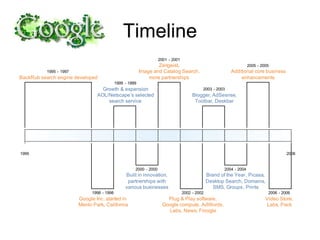
Timeline
 
The Company Started by licensing its search engine to third party sites eg. Yahoo! In Dec. 1999, they started using the Paid Listings Model   ”Sponsored links that appeared either adjacent to or interspersed with web search results for specific keywords. In March 2003, Google launched Contextual Paid Listings
Corporate structure Top Management: Sergey Brin, Larry Page, Eric Schmidt Went for an IPO April 2004 with a dual class equity structure Class B   10 votes Class A   1 vote (Top management would own 1/3 of shares but control 80% of votes to allow for stability over long time horizons.)
Corporate Values Don’t be evil. Technology matters. Make own rules. Managing innovation part of culture. Never settle for the best.
Management Policy To hire the right people for the job Facilitating efficient team dynamics and communication Encourage creativity To make decisions based on data “ Don’t be evil”
Brief overview of problem Over the past few years, Google has grown immensely and is still growing. Product innovations has expanded its domain beyond search into domains like: Portals (Google vs. Yahoo, MSN) Planned Payment Service (Google vs. EBay) Ad Supported Software (Google vs. Microsoft) What moves should Google make next?
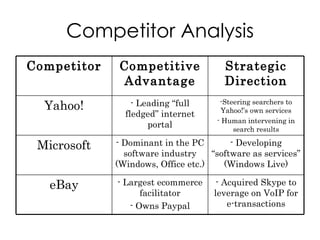
Competitor Analysis Competitor Competitive Advantage Strategic Direction Yahoo! - Leading “full fledged” internet portal Steering searchers to Yahoo!’s own services Human intervening in search results Microsoft - Dominant in the PC software industry (Windows, Office etc.) Developing “software as services” (Windows Live) eBay - Largest ecommerce facilitator - Owns Paypal - Acquired Skype to leverage on VoIP for e-transactions
Differentiation Strategy  Had a corporate structure which allowed quick decision making & encouraged innovation unlike competitors  Higher focus on innovation , 20% policy, resulted in products like Orkut, Google news  Offered free software to marketers so they could optimize their investment in Google  No adoption of commercial agendas unlike competitors, focus only on improving algorithms for better results Focused search engines like Froogle which are for specific products, these were free.  Faster, better search with many enhanced features like search history , language flexibility etc.
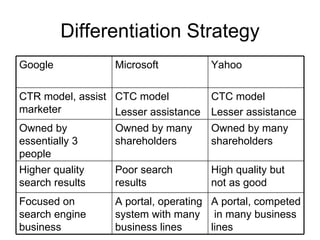
Differentiation Strategy Google Microsoft Yahoo CTR model, assist marketer  CTC model Lesser assistance CTC model Lesser assistance Owned by essentially 3 people Owned by many shareholders Owned by many shareholders Higher quality search results Poor search results High quality but not as good Focused on search engine business  A portal, operating system with many business lines A portal, competed  in many business lines
Porters 5 force model  Entrants to paid listings business faced considerable expenditure & need competent software developers. Suppliers: Companies placing ads on Google, get higher revenue splits , better results , more guidance etc. Buyers: better, faster, higher quality & speed of results  reducing chances of users to shift search engine.  Rivals: Diversified firms, not as competent as Google in search engines, fierce competition as low switching cost Substitutes: other media of communication , given the target market of e-advertisers, rapid increase in online access & surfing time, these hardly proved to be a threat
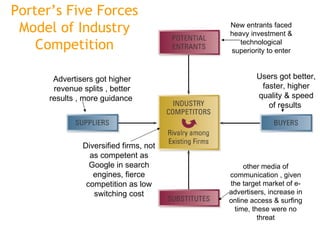
Porter’s Five Forces Model of Industry Competition New entrants faced heavy investment & technological superiority to enter Users got better, faster, higher quality & speed of results  Advertisers got higher revenue splits , better results , more guidance  other media of communication , given the target market of e-advertisers, increase in online access & surfing time, these were no threat Diversified firms, not as competent as Google in search engines, fierce competition as low switching cost
Resource Based Approach Resource based model emphasizes the use of a firm’s unique resources to target and apply them to new markets Unique corporate structure  Strategic alliances e.g. partnership with AOL Strong focus on innovation  Unique 70/20/10 corporate strategy  CTR advertisement rate model  Superior search engine & other products like Gmail Superior software tools & services  Strong support to advertisers & personalized search to users
Second Mover Advantage Google entered e-search market after Yahoo this helped them improve search results using algorithms  Google developed a CTR model which was an improvement over Overture’s CTC model  Developed “contextual based advertising” where listings appeared on editorial pages like blogs, news etc. Developed many new products like Froogle, Gmail , personalized home page before their competitors Developed brand ads & video ads which attracted brand advertisers
Competitive Advantage Google should offer personalized features like personalized search, search history Expand service range add features like desktop search , base , search Gmail,  Higher quality of accurate search results obtained faster Competitive rates to advertisers & better services like Google wallet, to increase their sales and reduce costs Google should lock itself as dominant design preferred by customers & firms who would incur switching costs if they changed their search engine
Technology Paradigm Shift A new technology getting its start away from the mainstream of a market, and invades the main market, as its functionality improves over time  Firm which develops a technology that changes they way an industry functions gets majority of market share of that industry Google discovered 2 killer applications  Page rank algorithm to improve search results CTR paid listings model It leveraged on these 2 competencies to make Google a favorite with buyers and advertisers and changed the way online search is conducted
What we do is search. Yahoo is a portal with a myriad of specialized services. What Google does is sufficiently limited. It's not really targeted at what Yahoo or AOL is trying to do. Our business strategy is not to compete, because we want them as customers  … Eric Schmidt, CEO Google
Other Future Offering  Extension of existing services in order to diversify Close potential gaps in service provision    Further partnership with AOL (biggest service provider in America) Create as much awareness as possible    Brand awareness plays a major role in search engine selection    Yahoo pays 900 million to ‘facebook’ to capitalize on the youth market, Google has ‘orkut’ which can be further developed to this purpose Very successful with project to provide free WiFi in San Francisco and Mountain Valley (California)    Extend such projects worldwide
To zoom in…4 Alternatives to Venture into Focus on Comparative Advantage:    Develop superior search solutions + monetizing through targeted advertising    Make it the trusted third part info escrow agent for all the world business    In line with its aim of organizing all of the world’s information Portal Building    Consolidating content     Up to date and subjective searches    Classified by relevance
eCommerce    Build trusted networks to provide intermediary function as an online payment inter phase (like PayPal)    Extending to purchasing journals, copyright articles via Google Channels  Extend Functionality    Compete head on with Microsoft as rumored    Desktop searches, office alternatives (provide support to development of open source initiatives like Open Office)    Provide interfaces compatible with Linux users to extend market base
Why  not  build their portal? According to Eric Schmidt, CEO of Google, Google is not in the portal business. Data also show that using websites as portals is the least important factor for respondents (internet users), among factors such as relevant results, speed of website, best features and the way results are presented.  There are already 2 big players in the Portal business, namely Yahoo! and MSN, due to high market commonality and high resources similarities, Google should practice mutual forbearance and not enter the portal business to prevent counter attacks by Yahoo! and MSN. Yahoo! has first mover advantage- loyal customers, who may find it difficult to switch to another portal format. Google may find it difficult to take the market share away from them.
Google has enough expertise to enter portal business.  Portal can be use as a complement service to their search engine. May be a relatively easy investment. Why build their own portal?
Why  not  focus on ecommerce? Already has big player Paypal 87million accounts in US
Next big thing Have enough capabilities to create a payment service Because Google Wallet is coming out Competitors are not into it yet Why focus on ecommerce?
Why  not  build their own OS? Not consistent with Google’s philosophy “Its best to do one thing really, really well” Google does search best Difficult to compete with Microsoft Microsoft already has positive feedback loop High installed base of users High switching cost
Possible in the long run Given that Google gain the technology Why build their own OS?
Why should Google focus on Core Competency? Shows a consistent image of the Google Porter’s 5: Low threat of new entrants Rivalry: defend against competitors due to better search functions Well-positioned relative to substitutes because of brand loyalty  Market Commonality – high Resource similarity – high  have mutual forbearance  should focus on their core competency to avoid from multi-market competition
The 70,20,10 Rule 70% should be on Core business Focus on search 20% should be on projects that extend the core Portal, eCommerce 10% should be on new business OS and other radical ideas
 

Google Case Study

  • 1.
                                
  • 2.
  • 3.
  • 4.
    The Company Startedby licensing its search engine to third party sites eg. Yahoo! In Dec. 1999, they started using the Paid Listings Model  ”Sponsored links that appeared either adjacent to or interspersed with web search results for specific keywords. In March 2003, Google launched Contextual Paid Listings
  • 5.
    Corporate structure TopManagement: Sergey Brin, Larry Page, Eric Schmidt Went for an IPO April 2004 with a dual class equity structure Class B  10 votes Class A  1 vote (Top management would own 1/3 of shares but control 80% of votes to allow for stability over long time horizons.)
  • 6.
    Corporate Values Don’tbe evil. Technology matters. Make own rules. Managing innovation part of culture. Never settle for the best.
  • 7.
    Management Policy Tohire the right people for the job Facilitating efficient team dynamics and communication Encourage creativity To make decisions based on data “ Don’t be evil”
  • 8.
    Brief overview ofproblem Over the past few years, Google has grown immensely and is still growing. Product innovations has expanded its domain beyond search into domains like: Portals (Google vs. Yahoo, MSN) Planned Payment Service (Google vs. EBay) Ad Supported Software (Google vs. Microsoft) What moves should Google make next?
  • 9.
    Competitor Analysis CompetitorCompetitive Advantage Strategic Direction Yahoo! - Leading “full fledged” internet portal Steering searchers to Yahoo!’s own services Human intervening in search results Microsoft - Dominant in the PC software industry (Windows, Office etc.) Developing “software as services” (Windows Live) eBay - Largest ecommerce facilitator - Owns Paypal - Acquired Skype to leverage on VoIP for e-transactions
  • 10.
    Differentiation Strategy Had a corporate structure which allowed quick decision making & encouraged innovation unlike competitors Higher focus on innovation , 20% policy, resulted in products like Orkut, Google news Offered free software to marketers so they could optimize their investment in Google No adoption of commercial agendas unlike competitors, focus only on improving algorithms for better results Focused search engines like Froogle which are for specific products, these were free. Faster, better search with many enhanced features like search history , language flexibility etc.
  • 11.
    Differentiation Strategy GoogleMicrosoft Yahoo CTR model, assist marketer CTC model Lesser assistance CTC model Lesser assistance Owned by essentially 3 people Owned by many shareholders Owned by many shareholders Higher quality search results Poor search results High quality but not as good Focused on search engine business A portal, operating system with many business lines A portal, competed in many business lines
  • 12.
    Porters 5 forcemodel Entrants to paid listings business faced considerable expenditure & need competent software developers. Suppliers: Companies placing ads on Google, get higher revenue splits , better results , more guidance etc. Buyers: better, faster, higher quality & speed of results reducing chances of users to shift search engine. Rivals: Diversified firms, not as competent as Google in search engines, fierce competition as low switching cost Substitutes: other media of communication , given the target market of e-advertisers, rapid increase in online access & surfing time, these hardly proved to be a threat
  • 13.
    Porter’s Five ForcesModel of Industry Competition New entrants faced heavy investment & technological superiority to enter Users got better, faster, higher quality & speed of results Advertisers got higher revenue splits , better results , more guidance other media of communication , given the target market of e-advertisers, increase in online access & surfing time, these were no threat Diversified firms, not as competent as Google in search engines, fierce competition as low switching cost
  • 14.
    Resource Based ApproachResource based model emphasizes the use of a firm’s unique resources to target and apply them to new markets Unique corporate structure Strategic alliances e.g. partnership with AOL Strong focus on innovation Unique 70/20/10 corporate strategy CTR advertisement rate model Superior search engine & other products like Gmail Superior software tools & services Strong support to advertisers & personalized search to users
  • 15.
    Second Mover AdvantageGoogle entered e-search market after Yahoo this helped them improve search results using algorithms Google developed a CTR model which was an improvement over Overture’s CTC model Developed “contextual based advertising” where listings appeared on editorial pages like blogs, news etc. Developed many new products like Froogle, Gmail , personalized home page before their competitors Developed brand ads & video ads which attracted brand advertisers
  • 16.
    Competitive Advantage Googleshould offer personalized features like personalized search, search history Expand service range add features like desktop search , base , search Gmail, Higher quality of accurate search results obtained faster Competitive rates to advertisers & better services like Google wallet, to increase their sales and reduce costs Google should lock itself as dominant design preferred by customers & firms who would incur switching costs if they changed their search engine
  • 17.
    Technology Paradigm ShiftA new technology getting its start away from the mainstream of a market, and invades the main market, as its functionality improves over time Firm which develops a technology that changes they way an industry functions gets majority of market share of that industry Google discovered 2 killer applications Page rank algorithm to improve search results CTR paid listings model It leveraged on these 2 competencies to make Google a favorite with buyers and advertisers and changed the way online search is conducted
  • 18.
    What we dois search. Yahoo is a portal with a myriad of specialized services. What Google does is sufficiently limited. It's not really targeted at what Yahoo or AOL is trying to do. Our business strategy is not to compete, because we want them as customers … Eric Schmidt, CEO Google
  • 19.
    Other Future Offering Extension of existing services in order to diversify Close potential gaps in service provision  Further partnership with AOL (biggest service provider in America) Create as much awareness as possible  Brand awareness plays a major role in search engine selection  Yahoo pays 900 million to ‘facebook’ to capitalize on the youth market, Google has ‘orkut’ which can be further developed to this purpose Very successful with project to provide free WiFi in San Francisco and Mountain Valley (California)  Extend such projects worldwide
  • 20.
    To zoom in…4Alternatives to Venture into Focus on Comparative Advantage:  Develop superior search solutions + monetizing through targeted advertising  Make it the trusted third part info escrow agent for all the world business  In line with its aim of organizing all of the world’s information Portal Building  Consolidating content  Up to date and subjective searches  Classified by relevance
  • 21.
    eCommerce  Build trusted networks to provide intermediary function as an online payment inter phase (like PayPal)  Extending to purchasing journals, copyright articles via Google Channels Extend Functionality  Compete head on with Microsoft as rumored  Desktop searches, office alternatives (provide support to development of open source initiatives like Open Office)  Provide interfaces compatible with Linux users to extend market base
  • 22.
    Why not build their portal? According to Eric Schmidt, CEO of Google, Google is not in the portal business. Data also show that using websites as portals is the least important factor for respondents (internet users), among factors such as relevant results, speed of website, best features and the way results are presented. There are already 2 big players in the Portal business, namely Yahoo! and MSN, due to high market commonality and high resources similarities, Google should practice mutual forbearance and not enter the portal business to prevent counter attacks by Yahoo! and MSN. Yahoo! has first mover advantage- loyal customers, who may find it difficult to switch to another portal format. Google may find it difficult to take the market share away from them.
  • 23.
    Google has enoughexpertise to enter portal business. Portal can be use as a complement service to their search engine. May be a relatively easy investment. Why build their own portal?
  • 24.
    Why not focus on ecommerce? Already has big player Paypal 87million accounts in US
  • 25.
    Next big thingHave enough capabilities to create a payment service Because Google Wallet is coming out Competitors are not into it yet Why focus on ecommerce?
  • 26.
    Why not build their own OS? Not consistent with Google’s philosophy “Its best to do one thing really, really well” Google does search best Difficult to compete with Microsoft Microsoft already has positive feedback loop High installed base of users High switching cost
  • 27.
    Possible in thelong run Given that Google gain the technology Why build their own OS?
  • 28.
    Why should Googlefocus on Core Competency? Shows a consistent image of the Google Porter’s 5: Low threat of new entrants Rivalry: defend against competitors due to better search functions Well-positioned relative to substitutes because of brand loyalty Market Commonality – high Resource similarity – high have mutual forbearance should focus on their core competency to avoid from multi-market competition
  • 29.
    The 70,20,10 Rule70% should be on Core business Focus on search 20% should be on projects that extend the core Portal, eCommerce 10% should be on new business OS and other radical ideas
  • 30.