The model originated from Michael 
E. Porter's 1980 book 
"Competitive Strategy: Techniques for 
Analysing Industries and 
Competitors."
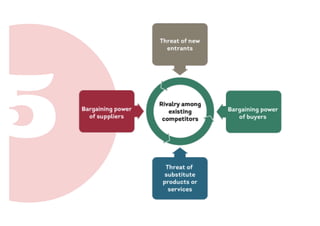
Porter identified five competitive 
forces that shape every single 
industry and market. 
These forces help us to analyse 
everything from the intensity of 
competition to the profitability and 
attractiveness of an industry.
Porter five forces analysis is a 
framework to analyse level of 
competition within an industry and 
business strategy development. 
It draws upon industrial organisation 
(IO) economics to derive five forces 
that determine the competitive 
intensity and therefore attractiveness 
of a market
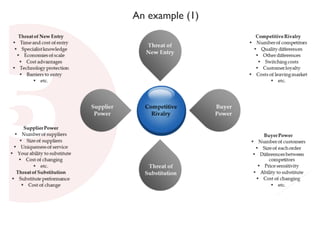
Supplier Power: 
Here you assess how easy it is for suppliers to 
drive up prices. 
This is driven by the number of suppliers of each 
key input, the uniqueness of their product or 
service, their strength and control over you, the 
cost of switching from one to another, and so on. 
The fewer the supplier choices you have, and the 
more you need suppliers' help, the more powerful 
your suppliers are.
Here are a few reasons that suppliers might have 
power: 
Existing loyalty to major brands 
Incentives for using a particular buyer (such as 
frequent shopper programs) 
High fixed costs 
Scarcity of resources 
High costs of switching companies 
Government restrictions or legislation
Buyer Power: 
Here you ask yourself how easy it is for buyers to 
drive prices down. 
Again, this is driven by the number of buyers, the 
importance of each individual buyer to your 
business, the cost to them of switching from your 
products and services to those of someone else, 
and so on. 
If you deal with few, powerful buyers, then they 
are often able to dictate terms to you.
Here are a few reasons that customers might have 
power: 
There are very few suppliers of a particular 
product 
There are no substitutes 
Switching to another (competitive) product is 
very costly 
The product is extremely important to buyers - 
can  can't do without it 
The supplying industry has a higher profitability 
than the buying industry
Competitive Rivalry: 
What is important here is the number and 
capability of your competitors. 
If you have many competitors, and they offer 
equally attractive products and services, then 
you'll most likely have little power in the situation, 
because suppliers and buyers will go elsewhere if 
they don't get a good deal from you. 
On the other hand, if no-one else can do what 
you do, then you can often have tremendous 
strength.
A highly competitive market might result from: 
The main issue is the similarity of substitutes. For 
example, if the price of coffee rises substantially, a 
coffee drinker may switch over to a beverage like 
tea. 
If substitutes are similar, it can be viewed in the 
same light as a new entrant.
Threat of Substitution: 
This is affected by the ability of your customers to 
find a different way of doing what you do – for 
example, if you supply a unique software product 
that automates an important process, people may 
substitute by doing the process manually or by 
outsourcing it. 
If substitution is easy and substitution is viable, 
then this weakens your power.
Here are a few factors that can affect the threat 
of substitutes: 
Small number of buyers 
Purchases large volumes 
Switching to another (competitive) product is 
simple 
The product is not extremely important to 
buyers; they can do without the product for a 
period of time 
Customers are price sensitive
Threat of New Entry: 
Power is also affected by the ability of people to 
enter your market. (Barriers to entry) 
If it costs little in time or money to enter your 
market and compete effectively, if there are few 
economies of scale in place, or if you have little 
protection for your key technologies, then new 
competitors can quickly enter your market and 
weaken your position. 
If you have strong and durable barriers to entry, 
then you can preserve a favourable position and 
take fair advantage of it.
Definition of ‘Barriers to entry’ 
The existence of high start-up costs or other 
obstacles that prevent new competitors from 
easily entering an industry or area of business. 
Barriers to entry benefit existing companies 
already operating in an industry because they 
protect an established company's revenues and 
profits from being whittled away by new 
competitors.
Definition of ‘Barriers to entry’ (2) 
Barriers to entry can exist as a result of 
government intervention (industry regulation, 
legislative limitations on new firms, special tax 
benefits to existing firms, etc.), or they can occur 
naturally within the business world. 
Some naturally occurring barriers to entry could 
be technological patents or patents on business 
processes, a strong brand identity, strong 
customer loyalty or high customer switching 
costs.
Using the Tool 
To use the tool to understand your situation, look 
at each of these forces one-by-one and write your 
observations on a worksheet. 
Brainstorm the relevant factors for your market 
or situation, and then check against the factors 
listed for the force in the diagram above. 
Then, mark the key factors on the diagram, and 
summarise the size and scale of the force on the 
diagram. An easy way of doing this is to use, for 
example, a single "+" sign for a force moderately 
in your favour, or "-" for a force strongly against 
you.
Using the Tool 
Then look at the situation you find using this 
analysis and think through how it affects you. 
Bear in mind that few situations are perfect; 
however looking at things in this way helps you 
think through what you could change to increase 
your power with respect to each force. 
What’s more, if you find yourself in a structurally 
weak position, this tool helps you think about 
what you can do to move into a stronger one.
An example (1)
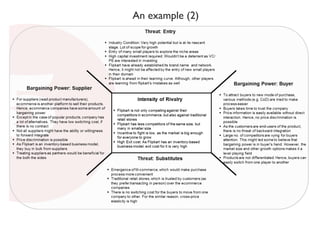
An example (2)
Thank you 
@Spillly 
brent@spillly.com 
0832533999 
spillly.com

Porters 5 forces - a simple explanation

  • 2.
    The model originatedfrom Michael E. Porter's 1980 book "Competitive Strategy: Techniques for Analysing Industries and Competitors."
  • 3.
    Porter identified fivecompetitive forces that shape every single industry and market. These forces help us to analyse everything from the intensity of competition to the profitability and attractiveness of an industry.
  • 4.
    Porter five forcesanalysis is a framework to analyse level of competition within an industry and business strategy development. It draws upon industrial organisation (IO) economics to derive five forces that determine the competitive intensity and therefore attractiveness of a market
  • 6.
    Supplier Power: Hereyou assess how easy it is for suppliers to drive up prices. This is driven by the number of suppliers of each key input, the uniqueness of their product or service, their strength and control over you, the cost of switching from one to another, and so on. The fewer the supplier choices you have, and the more you need suppliers' help, the more powerful your suppliers are.
  • 7.
    Here are afew reasons that suppliers might have power: Existing loyalty to major brands Incentives for using a particular buyer (such as frequent shopper programs) High fixed costs Scarcity of resources High costs of switching companies Government restrictions or legislation
  • 8.
    Buyer Power: Hereyou ask yourself how easy it is for buyers to drive prices down. Again, this is driven by the number of buyers, the importance of each individual buyer to your business, the cost to them of switching from your products and services to those of someone else, and so on. If you deal with few, powerful buyers, then they are often able to dictate terms to you.
  • 9.
    Here are afew reasons that customers might have power: There are very few suppliers of a particular product There are no substitutes Switching to another (competitive) product is very costly The product is extremely important to buyers - can can't do without it The supplying industry has a higher profitability than the buying industry
  • 10.
    Competitive Rivalry: Whatis important here is the number and capability of your competitors. If you have many competitors, and they offer equally attractive products and services, then you'll most likely have little power in the situation, because suppliers and buyers will go elsewhere if they don't get a good deal from you. On the other hand, if no-one else can do what you do, then you can often have tremendous strength.
  • 11.
    A highly competitivemarket might result from: The main issue is the similarity of substitutes. For example, if the price of coffee rises substantially, a coffee drinker may switch over to a beverage like tea. If substitutes are similar, it can be viewed in the same light as a new entrant.
  • 12.
    Threat of Substitution: This is affected by the ability of your customers to find a different way of doing what you do – for example, if you supply a unique software product that automates an important process, people may substitute by doing the process manually or by outsourcing it. If substitution is easy and substitution is viable, then this weakens your power.
  • 13.
    Here are afew factors that can affect the threat of substitutes: Small number of buyers Purchases large volumes Switching to another (competitive) product is simple The product is not extremely important to buyers; they can do without the product for a period of time Customers are price sensitive
  • 14.
    Threat of NewEntry: Power is also affected by the ability of people to enter your market. (Barriers to entry) If it costs little in time or money to enter your market and compete effectively, if there are few economies of scale in place, or if you have little protection for your key technologies, then new competitors can quickly enter your market and weaken your position. If you have strong and durable barriers to entry, then you can preserve a favourable position and take fair advantage of it.
  • 15.
    Definition of ‘Barriersto entry’ The existence of high start-up costs or other obstacles that prevent new competitors from easily entering an industry or area of business. Barriers to entry benefit existing companies already operating in an industry because they protect an established company's revenues and profits from being whittled away by new competitors.
  • 16.
    Definition of ‘Barriersto entry’ (2) Barriers to entry can exist as a result of government intervention (industry regulation, legislative limitations on new firms, special tax benefits to existing firms, etc.), or they can occur naturally within the business world. Some naturally occurring barriers to entry could be technological patents or patents on business processes, a strong brand identity, strong customer loyalty or high customer switching costs.
  • 17.
    Using the Tool To use the tool to understand your situation, look at each of these forces one-by-one and write your observations on a worksheet. Brainstorm the relevant factors for your market or situation, and then check against the factors listed for the force in the diagram above. Then, mark the key factors on the diagram, and summarise the size and scale of the force on the diagram. An easy way of doing this is to use, for example, a single "+" sign for a force moderately in your favour, or "-" for a force strongly against you.
  • 18.
    Using the Tool Then look at the situation you find using this analysis and think through how it affects you. Bear in mind that few situations are perfect; however looking at things in this way helps you think through what you could change to increase your power with respect to each force. What’s more, if you find yourself in a structurally weak position, this tool helps you think about what you can do to move into a stronger one.
  • 19.
  • 20.
  • 21.
    Thank you @Spillly brent@spillly.com 0832533999 spillly.com