Competitive Rivalry and Competitive Dynamics Chapter Six
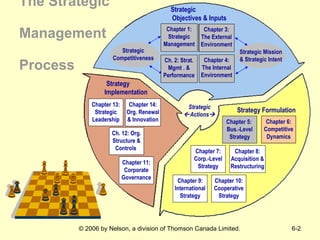
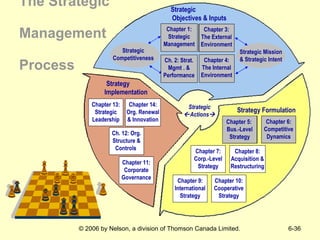
The Strategic  Management  Process Chapter 5:  Bus.-Level Strategy Chapter 6: Competitive Dynamics Chapter 7: Corp.-Level Strategy Chapter 8: Acquisition & Restructuring Chapter 9: International Strategy Chapter 10: Cooperative Strategy Strategy Formulation Strategic  Actions  Chapter 3: The External Environment  Strategic Competitiveness Strategic Mission & Strategic Intent Strategic  Objectives & Inputs Chapter 1: Strategic Management Ch. 2: Strat. Mgmt . & Performance Chapter 3: The External Environment  Chapter 3: The External Environment  Chapter 4: The Internal Environment Chapter 5:  Bus.-Level Strategy Chapter 6: Competitive Dynamics Chapter 11: Corporate Governance Ch. 12: Org. Structure & Controls  Chapter 13: Strategic Leadership Chapter 14: Org. Renewal & Innovation Strategy  Implementation Strategic Competitiveness
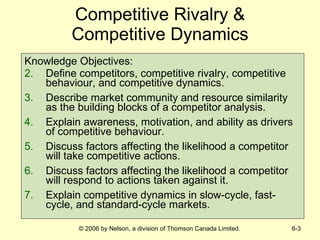
Competitive Rivalry & Competitive Dynamics Knowledge Objectives: Define competitors, competitive rivalry, competitive behaviour, and competitive dynamics. Describe market community and resource similarity as the building blocks of a competitor analysis. Explain awareness, motivation, and ability as drivers of competitive behaviour. Discuss factors affecting the likelihood a competitor will take competitive actions. Discuss factors affecting the likelihood a competitor will respond to actions taken against it. Explain competitive dynamics in slow-cycle, fast-cycle, and standard-cycle markets.
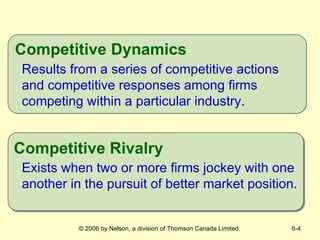
Competitive Dynamics Results from a series of competitive actions and competitive responses among firms competing within a particular industry. Competitive Rivalry Exists when two or more firms jockey with one another in the pursuit of better market position.
From Competitors to Competitive Dynamics Competitive Dynamics Competitive actions and responses taken by all firms competing in a market Creates? Creates? Competitors Competitive rivalry Engage  in Through competitive behavior - Competitive actions Competitive responses To gain an advantageous market position Why? How?
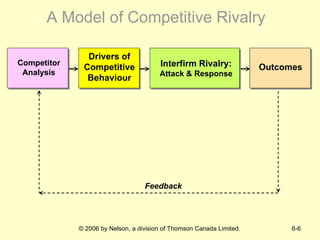
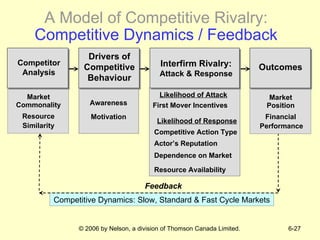
A Model of Competitive Rivalry Feedback Drivers of Competitive Behaviour Outcomes Interfirm Rivalry: Attack & Response Competitor Analysis
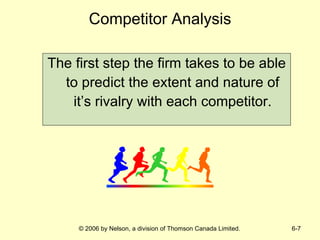
Competitor Analysis The first step the firm takes to be able to predict the extent and nature of it’s rivalry with each competitor.
A Model of Competitive Rivalry:  Competitor Analysis Feedback Market Commonality Resource Similarity Drivers of Competitive Behaviour Outcomes Interfirm Rivalry: Attack & Response Competitor Analysis
Competitor Analysis Market Commonality The number of markets with which the firm and a competitor are jointly involved and the degree of importance of each market. Resource Similarity The extent to which the firm’s tangible & intangible resources are comparable to a competitors in terms of both type & amount.
Competitor Analysis Competitor Analysis Multipoint competition tends to reduce competitive interactions, but increases likelihood of response where interaction occurs. For example, airlines price flights similarly, but respond quickly when competitors introduce promotional prices. Market Commonality Do firms compete with each other in multiple markets? Resource Similarity Do competitors possess similar types or amounts of resources?
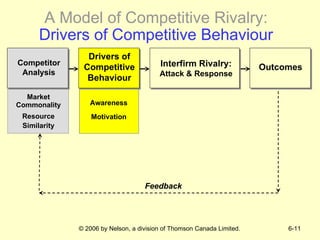
A Model of Competitive Rivalry:  Drivers of Competitive Behaviour Feedback Market Commonality Resource Similarity Awareness Motivation Drivers of Competitive Behaviour Outcomes Interfirm Rivalry: Attack & Response Competitor Analysis
Drivers of Competitive Behaviour Drivers of Competitive Behaviour * Does the firm have appropriate incentives to attack or respond? Do managers understand key characteristics of competitors? Motivation Awareness
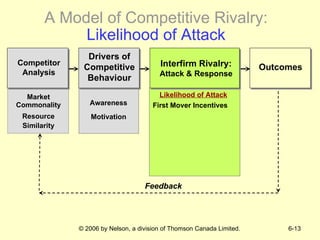
A Model of Competitive Rivalry:  Likelihood of Attack Market Commonality Resource Similarity Awareness Motivation Feedback Likelihood of Attack First Mover Incentives Drivers of Competitive Behaviour Outcomes Interfirm Rivalry: Attack & Response Competitor Analysis
Factors Affecting Likelihood of Attack: First movers allocate funds for product innovation and development aggressive advertising advanced research and development First Mover Incentives First movers can gain  the loyalty of customers who may become committed to the firm’s goods or services market share that can be difficult for competitors to take during future competitive rivalry First mover incentives
Small firms are more likely to launch competitive actions  to be quicker in doing so. Factors Affecting Likelihood of Attack: Size Small firms are perceived as nimble and flexible competitors  relying on speed and surprise to defend their competitive advantages or develop new ones while engaged in competitive rivalry. Small firms have the flexibility needed to launch a greater variety of competitive actions. First mover incentives Size “ Think and act big & we’ll get smaller.  Think & act small & we’ll get bigger.” -  Herb Kelleher, Former CEO, Southwest Air.
Factors Affecting Likelihood of Attack: Product quality dimensions include: Performance Features Flexibility Durability Conformance Serviceability Aesthetics Perceived quality Quality Quality exists when the firm’s goods or services meet or exceed customers’ expectations. Quality First mover incentives Size
Quality Dimensions of Goods & Services Product   Quality Dimensions: Performance   Operating characteristics Features   Important special characteristics Flexibility   Meeting operating specifications over time Durability   Amount of use before performance declines Conformance   Match with pre-established standards Serviceability   Ease and speed of repair or normal service Aesthetics   How a product looks and feels Perceived   Subjective assessment of characteristics  (product image) quality
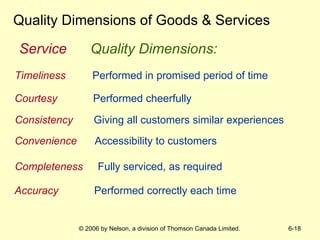
Quality Dimensions of Goods & Services Service   Quality Dimensions: Timeliness   Performed in promised period of time Courtesy   Performed cheerfully Consistency   Giving all customers similar experiences Convenience   Accessibility to customers Completeness   Fully serviced, as required Accuracy   Performed correctly each time
A Model of Competitive Rivalry:  Likelihood of Response Market Commonality Resource Similarity Awareness Motivation Feedback Likelihood of Attack First Mover Incentives Drivers of Competitive Behaviour Outcomes Interfirm Rivalry: Attack & Response Competitor Analysis Likelihood of Response Competitive Action Type Dependence on Market Resource Availability Actor’s Reputation
Factors Affecting Likelihood of Response Firms study three factors to predict how a competitor is likely to respond to competitive actions: - type of competitive action - reputation - market dependence
Competition Competitive Dynamics competitive dynamics concerns the ongoing actions and responses taking place among  all  firms competing within a market for advantageous positions Competitive Rivalry building and sustaining competitive advantages are at the core of competitive rivalry competitive advantages are the link to an advantageous market position
Factors Affecting Likelihood of Response: Strategic actions receive strategic responses Tactical responses are taken to counter the effects of tactical actions Strategic actions elicit fewer total competitive responses A competitor likely will respond quickly to a tactical action The time needed to implement and assess a strategic action delays competitors’ responses Type of Competitive Action Type of competitive action
Factors Affecting Likelihood of Response: An actor is the firm taking an action or response Reputation is the positive or negative attribute ascribed by one rival to another based on past competitive behavior The firm studies responses that a competitor has taken previously when attacked to predict likely responses Reputation Type of competitive action Reputation
Factors Affecting Likelihood of Response: Market dependence is: the extent to which a firm’s revenues or profits are derived from a particular market In general, firms can predict that competitors with high market dependence are likely to respond strongly to attacks threatening their market position Market Dependence Market dependence Type of competitive action Reputation
A Model of Competitive Rivalry:  Outcomes Likelihood of Attack First Mover Incentives Likelihood of Response Competitive Action Type Dependence on Market Resource Availability Actor’s Reputation Feedback Market Position Financial Performance Market Commonality Resource Similarity Awareness Motivation Drivers of Competitive Behaviour Outcomes Interfirm Rivalry: Attack & Response Competitor Analysis
Outcomes * * Financial Performance Better position should lead to better financial performance Market Position Is the firm creating a sustained competitive advantage Outcomes
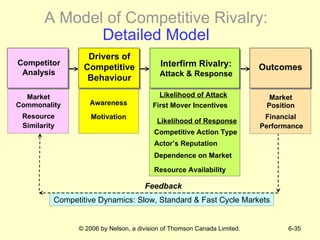
A Model of Competitive Rivalry:  Competitive Dynamics / Feedback Competitive Dynamics: Slow, Standard & Fast Cycle Markets Likelihood of Attack First Mover Incentives Likelihood of Response Competitive Action Type Dependence on Market Resource Availability Actor’s Reputation Feedback Market Position Financial Performance Market Commonality Resource Similarity Awareness Motivation Drivers of Competitive Behaviour Outcomes Interfirm Rivalry: Attack & Response Competitor Analysis
Competitive Dynamics Competitive Market Types Slow, Standard, Fast Cycle Feedback Slow cycle markets   are frequently shielded by monopoly power or very strong brand loyalties A lack of interfirm rivalry may lead to sustained competitive advantage Slow ,   Standard, Fast,   Cycle * *
Competitive Dynamics Competitive Market Types Slow, Standard, Fast Cycle Feedback Slow,   Standard ,   Fast   Cycle Firms with multi-market competition may dampen  rivalry somewhat Sustained competitive advantage is a possible outcome in this instance Standard cycle markets   often lead to highly competitive pressures despite world class products
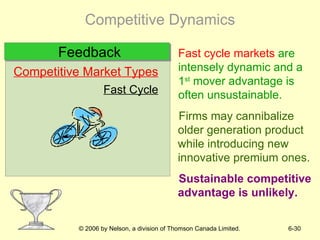
Competitive Dynamics Competitive Market Types Slow, Standard, Fast Cycle Feedback Slow, Standard,   Fast Cycle Fast cycle markets   are intensely dynamic and a 1 st  mover advantage is often unsustainable. Firms may cannibalize older generation product  while introducing new innovative premium ones. Sustainable competitive  advantage is unlikely.
Competitive Advantage  Which Eventually Erodes Time (years) 5 Launch Exploitation Counterattack Returns from a Competitive Advantage
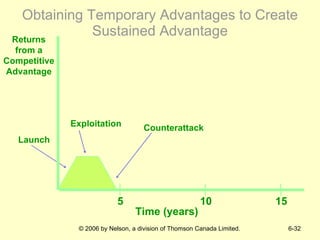
Obtaining Temporary Advantages to Create Sustained Advantage Time (years) 10 Launch Exploitation Counterattack Returns from a Competitive Advantage 5 15
Obtaining Temporary Advantages to Create Sustained Advantage Time (years) 10 Launch Exploitation Counterattack Returns from a Sustained Competitive Advantage 5 15 Firm has already moved on to Advantage No. 2
Obtaining Temporary Advantages to Create Sustained Advantage Time (years) 10 Launch Exploitation Counterattack Returns from a Sustained Competitive Advantage 5 15 Firm continues to move on to the next Advantage
A Model of Competitive Rivalry:  Detailed Model Competitive Dynamics: Slow, Standard & Fast Cycle Markets Likelihood of Attack First Mover Incentives Likelihood of Response Competitive Action Type Dependence on Market Resource Availability Actor’s Reputation Feedback Market Position Financial Performance Market Commonality Resource Similarity Awareness Motivation Drivers of Competitive Behaviour Outcomes Interfirm Rivalry: Attack & Response Competitor Analysis
The Strategic  Management  Process Chapter 5:  Bus.-Level Strategy Chapter 6: Competitive Dynamics Chapter 7: Corp.-Level Strategy Chapter 8: Acquisition & Restructuring Chapter 9: International Strategy Chapter 10: Cooperative Strategy Strategy Formulation Strategic  Actions  Chapter 3: The External Environment  Strategic Competitiveness Strategic Mission & Strategic Intent Strategic  Objectives & Inputs Chapter 1: Strategic Management Ch. 2: Strat. Mgmt . & Performance Chapter 3: The External Environment  Chapter 3: The External Environment  Chapter 4: The Internal Environment Chapter 5:  Bus.-Level Strategy Chapter 6: Competitive Dynamics Chapter 11: Corporate Governance Ch. 12: Org. Structure & Controls  Chapter 13: Strategic Leadership Chapter 14: Org. Renewal & Innovation Strategy  Implementation Strategic Competitiveness

Strategic Management Ch06

  • 1.
    Competitive Rivalry andCompetitive Dynamics Chapter Six
  • 2.
    The Strategic Management Process Chapter 5: Bus.-Level Strategy Chapter 6: Competitive Dynamics Chapter 7: Corp.-Level Strategy Chapter 8: Acquisition & Restructuring Chapter 9: International Strategy Chapter 10: Cooperative Strategy Strategy Formulation Strategic  Actions  Chapter 3: The External Environment Strategic Competitiveness Strategic Mission & Strategic Intent Strategic Objectives & Inputs Chapter 1: Strategic Management Ch. 2: Strat. Mgmt . & Performance Chapter 3: The External Environment Chapter 3: The External Environment Chapter 4: The Internal Environment Chapter 5: Bus.-Level Strategy Chapter 6: Competitive Dynamics Chapter 11: Corporate Governance Ch. 12: Org. Structure & Controls Chapter 13: Strategic Leadership Chapter 14: Org. Renewal & Innovation Strategy Implementation Strategic Competitiveness
  • 3.
    Competitive Rivalry &Competitive Dynamics Knowledge Objectives: Define competitors, competitive rivalry, competitive behaviour, and competitive dynamics. Describe market community and resource similarity as the building blocks of a competitor analysis. Explain awareness, motivation, and ability as drivers of competitive behaviour. Discuss factors affecting the likelihood a competitor will take competitive actions. Discuss factors affecting the likelihood a competitor will respond to actions taken against it. Explain competitive dynamics in slow-cycle, fast-cycle, and standard-cycle markets.
  • 4.
    Competitive Dynamics Resultsfrom a series of competitive actions and competitive responses among firms competing within a particular industry. Competitive Rivalry Exists when two or more firms jockey with one another in the pursuit of better market position.
  • 5.
    From Competitors toCompetitive Dynamics Competitive Dynamics Competitive actions and responses taken by all firms competing in a market Creates? Creates? Competitors Competitive rivalry Engage in Through competitive behavior - Competitive actions Competitive responses To gain an advantageous market position Why? How?
  • 6.
    A Model ofCompetitive Rivalry Feedback Drivers of Competitive Behaviour Outcomes Interfirm Rivalry: Attack & Response Competitor Analysis
  • 7.
    Competitor Analysis Thefirst step the firm takes to be able to predict the extent and nature of it’s rivalry with each competitor.
  • 8.
    A Model ofCompetitive Rivalry: Competitor Analysis Feedback Market Commonality Resource Similarity Drivers of Competitive Behaviour Outcomes Interfirm Rivalry: Attack & Response Competitor Analysis
  • 9.
    Competitor Analysis MarketCommonality The number of markets with which the firm and a competitor are jointly involved and the degree of importance of each market. Resource Similarity The extent to which the firm’s tangible & intangible resources are comparable to a competitors in terms of both type & amount.
  • 10.
    Competitor Analysis CompetitorAnalysis Multipoint competition tends to reduce competitive interactions, but increases likelihood of response where interaction occurs. For example, airlines price flights similarly, but respond quickly when competitors introduce promotional prices. Market Commonality Do firms compete with each other in multiple markets? Resource Similarity Do competitors possess similar types or amounts of resources?
  • 11.
    A Model ofCompetitive Rivalry: Drivers of Competitive Behaviour Feedback Market Commonality Resource Similarity Awareness Motivation Drivers of Competitive Behaviour Outcomes Interfirm Rivalry: Attack & Response Competitor Analysis
  • 12.
    Drivers of CompetitiveBehaviour Drivers of Competitive Behaviour * Does the firm have appropriate incentives to attack or respond? Do managers understand key characteristics of competitors? Motivation Awareness
  • 13.
    A Model ofCompetitive Rivalry: Likelihood of Attack Market Commonality Resource Similarity Awareness Motivation Feedback Likelihood of Attack First Mover Incentives Drivers of Competitive Behaviour Outcomes Interfirm Rivalry: Attack & Response Competitor Analysis
  • 14.
    Factors Affecting Likelihoodof Attack: First movers allocate funds for product innovation and development aggressive advertising advanced research and development First Mover Incentives First movers can gain the loyalty of customers who may become committed to the firm’s goods or services market share that can be difficult for competitors to take during future competitive rivalry First mover incentives
  • 15.
    Small firms aremore likely to launch competitive actions to be quicker in doing so. Factors Affecting Likelihood of Attack: Size Small firms are perceived as nimble and flexible competitors relying on speed and surprise to defend their competitive advantages or develop new ones while engaged in competitive rivalry. Small firms have the flexibility needed to launch a greater variety of competitive actions. First mover incentives Size “ Think and act big & we’ll get smaller. Think & act small & we’ll get bigger.” - Herb Kelleher, Former CEO, Southwest Air.
  • 16.
    Factors Affecting Likelihoodof Attack: Product quality dimensions include: Performance Features Flexibility Durability Conformance Serviceability Aesthetics Perceived quality Quality Quality exists when the firm’s goods or services meet or exceed customers’ expectations. Quality First mover incentives Size
  • 17.
    Quality Dimensions ofGoods & Services Product Quality Dimensions: Performance Operating characteristics Features Important special characteristics Flexibility Meeting operating specifications over time Durability Amount of use before performance declines Conformance Match with pre-established standards Serviceability Ease and speed of repair or normal service Aesthetics How a product looks and feels Perceived Subjective assessment of characteristics (product image) quality
  • 18.
    Quality Dimensions ofGoods & Services Service Quality Dimensions: Timeliness Performed in promised period of time Courtesy Performed cheerfully Consistency Giving all customers similar experiences Convenience Accessibility to customers Completeness Fully serviced, as required Accuracy Performed correctly each time
  • 19.
    A Model ofCompetitive Rivalry: Likelihood of Response Market Commonality Resource Similarity Awareness Motivation Feedback Likelihood of Attack First Mover Incentives Drivers of Competitive Behaviour Outcomes Interfirm Rivalry: Attack & Response Competitor Analysis Likelihood of Response Competitive Action Type Dependence on Market Resource Availability Actor’s Reputation
  • 20.
    Factors Affecting Likelihoodof Response Firms study three factors to predict how a competitor is likely to respond to competitive actions: - type of competitive action - reputation - market dependence
  • 21.
    Competition Competitive Dynamicscompetitive dynamics concerns the ongoing actions and responses taking place among all firms competing within a market for advantageous positions Competitive Rivalry building and sustaining competitive advantages are at the core of competitive rivalry competitive advantages are the link to an advantageous market position
  • 22.
    Factors Affecting Likelihoodof Response: Strategic actions receive strategic responses Tactical responses are taken to counter the effects of tactical actions Strategic actions elicit fewer total competitive responses A competitor likely will respond quickly to a tactical action The time needed to implement and assess a strategic action delays competitors’ responses Type of Competitive Action Type of competitive action
  • 23.
    Factors Affecting Likelihoodof Response: An actor is the firm taking an action or response Reputation is the positive or negative attribute ascribed by one rival to another based on past competitive behavior The firm studies responses that a competitor has taken previously when attacked to predict likely responses Reputation Type of competitive action Reputation
  • 24.
    Factors Affecting Likelihoodof Response: Market dependence is: the extent to which a firm’s revenues or profits are derived from a particular market In general, firms can predict that competitors with high market dependence are likely to respond strongly to attacks threatening their market position Market Dependence Market dependence Type of competitive action Reputation
  • 25.
    A Model ofCompetitive Rivalry: Outcomes Likelihood of Attack First Mover Incentives Likelihood of Response Competitive Action Type Dependence on Market Resource Availability Actor’s Reputation Feedback Market Position Financial Performance Market Commonality Resource Similarity Awareness Motivation Drivers of Competitive Behaviour Outcomes Interfirm Rivalry: Attack & Response Competitor Analysis
  • 26.
    Outcomes * *Financial Performance Better position should lead to better financial performance Market Position Is the firm creating a sustained competitive advantage Outcomes
  • 27.
    A Model ofCompetitive Rivalry: Competitive Dynamics / Feedback Competitive Dynamics: Slow, Standard & Fast Cycle Markets Likelihood of Attack First Mover Incentives Likelihood of Response Competitive Action Type Dependence on Market Resource Availability Actor’s Reputation Feedback Market Position Financial Performance Market Commonality Resource Similarity Awareness Motivation Drivers of Competitive Behaviour Outcomes Interfirm Rivalry: Attack & Response Competitor Analysis
  • 28.
    Competitive Dynamics CompetitiveMarket Types Slow, Standard, Fast Cycle Feedback Slow cycle markets are frequently shielded by monopoly power or very strong brand loyalties A lack of interfirm rivalry may lead to sustained competitive advantage Slow , Standard, Fast, Cycle * *
  • 29.
    Competitive Dynamics CompetitiveMarket Types Slow, Standard, Fast Cycle Feedback Slow, Standard , Fast Cycle Firms with multi-market competition may dampen rivalry somewhat Sustained competitive advantage is a possible outcome in this instance Standard cycle markets often lead to highly competitive pressures despite world class products
  • 30.
    Competitive Dynamics CompetitiveMarket Types Slow, Standard, Fast Cycle Feedback Slow, Standard, Fast Cycle Fast cycle markets are intensely dynamic and a 1 st mover advantage is often unsustainable. Firms may cannibalize older generation product while introducing new innovative premium ones. Sustainable competitive advantage is unlikely.
  • 31.
    Competitive Advantage Which Eventually Erodes Time (years) 5 Launch Exploitation Counterattack Returns from a Competitive Advantage
  • 32.
    Obtaining Temporary Advantagesto Create Sustained Advantage Time (years) 10 Launch Exploitation Counterattack Returns from a Competitive Advantage 5 15
  • 33.
    Obtaining Temporary Advantagesto Create Sustained Advantage Time (years) 10 Launch Exploitation Counterattack Returns from a Sustained Competitive Advantage 5 15 Firm has already moved on to Advantage No. 2
  • 34.
    Obtaining Temporary Advantagesto Create Sustained Advantage Time (years) 10 Launch Exploitation Counterattack Returns from a Sustained Competitive Advantage 5 15 Firm continues to move on to the next Advantage
  • 35.
    A Model ofCompetitive Rivalry: Detailed Model Competitive Dynamics: Slow, Standard & Fast Cycle Markets Likelihood of Attack First Mover Incentives Likelihood of Response Competitive Action Type Dependence on Market Resource Availability Actor’s Reputation Feedback Market Position Financial Performance Market Commonality Resource Similarity Awareness Motivation Drivers of Competitive Behaviour Outcomes Interfirm Rivalry: Attack & Response Competitor Analysis
  • 36.
    The Strategic Management Process Chapter 5: Bus.-Level Strategy Chapter 6: Competitive Dynamics Chapter 7: Corp.-Level Strategy Chapter 8: Acquisition & Restructuring Chapter 9: International Strategy Chapter 10: Cooperative Strategy Strategy Formulation Strategic  Actions  Chapter 3: The External Environment Strategic Competitiveness Strategic Mission & Strategic Intent Strategic Objectives & Inputs Chapter 1: Strategic Management Ch. 2: Strat. Mgmt . & Performance Chapter 3: The External Environment Chapter 3: The External Environment Chapter 4: The Internal Environment Chapter 5: Bus.-Level Strategy Chapter 6: Competitive Dynamics Chapter 11: Corporate Governance Ch. 12: Org. Structure & Controls Chapter 13: Strategic Leadership Chapter 14: Org. Renewal & Innovation Strategy Implementation Strategic Competitiveness

Editor's Notes