STRENGTHENING A COMPANY’S
COMPETITIVE POSITION
 - By Shyam Nair.10/6/2016
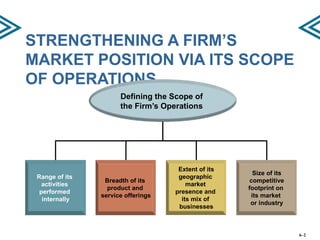
STRENGTHENING A FIRM’S
MARKET POSITION VIA ITS SCOPE
OF OPERATIONS
Range of its
activities
performed
internally
Breadth of its
product and
service offerings
Extent of its
geographic
market
presence and
its mix of
businesses
Size of its
competitive
footprint on
its market
or industry
Defining the Scope of
the Firm’s Operations
6–2
Vertical Integration
Horizontal Integration
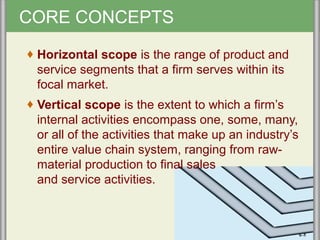
CORE CONCEPTS
♦ Horizontal scope is the range of product and
service segments that a firm serves within its
focal market.
♦ Vertical scope is the extent to which a firm’s
internal activities encompass one, some, many,
or all of the activities that make up an industry’s
entire value chain system, ranging from raw-
material production to final sales
and service activities.
6–5
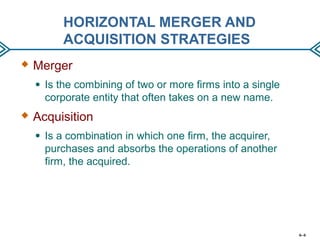
HORIZONTAL MERGER AND
ACQUISITION STRATEGIES
 Merger
● Is the combining of two or more firms into a single
corporate entity that often takes on a new name.
 Acquisition
● Is a combination in which one firm, the acquirer,
purchases and absorbs the operations of another
firm, the acquired.
6–6
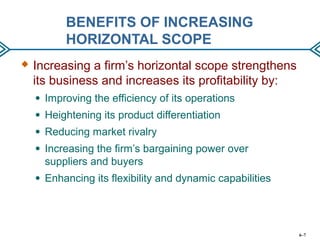
BENEFITS OF INCREASING
HORIZONTAL SCOPE
 Increasing a firm’s horizontal scope strengthens
its business and increases its profitability by:
● Improving the efficiency of its operations
● Heightening its product differentiation
● Reducing market rivalry
● Increasing the firm’s bargaining power over
suppliers and buyers
● Enhancing its flexibility and dynamic capabilities
6–7
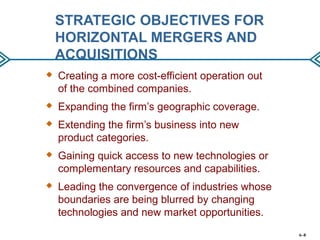
STRATEGIC OBJECTIVES FOR
HORIZONTAL MERGERS AND
ACQUISITIONS
 Creating a more cost-efficient operation out
of the combined companies.
 Expanding the firm’s geographic coverage.
 Extending the firm’s business into new
product categories.
 Gaining quick access to new technologies or
complementary resources and capabilities.
 Leading the convergence of industries whose
boundaries are being blurred by changing
technologies and new market opportunities.
6–8
VERTICAL INTEGRATION STRATEGIES
 Vertically Integrated Firm
● Is one that participates in multiple segments or
stages of an industry’s overall value chain.
 Vertical Integration Strategy
● Can expand the firm’s range of activities backward
into its sources of supply and/or forward toward end
users of its products.
6–9
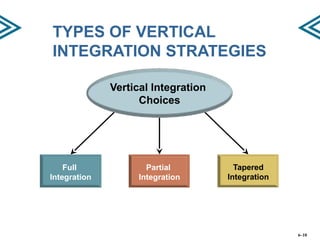
TYPES OF VERTICAL
INTEGRATION STRATEGIES
Full
Integration
Partial
Integration
Tapered
Integration
Vertical Integration
Choices
6–10
TYPES OF VERTICAL INTEGRATION
STRATEGIES
 Full Integration
● A firm participates in all stages
of the vertical activity chain.
 Partial Integration
● A firm builds positions only in selected
stages of the vertical chain.
 Tapered Integration
● Involves a mix of in-house and outsourced
activity in any stage of the vertical chain.
6–11
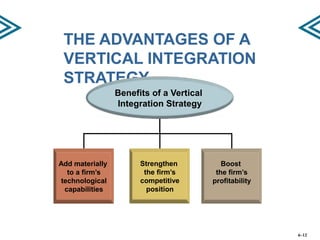
THE ADVANTAGES OF A
VERTICAL INTEGRATION
STRATEGY
Add materially
to a firm’s
technological
capabilities
Strengthen
the firm’s
competitive
position
Boost
the firm’s
profitability
Benefits of a Vertical
Integration Strategy
6–12
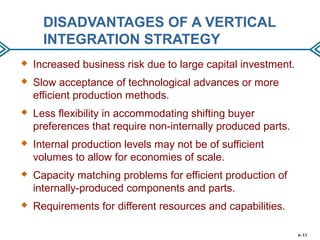
DISADVANTAGES OF A VERTICAL
INTEGRATION STRATEGY
 Increased business risk due to large capital investment.
 Slow acceptance of technological advances or more
efficient production methods.
 Less flexibility in accommodating shifting buyer
preferences that require non-internally produced parts.
 Internal production levels may not be of sufficient
volumes to allow for economies of scale.
 Capacity matching problems for efficient production of
internally-produced components and parts.
 Requirements for different resources and capabilities.
6–13
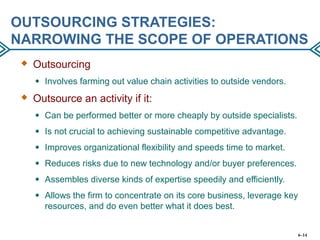
OUTSOURCING STRATEGIES:
NARROWING THE SCOPE OF OPERATIONS
 Outsourcing
● Involves farming out value chain activities to outside vendors.
 Outsource an activity if it:
● Can be performed better or more cheaply by outside specialists.
● Is not crucial to achieving sustainable competitive advantage.
● Improves organizational flexibility and speeds time to market.
● Reduces risks due to new technology and/or buyer preferences.
● Assembles diverse kinds of expertise speedily and efficiently.
● Allows the firm to concentrate on its core business, leverage key
resources, and do even better what it does best.
6–14
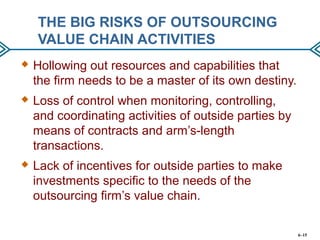
THE BIG RISKS OF OUTSOURCING
VALUE CHAIN ACTIVITIES
 Hollowing out resources and capabilities that
the firm needs to be a master of its own destiny.
 Loss of control when monitoring, controlling,
and coordinating activities of outside parties by
means of contracts and arm’s-length
transactions.
 Lack of incentives for outside parties to make
investments specific to the needs of the
outsourcing firm’s value chain.
6–15
THANK YOU

Strengthening a companies competitive position

  • 1.
    STRENGTHENING A COMPANY’S COMPETITIVEPOSITION  - By Shyam Nair.10/6/2016
  • 2.
    STRENGTHENING A FIRM’S MARKETPOSITION VIA ITS SCOPE OF OPERATIONS Range of its activities performed internally Breadth of its product and service offerings Extent of its geographic market presence and its mix of businesses Size of its competitive footprint on its market or industry Defining the Scope of the Firm’s Operations 6–2
  • 3.
  • 4.
  • 5.
    CORE CONCEPTS ♦ Horizontalscope is the range of product and service segments that a firm serves within its focal market. ♦ Vertical scope is the extent to which a firm’s internal activities encompass one, some, many, or all of the activities that make up an industry’s entire value chain system, ranging from raw- material production to final sales and service activities. 6–5
  • 6.
    HORIZONTAL MERGER AND ACQUISITIONSTRATEGIES  Merger ● Is the combining of two or more firms into a single corporate entity that often takes on a new name.  Acquisition ● Is a combination in which one firm, the acquirer, purchases and absorbs the operations of another firm, the acquired. 6–6
  • 7.
    BENEFITS OF INCREASING HORIZONTALSCOPE  Increasing a firm’s horizontal scope strengthens its business and increases its profitability by: ● Improving the efficiency of its operations ● Heightening its product differentiation ● Reducing market rivalry ● Increasing the firm’s bargaining power over suppliers and buyers ● Enhancing its flexibility and dynamic capabilities 6–7
  • 8.
    STRATEGIC OBJECTIVES FOR HORIZONTALMERGERS AND ACQUISITIONS  Creating a more cost-efficient operation out of the combined companies.  Expanding the firm’s geographic coverage.  Extending the firm’s business into new product categories.  Gaining quick access to new technologies or complementary resources and capabilities.  Leading the convergence of industries whose boundaries are being blurred by changing technologies and new market opportunities. 6–8
  • 9.
    VERTICAL INTEGRATION STRATEGIES Vertically Integrated Firm ● Is one that participates in multiple segments or stages of an industry’s overall value chain.  Vertical Integration Strategy ● Can expand the firm’s range of activities backward into its sources of supply and/or forward toward end users of its products. 6–9
  • 10.
    TYPES OF VERTICAL INTEGRATIONSTRATEGIES Full Integration Partial Integration Tapered Integration Vertical Integration Choices 6–10
  • 11.
    TYPES OF VERTICALINTEGRATION STRATEGIES  Full Integration ● A firm participates in all stages of the vertical activity chain.  Partial Integration ● A firm builds positions only in selected stages of the vertical chain.  Tapered Integration ● Involves a mix of in-house and outsourced activity in any stage of the vertical chain. 6–11
  • 12.
    THE ADVANTAGES OFA VERTICAL INTEGRATION STRATEGY Add materially to a firm’s technological capabilities Strengthen the firm’s competitive position Boost the firm’s profitability Benefits of a Vertical Integration Strategy 6–12
  • 13.
    DISADVANTAGES OF AVERTICAL INTEGRATION STRATEGY  Increased business risk due to large capital investment.  Slow acceptance of technological advances or more efficient production methods.  Less flexibility in accommodating shifting buyer preferences that require non-internally produced parts.  Internal production levels may not be of sufficient volumes to allow for economies of scale.  Capacity matching problems for efficient production of internally-produced components and parts.  Requirements for different resources and capabilities. 6–13
  • 14.
    OUTSOURCING STRATEGIES: NARROWING THESCOPE OF OPERATIONS  Outsourcing ● Involves farming out value chain activities to outside vendors.  Outsource an activity if it: ● Can be performed better or more cheaply by outside specialists. ● Is not crucial to achieving sustainable competitive advantage. ● Improves organizational flexibility and speeds time to market. ● Reduces risks due to new technology and/or buyer preferences. ● Assembles diverse kinds of expertise speedily and efficiently. ● Allows the firm to concentrate on its core business, leverage key resources, and do even better what it does best. 6–14
  • 15.
    THE BIG RISKSOF OUTSOURCING VALUE CHAIN ACTIVITIES  Hollowing out resources and capabilities that the firm needs to be a master of its own destiny.  Loss of control when monitoring, controlling, and coordinating activities of outside parties by means of contracts and arm’s-length transactions.  Lack of incentives for outside parties to make investments specific to the needs of the outsourcing firm’s value chain. 6–15
  • 16.